REVIEW 3 major objections 4 minor 1 cited by
Deciphering the AMS cosmic-ray positron flux
T0 review · 3 major / 4 minor · reviewed 2026-08-14 · deepseek-v4-flash
Pith's one-line read A supernova cannonball gamma-ray-burst model reproduces the AMS positron spectrum without any fitted parameters.
desk verdict Cannon-Ball explanation of the AMS positron excess, but the wind-attenuation formula is internally inconsistent and the no-parameter claim collapses. read the letter →
The pith
A machine-rendered reading of the paper's core claim, the machinery that carries it, and where it could break.
The reading
What carries the argument
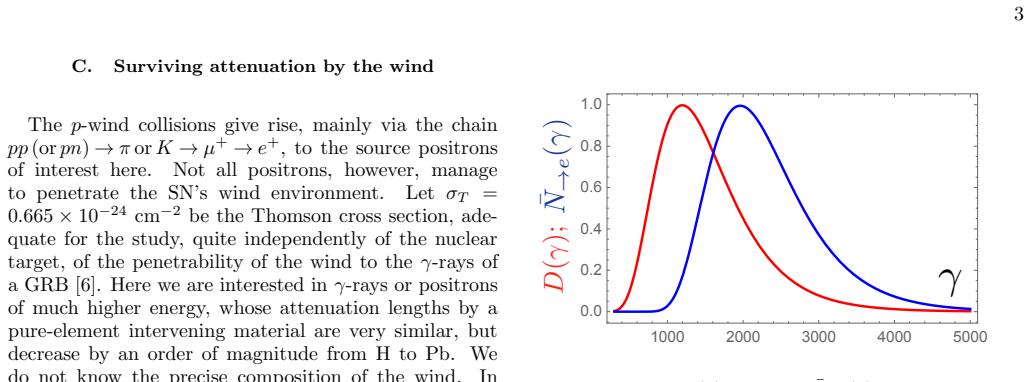
The central object is the Cannon-Ball (CB) model of gamma-ray bursts: a supernova ejects a compact blob of ordinary plasma with baryon number $\sim 10^{50}$ at Lorentz factor $\sim 10^3$. The load-bearing step is the wind-attenuation factor $A(l) = \exp[-(l_{\rm tr}/l)^2]$ of Eq. (3), which gives the probability that a positron born at distance $l$ from the supernova escapes the wind without being reabsorbed, with $l_{\rm tr} = \sigma_T \Sigma / m_p$ the distance at which the wind's optical depth is unity. This factor controls the number of surviving positrons $N_{\to e}(\gamma)$, and through Eq. (6) it up-weights higher Lorentz factors, because faster cannonballs keep colliding with the wind at larger distances where the wind is thinner. That weighting, together with the model's gamma distribution $D(y) = \exp[-((y-y_0)/\sigma)^2]$ with $y_0 = 6.3$ and $\sigma = 0.5$, sets the shape and peak of the predicted source spectrum.
What would settle it
Recompute Eq. (3) with the optical depth that follows from the paper's own wind density profile $n(l) = \Sigma/(m_p l^2)$, namely $\tau(l) = \sigma_T \Sigma/(m_p l)$, so that $A(l) = \exp(-l_{\rm tr}/l)$ instead of $\exp(-(l_{\rm tr}/l)^2)$; if the resulting source normalization moves away from the observed value by more than the stated uncertainties, the no-parameter match rests on the unstated attenuation ansatz.
Extended reading notes
Core claim
The central claim is that the AMS positron excess is a primary source effect of the Cannon-Ball model of gamma-ray bursts, not a dark-matter or pulsar signal. A cannonball with baryon number $N_B \sim 10^{50}$ and Lorentz factor $\gamma\sim 10^3$ crosses the dense wind of its parent supernova; $pp$ and $pn$ collisions feed the chain $pp$ (or $pn$) $\to \pi$ or $K \to \mu \to e^+$, and the positrons that survive wind attenuation are then propagated with a lifetime that combines galactic escape, inverse-Compton losses on starlight, and losses on the cosmic background, far-infrared, and magnetic-field photon baths. The author adopts a single parametrization for the diffuse secondary background and derives the source term from Eq. (11); the predicted source normalization is 1.23 times the observed one. The paper presents this factor as a satisfactory consistency check rather than a discrepancy, noting that a 19% change in the assumed wind surface density would bring the two into exact agreement.
Load-bearing premise
The load-bearing premise is the assumed attenuation formula $A(l) = \exp[-(l_{\rm tr}/l)^2]$ for how likely a positron is to escape the supernova wind; the paper's own wind density profile would suggest a different decay law, and the source flux depends critically on this choice.
Editorial extensions
If this is right
- If the CB source is correct, the positron excess and the proton, helium, iron, and $e^+e^-$ knees all share one origin, since the same Lorentz-factor distribution $D(\gamma)$ is used for each.
- The AMS normalization then becomes a counting measurement of galactic cannonball-launching supernovae, fixing their rate at about one per century with ten cannonballs per event.
- The positrons should be accompanied by prompt hard photons, but the paper estimates only about $5 \times 10^{-6}$ of a GRB's gamma-ray count, so no observable hard-photon counterpart is expected.
- Because all inputs are fixed priors, any future deviation of the measured positron flux from the predicted shape would directly constrain the wind surface density, the starlight energy density, or the CB Lorentz-factor distribution.
- The factor-1.23 normalization gap provides a sharp check: a 19% increase in the wind surface density removes it entirely, so better wind-density measurements would decide whether the match is meaningful.
Reading between the lines
- A testable extension the paper does not pursue: the same $pp$-collision machinery predicts a corresponding positron energy distribution at the source, so a simultaneous parameter-free fit to both the AMS positron and electron spectra would broaden the claim beyond positrons alone.
- The attenuation functional form is the fragile point; recomputing Eq. (3) with the optical depth implied by the paper's own $n(l) \propto l^{-2}$ profile, namely $A(l) = \exp(-l_{\rm tr}/l)$, would show whether the normalization match survives an alternative and arguably more natural ansatz.
- If future high-statistics data resolve the arrival direction of the positron excess, the wind-attenuation weighting predicts a small anisotropy toward the inner Galaxy, whereas dark-matter annihilation would be roughly isotropic; this could separate the two origins empirically.
Editorial analysis
A structured set of objections, weighed in public.
Referee Report
Summary. The paper proposes that the AMS-02 positron excess originates from positrons produced in proton-proton collisions between relativistic cannonballs of the Cannon-Ball GRB model and the wind of the exploding star. The authors derive a source spectrum using model priors fixed in earlier CB-model publications, with no parameters fitted to the AMS data, add a diffuse background taken from Lipari's fit to earlier AMS data, and compare the sum with the observed AMS-02 spectrum. They report a 1.23 times normalization overestimate, which they interpret as a satisfactory consistency check.
Significance. If the calculation were correct, this would be a noteworthy result: a pre-existing, non-dark-matter, non-pulsar astrophysical model predicting both the shape and the normalization of the AMS positron flux without free parameters. The paper's transparency in writing out the derivation is a strength, since it allows the main error to be identified precisely. However, the error in the wind-attenuation formula undermines the central quantitative claim, so the significance is conditional on a corrected calculation.
major comments (3)
- [Section III.C, Eq. (3)] The survival probability A(l)=exp[-(l_tr/l)^2] is inconsistent with the stated wind density profile n(l)=Sigma/(m_p l^2). The opacity from a production point l to infinity is tau(l)=sigma_T integral_l^infinity n(l') dl' = l_tr/l, so the correct survival probability is exp(-l_tr/l); the squared exponent would correspond to n proportional to l^-3. Since A(l) multiplies the integrand in Eq. (2) to produce N->e(gamma) in Eq. (3), and this quantity enters the source spectrum in Eqs. (4), (6), and the final flux in Eq. (11), the central claims about the shape and the 1.23 normalization are not supported by the calculation as presented. The numerical impact is parameter-dependent; for gamma approximately 1000, with l_tr approximately 4e15 cm and l_max approximately 1.7e15 cm, the two integrals differ by close to an order of magnitude. The authors should repeat the calculation with the attenuation law A(l)=exp(-l_tr/l) and check whether the agreement with AMS persists.
- [Eq. (3)] The expression for I in Eq. (3) has a dimensional inconsistency: the first term, l_max exp[-(l_tr/l_max)^2], has dimensions of length, while the second term, minus sqrt(pi) erfc[l_tr/l_max], is dimensionless. The correct expression for the integral of exp[-(l_tr/l)^2] contains an additional factor l_tr multiplying the erfc term. As printed, Eq. (3) cannot be evaluated in physical units, which compounds the error identified in the previous comment.
- [Sections I and V, Fig. 2] The adopted diffuse background is Lipari's parametrization of earlier AMS data, and the source term is then defined as the residual of the same spectrum. The comparison in Fig. 2 is therefore partly circular: the model is effectively tested against a leftover after a fit to the total data has been subtracted. To substantiate the 'no fitting' claim, the authors should show that their conclusions are insensitive to plausible alternatives for the diffuse term, for example a GALPROP/DRAGON secondary spectrum or a different analytic background. Without such a test, the 1.23 normalization and the shape agreement are less decisive than stated.
minor comments (4)
- [Section V, last paragraph] The statement that an increase by 40% (or 19%) of the wind surface density Sigma would reduce the cited normalization by a factor of two (or 1/1.23) is confusing, since a 19% increase producing a reduction by a factor 1/1.23 is a much weaker effect than a 40% increase producing a factor of two; please clarify the intended functional dependence.
- [Table I and Fig. 2 caption] The unit of Sigma appears as '10 16 g/cm' without a superscript; it should read 10^16 g cm^{-1}. In addition, the caption of Fig. 2 omits the symbol lambda in the label for the blue curve.
- [Section III.C] The text introducing A(l) states that l_tr is the distance at which the remaining optical depth of the wind is unity; with the correct attenuation law A(l)=exp(-l_tr/l) this definition is accurate, but it is inconsistent with the squared exponent used in Eq. (3). Please harmonize the definition with the final formula.
- [References] Reference [28] contains a typo ('or As- trophys. J.'), and the arXiv identifier for reference [8] should be checked for accuracy.
Circularity Check
Minor presentational circularity in Fig. 2; the central CB positron-source prediction is not fitted to AMS data.
-
other
[Section I, Figure 2 discussion (after Eq. (1))]
"The blue line in Fig.(2) is the source term we shall derive. Summed to the diffuse term it results in the black dotted line. The only arbitrarily chosen parameter in constructing this figure is the overall normalization of the source term."
The plotted source term is scaled by an arbitrary normalization before the model calculation is completed, so the visual magnitude agreement in Fig. 2 is not itself a test of the model. The central quantitative check is the separate statement that the calculated normalization from Eq. (11) is 1.23 times larger, which is an independently computed number. Thus the figure contains a minor, acknowledged self-definitional element, but it is not load-bearing for the model's claimed normalization test.
full rationale
No load-bearing circularity is present. The CB positron source is derived from independent prior inputs: the wind surface density, the Lorentz-factor distribution anchored to observed CR knees, the pp-to-positron decay chain, the galactic SN rate, and diffusion/loss lifetimes; none of these parameters is fitted to the AMS positron spectrum. The use of the Lipari diffuse term is an explicit empirical background subtraction based on earlier AMS data; it is not a model output, so it reduces the independence of the total-curve comparison but does not force the CB source term itself. The only noticeable circularity is presentational: the source-term normalization in Fig. 2 is chosen by hand, although the paper later supplies an independent 1.23 normalization check. The inconsistency in the wind attenuation factor A(l)=exp[-(l_tr/l)^2] with the stated n-proportional-to-l^-2 profile is an internal correctness issue, not a circularity, and is therefore not counted in the circularity score. Overall, the central claim retains independent content, so a low score of 2 is appropriate for the minor presentational and background-subtraction caveats.
Assumptions & free parameters
free parameters (6)
- CB Lorentz factor distribution parameters (y0, sigma) =
y0=6.3, sigma=0.5
- Wind surface density Sigma =
1e16 g/cm
- Starlight energy density enhancement lambda =
10 (with comparisons to 1 and 20)
- Charged-particle multiplicity correction factor =
5/6
- Leaky-box Galaxy volume V =
1.66e68 cm^3
- Source-term normalization in Fig. 2 =
1/1.23 times the computed value
assumptions (6)
- domain assumption The Cannon-Ball model of GRBs and cosmic rays is valid.
- domain assumption The wind density follows n(l) = Sigma/(m_p l^2).
- domain assumption The diffuse positron background is described by Lipari's Eq. (1).
- domain assumption The positron production spectrum F(x,Ep) from Moskalenko & Strong and Kelner et al. is correct.
- domain assumption The Galaxy can be modeled as a uniform leaky box of volume V=1.66e68 cm^3 with the positron density close to the average at the solar position.
- ad hoc to paper The attenuation of positrons in the wind is described by A(l) = exp[-(l_tr/l)^2].
Cite this review
Pith. "Pith review of Deciphering the AMS cosmic-ray positron flux." pith.science (2026). https://pith.science/paper/6JGT7HIL
@misc{pith2026190901277,
  author       = {Pith},
  title        = {Pith review of: Deciphering the AMS cosmic-ray positron flux},
  year         = {2026},
  howpublished = {\url{https://pith.science/paper/6JGT7HIL}},
  note         = {Machine review of arXiv:1909.01277}
}
read the original abstract
The flux of cosmic-ray high-energy positrons has recently been measured by AMS with unprecedented precision. This flux is well above the expectation from secondary positrons made by the observed fluxes of nuclear cosmic rays impinging on the interstellar medium. Various authors have pointed out that the positron excess may originate at the primary cosmic-ray source itself, rather than in the more local ISM, thus avoiding the temptation to invoke a dark-matter decay or annihilation origin, or nearby pulsars. We investigate the possibility that the source is the one of a comprehensive model of gamma-ray bursts and cosmic rays, proposed two decades ago. The result, based on the original unmodified priors of the model --and with no fitting of parameters-- very closely reproduces the shape and magnitude of the AMS observations.
Figures


Figures from the paper (1 more)

Forward citations
Cited by 1 Pith paper
-
A revamped understanding of Cosmic Rays and Gamma-Ray Bursts
The paper claims new GRB and cosmic-ray data validate the Cannonball Model, with knees and positrons explained by relativistic supernova ejecta, though several 'predictions' rely on fitted parameters.
Reference graph
Works this paper leans on
- [1]
-
[2]
Dark Matter Signals In Cosmic Rays?
S. Dado, & A. Dar, Mem. Soc. Ast. It. 81, 132 (2010), arXiv:0903.0165; P. Blasi, Phys. Rev. Lett. 103, 051104 (2009), arXiv:0903.2794; L. Stawarz, V. Pet- rosian, & R. D. Blandford, Astrophys. J.710, 236 (2010), arXiv:0908.1094; S. Dado, & A. Dar, arXiv:1505.04988
work page Pith review arXiv 2010
- [3]
- [4]
-
[5]
A. Dar & R. Plaga, Astron. & Astrophys. 349, 259 (1999); A. Dar, A. De R´ ujula & N. Antoniou, Proc. Vul- cano Workshop 1999 (eds. F. Giovanelli and G. Mannoc- chi) p. 51 Italian Physical Society, Bologna-Italy, astro- ph/9901004; A. De R´ ujula, Nucl. Phys. Proc. Suppl.151 23 (2006); hep-ph/0412094
-
[6]
A. Dar & A. De R´ ujula, Phys. Rept. 405, 203, (2004), arXiv:astro-ph/0308248 and references therein
arXiv 2004
-
[7]
I.F. Mirabel & L.F. Rodriguez, Annu. Rev. Astron. As- trophys. 37, 409 (1999)
work page 1999
-
[8]
A. De R´ ujula, Phys. Lett. B790C, 444 (2019), arXiv:1802.06626, and references therein
arXiv 2019
Show all 37 references
-
[9]
A. Dar & S. Dado, arXiv:1810.03514
-
[10]
Dar and A
A. Dar and A. De R´ ujula, Phys. Rept. 466, 179 (2008), hep-ph/0606199, and references therein
2008 arXiv
-
[11]
Hoerandel, Proc
J.R. Hoerandel, Proc. of the Workshop on Physics of the End of the Galactic Cosmic Ray Spectrum , Aspen, USA, 2005, astro-ph/0508014
2005 arXiv
-
[12]
winds”, before they die in SN ex- plosions. We shall refer to the pre-SN close-by material, accumulated by previous ejecta, as “the wind
spectra have been observed, precisely as predicted by the CB model of CRs [8]. In a nutshell: CRs are made by CBs as they scatter the constituents of the ISM. The maximum energy of a CR of mass M is 2γ2M, the limit of forward scattering. With the CBs’ LFs, γ, distributed aroun...
2000
-
[13]
Accardo et al., Phys
L. Accardo et al., Phys. Rev. Letters 113, 121101 (2014); J.J. Beatty, J. Matthews, & S.P. Wakely in Review of Particle Properties. http://pdg.lbl.gov/2017/reviews/rpp2017-rev-cosmic- rays.pdf; DAMPE Collaboration, Nature 552, 63 (2017). arXiv:1711.10981v1, and references ther...
2014 arXiv
-
[14]
Turatto et al., ApJ, 534, L57 (2000); A
M. Turatto et al., ApJ, 534, L57 (2000); A. Fassia, et al. MNRAS, 325, 907 (2001); I. Salamanca, R. J. Terlevich, & G. Tenorio-Tagle, MNRAS, 330, 844 (2002); N. N. Chugai & I. J. Danziger, 2003, Astron. Lett. 29, 649 (2003), astro-ph/0306330
2000 arXiv
-
[15]
Salamanca, et al., MNRAS, 300, L17S (1998)
I. Salamanca, et al., MNRAS, 300, L17S (1998)
1998
-
[16]
https://physics.nist.gov/PhysRefData/Xcom/html/xcom1.html
-
[17]
Moskalenko & A.W
I.V. Moskalenko & A.W. Strong, Astrophys. J. 493, 694 (1998)
1998
-
[18]
S. R. Kelner, F. A. Aharonian, & V.V. Bugayov Phys. Rev. D74, 034018 (2006)
2006
-
[19]
J. F. Grosse-Oetringhaus & K. Reygers J. Phys. G37:083001, (2010)
2010
-
[20]
Dado & A
S. Dado & A. Dar, ApJ, 855, 88 (2018)
2018
-
[21]
S. Dado, A. Dar & A. De R´ ujula, arXiv:1712.09970
-
[22]
Greiner http://www.mpe.mpg.de/∼jcg/grbgen.html
J. Greiner http://www.mpe.mpg.de/∼jcg/grbgen.html
-
[23]
Diehl et al
R. Diehl et al. Nature 439, 45 (2006)
2006
-
[24]
See, e.g., A. Lee, E. D. Bloom and J. Scargle in AIP Conf. Proc. 384, no.1, 47 (1996)
1996
-
[25]
See, e.g. S.P. Swordy et al., Astrophys. J. 349, 625 (1990)
1990
-
[26]
Aguilar et al., Phys
M. Aguilar et al., Phys. Rev. Lett. 117, 231102 (2016)
2016
-
[27]
A. N. Kolmogorov, Dokl. Akad. Nauk SSSR 30, 301 (1941); Proc. R. Soc. A434, 9 (1991)
1941
-
[28]
Dado & a
S. Dado & a. Dar, The Astrophysical Journal 812, 38 (2015), arxiv.org/abs/1502.01244
2015 arXiv
-
[29]
T. A. Porter, & A. W. Strong, in Proc. 29th Int. Cosmic Ray Conf. 2005 (Pune), astro-ph/0507119
2005 arXiv
-
[30]
T. A. Porter, I. V. Moskalenko & A. W. Strong or As- trophys. J. 648, L29, (2006) , arXiv:astro-ph/0607344
2006 arXiv
-
[31]
Schlickeiser & Ruppel, J., New Journal of Physics, 12, 033044 (2010)
R. Schlickeiser & Ruppel, J., New Journal of Physics, 12, 033044 (2010)
2010
-
[32]
A. W. Strong & I. V. Moskalenko, Contribution to the 31st ICRC, Lodz, Poland, July 2009. Paper ID 0626, arXiv:0907.0565
2009 arXiv
-
[33]
GALPROP, https://galprop.stanford.edu/
- [34]
-
[35]
A. W. Strong & I. V. Moskalenko in Topics in Cosmic Ray Astrophysics (vol. 230 in Horizons in World Physics), ed. M. A. DuVernois (New York: Nova Science Publish- ers), pp.81-103 (2000), arXiv:astro-ph/9812260
2000 arXiv
-
[36]
Gaggero, in Cosmic Ray Diffusion in the Galaxy and Diffuse Gamma Emission, Springer Science & Business Media, Jul 9, 2012
D. Gaggero, in Cosmic Ray Diffusion in the Galaxy and Diffuse Gamma Emission, Springer Science & Business Media, Jul 9, 2012
2012
-
[37]
Dado & A
S. Dado & A. Dar, Journal of High Energy Physics, 9-10, 9 (2016), arXiv:1504.03261
2016 arXiv
Reviewed August 14, 2026 · model on record in the stance chip above.
Discussion (0). Continue with ORCID to comment.