Input-driven analysis in predicting nuclear charge radii using Monte Carlo dropout Bayesian neural network
Pith reviewed 2026-06-26 06:41 UTC · model grok-4.3
The pith
Bayesian neural network with physical inputs reproduces abrupt nuclear charge radius increases around N=60 and shell quenching at N=126
A machine-rendered reading of the paper's core claim, the machinery that carries it, and where it could break.
Core claim
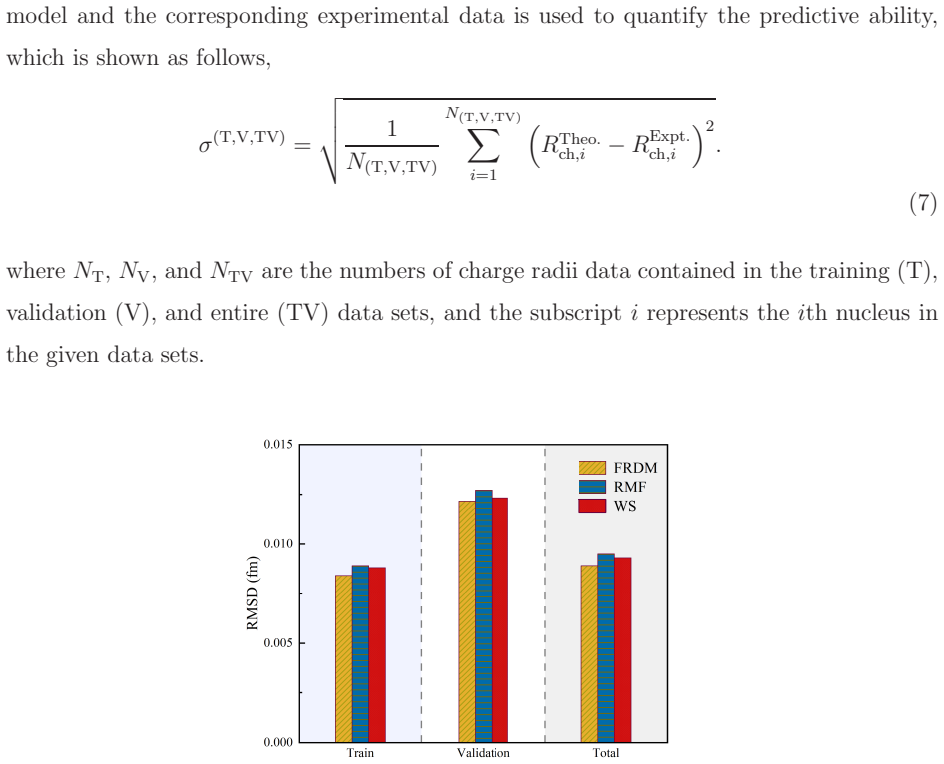
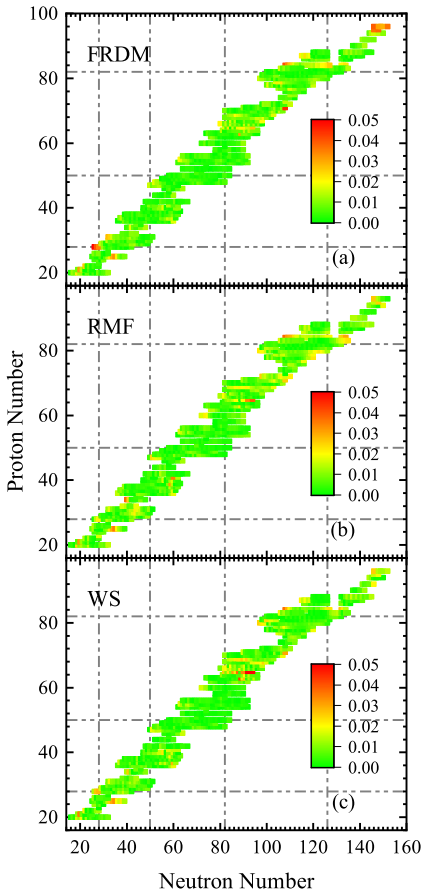
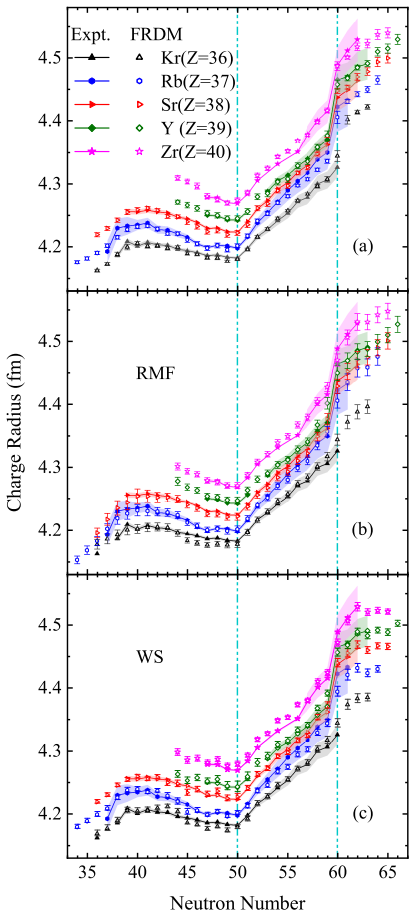
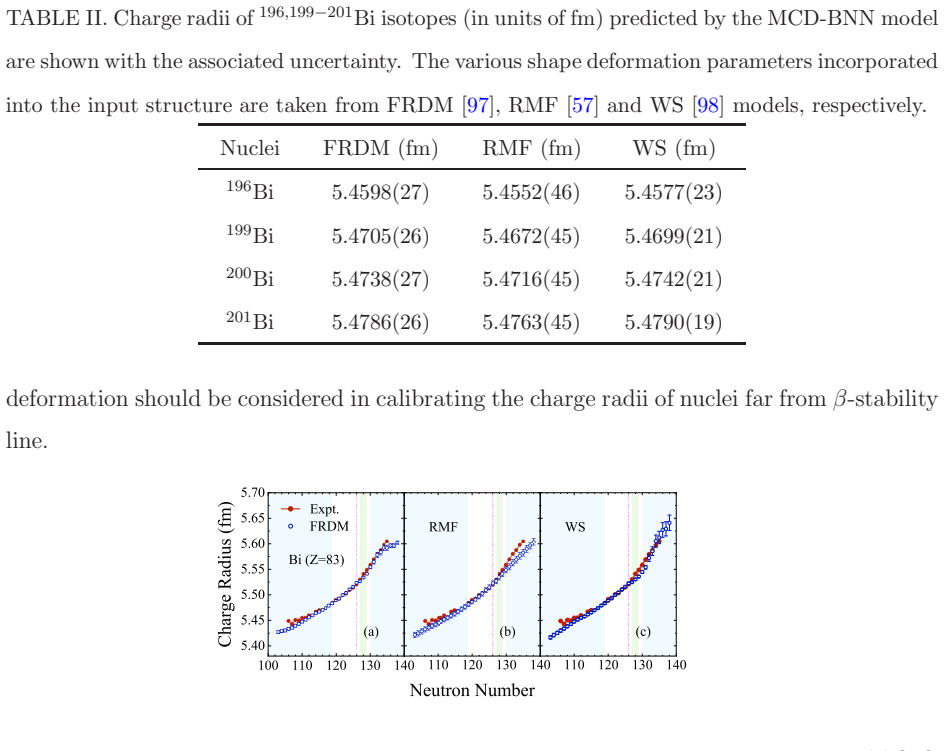
The input-driven Bayesian neural network with Monte Carlo dropout, supplied with quadrupole deformation parameters from FRDM, RMF, and WS models together with pairing, isospin, valence correlations, shape staggering, and modified Casten factor P*, produces comparable RMSD values across data sets while reproducing the abrupt increase in charge radii around N=60 along Z=37-40 isotopic chains and the shell quenching effect along bismuth isotopes at N=126, with minor deviations attributed to missing octupole deformation near N=130 and shape staggering in neutron-deficient regions.
What carries the argument
Monte Carlo dropout Bayesian neural network whose input layer encodes pairing effect, isospin asymmetry, valence-nucleon correlations, quadrupole deformation β20 from FRDM/RMF/WS, local shape staggering, and modified Casten factor P*
If this is right
- The reproduced radius jump around N=60 serves as an indicator of rapid shape-phase transitions in finite nuclei.
- Incorporating the modified Casten factor allows the network to capture shell quenching effects at N=126.
- Comparable performance across FRDM, RMF, and WS deformation inputs indicates robustness to the choice of deformation source.
- Deviations near N=130 point to the need for higher-order deformation terms in those regions.
Where Pith is reading between the lines
- The same input-construction strategy could be tested on other nuclear observables such as binding energies or magnetic moments.
- Combining deformation parameters from several models into a single averaged input might reduce sensitivity to model-specific errors.
- Regions where the network shows persistent deviations could be used to flag where new experimental radius data are most needed.
Load-bearing premise
The quadrupole deformation parameters taken from FRDM, RMF, and WS models plus the other selected inputs are enough to capture the main variations in charge radii without needing explicit higher-order effects.
What would settle it
Systematic failure of the model to match measured charge radii in additional chains that exhibit known shape transitions or octupole deformation, or a clear reduction in deviations around N=130 once octupole terms are added to the inputs.
Figures

read the original abstract
Nuclei charge radii play an essential role in understanding the fundamental interactions of finite quantum fermion systems. In this work, input-driven Bayesian neural network based on the Monte Carlo dropout approach has been built to characterize the systematic evolution of charge radii of nuclei with proton number $Z\geq20$ and mass number A\geq40$. The motivated underlying mechanisms have been introduced into the input structures, which contain pairing effect, isospin asymmetry degree, the correlations between the valence nucleons and valence holes for neutron and proton, quadrupole deformation parameter $\beta_{20}$, and the local shape staggering phenomena of $^{181,183,185}$Hg isotopes.In addition, shell quenching effect is also taken into account by incorporating the modified Casten factor $P^{*}$ into the input structure. The quadrupole deformation parameters $\beta_{20}$ derived from finite-range droplet model (FRDM), relativistic mean field (RMF) theory and Weizs\"{a}cker-Skyrme (WS) approach are employed to analyze the local variations of nuclear charge radii.The hyperparameter is adjusted automatically in the constructed model.The calibrated results give comparable root-mean-square deviations (RMSD) in the training and validation sets with various shape deformation inputs. The abrupt increase in charge radii around N=60 is well reproduced along Z=37-40 isotopic chains, but this trend is less pronounced along Z=36 and 41 chains. This provides a indicator to confirm the rapid shape-phase transition regions around N=60 from the perspective of finite nuclei size. Shell quenching effect of charge radii along the bismuth isotopes are reproduced well at N=126, but slight deviations can be encountered due to the absence of high-order octupole deformation around N=130 regions and shape-staggering phenomena toward neutron-deficient regions, respectively. This means that...
Editorial analysis
A structured set of objections, weighed in public.
Referee Report
Summary. The manuscript presents an input-driven Monte Carlo dropout Bayesian neural network for modeling nuclear charge radii with Z≥20 and A≥40. Physical mechanisms are encoded directly in the inputs: pairing, isospin asymmetry, valence nucleon/hole correlations, β20 quadrupole deformations taken from FRDM/RMF/WS, local shape staggering for Hg isotopes, and the modified Casten factor P* for shell quenching. The central claim is that the calibrated model yields comparable RMSD on training and validation sets and reproduces the abrupt radius increase around N=60 (Z=37-40 chains) together with shell quenching at N=126 in Bi isotopes.
Significance. If the quantitative performance and generalization claims are substantiated, the work illustrates how domain-specific inputs can be embedded in a Bayesian NN to capture selected nuclear-structure features such as shape-phase transitions and shell effects. The use of multiple independent β20 sources offers a limited robustness check. The significance is reduced, however, by the absence of numerical RMSD values and by the direct provision of deformation and shell inputs that already encode the reported trends.
major comments (2)
- [Abstract] Abstract: the claim that 'comparable root-mean-square deviations (RMSD) in the training and validation sets' are obtained supplies no numerical RMSD values, error bars, dataset sizes, or explicit validation protocol, leaving the quantitative support for the reproduction claim unassessable.
- [Input structure] Input structure (described in Abstract and Methods): β20 (from FRDM/RMF/WS) and P* are included precisely to encode the shape and shell effects whose reproduction is claimed. No ablation study that removes these inputs is reported, so it remains unclear whether the BNN extracts the N=60 and N=126 features from the remaining inputs or simply interpolates the supplied deformation data.
Simulated Author's Rebuttal
We thank the referee for the careful reading and constructive comments. We address each major comment below and will revise the manuscript to improve clarity and quantitative support where appropriate.
read point-by-point responses
-
Referee: [Abstract] Abstract: the claim that 'comparable root-mean-square deviations (RMSD) in the training and validation sets' are obtained supplies no numerical RMSD values, error bars, dataset sizes, or explicit validation protocol, leaving the quantitative support for the reproduction claim unassessable.
Authors: We agree that the abstract would benefit from explicit numerical values. The results section reports RMSD values obtained with different deformation inputs, but these are not restated in the abstract. In the revised version we will insert the specific RMSD figures (with uncertainties where available), the sizes of the training and validation sets, and a concise description of the validation protocol. revision: yes
-
Referee: [Input structure] Input structure (described in Abstract and Methods): β20 (from FRDM/RMF/WS) and P* are included precisely to encode the shape and shell effects whose reproduction is claimed. No ablation study that removes these inputs is reported, so it remains unclear whether the BNN extracts the N=60 and N=126 features from the remaining inputs or simply interpolates the supplied deformation data.
Authors: The β20 values from three independent models and the modified Casten factor P* are deliberately supplied as physically motivated features so that the network can incorporate established nuclear-structure information. The comparable RMSD obtained across the three β20 sources already provides a limited robustness check. Nevertheless, we acknowledge that an explicit ablation study would strengthen the claim that the network is not merely interpolating the supplied deformations. We will add a paragraph in the revised manuscript that (i) reiterates the physical rationale for these inputs and (ii) discusses the implications of the multi-model consistency; a full ablation study can be performed if the editor deems it essential. revision: partial
Circularity Check
No significant circularity detected
full rationale
The paper trains a Monte Carlo dropout BNN on experimental charge-radii data for Z≥20, A≥40 nuclei. Inputs explicitly include β20 values taken from independent models (FRDM, RMF, WS) plus the modified Casten factor P* chosen to encode shell effects. The reported reproduction of the N=60 radius jump (Z=37-40) and N=126 quenching is presented as the network learning the mapping from these supplied features to measured radii. This is standard supervised learning; the inputs are external quantities not defined from the target radii or fitted inside this work to force the observed trends. No equation reduces the output to the inputs by construction, no parameter is fitted on a subset and then renamed a prediction, and no load-bearing self-citation chain is invoked. The derivation chain (feature construction → network training → RMSD on train/validation sets) remains self-contained against the external experimental benchmark.
Axiom & Free-Parameter Ledger
free parameters (1)
- Neural network weights and biases
axioms (1)
- domain assumption The chosen inputs (pairing effect, isospin asymmetry, valence correlations, β20 from FRDM/RMF/WS, shape staggering, modified Casten factor) capture the essential physics determining nuclear charge radii.
Reference graph
Works this paper leans on
-
[1]
I. Angeli and K. Marinova, Table of experimental nuclear ground state charge radii: An update. At. Data Nucl. Data Tables 99, 69-95 (2013). doi: 10.1016/j.adt.2011.12.006
-
[2]
T. Li, Y. Luo and N. Wang, Compilation of recent nuclear ground state charge radius measurements and tests for models . At. Data Nucl. Data Tables 140, 101440 (2021). doi: 10.1016/j.adt.2021.101440
-
[3]
R. F. Garcia Ruiz and A. R. Vernon, Emergence of simple patterns in many-body sys- tems: from macroscopic objects to the atomic nucleus . Eur. Phys. J. A 56, 136 (2020). doi: 10.1140/epja/s10050-020-00134-8
-
[4]
M. Kortelainen, Z. H. Sun, G. Hagen, et al., Universal trend of charge radii of even-even Ca-Zn nuclei. Phys. Rev. C 105, L021303 (2022). doi: 10.1103/PhysRevC.105.L021303
-
[5]
A. Barzakh, A. N. Andreyev, Z. Yue, et al., Charge radii and electromagnetic moments of 214− 218Bi: Exploring the “southern ” border of the Z > 82 octupole-deformation region. Phys. Rev. C 112, 034304 (2025). doi:10.1103/sltw-g4d6
-
[6]
A. Klein, B. Brown, U. Georg, et al., Moments and mean square charge radii of short-lived argon isotopes. Nucl. Phys. A 607, 1 (1996). doi:10.1016/0375-9474(96)00192-3
-
[7]
F. Touchard, P. Guimbal, S. Bttgenbach, et al., Isotope shifts and hyperfine structure of 38− 47K by laser spectroscopy. Phys. Lett. B 108, 169 (1982). doi:10.1016/0370-2693(82)91167- 4
-
[8]
J. A. Behr, A. Gorelov, T. Swanson, et al., Magneto-optic trapping of β -decaying 38K m , 37K from an on-line isotope separator . Phys. Rev. Lett. 79, 375 (1997). doi:10.1103/PhysRevLett.79.375
-
[9]
D. M. Rossi, K. Minamisono, H. B. Asberry, et al., Charge radii of neutron-deficient 36K and 37K. Phys. Rev. C 92, 014305 (2015). doi:10.1103/PhysRevC.92.014305
-
[10]
R. F. Garcia Ruiz, M. L. Bissell, A. Ekstr¨ om, et al., Unexpectedly large charge radii of neutron-rich calcium isotopes . Nature Phys. 12, 594 (2016). doi:10.1038/nphys3645
-
[11]
K. K¨ onig, S. Fritzsche, G. Hagen, et al., Surprising Charge-Radius Kink in the Sc Isotopes at N = 20. Phys. Rev. Lett. 131, 102501 (2023). doi: 10.1103/PhysRevLett.131.102501 . 19
-
[12]
S. W. Bai, X. F. Yang, A. Koszor´ us, et al., Charge radii of neutron-rich scandium iso- topes and the seniority symmetry in the 0f7/ 2 shell. Phys. Rev. Lett. 134, 182501 (2025). doi:10.1103/PhysRevLett.134.182501
-
[13]
G. A. Lalazissis, M. M. Sharma, and P. Ring, Rare-earth nuclei: Radii, isotope-shifts and deformation properties in the relativistic mean-field theo ry. Nucl. Phys. A 597, 35 (1996). doi:10.1016/0375-9474(95)00436-X
-
[14]
R. F. Casten, Possible unified interpretation of heavy nuclei . Phys. Rev. Lett. 54, 1991 (1985). 10.1103/PhysRevLett.54.1991
-
[15]
T. Togashi, Y. Tsunoda, T Otsuka, et al., Quantum phase transition in the shape of Zr isotopes. Phys. Rev. Lett. 117, 172502 (2016). doi: 10.1103/PhysRevLett.117.172502
-
[16]
M. Anselment, W. Faubel, S. G¨ oring, et al., The odd-even staggering of the nuclear charge radii of Pb isotopes. Nucl. Phys. A 451, 471 (1986). doi:10.1016/0375-9474(86)90071-0
-
[18]
B. A. Marsh, T. D. Goodacre, S. Sels, et al., Characterization of the shape-staggering effect in mercury nuclei . Nature Phys. 14, 1163 (2018). doi:10.1038/s41567-018-0292-8
-
[19]
S. P´ eru, S. Hilaire, S. Goriely, et al., Description of magnetic moments within the Gogny Hartree-Fock-Bogolyubov framework: Applicatio n to Hg isotopes. doi:10.1103/PhysRevC.104.024328
-
[21]
P. Campbell, I. Moore, and M. Pearson, Laser spectroscopy for nuclear structure physics . Prog. Part. Nucl. Phys. 86, 127 (2016). doi:10.1016/j.ppnp.2015.09.003
-
[22]
X. Yang, S. Wang, S. Wilkins, et al., Laser spectroscopy for the study of exotic nuclei . Prog. Part. Nucl. Phys. 129, 104005 (2023). 10.1016/j.ppnp.2022.104005
-
[23]
U. C. Perera, A. V. Afanasjev and P. Ring, Charge radii in covariant density functional theory: A global view . Phys. Rev. C 104, 064313 (2021). doi: 10.1103/PhysRevC.104.064313 . 20
-
[24]
M. Hammen, W. N¨ ortersh¨ auser, D. L. Balabanski, et al., From Calcium to Cadmium: Testing the Pairing Functional through Charge Radii Measurements of 100− 130Cd. Phys. Rev. Lett. 121 102501 (2018). doi: 10.1103/PhysRevLett.121.102501
-
[25]
P.-G. Reinhard and W. Nazarewicz, Information content of the differences in the charge radii of mirror nuclei . Phys. Rev. C 105, L021301 (2022). doi: 10.1103/PhysRevC.105.L021301
-
[26]
K. Kreim, M. Bissell, J. Papuga, et al., Nuclear charge radii of potassium isotopes beyond N = 28. Phys. Lett. B 731, 97 (2014). doi: 10.1016/j.physletb.2014.02.012
-
[27]
C. Gorges, L. V. Rodr ´ ıguez, D. L. Balabanski, et al., Laser spectroscopy of neutron-rich tin isotopes: A discontinuity in charge radii across the N = 82 shell closure . Phys. Rev. Lett. 122, 192502 (2019). 10.1103/PhysRevLett.122.192502
-
[28]
S. J. Novario, G. Hagen, G. R. Jansen, et al., Charge radii of exotic neon and magnesium isotopes. Phys. Rev. C 102, 051303(R) (2020). doi: 10.1103/PhysRevC.102.051303
-
[29]
S. Bagchi, R. Kanungo, W. Horiuchi, et al., Neutron skin and signature of the N = 14 shell gap found from measured proton radii of 17− 22N. Phys. Lett. B 790, 251-256 (2019). doi: 10.1016/j.physletb.2019.01.024
-
[30]
S. Kaur, R. Kanungo, W. Horiuchi, et al., Proton Distribution Radii of 16− 24O: Signa- tures of New Shell Closures and Neutron Skin . Phys. Rev. Lett. 129, 142502 (2022). doi: 10.1103/PhysRevLett.129.142502
-
[31]
Z. Yue, A. E. Barzakh, A. N. Andreyev, et al., Charge radii of thallium isotopes near the N = 126 shell closure. Phys. Rev. C 110, 034315 (2024). doi: 10.1103/PhysRevC.110.034315
-
[32]
K. Heyde and J. L. Wood, Shape coexistence in atomic nuclei . Rev. Mod. Phys. 83, 1467 (2011). doi: 10.1103/RevModPhys.83.1467
-
[33]
R. An, X.-X. Dong, L.-G. Cao, et al., Local variations of charge radii for nuclei with even Z from 84 to 120 . Commun. Theor. Phys. 75, 035301 (2023). doi: 10.1088/1572-9494/acb58b
-
[34]
X. Y. Zhang, Z. M. Niu, W. Sun, et al., Nuclear charge radii and shape evolution of Kr and Sr isotopes with the deformed relativistic Hartree-Bogoliub ov theory in continuum . Phys. Rev. C 108, 024310 (2023). doi: 10.1103/PhysRevC.108.024310
-
[35]
H. H. Xie, J. Li, Y. L. Yang, et al., Charge radii of calcium isotopes within relativistic density functional theory: The finite size of the nucleon and q uadrupole shape-fluctuation effects. Phys. Rev. C 112, L021303 (2025). doi: 10.1103/1kbz-rx3m . 21
-
[36]
U. C. Perera and A. V. Afanasjev, Differential charge radii: Proton-neutron interaction effects. Phys. Rev. C 107, 064321 (2023). doi: 10.1103/PhysRevC.107.064321
-
[37]
H. H. Xie and J. Li, Impact of intrinsic electromagnetic structure on the nuclea r charge radius in relativistic density functional theory . doi: 10.1103/PhysRevC.110.064319
-
[38]
Rong, Accuracy of the mean-field theory in describing ground-stat e properties of light nuclei
Y.-T. Rong, Accuracy of the mean-field theory in describing ground-stat e properties of light nuclei. Phys. Rev. C 108, 054314 (2023). doi: 10.1103/PhysRevC.108.054314
-
[39]
Y. Tanimura and M.-K. Cheoun, Effects of center-of-mass correction and nucleon anoma- lous magnetic moments on nuclear charge radii . Phys. Rev. C 109, 054323 (2024). doi: 10.1103/PhysRevC.109.054323
-
[40]
Duflo, Phenomenological calculation for nuclear masses and charg e radii
J. Duflo, Phenomenological calculation for nuclear masses and charg e radii . Nucl. Phys. A 576, 29 (1994). doi: 10.1016/0375-9474(94)90737-4
-
[41]
S. Q. Zhang, J. Meng, S.-G. Zhou, et al., Isospin and Z 1/ 3 dependence of the nuclear charge radii. Eur. Phys. J. A 13, 285-289 (2002). doi: 10.1007/s10050-002-8757-6
-
[42]
J. Piekarewicz, M. Centelles, X. Roca-Maza, et al., Garvey-Kelson relations for nuclear charge radii. Eur. Phys. J. A 46, 379 (2010). doi: 10.1140/epja/i2010-11051-8
-
[43]
D. Ni, Z. Ren, T. Dong, et al., Nuclear charge radii of heavy and superheavy nuclei from the experimental α -decay energies and half-lives . doi: 10.1103/PhysRevC.87.024310
-
[44]
Y. Qian, Z. Ren, and D. Ni, Attempt to probe nuclear charge radii by cluster and proton emissions. doi: 10.1103/PhysRevC.87.054323
-
[45]
N. Wang and T. Li, Shell and isospin effects in nuclear charge radii . Phys. Rev. C 88, 011301(R) (2013). doi: 10.1103/PhysRevC.88.011301
-
[46]
Y. Qian, Z. Ren, and D. Ni, Tentative probe into the nuclear charge radii of superheavy odd- mass and odd-odd nuclei . Phys. Rev. C 89, 024318 (2014). doi: 10.1103/PhysRevC.89.024318
-
[47]
Z.-Q. Sheng, G. W. Fan, J. F. Qian, et al., An effective formula for nuclear charge radii . Eur. Phys. J. A 51, 40 (2015). doi: 10.1140/epja/i2015-15040-1
-
[49]
B. H. Sun, C. Y. Liu, and H. X. Wang, Correlating double-difference of charge radii with quadrupole deformation and B(E2) in atomic nuclei . Phys. Rev. C 95, 014307 (2017). doi: 10.1103/PhysRevC.95.014307. 22
-
[50]
M. Bao, Y. Y. Zong, Y. M. Zhao, et al., Local relations of nuclear charge radii . Phys. Rev. C 102, 014306 (2020). doi: 10.1103/PhysRevC.102.014306
-
[51]
C. Ma, Y. Y. Zong, Y. M. Zhao, et al., Evaluation of nuclear charge radii based on nuclear radii changes . Phys. Rev. C 104, 014303 (2021). doi: 10.1103/PhysRevC.104.014303
-
[52]
P. Navr´ atil, V. G. Gueorguiev, J. P. Vary, et al., Structure of A = 10 − 13 nuclei with two- plus three-nucleon interactions from chiral effective field theory. Phys. Rev. Lett. 99, 042501 (2007). doi: 10.1103/PhysRevLett.99.042501
-
[54]
H. Hergert, S. Binder, A. Calci, et al., Ab initio calculations of even oxygen isotopes with chiral two-plus-three-nucleon interactions . Phys. Rev. Lett. 110, 242501 (2013). doi: 10.1103/PhysRevLett.110.242501
-
[55]
A. Ekstr¨ om, G. R. Jansen, K. A. Wendt, et al., Accurate nuclear radii and binding energies from a chiral interaction. Phys. Rev. C 91, 051301 (2015). doi: 10.1103/PhysRevC.91.051301
-
[57]
L.-S. Geng, H. Toki, S, Sugimoto, et al., Relativistic mean field theory for deformed nuclei with the pairing correlations . Prog. Theor. Phys. 110, 921-936 (2003). doi: 10.1143/PTP.110.921
-
[58]
R. An, L.-S. Geng and S.-S. Zhang, Novel ansatz for charge radii in density functional theories. Phys. Rev. C 102, 024307 (2020). doi: 10.1103/PhysRevC.102.024307
-
[60]
C. Pan and J. Meng, Charge radii and their deformation correlation for even- Z nuclei in de- formed relativistic Hartree-Bogoliubov theory in continuum. Phys. Rev. C 112, 024316 (2025). doi: 10.1103/b6j7-6q8z
-
[61]
S. Goriely, S. Hilaire, M. Girod, et al., First Gogny-Hartree-Fock-Bogoliubov nuclear mass model. Phys. Rev. Lett. 102, 242501 (2009). doi: 10.1103/PhysRevLett.102.242501 . 23
-
[62]
S. Goriely, N. Chamel and J. M. Pearson, Further explorations of Skyrme-Hartree-Fock- Bogoliubov mass formulas. XII. Stiffness and stability of neut ron-star matter . Phys. Rev. C 82, 035804 (2010). doi: 10.1103/PhysRevC.82.035804
-
[63]
R. An, S. Sun, X. Jiang, et al., Shell effects in nuclear charge radii based on Skyrme density functionals. Phys. Rev. C 112, 024303 (2025). doi: 10.1103/nyn5-69s3
-
[64]
One-dimensional Dirac oscillator in a thermal bath,
S. Fayans, S. Tolokonnikov, E. Trykov, et al., Nuclear isotope shifts within the local energy-density functional approach . Nucl. Phys. A 676, 49 (2000). doi: 10.1016/S0375- 9474(00)00192-5
-
[65]
P.-G. Reinhard and W. Nazarewicz, Toward a global description of nuclear charge radii: Exploring the Fayans energy density functional . Phys. Rev. C 95, 064328 (2017). doi: 10.1103/PhysRevC.95.064328
-
[66]
Y. Ma, C. Su, J. Liu, et al., Predictions of nuclear charge radii and physical interpret ations based on the naive Bayesian probability classifier . Phys. Rev. C 101, 014304 (2020). doi: 10.1103/PhysRevC.101.014304
-
[67]
J.-Q. Ma and Z.-H. Zhang, Improved phenomenological nuclear charge radius formulae w ith kernel ridge regression . Chin. Phys. C 46, 074105 (2022). doi: 10.1088/1674-1137/ac6154
-
[68]
S. Akkoyun, T. Bayram, S. O. Kara, et al., An artificial neural network application on nuclear charge radii. J. Phys. G 40, 055106 (2013). doi: 10.1088/0954-3899/40/5/055106
-
[72]
M. Kn¨ oll, M. Lockner, P. Maris, et al., Benchmarking artificial neural network extrapolations of the ground-state energies and radii of Li isotopes. Phys. Rev. C 111, 064304 (2025). doi: 10.1103/PhysRevC.111.064304. 24
-
[73]
A. Jalili and A.-X. Chen, Prediction of ground state charge radius using support vect or re- gression. New J. Phys. 26, 103017 (2024). doi: 10.1088/1367-2630/ad850e
-
[74]
Y.-Y. Cao, J.-Y. Guo, and B. Zhou, Predictions of nuclear charge radii based on the convo- lutional neural network . Nucl. Sci. Tech. 34, 152 (2023). doi: 10.1007/s41365-023-01308-x
-
[75]
P. Su, W.-B. He, and D.-Q. Fang, Progress of machine learning studies on the nuclear charge radii. Symmetry 15, 1040 (2023). doi: 10.3390/sym15051040
-
[77]
X.-X. Dong, R. An, J.-X. Lu, et al., Novel Bayesian neural network based approach for nuclear charge radii . Phys. Rev. C 105, 014308 (2022). doi: 10.1103/PhysRevC.105.014308
-
[78]
X.-X. Dong, R. An, J.-X. Lu, et al., Nuclear charge radii in Bayesian neural networks revis- ited. Phys. Lett. B 838, 137726 (2023). doi: 10.1016/j.physletb.2023.137726
-
[80]
Z.-L. Li, Y.-J. Wang, Q.-F. Li, et al., Machine-learning predictions for the nuclear charge radius: Bayesian method versus decision-tree-based algor ithm. Phys. Rev. C 112, 014312 (2025). doi: 10.1103/vj25-zwd3
-
[81]
Z.-Y. Xian, Y. Ya, and R. An, Shell quenching in nuclear charge radii based on Monte Carlo dropout Bayesian neural network . Phys. Lett. B 868, 139662 (2025). doi: 10.1016/j.physletb.2025.139662
-
[82]
X. Zhang, X. Liu, H. Zheng, et al., A novel bayesian neural network approach for nuclear root-mean-square charge radii . IEEE Trans. Nucl. Sci. 72, 795 (2025). doi: 10.1109/TNS.2024.3451400
-
[84]
J. Xiang, Z. Li, Z. Li, et al., Covariant description of shape evolution and shape coexistence in neutron-rich nuclei at N ≈ 60. Nucl. Phys. A 873, 1 (2012). doi: 10.1016/j.nuclphysa.2011.10.002. 25
-
[85]
R. Rodrguez-Guzmn, P. Sarriguren, L. Robledo, et al., Charge radii and struc- tural evolution in Sr, Zr, and Mo isotopes. Phys. Lett. B 691, 202 (2010). doi: 10.1016/j.physletb.2010.06.035
-
[86]
Petrovici, Triple shape coexistence and shape evolution in the N = 58 Sr and Zr isotopes
A. Petrovici, Triple shape coexistence and shape evolution in the N = 58 Sr and Zr isotopes. Phys. Rev. C 85, 034337 (2012). doi: 10.1103/PhysRevC.85.034337
-
[87]
H. Mei, J. Xiang, J. M. Yao, et al., Rapid structural change in low-lying states of neutron-ric h Sr and Zr isotopes. Phys. Rev. C 85, 034321 (2012). doi: 10.1103/PhysRevC.85.034321
-
[88]
P. Kumar, V. Thakur, S. Thakur, et al., Nuclear shape evolution and shape coexistence in Zr and Mo isotopes. Eur. Phys. J. A 36, 57 (2021). doi: 10.1140/epja/s10050-021-00346-6
-
[89]
G. Tocabens, D. Verney, S. P´ eru, et al., New insights into shape coexistence in the N = 58 transition region from E0 strength measurements. doi: 10.1103/PhysRevC.111.034306
-
[90]
D. Y. Huo, Z. Wei, K. Wu, et al., Evaluation of pre-neutron-emission mass distributions in induced fission of typical actinides based on Monte Carlo drop out neural network . Eur. Phys. J. A 59, 265 (2023). doi: 10.1140/epja/s10050-023-01189-z
-
[91]
R. Zhang, M. E. Merkel, S. Beck, Training biases in machine learning for the analytic con- tinuation of quantum many-body Green ’s functions . Phys. Rev. Res. 4, 043082 (2022). doi: 10.1103/PhysRevResearch.4.043082
-
[92]
B. E. Kowal, K. M. Graczyk, A. M. Ankowski, et al., Empirical fits to inclusive electron- carbon scattering data obtained by deep-learning methods . Phys. Rev. C 110, 025501 (2024). doi: 10.1103/PhysRevC.110.025501
discussion (0)
Sign in with ORCID, Apple, or X to comment. Anyone can read and Pith papers without signing in.