REVIEW 3 major objections 4 minor 18 references
AdaFlow: Efficient Long Video Editing via Adaptive Attention Slimming And Keyframe Selection
T0 review · 3 major / 4 minor · reviewed 2026-08-08 · deepseek-v4-flash
Pith's one-line read AdaFlow claims that text-driven long video editing can be scaled to thousands of frames by trimming extended self-attention to the tokens most similar to each query frame, cutting memory while preserving consistency.
desk verdict Plausible training-free long-video editing with a clever KV-pruning trick, but the paper never isolates that trick in an ablation, leaving the central claim under-supported. read the letter →
The pith
A machine-rendered reading of the paper's core claim, the machinery that carries it, and where it could break.
The reading
What carries the argument
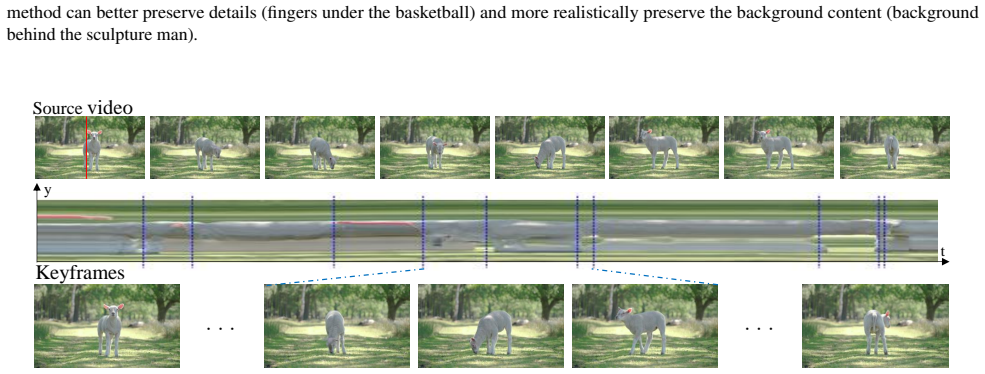
The load-bearing mechanism is Adaptive Attention Slimming (AAS), applied inside the extended self-attention of keyframe translation. For one query keyframe, DIFT cosine similarity heatmaps are built against every other keyframe; only the m pixel positions with the highest similarity survive, and K and V are replaced by eK and eV holding just those tokens, so Eq. (3) becomes Eq. (7). This shrinks the KV sequence length from the full set of keyframe tokens to a fixed number, directly attacking the quadratic memory cost of extended self-attention. The same DIFT heatmaps also drive Adaptive Keyframe Selection (AKS), which segments the video into clips of similar content using mean and sliding-window thresholds in Algorithm 1, and Feature-Matched Latent Propagation, which reuses corresponding source tokens to transfer keyframe outputs to non-keyframes.
What would settle it
A concrete test: pick a source video where a subject changes shape during motion, such as a person turning or an animal bending, apply AdaFlow with the same prompt under full extended self-attention and under AAS with progressively smaller m, and measure object consistency and edit fidelity on the shape-changing frames; if consistency collapses as m falls, or if the m retained positions per query do not cover the edited object, the central assumption is falsified. A second check is to run AdaFlow on a long static scene versus a rapid-cut video and compare whether quality degrades with length under a fixed m budget.
Extended reading notes
Core claim
On its own terms, the discovery is that the quadratic cost of extended self-attention in keyframe translation can be cut without sacrificing editing quality by observing that a query frame mainly needs tokens similar to itself. AdaFlow computes DIFT similarity heatmaps between each query keyframe and every other keyframe and retains only the m highest-similarity positions in K and V, replacing them with slimmed eK and eV in Eq. (7). That reduces the KV sequence from M times h times w tokens to a fixed budget, which is what allows the number of keyframes edited together to rise by an order of magnitude. Adaptive Keyframe Selection then distributes the budget according to content dynamics, and Feature-Matched Latent Propagation spreads keyframe edits to the remaining frames using correspondences computed once. The paper claims this yields high-quality editing of more than 1k frames in one inference, with quantitative results on LongV-EVAL and a user study favoring AdaFlow over five baselines.
Load-bearing premise
The load-bearing premise is that keeping only the m pixel tokens most similar to the query frame, measured by DIFT cosine similarity, preserves the information needed to produce a consistent edit, so the slimmed attention is as good as full attention; the paper's Appendix F acknowledges this can fail when edits require object-shape changes.
Editorial extensions
If this is right
- Videos of more than 1,000 frames can be edited in one inference on a single 80GB GPU, and the appendix reports one 10,000-frame edit.
- Editing time drops: AdaFlow averages 24 minutes per LongV-EVAL video, half or less of the 40 to 83 minutes reported for the five baselines.
- Because AAS is training-free, the method inherits improvements in the underlying image diffusion backbone without retraining.
- Keyframe density becomes content-adaptive: static segments consume fewer keyframes, while rapid-motion segments get denser sampling, which avoids both redundancy and blur around motion.
- The evaluation protocol of LongV-EVAL, covering frame quality, video quality, object consistency, and semantic consistency, can be reused to compare future long-video editors.
Reading between the lines
- Beyond the paper: the same DIFT-based token selection could be applied to temporal attention in other diffusion video pipelines, not just the keyframe-translation stage, since the underlying quadratic cost is shared.
- Beyond the paper: a fixed token budget suggests a testable scaling law, namely that object consistency should degrade with video length under AAS even if per-frame edit quality stays constant; measuring that curve would tell how far the method can scale.
- Beyond the paper: the reliance on DIFT similarity makes AdaFlow more suited to appearance and style edits than to geometry-changing edits, and the paper's Appendix F concedes exactly this weakness; a stress test separating the two edit types would locate the practical boundary of the method.
- Beyond the paper: a natural extension would be a variant that restores full attention only for tokens near regions named by the edit prompt, combining the memory savings with better shape-change handling.
Editorial analysis
A structured set of objections, weighed in public.
Referee Report
Summary. The paper proposes AdaFlow, a training-free method for long text-driven video editing. The approach divides the video into content-based segments via Adaptive Keyframe Selection (AKS), which uses DIFT features to measure frame similarity and chooses representative keyframes per segment. The keyframes are jointly edited using extended self-attention, but to fit more keyframes in memory, Adaptive Attention Slimming (AAS) prunes the KV token sequence: for each query keyframe, only the m pixel positions with highest DIFT cosine similarity to the query are retained across all keyframes (Eq. 7). The edited keyframe latents are then propagated to non-keyframes using precomputed DIFT correspondences. The paper also introduces a new benchmark, LongV-EVAL, consisting of 75 one-minute videos with three annotated editing prompts each, and reports experiments on an A800 GPU showing editing of more than 1,000 frames in a single inference, with better or comparable quality metrics and lower runtime than several baselines. The authors release their code.
Significance. If validated, AdaFlow's headline result — order-of-magnitude longer single-inference video editing through attention slimming — would be practically significant, and LongV-EVAL could fill a gap in long-video editing evaluation. The paper has clear strengths: it is training-free, the pipeline is described in sufficient detail to be reproduced, the code is released, qualitative results include 10k-frame examples (Appendix B, Fig. 6), and the benchmark provides a standardized set of long videos with prompts targeting foreground, background, and style edits. However, the central claim rests on an untested assumption about the KV-pruning proxy, and the quantitative evidence presented does not yet isolate the contribution of the main component, AAS. The user-study inconsistency and missing prompt-fidelity metric further weaken the current evaluation.
major comments (3)
- [§4.2, Eq. (7); §5.3, Table 1; Fig. 3(b)] The central claim that Adaptive Attention Slimming enables an order-of-magnitude increase in editable frames while preserving quality is not supported by any ablation of AAS itself. Figure 3(b) ablates only Adaptive Keyframe Selection, and Table 1 compares the full AdaFlow system against baselines. The paper needs a comparison of AdaFlow with and without AAS at matched keyframe count and video length, plus a sweep over the retained-token budget (the '14-frame token count' setting in §5.2), to show that the pruned attention preserves editing quality relative to full-KV extended self-attention. Without this, the headline capability cannot be attributed to AAS, and the limitation admitted in Appendix F (unsatisfactory results when object shapes change) is consistent with the hypothesis that the DIFT-similarity proxy discards tokens required for object-level consistency.
- [§4.2 and §5.2 (DIFT extraction at t=0)] The DIFT-based token selection used by AAS is computed from clean source frames at t=0 and then reused for all 50 DDIM denoising steps, because the latents being denoised change substantially over the schedule. The paper provides no evidence that the set of m most-similar tokens at t=0 remains the set of tokens that carry the attention mass needed at later timesteps. This is a load-bearing assumption for Eq. (7); a sensitivity analysis comparing the fixed t=0 selection against per-timestep selection, or at least reporting the overlap of selected tokens across timesteps, would test whether this assumption holds.
- [§5.3, Table 1 and §5.3 user study; Appendix C] The quantitative evaluation lacks error bars, statistical significance tests, and a direct prompt-fidelity metric. The four reported metrics (FQ, VQ, OC, SC) measure aesthetic/technical quality and temporal/object consistency, but none measures whether the output actually follows the editing prompt (e.g., CLIP text-image similarity against the prompt). The differences in OC and SC between AdaFlow and the best baseline are small (0.953 vs 0.947 and 0.969 vs 0.966), and without variance or significance testing the claim in §5.3 of 'obvious advantages' over the compared methods is not established. The user study also has an internal inconsistency: Table 2 and the main text state 18 participants, while Appendix C states 50 participants. This discrepancy must be resolved, and the study protocol (20 sets of 6 videos, 40 choices per participant) should be clarified so that the reported percentages are internally consistent.
minor comments (4)
- [§4.1, Algorithm 1] The 'window check' function in Algorithm 1 is not defined in the main text; the parameters l, s, ws are given in §5.2 but the precise procedure for the sliding-window similarity test should be specified, since it is a core part of AKS.
- [§5.2, keyframe pruning setting] The phrase 'We consistently retain the token count corresponding to 14 frames' is ambiguous: clarify whether this is 14 × h × w tokens per attention layer, and how the m positions are aggregated across keyframes (e.g., per query keyframe independently, or as a union).
- [§5.1 and Table 1] The benchmark name 'LongV-EV AL' appears with a stray space in several places (e.g., §5.1, Table 1); this should be corrected to 'LongV-EVAL' consistently.
- [§5.2, Table 1, timing comparison] The runtime comparison in Table 1 is confounded by the fact that baselines are edited in segments of 128, 32, or 16 frames, as stated in §5.2; reporting per-frame or per-keyframe timing and GPU memory would make the efficiency claim more interpretable.
Circularity Check
No circular derivation: AAS and AKS are hand-set heuristics evaluated against independent metrics; self-citations are not load-bearing.
full rationale
AdaFlow's central claim (order-of-magnitude more keyframes via Adaptive Attention Slimming) does not reduce to a fitted or self-defined quantity. In Eq. (7), K and V are replaced by eK and eV selected by DIFT cosine similarity, but that selection is a pruning heuristic computed from source-frame correspondences, not a parameter fitted to the reported FQ/VQ/OC/SC scores. Those scores come from external predictors (LAION aesthetic predictor, DOVER, DINO, CLIP) and a user study, so the evaluation is not built from the method's own outputs. The thresholds in Section 5.2 (mean similarity 0.75, window threshold 0.6, window size 42, step 21, 14-frame token budget) are engineering constants hand-set for the pipeline, not fitted parameters later renamed as predictions. The selection criterion is also not definitionally identical to the attention score: Eq. (3) uses projected latents W^Q and W^K, whereas Eqs. (4)-(6) use DIFT features from an intermediate decoder layer, so AAS is not force-equal to full attention by construction. The main validity risk, that one-shot DIFT selection is reused for all 50 denoising steps, is an untested assumption rather than a circularity; Appendix F (Limitations) explicitly concedes that the method 'often produces unsatisfactory results when changes in object shapes are required.' Self-citations by the Xiamen group (e.g., Zhou et al., 2019; Luo et al., 2024a/b; Zou et al., 2024) appear in the references and related work, but none is used to justify AAS, AKS, or the 1k-frame capability, so they do not make the derivation circular. No circular step was found; the score of 2 reflects only the presence of non-load-bearing self-citations, not any reduction of the central claim to its inputs.
Assumptions & free parameters
free parameters (6)
- mean_similarity_threshold (ms) =
0.75
- window_similarity_threshold (ws) =
0.6
- sliding_window_size (l) =
42 pixels
- sliding_window_step (s) =
21 pixels
- keyframe_budget =
14 frames
- DIFT_extraction_timestep =
t=0
assumptions (4)
- domain assumption DIFT features provide reliable token-wise correspondence between video frames.
- ad hoc to paper The tokens most similar to the query frame (by DIFT cosine similarity) are the tokens that matter for editing quality.
- domain assumption Token correspondences computed once from the source video remain valid through the denoising process of the edited video.
- domain assumption Plug-and-Play (PnP) image editing transfers to video keyframe editing without additional training.
Cite this review
Pith. "Pith review of AdaFlow: Efficient Long Video Editing via Adaptive Attention Slimming And Keyframe Selection." pith.science (2026). https://pith.science/paper/6KEYZYJW
@misc{pith2026250205433,
  author       = {Pith},
  title        = {Pith review of: AdaFlow: Efficient Long Video Editing via Adaptive Attention Slimming And Keyframe Selection},
  year         = {2026},
  howpublished = {\url{https://pith.science/paper/6KEYZYJW}},
  note         = {Machine review of arXiv:2502.05433}
}
abstract
Despite great progress, text-driven long video editing is still notoriously challenging mainly due to excessive memory overhead. Although recent efforts have simplified this task into a two-step process of keyframe translation and interpolation generation, the token-wise keyframe translation still plagues the upper limit of video length. In this paper, we propose a novel and training-free approach towards efficient and effective long video editing, termed AdaFlow. We first reveal that not all tokens of video frames hold equal importance for keyframe translation, based on which we propose an Adaptive Attention Slimming scheme for AdaFlow to squeeze the $KV$ sequence, thus increasing the number of keyframes for translations by an order of magnitude. In addition, an Adaptive Keyframe Selection scheme is also equipped to select the representative frames for joint editing, further improving generation quality. With these innovative designs, AdaFlow achieves high-quality long video editing of minutes in one inference, i.e., more than 1$k$ frames on one A800 GPU, which is about ten times longer than the compared methods, e.g., TokenFlow. To validate AdaFlow, we also build a new benchmark for long video editing with high-quality annotations, termed LongV-EVAL. Our code is released at: https://github.com/jidantang55/AdaFlow.
Figures


Figures from the paper (6 more)



Reference graph
Works this paper leans on
-
[1]
L., Almeida, D., Altenschmidt, J., Altman, S., Anadkat, S., et al
Achiam, J., Adler, S., Agarwal, S., Ahmad, L., Akkaya, I., Aleman, F. L., Almeida, D., Altenschmidt, J., Altman, S., Anadkat, S., et al. Gpt-4 technical report. arXiv preprint arXiv:2303.08774,
-
[3]
Slicedit: Zero-shot video editing with text-to-image diffusion models using spatio-temporal slices
Cohen, N., Kulikov, V ., Kleiner, M., Huberman-Spiegelglas, I., and Michaeli, T. Slicedit: Zero-shot video editing with text-to-image diffusion models using spatio-temporal slices. arXiv preprint arXiv:2405.12211,
-
[4]
Please add a caption to the video in great detail
Examples of results for dataset annotation. Each source video is accompanied by three different prompts that focus on three aspects: foreground, background, and style. A. Dataset Annotating Details We collected 75 videos, each approximately one minute long with a frame rate of 20-30 fps, from https://mixkit.co/, https://www.pexels.com, and https://pixabay...
work page 2023
-
[5]
Diffedit: Diffusion-based semantic image editing with mask guidance
Couairon, G., Verbeek, J., Schwenk, H., and Cord, M. Diffedit: Diffusion-based semantic image editing with mask guidance. arXiv preprint arXiv:2210.11427,
-
[6]
Tokenflow: Consistent diffusion features for consistent video editing
Geyer, M., Bar-Tal, O., Bagon, S., and Dekel, T. Tokenflow: Consistent diffusion features for consistent video editing. arXiv preprint arXiv:2307.10373,
-
[7]
Prompt-to-prompt im- age editing with cross attention control
Hertz, A., Mokady, R., Tenenbaum, J., Aberman, K., Pritch, Y ., and Cohen-Or, D. Prompt-to-prompt im- age editing with cross attention control. arXiv preprint arXiv:2208.01626,
-
[9]
Kingma, D. P. Auto-encoding variational bayes. arXiv preprint arXiv:1312.6114,
-
[11]
Glide: Towards photorealistic image generation and editing with text-guided diffusion models
Nichol, A., Dhariwal, P., Ramesh, A., Shyam, P., Mishkin, P., McGrew, B., Sutskever, I., and Chen, M. Glide: Towards photorealistic image generation and editing with text-guided diffusion models. arXiv preprint arXiv:2112.10741,
Show all 18 references
-
[14]
Diffusion model-based video editing: A survey
Sun, W., Tu, R.-C., Liao, J., and Tao, D. Diffusion model-based video editing: A survey. arXiv preprint arXiv:2407.07111,
-
[15]
Plug- and-play diffusion features for text-driven image-to- image translation
Tumanyan, N., Geyer, M., Bagon, S., and Dekel, T. Plug- and-play diffusion features for text-driven image-to- image translation. In Proceedings of the IEEE/CVF Con- ference on Computer Vision and Pattern Recognition, pp. 1921–1930,
1921
-
[16]
Zero-shot video editing using off-the-shelf image diffusion models
Wang, W., Jiang, Y ., Xie, K., Liu, Z., Chen, H., Cao, Y ., Wang, X., and Shen, C. Zero-shot video editing using off-the-shelf image diffusion models. arXiv preprint arXiv:2303.17599,
-
[17]
Exploring video quality assessment on user generated contents from aesthetic and technical perspectives
Wu, H., Zhang, E., Liao, L., Chen, C., Hou, J., Wang, A., Sun, W., Yan, Q., and Lin, W. Exploring video quality assessment on user generated contents from aesthetic and technical perspectives. In Proceedings of the IEEE/CVF International Conference on Computer Vision, pp. 2014...
2023
-
[2013]
Video-llava: Learning united visual representa- tion by alignment before projection
Lin, B., Zhu, B., Ye, Y ., Ning, M., Jin, P., and Yuan, L. Video-llava: Learning united visual representa- tion by alignment before projection. arXiv preprint arXiv:2311.10122,
-
[2020]
P., Poole, B., Norouzi, M., Fleet, D
Ho, J., Chan, W., Saharia, C., Whang, J., Gao, R., Gritsenko, A., Kingma, D. P., Poole, B., Norouzi, M., Fleet, D. J., et al. Imagen video: High definition video generation with diffusion models. arXiv preprint arXiv:2210.02303, 2022a. Ho, J., Salimans, T., Gritsenko, A., Chan...
-
[2021]
Denoising diffusion implicit models
Song, J., Meng, C., and Ermon, S. Denoising diffusion implicit models. arXiv preprint arXiv:2010.02502,
2010 arXiv
-
[2022]
Laion-400m: Open dataset of clip- filtered 400 million image-text pairs
Schuhmann, C., Vencu, R., Beaumont, R., Kaczmarczyk, R., Mullis, C., Katta, A., Coombes, T., Jitsev, J., and Komatsuzaki, A. Laion-400m: Open dataset of clip- filtered 400 million image-text pairs. arXiv preprint arXiv:2111.02114,
-
[2023]
Consistent video-to- video transfer using synthetic dataset
Cheng, J., Xiao, T., and He, T. Consistent video-to- video transfer using synthetic dataset. arXiv preprint arXiv:2311.00213,
-
[2024]
Flatten: optical flow-guided attention for consistent text- to-video editing
Cong, Y ., Xu, M., Simon, C., Chen, S., Ren, J., Xie, Y ., Perez-Rua, J.-M., Rosenhahn, B., Xiang, T., and He, S. Flatten: optical flow-guided attention for consistent text- to-video editing. arXiv preprint arXiv:2310.05922,
Reviewed August 8, 2026 · model on record in the stance chip above.
Discussion (0). Continue with ORCID to comment.