REVIEW 3 major objections 6 minor 1 cited by
An Invariant for Triple-Point-Free Immersed Spheres
T0 review · 3 major / 6 minor · reviewed 2026-08-06 · deepseek-v4-flash
Pith's one-line read Integer-sequence invariant separates triple-point-free immersed spheres into infinitely many classes
desk verdict The invariant and its invariance proof are solid and genuinely new; the surjectivity half of the image theorem is carried by figures and a one-sentence connected-sum assertion, which is a fixable gap in rigor, not a fatal flaw. read the letter →
The pith
A machine-rendered reading of the paper's core claim, the machinery that carries it, and where it could break.
The reading
What carries the argument
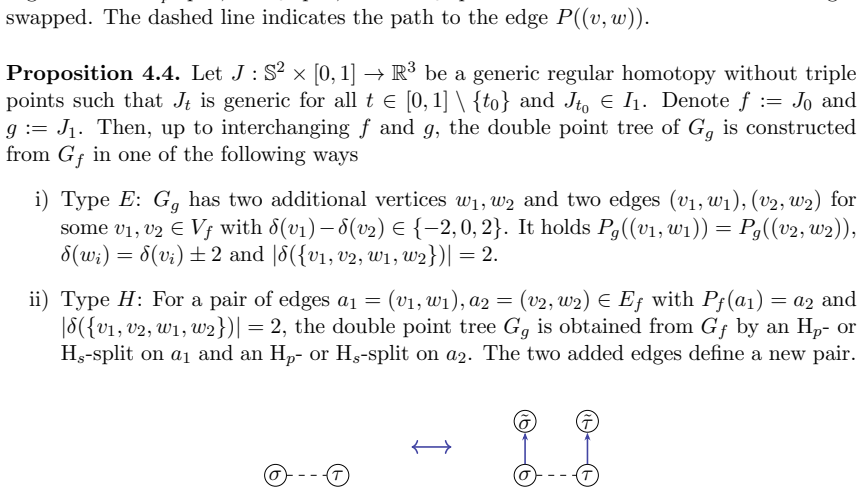
The key object is the double point tree $(G_f, P, \delta_f)$: the double point curves of a generic triple-point-free immersion are disjoint circles; cutting $S^2$ along them yields a finite tree with an edge for each double point curve, a pairing $P$ that identifies conjugate curves on the two sheets, and a vertex function $\delta_f$ equal to the sum of topological degrees of the two ambient components adjacent to the vertex's image. The invariant $F$ is the weighted sum $\sum_{v: \delta_f(v)=k} (1 - \deg^-(v))$ at each integer $k$. The proof of invariance hinges on Proposition 4.4, which classifies how a regular homotopy crossing an elliptic or hyperbolic tangency modifies the tree; in particular the H-split operations create a vertex with indegree one less than the sum of two new indegrees, so the contributions at each degree level cancel exactly. Surjectivity relies on Examples 6.1 and 6.2 (surfaces of revolution realizing basis vectors $e_k$ and $2e_1-e_k$) and on the connected-sum formula $F(f\#g)=F(f)+F(g)-e_1$, which lets one realize any sequence in $U$ by a connected sum of such pieces.
What would settle it
Carry out the construction of Lemma 6.3 for the sequence $h = e_7 + e_{-5} - e_1$: glue the surfaces $f_7$, $g_1$, and $f_{-5}$ along their poles and enumerate the double point tree of the result. If any gluing neck produces a triple point, if any vertex of the resulting tree has even local degree, or if the computed value of $F$ differs from $h$, then the surjectivity half of Theorem 1.4 fails.
Extended reading notes
Core claim
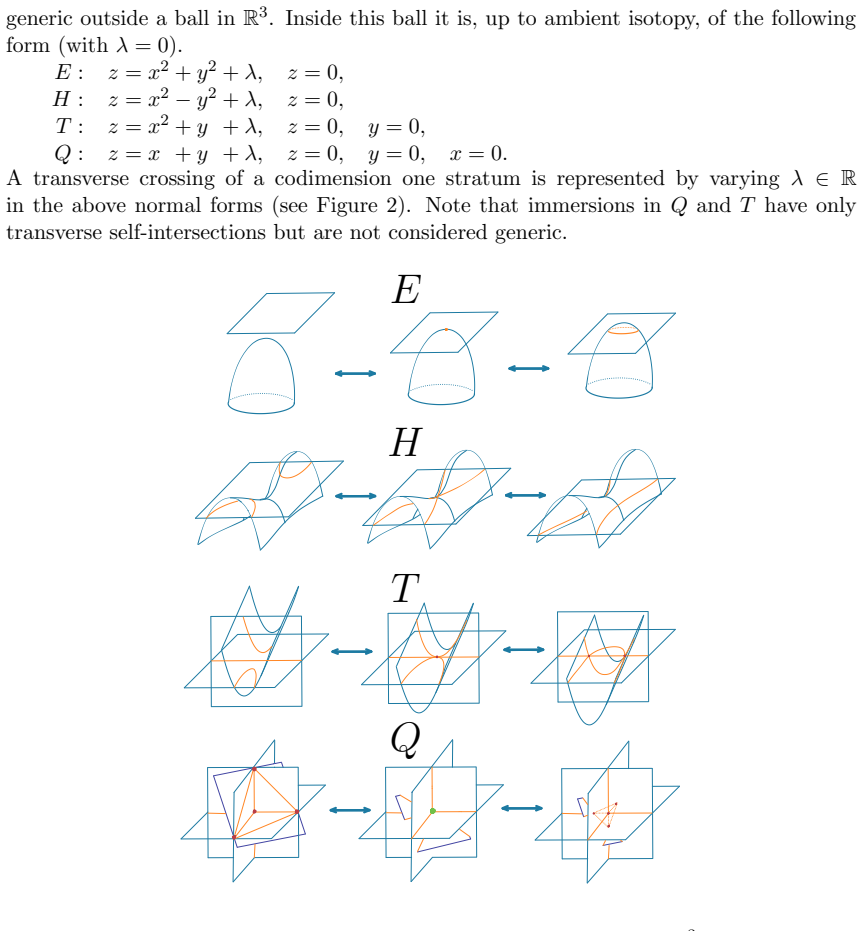
The central result, stated as Theorems 1.3 and 1.4, is that the map $F$ defined on generic triple-point-free immersions by $F(f)_k = \sum_{v \in \delta_f^{-1}(\{k\})} (1 - \deg^-(v))$ is invariant under regular homotopies staying within $\mathrm{Imm}_{<3}(S^2,\mathbb{R}^3)$, and its image is exactly $U = \{ (h_k) \in \mathbb{Z}^{\mathbb{Z}} : h_{2k}=0\ \forall k,\ \sum |h_k| < \infty,\ \sum h_k = 1 \}$. The invariant is read off from a double point tree: cutting the sphere along the double point curves gives a tree whose vertices are regions, with an edge for each double point curve, a pairing matching the two sheets along each curve, and a local topological degree $\delta_f$ on each vertex. Invariance is shown by classifying the two types of tangency events (E and H) that a generic deformation crosses; for H-events, the tree modification replaces one vertex by two whose indegrees satisfy $\deg^-(v_f) = \deg^-(v_g) + \deg^-(w_g) - 1$, making the weighted count per degree unchanged. Surjectivity is achieved by constructing surfaces of revolution with $F=e_k$ and $F=2e_1-e_k$ for every odd $k$, and a pole-gluing connected sum that obeys $F(f\#g)=F(f)+F(g)-e_1$.
Load-bearing premise
The surjectivity part of the image description rests on constructions presented mainly through figures: for every odd integer $k$, surfaces of revolution $f_k$ and $g_k$ exist without triple points and with $F(f_k)=e_k$ and $F(g_k)=2e_1-e_k$, and gluing such surfaces along their poles changes the invariant by $F(f\#g)=F(f)+F(g)-e_1$; if any of these constructions accidentally creates a triple point or changes the invariant differently, the image description and the infinitude of classes could fail.
Editorial extensions
If this is right
- The space $\mathrm{Imm}_{<3}(S^2,\mathbb{R}^3)$ of immersed spheres without triple points has infinitely many regular homotopy classes, whereas only two were known before.
- Any two immersed spheres with different values of $F$ can only be connected by a regular homotopy that passes through triple points, so the invariant detects a topological obstruction to avoiding triple points.
- For the Willmore-flow initial surface $j$ of Figure 1, $F(j)=e_3$; hence every regular homotopy from $j$ to the round sphere must cross a triple point, giving a topological reason for singular behaviour in the Willmore flow and restricting the components of energy sublevel sets.
- Since known finite-order local invariants cannot separate triple-point-free immersions from both standard embedded spheres, $F$ is necessarily a new kind of non-finite-order invariant.
- The invariant restricts to $\mathrm{Imm}_{<3}(S^2,\mathbb{R}^3)/\mathrm{Diff}(S^2)$ by identifying a sequence with its reflection, giving a version of the classification that is independent of sphere reparametrisation.
Reading between the lines
- The connected-sum relation $F(f\#g)+e_1 = (F(f)+e_1)+(F(g)+e_1)$ suggests that, if the invariant is ever shown to be complete, the regular homotopy classes of triple-point-free immersions would form a free abelian monoid under connected sum with the standard embedding as unit.
- Because $\mathrm{Imm}_{<4}(S^2,\mathbb{R}^3)$ is a subspace of $\mathrm{Imm}_{<3}(S^2,\mathbb{R}^3)$, any value of $F$ realized by an immersion without quadruple points obstructs quadruple-point-free deformations; the surfaces of revolution realizing all of $U$ might be adapted to answer Question 1.6, asking whether $\mathrm{Imm}_{<4}$ has more than two components.
- The explicit image of $F$ on the Willmore initial surface $j$ and the triple-point obstruction could be used to search for minimisers of the Willmore energy within each regular homotopy class, provided the gradient flow can stay away from triple points for a long time.
Editorial analysis
A structured set of objections, weighed in public.
Referee Report
Summary. The paper defines an invariant F for triple-point-free immersed spheres S^2 -> R^3. For a generic immersion f, the double points are encoded in a directed tree G_f with a pairing on edges and a local topological degree δ_f on vertices; F(f) is the integer sequence whose k-th entry is the sum of 1 - deg^-(v) over vertices with δ_f(v)=k. Theorem 1.3 states that F is invariant under regular homotopies through Imm_{<3}(S^2,R^3); the proof reduces to E and H singularities and uses the tree-modification classification of Section 4. Theorem 1.4 characterizes the image of F as the set U of finitely supported integer sequences with zero even entries and total sum 1. The paper also derives consequences: Imm_{<3}(S^2,R^3) has infinitely many regular homotopy classes, and a specific surface of revolution j cannot be regularly homotoped to an embedded sphere without triple points (Theorem 1.7).
Significance. If the main results are correct, this is a significant advance: it upgrades the previously known lower bound of two components of Imm_{<3}(S^2,R^3) to infinitely many, and it gives an explicit, computable invariant that is not of finite order. The construction of the invariant from a double-point tree plus local degrees is natural and elegant, and the invariance proof via a classification of E/H tree modifications is a substantial and mostly self-contained contribution. The inclusion im(F) ⊆ U is proved cleanly from tree identities. The main weakness is that the surjectivity half of Theorem 1.4 rests on unexpanded constructions and a connected-sum formula that are presented through figures rather than proved.
major comments (3)
- [Section 6, Examples 6.1 and 6.2] The existence of surfaces of revolution f_k and g_k for every odd k, with F(f_k)=e_k and F(g_k)=2e_1-e_k, is asserted and illustrated only by Figures 18 and 19. No explicit generating curves, parametrizations, or proofs that these surfaces have no triple points are supplied, and no computation of their double-point trees or local degrees is given. Since Lemma 6.3 uses these surfaces to realize every h in U, this is a load-bearing step: the exact image description in Theorem 1.4 is not established without a rigorous construction of f_k and g_k.
- [Section 6, equation (2)] The connected-sum formula F(f#g)=F(f)+F(g)-e_1 is justified only by the sentence that the double-point tree of f#g is the two trees glued along extremal vertices of degree δ=1, together with Figure 20. This requires proof that the poles used for the connected sum correspond to vertices of topological degree 1, that the gluing does not introduce triple points or additional double-point curves, and that the fused vertex has indegree equal to the sum of the two indegrees. Without these checks, the alternating connected-sum construction in Lemma 6.3 and hence the surjectivity part of Theorem 1.4 are unsupported.
- [Section 6, Lemma 6.3] The proof of Lemma 6.3 assumes that every f_k and g_k has an extremal polar vertex of topological degree δ=1 with the oriented normal pointing into the unbounded component of R^3 \ f(S^2). This property is not verified for the surfaces in Examples 6.1 and 6.2, nor is it proved that the pole connected sum preserves the absence of triple points under repeated gluing. If this polar-vertex condition fails for some k, the sequential gluing ih := fa(1)#gb(1)#... cannot be carried out as written, and the image theorem would require a different argument.
minor comments (6)
- [Introduction, after Theorem 1.4] The statement that the invariant 'is therefore necessarily not of finite order' is asserted without proof or reference; please either provide a short argument or soften the claim, since it is not needed for the main theorems.
- [Definition 1.2] The codomain of F is written as Z^Z, while the abstract and Theorem 1.4 describe the image in l^1(Z); this is harmless but the notation could be aligned, for example by defining the subset of finitely supported sequences.
- [Definition 4.3] The phrase 'double point tree with incomplete pairing' is used before a formal definition of an incomplete pairing is given; please define this notion explicitly.
- [Section 4, Proposition 4.4] The classification of H-singularity tree modifications is presented largely through figures and the phrase 'may (or may not)' for reattachments; a fully formal enumeration of the cases with explicit notation would make the proof easier to verify.
- [Section 5, proof of Theorem 1.3] In the H-singularity case, the equation deg^-(v_f)=deg^-(v_g)+deg^-(w_g)-1 is stated without indicating which vertices in Figure 16 correspond to v_f, v_g, and w_g in each of the Hp- and Hs-split cases; labelling the figure would improve readability.
- [Section 6, equation (2)] Equation (2) is introduced with a bare reference to Figure 20; adding a numbered display and a short derivation of the change in indegree at the glued vertex would make the argument explicit.
Circularity Check
No significant circularity: the invariant is defined directly from each immersion's double point tree and local degrees, and the image theorem is a forward construction rather than a retrodiction.
full rationale
The central invariant F (Definition 1.2) is computed from the double point tree (G_f, P_f, delta_f) of a given triple-point-free immersion, with no fitted parameters and no normalization chosen to hit a target. The invariance proof (Theorem 1.3) checks directly how the tree and the quantity sum_v (1 - deg^-(v)) change across the E and H codimension-one strata, using only the local classification of singularities and the tree modification rules. The image theorem (Theorem 1.4) has two parts. The inclusion im(F) subset U is proved from structural facts: delta takes odd values by Lemma 3.4, the tree is finite so F has finite support, and the total sum equals 1 because |V| - |E| = 1 for every finite tree. None of these conditions is imposed by fiat; they are consequences of the definition. The surjectivity part is a genuine construction: Lemma 6.3 builds surfaces f_k and g_k with prescribed invariant values (claimed in Examples 6.1 and 6.2) and glues them via a connected sum formula F(f # g) = F(f) + F(g) - e_1. This is a forward realization argument, not a restatement of the invariant's definition. The connected sum formula is asserted with a geometric explanation (gluing two degree-1 extremal vertices removes one e_1 contribution) rather than a full formal proof, but even if that formula or the claimed values of Examples 6.1 and 6.2 were insufficiently justified, that would be a rigor gap, not circularity: those claims are inputs to the construction, not renamings of the theorem's conclusion. The only self-references in the paper are to the author's own prior/companion work (e.g., [MBS25] in the Willmore application, and Example 5.2 used in the proof of Theorem 1.7), but these are peripheral applications, not load-bearing premises of the main derivation, and they are not used to forbid alternatives or to justify an unproved uniqueness statement. The paper explicitly notes that F is not known to be complete, which further confirms that it does not overclaim its invariant's strength.
Assumptions & free parameters
assumptions (3)
- domain assumption The codimension-1 strata of Imm(S2,R3) are exactly E, H, T, Q (elliptic and hyperbolic self-tangency, triple point, quadruple point).
- domain assumption Every immersion of RP2 into R3 has a triple point (Banchoff).
- ad hoc to paper For every odd k there exist triple-point-free surfaces of revolution f_k and g_k with F(f_k)=e_k and F(g_k)=2e1-e_k, and the pole-connected sum satisfies F(f#g)=F(f)+F(g)-e1.
Cite this review
Pith. "Pith review of An Invariant for Triple-Point-Free Immersed Spheres." pith.science (2026). https://pith.science/paper/6KUQMRJO
@misc{pith2026250621130,
  author       = {Pith},
  title        = {Pith review of: An Invariant for Triple-Point-Free Immersed Spheres},
  year         = {2026},
  howpublished = {\url{https://pith.science/paper/6KUQMRJO}},
  note         = {Machine review of arXiv:2506.21130}
}
abstract
We define an invariant of triple-point-free immersions of $2$-spheres into Euclidean $3$-space, taking values in $l^1(\mathbb{Z})$. It remains unchanged under regular homotopies through such immersions. An explicit description of its image shows that the space of triple-point-free immersed spheres has infinitely many regular homotopy classes. Consequently, many pairs of immersed spheres can only be connected by regular homotopies that pass through triple points. We represent the double points of a triple-point-free immersed sphere using a directed tree, equipped with a pair relation on the edges and an integer-valued function on the vertices. The invariant depends on this function and on the vertex indegrees.
Figures


Figures from the paper (17 more)




Forward citations
Cited by 1 Pith paper
-
The Willmore Energy Landscape of Spheres and Avoidable Singularities of the Willmore Flow
Every immersed 2-sphere with Willmore energy at most 12π admits an energy-nonincreasing regular homotopy to a round sphere or to a surface in the explicit family J, giving exactly four regular homotopy classes below 12π.
Reference graph
Works this paper leans on
-
[1]
J. W. Alexander. O n the S ubdivision of 3 - S pace by a P olyhedron. Proc. Nat. Acad. Sci. U.S.A. , 10(1):6--8, 1924
work page 1924
-
[2]
Triple points and singularities of projections of smoothly immersed surfaces
Thomas Banchoff. Triple points and singularities of projections of smoothly immersed surfaces. Proc. Amer. Math. Soc. , 46:402--406, 1974
work page 1974
- [3]
-
[4]
A singular example for the W illmore flow
Simon Blatt. A singular example for the W illmore flow. Analysis (Munich) , 29(4):407--430, 2009
2009
-
[5]
On the self-intersections of an immersed sphere
Albert Borb\'ely. On the self-intersections of an immersed sphere. Bull. Austral. Math. Soc. , 75(3):453--458, 2007
work page 2007
-
[6]
Glen E. Bredon. Topology and geometry , volume 139 of Graduate Texts in Mathematics . Springer-Verlag, New York, 1993
1993
-
[7]
S. Chmutov, S. Duzhin, and J. Mostovoy. Introduction to V assiliev knot invariants . Cambridge University Press, Cambridge, 2012
work page 2012
-
[8]
Goryunov
Victor V. Goryunov. Local invariants of mappings of surfaces into three-space. In The A rnold- G elfand mathematical seminars , pages 223--255. Birkh\"auser Boston, Boston, MA, 1997
1997
Show all 29 references
-
[9]
Morris W. Hirsch. Differential topology , volume No. 33 of Graduate Texts in Mathematics . Springer-Verlag, New York-Heidelberg, 1976
1976
-
[10]
C. A. Hobbs and N. P. Kirk. On the classification and bifurcation of multigerms of maps from surfaces to 3-space. Math. Scand. , 89(1):57--96, 2001
2001
-
[11]
John F. Hughes. Another proof that every eversion of the sphere has a quadruple point. Amer. J. Math. , 107(2):501--505, 1985
1985
-
[12]
Interlacement of double curves of immersed spheres
Boldizs \'a r Kalm \'a r. Interlacement of double curves of immersed spheres. Discrete Comput. Geom. , 55(3):550--570, 2016
2016
-
[13]
On double points of immersions of spheres
G\'abor Lippner. On double points of immersions of spheres. Manuscripta Math. , 113(2):239--250, 2004
2004
-
[14]
A new conformal invariant and its applications to the W illmore conjecture and the first eigenvalue of compact surfaces
Peter Li and Shing Tung Yau. A new conformal invariant and its applications to the W illmore conjecture and the first eigenvalue of compact surfaces. Invent. Math. , 69(2):269--291, 1982
1982
-
[15]
Every sphere eversion has a quadruple point
Nelson Max and Tom Banchoff. Every sphere eversion has a quadruple point. In Contributions to analysis and geometry ( B altimore, M d., 1980) , pages 191--209. Johns Hopkins Univ. Press, Baltimore, MD, 1981
1980
-
[16]
The W illmore E nergy L andscape of S pheres and A voidable S ingularities of the W illmore F low, 2025
Elena Mäder-Baumdicker and Jona Seidel. The W illmore E nergy L andscape of S pheres and A voidable S ingularities of the W illmore F low, 2025. arXiv:2506.23359 https://arxiv.org/abs/2506.23359
2025 arXiv
-
[17]
On the classification of germs of maps from R ^2 to R ^3
David Mond. On the classification of germs of maps from R ^2 to R ^3 . Proc. London Math. Soc. (3) , 50(2):333--369, 1985
1985
-
[18]
Mayer and Gieri Simonett
Uwe F. Mayer and Gieri Simonett. A numerical scheme for axisymmetric solutions of curvature-driven free boundary problems, with applications to the W illmore flow. Interfaces Free Bound. , 4(1):89--109, 2002
2002
-
[19]
Quadruple points of regular homotopies of surfaces in 3-manifolds
Tahl Nowik. Quadruple points of regular homotopies of surfaces in 3-manifolds. Topology , 39(5):1069--1088, 2000
2000
-
[20]
Automorphisms and embeddings of surfaces and quadruple points of regular homotopies
Tahl Nowik. Automorphisms and embeddings of surfaces and quadruple points of regular homotopies. J. Differential Geom. , 58(3):421--455, 2001
2001
-
[21]
Finite order q -invariants of immersions of surfaces into 3-space
Tahl Nowik. Finite order q -invariants of immersions of surfaces into 3-space. Math. Z. , 236(2):215--221, 2001
2001
-
[22]
Order one invariants of immersions of surfaces into 3-space
Tahl Nowik. Order one invariants of immersions of surfaces into 3-space. Math. Ann. , 328(1-2):261--283, 2004
2004
-
[23]
Higher-order invariants of immersions of surfaces into 3-space
Tahl Nowik. Higher-order invariants of immersions of surfaces into 3-space. Pacific J. Math. , 223(2):333--347, 2006
2006
-
[24]
Dissecting the 2-sphere by immersions
Tahl Nowik. Dissecting the 2-sphere by immersions. Geom. Dedicata , 127:37--41, 2007
2007
-
[25]
Oset Sinha and R
R. Oset Sinha and R. Wik Atique. New techniques for classification of multigerms. Topology Appl. , 234:311--334, 2018
2018
-
[26]
R. C. Read and P. Rosenstiehl. On the G auss crossing problem. In Combinatorics ( P roc. F ifth H ungarian C olloq., K eszthely, 1976), V ol. II , volume 18 of Colloq. Math. Soc. J\'anos Bolyai , pages 843--876. North-Holland, Amsterdam-New York, 1978
1976
-
[27]
A classification of immersions of the two-sphere
Stephen Smale. A classification of immersions of the two-sphere. Trans. Amer. Math. Soc. , 90:281--290, 1958
1958
-
[28]
Diffeomorphisms of the 2 -sphere
Stephen Smale. Diffeomorphisms of the 2 -sphere. Proc. Amer. Math. Soc. , 10:621--626, 1959
1959
-
[29]
V. A. Vassiliev. Cohomology of knot spaces. In Theory of singularities and its applications , volume 1 of Adv. Soviet Math. , pages 23--69. Amer. Math. Soc., Providence, RI, 1990
1990
Reviewed August 6, 2026 · model on record in the stance chip above.
Discussion (0). Continue with ORCID to comment.