Perturbative anomalous exponents from Kolmogorov multipliers
Pith reviewed 2026-06-29 20:01 UTC · model grok-4.3
The pith
Kolmogorov multiplier statistics from a perturbative Fokker-Planck solution around a Gaussian yield explicit anomalous scaling exponents for structure functions of any order.
A machine-rendered reading of the paper's core claim, the machinery that carries it, and where it could break.
Core claim
The invariant measure for Kolmogorov multipliers, defined as ratios of successive scalar amplitudes, is obtained through a perturbative expansion around a Gaussian distribution in the stationary Fokker-Planck equation. The resulting multiplier statistics then furnish explicit anomalous scaling exponents for structure functions of arbitrary order, including odd, even, and non-integer moments.
What carries the argument
Kolmogorov multipliers (ratios of successive scalar amplitudes) whose statistics are extracted from the stationary Fokker-Planck equation via perturbative expansion around a Gaussian distribution.
If this is right
- Anomalous exponents become available for odd moments as well as even and non-integer moments.
- The method supplies a concrete computational route for anomalous scaling that does not require closing the Hopf hierarchy.
- Multiplier statistics can be used to obtain the full set of scaling exponents once the invariant measure is known.
Where Pith is reading between the lines
- If the shell-model multipliers match those of the Navier-Stokes equations, the same perturbative procedure could be calibrated against direct numerical simulations to predict exponents in real flows.
- Higher-order terms in the perturbative series could be computed systematically to test convergence and refine the exponents.
- The ratio-based formulation may connect to cascade descriptions in other systems where successive amplitudes appear, such as wave turbulence or branching processes.
Load-bearing premise
The shell model is assumed to retain the essential multiplier statistics of real turbulent transport, and the perturbative expansion around the Gaussian is assumed to converge for the relevant parameter values.
What would settle it
Direct numerical extraction of the multiplier probability distribution from the shell model that deviates substantially from the perturbative Gaussian-based prediction would falsify the computed exponents.
Figures
read the original abstract
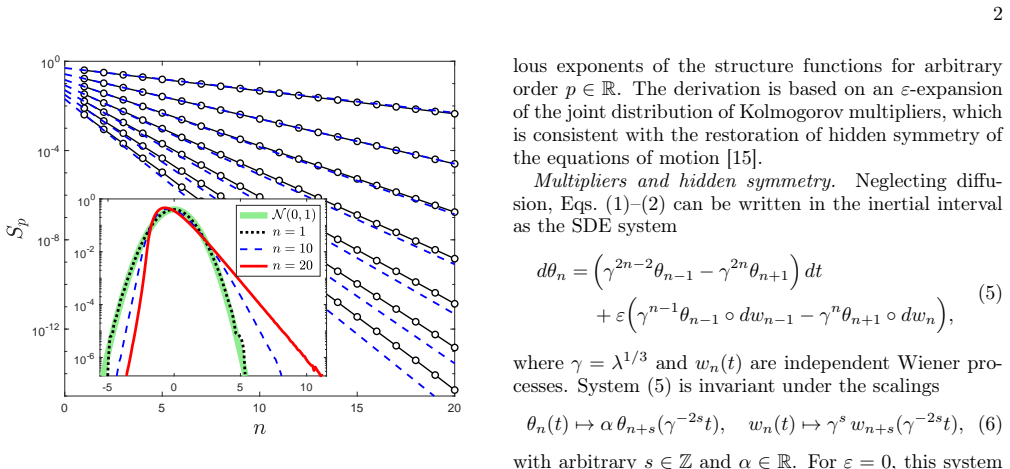
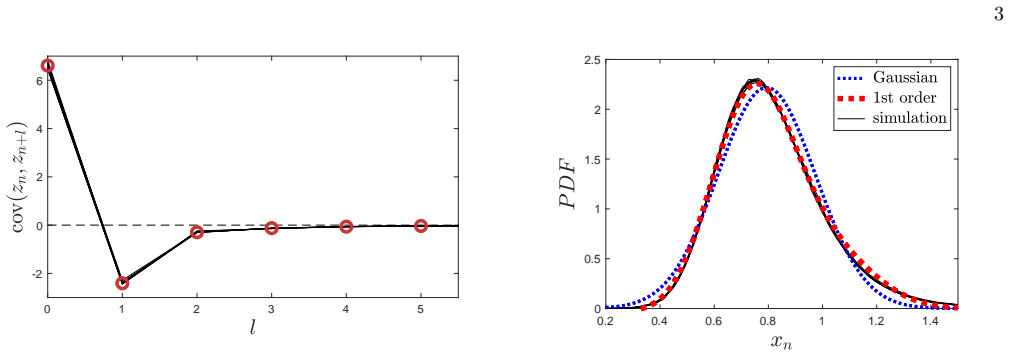
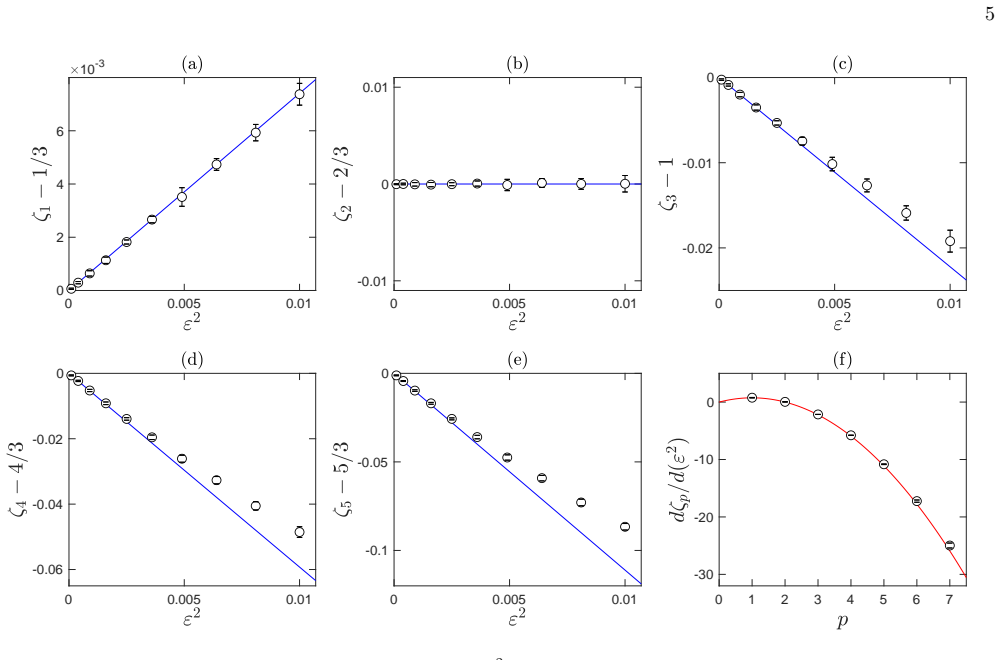
We introduce a perturbative framework for anomalous scaling in turbulent transport based on multiplier statistics, rather than zero-mode calculations. We illustrate the approach using a shell model combining deterministic and Kraichnan-like stochastic components. The problem is reduced to the analysis of a stationary Fokker--Planck equation for Kolmogorov multipliers, defined as ratios of successive scalar amplitudes. Its solution yields the invariant measure through a perturbative expansion around a Gaussian distribution. Using the resulting multiplier statistics, we compute explicit anomalous scaling exponents for structure functions of arbitrary order, including odd, even, and non-integer moments. More broadly, the results suggest that multiplier statistics provide a viable route for computing anomalous exponents in turbulent transport, complementing recent hidden-symmetry approaches while circumventing the limitations of zero-mode methods based on a closed Hopf hierarchy.
Editorial analysis
A structured set of objections, weighed in public.
Referee Report
Summary. The manuscript introduces a perturbative framework for anomalous scaling in turbulent transport based on Kolmogorov multiplier statistics in a shell model combining deterministic advection and Kraichnan-like stochastic forcing. The problem is reduced to a stationary Fokker-Planck equation for the multipliers (ratios of successive scalar amplitudes), whose invariant measure is obtained via a perturbative expansion around a Gaussian base distribution. From the resulting multiplier statistics, the paper derives explicit anomalous scaling exponents for structure functions of arbitrary order, including odd, even, and non-integer moments, positioning the approach as complementary to zero-mode methods.
Significance. If the expansion converges in the relevant parameter regime and the shell model retains essential multiplier statistics of real turbulence, the method would supply a systematic route to explicit, falsifiable anomalous exponents without closing a Hopf hierarchy. This could complement hidden-symmetry approaches and extend to higher-order moments where zero-mode techniques are limited. The manuscript does not yet demonstrate convergence or provide validation against known results or simulations, so the significance remains prospective.
major comments (1)
- [perturbative expansion around a Gaussian distribution] The central claim that the perturbative expansion yields explicit anomalous exponents of arbitrary order (including non-integer) requires the series for the invariant density to converge when the deterministic advection term is active and comparable to the stochastic forcing. No a-priori bound on the radius of convergence, error estimate, or numerical check against direct integration of the shell model is supplied in the description of the Fokker-Planck solution; without this, the reduction to explicit exponents is not controlled.
minor comments (1)
- [Abstract] The abstract asserts that 'explicit' exponents are computed for arbitrary order, yet no sample formula (even for a low-order moment) is shown to illustrate the output of the multiplier statistics; adding one concrete expression would clarify the method.
Simulated Author's Rebuttal
We thank the referee for the detailed review and constructive feedback on our manuscript introducing a perturbative framework based on Kolmogorov multipliers. We respond to the major comment point by point below.
read point-by-point responses
-
Referee: [perturbative expansion around a Gaussian distribution] The central claim that the perturbative expansion yields explicit anomalous exponents of arbitrary order (including non-integer) requires the series for the invariant density to converge when the deterministic advection term is active and comparable to the stochastic forcing. No a-priori bound on the radius of convergence, error estimate, or numerical check against direct integration of the shell model is supplied in the description of the Fokker-Planck solution; without this, the reduction to explicit exponents is not controlled.
Authors: The manuscript presents a formal perturbative expansion of the stationary Fokker-Planck equation around a Gaussian base distribution to obtain the invariant measure for the multipliers. From this, explicit expressions for the anomalous scaling exponents are derived for arbitrary order moments. We acknowledge that no rigorous a-priori bound on the radius of convergence is provided, nor is there a numerical validation against direct integration of the shell model. Such a bound would require advanced techniques in perturbation theory for Fokker-Planck operators and is outside the scope of this work, which aims to illustrate the method and obtain explicit formulas. The expansion is expected to be valid when the deterministic advection is weak compared to the stochastic forcing, but the precise regime of applicability remains to be quantified. We believe the explicit nature of the resulting exponents provides a testable prediction that can be checked in future numerical studies of the shell model. revision: no
- Providing an a-priori bound on the radius of convergence or error estimate for the perturbative series.
Circularity Check
No circularity: forward derivation from shell model via Fokker-Planck measure
full rationale
The paper reduces the shell model to a stationary Fokker-Planck equation for Kolmogorov multipliers, obtains the invariant measure by perturbative expansion around a Gaussian, and computes scaling exponents from the resulting statistics. This constitutes a self-contained forward calculation from the model equations and assumptions; no step equates an output exponent to a fitted input, renames a known result, or relies on a load-bearing self-citation whose content is unverified. The derivation chain remains independent of the target anomalous exponents.
Axiom & Free-Parameter Ledger
axioms (2)
- domain assumption The hybrid shell model retains the essential multiplier statistics of turbulent transport.
- ad hoc to paper A perturbative expansion around a Gaussian distribution converges for the stationary measure of the multipliers.
Reference graph
Works this paper leans on
-
[1]
Frisch.Turbulence: the legacy of Kolmogorov
U. Frisch.Turbulence: the legacy of Kolmogorov. Cam- bridge University Press, 1995
1995
-
[2]
A. N. Kolmogorov. A refinement of previous hypotheses concerning the local structure of turbulence in a viscous incompressible fluid at high Reynolds number.J. Fluid Mech., 13(1):82–85, 1962
1962
-
[3]
Benzi, L
R. Benzi, L. Biferale, and G. Parisi. On intermittency in a cascade model for turbulence.Phys D: Nonlin. Phen., 65(1-2):163–171, 1993
1993
-
[4]
G. L. Eyink, S. Chen, and Q. Chen. Gibbsian hypothesis in turbulence.J. Stat. Phys., 113:719–740, 2003
2003
-
[5]
Bernard, K
D. Bernard, K. Gawedzki, and A. Kupiainen. Slow modes in passive advection.J. Stat. Phys., 90:519–569, 1998
1998
-
[6]
Falkovich, K
G. Falkovich, K. Gawedzki, and M. Vergassola. Particles andfieldsinfluidturbulence.Rev. Mod. Phys., 73(4):913, 2001
2001
-
[7]
Benzi and F
R. Benzi and F. Toschi. Lectures on turbulence.Phys. Reports, 1021:1–106, 2023
2023
-
[8]
Dubrulle
B. Dubrulle. Intermittency in fully developed turbulence: Log-poisson statistics and generalized scale covariance. Phys. Rev. Lett., 73(7):959, 1994
1994
-
[9]
Q. Chen, S. Chen, G. Eyink, and K. Sreenivasan. Kol- mogorov’s third hypothesis and turbulent sign statistics. Phys. Rev. Lett., 90(25):254501, 2003
2003
-
[10]
W. Ruffenach and L. Chevillard. The spatio-temporal statistical structure of the turbulent dissipation field and its stochastic representation as a Gaussian Multiplicative Chaos.arXiv preprint: 2604.05736, 2026
work page internal anchor Pith review Pith/arXiv arXiv 2026
-
[11]
A. A. Mailybaev. Hidden scale invariance of intermit- tent turbulence in a shell model.Phys. Rev. Fluids, 6(1):L012601, 2021
2021
-
[12]
A. A. Mailybaev and S. Thalabard. Hidden scale invari- ance in Navier–Stokes intermittency.Phil. Trans. Roy. Soc. A, 380(2218):20210098, 2022
2022
-
[13]
A. A. Mailybaev. Hidden spatiotemporal symmetries and intermittency in turbulence.Nonlinearity, 35(7):3630, 2022
2022
-
[14]
A. A. Mailybaev. Hidden scale invariance of turbulence in a shell model: From forcing to dissipation scales.Phys. Rev. Fluids, 8(5):054605, 2023
2023
-
[15]
Thalabard and A
S. Thalabard and A. A. Mailybaev. From zero-mode in- termittency to hidden symmetry in random scalar advec- tion.J. Stat. Phys., 191(10):131, 2024
2024
-
[16]
Magacho, S
B. Magacho, S. Thalabard, M. Buzzicotti, F. Bonaccorso, L. Biferale, and A. A Mailybaev. Scale invariance of intermittency in les turbulence.J. Fluid Mech., 1016:R5, 2025
2025
-
[17]
Calascibetta, L
C. Calascibetta, L. Biferale, F. Bonaccorso, M. Cencini, and A. A Mailybaev. Hidden symmetry in passive scalar advected by two-dimensional Navier-Stokes turbulence. Phys. Rev. Fluids, 10(8):084605, 2025
2025
-
[18]
A. A. Mailybaev. Solvable intermittent shell model of turbulence.Comm. Math. Phys., 388(1):469–478, 2021
2021
-
[19]
Cardy, G
J. Cardy, G. Falkovich, and K. Gawędzki.Non- 6 equilibrium statistical mechanics and turbulence. Cam- bridge University Press, 2008
2008
-
[20]
Gawędzki and A
K. Gawędzki and A. Kupiainen. Anomalous scaling of the passive scalar.Phys. Rev. Lett., 75(21):3834, 1995
1995
-
[21]
Vergassola and A
M. Vergassola and A. Mazzino. Structures and inter- mittency in a passive scalar model.Phys. Rev. Lett., 79(10):1849, 1997
1997
-
[22]
Pumir, B
A. Pumir, B. Shraiman, and E. Siggia. Perturbation the- ory for theδ-correlated model of passive scalar advec- tion near the Batchelor limit.Phys. Rev. E, 55(2):R1263, 1997
1997
-
[23]
Shraiman and E
B. Shraiman and E. Siggia. Scalar turbulence.Nature, 405(6787):639–646, 2000
2000
-
[24]
Chertkov and G
M. Chertkov and G. Falkovich. Anomalous scaling ex- ponents of a white-advected passive scalar.Phys. Rev. Lett., 76(15):2706, 1996
1996
-
[25]
I. Arad, L. Biferale, A. Celani, I. Procaccia, and M. Ver- gassola. Statistical conservation laws in turbulent trans- port.Phys. Rev. Lett., 87(16):164502, 2001
2001
-
[26]
Angheluta, R
L. Angheluta, R. Benzi, L. Biferale, I. Procaccia, and F. Toschi. Anomalous scaling exponents in nonlinear models of turbulence.Phys. Rev. Lett., 97(16):160601, 2006
2006
-
[27]
Wirth and L
A. Wirth and L. Biferale. Anomalous scaling in random shell models for passive scalars.Phys. Rev. E, 54(5):4982, 1996
1996
-
[28]
Benzi, L
R. Benzi, L. Biferale, and A. Wirth. Analytic calculation of anomalous scaling in random shell models for a passive scalar.Phys. Rev. Lett., 78(26):4926, 1997
1997
-
[29]
Andersen and P
K. Andersen and P. Muratore-Ginanneschi. Shell model for time-correlated random advection of passive scalars. Phys. Rev. E, 60(6):6663, 1999
1999
-
[30]
Biferale
L. Biferale. Shell models of energy cascade in turbulence. Ann. Rev. Fluid Mech., 35(1):441–468, 2003
2003
-
[31]
M. H. Jensen, G. Paladin, and A. Vulpiani. Shell model forturbulentadvectionofpassive-scalarfields.Phys. Rev. A, 45(10):7214, 1992
1992
-
[32]
Biferale and A
L. Biferale and A. Wirth. A minimal model for inter- mittency of passive scalars. InTurbulence Modeling and Vortex Dynamics, pages 65–73. Springer, 2007
2007
-
[33]
R. H. Kraichnan. Small-scale structure of a scalar field convected by turbulence.Phys. Fluids, 11(5):945–953, 1968
1968
-
[34]
2zn −γ 2(zn +z n+1)− zn −z n−1 1 +εγz n−1 +εγ z2 n −γ 2znzn+1 # +ε γ 2n−5(1 +εγz n)
U. Frisch and A. Wirth. Intermittency of passive scalars in delta-correlated flow: Introduction to recent work. In Turbulence Modeling and Vortex Dynamics, pages 53–64. Springer, 2007. 1 Supplemental Material Perturbative anomalous exponents from Kolmogorov multipliers A. A. Mailybaev and S. Thalabard This Supplemental Material presents the detailed analy...
2007
discussion (0)
Sign in with ORCID, Apple, or X to comment. Anyone can read and Pith papers without signing in.