REVIEW 3 major objections 4 minor 2 cited by
Non-reciprocal interactions preserve the universality class of Potts model
T0 review · 3 major / 4 minor · reviewed 2026-08-11 · deepseek-v4-flash
Pith's one-line read Non-reciprocal nearest-neighbor couplings leave the equilibrium q-state Potts model in its usual universality class, and non-equilibrium 'selfish' dynamics still share the equilibrium scaling curve.
desk verdict The equilibrium mapping is likely correct but unproven as written; the non-equilibrium numerics are intriguing but too lightly error-controlled to carry the title's claim. read the letter →
The pith
A machine-rendered reading of the paper's core claim, the machinery that carries it, and where it could break.
The reading
What carries the argument
The carrying object is the pair of non-commuting local bond matrices $M_x$ and $M_y$ with entries $\langle s|M_{x,y}|\tilde s\rangle = e^{\beta J^{x,y}_{s,\tilde s}(2\delta_{s,\tilde s}-1)}$, which replace the single reciprocal Potts bond matrix. The argument's engine is isospectrality: $M_x$ and $M_y$ share a common eigenvalue spectrum with the ordinary Potts matrix $M$ at coupling $\epsilon = K+J$, and the paper uses that equality of spectra to identify the full partition functions. For the non-equilibrium part, the key mechanism is the selfish update rate $r=\min(1,e^{-\Delta E_i})$, which uses only the flipping spin's own energy change and drives the system to a non-equilibrium steady state. The superuniversal claim is carried by the Binder cumulant $U_4$ as a function of $\xi_2/\xi_0$ (second-moment correlation length divided by its maximum value), which is found to collapse for all $K,J,L$ onto the equilibrium curve.
What would settle it
Exactly diagonalize the full transfer operator of a finite-width periodic strip built from the non-commuting matrices $M_x$ and $M_y$, and compare its leading correlation-length gaps with the ordinary Potts strip at $\epsilon=K+J$; unequal gaps would falsify the exact-mapping claim. On the non-equilibrium side, a sharp check is to measure $U_4$ versus $\xi_2/\xi_0$ for a case not covered by the mapping, such as $q=5$ or a different spin-assignment convention, and look for a split from the equilibrium Potts curve.
Extended reading notes
Core claim
The central claim is that the non-reciprocal q-state Potts model retains the universality class of the ordinary reciprocal model whenever the dynamics follows detailed balance. The mechanism is spectral: the two directed bond matrices $M_x$ and $M_y$, whose entries carry the orientation-dependent couplings $K$ and $J$, have the same eigenvalue list as the single reciprocal Potts bond matrix with coupling $\epsilon = K+J$—namely $\lambda_1=\cdots=\lambda_{q-1}=2\sinh(\beta(K+J))$ and $\lambda_q=q\cosh(\beta(K+J))-(q-2)\sinh(\beta(K+J))$. The paper concludes that the two-dimensional partition functions coincide exactly, yielding the critical line $K_c = -J + \ln(1+\sqrt{q})$ with the exact $Z_q$ exponents of the standard Potts solution. Under the non-equilibrium 'selfish' dynamics, where a spin updates using only its own local energy change, the $q=2$ model still shows Ising exponents; for $q=3$ and $q=4$ the exponents vary continuously along the critical line, yet the super-universal scaling function $U_4$ versus $\xi_2/\xi_0$ matches the equilibrium Potts models. The paper states these results as showing that non-reciprocal Potts models belong to the superuniversality class of their equilibrium counterparts.
Load-bearing premise
The equilibrium result rests on the assumption that knowing the eigenvalues of the two non-commuting bond matrices $M_x$, $M_y$ is enough to conclude the full two-dimensional partition function equals the ordinary Potts one; the paper states this spectral-to-partition-function step rather than deriving it for a finite lattice.
Editorial extensions
If this is right
- The critical line for equilibrium dynamics is exactly $K_c = -J + \ln(1+\sqrt{q})$, so any point on that line, not just the reciprocal $J=K$ case, shows the same order-disorder transition.
- Along that line the exponents $\beta,\gamma,\nu,\beta/\nu$ take the exact $Z_q$ values from the standard Potts solution, verified numerically for $q=2,3,4$.
- Under selfish non-equilibrium dynamics, the $q=2$ model keeps Ising exponents $\beta=1/8$ and $\gamma=7/4$, so non-reciprocity alone does not push the Ising class out of equilibrium.
- For $q=3$ and $q=4$ with selfish dynamics, critical exponents vary continuously with position on the critical line, but the combination $U_4(\xi_2/\xi_0)$ is invariant along the line and matches the equilibrium Potts curve.
- Because $(J,K)$ and $(K,J)$ give the same critical line, the phase diagram is symmetric under exchange of the two non-reciprocal couplings.
Reading between the lines
- A natural extension the paper does not pursue: test the same two-step logic on clock ($Z_n$) or Ashkin–Teller-type models, predicting that non-reciprocal couplings shift the critical manifold but leave each universality class's scaling functions intact.
- The isospectrality step could be probed directly on a periodic strip: if the transfer-matrix spectrum of the non-commuting $M_x M_y$ product differs from the reciprocal strip at $\epsilon=K+J$, the exact-mapping conclusion would need revision even though the Monte Carlo data may still hold.
- Since the superuniversal curve appears for $q=3,4$, a sharp test is whether $q=5$ (where equilibrium Potts is first-order) or a different spin-assignment convention for $q=2$ also produces the same $U_4(\xi_2/\xi_0)$; the paper claims robustness for assignments only for equilibrium isospectrality.
- If confirmed, the results suggest that non-reciprocal interactions in discrete-symmetry systems may be filtered out of static critical exponents entirely, leaving a single effective reciprocal coupling; this would guide coarse-grained descriptions of active matter where directed interactions are common.
Editorial analysis
A structured set of objections, weighed in public.
Referee Report
Summary. The manuscript studies a square-lattice q-state Potts model with directed, spin-dependent nearest-neighbor couplings. Under equilibrium (Metropolis) dynamics it claims an exact mapping of the partition function to the conventional Potts model with coupling epsilon = K + J, from which it concludes that the Zq critical exponents and the critical line Kc = -J + ln(1 + sqrt(q)) are unchanged. Under a non-equilibrium 'selfish' single-spin dynamics, Monte Carlo simulations are reported: q = 2 remains Ising-like, while q = 3 and q = 4 show continuously varying critical exponents; nevertheless, the Binder cumulant as a function of xi2/xi0 collapses onto the equilibrium Potts super-universal curve. The exact mapping is the only analytical derivation in the paper; the non-equilibrium claims rest on finite-size scaling of systems up to L = 64.
Significance. Should the equilibrium mapping be valid, the paper would establish a surprising exact equivalence between a non-reciprocal model and an equilibrium reciprocal model, and the non-equilibrium data would extend superuniversality to non-reciprocal discrete-symmetry systems. The numerical effort is substantial: 10^7 samples, scaling-collapse figures in the Supplemental Material, and direct comparisons with Baxter's exact exponents and with simulated equilibrium reference curves. These strengths do not compensate for the fact that the central analytical inference is not a valid derivation, and at least one reported set of exponents is not straightforwardly reproduced by the accompanying FSS figure.
major comments (3)
- [The model, after Eq. (6)] The central claim that Eq. (5) can be exactly mapped to Eq. (8) with epsilon = K + J does not follow from the preceding isospectrality statement. The partition function in Eq. (5) is a two-dimensional tensor network in which Mx and My act on shared spin indices at every site; its value is not determined by the eigenvalues of the individual local matrices. Equality with Eq. (8) would require a simultaneous gauge transformation of the horizontal and vertical local weights that leaves the tensor contraction invariant, or a direct transfer-matrix argument, and none is supplied. This gap is load-bearing because Eq. (10) and the analytical statement that the equilibrium exponents are those of Eq. (9) both depend on this mapping. The problem is not merely formal: for q = 4 some off-diagonal bond weights in Eq. (6) are exp(-2 beta K) or exp(-2 beta J), not exp(-beta(K+J)), so the mapping would have to be nonlocal and cannot be concluded from local spectral equivalence.
- [Table I and Supplemental Material] The numerical evidence for continuously varying exponents is not self-consistent as presented. For q = 4, J = 0.5, Table I lists beta = 0.069, gamma = 1.40, beta/nu = 0.090, Kc = 0.606, while Supplemental Fig. 7 reports the collapse parameters 1/nu = 1.3, beta/nu = 0.1, gamma/nu = 1.8, which imply beta approximately 0.077 and gamma approximately 1.38. The discrepancy may be a rounding artifact, but the two sources should be reconciled explicitly, and the table should report the underlying 1/nu and gamma/nu values together with the derived beta and gamma, so that the q = 4 continuously varying exponents can be checked.
- [Table I and finite-size scaling section] The continuously varying exponents for q = 3 and q = 4 are extracted from data collapse for L = 16, 24, 32, 48, 64 and are reported without statistical errors or a collapse-quality measure. The claimed variation in Table I is modest (for example, q = 4 has beta between 0.069 and 0.083 and beta/nu between 0.090 and 0.125), and the fitting procedure varies several exponents simultaneously. Without error estimates or a systematic assessment of the collapse, the continuous-variation claim is not quantitatively established.
minor comments (4)
- [Eq. (2) and Fig. 1] The index convention in Eq. (2) is ambiguous for q < 4: the spin values s = 1, ..., q and the direction labels k = 0, ..., 3 are not related by an explicitly stated modulo convention. The final clarification paragraph mentions alternative assignments but does not remove the ambiguity; please define the delta functions modulo q (or modulo 4) before using Eq. (2) for q = 2 and q = 3.
- [Eq. (8) and the displayed Hamiltonian] The Hamiltonian displayed above Eq. (8) sums over k = 0, ..., 3, which double-counts every bond on the square lattice, whereas the partition-function product in Eq. (8) contains one factor per horizontal and one factor per vertical bond. The Hamiltonian should be restricted to k = 0, 1 if it is to match Eq. (8) and the quoted Baxter critical coupling.
- [Fig. 3 and super-universal curve] The definition of xi0 as 'its maximum value' of xi2 for finite L should be made precise, in particular whether xi0 is a function of L and K and how it is obtained from the data. Without this, the ratio xi2/xi0 is not a fully defined scaling variable.
- [General presentation] The reference to 'Supplemental Materaial' [46] should be completed, and the main text should refer to specific Supplemental figures when reporting the FSS results. The insets of Fig. 3 are too small to read the symbols and the critical-line comparison; larger panels or a separate table of Kc values would help.
Circularity Check
No significant circularity: equilibrium exponents are checked against Baxter's exact values and the super-universal curve against equilibrium Potts data, so the central claims rest on external benchmarks; the flagged isospectrality inference is a proof gap, not a by-construction reduction.
full rationale
Walk of the derivation chain: (i) Equilibrium dynamics. The partition function Q(β) (Eq. 5) is defined from the non-reciprocal Hamiltonian (Eqs. 1-2), and the paper claims an exact mapping to the reciprocal Potts partition function (Eq. 8) with ε = K+J, based on isospectrality of the non-commuting bond matrices Mx, My (Eq. 7). This is not circular: the eigenvalues are computed properties of the model, and the claimed equality is a nontrivial output that is then verified against external benchmarks—Baxter's exact exponents (Eq. 9) and direct Monte Carlo simulation of the non-reciprocal model (Fig. 2, Fig. 3 insets), with Kc located independently from Binder-cumulant crossings. The load-bearing inference is under-proved: a 2D tensor-network partition function is not determined by the individual spectra of Mx and My, so equality with Eq. (8) requires a simultaneous gauge transformation that the paper never supplies; that is a flagged proof gap (correctness risk), not an input-output reduction. Also noted as non-circular: the printed Eq. (10), Kc = -J + ln(1+√q), differs by a factor 1/2 from the simulated values (e.g., Fig. 2 uses Kc = 0.2407 for q=2, J=0.2, matching -J + (1/2)ln(1+√q)). (ii) Selfish non-equilibrium dynamics. The q=2 exponents are compared with equilibrium Ising values; the q=3,4 exponents are reported as measured (Table I), with the J=K row reducing to Eq. (9) by symmetry. The super-universal claim cites the authors' own framework [41-43] for the scaling function U4 = G(ξ2/ξ0), but the collapse in Fig. 3(c,d) is compared directly against the standard reciprocal q=3,4 Potts equilibrium curve—an external benchmark—rather than against any value fitted in the cited papers. The self-citations therefore supply vocabulary and analysis method, not the evidential content; no uniqueness theorem is imported to forbid alternatives, no fitted parameter is renamed as a prediction, and no known result is merely relabeled. Finding: no significant circularity; the minor cluster of non-load-bearing self-citations keeps the score at 2 rather than 0.
Assumptions & free parameters
free parameters (2)
- Critical exponents beta, gamma, beta/nu and 1/nu under selfish dynamics =
q=3: beta=0.111-0.160, gamma=1.444-1.586, beta/nu=0.128-0.168; q=4: beta=0.069-0.083, gamma=1.17-1.44…
- Critical point Kc for selfish dynamics =
q=3: Kc=0.738, 0.614, 0.503; q=4: Kc=0.606, 0.576, 0.549 (Table I)
assumptions (4)
- ad hoc to paper Isospectrality of local matrices Mx and My to M implies equality of the full 2D partition functions.
- domain assumption Equilibrium finite-size scaling forms apply to the selfish non-equilibrium steady state.
- standard math Known exact exponents for the q-state Potts model from Baxter are correct.
- ad hoc to paper The model definition in Eq. (2) is consistent for q less than 4.
Cite this review
Pith. "Pith review of Non-reciprocal interactions preserve the universality class of Potts model." pith.science (2026). https://pith.science/paper/6LW25ITP
@misc{pith2026241219664,
  author       = {Pith},
  title        = {Pith review of: Non-reciprocal interactions preserve the universality class of Potts model},
  year         = {2026},
  howpublished = {\url{https://pith.science/paper/6LW25ITP}},
  note         = {Machine review of arXiv:2412.19664}
}
abstract
We study the $q$-state Potts model on a square lattice with directed nearest-neighbor spin-spin interactions that are inherently non-reciprocal. Both equilibrium and non-equilibrium dynamics are investigated. Analytically, we demonstrate that non-reciprocal interactions do not alter the critical exponents of the model under equilibrium dynamics. In contrast, numerical simulations with selfish non-equilibrium dynamics reveal distinctive behavior. For $q=2$ (non-reciprocal non-equilibrium Ising model), the critical exponents remain consistent with those of the equilibrium Ising universality class. However, for $q=3$ and $q=4$, the critical exponents vary continuously. Remarkably, a super-universal scaling function -- Binder cumulant as a function of $\xi_2/\xi_0$, where $\xi_2$ is the second moment correlation length and $\xi_0$ its maximum value -- remains identical to that of the equilibrium $q=3,4$ Potts models. These findings indicate that non-reciprocal Potts models belong to the superuniversality class of their respective equilibrium counterparts.
Figures


Figures from the paper (9 more)




Forward citations
Cited by 2 Pith papers
-
The XY model with vision cone: non-reciprocal vs. reciprocal interactions
Long-range order in the vision-cone XY model comes from the cone-lattice coupling, not from non-reciprocity, and a symmetric variant shows an order-by-disorder transition.
-
Emergence of continuously varying critical exponents in coupled map lattice as an effect of quenched disorder
In a coupled map lattice with quenched asymmetric couplings, the absorbing transition exponents vary continuously with the fraction of asymmetric bonds, matching no known universality class.
Reference graph
Works this paper leans on
-
[1]
M. J. Bowick, N. Fakhri, M. C. Marchetti, and S. Ra- maswamy, Symmetry, thermodynamics, and topology in active matter, Phys. Rev. X 12, 010501 (2022)
2022
-
[2]
A. Dinelli, J. O’Byrne, A. Curatolo, Y. Zhao, P. Sollich, and J. Tailleur, Non-reciprocity across scales in active mixtures, Nat. Comm. 14, 7035 (2023)
work page 2023
-
[3]
Bechinger, R
C. Bechinger, R. D. Leonardo, H. L¨ owen, C. Reichhardt, G. Volpe, and G. Volpe, Active particles in complex and crowded environments, Rev. Mod. Phys. 88, 045006 (2016)
2016
-
[4]
Liu, J.-Y
T. Liu, J.-Y. Ou, K. F. MacDonald, and N. I. Zheludev, Photonic metamaterial analogue of a continuous time crystal, Nat. Phys. 19, 986 (2023)
2023
-
[5]
M. Reisenbauer, H. Rudolph, L. Egyed, K. Hornberger, A. V. Zasedatelev, M. Abuzarli, B. A. Stickler, and U. Deli´ c, Non-hermitian dynamics and non-reciprocity of optically coupled nanoparticles, Nat. Phys. 10, 1629 (2024)
work page 2024
-
[6]
Raskatla, T
V. Raskatla, T. Liu, J. Li, K. F. MacDonald, and N. I. Zheludev, Continuous space-time crystal state driven by nonreciprocal optical forces, Phys. Rev. Lett. 133, 136202 (2024)
2024
-
[7]
C. A. Downing and Z. D., Non-reciprocal population dynamics in a quantum trimer, Proc. R. Soc. A 477, 20210507 (2021)
work page 2021
-
[8]
S. H. L. Klapp, Non-reciprocal interaction for living mat- ter, Nat. Nanotech. 18, 8 (2023)
work page 2023
Show all 50 references
-
[9]
D. J. Hickey, R. Golestanian, and A. Vilfan, Nonrecip- rocal interactions give rise to fast cilium synchronization in finite systems, Proc. Nat. Acad. Sc. 120, e2307279120 (2023)
2023
-
[10]
Bhattacherjee, M
B. Bhattacherjee, M. Hayakawa, and T. Shibata, Structure formation induced by non-reciprocal cell- cell interactions in a multicellular system, Soft Matter 10.1039/D3SM01752D (2023)
2023 doi
-
[11]
S. Xie, R. Ye, X. Li, Z. Huang, S. Cao, W. Lv, H. He, P. Zhang, Z. Fang, J. Zhang, and W. Song, Nonrecipro- cal interactions in crowd dynamics: Investigating the im- pact of moving threats on pedestrian speed preferences, Transp. Res. C 162, 104586 (2024)
2024
-
[12]
S. F. Navas and S. H. L. Klapp, Impact of non- reciprocal interactions on colloidal self-assembly with tunable anisotropy, J. Chem. Phys 10.1063/5.0214730 (2023)
2023 doi
-
[13]
J. D. T¨ opfer and R. Fleury, Non-reciprocal topological phases in coupled oscillator networks, Phys. Rev. X 12, 011045 (2022)
2022
- [14]
-
[15]
J. Chen, X. Lei, Y. Xiang, M. Duan, X. Peng, and H. P. Zhang, Emergent chirality and hyperuniformity in an ac- tive mixture with nonreciprocal interactions, Phys. Rev. Lett. 132, 118301 (2024)
2024
-
[16]
C. Ho, L. Jutras-Dub´ e, M. L. Zhao, G. M¨ onke, I. Z. Kiss, and A. A., Nonreciprocal synchronization in em- bryonic oscillator ensembles, Proc. Nat. Acad. Sc. 121, e2401604121 (2024)
2024
-
[17]
Hanai, Nonreciprocal frustration: Time crystalline order-by-disorder phenomenon and a spin-glass-like state, Phys
R. Hanai, Nonreciprocal frustration: Time crystalline order-by-disorder phenomenon and a spin-glass-like state, Phys. Rev. X 14, 011029 (2024)
2024
-
[18]
Osat and R
S. Osat and R. Golestanian, Non-reciprocal multifarious self-organization, Nat. Nanotech. 18, 79 (2023)
2023
-
[19]
Fruchart, R
M. Fruchart, R. Hanai, P. B. Littlewood, and V. Vitelli, Non-reciprocal phase transitions, Nature 592, 363 (2021)
2021
-
[20]
N. P. Kryuchkov, A. V. Ivlev, and S. O. Yurchenko, Dis- sipative phase transitions in systems with nonreciprocal effective interactions, Soft Matter 14, 9720 (2018)
2018
-
[21]
S. Saha, J. Agudo-Canalejo, and R. Golestanian, Scalar active mixtures: The nonreciprocal cahn-hilliard model, Phys. Rev. X 10, 041009 (2020)
2020
-
[22]
Kneˇ zevi´ c, W
M. Kneˇ zevi´ c, W. T., and S. H., Collective motion of ac- tive particles exhibiting non-reciprocal orientational in- teractions, Scientific Reports 10.1038/s41598-022-23597- 9 (2022)
2022 doi
-
[23]
Sompolinsky and I
H. Sompolinsky and I. Kanter, Temporal association in asymmetric neural networks, Phys. Rev. Lett. 57, 2861 (1986)
1986
-
[25]
Mandal, A
N. Mandal, A. Sen, and R. D. Astumian, A molecu- lar origin of non-reciprocal interactions between interact- ing active catalysts, SSRN 10.1016/j.chempr.2023.11.017 (2024)
2024 doi
-
[26]
A. V. Ivlev, J. Bartnick, M. Heinen, C.-R. Du, V. Nosenko, and H. L¨ owen, Statistical mechanics where newton’s third law is broken, Phys. Rev. X 5, 011035 (2015)
2015
-
[27]
E. A. Lisin, O. F. Petrov, E. A. Sametov, O. S. Vaulina, K. B. Statsenko, M. M. Vasiliev, J. Carmona-Reyes, and T. W. Hyde, Experimental study of the nonrecip- rocal effective interactions between microparticles in an anisotropic plasma, Sci. Rep. 10, 13653 (2020)
2020
-
[28]
R. K. Gupta, R. Kant, H. Soni, A. K. Sood, and S. Ramaswamy, Active nonreciprocal attraction between motile particles in an elastic medium, Phys. Rev. E 105, 064602 (2022)
2022
-
[29]
Rieser, M
J. Rieser, M. A. Ciampini, H. Rudolph, N. Kiesel, K. Hornberger, B. A. Stickler, M. Aspelmeyer, and U. Deli´ c, Tunable light-induced dipole-dipole interaction between optically levitated nanoparticles, Science 377, 987 (2022)
2022
-
[30]
C. H. Meredith, P. G. Moerman, J. Groenewold, Y.-J. Chiu, W. K. Kegel, A. van Blaaderen, and L. D. Zarzar, Predator–prey interactions between droplets driven by 6 non-reciprocal oil exchange, Nat. Chem. 12, 1136 (2020)
2020
-
[31]
H. J. Kronzucker, M. W. Szczerba, L. M. Schulze, and D. T. Britto, Non-reciprocal interactions between k+ and na+ ions in barley, J. Expt. Bot. 59, 2793 (2008)
2008
-
[32]
Jim´ enez-´Angeles, K
F. Jim´ enez-´Angeles, K. J. Harmon, T. D. Nguyen, P. Fen- ter, and M. Olvera de la Cruz, Nonreciprocal interac- tions induced by water in confinement, Phys. Rev. Res. 2, 043244 (2020)
2020
-
[33]
Carletti and R
T. Carletti and R. Muolo, Non-reciprocal interactions en- hance heterogeneity, Chaos, Soliton Fract. 164, 112638 (2022)
2022
-
[34]
E. I. R. Chiacchio, A. Nunnenkamp, and M. Brunelli, Nonreciprocal dicke model, Phys. Rev. Lett. 131, 113602 (2023)
2023
-
[35]
S. Osat, J. Metson, M. Kardar, and R. Golestanian, Escaping kinetic traps using nonreciprocal interactions, Phys. Rev. Lett. 133, 028301 (2024)
2024
-
[36]
Durve, A
M. Durve, A. Saha, and A. Sayeed, Active particle con- densation by non-reciprocal and time-delayed interac- tions, Euro. Phys. J. E 41, 10.1140/epje/i2018-11653-4 (2018)
2018 doi
- [37]
-
[38]
A. K. Rajeev and A. V. A. Kumar, Ising model with non-reciprocal interactions, arXiv:2403.06875 (2024)
2024 arXiv
- [39]
-
[40]
Delfino and E
G. Delfino and E. Tartaglia, On superuniversality in the q-state potts model with quenched disorder, Journal of Statistical Mechanics: Theory and Experiment 2017, 123303 (2017)
2017
-
[41]
Bonati, A
C. Bonati, A. Pelissetto, and E. Vicari, Phase dia- gram, symmetry breaking, and critical behavior of three- dimensional lattice multiflavor scalar chromodynamics, Phys. Rev. Lett. 123, 232002 (2019)
2019
-
[42]
Mukherjee and P
I. Mukherjee and P. K. Mohanty, Hidden superuniversal- ity in systems with continuous variation of critical expo- nents, Phys. Rev. B 108, 174417 (2023)
2023
-
[43]
S. K. Saha, A. Banerjee, and P. K. Mohanty, Site- percolation transition of run-and-tumble particles, Soft Matter 20, 9503 (2024)
2024
-
[44]
Banerjee, P
A. Banerjee, P. Jana, and P. K. Mohanty, Geometric per- colation of spins and spin-dipoles in ashkin-teller model (2024), arXiv:2411.11644
2024 arXiv
-
[45]
R. J. Baxter, Exactly Solved Models in Statistical Me- chanics (Academic Press, London, 1982)
1982
-
[46]
H. E. Stanley, Introduction to Phase Transition and Crit- ical Phenomena (Oxford University Press, New York, 1971)
1971
-
[47]
Supplemental Materaial (Here we report on estimation of critical exponents for different points on the critical line.)
- [48]
-
[49]
Garc´ es and D
A. Garc´ es and D. Levis, Phase transitions in sin- gle species ising models with non-reciprocal couplings, arXiv:2411.03544 (2024). Supplementary Material for: Non-reciprocal interactions preserve the universality class of Potts model Soumya K. Saha and P. K. Mohanty ∗ Depart...
2024 arXiv
-
[50]
Introduction to Phase Transition and Critical Phenomena , H. E. Stanley, Oxford University Press, New York (1971)
1971
-
[51]
Baxter, Academic Press, London (1982)
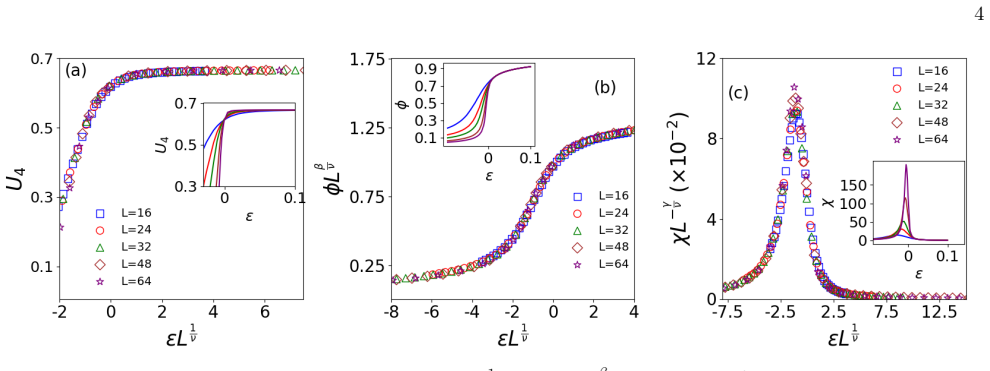
Exactly Solved Models in Statistical Mechanics , J. Baxter, Academic Press, London (1982). arXiv:2412.19664v1 [cond-mat.stat-mech] 27 Dec 2024 2 FIG. 1: From FSS, critical exponents obtained are (a) 1 ν = 1, (b) β ν = 0.125 and (c) γ ν = 1.75 for q = 2 equilibrium dynamics cor...
1982 arXiv
Reviewed August 11, 2026 · model on record in the stance chip above.
Discussion (0). Continue with ORCID to comment.