REVIEW 2 major objections 2 minor 6 cited by
Geometry-Structured Channel Reconstruction for Conventional and Fluid Antenna Systems: Bayesian Inference and Fundamental Limits
T0 review · 2 major / 2 minor · reviewed 2026-06-29 · grok-4.3
Pith's one-line read A Bayesian algorithm reconstructs fluid antenna channels near the fundamental mean square error bound by modeling them with few dominant paths.
desk verdict The paper derives analytical MSE/NMSE bounds for geometry-structured reconstruction in fluid antennas and shows GS-EM-AMP reaching near those bounds in simulations, but the gains rest on an unvalidated few-path model for dense ports. read the letter →
The pith
A machine-rendered reading of the paper's core claim, the machinery that carries it, and where it could break.
The reading
What carries the argument
GS-EM-AMP, the geometry-structured extension of expectation-maximization approximate message passing that incorporates the low-rank path parameterization of port-domain CSI into the message-passing updates and parameter learning steps.
What would settle it
Empirical measurements in which the reconstruction error of GS-EM-AMP exceeds the analytically derived MSE benchmark by a factor larger than the gap expected from finite-sample effects, or in which the observed spatial correlation cannot be explained by a small number of paths.
Extended reading notes
Core claim
The paper derives fundamental MSE and NMSE benchmarks that quantify the intrinsic benefit of geometric modeling over unstructured reconstruction for both conventional antenna systems and fluid antenna systems. It introduces the geometry-structured expectation-maximization approximate message passing (GS-EM-AMP) algorithm, which embeds the parameterization of port-domain CSI by dominant propagation paths into the EM-AMP iteration and adaptively learns unknown statistical parameters from noisy observations, achieving reconstruction accuracy close to the derived bounds with robustness to steering-domain correlation.
Load-bearing premise
The channel observed across different fluid antenna port positions can be accurately represented using only a small number of dominant propagation paths.
Editorial extensions
If this is right
- The derived MSE and NMSE benchmarks serve as analytical references for assessing the value of geometric modeling in channel reconstruction tasks.
- Direct port-wise estimation becomes unnecessary, lowering pilot overhead for large-scale CSI acquisition in fluid antenna systems.
- The method remains effective even when fluid antenna ports induce strong spatial correlation in the steering domain.
- Statistical parameters are learned on the fly, removing the need for accurate prior knowledge of path statistics.
Reading between the lines
- The same path-based parameterization could reduce overhead in other systems that exhibit strong spatial correlation, such as large-scale MIMO arrays.
- Practical deployment would benefit from tests on measured channels to confirm how often the small-path assumption holds outdoors or indoors.
- Combining the reconstruction with joint port selection and beamforming optimization could further improve overall spectral efficiency.
Signed reviews
Editorial analysis
A structured set of objections, weighed in public.
Referee Report
Summary. The paper claims that port-domain CSI in conventional and fluid antenna systems (FAS) can be parameterized by a small number of dominant propagation paths, enabling derivation of fundamental MSE/NMSE benchmarks for geometry-structured vs. unstructured reconstruction; it further proposes the GS-EM-AMP Bayesian algorithm that embeds this structure into EM-AMP, adaptively learns unknown parameters from noisy observations, and achieves near-bound accuracy with robustness to steering-domain correlation.
Significance. If the low-dimensional path parameterization is valid, the analytical benchmarks supply useful external references for quantifying the benefit of geometric modeling, and the GS-EM-AMP framework offers a practical route to low-overhead CSI acquisition in large-scale FAS; the explicit derivation of parameter-free limits (where achieved) would be a notable strength.
major comments (2)
- [Abstract] Abstract: the modeling premise that 'the port-domain CSI can be parameterized by a small number of dominant propagation paths' is asserted without independent validation, sensitivity analysis, or discussion of validity under continuous fluid-port movement or richer scattering; this assumption is load-bearing for both the derived MSE/NMSE benchmarks and the reported near-bound performance of GS-EM-AMP.
- [Abstract] Abstract: the fundamental limits are presented as independent analytical references, yet GS-EM-AMP adaptively learns unknown statistical parameters from the same noisy observations used for reconstruction; this creates a circularity risk that must be resolved by showing the benchmarks remain external to the estimation procedure.
minor comments (2)
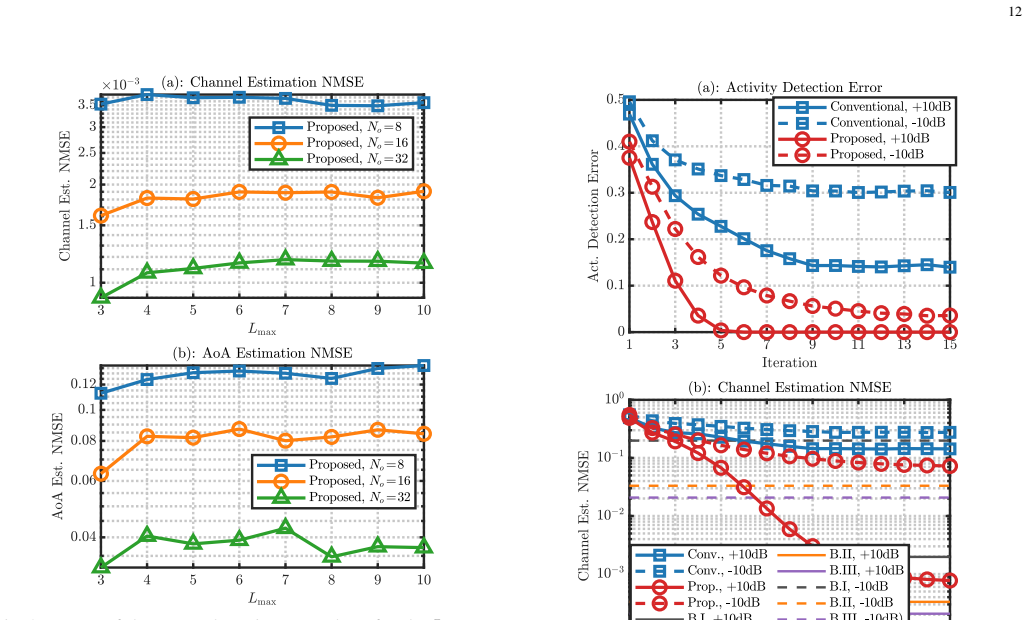
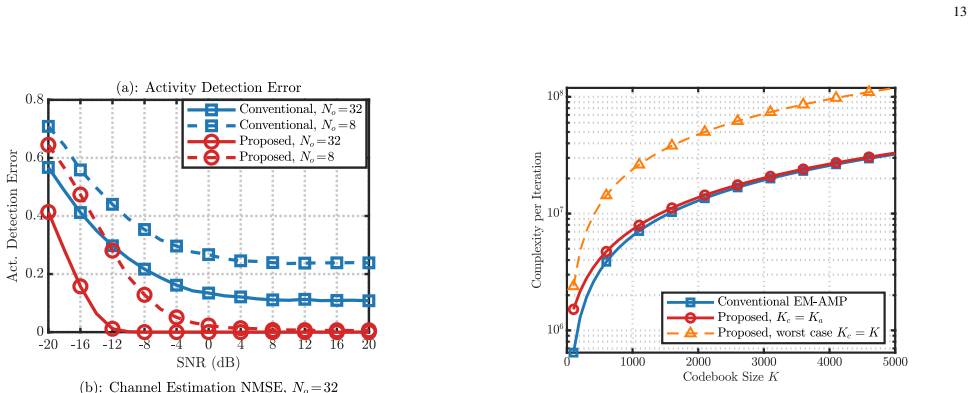
- Numerical results are summarized without details on error-bar computation, data-exclusion rules, or the precise generative model used to obtain the 'near-bound' gaps.
- Notation for the geometry-structured vs. unstructured cases should be introduced with explicit equations early in the manuscript to avoid ambiguity when comparing the two benchmark families.
Simulated Author's Rebuttal
We thank the referee for the constructive comments on our manuscript. We address each major comment point-by-point below with clarifications and indicate planned revisions where appropriate.
read point-by-point responses
-
Referee: [Abstract] Abstract: the modeling premise that 'the port-domain CSI can be parameterized by a small number of dominant propagation paths' is asserted without independent validation, sensitivity analysis, or discussion of validity under continuous fluid-port movement or richer scattering; this assumption is load-bearing for both the derived MSE/NMSE benchmarks and the reported near-bound performance of GS-EM-AMP.
Authors: The premise follows from the standard geometry-based stochastic channel model (GBSM) used throughout the wireless literature for sparse propagation environments. We will add a dedicated paragraph in the introduction citing supporting references and a new subsection in the numerical results section providing sensitivity analysis to the number of paths and scattering richness. We will also include additional simulations demonstrating that the parameterization remains valid under continuous port movement within the fluid aperture by varying port positions and showing consistent reconstruction performance. revision: yes
-
Referee: [Abstract] Abstract: the fundamental limits are presented as independent analytical references, yet GS-EM-AMP adaptively learns unknown statistical parameters from the same noisy observations used for reconstruction; this creates a circularity risk that must be resolved by showing the benchmarks remain external to the estimation procedure.
Authors: The MSE/NMSE benchmarks are derived analytically under the assumption that the true channel statistics (path parameters) are known to the estimator, yielding genie-aided lower bounds for the structured and unstructured cases. GS-EM-AMP operates without this knowledge and learns the parameters jointly via EM. Its near-bound performance therefore demonstrates the value of the learned structure. To eliminate any ambiguity, we will add an explicit remark in the section presenting the benchmarks stating that they assume known parameters and are external to the algorithm; we will also include a brief oracle-algorithm comparison in the simulations. revision: partial
Circularity Check
No significant circularity; derivation is self-contained under stated model
full rationale
The paper derives analytical MSE/NMSE benchmarks from the geometry-structured parameterization (small number of dominant paths) and evaluates GS-EM-AMP under the identical generative model. This is standard consistent analysis rather than circular reduction: the limits are obtained by direct calculation from the model assumptions (not fitted or self-referential), the algorithm learns parameters from observations without renaming a fit as a prediction, and no self-citation chain or ansatz smuggling is required for the central claims. The 'near-bound' result is a model-consistent validation, not an input-output equivalence by construction.
Assumptions & free parameters
free parameters (1)
- unknown statistical parameters
assumptions (1)
- domain assumption The port-domain CSI can be parameterized by a small number of dominant propagation paths.
Cite this review
Pith. "Pith review of Geometry-Structured Channel Reconstruction for Conventional and Fluid Antenna Systems: Bayesian Inference and Fundamental Limits." pith.science (2026). https://pith.science/paper/6M4RKL4D
@misc{pith2026260604001,
  author       = {Pith},
  title        = {Pith review of: Geometry-Structured Channel Reconstruction for Conventional and Fluid Antenna Systems: Bayesian Inference and Fundamental Limits},
  year         = {2026},
  howpublished = {\url{https://pith.science/paper/6M4RKL4D}},
  note         = {Machine review of arXiv:2606.04001}
}
read the original abstract
Accurate channel state information (CSI) acquisition is critical for exploiting the spatial flexibility of fluid antenna systems (FASs). However, port selection and transmission optimization require CSI over a large number of candidate port positions, making direct port-wise estimation prohibitively costly in terms of pilot overhead. This paper addresses this challenge through geometry-structured channel reconstruction, which exploits the fact that the port-domain CSI can be parameterized by a small number of dominant propagation paths. We first establish fundamental mean square error (MSE) and normalized MSE (NMSE) benchmarks for both geometry-structured and unstructured channel reconstruction, providing analytical references for evaluating the intrinsic benefit of geometric modeling in conventional antenna systems and FASs. Motivated by the strong spatial correlation induced by densely distributed fluid antenna ports, we further propose a Bayesian reconstruction framework, termed geometry-structured expectation-maximization approximate message passing (GS-EM-AMP). The proposed algorithm incorporates geometric channel structure into the EM-AMP procedure and adaptively learns unknown statistical parameters from noisy observations. Numerical results demonstrate that GS-EM-AMP achieves near-bound reconstruction accuracy while maintaining strong robustness against steering-domain correlation, thereby offering an efficient and reliable solution for large-scale CSI acquisition in FASs.
Figures


Figures from the paper (4 more)



Forward citations
Cited by 6 Pith papers
-
Electromagnetic-Aware Fluid Antenna Array
An EM-aware current-domain framework for planar fluid antenna arrays enables joint position–current optimization that exploits mutual coupling for lower sidelobes and higher multi-user sum rates in simulation.
-
EM-Guided Graph Learning for Fluid Antenna Beamforming under Current-Domain Constraints
A mutual-impedance-aware graph network that predicts fluid-antenna port layouts and precoders under current-domain constraints comes within about 0.7 bit/s/Hz of an iterative optimizer while cutting configuration late...
-
Modeling and Performance Analysis for Fluid Antenna System Enabled UAV Near-Field Communications
A dynamic port-reconfigurable near-field channel model and a greedy subarray partition scheme enable fluid-antenna UAV-to-ground links to track high-gain ports with lower complexity.
-
Learned Blockwise Port Activation for Real Time Beamforming in Fluid Antenna Arrays
A learned blockwise port-activation scheme for fluid antenna arrays lowers average peak sidelobes by 3.26 dB over uniform sparse activation at a slightly higher simulated sum rate, and by 8–10 dB over channel-driven s...
-
Impedance-Aware Zonal Port Activation for Fluid Antenna Arrays
IA-ZPA selects 64 of 256 fluid-antenna ports at 76.28 bit/s/Hz with -13.66 dB PSLL and 2.73 ms decision time, the best rate among methods meeting the -13.5 dB target.
-
CSI Reconstruction in Fluid Antenna Systems Without Spatial Covariance Priors
Under the Clarke model, fluid antenna channel recovery becomes feasible when the number of observed ports reaches the modal dimension r approximately 2W+1, which is set by aperture, not port count.
Reference graph
Works this paper leans on
-
[1]
An overview of signal processing techniques for millimeter wa ve MIMO systems,
R. W. Heath, N. Gonz´ alez-Prelcic, S. Rangan, W. Roh and A . M. Sayeed, “An overview of signal processing techniques for millimeter wa ve MIMO systems,” IEEE J. Sel. Topics Signal Process. , vol. 10, no. 3, pp. 436-453, April 2016
2016
-
[2]
Super-resolution mmWave c hannel estimation for generalized spatial modulation systems,
H. Chu, L. Zheng, and X. Wang, “Super-resolution mmWave c hannel estimation for generalized spatial modulation systems,” IEEE J. Sel. Topics Signal Process. , vol. 13, no. 6, pp. 1336–1347, Oct. 2019
2019
-
[3]
Unsourced random access u nder quasi-static fading channel: A less-is-more strategy,
Z. Zhang, J. Dang and Z. Zhang, “Unsourced random access u nder quasi-static fading channel: A less-is-more strategy,” IEEE Trans. Wireless Commun. , vol. 25, pp. 3287-3300, 2026
2026
-
[4]
Semi-blind detection in h ybrid massive MIMO systems via low-rank matrix completion,
S. Liang, X. Wang, and L. Ping, “Semi-blind detection in h ybrid massive MIMO systems via low-rank matrix completion,” IEEE Trans. Wireless Commun. , vol. 18, no. 11, pp. 5242–5254, Nov. 2019
2019
-
[5]
Unsourced ra ndom access with uncoupled compressive sensing and forward error correctio n,
Z. Zhang, J. Dang, Z. Zhang, L. Wu and B. Zhu, “Unsourced ra ndom access with uncoupled compressive sensing and forward error correctio n,” IEEE Trans. Veh. Technol., vol. 74, no. 2, pp. 3555-3560, Feb. 2025
2025
-
[6]
Sparsity-exploiting blind receiver algorithms for unsourced multiple access in MIMO and massive MIMO channels,
J. Liu and X. Wang, “Sparsity-exploiting blind receiver algorithms for unsourced multiple access in MIMO and massive MIMO channels,” IEEE Trans. Commun. , vol. 69, no. 12, pp. 8055–8067, Dec. 2021
2021
-
[7]
Effici ent ODMA for unsourced random access in MIMO and hybrid massive MIMO,
Z. Zhang, J. Dang, Y . Qi, Z. Zhang, L. Wu and H. Wang, “Effici ent ODMA for unsourced random access in MIMO and hybrid massive MIMO,” IEEE Internet Things J. , vol. 11, no. 23, pp. 38846-38860, 1 Dec., 2024
2024
-
[8]
Flui d antenna systems,
K. K. Wong, A. Shojaeifard, K.-F. Tong and Y . Zhang, “Flui d antenna systems,” IEEE Trans. Wireless Commun. , vol. 20, no. 3, pp. 1950–1962, Mar. 2021
1950
Show all 16 references
-
[9]
Closed-form exp ressions for spatial correlation parameters for performance analysis of fluid an tenna systems,
K. K. Wong, K. F. Tong, Y . Chen, Y . Zhang, “Closed-form exp ressions for spatial correlation parameters for performance analysis of fluid an tenna systems,” Elect. Lett., vol. 58, no. 11, pp. 454–457, Apr. 2022
2022
-
[10]
Channel estimation for FAS-assisted multius er mmWave systems,
H. Xu, G. Zhou, K.-K. Wong, W. K. New, C. Wang, C.-B. Chae, R. Murch, S. Jin, and Y . Zhang, “Channel estimation for FAS-assisted multius er mmWave systems,” IEEE Commun. Lett. , vol. 28, no. 3, pp. 632-636, March 2024
2024
-
[11]
S parsity-exploiting channel estimation for unsourced random access with fluid an tenna
K. Zhou, K. Zhou, Z. Zhang, J. Dang, Q. Sun and Z. Zhang, “S parsity-exploiting channel estimation for unsourced random access with fluid an tenna”, in Proc. IEEE Veh. Technol. Conf. (VTC2025-Spring) , Oslo, Norway, 2025, pp. 1-7
2025
-
[12]
Sparse bayesia n learning-based channel estimation for fluid antenna systems,
B. Xu, Y . Chen, Q. Cui, X. Tao, K.-K. Wong “Sparse bayesia n learning-based channel estimation for fluid antenna systems,” IEEE Wirel. Commun. Lett. , vol. 14, no. 2, pp. 325-329, Feb. 2025
2025
-
[13]
Joint activity detection and channel estimati on for fluid antenna system exploiting geographical and angular information,
Z. Zhang, J. Dang, D. Morales-Jimenez, H. Jiang, Z. Zhan g, C. Masouros, and C.-B. Chae, “Joint activity detection and channel estimati on for fluid antenna system exploiting geographical and angular information,” IEEE J. Sel. Topics Signal Process., early access, DOI:10.1109/J...
2026 doi
-
[14]
Lea rned-approximate message passing under Karhunen–Lo` eve modeling for fluid an tenna systems,
Y . Wu, Z. Zhang, H. Jiang, K. -K. Wong and C. -B. Chae, “Lea rned-approximate message passing under Karhunen–Lo` eve modeling for fluid an tenna systems,” IEEE Wireless Commun. Lett. , vol. 15, pp. 2719-2723, 2026
2026
-
[15]
Fluid antenna with li near MMSE channel estimation for large-scale cellular networks,
C. Skouroumounis and I. Krikidis “Fluid antenna with li near MMSE channel estimation for large-scale cellular networks,” IEEE Trans. Commun. , vol. 71, no. 2, pp. 1112-1125, Feb. 2023
2023
-
[16]
Expectation-maximization Gaussian-mixture approxi- mate message passing,
J. P . Vila and P . Schniter, “Expectation-maximization Gaussian-mixture approxi- mate message passing,” IEEE Trans. Signal Process., vol. 61, no. 19, pp. 4658-4672, Oct.1, 2013
2013
Reviewed June 29, 2026 · model on record in the stance chip above.
Discussion (0). Continue with ORCID to comment.