Electric Field Optimization of High-Voltage Vacuum Feedthroughs
Pith reviewed 2026-06-27 13:54 UTC · model grok-4.3
The pith
Commercial high-voltage vacuum feedthroughs can be retrofitted by enlarging center conductor diameters to lower electric fields on the vacuum side.
A machine-rendered reading of the paper's core claim, the machinery that carries it, and where it could break.
Core claim
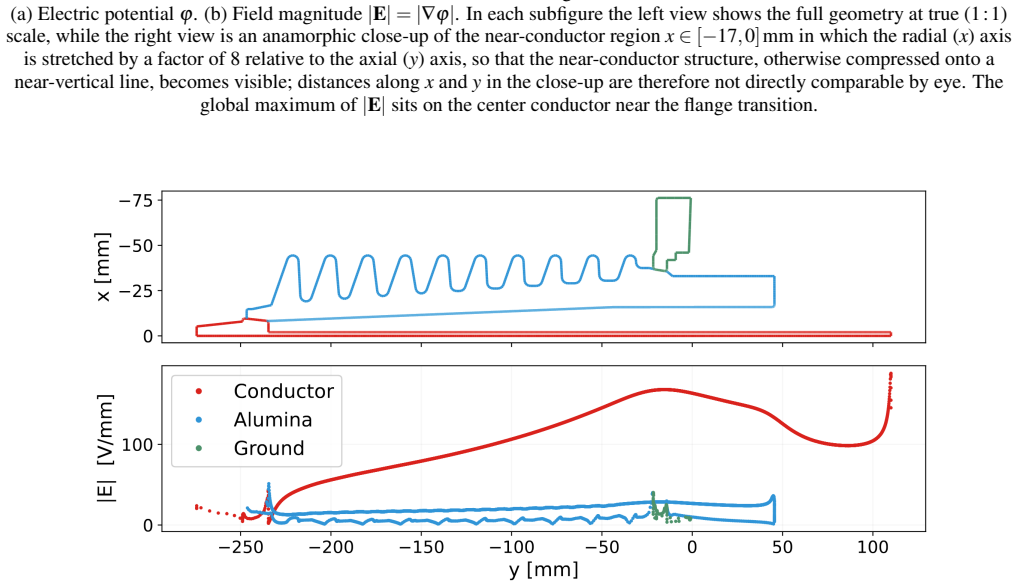
Commercial feedthroughs generally have center conductor diameters which are too small, resulting in unnecessarily large fields. A simple, optimized retrofit for the commercial feedthroughs studied here reduces the field while preserving outgassing properties, as shown through analytical calculations and finite element analysis.
What carries the argument
Analytical calculations and finite element analysis that determine the center conductor diameter minimizing the electric field on the vacuum side of the feedthrough.
If this is right
- The retrofit allows existing commercial feedthroughs to support higher voltages before breakdown.
- Electric fields drop without requiring new feedthrough manufacturing or altered outgassing behavior.
- Performance gains appear specifically when the vacuum side contains a dielectric rather than pure vacuum.
- The optimization applies to the studied commercial models without changing their vacuum integrity.
Where Pith is reading between the lines
- Design standards for other high-voltage vacuum components might benefit from similar diameter adjustments.
- Real-world testing under operating conditions would be required to confirm the simulation results.
- Applications in detectors or accelerators using dielectric-filled regions could see reliability improvements from this change.
Load-bearing premise
The assumption that the analytical calculations and finite element analysis accurately predict real-device performance and that the proposed retrofit preserves outgassing and vacuum integrity.
What would settle it
Direct measurement of breakdown voltage or electric field strength on a retrofitted commercial feedthrough versus an unmodified one in the same dielectric-filled setup.
Figures



read the original abstract
We report on the optimization of high voltage vacuum feedthroughs meant to minimize the electric field on the vacuum side of the device. We find that commercial feedthroughs generally have center conductor diameters which are too small, resulting in unnecessarily large fields. We study the problem with analytical calculations and finite element analysis, and present a simple, optimized retrofit for the commercial feedthroughs studied here, without compromising their outgassing properties. This work is important for applications whereby the ``vacuum side'' of the feedthrough is, in fact, filled with a dielectric which may not have the voltage rigidity of vacuum.
Editorial analysis
A structured set of objections, weighed in public.
Referee Report
Summary. The paper claims that commercial high-voltage vacuum feedthroughs typically have center conductor diameters that are too small, producing unnecessarily high electric fields on the vacuum side. Using analytical calculations and finite element analysis, it identifies an optimized geometry and proposes a simple retrofit for existing commercial units that minimizes these fields while preserving outgassing properties. The work targets applications in which the vacuum side is filled with a dielectric rather than true vacuum.
Significance. If the modeling predictions are borne out in practice, the retrofit approach could provide a low-cost way to improve voltage handling in existing feedthrough installations, particularly in detector or accelerator systems that use dielectrics on the high-voltage side. The combination of closed-form analysis and FEA is a strength, but the absence of any experimental validation of the predicted field values or retrofit integrity substantially limits the immediate applicability of the result.
major comments (2)
- [Abstract] Abstract: the claim that commercial feedthroughs have 'unnecessarily large fields' and that the retrofit 'does not compromise' outgassing or vacuum integrity rests entirely on unvalidated modeling assumptions about geometry, surface conditions, and material behavior; no measured breakdown data, field-probe results, or outgassing-rate comparisons are supplied to test these assumptions.
- [Abstract] Abstract: the central engineering recommendation (retrofit of commercial units) is load-bearing for the paper's practical utility, yet the manuscript provides no quantitative error estimates on the FEA field values, no sensitivity analysis to surface roughness or contact resistance, and no discussion of how the retrofit would be implemented without introducing new vacuum leaks or contamination paths.
Simulated Author's Rebuttal
We thank the referee for the careful review and constructive comments. We address the major comments point by point below.
read point-by-point responses
-
Referee: [Abstract] Abstract: the claim that commercial feedthroughs have 'unnecessarily large fields' and that the retrofit 'does not compromise' outgassing or vacuum integrity rests entirely on unvalidated modeling assumptions about geometry, surface conditions, and material behavior; no measured breakdown data, field-probe results, or outgassing-rate comparisons are supplied to test these assumptions.
Authors: We agree that the abstract overstates the strength of the conclusions. The claims rest on modeling assumptions, and the manuscript contains no experimental data. We will revise the abstract to qualify all statements as modeling predictions, remove the phrasing that the retrofit 'does not compromise' outgassing properties, and add an explicit statement that experimental validation is absent and required for practical application. revision: yes
-
Referee: [Abstract] Abstract: the central engineering recommendation (retrofit of commercial units) is load-bearing for the paper's practical utility, yet the manuscript provides no quantitative error estimates on the FEA field values, no sensitivity analysis to surface roughness or contact resistance, and no discussion of how the retrofit would be implemented without introducing new vacuum leaks or contamination paths.
Authors: We accept these criticisms. The current manuscript lacks the requested quantitative details and implementation discussion. In revision we will add mesh-convergence error estimates for the FEA results, a sensitivity study on surface roughness and contact resistance, and a dedicated subsection describing a practical retrofit procedure that addresses vacuum sealing and contamination risks. revision: yes
- Experimental validation of the predicted field reductions, breakdown voltages, and outgassing rates, which would require physical testing outside the scope of this modeling paper.
Circularity Check
No circularity; derivation uses standard external electrostatic methods
full rationale
The paper applies analytical electrostatic calculations and finite element analysis to commercial feedthrough geometries to identify field concentrations from small center-conductor diameters and to propose a retrofit. These steps rest on well-established Maxwell-equation solvers and boundary conditions external to the paper; no fitted parameters are renamed as predictions, no self-citations are invoked as uniqueness theorems, and no ansatz is smuggled in. The abstract and described workflow contain no self-definitional loops or load-bearing self-references, so the central claim remains independent of its own outputs.
Axiom & Free-Parameter Ledger
axioms (1)
- standard math Standard electrostatic equations govern the electric field in the feedthrough geometry
Reference graph
Works this paper leans on
-
[1]
, title =
Slade, Paul G. , title =. 2008 , address =
2008
-
[2]
Elmer finite element solver for multiphysics and multiscale problems , booktitle =
Malinen, Mika and R. Elmer finite element solver for multiphysics and multiscale problems , booktitle =. 2013 , pages =
2013
-
[3]
International Journal for Numerical Methods in Engineering , volume =
Geuzaine, Christophe and Remacle, Jean-Fran. International Journal for Numerical Methods in Engineering , volume =
-
[4]
1999 , address =
Jackson, John David , title =. 1999 , address =
1999
-
[5]
and others , title =
Aprile, E. and others , title =. European Physical Journal C , volume =
-
[6]
and others , title =
Akerib, D.\ S. and others , title =. Nuclear Instruments and Methods in Physics Research A , volume =
-
[7]
and Doke, T
Aprile, E. and Doke, T. , title =. Reviews of Modern Physics , volume =
-
[8]
VTT Tiedotteita -- Research Notes , volume =
Auerkari, Pertti , title =. VTT Tiedotteita -- Research Notes , volume =. 1996 , publisher =
1996
-
[9]
Science China Physics, Mechanics & Astronomy , volume =
Cao, XiGuang and others , title =. Science China Physics, Mechanics & Astronomy , volume =
-
[10]
Twentyman, M. E. , title =. Journal of Materials Science , volume =. 1975 , doi =
1975
-
[11]
and others , title =
Mathot, S. and others , title =. 2002 , url =
2002
-
[12]
and others , title =
Beck, D. and others , title =. Nature Communications , volume =. 2025 , doi =
2025
-
[13]
, title =
Schwartz, Mel M. , title =. 2003 , isbn =
2003
-
[14]
, title =
Weterings, W. , title =. 2002 , url =
2002
-
[15]
Nature Communications , volume =
Borghei, Moein and others , title =. Nature Communications , volume =. 2025 , doi =
2025
-
[16]
and others , title =
Xu, J. and others , title =. Phys. Rev. D , volume =. 2019 , doi =
2019
-
[17]
and Boumous, Z
Boumous, S. and Boumous, Z. and Fellah, M. and Habeeb, M. A. and Montage, A. and El-Hiti, G. A. and Abdelkawy, M. A. and Ahmed, A. M. , title =. Journal of Materials Science: Materials in Electronics , year =
-
[18]
Acciarri, R. and others , collaboration =. Design and. Journal of Instrumentation , volume =. 2017 , doi =. 1612.05824 , archivePrefix =
-
[19]
and others , collaboration =
Amerio, S. and others , collaboration =. Design,. Nuclear Instruments and Methods in Physics Research A , volume =. 2004 , doi =
2004
-
[20]
Abi, B. and others , collaboration =. Volume. Journal of Instrumentation , volume =. 2020 , doi =. 2002.03010 , archivePrefix =
-
[21]
, collaboration =
Peleganchuk, S. , collaboration =. Liquid noble gas calorimeters at. Nuclear Instruments and Methods in Physics Research A , volume =. 2009 , doi =
2009
-
[22]
Hertel, S. A. and Biekert, A. and Lin, J. and Velan, V. and McKinsey, D. N. , title =. Phys. Rev. D , volume =. 2019 , doi =
2019
-
[23]
Bandler, S. R. and Lanou, R. E. and Maris, H. J. and More, T. and Porter, F. S. and Seidel, G. M. and Torii, R. H. , title =. Phys. Rev. Lett. , volume =. 1992 , doi =
1992
-
[24]
author author M. M. \ Schwartz ,\ @noop title Brazing ,\ edition 2nd \ ed.\ ( publisher ASM International ,\ address Materials Park, OH ,\ year 2003 ) NoStop
2003
-
[25]
Weterings ,\ https://cds.cern.ch/record/702711 title Improvement in the Design of Metal-Ceramic Brazed Assemblies for High-Voltage Applications ,\ type Tech
author author W. Weterings ,\ https://cds.cern.ch/record/702711 title Improvement in the Design of Metal-Ceramic Brazed Assemblies for High-Voltage Applications ,\ type Tech. Rep. \ number SL-Note-2002-031 \ ( institution CERN ,\ year 2002 ) NoStop
2002
-
[26]
Aprile et al
author author E. Aprile et al. ,\ @noop journal journal European Physical Journal C \ volume 77 ,\ pages 881 ( year 2017 ) NoStop
2017
-
[27]
author author D. S. \ Akerib et al. ,\ @noop journal journal Nuclear Instruments and Methods in Physics Research A \ volume 953 ,\ pages 163047 ( year 2020 ) NoStop
2020
-
[28]
Cao et al
author author X. Cao et al. ,\ @noop journal journal Science China Physics, Mechanics & Astronomy \ volume 54 ,\ pages 1476 ( year 2014 ) NoStop
2014
-
[29]
author author R. Acciarri et al. ( collaboration MicroBooNE Collaboration ),\ 10.1088/1748-0221/12/02/P02017 journal journal Journal of Instrumentation \ volume 12 ,\ pages P02017 ( year 2017 ) ,\ http://arxiv.org/abs/1612.05824 arXiv:1612.05824 [physics.ins-det] NoStop
-
[30]
author author S. Amerio et al. ( collaboration ICARUS Collaboration ),\ 10.1016/j.nima.2004.02.044 journal journal Nuclear Instruments and Methods in Physics Research A \ volume 527 ,\ pages 329 ( year 2004 ) NoStop
-
[31]
author author B. Abi et al. ( collaboration DUNE Collaboration ),\ 10.1088/1748-0221/15/08/T08010 journal journal Journal of Instrumentation \ volume 15 ,\ pages T08010 ( year 2020 ) ,\ http://arxiv.org/abs/2002.03010 arXiv:2002.03010 [physics.ins-det] NoStop
-
[32]
author author S. Peleganchuk ( collaboration KEDR and CMD-3 Collaborations ),\ 10.1016/j.nima.2008.08.086 journal journal Nuclear Instruments and Methods in Physics Research A \ volume 598 ,\ pages 248 ( year 2009 ) NoStop
-
[33]
author author S. A. \ Hertel , author A. Biekert , author J. Lin , author V. Velan , \ and\ author D. N. \ McKinsey ,\ 10.1103/PhysRevD.100.092007 journal journal Phys. Rev. D \ volume 100 ,\ pages 092007 ( year 2019 ) NoStop
-
[34]
author author S. R. \ Bandler , author R. E. \ Lanou , author H. J. \ Maris , author T. More , author F. S. \ Porter , author G. M. \ Seidel , \ and\ author R. H. \ Torii ,\ 10.1103/PhysRevLett.68.2429 journal journal Phys. Rev. Lett. \ volume 68 ,\ pages 2429 ( year 1992 ) NoStop
-
[35]
author author J. D. \ Jackson ,\ @noop title Classical Electrodynamics ,\ edition 3rd \ ed.\ ( publisher Wiley ,\ address New York ,\ year 1999 ) NoStop
1999
-
[36]
author author J. Xu et al. ,\ 10.1103/PhysRevD.99.103024 journal journal Phys. Rev. D \ volume 99 ,\ pages 103024 ( year 2019 ) NoStop
-
[37]
author author S. Boumous , author Z. Boumous , author M. Fellah , author M. A. \ Habeeb , author A. Montage , author G. A. \ El-Hiti , author M. A. \ Abdelkawy , \ and\ author A. M. \ Ahmed ,\ 10.1007/s10854-025-15000-w journal journal Journal of Materials Science: Materials in Electronics \ ( year 2025 ),\ 10.1007/s10854-025-15000-w NoStop
-
[38]
Malinen \ and\ author P
author author M. Malinen \ and\ author P. R back ,\ in\ @noop booktitle Multiscale Modelling Methods for Applications in Material Science ,\ series IAS Series , Vol. volume 19 ,\ editor edited by\ editor I. Kondov \ and\ editor G. Sutmann \ ( publisher Forschungszentrum J\"ulich ,\ year 2013 )\ pp.\ pages 101--113 NoStop
2013
-
[39]
Geuzaine \ and\ author J.-F
author author C. Geuzaine \ and\ author J.-F. \ Remacle ,\ @noop journal journal International Journal for Numerical Methods in Engineering \ volume 79 ,\ pages 1309 ( year 2009 ) NoStop
2009
-
[40]
note Wire EDM performed by Spencer Corporation, Santa Clara, CA. Stop
discussion (0)
Sign in with ORCID, Apple, or X to comment. Anyone can read and Pith papers without signing in.