Analytical calculation of the observational parameters for tachyon inflation
Pith reviewed 2026-06-28 21:19 UTC · model grok-4.3
The pith
A linear dependence between the first two slow-roll Hubble flow parameters permits analytical expressions for the scalar spectral index and tensor-to-scalar ratio in tachyon inflation.
A machine-rendered reading of the paper's core claim, the machinery that carries it, and where it could break.
Core claim
For tachyon inflation with Hubble rate given as a function of the tachyon field, introducing a linear dependence between the first two slow-roll Hubble flow parameters as an input allows explicit analytical calculation of the scalar spectral index ns and the tensor-to-scalar ratio r for a class of such functions, with the resulting values being consistent with Planck observational constraints.
What carries the argument
Linear dependence between the first two slow-roll Hubble flow parameters, introduced to facilitate analytical study of the inflationary dynamics.
If this is right
- Explicit analytical formulas for ns and r are obtained for the chosen Hubble rate functions.
- New test functions achieve better agreement with recent Planck data than previous ones.
- The analytical predictions align with numerical results for the models.
- The linear dependence can be tested against data from ACT DR6, DESI and similar surveys.
Where Pith is reading between the lines
- If the linear dependence is a general feature, similar analytical methods could apply to other scalar field inflation models.
- Generalizing the dependence to higher slow-roll parameters might extend the analytical reach further.
- Such assumptions could help in constructing more tractable inflationary models that still fit observations.
Load-bearing premise
The assumption that the first two slow-roll Hubble flow parameters are linearly related is a valid description of the dynamics in these tachyon inflation models.
What would settle it
A significant mismatch between the analytically predicted values of ns and r and the constraints from Planck or newer cosmological surveys for the proposed Hubble rate functions would indicate the assumption does not hold.
Figures



read the original abstract
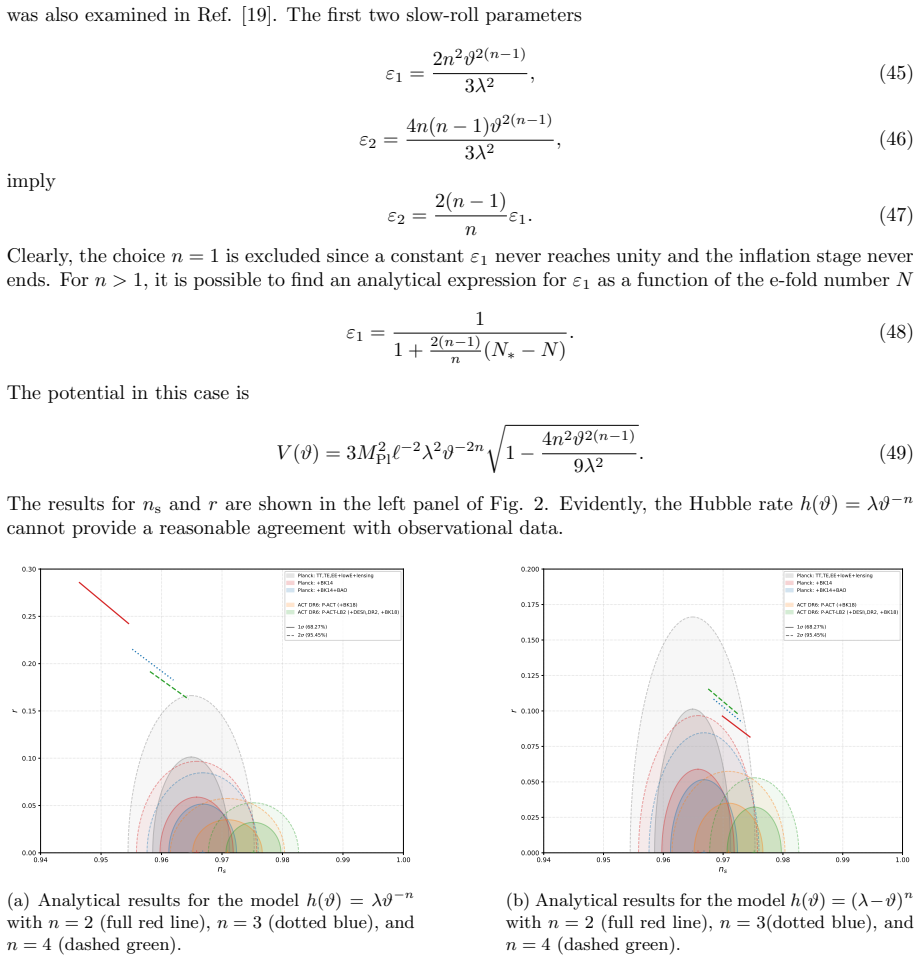
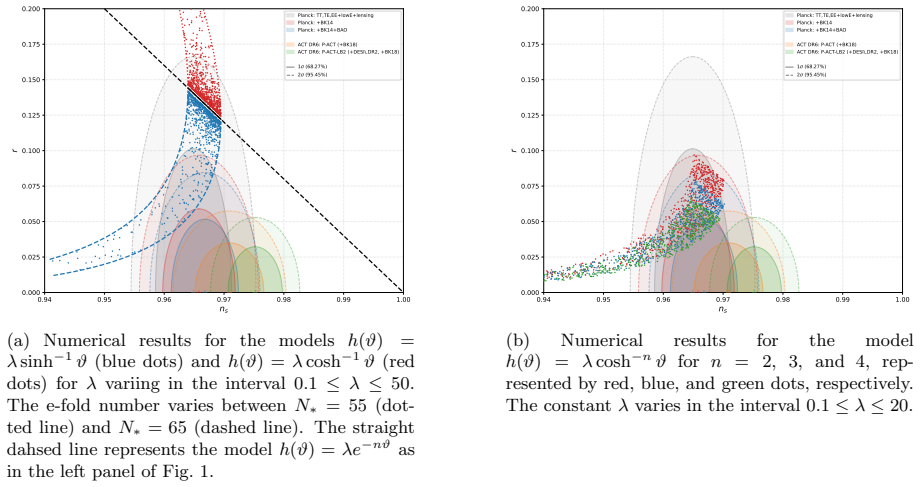
We investigate the possibility of analytically calculating observational parameters in tachyon inflation cosmology, using the Hubble expansion rate as a function of the tachyon field. First, in light of the newer Planck results, we analyze previous investigations in which the test Hubble rate functions were confronted with Planck 2013 data. We propose and analyze a number of new test Hubble rate functions, finding considerable improvement and approaching reasonable agreement with recent observational data. For a class of these functions, we were able to carry out analytical calculations. As a novelty, we introduce a functional dependence of the slow-roll Hubble flow parameters as an input, which facilitates an analytical study of inflation. In this way, we obtain explicit expressions for the scalar spectral index ($n_{\rm s}$) and the tensor-to-scalar ratio ($r$). We confront our analytical and numerical predictions with Planck observational constraints. Finally, we discuss the proposed linear dependence between the first two slow-roll parameters in light of recent data from ACT DR6, DESI, and others, as well as the potential to generalize this dependence to other inflation models.
Editorial analysis
A structured set of objections, weighed in public.
Referee Report
Summary. The paper investigates tachyon inflation using Hubble rate functions H(φ) as input. It reanalyzes prior test functions against Planck 2013 data, proposes new functions with improved agreement, introduces a linear relation ε₂ = a + b ε₁ between the first two slow-roll Hubble flow parameters as a novelty to enable analytical derivations, obtains explicit expressions for the scalar spectral index n_s and tensor-to-scalar ratio r, and compares both analytical and numerical results to Planck constraints while discussing the linear relation against ACT DR6 and DESI data.
Significance. If the imposed linear relation between slow-roll parameters is shown to be consistent with the tachyon dynamics for the chosen H(φ), the explicit analytical expressions for n_s and r would constitute a useful technical advance for this class of models. The manuscript explicitly credits the functional dependence as the enabling step for analytics.
major comments (2)
- [Abstract] Abstract: the linear dependence ε₂ = a + b ε₁ is introduced as an input to derive explicit n_s and r, but the manuscript provides no demonstration that this relation follows from the tachyon equation of motion or is satisfied by the reconstructed potential for the proposed test Hubble rate functions; this assumption is load-bearing for the central claim of analytical predictions in tachyon inflation.
- [Abstract] Abstract: the reported confrontation with Planck data claims improvement over 2013 results but supplies neither error bars on the derived n_s and r, explicit derivation steps for the analytical expressions, nor the data exclusion rules used, preventing verification of the quantitative agreement.
Simulated Author's Rebuttal
We thank the referee for the detailed and constructive report. We address each major comment below and will revise the manuscript to strengthen the presentation of the linear relation and the data comparison.
read point-by-point responses
-
Referee: [Abstract] Abstract: the linear dependence ε₂ = a + b ε₁ is introduced as an input to derive explicit n_s and r, but the manuscript provides no demonstration that this relation follows from the tachyon equation of motion or is satisfied by the reconstructed potential for the proposed test Hubble rate functions; this assumption is load-bearing for the central claim of analytical predictions in tachyon inflation.
Authors: The linear relation is introduced explicitly as a phenomenological input that enables closed-form expressions for n_s and r for a subclass of the test Hubble functions. For the specific H(φ) forms we propose, the relation holds to good accuracy over the relevant range of the slow-roll parameters (as can be verified by direct substitution into the tachyon equation of motion and numerical integration). We will add an appendix that (i) derives the condition under which the linear relation is consistent with the tachyon dynamics for a general H(φ), (ii) verifies it numerically for each new test function, and (iii) shows the reconstructed potential. This will make the assumption transparent and demonstrate its validity for the models under study. revision: yes
-
Referee: [Abstract] Abstract: the reported confrontation with Planck data claims improvement over 2013 results but supplies neither error bars on the derived n_s and r, explicit derivation steps for the analytical expressions, nor the data exclusion rules used, preventing verification of the quantitative agreement.
Authors: We agree that the abstract and main text would benefit from additional detail on the observational comparison. In the revised manuscript we will: (i) quote the explicit analytical expressions for n_s and r together with the intermediate steps in a dedicated appendix, (ii) report the numerical values with 1σ uncertainties obtained from the slow-roll parameters at horizon exit, and (iii) state the precise Planck 2018 likelihoods and contour levels used, together with the exclusion criteria applied to the parameter space. These additions will allow direct reproduction of the reported agreement. revision: yes
Circularity Check
No significant circularity in the derivation chain
full rationale
The paper explicitly introduces the linear functional dependence between the first two slow-roll Hubble flow parameters as a novel input assumption ('As a novelty, we introduce a functional dependence of the slow-roll Hubble flow parameters as an input, which facilitates an analytical study of inflation. In this way, we obtain explicit expressions for the scalar spectral index (ns) and the tensor-to-scalar ratio (r)'). This assumption, together with chosen test Hubble rate functions H(φ), enables derivation of analytical expressions for ns and r that are then compared to Planck data (alongside separate numerical results). The test functions are proposed to improve agreement with observations, but the central results are conditional on the stated inputs rather than reducing to them by construction. No self-citation load-bearing steps, uniqueness theorems, or renamings of known results are present. The derivation chain is self-contained with transparent modeling assumptions, as is standard in inflationary phenomenology.
Axiom & Free-Parameter Ledger
free parameters (2)
- parameters inside chosen Hubble rate functions
- slope and intercept of linear slow-roll parameter relation
axioms (2)
- domain assumption slow-roll approximation remains valid throughout inflation
- domain assumption tachyon field dynamics can be captured by a Hubble rate function of the field alone
Reference graph
Works this paper leans on
-
[1]
A. H. Guth, Phys. Rev. D23(1981), 347-356 doi:10.1103/PhysRevD.23.347 13
-
[2]
S. D. Odintsov, V. K. Oikonomou, I. Giannakoudi, F. P. Fronimos and E. C. Lymperiadou, Symmetry 15, no.9, 1701 (2023) doi:10.3390/sym15091701 [arXiv:2307.16308 [gr-qc]]
-
[3]
A. Sen, JHEP07, 065 (2002) doi:10.1088/1126-6708/2002/07/065 [arXiv:hep-th/0203265 [hep-th]]
work page internal anchor Pith review Pith/arXiv arXiv doi:10.1088/1126-6708/2002/07/065 2002
-
[4]
A. Sen, JHEP04, 048 (2002) doi:10.1088/1126-6708/2002/04/048 [arXiv:hep-th/0203211 [hep-th]]
work page internal anchor Pith review Pith/arXiv arXiv doi:10.1088/1126-6708/2002/04/048 2002
-
[5]
A. Sen, Mod. Phys. Lett. A17, 1797-1804 (2002) doi:10.1142/S0217732302008071 [arXiv:hep- th/0204143 [hep-th]]
-
[6]
G. W. Gibbons, Phys. Lett. B537(2002), 1-4 doi:10.1016/S0370-2693(02)01881-6 [arXiv:hep- th/0204008 [hep-th]]
-
[7]
A. Feinstein, Phys. Rev. D66(2002), 063511 doi:10.1103/PhysRevD.66.063511 [arXiv:hep- th/0204140 [hep-th]]
-
[8]
M. Sami, P. Chingangbam and T. Qureshi, Phys. Rev. D66(2002), 043530 doi:10.1103/PhysRevD.66.043530 [arXiv:hep-th/0205179 [hep-th]]
work page internal anchor Pith review Pith/arXiv arXiv doi:10.1103/physrevd.66.043530 2002
-
[9]
L. Kofman and A. D. Linde, JHEP07(2002), 004 doi:10.1088/1126-6708/2002/07/004 [arXiv:hep- th/0205121 [hep-th]]
-
[10]
A. V. Frolov, L. Kofman and A. A. Starobinsky, Phys. Lett. B545(2002), 8-16 doi:10.1016/S0370- 2693(02)02582-0 [arXiv:hep-th/0204187 [hep-th]]
work page internal anchor Pith review Pith/arXiv arXiv doi:10.1016/s0370- 2002
-
[11]
G. W. Gibbons, Class. Quant. Grav.20(2003), S321-S346 doi:10.1088/0264-9381/20/12/301 [arXiv:hep-th/0301117 [hep-th]]
work page internal anchor Pith review Pith/arXiv arXiv doi:10.1088/0264-9381/20/12/301 2003
-
[12]
D. A. Steer and F. Vernizzi, Phys. Rev. D70(2004), 043527 doi:10.1103/PhysRevD.70.043527 [arXiv:hep-th/0310139 [hep-th]]
work page internal anchor Pith review Pith/arXiv arXiv doi:10.1103/physrevd.70.043527 2004
-
[13]
Inflation from a Tachyon Fluid?
M. Fairbairn and M. H. G. Tytgat, Phys. Lett. B546(2002), 1-7 doi:10.1016/S0370-2693(02)02638-2 [arXiv:hep-th/0204070 [hep-th]]
work page internal anchor Pith review Pith/arXiv arXiv doi:10.1016/s0370-2693(02)02638-2 2002
-
[14]
Particle creation and reheating in a braneworld inflationary scenario
N. Bilic, S. Domazet and G. S. Djordjevic, Phys. Rev. D96(2017) no.8, 083518 doi:10.1103/PhysRevD.96.083518 [arXiv:1707.06023 [hep-th]]
work page internal anchor Pith review Pith/arXiv arXiv doi:10.1103/physrevd.96.083518 2017
-
[15]
A. R. Liddle, P. Parsons and J. D. Barrow, Phys. Rev. D50, 7222-7232 (1994) doi:10.1103/PhysRevD.50.7222 [arXiv:astro-ph/9408015 [astro-ph]]
work page internal anchor Pith review Pith/arXiv arXiv doi:10.1103/physrevd.50.7222 1994
-
[16]
A. R. Liddle and D. H. Lyth, Cosmological Inflation and Large-Scale Structure, Cambridhe Univer- sity Press, Cambridge, 2000
2000
-
[17]
D. H. Lyth and A. R. Liddle, The Primordial Density Perturbation, Cambridhe University Press, Cambridge, 2009
2009
-
[18]
N. Videla, Eur. Phys. J. C77, no.3, 142 (2017) doi:10.1140/epjc/s10052-017-4711-2 [arXiv:1612.04124 [gr-qc]]
work page internal anchor Pith review Pith/arXiv arXiv doi:10.1140/epjc/s10052-017-4711-2 2017
-
[19]
Hamilton-Jacobi Formalism for Tachyon Inflation
A. Aghamohammadi, A. Mohammadi, T. Golanbari and K. Saaidi, Phys. Rev. D90(2014) no.8, 084028 doi:10.1103/PhysRevD.90.084028 [arXiv:1502.07578 [gr-qc]]
work page internal anchor Pith review Pith/arXiv arXiv doi:10.1103/physrevd.90.084028 2014
-
[20]
Viscous Warm Inflation: Hamilton-Jacobi formalism
L. Akhtari, A. Mohammadi, K. Sayar and K. Saaidi, Astropart. Phys.90, 28-36 (2017) doi:10.1016/j.astropartphys.2017.02.002 [arXiv:1710.05793 [astro-ph.CO]]
work page internal anchor Pith review Pith/arXiv arXiv doi:10.1016/j.astropartphys.2017.02.002 2017
-
[21]
Hamilton-Jacobi formalism to warm inflationary scenario
K. Sayar, A. Mohammadi, L. Akhtari and K. Saaidi, Phys. Rev. D95(2017) no.2, 023501 doi:10.1103/PhysRevD.95.023501 [arXiv:1708.01714 [gr-qc]]
work page internal anchor Pith review Pith/arXiv arXiv doi:10.1103/physrevd.95.023501 2017
-
[22]
Hamilton-Jacobi formalism for inflation with non-minimal derivative coupling
H. Sheikhahmadi, E. N. Saridakis, A. Aghamohammadi and K. Saaidi, JCAP10(2016), 021 doi:10.1088/1475-7516/2016/10/021 [arXiv:1603.03883 [gr-qc]]
work page internal anchor Pith review Pith/arXiv arXiv doi:10.1088/1475-7516/2016/10/021 2016
-
[23]
R. J. Yang and M. Liu, Phys. Dark Univ.46, 101560 (2024) doi:10.1016/j.dark.2024.101560 [arXiv:2306.09843 [gr-qc]]
- [24]
-
[26]
D. D. Dimitrijevic, N. Bili´ c, G. S. Djordjevic, M. Milosevic and M. Stojanovic, Int. J. Mod. Phys. A33, no.34, 1845017 (2018) doi:10.1142/S0217751X18450173
-
[27]
Tachyon with an inverse power-law potential in a braneworld cosmology
N. Bili´ c, S. Domazet and G. Djordjevic, Class. Quant. Grav.34, no.16, 165006 (2017) doi:10.1088/1361-6382/aa7e0f [arXiv:1704.01072 [gr-qc]]
work page internal anchor Pith review Pith/arXiv arXiv doi:10.1088/1361-6382/aa7e0f 2017
-
[28]
Tachyon inflation in an AdS braneworld with back-reaction
N. Bilic, D. Dimitrijevic, G. Djordjevic and M. Milosevic, Int. J. Mod. Phys. A32, no.05, 1750039 (2017) doi:10.1142/S0217751X17500397 [arXiv:1607.04524 [gr-qc]]
work page internal anchor Pith review Pith/arXiv arXiv doi:10.1142/s0217751x17500397 2017
-
[29]
N. Bili´ c, D. D. Dimitrijevi´ c, G. S. Djordjevic, M. Miloˇ sevi´ c and M. Stojanovi´ c, Universe11(2025) no.4, 128 doi:10.3390/universe11040128 [arXiv:2502.06456 [gr-qc]]
-
[30]
M. Stojanovic, N. Bilic, D. D. Dimitrijevic, G. S. Djordjevic and M. Milosevic, Class. Quant. Grav. 41(2024) no.16, 165013 doi:10.1088/1361-6382/ad6058 [arXiv:2401.00352 [gr-qc]]
-
[31]
M. Stojanovic, N. Bilic, D. D. Dimitrijevic, G. S. Djordjevic and M. Milosevic, Int. J. Mod. Phys. A38(2023) no.32, 2343003 doi:10.1142/S0217751X23430030 [arXiv:2306.02423 [gr-qc]]
-
[32]
N. Bilic, D. D. Dimitrijevic, G. S. Djordjevic, M. Milosevic and M. Stojanovic, JCAP08(2019), 034 doi:10.1088/1475-7516/2019/08/034 [arXiv:1809.07216 [gr-qc]]
-
[33]
Planck 2018 results. X. Constraints on inflation
Y. Akramiet al.[Planck], Astron. Astrophys.641, A10 (2020) doi:10.1051/0004-6361/201833887 [arXiv:1807.06211 [astro-ph.CO]]
work page internal anchor Pith review Pith/arXiv arXiv doi:10.1051/0004-6361/201833887 2020
-
[34]
The Atacama Cosmology Telescope: DR6 Power Spectra, Likelihoods and $\Lambda$CDM Parameters
T. Louiset al.[Atacama Cosmology Telescope], JCAP11, 062 (2025) doi:10.1088/1475- 7516/2025/11/062 [arXiv:2503.14452 [astro-ph.CO]]
work page internal anchor Pith review Pith/arXiv arXiv doi:10.1088/1475- 2025
-
[35]
A. G. Adameet al.[DESI], JCAP02, 021 (2025) doi:10.1088/1475-7516/2025/02/021 [arXiv:2404.03002 [astro-ph.CO]]
work page internal anchor Pith review Pith/arXiv arXiv doi:10.1088/1475-7516/2025/02/021 2025
-
[36]
On attractor be- havior in braneworld constant-roll inflation,
G. S. Djordjevic, N. Bili´ c, D. D. Dimitrijevic, M. Milosevic and M. Stojanovic, “On attractor be- havior in braneworld constant-roll inflation,” inProceedings of the 3rd Conference on Nonlinearity, Belgrade, Serbia, Sep. 4–8, 2023, pp. 73–86, arXiv:2405.18420 [gr-qc]
arXiv 2023
-
[37]
P. A. R. Adeet al.[Planck], Astron. Astrophys.594, A20 (2016) doi:10.1051/0004-6361/201525898 [arXiv:1502.02114 [astro-ph.CO]]
work page internal anchor Pith review Pith/arXiv arXiv doi:10.1051/0004-6361/201525898 2016
-
[38]
P. A. R. Adeet al.[BICEP2], Phys. Rev. Lett.112, no.24, 241101 (2014) doi:10.1103/PhysRevLett.112.241101 [arXiv:1403.3985 [astro-ph.CO]]
work page internal anchor Pith review Pith/arXiv arXiv doi:10.1103/physrevlett.112.241101 2014
-
[39]
T. Padmanabhan, Phys. Rev. D66, 021301 (2002) doi:10.1103/PhysRevD.66.021301 [arXiv:hep- th/0204150 [hep-th]]
-
[40]
I. E. S. G. and O. P. Santillan, [arXiv:1508.03376 [gr-qc]]
-
[41]
Theoretical and observational constraints on Tachyon Inflation
N. Barbosa-Cendejas, J. De-Santiago, G. German, J. C. Hidalgo and R. R. Mora-Luna, JCAP03 (2018), 015 doi:10.1088/1475-7516/2018/03/015 [arXiv:1711.06693 [astro-ph.CO]]
work page internal anchor Pith review Pith/arXiv arXiv doi:10.1088/1475-7516/2018/03/015 2018
- [42]
-
[43]
Z. Yi, Y. Gong and M. Sabir, Phys. Rev. D98(2018) no.8, 083521 doi:10.1103/PhysRevD.98.083521 [arXiv:1804.09116 [gr-qc]]
work page internal anchor Pith review Pith/arXiv arXiv doi:10.1103/physrevd.98.083521 2018
-
[44]
F. Lucchin and S. Matarrese, Phys. Rev. D32(1985), 1316 doi:10.1103/PhysRevD.32.1316
-
[45]
Q. Gao, Y. Gong and Q. Fei, JCAP05, 005 (2018) doi:10.1088/1475-7516/2018/05/005 [arXiv:1801.09208 [gr-qc]]. 15
work page internal anchor Pith review Pith/arXiv arXiv doi:10.1088/1475-7516/2018/05/005 2018
discussion (0)
Sign in with ORCID, Apple, or X to comment. Anyone can read and Pith papers without signing in.