REVIEW 6 major objections 5 minor 9 references
The emergence of the relativistic Lagrangian from the non-relativistic multiplicative Lagrangian
T0 review · 6 major / 5 minor · reviewed 2026-08-15 · deepseek-v4-flash
Pith's one-line read The relativistic Lagrangian and Hamiltonian of a free particle arise as a statistical average of non-relativistic multiplicative Lagrangians.
desk verdict The central averaging identities are algebraically and dimensionally wrong, and the β-distribution is reverse-engineered, so the claimed emergence of relativistic dynamics does not hold up as written. read the letter →
The pith
A machine-rendered reading of the paper's core claim, the machinery that carries it, and where it could break.
The reading
What carries the argument
The load-bearing object is the multiplicative Lagrangian, a non-standard Lagrangian written as a product of a velocity-dependent factor and a position-dependent factor, $L_\lambda = m\lambda^2\left(e^{-\dot{x}^2/2\lambda^2} + \frac{\dot{x}}{\lambda^2}\int_0^{\dot{x}} e^{-v^2/2\lambda^2} dv\right)e^{-V/m\lambda^2}$, which reproduces the same equation of motion as the standard non-relativistic Lagrangian because the exponential prefactor never vanishes. Rescaling the free-particle version by $\lambda \to \beta\lambda$ creates the family $L_{\beta\lambda}$; introducing the normalized distribution $\rho(\beta) = \frac{2}{\sqrt{\pi}}e^{-1/\beta^2}/\beta^4$ and integrating over $\beta$ collapses the family into $L_c = -mc^2/\gamma$ when $\lambda^2 = c^2/2$. The same weighting converts the multiplicative Hamiltonian $H_\lambda = m\lambda^2 e^{H_N/m\lambda^2}$ into $H_c = mc^2\gamma$. The mechanism is a statistical average over an auxiliary parameter that labels equivalent classical descriptions, and the chosen weighting is what turns the parameter dependence into the relativistic factor.
What would settle it
Evaluate the free-particle average in Eq. (3.4) with any normalized distribution $\rho(\beta)$ different from Eq. (3.3), for instance a Gaussian centered at $\beta=1$ with finite width; the result will not equal $-mc^2/\gamma$ and the averaged equation of motion will not be $m\ddot{x}\gamma^3=0$, which would settle that the claimed emergence depends on the chosen weighting.
Extended reading notes
Core claim
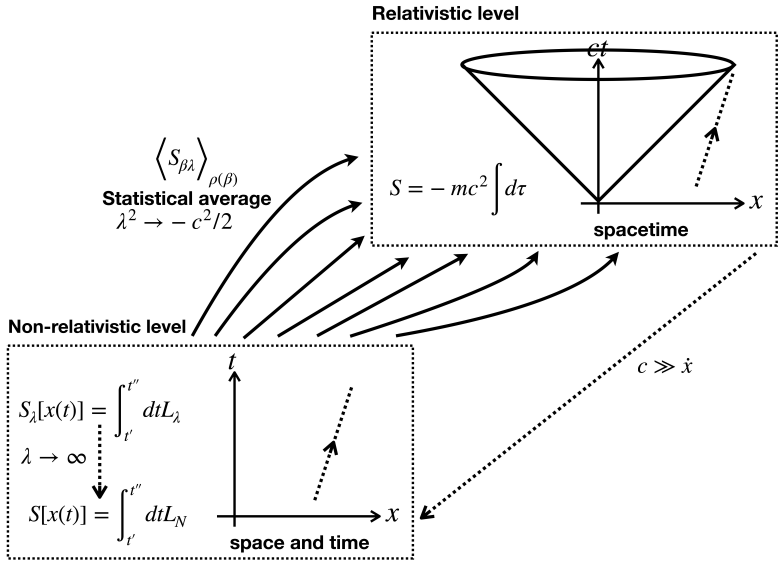
The central claim is that the relativistic free-particle Lagrangian $L_c = -mc^2/\gamma$ is the statistical average of the one-parameter family of multiplicative Lagrangians $L_{\beta\lambda}$ with distribution $\rho(\beta) = \frac{2}{\sqrt{\pi}} e^{-1/\beta^2}/\beta^4$, and that the relativistic Hamiltonian $H_c = mc^2\gamma$ is the same average of the multiplicative Hamiltonian $H_{\beta\lambda}$. Because the averaged equation of motion is $m\ddot{x}\gamma^3 = 0$, the paper claims that relativistic dynamics can be understood as emerging from an ensemble of classical models, in the same sense that thermodynamics emerges from statistical mechanics. At the action level, averaging the non-relativistic multiplicative action produces an expression proportional to proper time, $cd\tau = ds$ with $ds^2 = -d(ct)^2 + dx^2$, so the flat spacetime interval appears as a statistical result; including a potential leads to a curved $1+1$ metric whose weak-field limit resembles the standard static-source metric.
Load-bearing premise
The construction depends on the hand-chosen distribution $\rho(\beta) = \frac{2}{\sqrt{\pi}}e^{-1/\beta^2}/\beta^4$ in Eq. (3.3); the paper does not derive this distribution from a physical principle, so if that choice is unjustified the relativistic forms are placed into the average by hand rather than emerging from the classical models.
Editorial extensions
If this is right
- Once the free-particle scale is set to $\lambda^2=c^2/2$, relativistic dynamics appears as the result of an average over equivalent classical models, so the relativistic factor is a statistical output rather than a postulate.
- The averaged free-particle action is proportional to proper time, so the flat spacetime interval of special relativity emerges from a description whose pre-averaged variables treat time and space separately.
- Including a potential produces new Lagrangians and Hamiltonians that all give the same equation of motion as the standard non-relativistic one, and their expansions generate an infinite hierarchy of alternative Lagrangians with identical dynamics.
- The weak-field limit of the potential-dependent $1+1$ metric has the familiar static-source form, with a coordinate singularity at $V=mc^2/2$ that the paper argues is an artifact of the coordinates rather than a physical singularity.
Reading between the lines
- If a physical principle is later found that fixes the distribution $\rho(\beta)$, this construction would turn the relativistic kinetic energy into a derived quantity and would predict specific corrections whenever the distribution changes.
- The same averaging strategy could be applied to other one-parameter families of equivalent classical Lagrangians; deviations from the chosen $\rho$ would then produce modified dispersion relations, giving a possible low-energy test of the emergent-relativity idea.
- The coordinate singularity at $V=mc^2/2$ in the curved $1+1$ metric may indicate where the averaging expansion breaks down rather than a genuine horizon; the paper notes the resemblance but does not interpret it physically.
Signed reviews
Editorial analysis
A structured set of objections, weighed in public.
Referee Report
Summary. The paper proposes that the relativistic free-particle Lagrangian L_c = -mc^2/γ and Hamiltonian H_c = mc^2γ, together with the relativistic equation of motion, can be obtained by averaging a β-parameterized family of non-relativistic multiplicative Lagrangians against a distribution ρ(β). Section 4 extends the averaging to include a potential, Section 5 claims that the action-level average yields Minkowski and then curved spacetime intervals, and Appendix A offers an alternative Gaussian-weight derivation. The paper concludes that relativistic dynamics and spacetime geometry emerge from a statistical ensemble of classical non-relativistic structures.
Significance. If the central identities were correct and ρ(β) had an independent physical justification, the proposed bottom-up statistical route from classical mechanics to relativistic dynamics and spacetime geometry would be conceptually interesting and would tie into the authors' multiplicative-Lagrangian program. The paper is self-contained and, in Section 6, explicitly acknowledges that the role and uniqueness of ρ(β) remain open; that honesty is a strength. However, the main computations contain dimensional and algebraic errors at precisely the points where the relativistic results are said to emerge, and the distribution ρ(β) is reverse-engineered to produce the target expressions. These problems are load-bearing rather than cosmetic, so the central claim is not currently supported.
major comments (6)
- [§3.1, §6] The central emergence claim is circular. The distribution ρ(β) in Eq. (3.3) is introduced without derivation and is exactly the weight that converts the β-average of L_{βλ} into the relativistic Lagrangian; Section 6 concedes that the uniqueness and justification of ρ(β) remain open. Because no independent principle fixes ρ(β), the "emergence" is an identity engineered by the choice of ρ(β) rather than a derivation. A concrete test would be to obtain ρ from a symmetry, maximum-entropy, or renormalization-group argument; in the present manuscript this is absent.
- [§3.1, Eqs. (3.5)–(3.6)] Equation (3.5) is dimensionally inconsistent and algebraically wrong. L_{βλ} has dimensions of energy, while the right-hand side −2m²λ²√(1−ẋ²/(2λ²)) has dimensions of mass×energy. Direct evaluation of the average with ρ(β) of Eq. (3.3) gives ⟨L_{βλ}⟩ = −2mλ²√(1−ẋ²/(2λ²)); the m² factor is spurious. Consequently Eq. (3.6) is not derived: with λ²=c²/2 the correct average already equals −mc²/γ, whereas the printed expression with m² and the unexplained /√2 factor equals neither −mc²/γ nor −m²c²/γ.
- [§3.2, Eq. (3.8)] The moment in Eq. (3.8) is computed with the wrong exponent and sign. With ρ(β) as in Eq. (3.3), ∫ dβ ρ(β) e^{ẋ²/(β²λ²)} = (1 − ẋ²/λ²)^{−3/2}, so (1/2)⟨e^{ẋ²/(β²λ²)}⟩mẍ = (mẍ/2)(1 − ẋ²/λ²)^{−3/2}, not mẍ(1 − ẋ²/(2λ²))^{3/2}. The printed factor changes the sign of the exponent and halves the argument; for λ²=c²/2 it gives (1 − 2ẋ²/c²)^{3/2}, which is neither γ³ nor even real for ẋ²>c²/2. The claimed relativistic equation of motion mẍγ³=0 therefore does not follow.
- [§3.3, Eqs. (3.9)–(3.10)] Equation (3.9) is missing a factor of m in the exponent: from Hλ=mλ² exp(H_N/(mλ²)) with H_N=p_N²/(2m), the β-scaled Hamiltonian should be mβ²λ² exp[p_N²/(2m²β²λ²)]. As printed, the exponent p_N²/(2mβ²λ²) is not dimensionless. With the corrected exponent, the average gives 2mλ²(1−p_N²/(2m²λ²))^{−1/2}, which for λ²=c²/2 is mc²γ, so the extra /√2 in Eq. (3.10) is unexplained and changes the result by a factor 1/√2.
- [§4, Eq. (4.4)] The claimed Legendre transform is incorrect. Starting from ~Lλ in Eq. (4.3), p=∂~Lλ/∂ẋ = mẋ/[(1−V/(mλ²))Q] with Q=√(1−ẋ²/(2λ²)−V/(mλ²)), and the Legendre transform gives ~Hλ = pẋ−~Lλ = 2mλ²/Q. Equation (4.4) instead quotes ~Hλ = 2mλ²Q, which is not the Hamiltonian conjugate to Eq. (4.3). The subsequent equation of motion (4.5) is therefore unverified.
- [§5.2, Eq. (5.7); Appendix A, Eq. (1.4)] Two further algebraic errors affect the broader claims. (i) In §5.2, starting from ds²=σ²c²dt²−σ⁴dx², the rescaling ds′²=σ^{3/2}ds² gives ds′²=(1−2V/mc²)^{−7/4}c²dt²−(1−2V/mc²)^{−11/4}dx², not Eq. (5.7); the printed metric (5.7) would require multiplication by (1−2V/mc²)^{3/2}, not by σ^{3/2}. Thus the curved-spacetime interval is not derived as stated. (ii) In Appendix A, direct evaluation of ∫ L_{K,α,c}dα with L_{K,α,c} of Eq. (1.3) yields K√π/γ, not K√πγ: the second term contributes −K√π(ẋ²/c²)γ. The alternative derivation of Lc in Eq. (1.4) is therefore also incorrect.
minor comments (5)
- [§3.5, Eq. (3.17)] The normalization constant contains (−λ²δ/c²)^{3/2}, which is imaginary for λ²<c² and complex otherwise; as written, ρ(β) is not a real probability density on ℝ.
- [§5.2, Eq. (5.11)] The denominator "2mc²(m−2V)" mixes mass and energy dimensions; presumably this is a typo for "2mc²(mc²−2V)".
- [§4, Eq. (4.3)] The averaged Lagrangian ~Lλ in Eq. (4.3) contains the potential V, but the β-family being averaged is not written explicitly in this section; please state L_{βλ,V} and the averaging prescription before presenting the result, since the V dependence is not obvious from Eq. (3.2).
- [§3.4, Eqs. (3.13)–(3.14)] The q-deformed exponential e_q is not defined; for q=+1 it is the ordinary exponential, so calling the q=+1 case "non-additive" needs clarification.
- [Figs. 1, 3, 4] The interconnections in Figures 1, 3, and 4 are difficult to read at the printed scale; larger fonts and cleaner arrow routing would help.
Circularity Check
The relativistic Lagrangian is not derived; the averaging measure rho(beta) is reverse-engineered to produce it, as the paper itself concedes.
-
fitted input called prediction
[Section 6 admission; applied in Eqs. (3.3)-(3.6)]
"the role and uniqueness of the chosen distribution function ρ(β) warrants further analysis. While our selected form yields the desired relativistic dynamics, it remains to be studied whether this choice is unique, whether alternative distributions lead to physically meaningful deformations, or whether underlying principles might determine ρ(β) naturally."
This is the paper's own admission that ρ(β) is not derived but selected to yield the relativistic dynamics. In Eqs. (3.3)-(3.6), the same ρ is introduced without a physical principle and then used to average the multiplicative Lagrangian into −m^2c^2/γ. The target Lagrangian is therefore encoded in the measure; the claimed 'statistical emergence' is a mathematical identity imposed by the chosen distribution, not a consequence of the non-relativistic Lagrangian alone.
-
fitted input called prediction
[Section 3.5, Eqs. (3.17)-(3.18)]
"We proceed the same mathematical steps resulting in H′ = ⟨Hc,βλ⟩ = ∫ dβ ρ(β) Hc,βλ = m(4c^2/δ) sqrt(1/(1− ẋ^2/(4c^2/δ))). If we replace 4c^2/δ → c^2, we obtain H′ = mc^2γ, which is a relativistic Hamiltonian."
After introducing a second ad hoc distribution, the final step is to manually replace the combination 4c^2/δ by c^2. This is a parameter re-fit, not a derivation: the target H′ = mc^2γ is restored by hand, so the claimed result is put in at the last step rather than emerging from the averaging.
2 more flagged steps
-
fitted input called prediction
[Appendix A, Eqs. (1.2)-(1.4)]
"To make contact with relativistic dynamics, we reparametrise k2 = −Ke^{−α^2}, A = −2α^2/c^2 ... Integrating over all values yields ∫ L_{K,α,c} dα = K√π γ ... By choosing K√π = −mc^2, we recover the free-particle relativistic Lagrangian: Lc = −mc^2/γ."
The reparametrization A = −2α^2/c^2 is engineered so that the Gaussian integral over α produces γ = (1−ẋ^2/c^2)^{−1/2} times a constant, and that constant is then fixed to −mc^2. The relativistic Lagrangian is inserted twice: through the chosen α-dependence of A and through the final constant choice. The integration is an identity, not an independent derivation.
-
fitted input called prediction
[Section 5.1, Eq. (5.3)]
"Applying the same mathematical trick, λ→βλ, λ^2 = c^2/2 and considering the statistical average ⟨Sβλ[x(t)]⟩ρ(β) = −mc^2 ∫ dt sqrt(1− ẋ^2/c^2) = −mc^2 ∫ dτ"
The claimed emergence of the Minkowski spacetime interval uses exactly the same fitted distribution and parameter choices as Section 3. No independent principle fixes ρ(β) or λ; the interval is read off after the same reverse-engineered average, so this 'bottom-up' spacetime claim inherits the circularity of the preceding construction.
full rationale
The central derivation is not self-contained. The distribution function ρ(β) is the load-bearing free input, and the paper's own Section 6 concedes that its selection is unjustified and its uniqueness is open. Everything that follows—the averaged Lagrangian, Hamiltonian, equation-of-motion moments, and action—is obtained by choosing ρ(β), or by explicitly replacing constants (4c^2/δ → c^2, K√π = −mc^2) to match the known relativistic expressions. The averaging steps are therefore reverse-engineered identities rather than predictions from the non-relativistic multiplicative Lagrangian. The paper also contains algebraic and dimensional errors in the printed averages, but even setting those aside, the construction reduces to fitting the target result through the measure. There is no problematic self-citation chain here; the circularity is internal to the derivation itself. Since the paper's headline claim—relativistic dynamics and spacetime emerge statistically—is forced by the chosen ρ, the circularity score is 8.
Assumptions & free parameters
free parameters (2)
- Length/velocity scale λ =
λ^2 = c^2/2
- Coupling K in Appendix A =
K = -mc^2/√π
assumptions (4)
- domain assumption The multiplicative Lagrangian L_λ(x,ẋ) of ref [1] is a valid generalized classical Lagrangian with the same equations of motion as the standard Lagrangian.
- ad hoc to paper A statistical average over the parameter β with distribution ρ(β) produces a physically meaningful Lagrangian and Hamiltonian.
- ad hoc to paper The distribution ρ(β) in Eq. (3.3) (and ρ(α) in Appendix A) may be chosen freely.
- domain assumption The action S = ∫ L dt can be written as -mc ∫ ds, defining a spacetime metric; the resulting ds^2 is a valid spacetime interval.
Cite this review
Pith. "Pith review of The emergence of the relativistic Lagrangian from the non-relativistic multiplicative Lagrangian." pith.science (2026). https://pith.science/paper/6O4VGK2R
@misc{pith2026250504224,
  author       = {Pith},
  title        = {Pith review of: The emergence of the relativistic Lagrangian from the non-relativistic multiplicative Lagrangian},
  year         = {2026},
  howpublished = {\url{https://pith.science/paper/6O4VGK2R}},
  note         = {Machine review of arXiv:2505.04224}
}
read the original abstract
The multiplicative Lagrangian and Hamiltonian introduce an additional parameter that, despite its variation, results in identical equations of motion as those derived from the standard Lagrangian. This intriguing property becomes even more striking in the case of a free particle. By manipulating the parameter and integrating out, the statistical average of the multiplicative Lagrangian and Hamiltonian naturally arises. Astonishingly, from this statistical viewpoint, the relativistic Lagrangian and Hamiltonian emerge with remarkable elegance. On the action level, this formalism unveils a deeper connection: the spacetime of Einstein's theory reveals itself from a statistical perspective through the action associated with the multiplicative Lagrangian. This suggests that the multiplicative Lagrangian/Hamiltonian framework offers a profound and beautiful foundation, one that reveals the underlying unity between classical and relativistic descriptions in a way that transcends traditional formulations. In essence, the multiplicative approach introduces a richer and more intricate structure to our understanding of physics, bridging the gap between different theoretical realms through a statistical perspective.
Figures


Figures from the paper (3 more)


Reference graph
Works this paper leans on
-
[1]
K. Surawuttinack, S. Yoo-Kong, and M. Tanasittikosol. On the multiplicative form of the Lagrangian. Theor. Math. Phys. , 189:1693–1711, 2015
work page 2015
-
[2]
C. Tsallis. Generalizing what we learnt: Nonextensive statistical mechanics. In Introduction to Nonextensive Statistical Mechanics: Approaching a Complex World . Springer Interna- tional Publishing, Cham, 2023
work page 2023
-
[3]
Deriving Tsallis entropy from non-extensive Hamiltonian within a statistical mechanics framework
P. Krisut and S. Yoo-Kong. Deriving tsallis entropy from non-extensive Hamiltonian within a statistical mechanics framework. arXiv:2411.16757v2, 2025
work page Pith review arXiv 2025
-
[4]
Spacetime and Geometry: An Introduction to General Relativity
Sean Carroll. Spacetime and Geometry: An Introduction to General Relativity . Benjamin Cummings, 2003
work page 2003
-
[5]
W. Bukaew and S. Yoo-Kong. One-parameter generalised Fisher information matrix: One random variable. Rep. Math. Phys. , 91(1):57–78, 2023
work page 2023
-
[6]
S. Supanyo, M. Tanasittikosol, and S. Yoo-Kong. Natural TeV cutoff of the Higgs field from a multiplicative Lagrangian. Phys. Rev. D , 106:035020, 2022
work page 2022
-
[7]
S. Supanyo, C. Hasuwannakit, S. Yoo-Kong, L. Tannukij, and M. Tanasittikosol. Neutrino mass mechanisms from a nonstandard Higgs Lagrangian and implications for flavor hierar- chies. arXiv:2312.16587v3, 2024
arXiv 2024
-
[8]
S. Supanyo, M. Tanasittikosol, and S. Yoo-Kong. Nonstandard lagrangians for a real scalar field and a fermion field from the nonuniqueness principle. Theor. Math. Phys. , 221:1695– 1710, 2024
work page 2024
Show all 9 references
-
[9]
Supanyo, L
S. Supanyo, L. Tannukij, and S. Yoo-Kong. The mass spectra in the electroweak theory from the multiplicative lagrangian. arXiv:2504.17296v2, 2025. 14
2025 arXiv
Reviewed August 15, 2026 · model on record in the stance chip above.
Discussion (0). Continue with ORCID to comment.