REVIEW 3 major objections 5 minor 58 references
Magnetism and weak electronic correlations in Kagome metal ScV$_6$Sn$_6$
T0 review · 3 major / 5 minor · reviewed 2026-08-11 · deepseek-v4-flash
Pith's one-line read ScV6Sn6 is a weakly correlated metal, and electronic correlations do not drive its charge density wave order.
desk verdict A careful DFT+DMFT study showing weak local correlations in ScV6Sn6, whose CDW conclusion overreaches the bare-bubble FSN calculation. read the letter →
The pith
A machine-rendered reading of the paper's core claim, the machinery that carries it, and where it could break.
The reading
What carries the argument
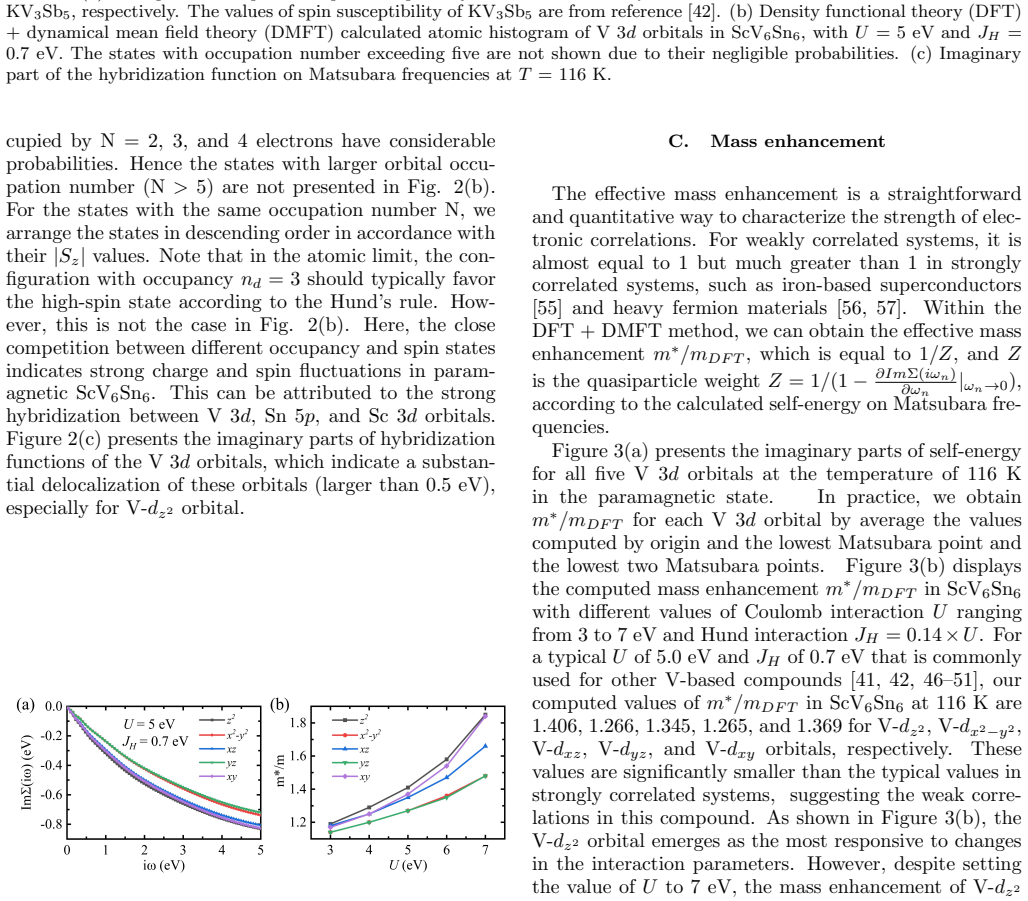
The argument runs on three calculated objects. The first is the static local spin susceptibility from continuous-time quantum Monte Carlo, $\chi = \int_0^\beta \langle S_z(\tau) S_z(0)\rangle d\tau$, whose temperature independence is read as the absence of local moments. The second is the quasiparticle mass enhancement $m^*/m_{\mathrm{DFT}} = 1/Z$, with $Z = 1/(1 - \partial \operatorname{Im}\Sigma(i\omega_n)/\partial \omega_n|_{\omega_n\to 0})$, extracted from the orbital-resolved self-energy, which quantifies correlation strength. The third is the Fermi surface nesting function $\lim_{\omega\to 0} \chi''_0(\mathbf{q},\omega)/\omega = \sum_{nn'\mathbf{k}} \delta(\epsilon_{n\mathbf{k}}-\epsilon_0)\delta(\epsilon_{n'\mathbf{k}+\mathbf{q}}-\epsilon_0)$, evaluated on the $q_z=0$, $1/3$, and $1/2$ planes; its maximum location is compared with the experimental CDW vector. The DFT+DMFT scheme supplies the correlated self-energy for all of these, and the comparison with YV6Sn6 provides the control experiment.
What would settle it
A Curie-Weiss upturn in the measured magnetic susceptibility of ScV6Sn6 below the CDW transition, or an ARPES spectrum showing a bandwidth renormalization much larger than the predicted mass enhancement of about 1.3, would overturn the weak-correlation and no-local-moment conclusion; a correlated calculation including long-range interactions that places a peak in the nesting function at $q_{\mathrm{CDW}}=(1/3,1/3,1/3)$ would overturn the nesting conclusion.
Extended reading notes
Core claim
On its own terms, the paper establishes that ScV6Sn6 is a weakly correlated paramagnetic metal. The computed local spin susceptibility is flat from 58 to 900 K, the hallmark of Pauli paramagnetism from itinerant electrons rather than Curie-Weiss local moments, and the V 3d atomic histogram shows strong charge and spin fluctuations instead of a Hund's-rule high-spin configuration. The orbital-resolved quasiparticle mass enhancements fall between 1.27 and 1.41, and the bands near the Fermi level are only weakly renormalized; even at U = 7 eV the largest enhancement is 1.85. Comparing DFT and DFT+DMFT Fermi surfaces, the only notable change is an enlargement of the pocket centered at the middle of L-M. Including correlations in the Fermi surface nesting function does not place a maximum at the experimental $q_{\mathrm{CDW}}$, so nesting is not the CDW driver even at the correlated level. Since the mass enhancements in CDW-ordered ScV6Sn6 and CDW-free YV6Sn6 are nearly equal, the paper concludes that electronic correlations play a non-crucial role in the formation of the CDW order, leaving the q-dependent electron-phonon coupling as a strong candidate.
Load-bearing premise
The conclusion rests on the assumption that a single-site DFT+DMFT treatment with density-density interactions, U = 5.0 eV, and J_H = 0.7 eV, which the authors note omits long-range correlations, captures the correlation physics relevant to both the magnetism and the CDW of ScV6Sn6.
Editorial extensions
If this is right
- The measured magnetic susceptibility of ScV6Sn6 should stay nearly flat from above the CDW transition up to room temperature, since the calculation predicts Pauli-like behavior with no local moment.
- Fermi surface nesting can be dismissed as the CDW mechanism for ScV6Sn6 even after correlations are included, so future mechanism studies should focus on lattice and electron-phonon degrees of freedom.
- The nearly identical mass enhancements in ScV6Sn6 and YV6Sn6 imply that the presence or absence of the CDW is not controlled by the strength of local electronic correlations across the RV6Sn6 family.
- The q-dependent electron-phonon coupling previously proposed as the CDW driver is compatible with the weak-correlation picture and is not weakened by correlation effects.
- ARPES experiments should see quasiparticle bands near the Fermi level with only mild renormalization relative to DFT, with the V-dz2 orbital showing the largest but still modest mass enhancement.
Reading between the lines
- A direct test would be to measure the low-temperature specific heat or quantum oscillation spectra: a Sommerfeld coefficient or cyclotron mass near 1.3 times the band value would confirm the weak-correlation prediction, whereas a much larger value would point to correlation physics missing from the single-site treatment.
- Because the paper omits long-range correlations, an extension with momentum-dependent self-energies or hybrid functionals could reveal whether nonlocal fluctuations shift the nesting function or generate a local-moment tendency; that is the most direct way to challenge the CDW conclusion.
- The same DFT+DMFT protocol applied across the RV6Sn6 family (R = Y, Gd, Ho) could test whether the near-identical mass enhancements hold generally; if CDW-free members all share the same correlation strength, local correlations are unlikely to control the CDW phase boundary anywhere in the family.
- If the CDW is indeed electron-phonon driven, one expects the CDW transition temperature to respond to isotope substitution and to show phonon anomalies at $q_{\mathrm{CDW}}$ in inelastic scattering, both of which are experimentally accessible.
Editorial analysis
A structured set of objections, weighed in public.
Referee Report
Summary. The manuscript reports DFT+DMFT calculations for the kagome metal ScV6Sn6, focusing on the role of electronic correlations in magnetism and the CDW transition. Using a five-orbital V 3d correlated subspace with U=5 eV and J_H=0.7 eV, the authors find a nearly temperature-independent local spin susceptibility, absence of local moments on V, mass enhancements m*/m_DFT around 1.3, and weak band renormalization near the Fermi level. They compare these results with YV6Sn6, which does not exhibit CDW order, and find similar mass enhancements and orbital occupations. They also compute the Fermi-surface nesting function from the DFT+DMFT band structure and find no maximum at the experimental q_CDW=(1/3,1/3,1/3). From these results the authors conclude that ScV6Sn6 is a weakly correlated metal and that electronic correlations play a non-crucial role in the formation of the CDW order, supporting an electron-phonon mechanism.
Significance. If the central conclusion is accepted, the paper would provide a systematic characterization of local correlation effects in a recently discovered kagome CDW compound, complementing earlier DFT and electron-phonon studies. The strengths of the work include the use of established DFT+DMFT machinery, a scan over U from 3 to 7 eV that shows the mass enhancement remains modest, the direct computation of the spin susceptibility and atomic histograms, and the absence of any fitting of parameters to the target CDW data. The comparison of two chemically similar compounds (CDW vs non-CDW) is a useful diagnostic that goes beyond a single-material study. However, the main limitation is that all computed correlation indicators are local or single-particle in nature, whereas CDW formation is a momentum-dependent two-particle phenomenon; this limits the strength of the conclusion about the role of correlations in the CDW instability.
major comments (3)
- [Section III.E] The conclusion that 'electronic correlations play a non-crucial role in the formation of the CDW order in ScV6Sn6' is a non-sequitur relative to the evidence presented. The mass enhancement, bandwidth renormalization, and spin susceptibility are local, single-particle quantities; the FSN function computed is the non-interacting particle-hole bubble in the zero-frequency limit. CDW ordering is governed by the momentum- and frequency-dependent charge response, which can be strongly modified by vertex corrections and long-range correlations even when the local self-energy is weak. The authors themselves state in Section III.D that long-range correlations are omitted. Therefore the data support only the weaker statement that local electronic correlations are weak and do not qualitatively change the bare FSN function; they do not rule out interaction effects on the charge response. Please either soften the conclusions to this weaker statement or supply an explicit calculation of an interacting charge susceptibility (e.g., RPA with the DMFT self-energy, or a two-particle DMFT susceptibility) to make the claim quantitative.
- [Section III.E] The construction of the 'DFT+DMFT calculated FSN function' shown in Fig. 6 is not precisely defined. The FSN function is defined through single-particle eigenvalues, but the manuscript does not state whether those eigenvalues are the original DFT eigenvalues, quasiparticle poles extracted from the DMFT spectral function A(k,omega), or the real part of the lattice Green's function. Without this information the reader cannot tell which step of the calculation actually includes electronic correlations. If the DFT band structure is used, the claim that correlations are incorporated in Fig. 6 is misleading. Please specify the exact energy dispersion used, and preferably show the DFT-only FSN function alongside the DFT+DMFT one so the effect of correlations can be assessed directly.
- [Table II] The comparison with YV6Sn6 is a key pillar of the argument that correlations are not crucial for CDW order, but the manuscript provides no computational details for YV6Sn6. It is not stated whether the same U, J_H, temperature, double-counting scheme, k-mesh, and structure relaxation protocol were used, nor whether the YV6Sn6 calculation was performed with the same eDMFT/WIEN2K setup. Without these details, the similarity in mass enhancements and orbital occupations reported in Table II cannot be evaluated. Please provide the YV6Sn6 parameters explicitly or add a sentence stating that the calculations are identical in all respects except the lattice parameters.
minor comments (5)
- [Section III.C] The mass enhancement is obtained by averaging the slope of Im Sigma(i omega_n) over the origin and the lowest Matsubara frequencies; this procedure is sensitive to the chosen frequency window and to the finite-temperature Matsubara grid. Please add a brief discussion of the frequency-window dependence or a convergence test, and include representative error estimates from the QMC run.
- [Fig. 2(a)] There is an inconsistency between the text and the caption of Fig. 2(a): the text refers to 'red dots' for ScV6Sn6 and the 'blue line' for KV3Sb5, while the caption says 'blue and red dots are ScV6Sn6 and KV3Sb5, respectively.' Please correct the colors or the wording.
- [Section III.B] The spin susceptibility is plotted without Monte Carlo error bars, even though its flatness in temperature is central to the no-local-moment conclusion. A representative error bar, or a statement that the statistical errors are smaller than the symbol size, would strengthen this claim.
- [Section III.E] There is a typo: 'the maximum shifts from M (Fig. 6(a)) to alone Γ−M' should read 'along Γ−M'.
- [References] Reference [40], used as the main support for the electron-phonon mechanism, is an arXiv preprint. If a peer-reviewed version has appeared, please cite it instead of or in addition to the preprint.
Circularity Check
No circularity: DFT+DMFT inputs are literature-standard and the FSN function is computed independently of the target q_CDW.
full rationale
The paper's derivation chain is self-contained rather than circular. The interaction parameters U = 5.0 eV and J_H = 0.7 eV are taken from prior V-based compounds (AV3Sb5, SrVO3, VO2, V2O3) and are then scanned over U = 3 to 7 eV; the weak mass enhancement (m*/m_DFT about 1.3, maximum 1.85 even at U = 7 eV) is therefore a computed output, not an input fitted to ScV6Sn6 data. The static spin susceptibility, atomic histogram, hybridization functions, and quasiparticle self-energies are direct CTQMC outputs, and the agreement with experiment is an external consistency check. The FSN function is defined as the standard zero-frequency limit of the bare particle-hole susceptibility from band eigenvalues and is evaluated on a dense k-mesh with no adjustment to the experimental q_CDW = (1/3, 1/3, 1/3); the test is falsifiable because the computed maximum lies elsewhere. The YV6Sn6 comparison is an independent same-method calculation serving as an external benchmark, not a fitted input. The conclusion that correlations are not crucial for CDW formation is an inference from local mass enhancement and the FSN function, and the paper explicitly acknowledges that long-range correlations were omitted; this is a limitation of the physical argument, not a circularity. Introductory self-citations (e.g., Ref. [4]) are not load-bearing for any central claim.
Assumptions & free parameters
free parameters (3)
- U (Coulomb interaction) =
5.0 eV
- JH (Hund's coupling) =
0.7 eV
- n (nominal V 3d occupation in double counting) =
3.0
assumptions (4)
- domain assumption DFT+DMFT with the density-density form of the Coulomb interaction adequately represents local correlations in ScV6Sn6.
- domain assumption The maximum entropy method yields a reliable real-frequency self-energy for spectral functions and Fermi surface.
- domain assumption YV6Sn6 is a valid non-CDW comparison compound.
- domain assumption The FSN function computed with Gaussian broadening of 0.001 eV and a 100x100x51 k-mesh accurately reflects nesting strength.
Cite this review
Pith. "Pith review of Magnetism and weak electronic correlations in Kagome metal ScV$_6$Sn$_6$." pith.science (2026). https://pith.science/paper/6SL7JRYR
@misc{pith2026241212908,
  author       = {Pith},
  title        = {Pith review of: Magnetism and weak electronic correlations in Kagome metal ScV$_6$Sn$_6$},
  year         = {2026},
  howpublished = {\url{https://pith.science/paper/6SL7JRYR}},
  note         = {Machine review of arXiv:2412.12908}
}
abstract
As one class of typical quantum materials, Kagome metals in $A$V$_3$Sb$_5$($A$ = K, Rb, Cs) have attracted extensive attentions due to their interesting physical properties and different quantum phases of charge density wave (CDW), superconductivity and nontrivial topology. Recently, a new CDW phase in ScV$_6$Sn$_6$ was experimentally observed and inspired a wide study of the mechanism of driving force. To have a clear understanding of the correlation effect in the CDW phase in ScV$_6$Sn$_6$, we performed a systematic density functional theory plus dynamical mean field theory (DFT + DMFT) calculations. The resulting static local spin susceptibility is nearly independent of temperature, indicating the absence of local moment on atom V, in full agreement with experimental measurements. The mass enhancements of quasiparticles and bandwidth renormalizations near the Fermi level show a weak correlation strength in ScV$_6$Sn$_6$. In addition, the comparable mass enhancements of quasiparticles in ScV$_6$Sn$_6$ with CDW order and YV$_6$Sn$_6$ without CDW phase suggests that electronic correlations corresponding to Fermi surface nesting do not play the dominant role in the formation of CDW order in ScV$_6$Sn$_6$.
Figures


Figures from the paper (3 more)


Reference graph
Works this paper leans on
-
[1]
J.-X. Yin, B. Lian, and M. Z. Hasan, Topological kagome magnets and superconductors, Nature 612, 647 (2022)
2022
-
[2]
L. Ye, M. Kang, J. Liu, F. Von Cube, C. R. Wicker, T. Suzuki, C. Jozwiak, A. Bostwick, E. Rotenberg, D. C. Bell, et al., Massive dirac fermions in a ferromagnetic 6 kagome metal, Nature 555, 638 (2018)
work page 2018
-
[3]
A. Nag, Y. Peng, J. Li, S. Agrestini, H. Robarts, M. Garc ´ ıa-Fern´ andez, A. Walters, Q. Wang, Q. Yin, H. Lei, et al., Correlation driven near-flat band stoner excitations in a kagome magnet, Nature Communications 13, 7317 (2022)
work page 2022
-
[4]
T. Yu, R. Liu, Y. Peng, P. Zheng, G. Wang, X. Ma, Z. Yuan, and Z. Yin, Correlated electronic structure of the kagome metal Mn 3Sn, Physical Review B 106, 205103 (2022)
work page 2022
-
[5]
C. Mielke III, D. Das, J.-X. Yin, H. Liu, R. Gupta, Y.- X. Jiang, M. Medarde, X. Wu, H. C. Lei, J. Chang, et al., Time-reversal symmetry-breaking charge order in a kagome superconductor, Nature 602, 245 (2022)
work page 2022
-
[6]
H. Chen, H. Yang, B. Hu, Z. Zhao, J. Yuan, Y. Xing, G. Qian, Z. Huang, G. Li, Y. Ye, et al., Roton pair den- sity wave in a strong-coupling kagome superconductor, Nature 599, 222 (2021)
work page 2021
-
[7]
Guo and M
H.-M. Guo and M. Franz, Topological insulator on the kagome lattice, Physical Review B 80, 113102 (2009)
2009
-
[8]
N. J. Ghimire and I. I. Mazin, Topology and correlations on the kagome lattice, Nature Materials 19, 137 (2020)
2020
Show all 58 references
-
[9]
M. Kang, S. Fang, L. Ye, H. C. Po, J. Denlinger, C. Jozwiak, A. Bostwick, E. Rotenberg, E. Kaxiras, J. G. Checkelsky, et al., Topological flat bands in frustrated kagome lattice cosn, Nature communications 11, 4004 (2020)
2020
-
[10]
Z. Liu, M. Li, Q. Wang, G. Wang, C. Wen, K. Jiang, X. Lu, S. Yan, Y. Huang, D. Shen,et al., Orbital-selective dirac fermions and extremely flat bands in frustrated kagome-lattice metal cosn, Nature communications 11, 4002 (2020)
2020
-
[11]
M. Kang, L. Ye, S. Fang, J.-S. You, A. Levitan, M. Han, J. I. Facio, C. Jozwiak, A. Bostwick, E. Rotenberg, et al., Dirac fermions and flat bands in the ideal kagome metal fesn, Nature materials 19, 163 (2020)
2020
-
[12]
M. Han, H. Inoue, S. Fang, C. John, L. Ye, M. K. Chan, D. Graf, T. Suzuki, M. P. Ghimire, W. J. Cho, et al., Evidence of two-dimensional flat band at the surface of antiferromagnetic kagome metal fesn, Nature communi- cations 12, 5345 (2021)
2021
-
[13]
M. Li, Q. Wang, G. Wang, Z. Yuan, W. Song, R. Lou, Z. Liu, Y. Huang, Z. Liu, H. Lei, et al., Dirac cone, flat band and saddle point in kagome magnet YMn 6Sn6, Na- ture communications 12, 3129 (2021)
2021
-
[14]
S. Peng, Y. Han, G. Pokharel, J. Shen, Z. Li, M. Hashimoto, D. Lu, B. R. Ortiz, Y. Luo, H. Li, et al., Realizing Kagome Band Structure in Two-Dimensional Kagome Surface States of R V6Sn6 (R= Gd, Ho), Physi- cal review letters 127, 266401 (2021)
2021
-
[15]
B. R. Ortiz, P. M. Sarte, E. M. Kenney, M. J. Graf, S. M. Teicher, R. Seshadri, and S. D. Wilson, Superconductiv- ity in the Z 2 kagome metal KV 3Sb5, Physical Review Materials 5, 034801 (2021)
2021
-
[16]
Q. Yin, Z. Tu, C. Gong, Y. Fu, S. Yan, and H. Lei, Su- perconductivity and normal-state properties of kagome metal RbV 3Sb5 single crystals, Chinese Physics Letters 38, 037403 (2021)
2021
-
[17]
B. R. Ortiz, S. M. Teicher, Y. Hu, J. L. Zuo, P. M. Sarte, E. C. Schueller, A. M. Abeykoon, M. J. Krogstad, S. Rosenkranz, R. Osborn, et al., CsV3Sb5: A Z2 topolog- ical kagome metal with a superconducting ground state, Physical Review Letters 125, 247002 (2020)
2020
-
[18]
B. R. Ortiz, L. C. Gomes, J. R. Morey, M. Winiarski, M. Bordelon, J. S. Mangum, I. W. Oswald, J. A. Rodriguez-Rivera, J. R. Neilson, S. D. Wilson, et al., New kagome prototype materials: discovery of KV 3Sb5, RbV3Sb5, and CsV 3Sb5, Physical Review Materials 3, 094407 (2019)
2019
-
[19]
Jiang, J.-X
Y.-X. Jiang, J.-X. Yin, M. M. Denner, N. Shumiya, B. R. Ortiz, G. Xu, Z. Guguchia, J. He, M. S. Hossain, X. Liu, et al., Unconventional chiral charge order in kagome su- perconductor KV3Sb5, Nature materials 20, 1353 (2021)
2021
-
[21]
Liang, X
Z. Liang, X. Hou, F. Zhang, W. Ma, P. Wu, Z. Zhang, F. Yu, J.-J. Ying, K. Jiang, L. Shan, et al., Three- dimensional charge density wave and surface-dependent vortex-core states in a kagome superconductor CsV 3Sb5, Physical Review X 11, 031026 (2021)
2021
-
[23]
X. Feng, K. Jiang, Z. Wang, and J. Hu, Chiral flux phase in the Kagome superconductor A V3Sb5, Science bulletin 66, 1384 (2021)
2021
-
[24]
M. L. Kiesel, C. Platt, and R. Thomale, Unconventional fermi surface instabilities in the kagome hubbard model, Physical review letters 110, 126405 (2013)
2013
-
[25]
Jiang, T
K. Jiang, T. Wu, J.-X. Yin, Z. Wang, M. Z. Hasan, S. D. Wilson, X. Chen, and J. Hu, Kagome superconductors A V3Sb5 (A= K, Rb, Cs), National Science Review 10, nwac199 (2023)
2023
-
[26]
L. Nie, K. Sun, W. Ma, D. Song, L. Zheng, Z. Liang, P. Wu, F. Yu, J. Li, M. Shan,et al., Charge-density-wave- driven electronic nematicity in a kagome superconductor, Nature 604, 59 (2022)
2022
-
[27]
Wang, Z.-Z
W.-S. Wang, Z.-Z. Li, Y.-Y. Xiang, and Q.-H. Wang, Competing electronic orders on kagome lattices at van Hove filling, Physical Review B 87, 115135 (2013)
2013
-
[28]
H. Tan, Y. Liu, Z. Wang, and B. Yan, Charge den- sity waves and electronic properties of superconduct- ing kagome metals, Physical review letters 127, 046401 (2021)
2021
-
[29]
M. M. Denner, R. Thomale, and T. Neupert, Analysis of Charge Order in the Kagome Metal A V3Sb5 (A= K, Rb, Cs), Physical Review Letters 127, 217601 (2021)
2021
-
[30]
Lin and R
Y.-P. Lin and R. M. Nandkishore, Complex charge den- sity waves at Van Hove singularity on hexagonal lattices: Haldane-model phase diagram and potential realization in the kagome metals A V3Sb5 (A= K, Rb, Cs), Physical Review B 104, 045122 (2021)
2021
-
[31]
T. Park, M. Ye, and L. Balents, Electronic instabilities of kagome metals: saddle points and landau theory, Physi- cal Review B 104, 035142 (2021)
2021
-
[32]
M. H. Christensen, T. Birol, B. M. Andersen, and R. M. Fernandes, Theory of the charge density wave in A V3Sb5 kagome metals, Physical Review B 104, 214513 (2021)
2021
-
[33]
H. Zhao, H. Li, B. R. Ortiz, S. M. Teicher, T. Park, M. Ye, Z. Wang, L. Balents, S. D. Wilson, and I. Zeljkovic, Cascade of correlated electron states in the kagome superconductor CsV 3Sb5, Nature 599, 216 7 (2021)
2021
-
[34]
H. Li, T. Zhang, T. Yilmaz, Y. Pai, C. Marvinney, A. Said, Q. Yin, C. Gong, Z. Tu, E. Vescovo,et al., Obser- vation of Unconventional Charge Density Wave without Acoustic Phonon Anomaly in Kagome Superconductors A V3Sb5 (A= Rb, Cs), Physical Review X 11, 031050 (2021)
2021
-
[35]
X. Teng, L. Chen, F. Ye, E. Rosenberg, Z. Liu, J.-X. Yin, Y.-X. Jiang, J. S. Oh, M. Z. Hasan, K. J. Neubauer, et al., Discovery of charge density wave in a kagome lat- tice antiferromagnet, Nature 609, 490 (2022)
2022
-
[36]
Wang, Enhanced spin-polarization via partial ge- dimerization as the driving force of the charge density wave in fege, Physical Review Materials7, 104006 (2023)
Y. Wang, Enhanced spin-polarization via partial ge- dimerization as the driving force of the charge density wave in fege, Physical Review Materials7, 104006 (2023)
2023
-
[37]
H. W. S. Arachchige, W. R. Meier, M. Marshall, T. Mat- suoka, R. Xue, M. A. McGuire, R. P. Hermann, H. Cao, and D. Mandrus, Charge Density Wave in Kagome Lat- tice Intermetallic ScV6Sn6, Physical Review Letters 129, 216402 (2022)
2022
-
[38]
Tan and B
H. Tan and B. Yan, Abundant Lattice Instability in Kagome Metal ScV 6Sn6, Physical review letters 130, 266402 (2023)
2023
-
[39]
T. Hu, H. Pi, S. Xu, L. Yue, Q. Wu, Q. Liu, S. Zhang, R. Li, X. Zhou, J. Yuan, et al., Optical spectroscopy and band structure calculations of the structural phase transition in the vanadium-based kagome metal ScV6Sn6, Physical Review B 107, 165119 (2023)
2023
-
[40]
S. Cao, C. Xu, H. Fukui, T. Manjo, M. Shi, Y. Liu, C. Cao, and Y. Song, Competing charge-density wave in- stabilities in the kagome metal ScV 6Sn6, arXiv preprint arXiv:2304.08197 (2023)
2023 arXiv
-
[41]
M. Liu, Z. Wang, and J.-J. Zhou, Weak electronic cor- relations in the kagome superconductor A V3Sb5 (A= K, Rb, Cs), Physical Review B 105, 235130 (2022)
2022
-
[42]
J. Zhao, W. Wu, Y. Wang, and S. A. Yang, Electronic correlations in the normal state of the kagome supercon- ductor KV3Sb5, Physical Review B 103, L241117 (2021)
2021
-
[43]
Haule, C.-H
K. Haule, C.-H. Yee, and K. Kim, Dynamical mean- field theory within the full-potential methods: Electronic structure of CeIrIn 5, CeCoIn 5, and CeRhIn 5, Physical Review B 81, 195107 (2010)
2010
-
[44]
Blaha, K
P. Blaha, K. Schwarz, G. K. Madsen, D. Kvasnicka, J. Luitz, et al., wien2k, An augmented plane wave+local orbitals program for calculating crystal properties 60 (2001)
2001
-
[45]
J. P. Perdew, K. Burke, and M. Ernzerhof, Generalized gradient approximation made simple, Physical review let- ters 77, 3865 (1996)
1996
-
[46]
Pavarini, S
E. Pavarini, S. Biermann, A. Poteryaev, A. Lichtenstein, A. Georges, and O. Andersen, Mott transition and sup- pression of orbital fluctuations in orthorhombic 3 d1 per- ovskites, Physical review letters 92, 176403 (2004)
2004
-
[47]
Taranto, M
C. Taranto, M. Kaltak, N. Parragh, G. Sangiovanni, G. Kresse, A. Toschi, and K. Held, Comparing quasi- particle GW+DMFT and LDA+DMFT for the test bed material SrVO3, Physical Review B 88, 165119 (2013)
2013
-
[48]
I. A. Nekrasov, G. Keller, D. Kondakov, A. Kozhevnikov, T. Pruschke, K. Held, D. Vollhardt, and V. Anisimov, Comparative study of correlation effects in CaVO 3 and SrVO3, Physical Review B 72, 155106 (2005)
2005
-
[49]
M. Laad, L. Craco, and E. M¨ uller-Hartmann, Metal- insulator transition in rutile-based VO2, Physical Review B 73, 195120 (2006)
2006
-
[50]
K. Held, G. Keller, V. Eyert, D. Vollhardt, and V. I. Anisimov, Mott-Hubbard Metal-Insulator Transition in Paramagnetic V 2O3: An LDA+DMFT (QMC) Study, Physical review letters 86, 5345 (2001)
2001
-
[51]
K. Held, I. Nekrasov, G. Keller, V. Eyert, N. Bl¨ umer, A. McMahan, R. Scalettar, T. Pruschke, V. Anisimov, and D. Vollhardt, Realistic investigations of correlated electron systems with LDA+DMFT, physica status solidi (b) 243, 2599 (2006)
2006
-
[52]
Werner, A
P. Werner, A. Comanac, L. De’Medici, M. Troyer, and A. J. Millis, Continuous-time solver for quantum impu- rity models, Physical Review Letters 97, 076405 (2006)
2006
-
[53]
K. Haule, Quantum monte carlo impurity solver for clus- ter dynamical mean-field theory and electronic structure calculations with adjustable cluster base, Physical Re- view B 75, 155113 (2007)
2007
-
[54]
Kresse and J
G. Kresse and J. Furthm¨ uller, Efficient iterative schemes for ab initio total-energy calculations using a plane-wave basis set, Physical review B 54, 11169 (1996)
1996
-
[55]
and heavy fermion materials [56, 57]. Within the DFT + DMFT method, we can obtain the effective mass enhancement m∗/mDF T, which is equal to 1 /Z, and Z is the quasiparticle weight Z = 1/(1 − ∂Im Σ(iωn) ∂ωn |ωn→0), according to the calculated self-energy on Matsubara fre- quen...
-
[56]
Z. Yin, K. Haule, and G. Kotliar, Kinetic frustration and the nature of the magnetic and paramagnetic states in iron pnictides and iron chalcogenides, Nature materials 10, 932 (2011)
2011
-
[57]
H. C. Choi, E. D. Bauer, F. Ronning, and J.-X. Zhu, DFT+DMFT study of dopant effects in the heavy- fermion compound CeCoIn 5, Physical Review B 105, 115121 (2022)
2022
-
[58]
M. Liu, Y. Xu, D. Hu, Z. Fu, N. Tong, X. Chen, J. Cheng, W. Xie, and Y.-f. Yang, Symmetry-enforced heavy-fermion physics in the quadruple-perovskite CaCu3Ir4O12, arXiv preprint arXiv:1705.00846 (2017)
2017 arXiv
-
[59]
Laverock, S
J. Laverock, S. Dugdale, Z. Major, M. Alam, N. Ru, I. Fisher, G. Santi, and E. Bruno, Fermi surface nesting and charge-density wave formation in rare-earth tritel- lurides, Physical Review B 71, 085114 (2005)
2005
-
[60]
Romaka, Y
L. Romaka, Y. Stadnyk, V. Romaka, P. Demchenko, M. Stadnyshyn, and M. Konyk, Peculiarities of compo- nent interaction in Gd, Er-V-Sn Ternary systems at 870 K and crystal structure of R V6Sn6 stannides, Journal of alloys and compounds 509, 8862 (2011)
2011
Reviewed August 11, 2026 · model on record in the stance chip above.
Discussion (0). Continue with ORCID to comment.