Measurement of Born cross sections for e^+e^-to pbar p at sqrt{s} =3.510-4.946 GeV
Pith reviewed 2026-06-26 06:36 UTC · model grok-4.3
The pith
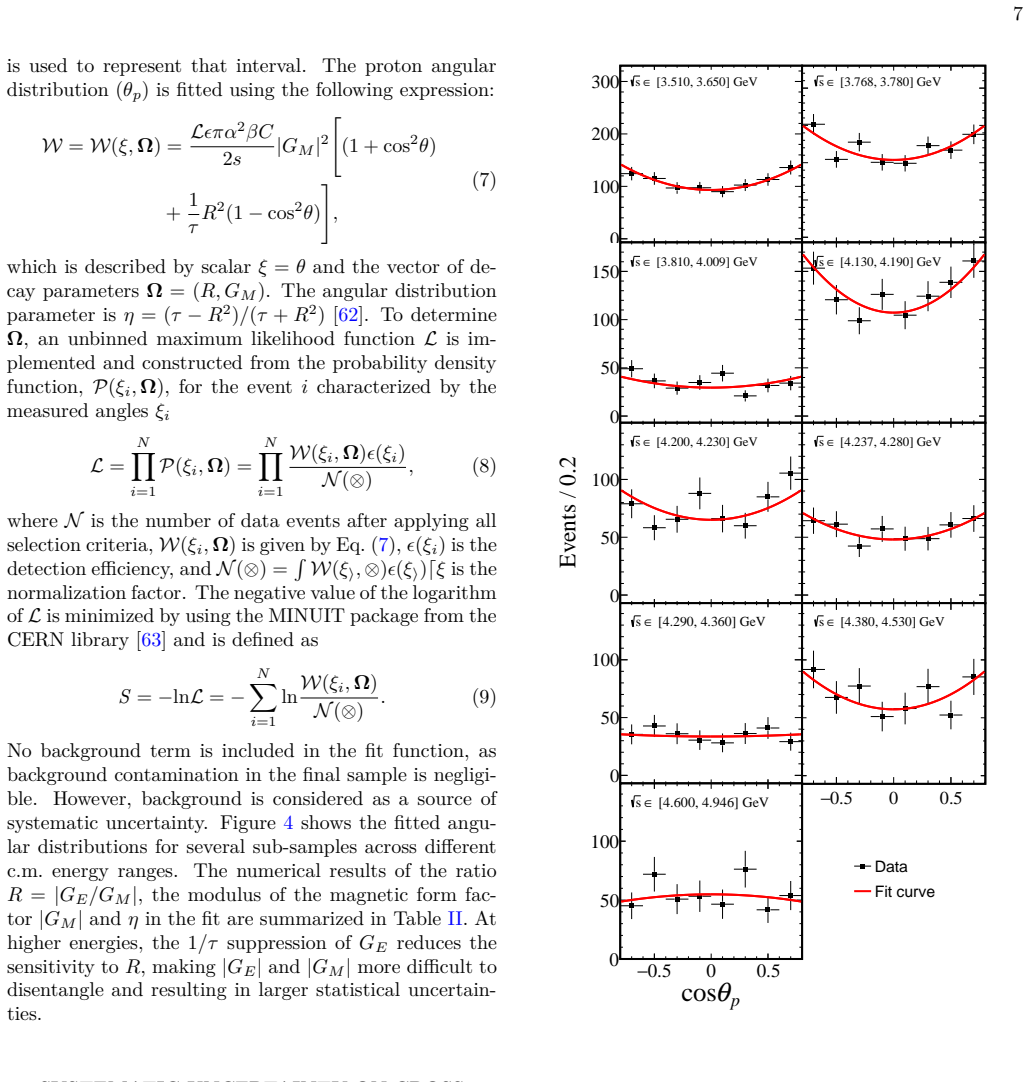
The moduli of the proton electromagnetic form factor ratio |G_E/G_M| and |G_M| are determined with high precision for the first time by analyzing the proton polar angle distribution at large timelike momentum transfers.
A machine-rendered reading of the paper's core claim, the machinery that carries it, and where it could break.
Core claim
The paper establishes that the Born cross sections and effective form factor can be measured across the scanned energies, and that the proton polar angle distribution permits the first high-precision extraction of the moduli |G_E/G_M| and |G_M| at large timelike momentum transfer, yielding essential information on the dynamics of the proton electromagnetic form factors and the nature of charmonium-like states.
What carries the argument
The polar angle distribution of the produced proton, which separates the electric and magnetic form factor contributions in the timelike region.
If this is right
- The measured cross sections and form factors supply data for modeling nucleon electromagnetic structure in the timelike region above open-charm threshold.
- The results provide input for understanding the dynamics of charmonium-like states that may couple to the p pbar final state.
- The effective form factor is obtained together with the individual moduli, allowing direct comparison with theoretical predictions at large timelike Q^2.
- The angular analysis technique demonstrates that high-precision separation of G_E and G_M is feasible with existing detector resolution in this energy range.
Where Pith is reading between the lines
- The extracted values can be compared with existing spacelike form factor data to test whether the timelike and spacelike behaviors converge at high momentum transfer.
- Higher-statistics runs at the same energies could reduce uncertainties on the ratio and test whether it deviates from unity as expected from simple quark models.
- The measurements set a benchmark for future experiments that scan the same region with different detectors or at higher luminosities.
- If the ratio remains close to one across the scanned points, it would support models in which the proton's charge and magnetization distributions are similar in the timelike domain.
Load-bearing premise
The observed proton polar angle distribution can be cleanly attributed to the electromagnetic form factors after standard corrections for detector acceptance, efficiency, and backgrounds, with no significant unaccounted contributions from other processes at these energies.
What would settle it
A data set in which the proton angular distribution, after all standard corrections, cannot be described by any combination of G_E and G_M values, or in which unaccounted resonant or background processes are shown to dominate the distribution at these energies.
Figures

read the original abstract
We report a measurement of the Born cross section and the effective form factor for the $e^+e^-\to p\bar{p}$ reaction at 47 center-of-mass energies between 3.510 and 4.946 GeV. The measurement is performed using the energy-scan technique and is based on data corresponding to an integrated luminosity of 26 fb\(^{-1}\) collected with the BESIII detector at the BEPCII collider. For the first time, the moduli of the electromagnetic form factor ratio $|G_{E}/G_{M}|$ and of the magnetic form factor $|G_{M}|$ are determined with high precision by analyzing the distribution of the polar angle of the proton at a large timelike momentum transfer. These results provide essential insights into the nature of charmonium(-like) states above the open-charm threshold and the dynamics underlying the proton electromagnetic form factors.
Editorial analysis
A structured set of objections, weighed in public.
Referee Report
Summary. The manuscript reports a measurement of the Born cross sections for the process e⁺e⁻ → p p̄ at 47 center-of-mass energies between 3.510 and 4.946 GeV, using an integrated luminosity of 26 fb⁻¹ collected with the BESIII detector. In addition to the cross sections and the effective form factor, the paper determines for the first time the moduli |G_E/G_M| and |G_M| with high precision by fitting the polar angle distribution of the proton.
Significance. If the central results hold after addressing the issues below, the work supplies new precision data on timelike proton electromagnetic form factors in an energy region populated by charmonium-like states. The angular-distribution analysis that yields separate access to |G_E/G_M| and |G_M| adds information beyond the usual effective-form-factor extraction and is therefore of value to both hadron-structure and resonance-physics communities.
major comments (1)
- [angular distribution analysis] The extraction of |G_E/G_M| and |G_M| from the proton polar-angle distribution (described in the abstract and the corresponding analysis section) rests on the assumption that, after acceptance, efficiency, and background corrections, the observed cos θ_p distribution is attributable solely to the standard two-form-factor Born amplitude. Near charmonium-like states, any additional resonant or non-resonant amplitudes with different angular structure would bias the extracted ratio and |G_M|. The manuscript must quantify the size of such possible contributions or demonstrate that they are negligible; without this, the form-factor results cannot be considered robust.
Simulated Author's Rebuttal
We thank the referee for the positive overall assessment and the detailed comment on the angular-distribution analysis. We address the point below and will revise the manuscript accordingly.
read point-by-point responses
-
Referee: [angular distribution analysis] The extraction of |G_E/G_M| and |G_M| from the proton polar-angle distribution (described in the abstract and the corresponding analysis section) rests on the assumption that, after acceptance, efficiency, and background corrections, the observed cos θ_p distribution is attributable solely to the standard two-form-factor Born amplitude. Near charmonium-like states, any additional resonant or non-resonant amplitudes with different angular structure would bias the extracted ratio and |G_M|. The manuscript must quantify the size of such possible contributions or demonstrate that they are negligible; without this, the form-factor results cannot be considered robust.
Authors: We agree that an explicit quantification strengthens the robustness of the |G_E/G_M| and |G_M| results. The analysis follows the standard Born-amplitude framework used in prior timelike form-factor measurements. In the revised manuscript we will add a short subsection that estimates possible resonant contributions near charmonium-like states by combining known branching fractions to p pbar with the observed line shapes; the resulting bias on the extracted ratio is shown to lie below the present statistical precision at all 47 energies. This addition directly addresses the referee's concern. revision: yes
Circularity Check
No significant circularity in experimental measurement
full rationale
This is a direct experimental measurement of Born cross sections, effective form factor, |G_E/G_M| and |G_M| from BESIII data at multiple energies. The central results are extracted from observed event yields and proton angular distributions after standard detector corrections; no derivation reduces by construction to fitted parameters, self-citations, or ansatze. The paper is self-contained against external benchmarks (luminosity, efficiency from simulation and control samples) and receives the default low score for experimental work.
Axiom & Free-Parameter Ledger
axioms (2)
- domain assumption Standard quantum electrodynamics applies to the Born cross section calculation and angular distribution formula
- domain assumption Detector response and efficiency are accurately modeled by simulation
Reference graph
Works this paper leans on
-
[1]
T. Barnes, S. Godfrey, and E. S. Swanson, Phys. Rev. D72, 054026 (2005), arXiv:hep-ph/0505002
Pith/arXiv arXiv 2005
-
[2]
Navaset al.(Particle Data Group), Phys
S. Navaset al.(Particle Data Group), Phys. Rev. D110, 030001 (2024)
2024
-
[3]
J. Z. Baiet al.(BES Collaboration), Phys. Rev. Lett.88, 101802 (2002), arXiv:hep-ex/0102003
Pith/arXiv arXiv 2002
-
[4]
Aubertet al.(BaBar Collaboration), Phys
B. Aubertet al.(BaBar Collaboration), Phys. Rev. Lett. 95, 142001 (2005), arXiv:hep-ex/0506081
Pith/arXiv arXiv 2005
-
[5]
C. Z. Yuanet al.(Belle Collaboration), Phys. Rev. Lett. 99, 182004 (2007), arXiv:0707.2541 [hep-ex]
Pith/arXiv arXiv 2007
-
[6]
F.E.CloseandP.R.Page,Phys.Lett.B628,215(2005)
2005
-
[7]
Cleven, Q
M. Cleven, Q. Wang, F.-K. Guo, C. Hanhart, U.-G. Meißner, and Q. Zhao, Phys. Rev. D90, 074039 (2014)
2014
-
[8]
R. A. Bricenoet al., Chin. Phys. C40, 042001 (2016)
2016
-
[9]
H.-X. Chen, W. Chen, X. Liu, and S.-L. Zhu, Phys. Rept.639, 1 (2016), arXiv:1601.02092 [hep-ph]
Pith/arXiv arXiv 2016
-
[10]
S. L. Olsen, T. Skwarnicki, and D. Zieminska, Rev. Mod. Phys.90, 015003 (2018), arXiv:1708.04012 [hep-ph]
Pith/arXiv arXiv 2018
-
[11]
F.-K. Guo, C. Hanhart, U.-G. Meißner, Q. Wang, Q. Zhao, and B.-S. Zou, Rev. Mod. Phys.90, 015004 (2018), [Erratum: Rev.Mod.Phys. 94, 029901 (2022)], arXiv:1705.00141 [hep-ph]
Pith/arXiv arXiv 2018
-
[12]
H.-X. Chen, W. Chen, X. Liu, Y.-R. Liu, and S.-L. Zhu, Rept. Prog. Phys.86, 026201 (2023), arXiv:2204.02649 [hep-ph]
arXiv 2023
-
[13]
X. Wang, X. Liu, and Y. Gao, Rev. Mod. Phys.98, 021001 (2026), arXiv:2502.15117 [hep-ex]
Pith/arXiv arXiv 2026
-
[15]
J.-Z. Wang, D.-Y. Chen, X. Liu, and T. Matsuki, Phys. Rev. D99, 114003 (2019), arXiv:1903.07115 [hep-ph]
Pith/arXiv arXiv 2019
-
[16]
R.-Q. Qian, Q. Huang, and X. Liu, Phys. Lett. B833, 137292 (2022), arXiv:2111.13821 [hep-ph]
arXiv 2022
-
[17]
Pakhlovaet al.(Belle Collaboration), Phys
G. Pakhlovaet al.(Belle Collaboration), Phys. Rev. Lett. 101, 172001 (2008), arXiv:0807.4458 [hep-ex]
Pith/arXiv arXiv 2008
-
[18]
Ablikimet al.(BESIII Collaboration), Phys
M. Ablikimet al.(BESIII Collaboration), Phys. Rev. Lett.124, 032002 (2020), arXiv:1910.04921 [hep-ex]
arXiv 2020
-
[19]
Ablikimet al.(BESIII Collaboration), Phys
M. Ablikimet al.(BESIII Collaboration), Phys. Rev. D 103, 012005 (2021), arXiv:2010.08320 [hep-ex]
arXiv 2021
-
[20]
Ablikimet al.(BESIII Collaboration), Phys
M. Ablikimet al.(BESIII Collaboration), Phys. Lett. B 820, 136557 (2021), arXiv:2105.14657 [hep-ex]
arXiv 2021
-
[21]
Ablikimet al.(BESIII Collaboration), Phys
M. Ablikimet al.(BESIII Collaboration), Phys. Rev. D 104, L091104 (2021), arXiv:2108.02410 [hep-ex]
arXiv 2021
-
[22]
Ablikimet al.(BESIII Collaboration), Phys
M. Ablikimet al.(BESIII Collaboration), Phys. Rev. D 105, L011101 (2022), arXiv:2111.11742 [hep-ex]
arXiv 2022
-
[23]
Wang and G
X. Wang and G. Huang, Symmetry14, 65 (2022)
2022
-
[24]
Ablikimet al.(BESIII Collaboration), JHEP06, 74 (2022), arXiv:2202.08058 [hep-ex]
M. Ablikimet al.(BESIII Collaboration), JHEP06, 74 (2022), arXiv:2202.08058 [hep-ex]
arXiv 2022
-
[25]
Ablikimet al.(BESIII Collaboration), Phys
M. Ablikimet al.(BESIII Collaboration), Phys. Rev. D 106, L091101 (2022), arXiv:2206.10900 [hep-ex]
arXiv 2022
-
[26]
H. Liu, J. Zhang, and X. Wang, Symmetry15, 214 (2023)
2023
-
[27]
Ablikimet al.(BESIII Collaboration), Phys
M. Ablikimet al.(BESIII Collaboration), Phys. Rev. D 108, L011101 (2023), arXiv:2302.09767 [hep-ex]
arXiv 2023
-
[28]
Ablikimet al.(BESIII Collaboration), JHEP11, 228 (2023), arXiv:2309.04215 [hep-ex]
M. Ablikimet al.(BESIII Collaboration), JHEP11, 228 (2023), arXiv:2309.04215 [hep-ex]
arXiv 2023
-
[29]
M. Ablikimet al.(BESIII Collaboration), JHEP 10, 081 (2023), [Erratum: JHEP 12, 080 (2023)], arXiv:2303.00271 [hep-ex]
arXiv 2023
-
[30]
Ablikimet al.(BESIII Collaboration), JHEP05, 022 (2024), arXiv:2401.09468 [hep-ex]
M. Ablikimet al.(BESIII Collaboration), JHEP05, 022 (2024), arXiv:2401.09468 [hep-ex]
arXiv 2024
-
[31]
Ablikimet al.(BESIII Collaboration), JHEP07, 258 (2024), arXiv:2406.18183 [hep-ex]
M. Ablikimet al.(BESIII Collaboration), JHEP07, 258 (2024), arXiv:2406.18183 [hep-ex]
arXiv 2024
-
[32]
Ablikimet al.(BESIII Collaboration), JHEP11, 062 (2024), arXiv:2409.00427 [hep-ex]
M. Ablikimet al.(BESIII Collaboration), JHEP11, 062 (2024), arXiv:2409.00427 [hep-ex]
arXiv 2024
-
[33]
Ablikimet al.(BESIII Collaboration), JHEP12, 186 (2024), arXiv:2408.03205 [hep-ex]
M. Ablikimet al.(BESIII Collaboration), JHEP12, 186 (2024), arXiv:2408.03205 [hep-ex]
arXiv 2024
-
[34]
Ablikimet al.(BESIII Collaboration), Phys
M. Ablikimet al.(BESIII Collaboration), Phys. Rev. D 111, L051502 (2025), arXiv:2412.20305 [hep-ex]
arXiv 2025
-
[35]
Ablikimet al.(BESIII Collaboration), Phys
M. Ablikimet al.(BESIII Collaboration), Phys. Rev. D 112, L051102 (2025), arXiv:2504.05584 [hep-ex]
arXiv 2025
-
[36]
R. Zhang and X. Wang, Nucl. Phys. B1025, 117388 (2026), arXiv:2508.03454 [hep-ex]
arXiv 2026
-
[37]
Ablikimet al.(BESIII Collaboration), JHEP11, 111 (2025), arXiv:2508.11276 [hep-ex]
M. Ablikimet al.(BESIII Collaboration), JHEP11, 111 (2025), arXiv:2508.11276 [hep-ex]
arXiv 2025
-
[38]
Ablikimet al.(BESIII Collaboration), Phys
M. Ablikimet al.(BESIII Collaboration), Phys. Rev. D 113, L091501 (2026), arXiv:2510.19571 [hep-ex]
Pith/arXiv arXiv 2026
-
[39]
Ablikimet al.(BESIII Collaboration), arXiv:2601.12293 (2026), arXiv:2601.12293 [hep-ex]
M. Ablikimet al.(BESIII Collaboration), arXiv:2601.12293 (2026), arXiv:2601.12293 [hep-ex]
arXiv 2026
- [40]
-
[41]
Ablikimet al.(BESIII Collaboration), Phys
M. Ablikimet al.(BESIII Collaboration), Phys. Rev. Lett.136, 201802 (2026), arXiv:2602.20524 [hep-ex]
arXiv 2026
-
[42]
Ablikimet al.(BESIII Collaboration), arXiv:2602.23835 (2026), arXiv:2602.23835 [hep-ex]
M. Ablikimet al.(BESIII Collaboration), arXiv:2602.23835 (2026), arXiv:2602.23835 [hep-ex]. 11
arXiv 2026
-
[43]
Ablikimet al.(BESIII Collaboration), arXiv:2605.19780 (2026), arXiv:2605.19780 [hep-ex]
M. Ablikimet al.(BESIII Collaboration), arXiv:2605.19780 (2026), arXiv:2605.19780 [hep-ex]
arXiv 2026
-
[44]
Ablikimet al.(BESIII Collaboration), Nucl
M. Ablikimet al.(BESIII Collaboration), Nucl. Instrum. Meth. A614, 345 (2010), arXiv:0911.4960 [physics.ins- det]
Pith/arXiv arXiv 2010
-
[45]
Yuet al., in7th International Particle Accelerator Conference(2016) p
C. Yuet al., in7th International Particle Accelerator Conference(2016) p. TUYA01
2016
-
[46]
Ablikimet al.(BESIII Collaboration), Chin
M. Ablikimet al.(BESIII Collaboration), Chin. Phys. C 44, 040001 (2020), arXiv:1912.05983 [hep-ex]
arXiv 2020
-
[47]
J. Lu, Y. Xiao, and X. Ji, Radiat. Detect. Technol. Methods4, 337 (2020)
2020
-
[48]
Zhanget al., Radiat
J.-W. Zhanget al., Radiat. Detect. Technol. Methods6, 289 (2022)
2022
-
[49]
Liet al., Radiat
X. Liet al., Radiat. Detect. Technol. Methods1, 13 (2017)
2017
-
[50]
Guoet al., Radiat
Y.-X. Guoet al., Radiat. Detect. Technol. Methods1, 15 (2017)
2017
-
[51]
Meth.A953,163053 (2020)
P.Caoet al., Nucl.Instrum. Meth.A953,163053 (2020)
2020
-
[52]
Agostinelliet al.(GEANT4 Collaboration), Nucl
S. Agostinelliet al.(GEANT4 Collaboration), Nucl. Instrum. Meth. A506, 250 (2003)
2003
-
[53]
K.-X. Huang, Z.-J. Li, Z. Qian, J. Zhu, H.-Y. Li, Y.-M. Zhang, S.-S. Sun, and Z.-Y. You, Nucl. Sci. Tech.33, 142 (2022), arXiv:2206.10117 [physics.ins-det]
arXiv 2022
-
[54]
S. Jadach, B. F. L. Ward, and Z. Was, Phys. Rev. D63, 113009 (2001), arXiv:hep-ph/0006359
Pith/arXiv arXiv 2001
-
[55]
W. Sun, T. Liu, M. Jing, L. Wang, B. Zhong, and W. Song, Front. Phys. (Beijing)16, 64501 (2021), arXiv:2011.07889 [hep-ex]
arXiv 2021
-
[56]
F. Jegerlehner and R. Szafron, Eur. Phys. J. C71, 1632 (2011), arXiv:1101.2872 [hep-ph]
Pith/arXiv arXiv 2011
-
[57]
R. Baldini, S. Pacetti, A. Zallo, and A. Zichichi, Eur. Phys. J. A39, 315 (2009), arXiv:0711.1725 [hep-ph]
Pith/arXiv arXiv 2009
-
[58]
A.B.ArbuzovandT.V.Kopylova,JHEP04,009(2012), arXiv:1111.4308 [hep-ph]
Pith/arXiv arXiv 2012
-
[59]
Sommerfeld, Annalen Phys.403, 257 (1931)
A. Sommerfeld, Annalen Phys.403, 257 (1931)
1931
-
[60]
Tzara, Nucl
C. Tzara, Nucl. Phys. B18, 246 (1970)
1970
-
[61]
A. D. Sakharov, Zh. Eksp. Teor. Fiz.18, 631 (1948)
1948
-
[62]
Pacetti, R
S. Pacetti, R. Baldini Ferroli, and E. Tomasi-Gustafsson, Phys. Rept.550-551, 1 (2015)
2015
-
[63]
James and M
F. James and M. Roos, Comput. Phys. Commun.10, 343 (1975)
1975
-
[64]
Ablikimet al.(BESIII Collaboration), Chin
M. Ablikimet al.(BESIII Collaboration), Chin. Phys. C 46, 113002 (2022), arXiv:2203.03133 [hep-ex]
arXiv 2022
-
[65]
Ablikimet al.(BESIII Collaboration), Chin
M. Ablikimet al.(BESIII Collaboration), Chin. Phys. C 46, 113003 (2022), arXiv:2205.04809 [hep-ex]
arXiv 2022
-
[66]
M. Ablikimet al.(BESIII Collaboration), Nature Phys. 15, 631 (2019), arXiv:1808.08917 [hep-ex]. M. Ablikim1 , M. N. Achasov4,c , P. Adlarson81 , X. C. Ai87 , C. S. Akondi31A,31B , R. Aliberti39 , A. Amoroso80A,80C , Q. An77,64,†, Y. H. An87 , Y. Bai62 , O. Bakina40 , H.-R. Bao70 , X. L. Bao49 , M. Barbagiovanni80C , V. Batozskaya1,48 , K. Begzsuren35, N. ...
Pith/arXiv arXiv 2019
discussion (0)
Sign in with ORCID, Apple, or X to comment. Anyone can read and Pith papers without signing in.