Odderon Form Factors in Reggeized Spin-2 Pomeron and Spin-3 Odderon Exchange in pp and pbar p Elastic Scattering
Pith reviewed 2026-06-29 21:47 UTC · model grok-4.3
The pith
An exponential Odderon-proton form factor fits high-energy elastic scattering data far better than dipole, polynomial or Gaussian alternatives.
A machine-rendered reading of the paper's core claim, the machinery that carries it, and where it could break.
Core claim
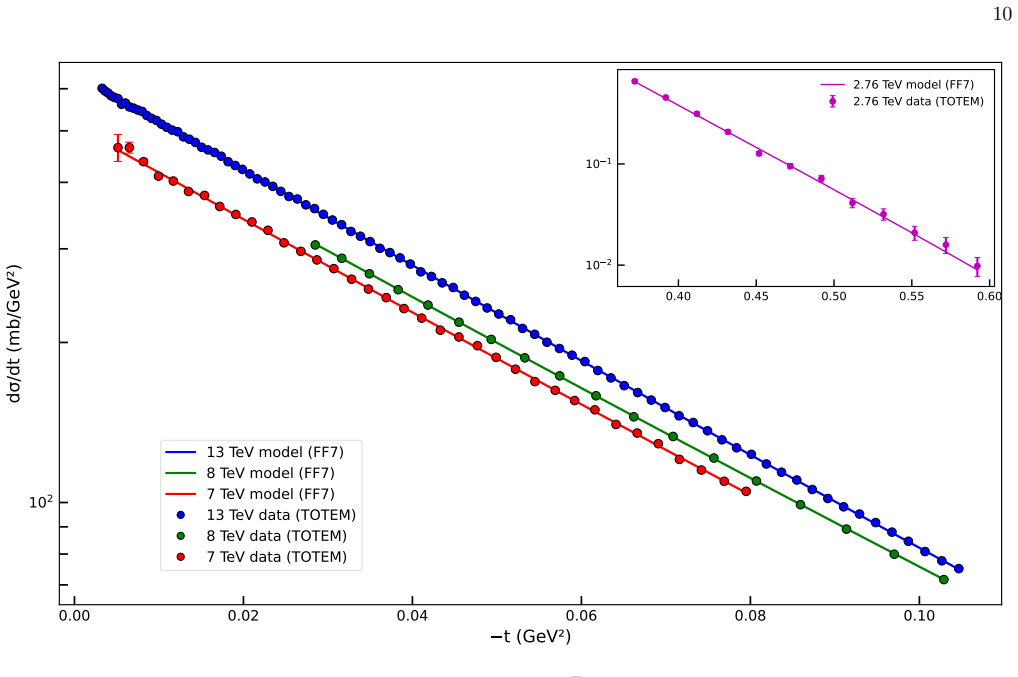
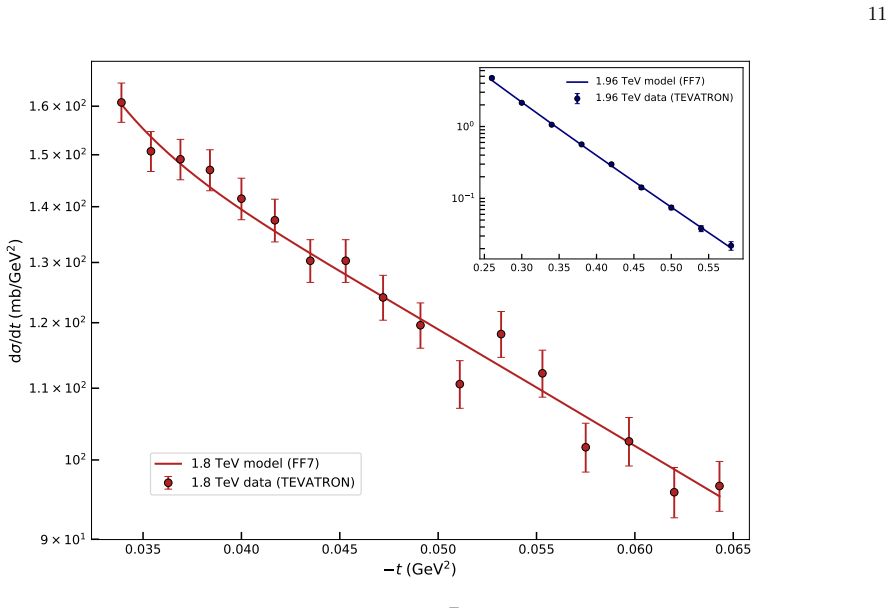
Among seven Odderon-proton form-factor parametrizations tested in a global fit to TOTEM pp data at 2.76-13 TeV and Tevatron pbarp data at 1.8-1.96 TeV, the exponential form F_O(t) = exp[-B|t|/2] gives chi^2_red = 0.98 for 138 degrees of freedom while the other six forms (dipole, polynomial, Gaussian, hybrid) give 1.44-1.48; the extracted couplings and trajectory slopes remain stable, showing that the fit improvement arises from the vertex itself rather than compensatory changes in the Regge dynamics.
What carries the argument
Covariant spin-3 projector for the Reggeized Odderon kept factorized from the scalar trajectory kernel, combined with different Odderon-proton form-factor parametrizations.
If this is right
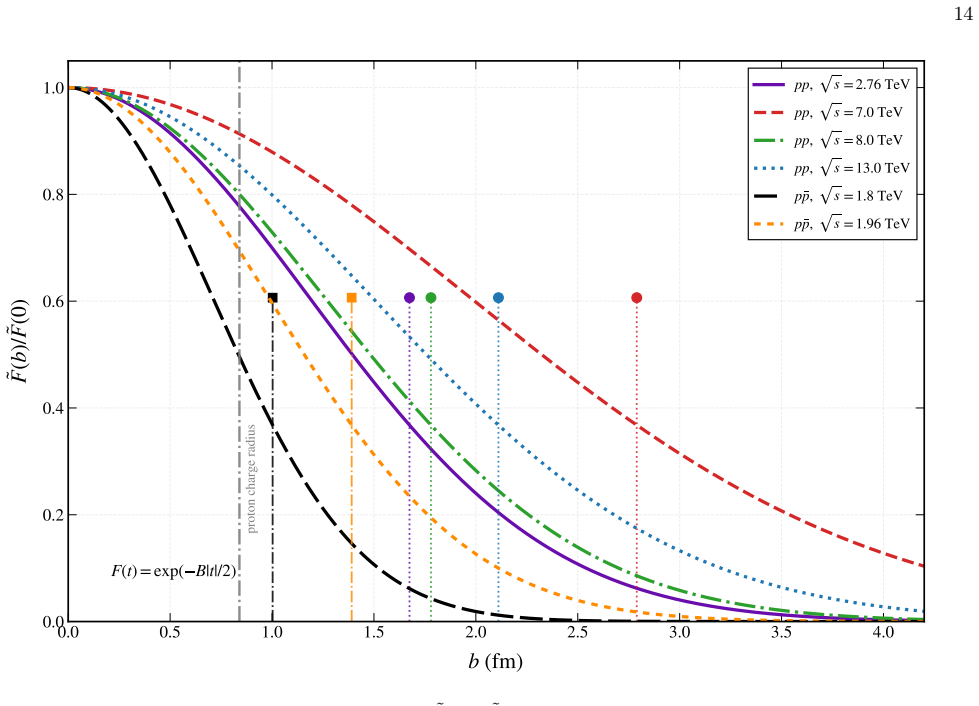
- The Odderon-proton interaction has an effective transverse radius of hadronic size corresponding to a Gaussian impact-parameter profile.
- The t-range where single-Regge exchange works shrinks with rising energy, signalling the onset of absorptive and unitarity corrections.
- The dip-bump structure difference between pp and pbarp scattering is directly tied to the transverse profile of the C-odd color-singlet exchange.
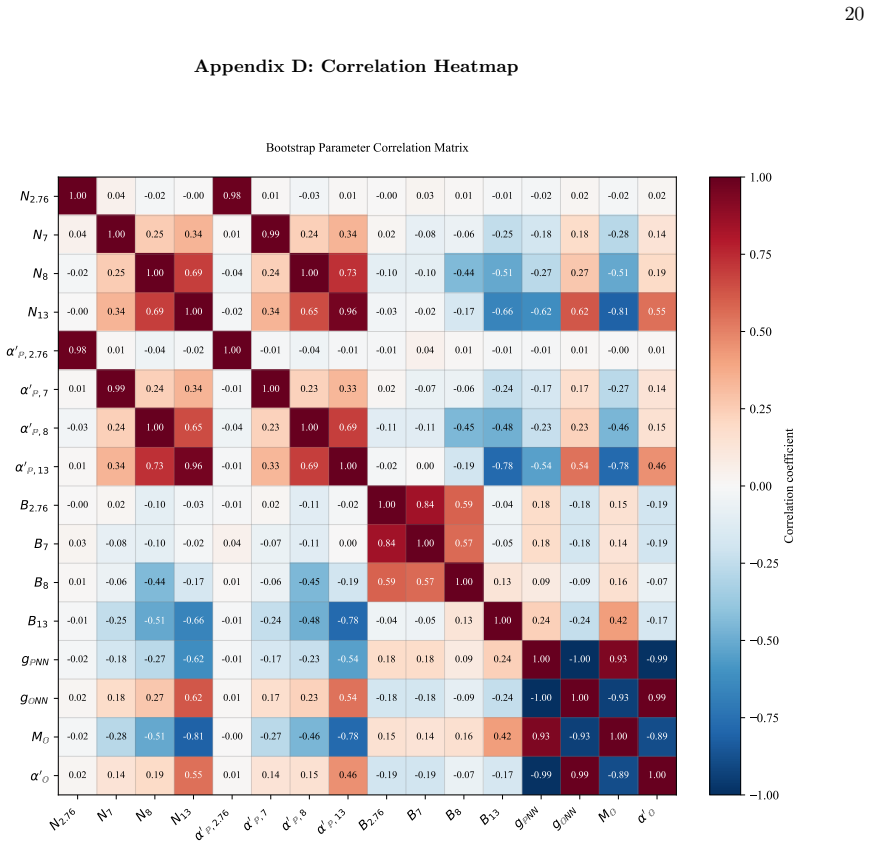
- Fitted Regge couplings and slopes are robust against the choice among the tested form factors.
Where Pith is reading between the lines
- Models of soft diffraction that treat the Odderon vertex as more peripheral than the Pomeron vertex may be preferred by data.
- Extending the same exponential form factor to higher energies could predict the rate at which the single-exchange window closes.
- Direct comparison of the extracted radius with lattice or holographic estimates of the Odderon size would test the peripheral-interaction picture.
Load-bearing premise
The single-Regge-exchange description with factorized spin projectors remains accurate throughout the fitted t-range at each energy.
What would settle it
A precise measurement of the differential cross section at energies above 13 TeV or at |t| values beyond the fitted range that deviates from the single-exchange prediction while the exponential form factor is held fixed would falsify the claim.
Figures

read the original abstract
We investigate the form-factor dependence of Reggeized tensor Pomeron and Odderon exchanges in high-energy elastic $pp$ and $p\bar p$ scattering. The spin structure is implemented through explicit covariant spin-2 and spin-3 projectors, kept factorized from the Reggeized scalar kernels, so that vertex effects can be separated from trajectory dynamics. Seven Odderon--proton form-factor parametrizations are tested against a global dataset including TOTEM $pp$ data at $\sqrt{s}=2.76$, $7$, $8$, and $13$~TeV and Tevatron $p\bar p$ data at $\sqrt{s}=1.80$ and $1.96$~TeV. A clear hierarchy is found. Six dipole, polynomial, Gaussian, and hybrid parametrizations give comparable fit qualities, $\chi^2_{\rm red}\simeq 1.44$--$1.48$, whereas a one-parameter exponential form, $F_{\mathbb O}(t)=\exp[-B|t|/2]$, yields $\chi^2_{\rm red}=0.98$ for 138 degrees of freedom. The fitted couplings and Regge slopes remain comparatively stable across the form-factor choices, indicating that the improvement is driven mainly by the Odderon--proton vertex rather than by large compensating shifts in trajectory parameters. The exponential form admits an impact-parameter interpretation as a Gaussian transverse profile, with an effective radius $\sqrt{\langle b^2\rangle}=\sqrt{2B}\,\hbar c$. The extracted radii are of hadronic size and suggest a peripheral soft Odderon interaction. The shrinking $t$-range over which the single-Regge-exchange description remains accurate at increasing energy indicates the onset of absorptive and unitarity corrections. These results provide a compact phenomenological framework for connecting the $pp/p\bar p$ dip--bump difference with the transverse structure of $C$-odd color-singlet exchange.
Editorial analysis
A structured set of objections, weighed in public.
Referee Report
Summary. The manuscript examines the dependence of Reggeized spin-2 Pomeron and spin-3 Odderon exchanges on the choice of Odderon-proton form factor in high-energy elastic pp and p¯p scattering. Using covariant spin projectors factorized from Reggeized kernels, seven form-factor parametrizations are tested in a global fit to TOTEM and Tevatron data. The authors report that an exponential form factor yields a substantially better reduced chi-squared (0.98 for 138 dof) than six other dipole, polynomial, Gaussian, and hybrid forms (χ²_red ≈ 1.44–1.48), with fitted couplings and Regge slopes remaining stable across choices.
Significance. If the single-Regge-exchange framework remains valid over the fitted kinematic range, the result indicates that the exponential Odderon form factor, interpretable as a Gaussian impact-parameter profile with hadronic radius, provides a superior description of the C-odd exchange. The explicit reporting of χ²_red values and parameter stability across models is a positive feature, offering a concrete phenomenological benchmark for future studies of the Odderon.
major comments (1)
- [Abstract] Abstract: the abstract states that 'the shrinking t-range over which the single-Regge-exchange description remains accurate at increasing energy indicates the onset of absorptive and unitarity corrections.' The global fit nevertheless incorporates data at √s = 2.76–13 TeV without apparent restriction to energy-dependent validity windows. If points outside these windows are included, the one-parameter exponential's improvement (χ²_red = 0.98) may partly compensate for missing higher-order effects rather than isolate a genuine vertex structure, weakening the claim that the hierarchy is 'driven mainly by the Odderon-proton vertex'.
Simulated Author's Rebuttal
We thank the referee for the detailed reading and the constructive comment on the abstract. We address the point below and indicate the revision we will make.
read point-by-point responses
-
Referee: [Abstract] Abstract: the abstract states that 'the shrinking t-range over which the single-Regge-exchange description remains accurate at increasing energy indicates the onset of absorptive and unitarity corrections.' The global fit nevertheless incorporates data at √s = 2.76–13 TeV without apparent restriction to energy-dependent validity windows. If points outside these windows are included, the one-parameter exponential's improvement (χ²_red = 0.98) may partly compensate for missing higher-order effects rather than isolate a genuine vertex structure, weakening the claim that the hierarchy is 'driven mainly by the Odderon-proton vertex'.
Authors: The global fit is performed uniformly over the full dataset without energy-dependent t-cuts, as the single-Regge-exchange framework is applied consistently to isolate the effect of the Odderon-proton form factor. The abstract statement on the shrinking t-range reflects the empirical observation that the model's applicability narrows with rising energy, signaling the eventual importance of absorptive corrections. The exponential form factor's markedly lower χ²_red (0.98 vs. 1.44–1.48) occurs together with stable fitted values for the Regge slopes and couplings across all seven parametrizations; such stability would be unlikely if the improvement were mainly from compensating missing higher-order terms. We therefore maintain that the hierarchy is driven primarily by the vertex. To address the concern explicitly, we will add a clarifying paragraph in the results section stating that the form-factor comparison is conducted inside the single-exchange approximation and that the observed hierarchy persists despite the model's known limitations at the highest energies. revision: yes
Circularity Check
No significant circularity detected in form-factor comparison
full rationale
The paper conducts an empirical comparison of seven Odderon-proton form-factor parametrizations by fitting each to the same global dataset of TOTEM and Tevatron elastic scattering data, then reports the resulting reduced chi-squared values (with the exponential form yielding 0.98 for 138 dof versus 1.44-1.48 for the others). This constitutes a standard model-selection exercise within a phenomenological Regge-exchange framework rather than any derivation in which a claimed result reduces by construction to its own inputs. No equations are presented that equate a fitted quantity to a prediction, no self-citations serve as load-bearing uniqueness theorems, and no ansatz is smuggled via prior work. The stability of extracted couplings and slopes is reported as an observation from the fits themselves. The analysis is therefore self-contained against external benchmarks with no circular steps.
Axiom & Free-Parameter Ledger
free parameters (3)
- B (exponential slope)
- Odderon and Pomeron couplings
- Regge slopes alpha'
axioms (2)
- domain assumption Factorization of covariant spin-2 and spin-3 projectors from the Reggeized scalar kernels
- domain assumption Single-Regge-exchange approximation is valid in the t-range used for the fits
Reference graph
Works this paper leans on
-
[1]
The parameterM 0 is a mass scale fixed toM 0 = 1 GeV
and read LP =−ig PN NPµνGµ′ν′ µν ¯ψγµ′ ← →∂ ν′ψ(1) LO = i 3 ! gON N M0 Oµνρ ψγµ′ ← →∂ ν′ ← →∂ ρ′ ψG µ′ν′ρ′ µνρ .(2) Here,P µν andO µνρ denote the spin–2 and spin–3 tensor fields associated with the Pomeron and Odderon, respec- tively. The parameterM 0 is a mass scale fixed toM 0 = 1 GeV. The fieldψrepresents the Dirac proton field, and the derivative oper...
-
[2]
(q3,ρ′ 1 +q 1,ρ′ 1)u(q 1)G µ′ 1ν′ 1ρ′ 1 µ1ν1ρ1 ∆µ1ν1ρ1;µ2ν2ρ2 O (s, t)G µ′ 2ν′ 2ρ′ 2 µ2ν2ρ2 × u(q 4)γ µ′ 2 (q4,ν′ 2 +q 2,ν′
-
[3]
(q4,ρ′ 2 +q 2,ρ′ 2)u(q 2)F 2 O (t).(7) 4 iAp¯p O =⟨¯p(q3)p(q4)|:Texp i Z LO(x)d4x ! :|¯p(q1)p(q2)⟩ = ig2 ON N 36M2 0 v(q 1)γµ′ 1 (q1,ν′ 1 +q 3,ν′
-
[4]
(q1,ρ′ 1 +q 3,ρ′ 1)v(q 3)G µ′ 1ν′ 1ρ′ 1 µ1ν1ρ1 ∆µ1ν1ρ1;µ2ν2ρ2 O (s, t)G µ′ 2ν′ 2ρ′ 2 µ2ν2ρ2 × u(q 4)γ µ′ 2 (q4,ν′ 2 +q 2,ν′
-
[5]
1 + nX α=1 q2 −M 2 O ∆2 α#−1 .(23) Alternatively, a smooth, Gaussian-type suppression of the vertex coupling can be modeled using the Gaussian form factor (FF4): F4(q2) = exp
(q4,ρ′ 2 +q 2,ρ′ 2)u(q 2)F 2 O (t).(8) Herei∆ µ1ν1;µ2ν2 P (t, s) andi∆ µ1ν1ρ1;µ2ν2ρ2 O (t, s) denote the propagators of the tensor Pomeron and the spin–3 Odd- eron, respectively. In the present work, these propagators are modeled as effective massive exchanges and written in factorized form as a Lorentz projector multiplied by a scalar propagator. The ten...
1913
-
[6]
Antchev, P
G. Antchev, P. Aspell, I. Atanassov, V. Avati, J. Baechler, C. B. Barrera, V. Berardi, M. Berretti, E. Bossini, U. Bottigli, et al., The European Physical Journal C79, 785 (2019)
2019
-
[7]
Donnachie and P
A. Donnachie and P. V. Landshoff, Nuclear Physics B244, 322 (1984)
1984
-
[8]
M. M. Block and F. Halzen, Physical Review D—Particles, Fields, Gravitation, and Cosmology86, 014006 (2012)
2012
-
[9]
I. M. Dremin, Physics—Uspekhi56, 3 (2013)
2013
-
[10]
Bourrely, J
C. Bourrely, J. Soffer, and T. T. Wu, The European Physical Journal C-Particles and Fields28, 97 (2003)
2003
- [11]
-
[12]
Differential and total cross sections of high energy proton-proton scattering in holographic QCD
A. Watanabe, PoSDIS2019, 078 (2019), 1907.01416
work page internal anchor Pith review Pith/arXiv arXiv 2019
- [13]
- [14]
- [15]
-
[16]
R. Eden, P. Landshoff, P. Olive, and J. Polkinghorne,The analytic s matrix, cambridge, uk: Univ(1966)
1966
-
[17]
G. F. Chew and S. C. Frautschi, Physical Review Letters7, 394 (1961). 16
1961
-
[18]
V. N. Gribov,The theory of complex angular momenta: Gribov lectures on theoretical physics(Cambridge University Press, 2003)
2003
-
[19]
Froissart, Physical Review123, 1053 (1961)
M. Froissart, Physical Review123, 1053 (1961)
1961
-
[20]
Amendolia, G
S. Amendolia, G. Bellettini, P. Braccini, C. Bradaschia, R. Castaldi, V. Cavasinni, C. Cerri, T. Del Prete, L. Foa, P. Giromini, et al., Physics Letters B44, 119 (1973)
1973
-
[21]
Low, Physical Review D12, 163 (1975)
F. Low, Physical Review D12, 163 (1975)
1975
-
[22]
Nussinov, Physical Review Letters35, 1672 (1975)
S. Nussinov, Physical Review Letters35, 1672 (1975)
1975
-
[23]
V. S. Fadin, E. A. Kuraev, and L. N. Lipatov, Phys. Lett. B60, 50 (1975)
1975
-
[24]
E. A. Kuraev, L. N. Lipatov, and V. S. Fadin, Sov. Phys. JETP45, 199 (1977)
1977
-
[25]
Abazov, B
V. Abazov, B. Abbott, B. Acharya, M. Adams, T. Adams, J. Agnew, G. Alexeev, G. Alkhazov, A. Alton, G. Alves, et al., Physical review letters127, 062003 (2021)
2021
-
[26]
I. Y. Pomeranchuk, Sov. Phys. JETP7, 499 (1958)
1958
-
[27]
Breakstone, H
A. Breakstone, H. Crawley, G. M. Dallavalle, K. Doroba, D. Drijard, F. Fabbri, A. Firestone, H. Fischer, H. Frehse, W. Geist, et al., Physical Review Letters54, 2180 (1985)
1985
-
[28]
Lukaszuk and B
L. Lukaszuk and B. Nicolescu, Tech. Rep., Institut de Physique Nucleaire, Paris (1973)
1973
-
[29]
Martynov and B
E. Martynov and B. Nicolescu, Physics Letters B778, 414 (2018)
2018
-
[30]
Ewerz, P
C. Ewerz, P. Lebiedowicz, O. Nachtmann, and A. Szczurek, Physics Letters B763, 382 (2016)
2016
-
[31]
Ewerz, M
C. Ewerz, M. Maniatis, and O. Nachtmann, Annals of Physics342, 31 (2014)
2014
-
[32]
J. B. Magallanes, P. Sawasdipol, C. Pongkitivanichkul, and D. Samart, Physical Review D109, 034007 (2024)
2024
-
[33]
Cs¨ org˝ o, T
T. Cs¨ org˝ o, T. Novak, R. Pasechnik, A. Ster, and I. Szanyi, The European Physical Journal C81, 180 (2021)
2021
-
[34]
Sawasdipol, J
P. Sawasdipol, J. B. Magallanes, C. Pongkitivanichkul, and D. Samart, The European Physical Journal C83, 953 (2023)
2023
-
[35]
Selyugin, Physical Review D91, 113003 (2015)
O. Selyugin, Physical Review D91, 113003 (2015)
2015
-
[36]
M. E. Peskin,An Introduction to quantum field theory(CRC press, 2018)
2018
-
[37]
Das,Lectures on quantum field theory(World Scientific, 2020)
A. Das,Lectures on quantum field theory(World Scientific, 2020)
2020
-
[38]
Mathieu, G
V. Mathieu, G. Fox, and A. P. Szczepaniak, Physical Review D92, 074013 (2015)
2015
-
[39]
Mart and A
T. Mart and A. Sari, Modern Physics Letters A28, 1350054 (2013)
2013
-
[40]
Wolfram Research, Inc.,Mathematica (Version 12.0) [Computer software](2019), URLhttps://wolfram.com
2019
-
[41]
Shtabovenko, R
V. Shtabovenko, R. Mertig, and F. Orellana, Computer Physics Communications256, 107478 (2020)
2020
-
[42]
Shtabovenko, R
V. Shtabovenko, R. Mertig, and F. Orellana, Computer Physics Communications207, 432 (2016)
2016
-
[43]
Mertig, M
R. Mertig, M. B¨ ohm, and A. Denner, Computer Physics Communications64, 345 (1991). 17 Appendix A: Fit parameters for alternative form-factor models TABLE V: Comparison of best-fit parameters obtained from Monte Carlo error propagation for the seven form-factor models (FF1–FF7) in elasticppscattering. Uncertainties are statistical only. Parameter FF1 FF2 ...
1991
discussion (0)
Sign in with ORCID, Apple, or X to comment. Anyone can read and Pith papers without signing in.