Automating proof search when equality is a logical connective
Pith reviewed 2026-05-20 03:33 UTC · model grok-4.3
The pith
An extended unification procedure automates proof search when equality is treated as a logical connective in sequent calculi.
A machine-rendered reading of the paper's core claim, the machinery that carries it, and where it could break.
Core claim
The central claim is that extending unification to all cases of quantifier alternation and both positive and negative occurrences of equations yields a complete and consistent proof search procedure for first-order sequent calculi that treat equality as a logical connective.
What carries the argument
The unification-aware proof search procedure that extends standard unification across quantifier alternations and positive/negative equation occurrences.
If this is right
- The method supports unification-aware search across a range of first-order sequent calculi.
- It enables a lightweight logical framework that directly uses this form of equality.
- Derivations of core principles such as Peano axioms become available inside automated search.
- The approach addresses the lack of direct support for this equality in systems such as lambdaProlog and LF.
Where Pith is reading between the lines
- The same extension might transfer to other introduction-rule-based connectives beyond equality.
- An implementation could be checked for completeness on standard first-order equality examples.
- The technique may reduce the need for separate equality axioms in certain logical frameworks.
Load-bearing premise
The procedure correctly extends unification to every combination of quantifier alternation and equation polarity without creating incompleteness or inconsistency.
What would settle it
A concrete sequent containing alternating quantifiers and mixed-polarity equations for which the procedure either misses an existing proof or accepts an invalid one.
Figures

read the original abstract
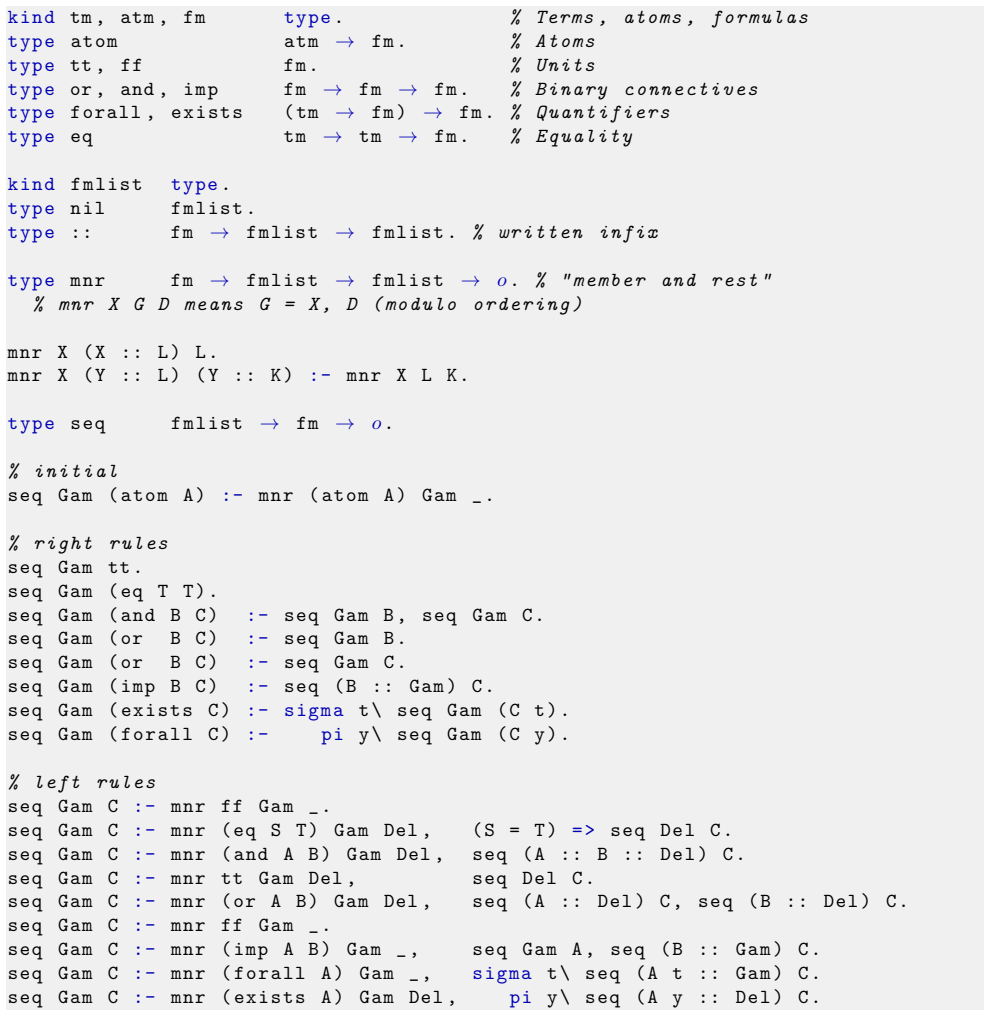
Treating syntactic equality as a logical connective -- governed by left- and right-introduction rules within the sequent calculus -- offers an elegant and powerful approach to term identity. This treatment of equality allows for the derivation of core mathematical principles, such as Peano's axioms (excluding induction), and serves as a foundation for the Abella interactive proof assistant. However, integrating this equality into automated proof search remains challenging. We present a proof search procedure that extends unification to handle the complexities of quantifier alternation and equations that occur in both positive and negative occurrences. While established logical frameworks such as $\lambda$Prolog and LF lack direct support for this kind of equality, our procedure enables a lightweight logical framework that addresses this gap. Our system enables unification-aware proof search across a diverse range of first-order sequent calculi that can directly use this form of equality.
Editorial analysis
A structured set of objections, weighed in public.
Referee Report
Summary. The paper presents a proof search procedure for first-order sequent calculi in which equality is treated as a logical connective with explicit left- and right-introduction rules. The central contribution is an extension of unification that handles quantifier alternation and equations in both positive and negative positions while preserving sequent calculus invariants. The manuscript supplies the inference rules for the extended procedure together with a termination argument based on a lexicographic measure combining the multiset of goals and the depth of quantifier nesting.
Significance. If the procedure is terminating and complete for the stated fragment, the result would enable unification-aware automated proof search in lightweight logical frameworks that directly support equality as a connective, addressing a documented gap relative to systems such as λProlog and LF. The explicit construction of inference rules and the termination argument based on a lexicographic measure on goals and quantifier depth constitute concrete strengths that support the central claim.
major comments (1)
- [§4.2] §4.2 (Unification extension): the claim that the procedure correctly handles all quantifier alternations for negative equation occurrences rests on the preservation of sequent invariants, yet the manuscript does not exhibit a derivation showing how the new rules interact with ∀-L when the equation is introduced after quantifier movement; this case is load-bearing for the completeness argument.
minor comments (3)
- [§3] The notation distinguishing positive and negative equation occurrences is introduced in §3 without a small worked example that displays both polarities in the same sequent; adding one would improve readability.
- [Table 1] Table 1 (example derivations) reports success on a Peano axiom fragment but does not list the number of unification steps or the final measure value; including these would make the termination claim easier to inspect.
- [Introduction] The reference list omits the original Abella paper on equality as a connective; adding it would strengthen the positioning in the introduction.
Simulated Author's Rebuttal
We thank the referee for the careful reading and positive evaluation of the manuscript. The single major comment identifies a useful way to make the completeness argument more explicit, and we address it directly below.
read point-by-point responses
-
Referee: §4.2 (Unification extension): the claim that the procedure correctly handles all quantifier alternations for negative equation occurrences rests on the preservation of sequent invariants, yet the manuscript does not exhibit a derivation showing how the new rules interact with ∀-L when the equation is introduced after quantifier movement; this case is load-bearing for the completeness argument.
Authors: We agree that an explicit derivation would make the interaction between the extended unification rules and ∀-L clearer for negative equation occurrences after quantifier movement. The manuscript already states that the rules are designed to preserve sequent invariants, but we acknowledge that a concrete step-by-step derivation for this specific case would strengthen the completeness argument. In the revised version we will insert such a derivation in §4.2, showing how the new rules apply while maintaining the required invariants. revision: yes
Circularity Check
No significant circularity identified
full rationale
The paper constructs a unification-aware proof search procedure for sequent calculi treating equality as a logical connective by explicitly extending standard unification with new introduction rules for equations and quantifier movements. It supplies the inference rules directly and proves termination via a lexicographic measure on goals and quantifier depth, preserving sequent invariants. No load-bearing step reduces by definition or self-citation to its own inputs; the derivation is self-contained with independent content against the stated fragment.
Axiom & Free-Parameter Ledger
axioms (1)
- domain assumption Sequent calculus admits left and right introduction rules for syntactic equality as a logical connective.
Lean theorems connected to this paper
-
IndisputableMonolith/Foundation/ArithmeticFromLogic.leanLogicNat ≃ Nat (recovery theorem) echoes?
echoesECHOES: this paper passage has the same mathematical shape or conceptual pattern as the Recognition theorem, but is not a direct formal dependency.
Treating syntactic equality as a logical connective... derivation of core mathematical principles, such as Peano's axioms (excluding induction)
What do these tags mean?
- matches
- The paper's claim is directly supported by a theorem in the formal canon.
- supports
- The theorem supports part of the paper's argument, but the paper may add assumptions or extra steps.
- extends
- The paper goes beyond the formal theorem; the theorem is a base layer rather than the whole result.
- uses
- The paper appears to rely on the theorem as machinery.
- contradicts
- The paper's claim conflicts with a theorem or certificate in the canon.
- unclear
- Pith found a possible connection, but the passage is too broad, indirect, or ambiguous to say the theorem truly supports the claim.
Reference graph
Works this paper leans on
-
[1]
Baelde, D., Chaudhuri, K., Gacek, A., Miller, D., Nadathur, G., Tiu, A., Wang, Y.: Abella: A sys- tem for reasoning about relational specifications. J. of Formalized Reasoning7(2), 1–89 (2014). DOI: 10.6092/issn.1972-5787/4650
-
[2]
Baelde, D., Gacek, A., Miller, D., Nadathur, G., Tiu, A.: The Bedwyr system for model checking over syntactic expressions. In: Pfenning, F. (ed.) 21th Conf. on Automated Deduction (CADE). pp. 391–397. No. 4603 in LNAI, Springer, New York (2007). DOI: 10.1007/978-3-540-73595-3_28, https://www.lix.polytechnique. fr/Labo/Dale.Miller/papers/cade2007.pdf 11
-
[3]
Blanco, R., Chihani, Z., Miller, D.: Translating between implicit and explicit versions of proof. In: de Moura, L. (ed.) Automated Deduction - CADE 26 - 26th International Conference on Automated Deduction, Gothen- burg, Sweden, August 6-11, 2017, Proceedings. LNCS, vol. 10395, pp. 255–273. Springer (2017). DOI: 10.1007/978-3-319-63046-5_16
-
[4]
Chihani, Z., Libal, T., Reis, G.: The proof certifier Checkers. In: Nivelle, H.D. (ed.) Proceedings of the 24th Automated Reasoning with Analytic Tableaux and Related Methods (TABLEAUX). pp. 201–210. No. 9323 in LNCS, Springer (2015). DOI:10.1007/978-3-319-24312-2_14
-
[5]
Chihani, Z., Miller, D., Renaud, F.: A semantic framework for proof evidence. J. of Automated Reasoning 59(3), 287–330 (2017). DOI:10.1007/s10817-016-9380-6
-
[6]
Church, A.: A formulation of the Simple Theory of Types. J. of Symbolic Logic5, 56–68 (1940). DOI: 10.2307/2266170
-
[7]
Journal of Symbolic Computation7, 371–425 (1989)
Comon, H., Lescanne, P.: Equational problems and disunification. Journal of Symbolic Computation7, 371–425 (1989). DOI:10.1016/S0747-7171(89)80017-3
-
[8]
Dowek, G.: Third order matching is decidable. Ann. Pure Appl. Log.69(2-3), 135–155 (1994). DOI: 10.1016/0168-0072(94)90083-3
-
[9]
Felty, A., Miller, D.: Specifying theorem provers in a higher-order logic programming language. In: Lusk, E., Overbeck, R. (eds.) Ninth International Conference on Automated Deduction. pp. 61–80. No. 310 in LNCS, Springer, Argonne, IL (May 1988). DOI:10.1007/BFb0012823
-
[10]
The Journal of Logic Programming37(1), 95–138 (1998)
Fr¨ uhwirth, T.: Theory and practice of constraint handling rules. The Journal of Logic Programming37(1), 95–138 (1998). DOI:10.1016/S0743-1066(98)10005-5
-
[11]
Untersuchungen über das logische Schließen. I
Gentzen, G.: Investigations into logical deduction. In: Szabo, M.E. (ed.) The Collected Papers of Gerhard Gentzen, pp. 68–131. North-Holland, Amsterdam (1935). DOI: 10.1007/BF01201353, translation of articles that appeared in 1934-35. Collected papers appeared in 1969
-
[12]
Girard, J.Y.: A fixpoint theorem in linear logic (Feb 1992), an email posting to linear@cs.stanford.edu archived athttps://www.seas.upenn.edu/ ~sweirich/types/archive/1992/msg00030.html
work page 1992
-
[13]
Cambridge University Press (1989)
Girard, J.Y., Taylor, P., Lafont, Y.: Proofs and Types. Cambridge University Press (1989)
work page 1989
-
[14]
Journal of the ACM40(1), 143–184 (1993)
Harper, R., Honsell, F., Plotkin, G.: A framework for defining logics. Journal of the ACM40(1), 143–184 (1993). DOI:10.1145/138027.138060
-
[15]
In: Proceedings of the 3rd International Joint Conference on Artificial Intelligence
Huet, G.P.: A mechanization of type theory. In: Proceedings of the 3rd International Joint Conference on Artificial Intelligence. pp. 139–146. William Kaufmann (1973)
work page 1973
-
[16]
Theoretical Computer Science1, 27–57 (1975)
Huet, G.P.: A unification algorithm for typed λ-calculus. Theoretical Computer Science1, 27–57 (1975). DOI: 10.1016/0304-3975(75)90011-0
-
[17]
In: Proceedings of the 14th ACM Symposium on the Principles of Programming Languages
Jaffar, J., Lassez, J.L.: Constraint logic programming. In: Proceedings of the 14th ACM Symposium on the Principles of Programming Languages. ACM (1987)
work page 1987
-
[18]
Annals of Mathematics and Artificial Intelligence90(5), 455–479 (2022)
Libal, T., Miller, D.: Functions-as-constructors higher-order unification: extended pattern unification. Annals of Mathematics and Artificial Intelligence90(5), 455–479 (2022). DOI: 10.1007/s10472-021-09774-y, appears in theSpecial Issue on Theoretical and Practical Aspects of Unification
-
[19]
Theoretical Computer Science232, 91–119 (2000)
McDowell, R., Miller, D.: Cut-elimination for a logic with definitions and induction. Theoretical Computer Science232, 91–119 (2000). DOI:10.1016/S0304-3975(99)00171-1
-
[20]
Miller, D.: A logic programming language with lambda-abstraction, function variables, and simple unification. J. of Logic and Computation1(4), 497–536 (1991). DOI:10.1093/logcom/1.4.497
-
[21]
Journal of Symbolic Computation14(4), 321–358 (1992)
Miller, D.: Unification under a mixed prefix. Journal of Symbolic Computation14(4), 321–358 (1992). DOI: 10.1016/0747-7171(92)90011-R
-
[22]
Theory and Practice of Logic Programming24(6), 1123–1162 (Nov 2024)
Miller, D., Momigliano, A.: Property-based testing by elaborating proof outlines. Theory and Practice of Logic Programming24(6), 1123–1162 (Nov 2024). DOI:10.1017/S1471068424000176 12
-
[23]
Cambridge University Press (Jun 2012)
Miller, D., Nadathur, G.: Programming with Higher-Order Logic. Cambridge University Press (Jun 2012). DOI: 10.1017/CBO9781139021326
-
[24]
Annals of Pure and Applied Logic51(1–2), 125–157 (1991)
Miller, D., Nadathur, G., Pfenning, F., Scedrov, A.: Uniform proofs as a foundation for logic programming. Annals of Pure and Applied Logic51(1–2), 125–157 (1991). DOI:10.1016/0168-0072(91)90068-W
-
[25]
Miller, D., Tiu, A.: A proof theory for generic judgments. ACM Trans. on Computational Logic6(4), 749–783 (Oct 2005). DOI:10.1145/1094622.1094628
-
[26]
Annals of Mathematics and Artificial Intelligence90(5), 523–535 (2022)
Miller, D., Viel, A.: Proof search when equality is a logical connective. Annals of Mathematics and Artificial Intelligence90(5), 523–535 (2022). DOI: 10.1007/s10472-021-09764-0,Special Issue on Theoretical and Practical Aspects of Unification
-
[27]
Journal of Automated Reasoning 11(1), 115–145 (Aug 1993)
Nadathur, G.: A proof procedure for the logic of hereditary Harrop formulas. Journal of Automated Reasoning 11(1), 115–145 (Aug 1993). DOI:10.1007/BF00881902
-
[28]
Pfenning, F.: Logic programming in the LF logical framework. In: Huet, G., Plotkin, G. (eds.) Logical Frameworks. pp. 149–181. Cambridge University Press (1991)
work page 1991
-
[29]
In: Robinson, J.A., Voronkov, A
Pfenning, F.: Logical frameworks. In: Robinson, J.A., Voronkov, A. (eds.) Handbook of Automated Reasoning (in 2 volumes), pp. 1063–1147. Elsevier and MIT Press (2001)
work page 2001
-
[30]
Pfenning, F., Sch¨ urmann, C.: System description: Twelf — A meta-logical framework for deductive systems. In: Ganzinger, H. (ed.) 16th Conf. on Automated Deduction (CADE). pp. 202–206. No. 1632 in LNAI, Springer, Trento (1999). DOI:10.1007/3-540-48660-7_14
-
[31]
Journal of Functional Programming23(1), 1–37 (2013)
Pientka, B.: An insider’s look at LF type reconstruction: everything you (n)ever wanted to know. Journal of Functional Programming23(1), 1–37 (2013). DOI:10.1017/S0956796812000408
-
[32]
In: Siekmann, J.H., Wrightson, G
Robinson, G., Wos, L.: Paramodulation and theorem-proving in first-order theories with equality. In: Siekmann, J.H., Wrightson, G. (eds.) Automation of Reasoning, pp. 298–313. Symbolic Computation, Springer Berlin Heidelberg (1983). DOI:10.1007/978-3-642-81955-1_19
-
[33]
Schroeder-Heister, P.: Rules of definitional reflection. In: Vardi, M. (ed.) 8th Symp. on Logic in Computer Science. pp. 222–232. IEEE Computer Society Press, IEEE (Jun 1993). DOI:10.1109/LICS.1993.287585
-
[34]
Tassi, E.: Elpi: rule-based meta-languge for Rocq. In: Proceedings of CoqPL 2025. ACM (Jan 2025) A Provability from the empty logic program Consider the simple case of the empty logic program and the two classes of (first-order), atom-free formulas defined by the following recursive definition (taken from [26]): Φ ::= Φ1 ∧Φ 2 | ∃ σx.Φ| ∀ σx.Φ|Ψ Ψ ::=t 1 =...
work page 2025
discussion (0)
Sign in with ORCID, Apple, or X to comment. Anyone can read and Pith papers without signing in.