Superconductivity in the high-pressure tetragonal phase of UTe2
Pith reviewed 2026-06-27 20:00 UTC · model grok-4.3
The pith
Tetragonal UTe2 under pressure shows conventional superconductivity with upper critical field below the Pauli limit.
A machine-rendered reading of the paper's core claim, the machinery that carries it, and where it could break.
Core claim
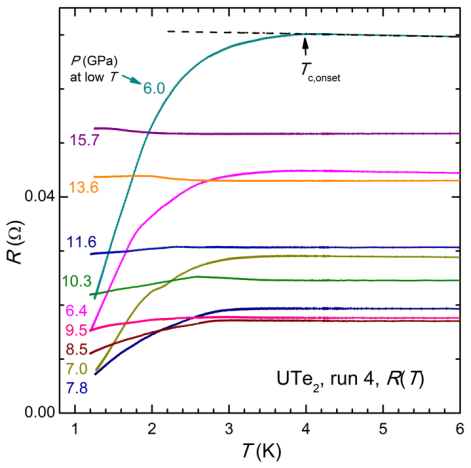
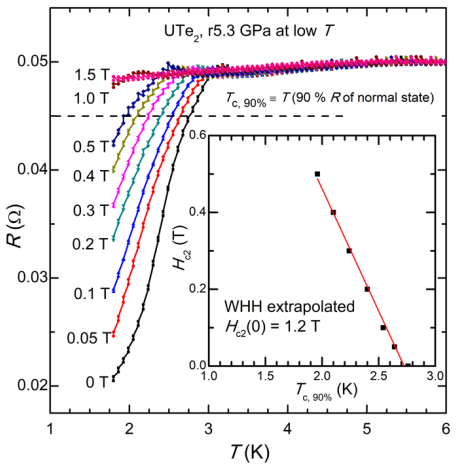
In the tetragonal phase of UTe2, superconductivity emerges near the orthorhombic-to-tetragonal transition at 5 GPa, reaches a maximum Tc of approximately 4 K at 6 GPa, and disappears near 18 GPa. The upper critical field Hc2(0) is only about 1.2 T at 5.3 GPa, lies below the Pauli paramagnetic limit, and is orbitally limited with coherence length 16.5 nm, favoring conventional superconductivity. This contrasts with the orthorhombic phase, where Hc2 exceeds the Pauli limit in all three directions and has been attributed to unconventional spin-triplet pairing. The resulting temperature-pressure diagram shows a broad robust superconducting dome in the tetragonal phase versus a narrow fragile reg
What carries the argument
Upper critical field Hc2 compared against the Pauli paramagnetic limit, used to distinguish conventional from unconventional pairing across the pressure-driven structural transition.
If this is right
- Superconductivity in the tetragonal phase forms a broad dome spanning roughly 5 to 18 GPa.
- Absence of U-dimers in the tetragonal structure correlates with the switch to conventional pairing.
- A knee in resistivity between 200 and 240 K marks the likely onset of magnetic order that coexists with superconductivity.
- The structural transition itself toggles the material between unconventional and conventional superconducting regimes.
Where Pith is reading between the lines
- Pressure may act as a clean tuning knob to switch pairing symmetry within a single compound without altering chemistry.
- Similar dimer-dependent mechanisms could operate in other uranium heavy-fermion superconductors under compression.
- Transport or thermodynamic probes that track the magnetic transition across the superconducting dome would test coexistence directly.
Load-bearing premise
That staying below the Pauli paramagnetic limit reliably indicates conventional pairing while exceeding it indicates unconventional spin-triplet pairing.
What would settle it
Direct measurement showing the superconducting gap or spin susceptibility consistent with spin-triplet pairing in the tetragonal phase, or observation of Hc2 exceeding the Pauli limit there.
Figures


read the original abstract
Electrical transport and magnetic measurements have been made on UTe2 under pressure P up to approximately 16 GPa to determine the superconducting transition temperature Tc vs P phase diagram in the high-pressure tetragonal phase. Superconductivity emerges near 5 GPa, coincident with the orthorhombic to tetragonal phase transition; in the tetragonal phase, Tc reaches a maximum value of approximately 4 K at 6 GPa and then decreases with P and appears to vanish near 18 GPa. Tetragonal UTe2 has a relatively small upper critical field Hc2(0) $\approx$ 1.2 T at 5.3 GPa, smaller than the Pauli paramagnetic limit, and is orbitally limited with a coherence length $\xi$tetra $\approx$ 16.5 nm. This small value of Hc2(0) favors more conventional superconductivity; in contrast, the large values of Hc2(T) for orthorhombic UTe2 exceed the Pauli paramagnetic limit in all three crystallographic directions and have been attributed to unconventional superconductivity, widely believed to involve spin-triplet pairing. The temperature-pressure phase diagram of UTe2 shows a striking dichotomy: a narrow, fragile, unconventional superconducting region in the orthorhombic phase vs a broad, robust, and more conventional superconducting dome in the tetragonal phase. This dichotomy is consistent with the proposal that U-dimers, present (absent) in the orthorhombic (tetragonal) phase, may play a role in spin-triplet superconductivity of orthorhombic UTe2. In the tetragonal phase, the normal-state electrical resistivity $\rho$(T) exhibits metallic behavior with a knee between 200 and 240 K that depends weakly on P and most likely marks the onset of a transition to a magnetically ordered phase that coexists with superconductivity.
Editorial analysis
A structured set of objections, weighed in public.
Referee Report
Summary. The manuscript reports electrical transport and magnetic measurements on UTe2 under hydrostatic pressure up to ~16 GPa. Superconductivity onsets near 5 GPa coincident with the orthorhombic-to-tetragonal structural transition; in the tetragonal phase a Tc dome is mapped with maximum Tc ≈ 4 K near 6 GPa that vanishes near 18 GPa. At 5.3 GPa the upper critical field is reported as Hc2(0) ≈ 1.2 T, below the Pauli paramagnetic limit, orbitally limited, and yielding a coherence length ξtetra ≈ 16.5 nm; this is interpreted as evidence for conventional superconductivity. In contrast, the orthorhombic phase exhibits Hc2 values exceeding the Pauli limit in all directions, previously linked to spin-triplet pairing. The normal-state resistivity shows a knee at 200–240 K attributed to the onset of magnetic order that coexists with superconductivity. The work emphasizes a dichotomy between a narrow unconventional SC region in the orthorhombic phase and a broad conventional dome in the tetragonal phase, consistent with a proposed role for U-dimers.
Significance. If the reported Hc2 values, phase boundaries, and structural coincidence hold under scrutiny, the results supply direct experimental contrast between pairing regimes in the two UTe2 structures and link the difference to the presence or absence of U-dimers. The data on the pressure evolution of Tc and the resistivity knee provide a concrete platform for testing models of spin-triplet versus conventional superconductivity in heavy-fermion systems and for exploring coexistence of magnetism and superconductivity.
minor comments (3)
- The abstract states Hc2(0) ≈ 1.2 T at 5.3 GPa and ξtetra ≈ 16.5 nm but does not specify the extrapolation procedure (e.g., WHH fit or linear extrapolation) or the precise value of the Pauli limit used for comparison; a short methods paragraph or supplementary note would strengthen the claim that the field is orbitally limited.
- The resistivity knee is reported between 200 and 240 K with weak P dependence; the manuscript should clarify whether this feature is identified from dρ/dT maxima, inflection points, or another criterion, and whether its pressure evolution is shown in a dedicated panel.
- The phase diagram figure (presumably Fig. 1 or equivalent) would benefit from explicit error bars on Tc(P) points and from indicating the pressure range over which the tetragonal structure is confirmed by diffraction or other probes.
Simulated Author's Rebuttal
We thank the referee for their careful reading of our manuscript and for the positive recommendation of minor revision. The report provides a clear summary of our results but does not raise any specific major comments requiring point-by-point responses.
Circularity Check
No significant circularity; purely experimental
full rationale
The manuscript consists of electrical transport and magnetic measurements under pressure, reporting direct observations of the Tc(P) phase diagram, Hc2(0) ≈ 1.2 T, coherence length ξtetra ≈ 16.5 nm, and resistivity features. All load-bearing claims are experimental data or standard interpretive mappings from established superconductivity theory (Pauli limit, orbital limiting). No derivations, fitted parameters, or equations are present that reduce to inputs by construction, and no self-citation chains support central results. The paper is self-contained against external benchmarks as a measurement study.
Axiom & Free-Parameter Ledger
axioms (1)
- domain assumption Standard assumptions in high-pressure superconductivity experiments regarding accurate pressure determination and structural phase identification at the orthorhombic-tetragonal transition.
Reference graph
Works this paper leans on
-
[1]
[Ambika22] D. V. Ambika et al., Possible coexistence of antiferromagnetic and ferromagnetic spin fluctuations in the spin -triplet superconductor UTe2 revealed by 125Te NMR under pressure. Phys. Rev. B 105, L220403 (2022). [Aoki19] D. Aoki et al., Unconventional superconductivity in heavy fermion UTe
2022
-
[2]
J. Phys. Soc. Jpn. 88, 043702 (2019). [Aoki24] D. Aoki, Molten salt flux liquid transport method for ultra clean single crystals UTe2. J. Phys. Soc. Jpn. 93, 043703 (2024). [Braithwaite19] D. Braithwaite et al., Multiple superconducting phases in a nearly ferromagnetic system. Commun. Phys. 2, 147 (2019). [Butch22] N. P. Butch et al., Symmetry of magnetic...
2019
-
[3]
https://doi.org/10.48550/arXiv.2112.14750
arXiv [Preprint] (2021). https://doi.org/10.48550/arXiv.2112.14750. Accessed 29 December
-
[4]
Deng et al., Structural transition and uranium valence change in UTe2 at high pressure revealed by x-ray diffraction and spectroscopy
[Deng24] Y. Deng et al., Structural transition and uranium valence change in UTe2 at high pressure revealed by x-ray diffraction and spectroscopy. Phys. Rev. B 110, 075140 (2024). [Duan20] C. Duan et al ., Incommensurate spin fluctuations in the spin -triplet superconductor candidate UTe2. Phys. Rev. Lett. 125, 237003 (2020). [Duan21] C. Duan et al ., Res...
2024
-
[5]
[Ho66] J. C. Ho, N. E. Phillips, and T. F. Smith, Heat capacity of α uranium at a pressure of 10 kbar, between 0.3 and 6° K. Phys. Rev. Lett. 17, 694 (1966). [Honda23] F. Honda et al., Pressure-induced structural phase transition and new superconducting phase in UTe2. J. Phys. Soc. Jpn. 92, 044702 (2023). [Huston22] L. Q. Huston et al., Metastable phase o...
1966
-
[6]
Proc. Natl. Acad. Sci. U.S.A. 122, e2419734122 (2025). [Lin20] L. Jiao et al., Chiral superconductivity in heavy -fermion metal UTe
2025
-
[7]
[Maple72] M
Nature 579, 523– 527 (2020). [Maple72] M. B. Maple and D. Wohlleben, Superconducting transition temperature and magnetic susceptibility of polycrystalline a-Uranium under pressure. Phys. Lett. 38A, 351 (1972). [Matthias66] B. T. Matthias et al ., Superconductivity of beta -uranium. Science 151, 985 –986 (1966). [Moir25] C. M. Moir et al ., High -magnetic-...
2020
-
[8]
Phys. Rev. Lett. 134, 096501 (2025). [Wilhelm23] F. Wilhelm et al ., Investigating the electronic states of UTe 2 using X -ray spectroscopy. Commun. Phys. 6, 96 (2023). [Wu24] Z. Wu et al., Enhanced triplet superconductivity in next-generation ultraclean UTe2. Proc. Natl. Acad. Sci. U.S.A. 121, e2403067121 (2024). [Yang25] Z. Yang et al., Spectroscopic ev...
2025
discussion (0)
Sign in with ORCID, Apple, or X to comment. Anyone can read and Pith papers without signing in.