REVIEW 4 major objections 6 minor 26 references
Blind dynamic range compression can be inverted by treating parameter estimation as black-box optimization in a perceptual histogram feature space.
Reviewed by Pith at T0; open to challenge. T0 means a machine referee read the full paper against a public rubric. the ladder, T0–T4 →
T0 review · deepseek-v4-flash
2026-08-01 12:06 UTC pith:733FPQCM
load-bearing objection Plausible black-box DRC inversion with a useful new feature-space formulation, but the dry-centroid reference and missing split details mean the evaluation needs a closer look. the 4 major comments →
Black-Box Optimization for Identifying and Inverting Audio Dynamic Range Control Effects
The pith
A machine-rendered reading of the paper's core claim, the machinery that carries it, and where it could break.
Core claim
On the paper's own terms, the central claim is that minimizing a Euclidean distance in a three-dimensional dynamic-histogram feature space between the output of a model-based inverse compressor and a fixed dry-signal centroid is a viable formulation of blind DRC inversion. The authors find that the dynamic histogram statistics DH1, DH4, and DH5 rank highest under a matched success-rate criterion: for about 91% of compressed examples, feature-space inversion moves the signal closer to the dry reference than the processed signal itself. With this objective, pattern search and Bayesian optimization recover compressor parameters and dry signals that compete with or beat supervised deep-learning
What carries the argument
The load-bearing object is the composite objective: minimize over candidate compressor parameters the Euclidean distance between the perceptually motivated features of the signal reconstructed by an inverse DRC model and a reference feature vector, where the reference is the centroid of standardized dry-signal features computed from the training set. The feature space is built from the dynamic histogram, a time-aggregated distribution of signal amplitudes from which eight summary statistics are drawn; three of them (DH1, DH4, DH5) are selected by a success-rate criterion and define the space used in optimization. Because these histogram operations are non-differentiable, the paper avoids gra
Load-bearing premise
The optimization target is the centroid of training dry-signal features; if the true dry signal falls outside that distribution, minimizing distance to the centroid will favor an average-sounding reconstruction over the actual one.
What would settle it
Take held-out dry signals whose dynamic-histogram coordinates lie far outside the training cloud, compress them with known parameters, and run the method; if the recovered parameters are no closer to the truth than the fixed-average anchor, or the recovered SI-SDR does not beat the anchor, the centroid reference is the load-bearing assumption that fails.
If this is right
- Blind inversion of any nonlinear audio effect with an available forward/inverse model can be attempted by the same black-box loop, provided a feature space with a high success rate can be found.
- Three dynamic-histogram statistics are sufficient to guide DRC inversion, so the expensive part of the pipeline may be feature selection rather than model capacity.
- A learned parameter estimator is not needed as a final predictor; its value is as an initialization and regularizer that steers derivative-free search, which changes how hybrid audio-restoration systems are designed.
- Bayesian optimization gives most of the quality gain of pattern search at a fraction of the compute, making test-time DRC inversion practical on a CPU.
Where Pith is reading between the lines
- The paper leaves implicit that a per-example dry reference — say genre-conditioned or estimated from the observed signal's own histogram — would likely reduce bias when the true dry signal is atypical; this is my inference, not the paper's.
- A direct extension is to replace the three hand-picked histogram statistics with learned embeddings inside the same non-differentiable objective; if embeddings close the compression-expansion gap, the histogram space is the bottleneck, and if not, the optimizer is.
- The success-rate criterion could be reused as a generic feature-selection tool for other effects, turning the paper's recipe into a template rather than a single-task fix.
Editorial analysis
A structured set of objections, weighed in public.
Referee Report
Summary. The paper proposes a black-box optimization framework for blind estimation of dynamic range compressor (DRC) parameters and dry-signal recovery. The observed compressed/expanded signal is inverted with a model-based DRC^{-1} parameterized by a candidate θ, and the parameters are optimized by Pattern Search or Bayesian Optimization to minimize the Euclidean distance between the feature vector of the reconstructed signal and a reference feature vector, defined as the centroid of training dry-signal features in a 3D dynamic-histogram space (DH1, DH4, DH5). A prior from a Music Effect Encoder (MEE) is incorporated as a regularizer/init. Experiments on MedleyDB excerpts compare to MEE and CleanUMamba, reporting feature-space distance, parameter MSE, SI-SDR, Mel loss, and 2f-score.
Significance. The derivative-free formulation is the paper's main strength: it allows non-differentiable, histogram-based features to be used as optimization targets, which is a genuine extension of differentiable-DSP approaches. The selected dynamic-histogram features appear to move reconstructions closer to dry references on the evaluated corpus. However, the evaluation has a serious circularity issue: the feature space is selected using the same distance metric used for evaluation, and the dry-reference centroid is not validated on held-out or out-of-distribution signals. The independent metrics show partial but not uniform improvements over a fixed-parameter anchor, with a large gap to the oracle. Thus, the evidence is not yet sufficient to support the general claim of outperforming state-of-the-art.
major comments (4)
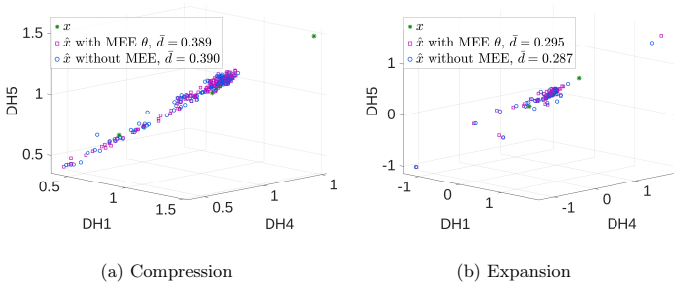
- [Sec. 5.1 / Sec. 5.3.1 / Eq. (8)] The paper states that normalization statistics and ϕ_ref are computed exclusively from the training set, but Sec. 5.1 describes only 25 MedleyDB excerpts with no explicit train/test split. As far as the evaluation is described, the same 25 excerpts are used to define the dry centroid and to compute Table 3, making the reported feature-space distances in-sample. Because Eq. (8) minimizes distance to this centroid, a test signal whose dry feature vector is far from the centroid will be pulled toward the average dry signal. Please clarify the experimental split, run a leave-one-genre-out or held-out-excerpt evaluation, and report how performance depends on the distance between test dry features and the centroid.
- [Sec. 4.2 / Eq. (7) / Table 3] The feature space is selected using a success rate defined by comparing feature-space distances to the true dry signal (Eq. 7), and the primary reconstruction metric in Table 3 is exactly the same feature-space distance (to the centroid). This circularity means the headline numbers reflect the selection criterion more than the actual audio quality. The independent metrics in Fig. 4 are more encouraging (e.g., compression 2f-score 49 vs anchor 16, Mel 0.32 vs 3), but SI-SDR gains over the fixed-parameter anchor are small (15 vs 13 dB), and the gap to the oracle remains large (SI-SDR 45 dB, 2f-score 90). The central claim should be re-based on the independent metrics or qualified as a proxy evaluation.
- [Sec. 6 / Table 3] The reported parameter MSE is worse for the proposed optimization than for direct MEE estimation in the compression task (Pattern Search 0.36, Bayesian 0.23, Bayes+MEE 0.19 vs MEE 0.05). The paper's abstract claims competitive blind parameter estimation, but the method appears to sacrifice parameter accuracy for feature-space closeness. Moreover, optimizing a 6-dimensional parameter vector against a 3-dimensional feature objective is underdetermined; multiple parameter settings can yield the same feature distance. Please discuss identifiability and either moderate the parameter-estimation claim or evaluate parameter accuracy on a separate task.
- [Fig. 4 / Sec. 5.3.2] The anchor baseline uses a single fixed average parameter vector; this is a weak baseline. Direct MEE outperforms Pattern Search on expansion SI-SDR (14 vs 13 dB) and is comparable on 2f-score, so the stated claim of outperforming or matching state-of-the-art is only partially supported by the independent metrics. Please add stronger supervised baselines (e.g., a dedicated DRC-parameter estimator trained on the same profiles) and run significance tests across the 25 excerpts.
minor comments (6)
- [Sec. 5.1] Define 'dry mixture signals' and clarify whether the 30-second excerpts are mono downmixes of multitrack stems or full mixes. Also specify the exact procedure for random sampling.
- [Table 1] The parameter-range column is malformed in the text ('5, 130' should be '5–130', and the rows are interleaved). Please fix the table formatting.
- [Eq. (9)] Report the value of µ for Pattern Search and Bayesian Optimization without MEE; currently only Bayes+MEE's µ=0.2 is given.
- [Figure 4] The caption says the mean value is indicated next to each box, but the figure displays a single number per box. Clarify whether these are means or medians, and show the variance explicitly (or state that the boxes are quartiles).
- [Table 3] The MEE row cites [4], but the text defines MEE as [2,25]; update the citation to avoid ambiguity.
- [Sec. 5.3.2] The optimization budgets differ between Pattern Search (300 evaluations) and Bayesian (80 evaluations); this difference may affect the comparison. Please discuss or equalize the budgets.
Circularity Check
The dry-reference centroid that anchors the inversion objective is computed from the same signals used for evaluation, making the feature-space recovery partly circular; independent audio metrics keep the central claim from being fully forced.
specific steps
-
self definitional
[Sec. 5.3.1 (Dry Signal Reference Point); objective Eq. (8) in Sec. 4.3]
"Since the original dry signal x is not available at inference time, the inversion is guided by a reference point denoted ϕref that is defined in the selected feature space. ... The dry reference point ϕref is then defined as the centroid of the standardized dry feature vectors of the considered dataset. ... θ̂ = arg min θ d(ϕ(DRC^{-1}(y;θ)), ϕref)"
The objective minimizes distance to ϕref, but ϕref is defined as the centroid of the dry feature vectors of the very dataset on which the method is evaluated. Section 5.1 describes a single set of 25 MedleyDB excerpts with no held-out split, so the optimization target is a statistic of the ground-truth dry signals that the paper claims to recover. Table 3 then reports d(ϕ(x), ϕ(x̂)) in that same feature space, so the feature-space recovery is biased toward the target cluster by construction. Independent metrics (SI-SDR, Mel loss, 2f-score) are external to this loop and prevent the whole claim from being forced.
full rationale
The paper's main derivation chain is not globally circular: Eq. (8) is a genuine black-box objective, the baselines are external, and the independent SI-SDR/Mel/2f-score metrics confirm that the optimized reconstructions carry real information beyond the anchor. However, the use of ϕref as the optimization target is partially circular/leaky. As described, the dataset consists of 25 MedleyDB excerpts with no train/test split; ϕref is the centroid of the standardized dry feature vectors of that same set. The objective then pulls reconstructions toward the center of the very dry signals used as ground truth. Consequently, the feature-space clustering shown in Fig. 3 and the d(ϕ(x), ϕ(x̂)) column of Table 3 are inflated by construction: the target is a statistic of the evaluation targets. Additionally, the feature space itself is selected by a success-rate proxy computed on the same data, so the primary feature-space metric is not an independent test of the feature-space claim. These issues affect the significance of the feature-space results but not the whole paper, since parameter MSE and the independent audio metrics provide orthogonal evidence. Hence score 5, not higher.
Axiom & Free-Parameter Ledger
free parameters (3)
- Regularization weight mu =
0.2
- Feature subset size =
3 (DH1, DH4, DH5)
- Optimization budgets =
300 evals (Pattern Search), 80 evals (Bayesian)
axioms (4)
- domain assumption The model-based inverse DRC operator DRC^{-1}(y, theta) correctly inverts the forward DRC for the true theta.
- domain assumption The feature extractor phi from [20] captures perceptually relevant and compression-sensitive structure.
- domain assumption MedleyDB excerpts are representative of the target distribution for both training the reference centroid and evaluating.
- domain assumption Black-box optimizers reach a near-global optimum within the evaluation budget.
read the original abstract
Dynamic Range Compression (DRC) is a widely used nonlinear audio effect whose parameters are often unknown, making blind estimation and inversion challenging. In this work, we formulate DRC parameter estimation as a black-box optimization problem in a perceptually motivated feature space. Given an observed signal and a reference representation, we estimate the parameters that minimize the distance between feature descriptors of the reconstructed and reference signals. Unlike gradient-based approaches, the proposed method does not require differentiability of the DRC model or the feature extraction pipeline, enabling the use of nonlinear and histogram-based descriptors. Experimental results demonstrate that the proposed method achieves competitive performance in blind parameter estimation and dry signal recovery, outperforming or matching state-of-the-art models in terms of reconstruction quality.
Figures


Reference graph
Works this paper leans on
-
[1]
J. D. Reiss and A. McPherson,Audio Effects. CRC Press, 2014
2014
-
[2]
Blind estimation of audio effects using an auto- encoder approach and differentiable digital signal processing,
C. Peladeau and G. Peeters, “Blind estimation of audio effects using an auto- encoder approach and differentiable digital signal processing,” inProc. IEEE In- ternational Conference on Acoustics, Speech and Signal Processing (ICASSP), 2024, pp. 856–860
2024
-
[3]
Audio processor parameters: estimating distributions instead of deterministic values,
C. Peladeau, D. Fourer, and G. Peeters, “Audio processor parameters: estimating distributions instead of deterministic values,” inProc. International Conference on Digital Audio Effects (DAFx25), 2025
2025
-
[4]
H. Sun, D. Fourer, and H. Maaref, “Neural-enhanced dynamic range compres- sion inversion: A hybrid approach for restoring audio dynamics,”arXiv preprint arXiv:2411.04337, 2024
Pith/arXiv arXiv 2024
-
[5]
Neural parametric equalizer matching using differentiable bi- quads,
S. Nercessian, “Neural parametric equalizer matching using differentiable bi- quads,” inProc. International Conference on Digital Audio Effects (DAFx20), 2020
2020
-
[6]
Direct design of biquad filter cascades with deep learning by sampling random polynomials,
J. T. Colonel, C. J. Steinmetz, M. Michelen, and J. D. Reiss, “Direct design of biquad filter cascades with deep learning by sampling random polynomials,” in Proc. IEEE International Conference on Acoustics, Speech and Signal Processing (ICASSP), 2022
2022
-
[7]
Style transfer of audio effects with differentiable signal processing,
C. J. Steinmetz, N. J. Bryan, and J. D. Reiss, “Style transfer of audio effects with differentiable signal processing,”arXiv preprint arXiv:2207.08759, 2022
Pith/arXiv arXiv 2022
-
[8]
Two decades of blackbox optimization applications,
S. Alarie, C. Audet, A. E. Gheribi, M. Kokkolaras, and S. Le Digabel, “Two decades of blackbox optimization applications,”EURO Journal on Computational Optimization, vol. 9, p. 100011, 2021
2021
-
[9]
Zölzer,DAFX: Digital Audio Effects
U. Zölzer,DAFX: Digital Audio Effects. Chichester, UK: Wiley Online Library, 2011
2011
-
[10]
Digital dynamic range compres- sor design—a tutorial and analysis,
D. Giannoulis, M. Massberg, and J. D. Reiss, “Digital dynamic range compres- sor design—a tutorial and analysis,”Journal of the Audio Engineering Society, vol. 60, no. 6, pp. 399–408, 2012
2012
-
[11]
Model-based inversion of dynamic range compression,
S. Gorlow and J. D. Reiss, “Model-based inversion of dynamic range compression,” IEEE Transactions on Audio, Speech, and Language Processing, vol. 21, no. 7, pp. 1434–1444, 2013
2013
-
[12]
Signaltrain: Profiling audio com- pressors with deep neural networks,
S. H. Hawley, B. Colburn, and S. I. Mimilakis, “Signaltrain: Profiling audio com- pressors with deep neural networks,”arXiv preprint arXiv:1905.11928, 2019
Pith/arXiv arXiv 1905
-
[13]
Real-time black-box modelling with recurrent neural networks,
A. Wright, E.-P. Damskägg, and V. Välimäki, “Real-time black-box modelling with recurrent neural networks,” inProc. International Conference on Digital Audio Effects (DAFx19). University of Birmingham, 2019
2019
-
[14]
A feature learning siamese model for intelligent control of the dynamic range compressor,
D. Sheng and G. Fazekas, “A feature learning siamese model for intelligent control of the dynamic range compressor,” in2019 International Joint Conference on Neural Networks (IJCNN), 2019, pp. 1–8
2019
-
[15]
Ddsp: Differentiable digital signal processing,
J. Engel, L. Hantrakul, C. Gu, and A. Roberts, “Ddsp: Differentiable digital signal processing,”arXiv preprint arXiv:2001.04643, 2020
Pith/arXiv arXiv 2001
-
[16]
Audio effect chain estimation and dry sig- nal recovery from multi-effect-processed musical signals,
O. Take, K. Watanabe, T. Nakatsuka, T. Cheng, T. Nakano, M. Goto, S. Takamichi, and H. Saruwatari, “Audio effect chain estimation and dry sig- nal recovery from multi-effect-processed musical signals,” inProc. International Conference on Digital Audio Effects (DAFx24), 2024, pp. 1–8. 14
2024
-
[17]
Differentiableblack-boxandgray- box modeling of nonlinear audio effects,
M.Comunità, C.J.Steinmetz, andJ.D.Reiss, “Differentiableblack-boxandgray- box modeling of nonlinear audio effects,”Frontiers in Signal Processing, vol. 5, p. 1580395, 2025
2025
-
[18]
Differentiable signal processing with black-box audio effects,
M. A. M. Ramírez, O. Wang, P. Smaragdis, and N. J. Bryan, “Differentiable signal processing with black-box audio effects,” inProc. IEEE International Conference on Acoustics, Speech and Signal Processing (ICASSP), 2021, pp. 66–70
2021
-
[19]
AST: Audio Spectrogram Transformer,
Y. Gong, Y.-A. Chung, and J. Glass, “AST: Audio Spectrogram Transformer,” in Proc. Interspeech 2021, 2021, pp. 571–575
2021
-
[20]
Objective characterization of audio signal quality: applications to music collection description,
D. Fourer and G. Peeters, “Objective characterization of audio signal quality: applications to music collection description,” inProc. IEEE International Con- ference on Acoustics, Speech and Signal Processing (ICASSP), 2017, pp. 711–715
2017
-
[21]
Pattern search for optimization,
N. V. Findler, C. Lo, and R. Lo, “Pattern search for optimization,”Mathematics and computers in simulation, vol. 29, no. 1, pp. 41–50, 1987
1987
-
[22]
Bayesian optimization with unknown constraints,
M. A. Gelbart, J. Snoek, and R. P. Adams, “Bayesian optimization with unknown constraints,”arXiv preprint arXiv:1403.5607, 2014
Pith/arXiv arXiv 2014
-
[23]
Medleydb: A multitrack dataset for annotation-intensive mir research
R. M. Bittner, J. Salamon, M. Tierney, M. Mauch, C. Cannam, and J. P. Bello, “Medleydb: A multitrack dataset for annotation-intensive mir research.” inProc. International Society for Music Information Retrieval Conference (ISMIR), 2014, pp. 155–160
2014
-
[24]
Cleanumamba: a compact mamba network for speech denoising using channel pruning,
S. Groot, Q. Chen, J. C. Van Gemert, and C. Gao, “Cleanumamba: a compact mamba network for speech denoising using channel pruning,” inProc. IEEE IS- CAS, 2025, pp. 1–5
2025
-
[25]
End-to-end music remastering system using self- supervised and adversarial training,
J. Koo, S. Paik, and K. Lee, “End-to-end music remastering system using self- supervised and adversarial training,” inProc. IEEE International Conference on Acoustics, Speech and Signal Processing (ICASSP), 2022, pp. 4608–4612
2022
-
[26]
An efficient model for estimating subjective quality of separated audio source signals,
T. Kastner and J. Herre, “An efficient model for estimating subjective quality of separated audio source signals,” inProc. IEEE WASPAA, 2019, pp. 95–99. 15
2019
discussion (0)
Sign in with ORCID, Apple, or X to comment. Anyone can read and Pith papers without signing in.