REVIEW 3 major objections 4 minor 64 references
Fractionalized Prethermalization in the One-Dimensional Hubbard Model
T0 review · 3 major / 4 minor · reviewed 2026-08-07 · deepseek-v4-flash
Pith's one-line read A periodically driven one-dimensional Hubbard model can form a quasi-steady state in which charge quasiparticles are hot while spin quasiparticles remain cold, a fractionalized prethermal plateau beyond any single local Floquet Hamiltonian.
desk verdict The fractionalized prethermal plateau in the driven Hubbard model is credible and the drive classification is useful, but the Class (II) lifetime formula in Fig. 1(b) is contradicted by the paper's own Fig. 5(d) fit. read the letter →
The pith
A machine-rendered reading of the paper's core claim, the machinery that carries it, and where it could break.
The reading
What carries the argument
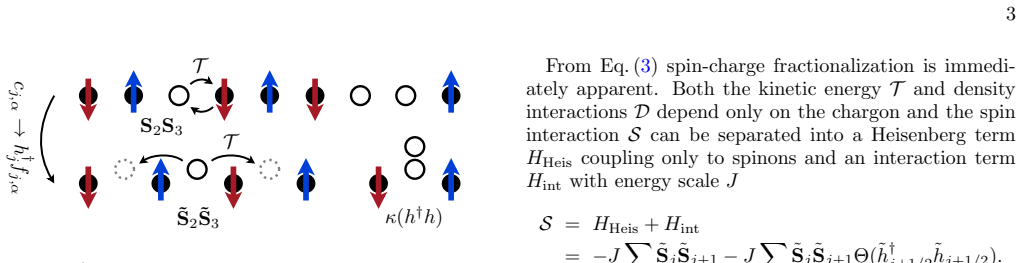
The central machinery is a time-dependent Schrieffer-Wolff transformation for driven Hubbard models. This transformation removes doublon-holon processes order by order in $t/U$ and yields an effective driven low-energy Hamiltonian; its derivative terms enter only at relative order $\omega/U$, so for $\omega\sim t$ and $U\gg t$ the generator can be approximated as time independent, giving a driven tJ model. Into that effective model the paper inserts the squeezed-space parton representation, where holes become bosonic chargons hopping on the links of a squeezed spin chain and spins become fermionic spinons with Heisenberg exchange that is switched off at occupied links. The separation $H_0+H_{\rm int}$, a non-interacting chargon-and-spinon part plus a static coupling of order $J$, identifies the quasiparticle lifetime via Fermi's golden rule and organizes the drive classification: whether the drive enters through the chargon kinetic term (order $t$), through the spinon exchange term (order $J$), or through both.
What would settle it
Measure the spin-spin correlation decay time $\tau_{\rm th}$ in the driven Hubbard model with a staggered-potential drive as a function of $U/t$ at fixed $\omega=4t$; if the extracted exponent in $\tau_{\rm th}\sim U^\alpha$ deviates from 2 at the largest accessible $U$, or if the effective spin temperature rises on the same timescale as the charge temperature, the fractionalized plateau is not present. A direct check of the machinery would be to solve the full time-dependent Schrieffer-Wolff equation for $S_1(\tau)$ including the $i\partial_\tau S_1$ term at $U=10t$ and verify that the drive-induced spinon coupling stays of order $J$ rather than order $t$.
Extended reading notes
Core claim
The paper's central claim is that a periodically driven Hubbard model at strong coupling hosts fractionalized prethermalization: for drive frequencies $\omega$ of order the hopping $t$ but large compared to the spin exchange $J=4t^2/U$, the stroboscopic dynamics enter a quasi-steady state with a high effective temperature in the charge sector and a low effective temperature in the spin sector. The lifetime of this plateau is determined by whichever is shorter of two processes: the Fermi-Golden-rule quasiparticle lifetime $\tau_0\sim U^2/t^2$ and the exponentially long lifetime of a Floquet prethermal plateau, $e^{O(\omega U/t^2)}$. Drives that couple only to chargons, for example a staggered potential, produce the FGR-limited plateau; drives that couple strongly to chargons and only weakly to spinons, such as staggered hopping, produce the exponential plateau; drives that couple strongly to both sectors destroy spin-charge separation and thermalize rapidly. The paper derives this structure from the underlying Hubbard model through a time-dependent Schrieffer-Wolff transformation, and shows numerically that the effect survives in the full Hubbard model rather than only in its effective tJ description.
Load-bearing premise
The load-bearing premise is that the perturbative transformation used to derive the effective low-energy model is accurate when truncated at second order in hopping over interaction, and that the neglected frequency-dependent corrections, of order $\omega/U$ for drive frequencies comparable to the hopping, are small enough not to couple the drive directly to the spin degrees of freedom; for the interaction values used in the numerics ($U=10t$ to $40t$), those corrections are only moderately small.
Editorial extensions
If this is right
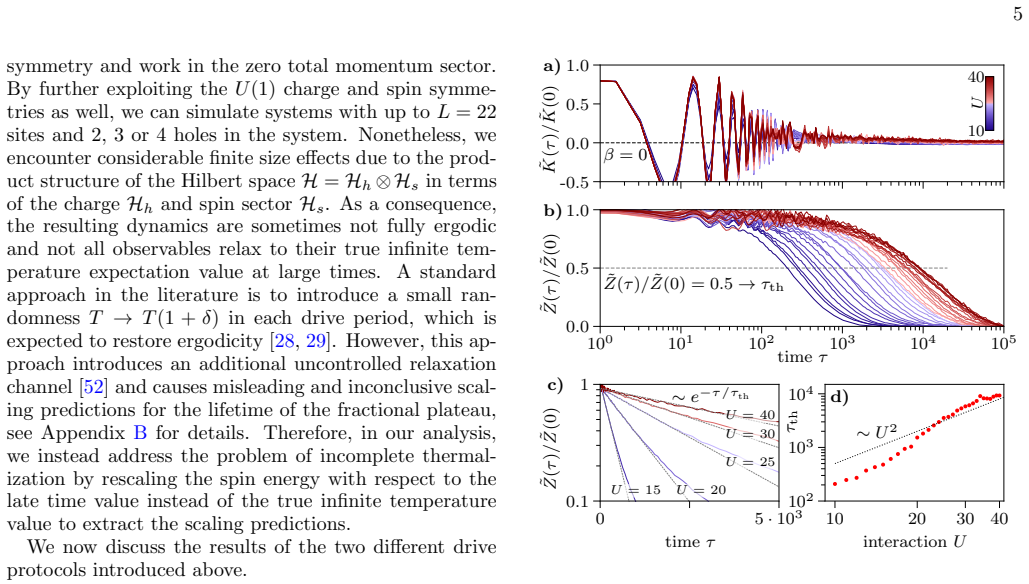
- For the staggered-potential drive (Class I), the charge sector reaches an effectively infinite temperature on a timescale of order $10^2/t$, while the spin sector keeps most of its initial correlations up to times of order $U^2/t^2$.
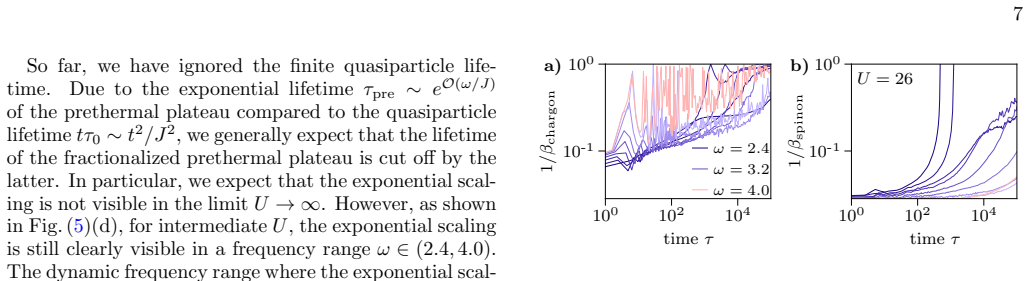
- For the staggered-hopping drive (Class II), the spin sector exhibits a prethermal plateau with lifetime growing exponentially in $\omega U/t^2$, bounded from above by the quasiparticle lifetime at large $U$.
- The two sectors have effective temperatures differing by roughly two orders of magnitude throughout the plateau, ruling out a single-temperature Gibbs ensemble of any local effective Floquet Hamiltonian.
- The same qualitative features appear in numerical simulations of the full driven Hubbard model, with better agreement with the effective tJ model as $U/t$ increases.
- A drive that couples strongly to both spinons and chargons, such as a next-nearest-neighbor $S^z S^z$ drive, eliminates the plateau: spin and charge heat on the same timescale.
Reading between the lines
- A direct experimental test is available: in an optical lattice with a superlattice drive, measure the spin correlation lifetime as a function of $U/t$ at fixed drive frequency; a clean $U^2$ scaling identifies a charge-only drive, while a crossover to exponential-in-frequency scaling would reveal a spinon coupling of order $J$.
- The same spin-charge asymmetry should appear in bosonic Hubbard and tJ models, which the paper mentions as a natural extension; one could probe those with time-dependent density measurements rather than spin-resolved imaging.
- Because the derivative corrections grow as $\omega/U$, varying the drive frequency toward $U$ at fixed $t/U$ provides a sharp test of the time-dependent Schrieffer-Wolff truncation: the plateau lifetime should drop once the neglected corrections become sizable.
- The narrow frequency window for the exponential plateau suggests that drive engineering, for instance shaping the pulse to avoid charge-sector prethermalization at higher frequencies, could widen the regime where fractionalized prethermalization is observable.
Editorial analysis
A structured set of objections, weighed in public.
Referee Report
Summary. This paper studies a periodically driven one-dimensional hole-doped Hubbard model in the strong-coupling regime. Using a time-dependent Schrieffer-Wolff transformation and exact diagonalization of the low-energy t-J model, the authors argue that at intermediate drive frequencies the system develops a fractionalized prethermal plateau in which the charge sector heats to a high effective temperature while the spin sector remains cold. They classify drives into three classes: drives that couple only to chargons (Class I, lifetime ~ U^2/t^2), drives that couple weakly to spinons (Class II, lifetime min(O(U^2/t^2), e^{O(omega U/t^2)})), and drives that couple strongly to both sectors (Class III, no plateau). They derive the low-energy effective driven Hamiltonian for a staggered-hopping drive, present Hubbard-model exact-diagonalization data that qualitatively match the t-J results, and propose an optical-lattice realization.
Significance. If correct, this work would establish fractionalized prethermalization as a generic phenomenon in one-dimensional spin-charge separated systems, going beyond the Kitaev spin liquid example, and would provide a practical drive classification. Strengths include the transparent squeezed-space parton mapping, the use of multiple diagnostics (kinetic energy, spin correlations, entanglement entropy), a direct Hubbard-model comparison in Fig. 7, and the concrete superlattice protocol in Appendix D; the data and code are promised on Zenodo. However, the most quantitative claim, the U-dependent exponential lifetime of Class (II), is not supported by the shown numerics, and the Schrieffer-Wolff derivative corrections are not fully accounted for; these issues need to be resolved before the central classification can be accepted as stated.
major comments (3)
- [Sec. III B, Fig. 5(d)] The claimed Class (II) lifetime is inconsistent with the presented data. The text and Fig. 1(b) give tau_pre ~ e^{O(omega/J)} = e^{O(omega U/t^2)}. With U=26t and J=4t^2/U ~ 0.154t, the exponent is about 6.5 omega, so even at the lowest shown frequency omega=2.4 the predicted prethermal lifetime is e^{15.6} ~ 6 x 10^6, already far above the quasiparticle cutoff U^2/t^2 = 676; the min() formula would then predict tau_th ~ 676, not the factor ~100 growth shown. The fit in Fig. 5(d), labeled ~e^omega, has no U enhancement and is inconsistent with e^{6.5 omega} by many orders of magnitude in the same range. Since only U=26 is simulated, the U dependence that distinguishes e^{omega/t} from e^{omega U/t^2} is not tested. The authors should either provide multi-U data demonstrating the omega/J collapse or revise the lifetime formula in the abstract, Fig. 1(b), and Sec. III B.
- [Sec. IV, Eqs. (27)-(37); Appendix C] The treatment of derivative terms in the time-dependent Schrieffer-Wolff expansion is not yet complete. The text first states that i*d_tau S_n gives corrections of relative order O(omega/U) and is negligible for U >> omega, then concludes that corrections to the second-order exchange strength are O(omega^2/U^3). However, Eq. (C13) contains the block-diagonal term H_delta^{(2)} = (1/2)(S_1 d_tau S_1 - (d_tau S_1) S_1), which scales as O(omega t^2/U^2), i.e. O(omega/U) relative to J, and this term is not included in the modified J' expression of Eq. (C15). For the parameters used in the numerics (omega ~ t, U in [10t, 40t]) this is a 10-40% correction to the effective spin-sector coupling, precisely the quantity controlling the Class (I)/(II) distinction. Please clarify whether H_delta^{(2)} contributes to the low-energy spin Hamiltonian and, if it does, include it in the derivation and in the estimate of the prethermal lifetime.
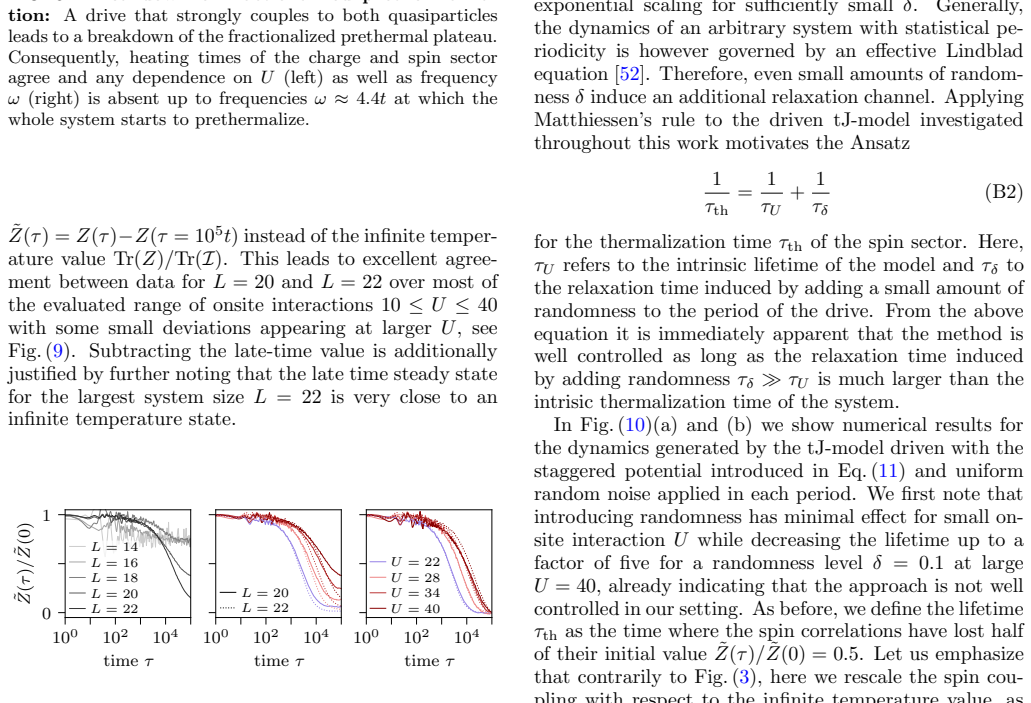
- [Sec. III, Eq. (10); Appendix B 2] The lifetime extraction uses the rescaled observable Z_tilde(tau) = Z(tau) - Z(tau=10^5 t) rather than the deviation from the true infinite-temperature value. At large U the late-time value is not close to Tr(Z)/Tr(I), as the authors acknowledge, and the plateau lifetime is defined through decay of this shifted quantity. This post-hoc normalization can bias the extracted tau_th, particularly for the long-plateau regimes central to the U^2 and exponential scaling claims. The L=20 versus L=22 comparison in Fig. 9 is useful, but the Class (II) data in Fig. 5 are for a single U and no such cross-check is shown there; please demonstrate that the reported scalings are insensitive to the choice of late-time reference or to an alternative definition of tau_th.
minor comments (4)
- [Fig. 3 caption] The caption contains the typo 'fractionalized perthermal plateau'; it should read 'fractionalized prethermal plateau'.
- [Sec. III B and Fig. 5] The notation for time is sometimes confusing: Eq. (5) uses t*tau_0 for the quasiparticle lifetime, while Fig. 5(d) labels the extracted quantity tau_th; stating explicitly that all lifetimes are in units of t^{-1} would improve readability.
- [Eq. (2)] The spin-interaction term in the t-J Hamiltonian is written without an explicit projector onto the singly occupied subspace; adding P_0 to that term would make the strong-coupling derivation more transparent.
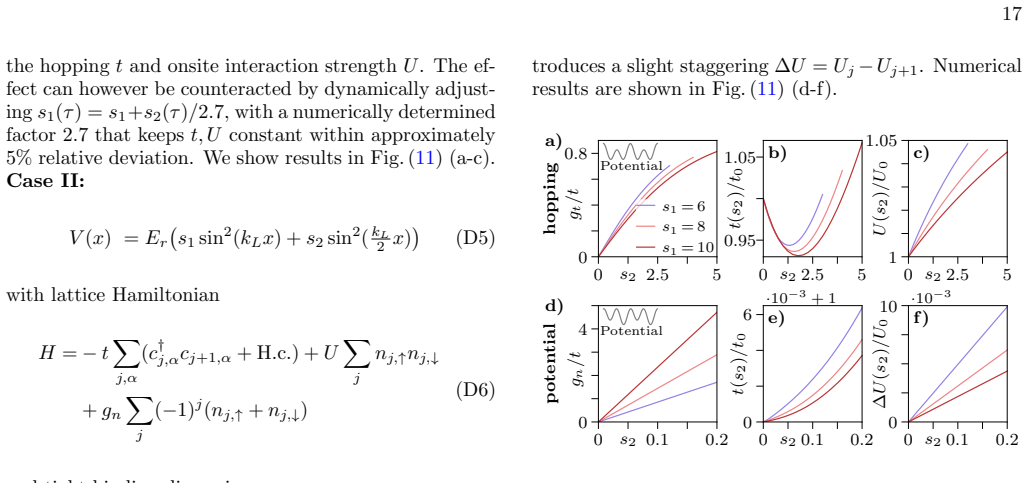
- [Appendix D] The dynamic stabilization s_1(tau) = s_1 + s_2(tau)/2.7 is quoted with a 5% deviation; stating the range of s_2 over which this calibration holds would aid experimental reproducibility.
Circularity Check
No significant circularity: the central predictions are derived from Fermi's Golden Rule and Floquet prethermalization arguments and checked against exact-diagonalization numerics; the Fig. 5(d) lifetime scaling is a quantitative concern, not a circular reduction.
full rationale
The paper's central derivation starts from the driven Hubbard Hamiltonian and constructs the low-energy effective theory through a time-dependent Schrieffer-Wolff transformation (Sec. IV, Eqs. (25)-(36)), with the O(omega/U) derivative corrections explicitly estimated rather than tuned to reproduce the target plateau. The Class (I) FGR lifetime U^2/t^2 follows from a standard golden-rule estimate of the static spinon-chargon coupling (Eq. (5)) and is compared with, not fitted to, the exact-diagonalization lifetimes (Fig. 3(d)). The Class (II) exponential prethermal lifetime is imported from standard prethermalization theorems (Refs. [17-19,54]) with the spin-drive amplitude O(J) derived from the SW effective Hamiltonian, and the numerical plateau is then checked against this expectation (Fig. 5). Refs. [34] and [46] are self-citations, but they supply only motivation and a rederived squeezed-space formalism; the present model, drive classification, and two-temperature plateau are demonstrated by independent exact-diagonalization data, including the Hubbard-model check of Fig. 7. The e^omega fit in Fig. 5(d) at U=26 is inconsistent with the stated e^{O(omega U/t^2)} enhancement, but this is a quantitative/falsifiability concern about the lifetime formula, not a circularity: the prediction is not definitionally equal to its inputs.
Assumptions & free parameters
free parameters (2)
- Drive amplitude g = 0.324t in Class (I) simulations =
0.324 t
- Lattice stabilization factor 2.7 in s1(tau) = s1 + s2(tau)/2.7 =
2.7
assumptions (6)
- domain assumption At U >> t and low hole doping, the Hubbard model is equivalent to the tJ-model, neglecting the O(J/8) three-site terms.
- domain assumption The squeezed-space parton mapping (bosonic chargon + fermionic spinon) exactly captures the low-energy tJ Hilbert space and separates spin and charge degrees of freedom.
- standard math Fermi's Golden Rule gives the quasiparticle lifetime t*tau0 ~ t^2/J^2 (Eq. 5).
- domain assumption A Floquet prethermal plateau exists for the driven spin sector with exponentially long lifetime, per Refs. [17-24,54].
- ad hoc to paper In the time-dependent Schrieffer-Wolff transformation, the derivative term i*∂_τ S_n is of order O(omega/U) relative to leading terms and can be neglected for U >> omega.
- domain assumption The non-interacting quasiparticle description H0 = T + D + S (independent chargon and spinon) remains valid up to the quasiparticle lifetime.
Cite this review
Pith. "Pith review of Fractionalized Prethermalization in the One-Dimensional Hubbard Model." pith.science (2026). https://pith.science/paper/77HB33T2
@misc{pith2026250209708,
  author       = {Pith},
  title        = {Pith review of: Fractionalized Prethermalization in the One-Dimensional Hubbard Model},
  year         = {2026},
  howpublished = {\url{https://pith.science/paper/77HB33T2}},
  note         = {Machine review of arXiv:2502.09708}
}
read the original abstract
Prethermalization phenomena in driven systems are generally understood via a local Floquet Hamiltonian obtained from a high-frequency expansion. Remarkably, recently it has been shown that a driven Kitaev spin liquid with fractionalized excitations can realize a quasi-stationary state that is not captured by this paradigm. Instead distinct types of fractionalized excitations are characterized by vastly different temperatures-a phenomenon dubbed "fractionalized prethermalization". In our work, we analyze fractionalized prethermalization in a driven one-dimensional Hubbard model at strong coupling which hosts spin-charge fractionalization. At intermediate frequencies quasi-steady states emerge which are characterized by a low spin and high charge temperature with lifetimes set by two competing processes: the lifetime of the quasiparticles determined by Fermi's Golden rule and the exponentially long lifetime of a Floquet prethermal plateau. We classify drives into three categories, each giving rise to distinct (fractional) prethermalization dynamics. Resorting to a time-dependent variant of the Schrieffer-Wolff transformation, we systematically analyze how these drive categories are linked to the underlying driven Hubbard model, thereby providing a general understanding of the emergent thermalization dynamics. We discuss routes towards an experimental realization of this phenomenon in quantum simulation platforms.
Figures

Figures from the paper (8 more)





Reference graph
Works this paper leans on
-
[1]
Class (III): Drive with strong spin coupling In Sec. III of the main text, we have analyzed different drive protocols in which a clear fractionalized prethermal regime is observable. Here, we introduce a drive proto- col that couples strongly to the spinons. To this end, we drive the tJ-model with a next-nearest neighbor spin interaction V= X j Sz j Sz j+...
-
[2]
Finite size effects in numerical simulations In the main text, we restrict to simulating systems with L= 20 sites andL−N= 3 holes for numerical feasibil- ity. Here we give further remarks on the finite size effects that appear in the spin correlations due to the product structure of the Hilbert space; see Fig. (9). First, we note that the correct qualitat...
-
[3]
(6) is generally expected to thermalize to an infinite temperature state at late times
Effect of noise on the lifetime The driven tJ-model introduced in Eq. (6) is generally expected to thermalize to an infinite temperature state at late times. In exact diagonalization studies, finite size effects can however cause the dynamics to not be fully er- godic, see Fig. (9). The consequence is that observables do not relax to their infinite temper...
-
[5]
A. Eckardt, Colloquium: Atomic quantum gases in pe- riodically driven optical lattices, Reviews of Modern Physics89, 10.1103/revmodphys.89.011004 (2017)
-
[6]
Oka and H
T. Oka and H. Aoki, Photovoltaic hall effect in graphene, Phys. Rev. B79, 081406 (2009)
2009
-
[7]
N. H. Lindner, G. Refael, and V. Galitski, Floquet topo- logical insulator in semiconductor quantum wells, Nature Physics7, 490 (2011)
2011
-
[8]
Goldman and J
N. Goldman and J. Dalibard, Periodically driven quan- tum systems: Effective hamiltonians and engineered gauge fields, Phys. Rev. X4, 031027 (2014)
2014
-
[9]
Kitagawa, E
T. Kitagawa, E. Berg, M. Rudner, and E. Demler, Topo- logical characterization of periodically driven quantum systems, Phys. Rev. B82, 235114 (2010)
2010
Show all 64 references
-
[10]
M. S. Rudner, N. H. Lindner, E. Berg, and M. Levin, Anomalous edge states and the bulk-edge correspondence for periodically driven two-dimensional systems, Phys. Rev. X3, 031005 (2013)
2013
-
[11]
N. R. Cooper, J. Dalibard, and I. B. Spielman, Topo- logical bands for ultracold atoms, Rev. Mod. Phys.91, 015005 (2019)
2019
-
[12]
Oka and S
T. Oka and S. Kitamura, Floquet engineering of quantum materials, Annual Review of Condensed Matter Physics 10, 387–408 (2019)
2019
-
[13]
M. S. Rudner and N. H. Lindner, Band structure engi- neering and non-equilibrium dynamics in floquet topo- logical insulators, Nature Reviews Physics2, 229–244 (2020)
2020
-
[14]
H. C. Po, L. Fidkowski, A. Vishwanath, and A. C. Potter, Radical chiral floquet phases in a periodically driven ki- taev model and beyond, Phys. Rev. B96, 245116 (2017)
2017
-
[15]
I. C. Fulga, M. Maksymenko, M. T. Rieder, N. H. Lind- ner, and E. Berg, Topology and localization of a peri- odically driven kitaev model, Phys. Rev. B99, 235408 (2019)
2019
-
[16]
Roy and F
R. Roy and F. Harper, Periodic table for floquet topo- logical insulators, Phys. Rev. B96, 155118 (2017)
2017
-
[17]
(5)(a,b)
within the sector with exponential lifetime in fre- quency [18], again leading to a fractionalized prethermal plateau; see Fig. (5)(a,b). 7 So far, we have ignored the finite quasiparticle life- time. Due to the exponential lifetimeτ pre ∼e O(ω/J) of the prethermal plateau com...
-
[18]
Wintersperger, C
K. Wintersperger, C. Braun, F. N. ¨Unal, A. Eckardt, M. D. Liberto, N. Goldman, I. Bloch, and M. Aidels- burger, Realization of an anomalous floquet topologi- cal system with ultracold atoms, Nature Physics16, 1058–1063 (2020)
2020
-
[19]
Braun, R
C. Braun, R. Saint-Jalm, A. Hesse, J. Arceri, I. Bloch, and M. Aidelsburger, Real-space detection and manipu- lation of topological edge modes with ultracold atoms, Nature Physics20, 1306 (2024)
2024
-
[21]
M. Will, T. A. Cochran, E. Rosenberg, B. Jobst, N. M. Eassa, P. Roushan, M. Knap, A. Gammon-Smith, and F. Pollmann, Probing non-equilibrium topological order on a quantum processor (2025), arXiv:2501.18461 [quant- ph]
2025
-
[22]
Bukov, L
M. Bukov, L. D’Alessio, and A. Polkovnikov, Universal high-frequency behavior of periodically driven systems: from dynamical stabilization to floquet engineering, Ad- vances in Physics64, 139–226 (2015)
2015
-
[23]
Kuwahara, T
T. Kuwahara, T. Mori, and K. Saito, Floquet–magnus theory and generic transient dynamics in periodically driven many-body quantum systems, Annals of Physics 367, 96–124 (2016). 18
2016
-
[26]
T. Mori, T. Kuwahara, and K. Saito, Rigorous bound on energy absorption and generic relaxation in periodically driven quantum systems, Phys. Rev. Lett.116, 120401 (2016)
2016
-
[27]
S. A. Weidinger and M. Knap, Floquet prether- malization and regimes of heating in a periodically driven, interacting quantum system, Scientific Reports 7, 10.1038/srep45382 (2017)
2017 doi
-
[28]
Abanin, W
D. Abanin, W. De Roeck, W. W. Ho, and F. Huve- neers, A rigorous theory of many-body prethermaliza- tion for periodically driven and closed quantum systems, Communications in Mathematical Physics354, 809–827 (2017)
2017
-
[29]
Mori, Floquet prethermalization in periodically driven classical spin systems, Physical Review B98, 10.1103/physrevb.98.104303 (2018)
T. Mori, Floquet prethermalization in periodically driven classical spin systems, Physical Review B98, 10.1103/physrevb.98.104303 (2018)
2018 doi
-
[30]
O’Dea, F
N. O’Dea, F. Burnell, A. Chandran, and V. Khe- mani, Prethermal stability of eigenstates under high fre- quency floquet driving, Physical Review Letters132, 10.1103/physrevlett.132.100401 (2024)
2024 doi
-
[31]
Mallayya, M
K. Mallayya, M. Rigol, and W. De Roeck, Prethermal- ization and thermalization in isolated quantum systems, Physical Review X9, 10.1103/physrevx.9.021027 (2019)
2019 doi
-
[32]
Kuhlenkamp and M
C. Kuhlenkamp and M. Knap, Periodically driven sachdev-ye-kitaev models, Physical Review Letters124, 10.1103/physrevlett.124.106401 (2020)
2020 doi
-
[33]
Fleckenstein and M
C. Fleckenstein and M. Bukov, Prethermalization and thermalization in periodically driven many-body systems away from the high-frequency limit, Physical Review B 103, 10.1103/physrevb.103.l140302 (2021)
2021 doi
-
[35]
Kitaev, Anyons in an exactly solved model and be- yond, Annals of Physics321, 2 (2006), january Special Issue
A. Kitaev, Anyons in an exactly solved model and be- yond, Annals of Physics321, 2 (2006), january Special Issue
2006
-
[36]
H. Zhao, F. Mintert, R. Moessner, and J. Knolle, Random multipolar driving: Tunably slow heating through spectral engineering, Physical Review Letters 126, 10.1103/physrevlett.126.040601 (2021)
2021 doi
-
[38]
A. J. McRoberts, H. Zhao, R. Moessner, and M. Bukov, Prethermalization in periodically driven nonreciprocal many-body spin systems, Physical Review Research5, 10.1103/physrevresearch.5.043008 (2023)
2023 doi
-
[39]
H.-K. Jin, J. Knolle, and M. Knap, Fractionalized prethermalization in a driven quantum spin liquid, Phys- ical Review Letters130, 10.1103/physrevlett.130.226701 (2023)
2023 doi
-
[41]
Meden and K
V. Meden and K. Sch¨ onhammer, Spectral functions for the tomonaga-luttinger model, Physical Review B46, 15753–15760 (1992)
1992
-
[42]
Voit, Charge-spin separation and the spectral proper- ties of luttinger liquids, Journal of Physics: Condensed Matter5, 8305–8336 (1993)
J. Voit, Charge-spin separation and the spectral proper- ties of luttinger liquids, Journal of Physics: Condensed Matter5, 8305–8336 (1993)
1993
-
[43]
Giamarchi,Quantum physics in one dimension, Vol
T. Giamarchi,Quantum physics in one dimension, Vol. 121 (Clarendon press, 2003)
2003
-
[44]
Vijayan, P
J. Vijayan, P. Sompet, G. Salomon, J. Koepsell, S. Hirthe, A. Bohrdt, F. Grusdt, I. Bloch, and C. Gross, Time-resolved observation of spin-charge deconfinement in fermionic hubbard chains, Science367, 186–189 (2020)
2020
-
[45]
Auerbach,Interacting Electrons and Quantum Mag- netism(Springer New York, 1994)
A. Auerbach,Interacting Electrons and Quantum Mag- netism(Springer New York, 1994)
1994
-
[46]
Miyake, G
H. Miyake, G. A. Siviloglou, C. J. Kennedy, W. C. Bur- ton, and W. Ketterle, Realizing the harper hamiltonian with laser-assisted tunneling in optical lattices, Physi- cal Review Letters111, 10.1103/physrevlett.111.185302 (2013)
2013 doi
-
[47]
Jotzu, M
G. Jotzu, M. Messer, R. Desbuquois, M. Lebrat, T. Uehlinger, D. Greif, and T. Esslinger, Experimental realization of the topological haldane model with ultra- cold fermions, Nature515, 237 (2014)
2014
-
[48]
Bordia, H
P. Bordia, H. L¨ uschen, U. Schneider, M. Knap, and I. Bloch, Periodically driving a many-body localized quantum system, Nature Physics13, 460 (2017)
2017
-
[49]
Rubio-Abadal, M
A. Rubio-Abadal, M. Ippoliti, S. Hollerith, D. Wei, J. Rui, S. Sondhi, V. Khemani, C. Gross, and I. Bloch, Floquet prethermalization in a bose-hubbard system, Physical Review X10, 10.1103/physrevx.10.021044 (2020)
2020 doi
-
[50]
Sugiura and A
S. Sugiura and A. Shimizu, Thermal pure quantum states at finite temperature, Physical Review Letters 108, 10.1103/physrevlett.108.240401 (2012)
2012 doi
-
[51]
Bohrdt, D
A. Bohrdt, D. Greif, E. Demler, M. Knap, and F. Grusdt, Angle-resolved photoemission spectroscopy with quantum gas microscopes, Physical Review B97, 10.1103/physrevb.97.125117 (2018)
2018 doi
-
[52]
R. N. Bannister and N. d’Ambrumenil, Spectral functions of half-filled one-dimensional hubbard rings with varying boundary conditions, Physical Review B61, 4651–4658 (2000)
2000
-
[53]
Bartsch and J
C. Bartsch and J. Gemmer, Dynamical typicality of quantum expectation values, Physical Review Letters 102, 10.1103/physrevlett.102.110403 (2009)
2009 doi
-
[55]
Bravyi, D
S. Bravyi, D. P. DiVincenzo, and D. Loss, Schrieffer–wolff transformation for quantum many-body systems, Annals of Physics326, 2793–2826 (2011)
2011
-
[56]
Weinberg and M
P. Weinberg and M. Bukov, Quspin: a python package for dynamics and exact diagonalisation of quantum many body systems. part ii: bosons, fermions and higher spins, SciPost Physics7, 10.21468/scipostphys.7.2.020 (2019)
2019 doi
-
[57]
due to interband processes becoming relevant. How- ever, in contrast to multiband systems, fractionalized prethermalization emerges in a system with a single phys- ical degree (the electron), which due to the interact- ing nature of the problem fractionalizes into spinon and h...
2020
-
[59]
Bukov, M
M. Bukov, M. Kolodrubetz, and A. Polkovnikov, Schrieffer-wolff transformation for periodically driven systems: Strongly correlated systems with artificial gauge fields, Physical Review Letters116, 10.1103/phys- revlett.116.125301 (2016)
2016 doi
- [60]
-
[61]
R. M. Wilcox, Exponential operators and parameter dif- ferentiation in quantum physics, Journal of Mathematical Physics8, 962–982 (1967)
1967
-
[62]
Sun and A
G. Sun and A. Eckardt, Optimal frequency window for floquet engineering in optical lattices, Physical Review Research2, 10.1103/physrevresearch.2.013241 (2020)
2020 doi
-
[63]
Bloch, J
I. Bloch, J. Dalibard, and W. Zwerger, Many-body physics with ultracold gases, Reviews of Modern Physics 80, 885–964 (2008)
2008
-
[64]
D. Wei, A. Rubio-Abadal, B. Ye, F. Machado, J. Kemp, K. Srakaew, S. Hollerith, J. Rui, S. Gopalakrishnan, N. Y. Yao, I. Bloch, and J. Zeiher, Quantum gas mi- croscopy of kardar-parisi-zhang superdiffusion, Science 376, 716–720 (2022)
2022
-
[65]
E. Wybo, A. Bastianello, M. Aidelsburger, I. Bloch, and M. Knap, Preparing and analyzing solitons in the sine-gordon model with quantum gas microscopes, PRX Quantum4, 10.1103/prxquantum.4.030308 (2023)
2023 doi
-
[66]
Impertro, S
A. Impertro, S. Karch, J. F. Wienand, S. Huh, C. Schweizer, I. Bloch, and M. Aidelsburger, Local read- out and control of current and kinetic energy opera- tors in optical lattices, Physical Review Letters133, 10.1103/physrevlett.133.063401 (2024)
2024 doi
-
[67]
D. V. Else, C. Monroe, C. Nayak, and N. Y. Yao, Dis- crete time crystals, Annual Review of Condensed Matter Physics11, 467–499 (2020)
2020
-
[68]
Zhang, P
J. Zhang, P. W. Hess, A. Kyprianidis, P. Becker, A. Lee, J. Smith, G. Pagano, I.-D. Potirniche, A. C. Potter, A. Vishwanath, N. Y. Yao, and C. Monroe, Observation of a discrete time crystal, Nature543, 217–220 (2017)
2017
-
[69]
M. P. Zaletel, M. Lukin, C. Monroe, C. Nayak, F. Wilczek, and N. Y. Yao, Colloquium: Quantum and classical discrete time crystals, Reviews of Modern Physics95, 10.1103/revmodphys.95.031001 (2023)
2023 doi
-
[70]
E. A. Martinez, C. A. Muschik, P. Schindler, D. Nigg, A. Erhard, M. Heyl, P. Hauke, M. Dalmonte, T. Monz, P. Zoller, and R. Blatt, Real-time dynamics of lattice gauge theories with a few-qubit quantum computer, Na- ture534, 516–519 (2016)
2016
-
[71]
T. A. Cochran, B. Jobst, E. Rosenberg, Y. D. Lensky, G. Gyawali,et al., Visualizing dynamics of charges and strings in (2+1)d lattice gauge theories (2024), arXiv:2409.17142
2024 arXiv
-
[72]
All data and simulation codes are available upon reason- able request at 10.5281/zenodo.14794905
-
[73]
Bissbort,Dynamical effects and disorder in ultracold bosonic matter, doctoralthesis, Universit¨ atsbibliothek Jo- hann Christian Senckenberg (2013)
U. Bissbort,Dynamical effects and disorder in ultracold bosonic matter, doctoralthesis, Universit¨ atsbibliothek Jo- hann Christian Senckenberg (2013)
2013
Reviewed August 7, 2026 · model on record in the stance chip above.
Discussion (0). Continue with ORCID to comment.