REVIEW 3 major objections 8 minor 37 references
An End-to-End Neighborhood-based Interaction Model for Knowledge-enhanced Recommendation
T0 review · 3 major / 8 minor · reviewed 2026-08-14 · deepseek-v4-flash
Pith's one-line read A bi-attention over neighbor pairs improves graph-based recommendation, reporting 1.1–8.4% AUC gains over strong baselines on four datasets.
desk verdict A genuinely new interaction mechanism with a clean unifying view, but the headline AUC gains rest on a sampled-negative protocol that needs more scrutiny before I would trust the absolute numbers. read the letter →
The pith
A machine-rendered reading of the paper's core claim, the machinery that carries it, and where it could break.
The reading
What carries the argument
The central object is the neighborhood-interaction decomposition $\hat{y} = A \odot Z$, read as a weighted sum over all pairs $(i,j)$ of user-side neighbor $i$ and item-side neighbor $j$: $A_{i,j}$ is a nonnegative weight summing to 1 and $Z_{i,j} = \langle x_i, x_j \rangle$. The paper shows that average aggregation and attention aggregation are special cases of this form, with $A$ constant or rank-one; NI instead learns $A$ directly through a bi-attention network $\alpha_{i,j} = \mathrm{softmax}(w^\top[x_u, x_i, x_v, x_j] + b)$. This machinery is what lets the model give distinct weight to informative neighbor pairs, such as a liked romance film matching a romance tag, while down-weighting noise, such as a liked film matching an unrelated tag.
What would settle it
Rerun KNI and the attention-aggregation baseline on data where explicit low ratings (1–2 stars) serve as negatives instead of sampled unseen items; if KNI's AUC and top-N advantages shrink or disappear, the reported superiority depends on the unobserved-as-negative assumption rather than on neighborhood interaction.
Extended reading notes
Core claim
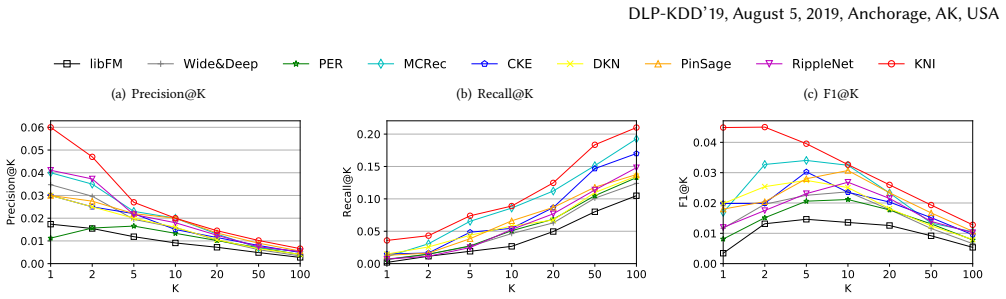
The paper's central claim is that standard graph-based recommendation pipelines throw away information by aggregating neighborhoods into two vectors before computing a prediction. The proposed fix is to score the neighborhoods directly: for a user $u$ and item $v$, $\hat{y}_{u,v}$ is a weighted sum over all pairs $(i,j)$ where $i$ is a user-side neighbor and $j$ is an item-side neighbor, with weights assigned by a bi-attention network that sees both neighborhoods at once. The paper shows this re-expresses prior graph models in the general form $\hat{y} = A \odot Z$, with the average aggregator as a constant weight matrix and the attention aggregator as a rank-one weight matrix; NI replaces both with a fully learned weight matrix. Adding graph convolution and attention encoders and knowledge-graph entities yields KNI. The paper's reported result is that KNI beats the strongest compared methods by 1.1%–8.4% absolute AUC in CTR prediction and by a wide margin in top-N recommendation on four real-world datasets, with the biggest gains on the two sparser book datasets.
Load-bearing premise
The argument's load-bearing premise is that unseen items are negatives: for each user the paper samples the same number of '0' labels from unseen items and computes AUC and top-N metrics against that sample, so if many unobserved items would actually be liked, the reported gains may not reflect true ranking quality.
Editorial extensions
If this is right
- NI outperforms PinSage and RippleNet even without the knowledge graph, so pairwise neighborhood interaction itself, not the KG, drives much of the gain.
- The absolute AUC advantage over the best baseline is largest on the sparsest datasets (4.33% on C-Book, 5.02% on A-Book), so the method helps most where interactions are scarce.
- High-order neighbors are useful only up to a point: performance drops at 3–4 hops because neighborhood sizes explode and add noise, and one hop is enough for KNI.
- With neighbor sampling, KNI trains 5.6–8.6 times faster per iteration than RippleNet in the reported settings, so the added expressiveness does not require slower training.
Reading between the lines
- Beyond the paper's experiments, the $\hat{y} = A \odot Z$ form suggests a diagnostic: when a model's attention-weight matrix has near-zero entropy, it has collapsed to one neighbor pair, so such cases should be over-represented among errors of attention-aggregation models.
- A direct ablation test follows from the paper's decomposition: hold the GNN encoder and KG fixed and replace the bi-attention with the rank-one attention form; the gap between the two versions would quantify how much of KNI's gain comes specifically from joint neighbor weighting.
- The paper treats all unobserved pairs as negatives in training; an untested extension is to vary the negative-sampling ratio or use explicit low ratings as negatives, which would separate the model's ranking ability from the evaluation assumption.
- The decomposition also hints at a practical scaling route the paper does not pursue: for very large neighborhoods, sparsifying low-weight pairs in $A$ before the weighted sum could preserve most of the signal while cutting computation.
Signed reviews
Editorial analysis
A structured set of objections, weighed in public.
Referee Report
Summary. The paper addresses graph-based recommendation and identifies an 'early summarization' problem: existing models aggregate user- and item-side neighborhoods into single embeddings before scoring, losing pairwise structural information. It proposes Neighborhood Interaction (NI), which scores a user-item pair by a bi-attention-weighted sum of inner products over all user-neighbor/item-neighbor pairs, and Knowledge-enhanced NI (KNI), which augments the interaction graph with a knowledge graph and applies GNN propagation. The central claim, stated in the abstract and Section 3.4, is that KNI outperforms state-of-the-art feature-based, meta path-based, and KG-based recommenders by 1.1%-8.4% absolute AUC and by a wide margin in top-N recommendation on four real-world datasets. The paper also provides a case study aiming to show that NI learns more informative attention distributions than attention aggregation models.
Significance. If the empirical claims hold, KNI is a meaningful contribution: it offers a clean reformulation of neighborhood-based scoring (Eq. (11)) that unifies average and attention aggregation as special cases, and it gives a concrete, end-to-end architecture with publicly available code and datasets. The derivation of the pairwise interaction form and the bi-attention model is transparent and reproducible. The claimed gains on sparse book datasets are particularly interesting, as they suggest the model handles sparsity well. However, the current evaluation does not fully establish the magnitude of the advantage, because the reported numbers depend on a sampled-negative protocol and lack variance information.
major comments (3)
- [Section 3.1, Table 2, Figs. 3-6] The central empirical claim rests on a negative-sampling protocol that is not fully specified. For A-Book and Movie-20M, Section 3.1 says 'For each user, we sample the same amount of negative samples ... from unseen items'; it is not stated how many negatives are sampled at test time, whether the same negative set is used for all models, or whether any negative sampling is applied to C-Book and Movie-1M. AUC and top-N metrics computed against a small or easy negative set can inflate absolute gains, because KNI's neighborhood representations may separate sampled negatives more easily than baselines. The authors should report the negative-set construction in detail, evaluate on a fixed large negative set or full item ranking for test users, and show sensitivity to the negative sampling ratio. This is required to support the 1.1%-8.4% absolute AUC claim.
- [Section 3.3 and Table 2] The paper reports no standard deviations or confidence intervals, despite saying 'We repeat each experiment 5 times and report the average scores' and using 40 evaluations per run (Fig. 2). The p<1e-6 significance asterisks in Table 2 cannot be audited without knowing the unit of analysis (5 runs? 40 evaluations?) and the variance across runs. This matters because the smallest claimed improvements are around 1% absolute AUC (Table 3, Movie-20M: 1.07%), which may be within run-to-run variability. Please report mean ± std or a confidence interval over repeated runs for all metrics.
- [Section 3.6 and Fig. 7] The case study's conclusion that NI 'has the capability to learn more informative neighborhood interactions' is based on entropy histograms from a single random subset and one hand-picked test pair. No statistical test accompanies the average entropy values (2.12 vs. 3.18), and higher attention entropy is not established as a reliable proxy for predictive quality. This evidence is suggestive but does not by itself confirm the early-summarization mechanism. Please either add significance testing and variance over multiple subsets, or soften the causal interpretation.
minor comments (8)
- [Section 2.1.3] There is a typo: 'asnd' should be 'and' in the sentence describing the average form as a special case.
- [Section 2.2] The phrase 'we can recklessly replace Gr ec with G' should likely be 'readily replace' or 'directly replace'; 'recklessly' is not the intended meaning.
- [Section 3.6] The sentence 'we conduct a case study on in this section' is grammatically incomplete and should be revised.
- [Section 3 and Table 4] The paper does not state which GNN encoder (GCN or GAT) is used in the final KNI model for the experiments; Section 2.2 presents both, but Section 3 never specifies which architecture produced Tables 2-4. This should be clarified for reproducibility.
- [Section 3.1 and Table 3] It is unclear whether C-Book and Movie-1M use the same negative-sampling protocol as A-Book and Movie-20M, and whether the n-hop columns in Table 3 are average numbers of neighbors per node or total counts; please clarify both points.
- [Section 3.3 and Fig. 2] The relationship between 'repeat each experiment 5 times' and 'fix this number to 40' is ambiguous; please state explicitly how the 40 evaluations and 5 repeats are combined to produce the reported averages and significance tests.
- [Section 2.2, Eq. (19)] The notation for attention parameters (wla, bla) is inconsistent with the GCN notation (w, b) used earlier; please unify the notation.
- [Figure 8] The color bars have different scales across panels (a)-(d), making visual comparison of AAM and NI difficult; consider using a shared color scale.
Circularity Check
No circularity found: KNI's reported gains come from held-out evaluation, and Eq. (11) is a reformulation, not a fitted input.
full rationale
The paper's central claim is empirical: KNI outperforms eight baselines on CTR prediction and top-N recommendation. That claim is supported by training with the log-loss of Eq. (21), validation-based hyperparameter selection, and evaluation on held-out test splits. The mathematical core, Eq. (11), is explicitly derived as the common algebraic form of the average and attention aggregation schemes in Eqs. (8) and (10), so it is a reformulation of existing model forms rather than a fitted quantity or an assumed conclusion. The bi-attention NI model in Eqs. (13)-(14) is a new architectural choice and is not defined in terms of the reported AUC improvements. GCN/GAT components are standard external architectures cited from [15,24], and the knowledge-graph construction follows RippleNet/KB4Rec, which are not authored by this paper's authors in a way that would make the comparison circular. The only self-references, to the authors' earlier PNN papers in the related-work enumeration, are not load-bearing for the central claim. The sampled-negative evaluation protocol is a legitimate concern about external validity, but it is not circularity: the test negatives are not used to fit the model, and the reported predictions are not a re-statement of the sampled labels. No derivation step reduces by construction to its own input.
Assumptions & free parameters
free parameters (5)
- hop_number =
1 (KNI), 1 (PinSage), 3/2/1/1 (RippleNet per dataset)
- neighbor_sample_size =
4 (C-Book), 32 (Movie-1M), 8 (A-Book), 32 (Movie-20M)
- embedding_dimension =
128
- learning_rate =
0.001
- l2_regularization =
1e-5 (C-Book), 1e-7 (Movie-1M), 1e-7 (A-Book), 1e-8 (Movie-20M)
assumptions (4)
- domain assumption Unseen items are treated as negative examples for training and evaluation.
- domain assumption The knowledge graph linkage from items to entities is accurate for A-Book and Movie-20M.
- domain assumption Neighbor sampling (NS) with fixed size K preserves the information needed for the model.
- domain assumption The binary conversion of ratings (4/5 positive, others negative) preserves the signal for CTR prediction.
Cite this review
Pith. "Pith review of An End-to-End Neighborhood-based Interaction Model for Knowledge-enhanced Recommendation." pith.science (2026). https://pith.science/paper/7GDRYHT3
@misc{pith2026190804032,
  author       = {Pith},
  title        = {Pith review of: An End-to-End Neighborhood-based Interaction Model for Knowledge-enhanced Recommendation},
  year         = {2026},
  howpublished = {\url{https://pith.science/paper/7GDRYHT3}},
  note         = {Machine review of arXiv:1908.04032}
}
read the original abstract
This paper studies graph-based recommendation, where an interaction graph is constructed from historical records and is lever-aged to alleviate data sparsity and cold start problems. We reveal an early summarization problem in existing graph-based models, and propose Neighborhood Interaction (NI) model to capture each neighbor pair (between user-side and item-side) distinctively. NI model is more expressive and can capture more complicated structural patterns behind user-item interactions. To further enrich node connectivity and utilize high-order structural information, we incorporate extra knowledge graphs (KGs) and adopt graph neural networks (GNNs) in NI, called Knowledge-enhanced NeighborhoodInteraction (KNI). Compared with the state-of-the-art recommendation methods,e.g., feature-based, meta path-based, and KG-based models, our KNI achieves superior performance in click-through rate prediction (1.1%-8.4% absolute AUC improvements) and out-performs by a wide margin in top-N recommendation on 4 real-world datasets.
Figures


Figures from the paper (5 more)


Reference graph
Works this paper leans on
-
[1]
Kurt Bollacker, Colin Evans, Praveen Paritosh, Tim Sturge, and Jamie Taylor
-
[2]
Jie Chen, Tengfei Ma, and Cao Xiao. 2018. FastGCN: fast learning with graph convolutional networks via importance sampling. arXiv preprint arXiv:1801.10247 (2018)
arXiv 2018
-
[3]
Heng-Tze Cheng, Levent Koc, Jeremiah Harmsen, Tal Shaked, Tushar Chandra, Hrishi Aradhye, Glen Anderson, Greg Corrado, Wei Chai, Mustafa Ispir, et al
-
[4]
Hanjun Dai, Yichen Wang, Rakshit Trivedi, and Le Song. 2016. Deep coevolu- tionary network: Embedding user and item features for recommendation. arXiv preprint arXiv:1609.03675 (2016)
arXiv 2016
-
[5]
Aditya Grover and Jure Leskovec. 2016. node2vec: Scalable feature learning for networks. In SIGKDD. ACM
work page 2016
-
[6]
Huifeng Guo, Ruiming Tang, Yunming Ye, Zhenguo Li, and Xiuqiang He. 2017. Deepfm: a factorization-machine based neural network for ctr prediction. arXiv preprint arXiv:1703.04247 (2017)
arXiv 2017
-
[7]
Will Hamilton, Zhitao Ying, and Jure Leskovec. 2017. Inductive representation learning on large graphs. In Advances in Neural Information Processing Systems
2017
-
[8]
Ruining He and Julian McAuley. 2016. Ups and downs: Modeling the visual evolution of fashion trends with one-class collaborative filtering. In WWW. International World Wide Web Conferences Steering Committee
work page 2016
Show all 37 references
-
[9]
Xiangnan He, Zhenkui He, Jingkuan Song, Zhenguang Liu, Yu-Gang Jiang, and Tat-Seng Chua. 2018. NAIS: Neural Attentive Item Similarity Model for Recom- mendation. TKDE (2018)
2018
-
[10]
Binbin Hu, Chuan Shi, Wayne Xin Zhao, and Philip S Yu. 2018. Leveraging meta-path based context for top-n recommendation with a neural co-attention model. In SIGKDD. ACM
2018
-
[11]
Jin Huang, Wayne Xin Zhao, Hong-Jian Dou, Ji-Rong Wen, and Edward Y. Chang
-
[12]
Xiao Huang, Jundong Li, and Xia Hu. 2017. Label informed attributed network embedding. In WSDM. ACM
2017
-
[13]
Yuchin Juan, Yong Zhuang, Wei-Sheng Chin, and Chih-Jen Lin. 2016. Field-aware factorization machines for CTR prediction. In RecSys. ACM
2016
-
[14]
Santosh Kabbur, Xia Ning, and George Karypis. 2013. Fism: factored item simi- larity models for top-n recommender systems. In SIGKDD. ACM
2013
-
[15]
Thomas N Kipf and Max Welling. 2016. Semi-supervised classification with graph convolutional networks. arXiv preprint arXiv:1609.02907 (2016)
2016 arXiv
-
[16]
Yehuda Koren. 2008. Factorization meets the neighborhood: a multifaceted collaborative filtering model. In SIGKDD. ACM
2008
-
[17]
Yankai Lin, Zhiyuan Liu, Maosong Sun, Yang Liu, and Xuan Zhu. 2015. Learning entity and relation embeddings for knowledge graph completion.. In AAAI
2015
-
[18]
Bryan Perozzi, Rami Al-Rfou, and Steven Skiena. 2014. Deepwalk: Online learning of social representations. In SIGKDD. ACM
2014
-
[19]
Yanru Qu, Han Cai, Kan Ren, Weinan Zhang, Yong Yu, Ying Wen, and Jun Wang
-
[20]
Yanru Qu, Bohui Fang, Weinan Zhang, and et al. 2018. Product-based Neural Networks for User Response Prediction over Multi-field Categorical Data. arXiv preprint arXiv:1807.00311 (2018)
2018 arXiv
-
[21]
Steffen Rendle. 2010. Factorization machines. In ICDM. IEEE
2010
-
[22]
Jian Tang, Meng Qu, Mingzhe Wang, Ming Zhang, Jun Yan, and Qiaozhu Mei
-
[23]
Product-based neural networks for user response prediction. In ICDM
-
[24]
Petar Velickovic, Guillem Cucurull, Arantxa Casanova, Adriana Romero, Pietro Lio, and Yoshua Bengio. 2017. Graph attention networks. arXiv preprint arXiv:1710.10903 (2017)
2017 arXiv
-
[25]
Hongwei Wang, Jia Wang, Jialin Wang, Miao Zhao, Weinan Zhang, Fuzheng Zhang, Xing Xie, and Minyi Guo. 2017. Graphgan: Graph representation learning with generative adversarial nets. arXiv preprint arXiv:1711.08267 (2017)
2017 arXiv
-
[26]
Hongwei Wang, Fuzheng Zhang, Jialin Wang, Miao Zhao, Wenjie Li, Xing Xie, and Minyi Guo. 2018. RippleNet: Propagating User Preferences on the Knowledge Graph for Recommender Systems. In CIKM. ACM
2018
-
[27]
Hongwei Wang, Fuzheng Zhang, Xing Xie, and Minyi Guo. 2018. DKN: Deep Knowledge-Aware Network for News Recommendation. arXiv preprint arXiv:1801.08284 (2018)
2018 arXiv
-
[28]
Rianne van den Berg, Thomas N Kipf, and Max Welling. 2017. Graph Convolu- tional Matrix Completion. stat 1050 (2017)
2017
-
[29]
Xiao Yu, Xiang Ren, Yizhou Sun, Quanquan Gu, Bradley Sturt, Urvashi Khandel- wal, Brandon Norick, and Jiawei Han. 2014. Personalized entity recommendation: A heterogeneous information network approach. In WSDM. ACM
2014
-
[30]
Fuzheng Zhang, Nicholas Jing Yuan, Defu Lian, Xing Xie, and Wei-Ying Ma. 2016. Collaborative knowledge base embedding for recommender systems. InSIGKDD
2016
-
[31]
Huan Zhao, Quanming Yao, Jianda Li, Yangqiu Song, and Dik Lun Lee. 2017. Meta- graph based recommendation fusion over heterogeneous information networks. In SIGKDD. ACM
2017
-
[32]
Wayne Xin Zhao, Gaole He, Hongjian Dou, Jin Huang, Siqi Ouyang, and Ji-Rong Wen. 2018. KB4Rec: A Dataset for Linking Knowledge Bases with Recommender Systems. arXiv preprint arXiv:1807.11141 (2018)
2018 arXiv
-
[33]
Rex Ying, Ruining He, Kaifeng Chen, Pong Eksombatchai, William L Hamilton, and Jure Leskovec. 2018. Graph Convolutional Neural Networks for Web-Scale Recommender Systems. arXiv preprint arXiv:1806.01973 (2018)
2018 arXiv
-
[2008]
In SIGMOD
Freebase: a collaboratively created graph database for structuring human knowledge. In SIGMOD. AcM
-
[2015]
Line: Large-scale information network embedding. In WWW. International World Wide Web Conferences Steering Committee
-
[2016]
In Proceedings of the 1st Workshop on Deep Learning for Recommender Systems
Wide & deep learning for recommender systems. In Proceedings of the 1st Workshop on Deep Learning for Recommender Systems . ACM
-
[2018]
In SIGIR
Improving Sequential Recommendation with Knowledge-Enhanced Mem- ory Networks. In SIGIR
Reviewed August 14, 2026 · model on record in the stance chip above.
Discussion (0). Continue with ORCID to comment.