Constraining ADD black holes at the LHC with sqrt{s} = 14 TeV
Pith reviewed 2026-06-26 17:20 UTC · model grok-4.3
The pith
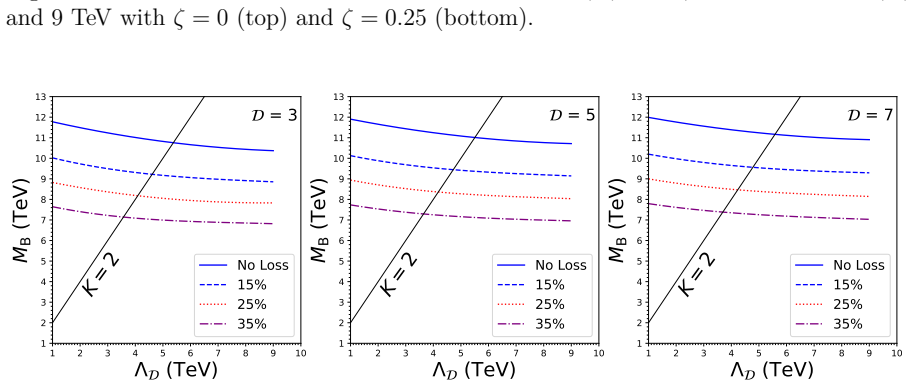
LHC data disfavors ADD black holes with masses up to 11.83 TeV for three extra dimensions when formation loss is zero.
A machine-rendered reading of the paper's core claim, the machinery that carries it, and where it could break.
Core claim
We explore microscopic black holes at the Large Hadron Collider in the context of the ADD model for the centre-of-mass energy √s = 14 TeV at an integrated luminosity of 349.4 fb^{-1} and provide constraints on the black hole mass MB by taking into account the effects of loss during the formation process of black holes through the parameter ζ. Our analysis reveals that for ζ = 0, black holes with MB ≤ 11.83 TeV are disfavored in the case of three extra dimensions, for the reduced Planck scale of about a TeV. The corresponding values for ΛD = 9 TeV turned out to be about 10.33 TeV. A significant reduction in the aforementioned limits is observed while the loss gets higher, e.g. for ζ = 0.35, M
What carries the argument
The parameter ζ that accounts for energy loss during black hole formation, used to adjust the production threshold in the ADD extra-dimension scenario.
If this is right
- Excluded black hole masses decrease as the formation loss parameter ζ increases.
- Raising the number of extra dimensions from three to seven increases the excluded mass values.
- Higher reduced Planck scales result in lower excluded black hole masses.
- The 95% C.L. limits are higher than the reported central values for the same parameters.
Where Pith is reading between the lines
- If black holes are not observed, future LHC runs at higher luminosity could tighten these mass bounds further.
- The model could be tested by searching for specific decay signatures predicted for these black holes.
- Similar constraints might apply in other large extra dimension models beyond ADD.
Load-bearing premise
The analysis assumes that the black-hole production cross-section and decay signatures in the ADD model, together with the single parameter ζ for formation loss, fully capture the observable signal without unaccounted detector or background effects at the stated luminosity.
What would settle it
An observation of black hole production events with masses below the stated limits in the LHC data would contradict the disfavoring of those masses.
Figures

read the original abstract
We explore microscopic black holes at the Large Hadron Collider (LHC) in the context of the ADD model for the centre-of-mass energy $\sqrt{s} = 14~\mathrm{TeV}$ at an integrated luminosity of $349.4~\mathrm{fb}^{-1}$ and provide constraints on the black hole mass, $M_{\mathrm{B}}$ by taking into account the effects of loss during the formation process of black holes through the parameter $\zeta$. Our analysis reveals that for $\zeta = 0$, black holes with $M_{\mathrm{B}} \leq 11.83~\mathrm{TeV}$ are disfavored in the case of three extra dimensions ($\mathcal{D}$), for the reduced Planck scale ($\Lambda_{\mathcal{D}}$) of about a TeV. The corresponding values for $\Lambda_{\mathcal{D}} = 9~\mathrm{TeV}$ turned out to be about $10.33~\mathrm{TeV}$. A significant reduction in the aforementioned limits is observed while the loss gets higher, e.g. for $\zeta = 0.35$, $M_{\mathrm{B}}$ reduces to $7.65 (6.82)~\mathrm{TeV}$ at $\Lambda_{\mathcal{D}} = 1 (9)~\mathrm{TeV}$. These limits change to $12.03 ~(10.88)~\mathrm{TeV}$ and $7.80~ (7.03)~\mathrm{TeV}$ respectively for $\zeta = 0~(0.35)$ for $\Lambda_{\mathcal{D}} = 1 (9)~\mathrm{TeV}$ at 95\% C.L. in case $\mathcal{D}$ is raised to seven.
Editorial analysis
A structured set of objections, weighed in public.
Referee Report
Summary. The paper explores microscopic black holes in the ADD model at the LHC with √s = 14 TeV and 349.4 fb^{-1} integrated luminosity. It incorporates a loss parameter ζ during black hole formation and reports specific exclusion limits on the black hole mass MB, such as MB ≤ 11.83 TeV for ζ = 0, D = 3, ΛD ≈ 1 TeV (with reductions to 7.65 TeV at ζ = 0.35), and corresponding values at 95% C.L. for D = 7 and ΛD = 9 TeV.
Significance. If the numerical limits are correctly derived, the results would provide updated constraints on ADD model parameters (D and ΛD) using current LHC luminosity, with the ζ parameter allowing exploration of formation effects. This could be relevant for interpreting null results in black hole searches, though the overall impact depends on verification of the underlying analysis.
major comments (2)
- [Abstract] Abstract: The central numerical limits on MB (e.g., 11.83 TeV for ζ=0, D=3, ΛD≈1 TeV and 7.65 TeV for ζ=0.35) are stated without any derivation, cross-section formula, acceptance calculation, background estimation procedure, or error propagation. This is load-bearing for the claim, as the translation from model parameters to exclusion thresholds requires these steps to be valid at the quoted luminosity.
- The analysis assumes the ζ-modified geometric cross-section plus decay signatures fully determine the observable rates without unaccounted backgrounds or detector effects. No information is given on how backgrounds are modeled or subtracted, which directly affects whether the quoted MB thresholds hold if backgrounds are non-negligible.
minor comments (2)
- The notation ϒ for the number of extra dimensions is non-standard and should be defined explicitly on first use for clarity.
- [Abstract] The abstract reports limits both with and without the 95% C.L. qualifier; consistency in presentation of the confidence level across all quoted values would improve readability.
Simulated Author's Rebuttal
We thank the referee for their review and comments on our manuscript. We address the major points below regarding the presentation of limits and background assumptions, and indicate where revisions will be made.
read point-by-point responses
-
Referee: [Abstract] Abstract: The central numerical limits on MB (e.g., 11.83 TeV for ζ=0, D=3, ΛD≈1 TeV and 7.65 TeV for ζ=0.35) are stated without any derivation, cross-section formula, acceptance calculation, background estimation procedure, or error propagation. This is load-bearing for the claim, as the translation from model parameters to exclusion thresholds requires these steps to be valid at the quoted luminosity.
Authors: The abstract is necessarily concise, but the full manuscript derives the quoted MB limits from the ζ-modified geometric cross-section (detailed in Section 2), integrated with parton luminosities at √s=14 TeV, and sets the threshold where the expected yield falls below the 95% CL exclusion for 349.4 fb^{-1} assuming Poisson statistics with zero events. Acceptance is taken near unity for the high-multiplicity final states considered, with no additional error propagation beyond luminosity. We will revise the abstract to reference the cross-section formula and exclusion criterion used. revision: partial
-
Referee: [—] The analysis assumes the ζ-modified geometric cross-section plus decay signatures fully determine the observable rates without unaccounted backgrounds or detector effects. No information is given on how backgrounds are modeled or subtracted, which directly affects whether the quoted MB thresholds hold if backgrounds are non-negligible.
Authors: This is a phenomenological study that computes the mass at which the production rate becomes unobservable at the stated luminosity, under the standard assumption for such high-mass searches that SM backgrounds are negligible (or have already been accounted for in referenced experimental results). No full detector simulation or background subtraction is performed, as the focus is on the model-dependent cross-section modified by ζ. We will add an explicit paragraph in the revised text discussing this assumption, its validity in the high-mass regime, and the fact that non-zero backgrounds would weaken the limits. revision: yes
Circularity Check
No significant circularity; limits are conditional on model parameters without self-referential reduction.
full rationale
The paper computes exclusion limits on MB as functions of the free parameter ζ (varied at discrete values 0 and 0.35) and D, using the standard ADD geometric cross-section modified by ζ. No equation or step equates a derived quantity back to its own input by construction, no fitted subset is relabeled as a prediction, and no load-bearing uniqueness theorem or ansatz is imported via self-citation. The numerical thresholds (e.g., MB ≤ 11.83 TeV) follow from applying the model cross-section, multiplicity, and acceptance to the stated luminosity; these steps remain independent of the target result itself. The dependence on ζ is explicit and does not constitute circularity under the defined patterns.
Axiom & Free-Parameter Ledger
free parameters (3)
- ζ
- ΛD
- D
axioms (2)
- domain assumption ADD model permits microscopic black-hole production at LHC energies when ΛD is near the TeV scale.
- standard math Integrated luminosity of 349.4 fb^{-1} at √s = 14 TeV is the relevant exposure for exclusion.
Reference graph
Works this paper leans on
-
[1]
G. Aadet al.[ATLAS], Phys. Lett. B716, 1-29 (2012) doi:10.1016/j.physletb.2012.08.020 [arXiv:1207.7214 [hep-ex]]
work page internal anchor Pith review Pith/arXiv arXiv doi:10.1016/j.physletb.2012.08.020 2012
-
[2]
Observation of a new boson at a mass of 125 GeV with the CMS experiment at the LHC
S. Chatrchyanet al.[CMS], Phys. Lett. B716, 30-61 (2012) doi:10.1016/j.physletb.2012.08.021 [arXiv:1207.7235 [hep-ex]]
work page internal anchor Pith review Pith/arXiv arXiv doi:10.1016/j.physletb.2012.08.021 2012
-
[3]
L. Susskind, Phys. Rev. D20, 2619-2625 (1979) doi:10.1103/PhysRevD.20.2619
-
[4]
S. Weinberg, Phys. Rev. D13, 974-996 (1976) doi:10.1103/PhysRevD.19.1277
-
[5]
R. N. Mohapatra and G. Senjanovic, Phys. Rev. Lett.44, 912 (1980) doi:10.1103/PhysRevLett.44.912
-
[6]
Particle Dark Matter: Evidence, Candidates and Constraints
G. Bertone, D. Hooper and J. Silk, Phys. Rept.405, 279-390 (2005) doi:10.1016/j.physrep.2004.08.031 [arXiv:hep-ph/0404175 [hep-ph]]
work page internal anchor Pith review Pith/arXiv arXiv doi:10.1016/j.physrep.2004.08.031 2005
-
[7]
A direct empirical proof of the existence of dark matter
D. Clowe, M. Bradac, A. H. Gonzalez, M. Markevitch, S. W. Randall, C. Jones and D. Zaritsky, Astrophys. J. Lett.648, L109-L113 (2006) doi:10.1086/508162 [arXiv:astro-ph/0608407 [astro-ph]]
work page internal anchor Pith review Pith/arXiv arXiv doi:10.1086/508162 2006
-
[8]
New Dimensions at a Millimeter to a Fermi and Superstrings at a TeV
I. Antoniadis, N. Arkani-Hamed, S. Dimopoulos and G. R. Dvali, Phys. Lett. B436, 257-263 (1998) doi:10.1016/S0370-2693(98)00860-0 [arXiv:hep-ph/9804398 [hep-ph]]. 10
work page internal anchor Pith review Pith/arXiv arXiv doi:10.1016/s0370-2693(98)00860-0 1998
-
[9]
The Hierarchy Problem and New Dimensions at a Millimeter
N. Arkani-Hamed, S. Dimopoulos and G. R. Dvali, Phys. Lett. B429, 263-272 (1998) doi:10.1016/S0370-2693(98)00466-3 [arXiv:hep-ph/9803315 [hep-ph]]
work page internal anchor Pith review Pith/arXiv arXiv doi:10.1016/s0370-2693(98)00466-3 1998
-
[10]
G. Aadet al.[ATLAS], New J. Phys.15, 043007 (2013) doi:10.1088/1367-2630/15/4/043007 [arXiv:1210.8389 [hep-ex]]
work page internal anchor Pith review Pith/arXiv arXiv doi:10.1088/1367-2630/15/4/043007 2013
-
[11]
S. Chatrchyanet al.[CMS], Phys. Lett. B711, 15-34 (2012) doi:10.1016/j.physletb.2012.03.029 [arXiv:1202.3827 [hep-ex]]
work page internal anchor Pith review Pith/arXiv arXiv doi:10.1016/j.physletb.2012.03.029 2012
-
[12]
A. M. Sirunyanet al.[CMS], JHEP07, 208 (2021) doi:10.1007/JHEP07(2021)208 [arXiv:2103.02708 [hep-ex]]
-
[13]
V. M. Abazovet al.[D0], Phys. Rev. Lett.90, 251802 (2003) doi:10.1103/PhysRevLett.90.251802 [arXiv:hep-ex/0302014 [hep-ex]]
work page internal anchor Pith review Pith/arXiv arXiv doi:10.1103/physrevlett.90.251802 2003
-
[14]
Nonspherical Gravitational Collapse: A Short Review,
K. S. Thorne, “Nonspherical Gravitational Collapse: A Short Review,” in J. R. Klauder (ed.), Magic Without Magic: John Archibald Wheeler, Freeman, San Francisco (1972), pp. 231–258
1972
-
[15]
Black hole and brane production in TeV gravity: A review
M. Cavaglia, Int. J. Mod. Phys. A18, 1843-1882 (2003) doi:10.1142/S0217751X03013569 [arXiv:hep-ph/0210296 [hep-ph]]
work page internal anchor Pith review Pith/arXiv arXiv doi:10.1142/s0217751x03013569 2003
-
[16]
S. W. Hawking, Commun. Math. Phys.43, 199-220 (1975) [erratum: Commun. Math. Phys.46, 206 (1976)] doi:10.1007/BF02345020
-
[17]
S. Dimopoulos and G. L. Landsberg, Phys. Rev. Lett.87, 161602 (2001) doi:10.1103/PhysRevLett.87.161602 [arXiv:hep-ph/0106295 [hep-ph]]
work page internal anchor Pith review Pith/arXiv arXiv doi:10.1103/physrevlett.87.161602 2001
-
[18]
S. B. Giddings and S. D. Thomas, Phys. Rev. D65, 056010 (2002) doi:10.1103/PhysRevD.65.056010 [arXiv:hep-ph/0106219 [hep-ph]]
work page internal anchor Pith review Pith/arXiv arXiv doi:10.1103/physrevd.65.056010 2002
-
[19]
P. Kanti, Lect. Notes Phys.769, 387-423 (2009) doi:10.1007/978-3-540-88460-6_10 [arXiv:0802.2218 [hep-th]]
work page internal anchor Pith review Pith/arXiv arXiv doi:10.1007/978-3-540-88460-6_10 2009
-
[20]
G. L. Landsberg, [arXiv:hep-ph/0211043 [hep-ph]]
-
[21]
A. M. Sirunyanet al.[CMS], Phys. Lett. B774, 279-307 (2017) doi:10.1016/j.physletb.2017.09.053 [arXiv:1705.01403 [hep-ex]]
work page internal anchor Pith review Pith/arXiv arXiv doi:10.1016/j.physletb.2017.09.053 2017
-
[22]
A. M. Sirunyanet al.[CMS], JHEP11, 042 (2018) doi:10.1007/JHEP11(2018)042 [arXiv:1805.06013 [hep-ex]]
work page internal anchor Pith review Pith/arXiv arXiv doi:10.1007/jhep11(2018)042 2018
-
[23]
M. V. Savina, Phys. Atom. Nucl.74, 496-504 (2011) doi:10.1134/S1063778811020190
-
[24]
M. V. Savina [CMS], Phys. Atom. Nucl.76, 1090-1099 (2013) doi:10.1134/S1063778813090160
-
[25]
M. V. Savina, Phys. Atom. Nucl.78, no.4, 532-536 (2015) doi:10.1134/S1063778815030102
-
[26]
Hayrapetyanet al.[CMS], [arXiv:2604.10732 [hep-ex]]
A. Hayrapetyanet al.[CMS], [arXiv:2604.10732 [hep-ex]]
-
[27]
G. Aadet al.[ATLAS], Phys. Rev. D109, no.3, 032010 (2024) doi:10.1103/PhysRevD.109.032010 [arXiv:2307.14967 [hep-ex]]. 11
-
[28]
T. A. Vami and D. Zhang, [arXiv:2511.10662 [hep-ex]]
-
[29]
Aadet al.[ATLAS], [arXiv:2604.19495 [hep-ex]]
G. Aadet al.[ATLAS], [arXiv:2604.19495 [hep-ex]]
- [30]
-
[31]
N. Arkani-Hamed, S. Dimopoulos and G. R. Dvali, Phys. Rev. D59, 086004 (1999) doi:10.1103/PhysRevD.59.086004 [arXiv:hep-ph/9807344 [hep-ph]]
work page internal anchor Pith review Pith/arXiv arXiv doi:10.1103/physrevd.59.086004 1999
-
[32]
What we (don't) know about black hole formation in high-energy collisions
V. Cardoso, E. Berti and M. Cavaglia, Class. Quant. Grav.22, L61-R84 (2005) doi:10.1088/0264-9381/22/12/L01 [arXiv:hep-ph/0505125 [hep-ph]]
work page internal anchor Pith review Pith/arXiv arXiv doi:10.1088/0264-9381/22/12/l01 2005
-
[33]
C. D. Hoyle, D. J. Kapner, B. R. Heckel, E. G. Adelberger, J. H. Gundlach, U. Schmidt and H. E. Swanson, Phys. Rev. D70, 042004 (2004) doi:10.1103/PhysRevD.70.042004 [arXiv:hep-ph/0405262 [hep-ph]]
work page internal anchor Pith review Pith/arXiv arXiv doi:10.1103/physrevd.70.042004 2004
-
[34]
J. C. Long and J. C. Price, Comptes Rendus Physique4, 337-346 (2003) doi:10.1016/S1631-0705(03)00042-2 [arXiv:hep-ph/0303057 [hep-ph]]
work page internal anchor Pith review Pith/arXiv arXiv doi:10.1016/s1631-0705(03)00042-2 2003
-
[35]
G. L. Landsberg [CDF and D0], eConfC040802, MOT006 (2004) [arXiv:hep-ex/0412028 [hep-ex]]
Pith/arXiv arXiv 2004
-
[36]
Gamma rays from the Galactic bulge and large extra dimensions
M. Casse, J. Paul, G. Bertone and G. Sigl, Phys. Rev. Lett.92, 111102 (2004) doi:10.1103/PhysRevLett.92.111102 [arXiv:hep-ph/0309173 [hep-ph]]
work page internal anchor Pith review Pith/arXiv arXiv doi:10.1103/physrevlett.92.111102 2004
-
[37]
Planck-scale physics: facts and beliefs
D. Meschini, Found. Sci.12, 277-294 (2007) doi:10.1007/s10699-006-9102-3 [arXiv:gr-qc/0601097 [gr-qc]]
work page internal anchor Pith review Pith/arXiv arXiv doi:10.1007/s10699-006-9102-3 2007
- [38]
-
[39]
Black hole particle emission in higher-dimensional spacetimes
V. Cardoso, M. Cavaglia and L. Gualtieri, Phys. Rev. Lett.96, 071301 (2006) [erratum: Phys. Rev. Lett.96, 219902 (2006)] doi:10.1103/PhysRevLett.96.071301 [arXiv:hep-th/0512002 [hep-th]]
work page internal anchor Pith review Pith/arXiv arXiv doi:10.1103/physrevlett.96.071301 2006
-
[40]
Black hole formation in the head-on collision of ultrarelativistic charges
H. Yoshino and R. B. Mann, Phys. Rev. D74, 044003 (2006) doi:10.1103/PhysRevD.74.044003 [arXiv:gr-qc/0605131 [gr-qc]]
work page internal anchor Pith review Pith/arXiv arXiv doi:10.1103/physrevd.74.044003 2006
-
[41]
D. M. Eardley and S. B. Giddings, Phys. Rev. D66, 044011 (2002) doi:10.1103/PhysRevD.66.044011 [arXiv:gr-qc/0201034 [gr-qc]]
work page internal anchor Pith review Pith/arXiv arXiv doi:10.1103/physrevd.66.044011 2002
-
[42]
Black hole formation in the grazing collision of high-energy particles
H. Yoshino and Y. Nambu, Phys. Rev. D67, 024009 (2003) doi:10.1103/PhysRevD.67.024009 [arXiv:gr-qc/0209003 [gr-qc]]
work page internal anchor Pith review Pith/arXiv arXiv doi:10.1103/physrevd.67.024009 2003
-
[43]
D. C. Dai, G. Starkman, D. Stojkovic, C. Issever, E. Rizvi and J. Tseng, Phys. Rev. D77, 076007 (2008) doi:10.1103/PhysRevD.77.076007 [arXiv:0711.3012 [hep-ph]]
work page internal anchor Pith review Pith/arXiv arXiv doi:10.1103/physrevd.77.076007 2008
-
[44]
Black Holes in Theories with Large Extra Dimensions: a Review
P. Kanti, Int. J. Mod. Phys. A19, 4899-4951 (2004) doi:10.1142/S0217751X04018324 [arXiv:hep-ph/0402168 [hep-ph]]
work page internal anchor Pith review Pith/arXiv arXiv doi:10.1142/s0217751x04018324 2004
-
[45]
S. C. Park, Prog. Part. Nucl. Phys.67, 617-650 (2012) doi:10.1016/j.ppnp.2012.03.004 [arXiv:1203.4683 [hep-ph]]
work page internal anchor Pith review Pith/arXiv arXiv doi:10.1016/j.ppnp.2012.03.004 2012
-
[46]
Micro black holes in the laboratory
M. Bleicher, P. Nicolini, M. Sprenger and E. Winstanley, Int. J. Mod. Phys. E20S2, 7-14 (2011) doi:10.1142/S0218301311040529 [arXiv:1111.0657 [hep-th]]. 12
work page internal anchor Pith review Pith/arXiv arXiv doi:10.1142/s0218301311040529 2011
-
[47]
P. Mandrik [CMS], EPJ Web Conf.191, 02009 (2018) doi:10.1051/epjconf/201819102009 [arXiv:1808.09915 [hep-ex]]
-
[48]
D. C. Dai, C. Issever, E. Rizvi, G. Starkman, D. Stojkovic and J. Tseng, Comput. Phys. Commun.236, 285-301 (2019) doi:10.1016/j.cpc.2018.10.021 [arXiv:0902.3577 [hep-ph]]
work page internal anchor Pith review Pith/arXiv arXiv doi:10.1016/j.cpc.2018.10.021 2019
-
[49]
Hossenfelder, [arXiv:hep-ph/0412265 [hep-ph]]
S. Hossenfelder, [arXiv:hep-ph/0412265 [hep-ph]]
-
[50]
S. N. Solodukhin, Phys. Lett. B533, 153-161 (2002) doi:10.1016/S0370-2693(02)01589-7 [arXiv:hep-ph/0201248 [hep-ph]]
work page internal anchor Pith review Pith/arXiv arXiv doi:10.1016/s0370-2693(02)01589-7 2002
-
[51]
S. D. H. Hsu, Phys. Lett. B555, 92-98 (2003) doi:10.1016/S0370-2693(03)00012-1 [arXiv:hep-ph/0203154 [hep-ph]]
work page internal anchor Pith review Pith/arXiv arXiv doi:10.1016/s0370-2693(03)00012-1 2003
-
[52]
Black Holes Radiate Mainly on the Brane
R. Emparan, G. T. Horowitz and R. C. Myers, Phys. Rev. Lett.85, 499-502 (2000) doi:10.1103/PhysRevLett.85.499 [arXiv:hep-th/0003118 [hep-th]]. 13
work page internal anchor Pith review Pith/arXiv arXiv doi:10.1103/physrevlett.85.499 2000
discussion (0)
Sign in with ORCID, Apple, or X to comment. Anyone can read and Pith papers without signing in.