Theory perspectives on rare Kaon decays and CPV
Pith reviewed 2026-05-24 22:39 UTC · model grok-4.3
The pith
Rare kaon decays like K to pi nu nu bar can probe new physics in direct CP violation and its link to B anomalies.
A machine-rendered reading of the paper's core claim, the machinery that carries it, and where it could break.
Core claim
Very rare kaon decays like K to pi nu nu bar are very important to probe New Physics in direct CP violation in K to 2 pi and the interplay with B anomalies.
What carries the argument
Branching ratios of rare kaon decays, especially K to pi nu nu bar, serving as precision observables for new physics contributions to CP violation.
Load-bearing premise
Precision measurements of these rare decays can isolate new physics effects from standard model predictions without needing model-specific assumptions about the new physics form.
What would settle it
A measurement of the K to pi nu nu bar branching ratio that exactly matches the standard model expectation with no deviation, even while B anomalies persist.
Figures


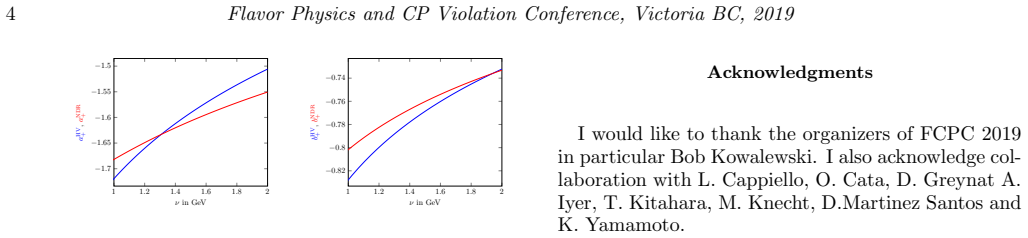
read the original abstract
The following proceedings contain a theory perspective on rare Kaon decays. I review rare kaon decays in the LHC era: we discuss interplay with B-anomalies and possible New Physics in direct CP violation in $K\to 2\pi$: very rare kaon decays like $K \to \pi \nu \bar{\nu}$ are very important to this purpose. We discuss also the decays $K^0 \to \mu ^+ \mu ^-$ due to the LHCB measurement
Editorial analysis
A structured set of objections, weighed in public.
Referee Report
Summary. The manuscript is a short proceedings review offering theory perspectives on rare kaon decays in the LHC era. It summarizes the interplay between these decays (particularly K → π ν ν̄) and B anomalies, the potential for New Physics in direct CP violation in K → 2π, and the status of K⁰ → μ⁺ μ⁻ in light of LHCb measurements.
Significance. The review provides a compact overview connecting rare kaon observables to broader New Physics searches. Its value lies in contextualizing existing literature rather than advancing new derivations, predictions, or model-independent results.
minor comments (2)
- The abstract and text contain the abbreviation 'LHCB'; standard notation is LHCb.
- As a proceedings contribution, the manuscript would benefit from a brief concluding paragraph that explicitly lists the key open questions or experimental targets highlighted in the review.
Simulated Author's Rebuttal
We thank the referee for the positive review and the recommendation to accept the manuscript. The report accurately captures the scope of this short proceedings contribution as a theory perspective connecting rare kaon decays to B anomalies and CP violation in the LHC era.
Circularity Check
No significant circularity
full rationale
The paper is a short proceedings review that summarizes existing theory perspectives on rare kaon decays and their relation to B anomalies and CP violation. It advances no new quantitative claims, derivations, equations, predictions, or fitted parameters. No load-bearing steps exist that could reduce to self-citation chains, self-definitions, or fitted inputs renamed as predictions. The document is self-contained as a perspective summary against external benchmarks.
Axiom & Free-Parameter Ledger
axioms (2)
- domain assumption Standard Model governs the baseline predictions for kaon decays
- domain assumption Rare kaon decays can probe New Physics effects
Lean theorems connected to this paper
-
IndisputableMonolith/Cost/FunctionalEquation.leanwashburn_uniqueness_aczel unclear?
unclearRelation between the paper passage and the cited Recognition theorem.
SM predicts the V−A⊗V−A effective hamiltonian ... XNL(λxc) + ... X(xt) A²λ⁵(1−ρ−iη)xt
-
IndisputableMonolith/Foundation/AlexanderDuality.leanalexander_duality_circle_linking unclear?
unclearRelation between the paper passage and the cited Recognition theorem.
Randall Sundrum models ... flavor anarchy scenario with 5D MFV and custodial symmetry
What do these tags mean?
- matches
- The paper's claim is directly supported by a theorem in the formal canon.
- supports
- The theorem supports part of the paper's argument, but the paper may add assumptions or extra steps.
- extends
- The paper goes beyond the formal theorem; the theorem is a base layer rather than the whole result.
- uses
- The paper appears to rely on the theorem as machinery.
- contradicts
- The paper's claim conflicts with a theorem or certificate in the canon.
- unclear
- Pith found a possible connection, but the passage is too broad, indirect, or ambiguous to say the theorem truly supports the claim.
Reference graph
Works this paper leans on
-
[1]
Theory perspectives on rare Kaon decays and CPV
to this purpose. MonB1630 arXiv:1907.05616v1 [hep-ph] 12 Jul 2019 2 Flavor Physics and CP Violation Conference, Victoria BC, 2019 II. KL,S→µ+µ− RecentKS→µµ LHCB measurement is very inter- esting and unexpected B(KS→µµ)LHCB < 9× 10⁻⁹ at 90 % CL (2) B(KS→µµ)SM = (5.0± 1.5)× 10−12. (3) It represents an important milestone since it has im- proved the previous...
work page internal anchor Pith review Pith/arXiv arXiv 1907
-
[2]
$K\to \pi \nu\overline{\nu}$ in the MSSM in Light of the $\epsilon^{\prime}_K/\epsilon_K$ Anomaly
A. Crivellin, G. D’Ambrosio, T. Kitahara and U. Nierste, Phys. Rev. D 96, no. 1, 015023 (2017) doi:10.1103/PhysRevD.96.015023 [arXiv:1703.05786 [hep-ph]]
work page internal anchor Pith review Pith/arXiv arXiv doi:10.1103/physrevd.96.015023 2017
-
[3]
Michal ZAMKOVSKY, these Proceedings
-
[4]
Supersymmetric Explanation of CP Violation in $K\to \pi\pi$ Decays
T. Kitahara, U. Nierste and P. Trem- per, Phys. Rev. Lett. 117, no. 9, 091802 (2016) doi:10.1103/PhysRevLett.117.091802 [arXiv:1604.07400 [hep-ph]]
work page internal anchor Pith review Pith/arXiv arXiv doi:10.1103/physrevlett.117.091802 2016
-
[5]
Direct determination of Wilson coefficients using $B^0\to K^{*0}\mu^+\mu^-$ decays
T. Hurth, C. Langenbruch and F. Mahmoudi, JHEP 1711, 176 (2017) doi:10.1007/JHEP11(2017)176 [arXiv:1708.04474 [hep-ph]]
work page internal anchor Pith review Pith/arXiv arXiv doi:10.1007/jhep11(2017)176 2017
-
[6]
Flavour issues in warped custodial models: $B$ anomalies and rare $K$ decays
G. D’Ambrosio and A. M. Iyer, Eur. Phys. J. C 78, no. 6, 448 (2018) doi:10.1140/epjc/s10052-018-5915-9 [arXiv:1712.08122 [hep-ph]]
work page internal anchor Pith review Pith/arXiv arXiv doi:10.1140/epjc/s10052-018-5915-9 2018
-
[7]
A Framework for Finding Anomalous Objects at the LHC
A. Chakraborty, A. M. Iyer and T. S. Roy, arXiv:1707.07084 [hep-ph]
work page internal anchor Pith review Pith/arXiv arXiv
-
[8]
G. D’Ambrosio and T. Kitahara, Phys. Rev. Lett. 119, no. 20, 201802 (2017)
work page 2017
-
[9]
Direct determination of Wilson coefficients using $B^0\to K^{*0}\mu^+\mu^-$ decays
V. Chobanova, G. D’Ambrosio, T. Kitahara, M. Lu- cio Martinez, D. Martinez Santos, I. S. Fernan- dez and K. Yamamoto, JHEP 1805, 024 (2018) doi.org/10.1007/JHEP05(2018)024 [arXiv:1708.04474 [hep-ph]] arXiv:1711.11030 [hep-ph]
work page internal anchor Pith review Pith/arXiv arXiv doi:10.1007/jhep05(2018)024 2018
-
[10]
A. A. Alves Junior et al. , JHEP 1905, 048 (2019) doi:10.1007/JHEP05(2019)048 [arXiv:1808.03477 [hep-ex]]
-
[11]
Closing in on the radiative weak chiral couplings
L. Cappiello, O. Cat` a and G. D’Ambrosio, Eur. Phys. J. C 78, no. 3, 265 (2018) doi:10.1140/epjc/s10052- 018-5748-6 [arXiv:1712.10270 [hep-ph]]
work page internal anchor Pith review Pith/arXiv arXiv doi:10.1140/epjc/s10052- 2018
-
[12]
The Decays $K \to \pi \ell^+ \ell^-$ beyond Leading Order in the Chiral Expansion
G. D’Ambrosio, G. Ecker, G. Isidori and J. Por- toles, JHEP 9808, 004 (1998) doi:10.1088/1126- 6708/1998/08/004 [hep-ph/9808289]
work page internal anchor Pith review Pith/arXiv arXiv doi:10.1088/1126- 1998
-
[13]
A new measurement of the properties of the rare decay K -> pi+ e+ e-
R. Appel et al. [E865 Collaboration], Phys. Rev. Lett. 83 (1999) 4482 [arxiv:hep-ex/9907045]
work page internal anchor Pith review Pith/arXiv arXiv 1999
-
[14]
J. R. Batley et al. [NA48/2 Collaboration], Phys. Lett. B 677 (2009) 246 [arxiv:hep-ex/0903.3130]
work page internal anchor Pith review Pith/arXiv arXiv 2009
-
[15]
J. R. Batley et al. [NA48/2 Collaboration], Phys. Lett. B 697 (2011) 107 [arxiv:hep-ex/1011.4817]
work page internal anchor Pith review Pith/arXiv arXiv 2011
-
[16]
Lepton flavor (universality) violation in rare kaon decays
A. Crivellin, G. D’Ambrosio, M. Hoferichter and L. C. Tunstall, Phys. Rev. D 93 (2016) 074038 [arxiv:hep-ph/1601.00970]
work page internal anchor Pith review Pith/arXiv arXiv 2016
-
[17]
Global analysis of $b\to s\ell\ell$ anomalies
S. Descotes-Genon, L. Hofer, J. Matias and J. Virto, JHEP 1606, 092 (2016) [arxiv:hep-ph/1510.04239]
work page internal anchor Pith review Pith/arXiv arXiv 2016
-
[18]
On the amplitudes for the CP-conserving $K^\pm(K_S)\to\pi^\pm(\pi^0)\ell^+\ell^-$ rare decay modes
G. D’Ambrosio, D. Greynat and M. Knecht, JHEP 1902, 049 (2019) doi:10.1007/JHEP02(2019)049 [arXiv:1812.00735 [hep-ph]]
work page internal anchor Pith review Pith/arXiv arXiv doi:10.1007/jhep02(2019)049 1902
-
[19]
G. D’Ambrosio, D. Greynat and M. Knecht, arXiv:1906.03046 [hep-ph]. MonB1630
discussion (0)
Sign in with ORCID, Apple, or X to comment. Anyone can read and Pith papers without signing in.