REVIEW 3 major objections 5 minor 48 references
Co-DETECT: Collaborative Discovery of Edge Cases in Text Classification
T0 review · 3 major / 5 minor · reviewed 2026-08-06 · deepseek-v4-flash
Pith's one-line read Co-DETECT is a mixed-initiative annotation framework that uses LLM-flagged low-confidence examples to produce high-level edge-case rules, and reports F1 gains on hate-speech and emotion classification after one iteration.
desk verdict A useful mixed-initiative annotation tool that is currently oversold: the F1 gain in Table 1 is in-sample, so the central claim of generalization is not yet established. read the letter →
The pith
A machine-rendered reading of the paper's core claim, the machinery that carries it, and where it could break.
The reading
What carries the argument
The load-bearing mechanism is a three-step backend that converts individual low-confidence predictions into codebook-ready rules. First, a non-reasoning LLM annotates each text and, when confidence is low, emits an explanation framed as 'when [case], do [action]'. Second, these pointwise descriptions are embedded, clustered with constrained KMeans into balanced groups of 10 to 20 items, and each cluster is summarized by a reasoning LLM into a high-level edge case with a handling rule. Third, a final reasoning-LLM pass merges similar cluster-level cases so that the same phenomenon is not handled by multiple rules. The human expert then reviews clusters and rules in a dashboard, edits or rejects them, and triggers another iteration of annotation with the augmented codebook.
What would settle it
Run Co-DETECT on a training split of GabHateCorpus and GoEmotions, append the induced rules, and measure F1 on a held-out test split; if the F1 gain disappears or reverses on the held-out split, the reported improvement is a fit to the low-confidence cases used to create the rules rather than a generalizable codebook gain.
Extended reading notes
Core claim
The paper's central claim is that descriptive, high-level, generalizable edge cases can be discovered collaboratively: the LLM supplies candidate cases through low confidence scores and explanations, a clustering-and-reasoning stage turns them into compact handling rules, and the human expert decides which rules enter the codebook. In the paper's framing, edge-case discovery is a mixed-initiative process rather than purely manual review or a fully automatic annotation pass. The companion quantitative experiment holds the annotator fixed and varies only the codebook, reporting F1 gains on all three evaluated tasks after one Co-DETECT iteration. A user study with 10 experts, plus a check in which 33 of 41 sampled cases (80.5%) were judged well-described by the suggested edge-case descriptions, is offered as evidence that the proposed cases are relevant and at the right level of abstraction.
Load-bearing premise
The central claim rests on the assumption that edge-case rules induced from a corpus's low-confidence examples improve classification on that same corpus in a way that also holds for new, unseen data, since the reported F1 gains use the same corpus for both rule induction and evaluation.
Editorial extensions
If this is right
- A single iteration of Co-DETECT can augment a sketch-level codebook with compact handling rules that raise F1 on the same corpus, as shown in Table 1.
- The workflow can surface edge cases beyond an expert's prior knowledge: 90% of user-study participants said Co-DETECT may help discover new edge cases.
- The suggested rules are judged quickly: in the quantitative evaluation, an expert could decide whether a sample was covered by an edge-case description in under 5 seconds.
- Because the annotator is held fixed and only the codebook changes, the F1 gains are attributed to codebook improvement rather than to a stronger model.
Reading between the lines
- Beyond the paper's evaluation, the same pipeline could target other failure modes, such as label imbalance or domain shift, by changing what counts as 'low confidence' from a model confidence score to a calibration or uncertainty measure.
- The generalization of the rules is under-tested; a natural extension would be to induce rules on one corpus and measure F1 on a held-out split, which would separate genuine rule discovery from in-sample fitting.
- If edge-case rules prove stable across corpora, accumulated codebooks could become reusable domain assets that bootstrap future annotation tasks.
- The 40% of participants who worried about missed edge cases points to a useful next metric: recall of edge cases, not just precision of the proposed ones.
Editorial analysis
A structured set of objections, weighed in public.
Referee Report
Summary. The paper introduces Co-DETECT, a mixed-initiative annotation framework in which an LLM annotates a user-provided corpus, flags low-confidence examples as potential edge cases, clusters and induces high-level rules with a reasoning LLM, and lets a human expert edit and append rules to a codebook. The paper reports a 10-participant user study, a small quantitative human check of edge-case descriptions, and F1 comparisons on GabHateCorpus and GoEmotions before and after one Co-DETECT iteration, concluding that the framework is effective.
Significance. If validated, Co-DETECT addresses a real bottleneck in codebook-based text annotation: the costly discovery and codification of edge cases. The backend pipeline (item-level flagging, constrained KMeans, and DeepSeek-R1 based induction and merging) is clearly described, and the public demo and code are concrete assets. However, the current validation is insufficient to support the paper's central claim that Co-DETECT discovers high-level, generalizable edge-case rules that improve codebook-driven classification, because the main quantitative experiment is evaluated on the same corpus used to induce the rules and the user study is small and partly author-included.
major comments (3)
- [Section 5 (Table 1)] The F1 comparison evaluates the augmented codebook on the same corpus from which the edge-case rules were induced (Step 1 flags low-confidence examples in the full corpus and Step 3 merges rules derived from those same examples), so the reported gains, including the GoEmotions-Positive jump from 0.0300 to 0.3297, may reflect in-sample fitting rather than generalizable codebook improvement; no held-out split, cross-validation, or out-of-distribution evaluation is reported. This is the central evidence for the claim that Co-DETECT produces high-level, generalizable rules, and the paper's own Broader Impact Statement acknowledges the analogous Clever Hans risk. A held-out split (or nested cross-validation) with confidence intervals and, ideally, a comparison against a human-only codebook revision baseline, is needed before the claim is supported.
- [Section 4] The user study has only 10 participants, 5 of whom are co-authors, and the quantitative human evaluation in Section 4.3 involves 3 participants and 41 self-selected samples; while these results are useful as pilot usability feedback, they do not provide evidence about downstream annotation quality (for example, whether the improved codebook changes annotator agreement or accuracy on unseen data). The paper should either soften the effectiveness claims or add a larger, preregistered evaluation with non-author participants and a measured annotation-quality outcome.
- [Section 3 (Steps 1-3)] The algorithm's behavior depends on several free parameters—the low-confidence threshold for flagging edge cases, the cluster-size bounds (10-20) for constrained KMeans, and the verbalized-confidence prompt—but no sensitivity analysis or ablation is reported, so it is unclear how stable the discovered rules are across reasonable settings. Reporting these ablations would strengthen the reproducibility of the central pipeline.
minor comments (5)
- [Abstract and Section 7] The phrases 'prove the effectiveness' overstate what the evidence supports; 'provide evidence for' or 'suggest' would be more accurate given the preliminary evaluation.
- [Section 5 (Table 1)] Table 1 does not report the number of annotated examples, standard deviations, or significance tests, and it is unclear whether the two iterations use identical test instances.
- [Section 5 and Appendix] The initial codebooks and the exact prompts used for GPT-4.1 and DeepSeek-R1 are not provided in the appendix, which hinders replication of Section 5.
- [Appendix A] One survey question refers to 'AutoDETECT' instead of Co-DETECT, which is inconsistent with the system name used elsewhere.
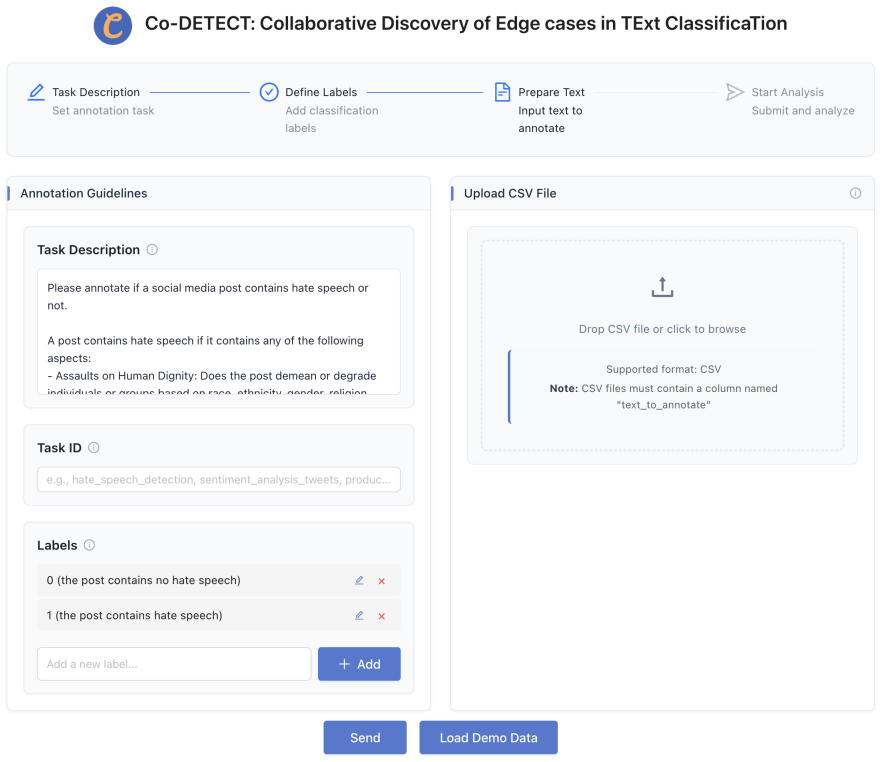
- [Figure 2] The screenshot in Figure 2 is difficult to read in the submitted PDF; enlarging the relevant panels or adding an annotated schematic would improve clarity.
Circularity Check
Table 1's F1 gains are in-sample: edge-case rules are induced from the same corpus on which the improved codebook is then evaluated.
-
fitted input called prediction
[Section 5, Table 1 (Can Improved Codebook Benefit Automatic Annotation?)]
"we provide GPT-4.1 with codebooks before and after Co-DETECT enhancement and compare its classification F1, varying only the codebook. ... The results are exhibited in table 1, where we observe an increase in F1 scores across different datasets."
The augmented codebook is built from edge-case rules induced from low-confidence examples in the same corpus: Step 1 flags low-confidence items, Step 2 clusters their case descriptions, and Step 3 merges cluster-level rules. Table 1 then measures F1 with the augmented codebook on that same corpus, with no held-out split or cross-validation reported. A rule such as 'ambiguous references to protected groups lack explicit demeaning language -> no hate speech' is derived from the very examples whose low confidence flagged them; re-applying it to those examples reassigns them by construction, so the F1 gain in Table 1 is an in-sample fit rather than a prediction on unseen data.
-
other
[Section 4.3, Quantitative Human Evaluation on Edge Case Validity]
"Each participant was asked to randomly select 1 to 2 samples from each edge case cluster and manually assess how many were accurately captured by the Co-DETECT-suggested edge case descriptions. Among 41 randomly selected samples, 33 (80.5%) were reported as well-described by the suggested edge case descriptions."
The suggested descriptions are generated from those same clusters in Step 2 ('Each cluster of [Case Description] ... are fed to DeepSeek-R1 to generate Cluster-wise Edge Cases'), so evaluating whether a description covers samples drawn from the very cluster it summarizes is a consistency check, not an independent test of generality. The paper uses this result to infer that the descriptions are 'sufficiently high-level to cover more than one samples,' but no unseen or held-out cluster is evaluated, so the high-level generalization claim is not independently supported.
full rationale
The paper is a system paper, not a formal derivation, so most of its claims are empirical rather than equation-level. The central quantitative claim, however, reduces to an in-sample comparison. Co-DETECT's Steps 1-3 induce edge-case handling rules from low-confidence examples in the target corpus; Section 5 then compares GPT-4.1's F1 with the original versus augmented codebook on that same corpus, with no held-out split or cross-validation. Because the added rules were fitted to the very examples whose confidence was low, the observed F1 increase is statistically forced and does not demonstrate that the codebook generalizes to unseen posts. The paper's own broader impact statement names exactly this Clever Hans risk. The user study (10 participants, half co-authors) is self-reported and small but not circular; the Section 4.3 validity check is also in-sample because participants pick samples from the same clusters the descriptions were induced from. No other load-bearing self-citation or imported uniqueness theorem appears. Overall, the headline improvement is partially circular/in-sample, warranting a 6.
Assumptions & free parameters
free parameters (3)
- Cluster size bounds for constrained KMeans =
10-20
- Low-confidence threshold for flagging edge cases =
not reported
- Verbalized confidence prompting =
LLM-reported confidence scores
assumptions (4)
- domain assumption LLM verbalized confidence scores are reliable indicators of annotation quality
- domain assumption Reasoning LLMs can induce high-level, generalizable edge case descriptions from clustered item-level cases
- domain assumption A corpus of 500-1000 texts is sufficient for representative edge case discovery
- domain assumption Human expert review prevents model-specific biases from entering the codebook
Cite this review
Pith. "Pith review of Co-DETECT: Collaborative Discovery of Edge Cases in Text Classification." pith.science (2026). https://pith.science/paper/7LX4QRRV
@misc{pith2026250705010,
  author       = {Pith},
  title        = {Pith review of: Co-DETECT: Collaborative Discovery of Edge Cases in Text Classification},
  year         = {2026},
  howpublished = {\url{https://pith.science/paper/7LX4QRRV}},
  note         = {Machine review of arXiv:2507.05010}
}
read the original abstract
We introduce Co-DETECT (Collaborative Discovery of Edge cases in TExt ClassificaTion), a novel mixed-initiative annotation framework that integrates human expertise with automatic annotation guided by large language models (LLMs). Co-DETECT starts with an initial, sketch-level codebook and dataset provided by a domain expert, then leverages the LLM to annotate the data and identify edge cases that are not well described by the initial codebook. Specifically, Co-DETECT flags challenging examples, induces high-level, generalizable descriptions of edge cases, and assists user in incorporating edge case handling rules to improve the codebook. This iterative process enables more effective handling of nuanced phenomena through compact, generalizable annotation rules. Extensive user study, qualitative and quantitative analyses prove the effectiveness of Co-DETECT.
Figures


Figures from the paper (1 more)
Reference graph
Works this paper leans on
-
[1]
David Autor. 2014. https://www.nber.org/papers/w20485 Polanyi's paradox and the shape of employment growth . Technical report, National Bureau of Economic Research
work page 2014
-
[2]
Aida Mostafazadeh Davani, Mark Díaz, and Vinodkumar Prabhakaran. 2022. https://doi.org/10.1162/tacl_a_00449 Dealing with disagreements: Looking beyond the majority vote in subjective annotations . Transactions of the Association for Computational Linguistics, 10:92--110
-
[3]
DeepSeek-AI. 2025. https://arxiv.org/abs/2501.12948 Deepseek-r1: Incentivizing reasoning capability in llms via reinforcement learning . Preprint, arXiv:2501.12948
arXiv 2025
-
[4]
Dorottya Demszky, Dana Movshovitz-Attias, Jeongwoo Ko, Alan Cowen, Gaurav Nemade, and Sujith Ravi. 2020. https://doi.org/10.18653/v1/2020.acl-main.372 G o E motions: A dataset of fine-grained emotions . In Proceedings of the 58th Annual Meeting of the Association for Computational Linguistics, pages 4040--4054, Online. Association for Computational Linguistics
-
[5]
Bosheng Ding, Chengwei Qin, Linlin Liu, Yew Ken Chia, Boyang Li, Shafiq Joty, and Lidong Bing. 2023. https://doi.org/10.18653/v1/2023.acl-long.626 Is GPT -3 a good data annotator? In Proceedings of the 61st Annual Meeting of the Association for Computational Linguistics (Volume 1: Long Papers), pages 11173--11195, Toronto, Canada. Association for Computat...
-
[6]
Jakub Dr \'a pal, Hannes Westermann, Jaromir Savelka, et al. 2023. Using large language models to support thematic analysis in empirical legal studies. In JURIX, pages 197--206
work page 2023
-
[7]
Zackary Okun Dunivin. 2024. https://arxiv.org/abs/2401.15170 Scalable qualitative coding with llms: Chain-of-thought reasoning matches human performance in some hermeneutic tasks . Preprint, arXiv:2401.15170
arXiv 2024
-
[8]
James A Evans and Jacob G Foster. 2011. https://www.science.org/doi/abs/10.1126/science.1201765 Metaknowledge . Science, 331(6018):721--725
Show all 48 references
-
[9]
Yu Fan, Jingwei Ni, Jakob Merane, Etienne Salimbeni, Yang Tian, Yoan Hermstrüwer, Yinya Huang, Mubashara Akhtar, Florian Geering, Oliver Dreyer, Daniel Brunner, Markus Leippold, Mrinmaya Sachan, Alexander Stremitzer, Christoph Engel, Elliott Ash, and Joel Niklaus. 2025 a . htt...
2025
-
[10]
Yu Fan, Yang Tian, Shauli Ravfogel, Mrinmaya Sachan, Elliott Ash, and Alexander Hoyle. 2025 b . https://arxiv.org/abs/2507.01234 The medium is not the message: Deconfounding text embeddings via linear concept erasure . Preprint, arXiv:2507.01234
2025
-
[11]
Eve Fleisig, Rediet Abebe, and Dan Klein. 2023. https://doi.org/10.18653/v1/2023.emnlp-main.415 When the majority is wrong: Modeling annotator disagreement for subjective tasks . In Proceedings of the 2023 Conference on Empirical Methods in Natural Language Processing, pages 6...
2023 doi
-
[12]
Tommaso Fornaciari, Alexandra Uma, Silviu Paun, Barbara Plank, Dirk Hovy, and Massimo Poesio. 2021. https://doi.org/10.18653/v1/2021.naacl-main.204 Beyond black & white: Leveraging annotator disagreement via soft-label multi-task learning . In Proceedings of the 2021 Conferenc...
2021 doi
-
[13]
Lukas M Fuchs, Yu Fan, and Christian von Scheve. 2021. https://onlinelibrary.wiley.com/doi/full/10.1111/imig.12795 Value differences between refugees and german citizens: insights from a representative survey . International Migration, 59(5):59--81
2021 doi
-
[14]
u gener, J \
Andreas F \"u gener, J \"o rn Grahl, Alok Gupta, and Wolfgang Ketter. 2022. https://pubsonline.informs.org/doi/abs/10.1287/isre.2021.1079 Cognitive challenges in human--artificial intelligence collaboration: Investigating the path toward productive delegation . Information Sys...
2022
-
[15]
Fabrizio Gilardi, Meysam Alizadeh, and Ma \"e l Kubli. 2023. https://www.pnas.org/doi/abs/10.1073/pnas.2305016120 Chatgpt outperforms crowd workers for text-annotation tasks . Proceedings of the National Academy of Sciences, 120(30):e2305016120
2023 doi
-
[16]
Andrew Halterman and Katherine A. Keith. 2025. https://arxiv.org/abs/2407.10747 Codebook llms: Evaluating llms as measurement tools for political science concepts . Preprint, arXiv:2407.10747
2025
-
[17]
Xingwei He, Zhenghao Lin, Yeyun Gong, A-Long Jin, Hang Zhang, Chen Lin, Jian Jiao, Siu Ming Yiu, Nan Duan, and Weizhu Chen. 2024 a . https://doi.org/10.18653/v1/2024.naacl-industry.15 A nno LLM : Making large language models to be better crowdsourced annotators . In Proceeding...
2024 doi
-
[19]
Brendan Kennedy, Mohammad Atari, Aida Mostafazadeh Davani, Leigh Yeh, Ali Omrani, Yehsong Kim, Kris Coombs, Shreya Havaldar, Gwenyth Portillo-Wightman, Elaine Gonzalez, et al. 2018. https://doi.org/10.31234/osf.io/hqjxn The gab hate corpus: A collection of 27k posts annotated ...
2018 doi
-
[20]
Brendan Kennedy, Mohammad Atari, Aida Mostafazadeh Davani, Yehsong Kim, Kris Coombs, Gwenyth Portillo-Wightman, Shreya Havaldar, Elaine Gonzalez, Joseph Hoover, Aida Azatian, Gabriel Cardenas, Alyzeh Hussain, Austin Lara, Adam Omary, Christina Park, Xin Wang, Clarisa Wijaya, Y...
2021
-
[21]
Hannah Kim, Kushan Mitra, Rafael Li Chen, Sajjadur Rahman, and Dan Zhang. 2024. https://aclanthology.org/2024.eacl-demo.18/ MEGA nno+: A human- LLM collaborative annotation system . In Proceedings of the 18th Conference of the European Chapter of the Association for Computatio...
2024
-
[22]
Elisabeth Kirsten, Annalina Buckmann, Leona Lassak, Nele Borgert, Abraham Mhaidli, and Steffen Becker. 2025. https://arxiv.org/abs/2501.19275 From assistance to autonomy -- a researcher study on the potential of ai support for qualitative data analysis . Preprint, arXiv:2501.19275
2025 arXiv
-
[23]
Lam, Janice Teoh, James A
Michelle S. Lam, Janice Teoh, James A. Landay, Jeffrey Heer, and Michael S. Bernstein. 2024. https://doi.org/10.1145/3613904.3642830 Concept induction: Analyzing unstructured text with high-level concepts using lloom . In Proceedings of the CHI Conference on Human Factors in C...
2024
-
[24]
Josh Levy-Kramer. 2018. https://github.com/joshlk/k-means-constrained k-means-constrained
2018
-
[25]
Rajiv Movva, Kenny Peng, Nikhil Garg, Jon Kleinberg, and Emma Pierson. 2025. https://arxiv.org/abs/2502.04382 Sparse autoencoders for hypothesis generation . Preprint, arXiv:2502.04382
2025 arXiv
-
[26]
Jingwei Ni, Yu Fan, Vilém Zouhar, Donya Rooein, Alexander Hoyle, Mrinmaya Sachan, Markus Leippold, Dirk Hovy, and Elliott Ash. 2025 a . https://arxiv.org/abs/2506.19467 Can large language models capture human annotator disagreements? Preprint, arXiv:2506.19467
2025
-
[27]
Jingwei Ni, Tobias Schimanski, Meihong Lin, Mrinmaya Sachan, Elliott Ash, and Markus Leippold. 2025 b . https://aclanthology.org/2025.naacl-long.271/ DIRAS : Efficient LLM annotation of document relevance for retrieval augmented generation . In Proceedings of the 2025 Conferen...
2025
-
[28]
Jingwei Ni, Minjing Shi, Dominik Stammbach, Mrinmaya Sachan, Elliott Ash, and Markus Leippold. 2024. https://doi.org/10.18653/v1/2024.acl-long.104 AF a CTA : Assisting the annotation of factual claim detection with reliable LLM annotators . In Proceedings of the 62nd Annual Me...
2024 doi
-
[29]
OpenAI . 2024. New embedding models and api updates: text-embedding-3-large. https://openai.com/index/new-embedding-models-and-api-updates/. Introduced text‑embedding‑3‑large (3072‑dim), offers strongest performance on MIRACL (54.9
2024
-
[30]
OpenAI . 2025 a . Introducing gpt‑4.1, gpt‑4.1 mini & nano. https://openai.com/index/gpt-4-1/. Released April 14, 2025; includes full, mini, and nano variants (1M token context window; optimized for coding and instruction‑following)
2025
-
[31]
OpenAI . 2025 b . https://openai.com/index/introducing-o3-and-o4-mini Introducing openai o3 and o4‑mini . O3 is a reasoning‑focused generative model with advanced capabilities in coding, math, and visual perception; system card provides detailed benchmarks and safety evaluations
2025
-
[32]
Nicholas Pangakis, Samuel Wolken, and Neil Fasching. 2023. https://api.semanticscholar.org/CorpusID:259000016 Automated annotation with generative ai requires validation . ArXiv, abs/2306.00176
2023 arXiv
-
[33]
Chau Minh Pham, Alexander Hoyle, Simeng Sun, Philip Resnik, and Mohit Iyyer. 2024. https://doi.org/10.18653/v1/2024.naacl-long.164 T opic GPT : A prompt-based topic modeling framework . In Proceedings of the 2024 Conference of the North American Chapter of the Association for ...
2024 doi
-
[34]
Katherine Tian, Eric Mitchell, Allan Zhou, Archit Sharma, Rafael Rafailov, Huaxiu Yao, Chelsea Finn, and Christopher Manning. 2023 a . https://doi.org/10.18653/v1/2023.emnlp-main.330 Just ask for calibration: Strategies for eliciting calibrated confidence scores from language ...
2023 doi
-
[35]
Katherine Tian, Eric Mitchell, Allan Zhou, Archit Sharma, Rafael Rafailov, Huaxiu Yao, Chelsea Finn, and Christopher D. Manning. 2023 b . https://arxiv.org/abs/2305.14975 Just ask for calibration: Strategies for eliciting calibrated confidence scores from language models fine-...
2023 arXiv
-
[36]
Petter T \"o rnberg. 2024. https://api.semanticscholar.org/CorpusID:267547980 Best practices for text annotation with large language models . ArXiv, abs/2402.05129
2024 arXiv
-
[37]
Petter Törnberg. 2023. https://arxiv.org/abs/2304.06588 Chatgpt-4 outperforms experts and crowd workers in annotating political twitter messages with zero-shot learning . Preprint, arXiv:2304.06588
2023 arXiv
-
[38]
Vijay Viswanathan, Kiril Gashteovski, Kiril Gashteovski, Carolin Lawrence, Tongshuang Wu, and Graham Neubig. 2024. https://doi.org/10.1162/tacl_a_00648 Large language models enable few-shot clustering . Transactions of the Association for Computational Linguistics, 12:321--333
2024 doi
-
[39]
Xinru Wang, Hannah Kim, Sajjadur Rahman, Kushan Mitra, and Zhengjie Miao. 2024. https://doi.org/10.1145/3613904.3641960 Human-llm collaborative annotation through effective verification of llm labels . In Proceedings of the 2024 CHI Conference on Human Factors in Computing Sys...
2024
-
[40]
Zihan Wang, Jingbo Shang, and Ruiqi Zhong. 2023. https://arxiv.org/abs/2305.13749 Goal-driven explainable clustering via language descriptions . Preprint, arXiv:2305.13749
2023 arXiv
-
[41]
John Wilkerson and Andreu Casas. 2017. https://papers.ssrn.com/sol3/papers.cfm?abstract_id=2968080 Large-scale computerized text analysis in political science: Opportunities and challenges . Annual Review of Political Science, 20(1):529--544
2017
-
[42]
Ziang Xiao, Xingdi Yuan, Q Vera Liao, Rania Abdelghani, and Pierre-Yves Oudeyer. 2023. https://dl.acm.org/doi/abs/10.1145/3581754.3584136 Supporting qualitative analysis with large language models: Combining codebook with gpt-3 for deductive coding . In Companion proceedings o...
2023
-
[43]
Tian Xie and Xueru Zhang. 2024. https://arxiv.org/abs/2405.08027 Automating data annotation under strategic human agents: Risks and potential solutions . Preprint, arXiv:2405.08027
2024 arXiv
-
[44]
Yuwei Zhang, Zihan Wang, and Jingbo Shang. 2023. https://doi.org/10.18653/v1/2023.emnlp-main.858 C luster LLM : Large language models as a guide for text clustering . In Proceedings of the 2023 Conference on Empirical Methods in Natural Language Processing, pages 13903--13920,...
2023 doi
-
[45]
Chengshuai Zhao, Zhen Tan, Chau-Wai Wong, Xinyan Zhao, Tianlong Chen, and Huan Liu. 2025. https://arxiv.org/abs/2502.10937 SCALE : Towards collaborative content analysis in social science with large language model agents and human intervention . Preprint, arXiv:2502.10937
2025
-
[46]
Ruiqi Zhong, Peter Zhang, Steve Li, Jinwoo Ahn, Dan Klein, and Jacob Steinhardt. 2023. https://proceedings.neurips.cc/paper_files/paper/2023/file/7e810b2c75d69be186cadd2fe3febeab-Paper-Conference.pdf Goal driven discovery of distributional differences via language descriptions...
2023
-
[47]
Caleb Ziems, William Held, Omar Shaikh, Jiaao Chen, Zhehao Zhang, and Diyi Yang. 2024. https://direct.mit.edu/coli/article/50/1/237/118498 Can large language models transform computational social science? Computational Linguistics, 50(1):237--291
2024
-
[48]
online" 'onlinestring :=
ENTRY address archivePrefix author booktitle chapter edition editor eid eprint eprinttype howpublished institution journal key month note number organization pages publisher school series title type volume year doi pubmed url lastchecked label extra.label sort.label short.list...
-
[49]
write newline
" write newline "" before.all 'output.state := FUNCTION n.dashify 't := "" t empty not t #1 #1 substring "-" = t #1 #2 substring "--" = not "--" * t #2 global.max substring 't := t #1 #1 substring "-" = "-" * t #2 global.max substring 't := while if t #1 #1 substring * t #2 gl...
Reviewed August 6, 2026 · model on record in the stance chip above.
Discussion (0). Sign in to comment.