REVIEW 3 major objections 5 minor 46 references
Future lepton colliders can measure gluon spin correlations in Higgs decay via a four-particle energy correlator, reaching CP-mixing angles of 0.03π.
Reviewed by Pith at T0; open to challenge. T0 means a machine referee read the full paper against a public rubric. the ladder, T0–T4 →
T0 review · deepseek-v4-flash
2026-08-03 06:43 UTC pith:7M64UAQ4
load-bearing objection Clean parton-level case for E4C n=4 in H→gg, but the 0.03π CP reach rests on ideal splitting-mode separation and needs a realistic tagging study before being quoted. the 3 major comments →
Parton spin correlations and mathcal{CP} properties in Higgs boson decay at future lepton colliders
The pith
A machine-rendered reading of the paper's core claim, the machinery that carries it, and where it could break.
Core claim
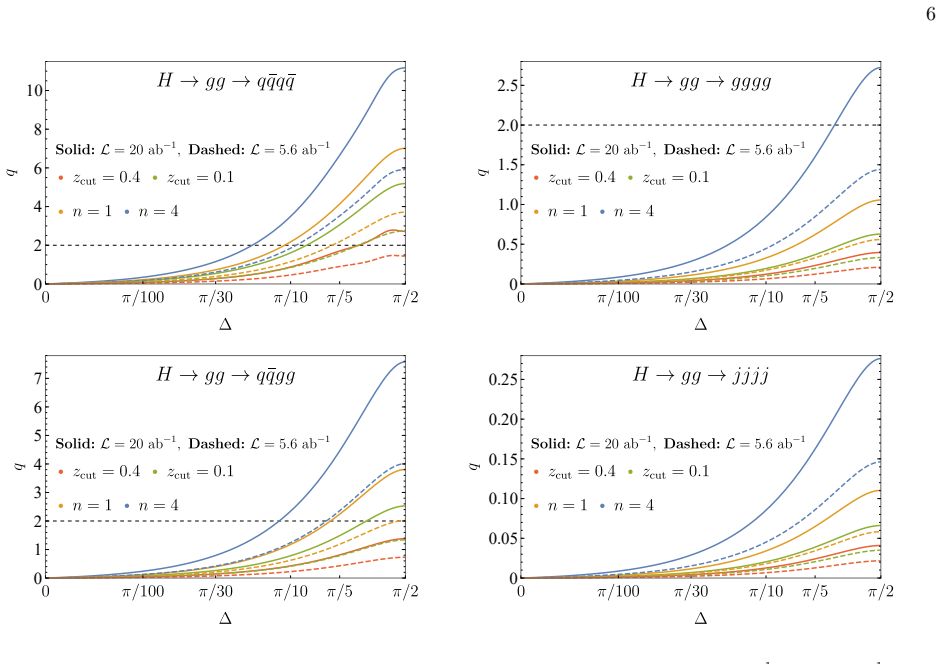
The authors establish, within a leading-order one-step-splitting approximation, that the normalized E4C(ϕ,n) and Lund-observable distributions both take the form 1 + A(x) cos(2ϕ − 2Δ), where Δ is the CP-mixing phase of the Hgg coupling and A(x) is a computable correlation strength. For E4C with n=4, A reaches 0.69 in the qq̄qq̄ splitting mode, versus 0.42 for the Lund observable with a softness cut zcut=0.1; the inclusive four-jet sample has A ≈ 0.001 because g→gg and g→qq̄ contributions cancel. Using Poisson statistics, they find that a 240 GeV collider with 5.6 ab⁻¹ can exclude the uncorrelated-spin hypothesis in the qq̄qq̄ channel at 95% confidence, and with 20 ab⁻¹ can exclude any CP-mix
What carries the argument
The four-point energy-energy correlator (E4C) between particles inside two jets — an infrared-safe observable that sums, over all pairs of particles (i,j) in one jet and (k,l) in the other, the product of their energy fractions raised to a power n and the delta function fixing the azimuthal difference ϕ between the splitting planes. A companion observable is the Lund-plane azimuthal difference between subjets. The paper computes both using the collinear factorization of H→gg followed by one gluon splitting on each side, with spin-dependent Altarelli-Parisi splitting kernels (here called the standard splitting functions). The one-step splitting is the key machinery because it converts the har
Load-bearing premise
The quoted sensitivity rests entirely on the ability to separate the gluon-splitting modes — especially the rare four-quark mode — at jet level in real data; if that separation is imperfect or impossible, the inclusive four-jet sample has nearly zero correlation strength and the 0.03π reach evaporates.
What would settle it
A detector-level simulation that includes full shower and hadronization plus a realistic quark/gluon tagger would settle it: if the qq̄qq̄ purity is too low, or the E4C amplitude drops by more than a factor of two from the one-step value of 0.69, the projected CP reach fails.
If this is right
- A 240 GeV lepton collider with 20 ab⁻¹ could exclude the uncorrelated-gluon-spin hypothesis at roughly 5.4σ using E4C(n=4) in the qq̄qq̄ mode, turning a quantum-correlation measurement into a discovery-level probe.
- The CP-mixing angle of the Hgg coupling could be constrained to ≈0.03π, about a factor of four better than the projected global fit at the high-luminosity hadron collider era.
- Because the inclusive four-jet sample has a correlation strength near 10⁻³, the measurement must deliberately select rare splitting modes rather than accumulate inclusive statistics.
- The same formalism predicts a specific phase shift cos(2ϕ−2Δ) in the E4C distribution, so the observable measures the sign as well as the magnitude of CP violation in the coupling.
- The E4C is infrared safe, so it does not require the soft-subjet cuts that reduce Lund-observable statistics; the zcut efficiency is only 2% for the dominant gggg mode at zcut=0.4.
Where Pith is reading between the lines
- If real jet tagging cannot reach the assumed perfect separation, the headline reach degrades sharply; a realistic characterization of quark/gluon tagging at lepton colliders would tell how much remains. This is the most direct test of the paper's program.
- The one-step splitting approximation omits multiple emissions that may dilute the azimuthal correlation; if NLL parton showers with spin correlations show a dilution factor, the required luminosity for 0.03π would grow accordingly. Conversely, the approximation could also underestimate the signal if higher-order effects sharpen the planes.
- The same E4C observable could be turned upside down: rather than measuring the Higgs CP phase, it could serve as a calibrated probe of how QCD evolution transports quantum information from hard scales to hadrons, complementing entanglement studies at hadron colliders.
- A testable extension suggested by the paper is to apply E4C to the top-quark or bottom-quark analog; the authors note quark splittings do not preserve quark spin correlations, so the gluonic case is special. One could therefore use H→gg as a benchmark to validate spin-dependent parton shower algorithms.
Editorial analysis
A structured set of objections, weighed in public.
Referee Report
Summary. The paper studies spin correlations between the two gluons in H→gg decays at future lepton colliders, using two jet-substructure observables: a Lund-plane azimuthal-angle observable and a four-point energy-energy correlator (E4C) with energy-weighting power n. The Hgg coupling is parametrized with a CP-mixing angle Δ, and the parton-level correlation amplitudes A_Lund and A_E4C are computed from standard spin-dependent splitting kernels for the different gluon-splitting modes gggg, qq̄gg, and qq̄qq̄, and for the inclusive jjjj sample. The predictions are compared with MadGraph tree-level matrix elements for one benchmark mode. Assuming perfect jet-level separation of splitting modes, the paper estimates that gluon spin correlations can be established with 5.6 ab⁻¹ and that the CP-mixing angle can be probed to Δ ≈ 0.03π with 20 ab⁻¹, using E4C with n=4 in the qq̄qq̄ mode.
Significance. If the quoted sensitivity survives a full shower-and-detector treatment, the E4C observable would provide a genuinely new and theoretically clean probe of the CP structure of the Hgg coupling at lepton colliders, complementary to LHC H+2j analyses and potentially far more precise. The paper's analytical framework is transparent, the factorization structure is standard, and the comparison to MadGraph in Fig. 2 is a useful check. It also correctly identifies the cancellation between g→gg and g→qq̄ contributions that makes the inclusive channel nearly insensitive. These are genuine strengths. However, the headline reach is explicitly conditional on two strong assumptions—one-step parton splitting and ideal splitting-mode identification—and the paper provides no validation of the first and no algorithm for the second. The significance is therefore best read as an idealized parton-level projection, not a demonstrated collider measurement.
major comments (3)
- [Sec. IV.A and Sec. IV.B, Eq. (12), Tables III–IV, Fig. 4] The quoted reach—5.6 ab⁻¹ for spin correlations and Δ ≈ 0.03π for CP—depends entirely on the assumption stated in Sec. IV.A that 'each splitting modes at jet level can be fully separated.' No tagger, efficiency, or mistag model is provided, and the paper itself defers this to future work in Sec. V. This is load-bearing because the qq̄qq̄ mode is only ~0.1% of H→gg: with the paper's own selection (Eq. (12)), 20 ab⁻¹ yields only O(50) qq̄qq̄ events before mode tagging, while the inclusive jjjj channel has A_E4C(n=4)=0.0007 and significance 0.138 at 20 ab⁻¹ (Table IV). The observable is essentially blind unless the rare mode is isolated. The headline CP sensitivity is therefore an unvalidated conditional statement, and the paper should either demonstrate a realistic tagging strategy or explicitly re-frame the claim as an idealized upper bound.
- [Sec. III, Eqs. (6)–(8), Fig. 2] The entire calculation uses a one-step gluon splitting approximation, described in Sec. III as 'a leading-order approximation.' This is validated only against MadGraph tree-level matrix elements for the partonic final state (Fig. 2). No parton-shower, hadronization, or detector-level simulation is shown. Subsequent emissions can dilute the azimuthal correlation, and the paper itself acknowledges that 'it is yet to fully understand how the correlation information propagation in showering and jet fragmentation.' Without an estimate of this dilution, the parton-level A values—and hence the significances in Tables III and IV—may be optimistic. At minimum, a quantitative statement about expected degradation under a standard shower would be needed to support the collider projections.
- [Sec. II.A, Eq. (5), and Sec. III.B] The E4C observable sums over all particle pairs {i,j} and {k,l} in the two jets, not only the primary g→qq̄ splitting pair. Even with perfect quark/gluon jet discrimination, the primary splitting pair is not uniquely identified: later intra-jet splittings contribute to the E4C sum and can dilute the spin-correlation signal. The parton-level calculation approximates the two splitting products as the full jet content. The paper does not describe how the E4C sum over multiple pairs is related to the single-splitting approximation, nor how the primary pair could be isolated experimentally. This gap connects the computed A_E4C to the experimental E4C observable and should be addressed or explicitly quantified.
minor comments (5)
- [Sec. IV] The cross section is quoted as σZH = 204.7 fb⁻¹; the units should be fb, and the integrated luminosity should carry the inverse-femtobarn units.
- [Sec. II, around Eqs. (2)–(3)] The text says 'Eq. 3 takes the form' but Eq. (2) is the matrix element before that display. Please renumber or clarify the cross-reference.
- [Sec. III.B, Fig. 3] The caption states results for Δ = 0 and π, but the text says π/2 in the figure label. Please make consistent.
- [Tab. I and text before Eq. (10)] The variable x is used for both zcut and n in different contexts; for readability define x (or use separate symbols) in the text accompanying Eqs. (10)–(11).
- [Sec. V] The sentence 'the quark splittings into vector bosons do not preserve the initial quark spin correlations' is an important physics caveat but is not derived or referenced; consider adding a one-line justification.
Circularity Check
No significant circularity: correlation amplitudes are computed from standard splitting functions, and the CP sensitivity is a parameterized counting experiment, not a fitted prediction.
full rationale
The paper's derivation chain is self-contained and does not reduce to its inputs. The spin-correlation amplitudes A_Lund and A_E4C are computed analytically from the spin-dependent Altarelli-Parisi splitting kernels in Eqs. (6)-(8), with the resulting distributions parametrized as Obs(φ,x)=1+A(x)cos(2φ−2Δ) in Eqs. (10)-(11). The CP-mixing angle Δ enters through the H→gg helicity amplitudes in Eq. (3); the sensitivity estimate is a standard binned counting significance computed from Eq. (13) under the assumed signal shape. No parameter is fitted to the quoted collider data sets, and no 'prediction' is statistically forced by a prior fit. The paper explicitly labels its one-step splitting treatment as a 'leading-order approximation' and the mode separation as an 'assumption' of ideal identification; these are acknowledged limitations, not circular steps. The E4C definition is attributed to the authors' prior work [32], but the observable is restated fully in Eq. (5), so the derivation does not depend on an unverified self-citation. Self-citations to [13,20,32] provide context and prior definitions, but none is load-bearing in a way that makes the central claim equivalent to an input. The comparison to MadGraph in Sec. III is an external check, not a fit. Therefore no circularity is present; the conditional character of the collider reach is a physics/feasibility caveat, not a circularity concern.
Axiom & Free-Parameter Ledger
free parameters (4)
- E4C energy weight n =
4
- Lund zcut =
0.1, 0.4
- Pairing threshold ΔR_th =
0.1
- Number of φ bins M =
5
axioms (5)
- domain assumption The Hgg interaction is described by the effective Lagrangian Eq. (1) with a single CP-mixing angle Δ.
- domain assumption Collinear factorization with spin-dependent Altarelli-Parisi splitting kernels (Eqs. 6–8) captures the spin correlations of the one-step splitting.
- ad hoc to paper One-step splitting approximates the full parton shower without additional spin-diluting emissions.
- ad hoc to paper Different gluon-splitting modes can be identified with perfect efficiency at jet level.
- domain assumption Non-Higgs backgrounds (ZZ, H→bb, H→VV*) are negligible after a 90% gg-tagging efficiency with ~3% mistag rate (from Ref. [38]).
read the original abstract
We present a phenomenological study of partonic spin correlations and $\mathcal{CP}$ properties in $H\to gg$ decay channel at future lepton colliders. We investigate two classes of observables: Lund observable defined based on subjets and four-point energy-energy correlator (E4C) between particles inside two jets. Our results show that the E4C with energy weighted to the power of $n=4$ achieves the strongest sensitivity to the spin correlations of gluons from Higgs boson decay. Under the assumption of ideal identification of different gluon splitting modes, we estimate that future lepton colliders operating at $\sqrt{s}=240~\mathrm{GeV}$ with an integrated luminosities of $5.6~\mathrm{ab}^{-1}$ can successfully probe gluon spin correlations, while $20~\mathrm{ab}^{-1}$ of data can probe the $\mathcal{CP}$-mixing angle in the $Hgg$ coupling to $\lesssim 0.03\pi$ using E4C. We outline strategies for extending this framework to realistic detector-level analyses, which can provide a new pathway for the precision test of Standard Model and searches for new physics.
Figures


Reference graph
Works this paper leans on
-
[1]
A. J. Barr, M. Fabbrichesi, R. Floreanini, E. Gabrielli, and L. Marzola, Quantum entanglement and Bell inequality violation at colliders, Prog. Part. Nucl. Phys.139, 104134 (2024), arXiv:2402.07972 [hep-ph]
Pith/arXiv arXiv 2024
-
[2]
Y. Fang, C. Gao, Y.-Y. Li, J. Shu, Y. Wu, H. Xing, B. Xu, L. Xu, and C. Zhou, Quantum frontiers in high energy physics, Sci. China Phys. Mech. Astron.68, 260301 (2025), arXiv:2411.11294 [hep-ph]
Pith/arXiv arXiv 2025
-
[3]
G. Aadet al.(ATLAS), Measurement of Spin Correlation in Top-Antitop Quark Events and Search for Top Squark Pair Production in pp Collisions at √s = 8 TeV Using the ATLAS Detector, Phys. Rev. Lett.114, 142001 (2015), arXiv:1412.4742 [hep-ex]
Pith/arXiv arXiv 2015
-
[4]
A. Kobakhidze, L. Wu, and J. Yue, Anomalous Top- Higgs Couplings and Top Polarisation in Single Top and Higgs Associated Production at the LHC, JHEP10, 100, arXiv:1406.1961 [hep-ph]
Pith/arXiv arXiv 1961
-
[5]
W. Bernreuther, D. Heisler, and Z.-G. Si, A set of top quark spin correlation and polarization observables for the LHC: Standard Model predictions and new physics contributions, JHEP12, 026, arXiv:1508.05271 [hep-ph]
-
[6]
F. Arco, T. Biek¨ otter, P. Stylianou, and G. Weiglein, Top-quark spin correlations as a tool to distinguish pseu- doscalar A→ZH and scalar H→ZA signatures in Ztt final states at the LHC, JHEP06, 170, arXiv:2502.03443 [hep-ph]
-
[7]
F. Maltoni, C. Severi, S. Tentori, and E. Vryonidou, Quan- tum detection of new physics in top-quark pair production at the LHC, JHEP03, 099, arXiv:2401.08751 [hep-ph]
-
[8]
G. Aadet al.(ATLAS), Observation of quantum entan- glement with top quarks at the ATLAS detector, Nature 633, 542 (2024), arXiv:2311.07288 [hep-ex]
Pith/arXiv arXiv 2024
-
[9]
A. Hayrapetyanet al.(CMS), Observation of quantum en- tanglement in top quark pair production in proton–proton collisions at √s = 13 TeV, Rept. Prog. Phys.87, 117801 (2024), arXiv:2406.03976 [hep-ex]
Pith/arXiv arXiv 2024
-
[10]
M. Dasgupta, F. A. Dreyer, K. Hamilton, P. F. Monni, G. P. Salam, and G. Soyez, Parton showers beyond leading logarithmic accuracy, Phys. Rev. Lett.125, 052002 (2020), arXiv:2002.11114 [hep-ph]
Pith/arXiv arXiv 2020
-
[11]
J. R. Forshaw, J. Holguin, and S. Pl¨ atzer, Building a consistent parton shower, JHEP09, 014, arXiv:2003.06400 [hep-ph]
Pith/arXiv arXiv 2003
-
[12]
Z. Nagy and D. E. Soper, Summations of large logarithms by parton showers, Phys. Rev. D104, 054049 (2021), arXiv:2011.04773 [hep-ph]
Pith/arXiv arXiv 2021
-
[13]
A. Karlberg, G. P. Salam, L. Scyboz, and R. Ver- heyen, Spin correlations in final-state parton showers and jet observables, Eur. Phys. J. C81, 681 (2021), arXiv:2103.16526 [hep-ph]
Pith/arXiv arXiv 2021
-
[14]
F. Herren, S. H¨ oche, F. Krauss, D. Reichelt, and M. Schoenherr, A new approach to color-coherent parton evolution, JHEP10, 091, arXiv:2208.06057 [hep-ph]
-
[15]
C. T. Preuss, A partitioned dipole-antenna shower with improved transverse recoil, JHEP07, 161, arXiv:2403.19452 [hep-ph]
-
[16]
B. Assi and S. H¨ oche, New approach to QCD final-state evolution in processes with massive partons, Phys. Rev. D109, 114008 (2024), arXiv:2307.00728 [hep-ph]
Pith/arXiv arXiv 2024
-
[17]
C. W. Bauer, W. A. de Jong, B. Nachman, and D. Provasoli, Quantum Algorithm for High Energy Physics Simulations, Phys. Rev. Lett.126, 062001 (2021), arXiv:1904.03196 [hep-ph]
Pith/arXiv arXiv 2021
-
[18]
K. Bepari, S. Malik, M. Spannowsky, and S. Williams, Quantum walk approach to simulating parton showers, Phys. Rev. D106, 056002 (2022), arXiv:2109.13975 [hep- ph]
Pith/arXiv arXiv 2022
-
[19]
C. W. Bauer, S. Chigusa, and M. Yamazaki, Quantum parton shower with kinematics, Phys. Rev. A109, 032432 (2024), arXiv:2310.19881 [hep-ph]
Pith/arXiv arXiv 2024
-
[20]
H. Chen, I. Moult, and H. X. Zhu, Quantum Interference in Jet Substructure from Spinning Gluons, Phys. Rev. Lett.126, 112003 (2021), arXiv:2011.02492 [hep-ph]
Pith/arXiv arXiv 2021
-
[21]
X. L. Li, X. Liu, F. Yuan, and H. X. Zhu, Illuminating nucleon-gluon interference via calorimetric asymmetry, Phys. Rev. D108, L091502 (2023), arXiv:2308.10942 [hep-ph]
Pith/arXiv arXiv 2023
-
[22]
Z.-B. Kang, K. Lee, D. Y. Shao, and F. Zhao, Prob- ing transverse momentum dependent structures with az- imuthal dependence of energy correlators, JHEP03, 153, arXiv:2310.15159 [hep-ph]
-
[23]
H. M¨ antysaari, Y. Tawabutr, and X.-B. Tong, Nucleon energy correlators for the odderon, Phys. Rev. D112, 114027 (2025), arXiv:2503.20157 [hep-ph]
Pith/arXiv arXiv 2025
-
[24]
Y. Huang, X.-B. Tong, and H.-L. Wang, Nucleon energy correlators as a probe of light-quark dipole operators at the EIC (2025), arXiv:2508.08516 [hep-ph]. 8
Pith/arXiv arXiv 2025
-
[25]
Y.-K. Song, S.-Y. Wei, L. Yang, and J. Zhou, Gluon Polarimetry with Energy-Energy Correlators (2025), arXiv:2509.14960 [hep-ph]
arXiv 2025
-
[26]
J. Gao, H. T. Li, and Y. J. Zhu, Energy Correlators Resolving Proton Spin (2025), arXiv:2509.17596 [hep-ph]
Pith/arXiv arXiv 2025
-
[27]
Q.-H. Cao, Z. Yu, C. P. Yuan, S. Zhang, and H. X. Zhu, Collins-type fragmentation energy correlator in semi- inclusive deep inelastic lepton-hadron scattering (2025), arXiv:2509.18892 [hep-ph]
arXiv 2025
-
[28]
M.-S. Gao, Z.-B. Kang, W. Li, and D. Y. Shao, Accessing nucleon transversity with one-point energy correlators (2025), arXiv:2509.15809 [hep-ph]
Pith/arXiv arXiv 2025
-
[29]
I. Moult and H. X. Zhu, Energy Correlators: A Journey From Theory to Experiment (2025), arXiv:2506.09119 [hep-ph]
Pith/arXiv arXiv 2025
-
[30]
Abadaet al., FCC Physics Opportunities, The Euro- pean Physical Journal C79, 474 (2019)
A. Abadaet al., FCC Physics Opportunities, The Euro- pean Physical Journal C79, 474 (2019)
2019
-
[31]
M. Donget al.(CEPC Study Group), CEPC Conceptual Design Report: Volume 2 - Physics & Detector (2018), arXiv:1811.10545 [hep-ex]
Pith/arXiv arXiv 2018
-
[32]
H. Chen, I. Moult, and H. X. Zhu, Quantum interference in jet substructure from spinning gluons, Physical Review Letters126, 10.1103/physrevlett.126.112003 (2021)
-
[33]
S. Catani and M. Grazzini, Infrared factorization of tree level QCD amplitudes at the next-to-next-to-leading order and beyond, Nucl. Phys. B570, 287 (2000), arXiv:hep- ph/9908523
arXiv 2000
-
[34]
V. N. Gribov and L. N. Lipatov, Deep inelastic e p scat- tering in perturbation theory, Sov. J. Nucl. Phys.15, 438 (1972)
1972
-
[35]
Y. L. Dokshitzer, Calculation of the Structure Functions for Deep Inelastic Scattering and e+ e- Annihilation by Perturbation Theory in Quantum Chromodynamics., Sov. Phys. JETP46, 641 (1977)
1977
-
[36]
Altarelli and G
G. Altarelli and G. Parisi, Asymptotic freedom in parton language, Nuclear Physics B126, 298 (1977)
1977
-
[37]
A. J. Larkoski, D. Neill, and I. W. Stewart, Soft The- orems from Effective Field Theory, JHEP06, 077, arXiv:1412.3108 [hep-th]
-
[38]
L. Li, Y.-Y. Li, T. Liu, and S.-J. Xu, Learning physics at future e−e+ colliders with machine, JHEP10, 018, arXiv:2004.15013 [hep-ph]
Pith/arXiv arXiv 2004
-
[39]
Chenget al.(CEPC Physics Study Group), The Physics potential of the CEPC
H. Chenget al.(CEPC Physics Study Group), The Physics potential of the CEPC. Prepared for the US Snow- mass Community Planning Exercise (Snowmass 2021), in Snowmass 2021(2022) arXiv:2205.08553 [hep-ph]
Pith/arXiv arXiv 2021
-
[40]
J. Kley, T. Theil, E. Venturini, and A. Weiler, Electric dipole moments at one-loop in the dimension-6 SMEFT, Eur. Phys. J. C82, 926 (2022), arXiv:2109.15085 [hep-ph]
Pith/arXiv arXiv 2022
-
[41]
U. Haisch and A. Hala, Bounds on CP-violating Higgs- gluon interactions: the case of vanishing light-quark Yukawa couplings, JHEP11, 117, arXiv:1909.09373 [hep- ph]
Pith/arXiv arXiv 1909
-
[42]
V. Cirigliano, A. Crivellin, W. Dekens, J. de Vries, M. Hoferichter, and E. Mereghetti, CP Violation in Higgs-Gauge Interactions: From Tabletop Experiments to the LHC, Phys. Rev. Lett.123, 051801 (2019), arXiv:1903.03625 [hep-ph]
Pith/arXiv arXiv 2019
-
[43]
H. Bahl, E. Fuchs, M. Hannig, and M. Menen, Classifying the CP properties of the ggH coupling in H + 2j produc- tion, SciPost Phys. Core8, 006 (2025), arXiv:2309.03146 [hep-ph]
Pith/arXiv arXiv 2025
-
[44]
C. Englert, P. Galler, A. Pilkington, and M. Span- nowsky, Approaching robust EFT limits for CP-violation in the Higgs sector, Phys. Rev. D99, 095007 (2019), arXiv:1901.05982 [hep-ph]
Pith/arXiv arXiv 2019
-
[45]
F. U. Bernlochner, C. Englert, C. Hays, K. Lohwasser, H. Mildner, A. Pilkington, D. D. Price, and M. Span- nowsky, Angles on CP-violation in Higgs boson interac- tions, Phys. Lett. B790, 372 (2019), arXiv:1808.06577 [hep-ph]
Pith/arXiv arXiv 2019
-
[46]
Measurement of gluon spin effect in parton splittings, Tech. Rep. (CERN, Geneva, 2025)
2025
discussion (0)
Sign in with ORCID, Apple, or X to comment. Anyone can read and Pith papers without signing in.