Nucleon Energy Correlators as a Probe of Light-Quark Dipole Operators at the Electron-Ion Collider
Pith reviewed 2026-05-18 23:07 UTC · model grok-4.3
The pith
Chiral-odd nucleon energy correlators provide linear sensitivity to light-quark dipole operators through azimuthal asymmetries in the target fragmentation region.
A machine-rendered reading of the paper's core claim, the machinery that carries it, and where it could break.
Core claim
We construct a chiral-odd quark nucleon energy correlator in the target fragmentation region of deep inelastic scattering. This correlator accesses the transverse spin of quarks through azimuthal angle asymmetries in the energy flow. The resulting asymmetries are linearly sensitive to the quark dipole operators and serve as clean observables for constraining these chirality-flipping couplings without requiring polarized nucleon targets or final-state hadron identification.
What carries the argument
Chiral-odd quark nucleon energy correlator that correlates energy flows to extract azimuthal asymmetries sensitive to quark transverse spin.
If this is right
- Linear constraints on the strength of light-quark dipole operators become feasible in unpolarized deep inelastic scattering.
- Measurements rely solely on fully inclusive calorimetric data in the target fragmentation region.
- The approach enables new physics searches using energy correlator observables at electron-ion colliders.
- Precision studies of chirality-flipping effects can proceed without polarized beams or hadron identification.
Where Pith is reading between the lines
- If the predicted asymmetries are observed, they could help distinguish between different models of electroweak new physics.
- This method might be extended to other collider processes involving similar dipole operators.
- Connections to existing energy correlator techniques in QCD could allow for improved theoretical predictions of the asymmetries.
Load-bearing premise
The azimuthal asymmetries generated by the chiral-odd nucleon energy correlator stay linearly dependent on the dipole operators with negligible contributions from other operators or higher-order corrections.
What would settle it
A measurement showing no azimuthal asymmetry or asymmetries that do not scale linearly with the expected dipole strength in the target fragmentation region would indicate the method does not provide the claimed clean linear probe.
Figures




read the original abstract
We propose nucleon energy correlators (NECs) as a novel framework to probe electroweak light-quark dipole operators in deep inelastic scattering with an unpolarized nucleon. These operators encode chirality-flipping interactions, whose effects are usually quadratically suppressed in unpolarized cross sections. We construct a chiral-odd quark NEC that accesses quark transverse spin via azimuthal angle asymmetries in the energy flow of the target fragmentation region. These asymmetries serve as clean and powerful observables, enabling linear constraints on the quark dipole couplings. Unlike existing methods, our approach requires neither polarized nucleon beams nor final-state hadron identification, relying instead on fully inclusive calorimetric measurements. This work establishes one of the first applications of energy correlator observables to new physics searches and opens a promising direction for precision studies of chirality-flipping effects at electron-ion colliders.
Editorial analysis
A structured set of objections, weighed in public.
Referee Report
Summary. The paper proposes nucleon energy correlators (NECs) as a novel framework to probe electroweak light-quark dipole operators in deep inelastic scattering with an unpolarized nucleon at the EIC. It constructs a chiral-odd quark NEC that accesses quark transverse spin via azimuthal angle asymmetries in the energy flow of the target fragmentation region. These asymmetries are presented as clean observables that enable linear constraints on the dipole couplings, without requiring polarized beams or final-state hadron identification, relying instead on inclusive calorimetric measurements.
Significance. If the central construction holds and the asymmetries remain linearly sensitive with negligible contamination, the work would be significant as one of the first applications of energy correlators to new physics searches. It provides a method to access chirality-flipping effects linearly in an unpolarized setup, opening a promising direction for precision studies at the EIC that complements polarized or hadron-tagged approaches.
major comments (1)
- [Abstract / chiral-odd NEC construction] Abstract and the section constructing the chiral-odd quark NEC: the central claim that the azimuthal asymmetries 'serve as clean and powerful observables, enabling linear constraints' with 'negligible contamination from other effects or higher-order corrections' is load-bearing for the proposal. No explicit power counting, NLO estimate, or bound on contributions from soft radiation or higher-twist operators (which can generate cos(phi) modulations in the unpolarized target fragmentation region) is provided to support linearity and cleanliness for realistic EIC kinematics.
minor comments (1)
- [Definitions section] Notation for the NEC definitions and energy flow variables could be clarified with an explicit kinematic diagram or table of variables to aid readability.
Simulated Author's Rebuttal
We thank the referee for the careful reading of our manuscript and for the constructive feedback. We appreciate the positive assessment of the potential significance of the work and address the major comment below. We will revise the manuscript to incorporate additional discussion that strengthens the central claims.
read point-by-point responses
-
Referee: [Abstract / chiral-odd NEC construction] Abstract and the section constructing the chiral-odd quark NEC: the central claim that the azimuthal asymmetries 'serve as clean and powerful observables, enabling linear constraints' with 'negligible contamination from other effects or higher-order corrections' is load-bearing for the proposal. No explicit power counting, NLO estimate, or bound on contributions from soft radiation or higher-twist operators (which can generate cos(phi) modulations in the unpolarized target fragmentation region) is provided to support linearity and cleanliness for realistic EIC kinematics.
Authors: We agree that an explicit discussion of power counting and estimates for potential contaminations would strengthen the presentation of the chiral-odd NEC construction and the associated claims of cleanliness. In the revised manuscript, we will add a new subsection in the theoretical framework section that outlines the relevant power counting in the target fragmentation region at leading twist. We will include order-of-magnitude estimates for higher-twist operator contributions and soft radiation effects under realistic EIC kinematics (Q^2 ~ 10-100 GeV^2, x ~ 0.1-0.5), arguing that they are suppressed relative to the leading linear dipole signal by factors of Lambda_QCD/Q or 1/Q. We will also comment on the absence of cos(phi) modulations from unpolarized higher-twist effects at the order considered, while noting that a full NLO calculation is beyond the scope of this proposal paper but would be a natural follow-up. These additions will provide quantitative support for the linearity and negligible contamination without altering the core results. revision: yes
Circularity Check
No significant circularity in NEC construction for dipole probes
full rationale
The paper introduces nucleon energy correlators as a new framework and constructs a chiral-odd quark NEC observable to access transverse spin via azimuthal asymmetries in the target fragmentation region. This construction is presented as an independent theoretical proposal relying on definitions of energy flow observables in unpolarized DIS, without reducing the central result to a fitted parameter, self-citation chain, or ansatz imported from prior work by the same authors. The linear sensitivity to dipole operators follows from the interference structure in the defined correlator rather than by construction from the input data or assumptions. No load-bearing step equates the output prediction to its own inputs.
Axiom & Free-Parameter Ledger
axioms (1)
- standard math Standard QCD factorization theorems apply to energy correlators in the target fragmentation region of DIS.
Lean theorems connected to this paper
-
IndisputableMonolith/Cost/FunctionalEquation.leanwashburn_uniqueness_aczel unclear?
unclearRelation between the paper passage and the cited Recognition theorem.
We construct a chiral-odd quark NEC that accesses quark transverse spin via azimuthal angle asymmetries in the energy flow of the target fragmentation region.
-
IndisputableMonolith/Foundation/RealityFromDistinction.leanreality_from_one_distinction unclear?
unclearRelation between the paper passage and the cited Recognition theorem.
These asymmetries serve as clean and powerful observables, enabling linear constraints on the quark dipole couplings.
What do these tags mean?
- matches
- The paper's claim is directly supported by a theorem in the formal canon.
- supports
- The theorem supports part of the paper's argument, but the paper may add assumptions or extra steps.
- extends
- The paper goes beyond the formal theorem; the theorem is a base layer rather than the whole result.
- uses
- The paper appears to rely on the theorem as machinery.
- contradicts
- The paper's claim conflicts with a theorem or certificate in the canon.
- unclear
- Pith found a possible connection, but the passage is too broad, indirect, or ambiguous to say the theorem truly supports the claim.
Forward citations
Cited by 3 Pith papers
-
Sivers Tomography from Charge and Angle Only
The OPCC observable is IRC finite and factorizes into the Sivers distribution plus a perturbatively calculable charge-weighted jet function, eliminating dependence on non-perturbative fragmentation functions via charg...
-
On Exclusive Coherent Production of Bosons in Electron-Proton Collisions
A phenomenological 2-to-3 framework is constructed for exclusive boson electroproduction that matches flux-factorized predictions near Q^{2}=0 while capturing finite-Q^{2} effects at larger virtualities.
-
Braking protons at the EIC: from invisible meson decay to new physics searches
The EIC can probe invisible pseudoscalar meson decays down to branching ratios of 10^{-8} and invisibly decaying ALPs with couplings up to 10^5 GeV for masses 0.1-2 GeV.
Reference graph
Works this paper leans on
-
[1]
As indicated later, this leads to an enhanced sensitivity to the dipole couplings
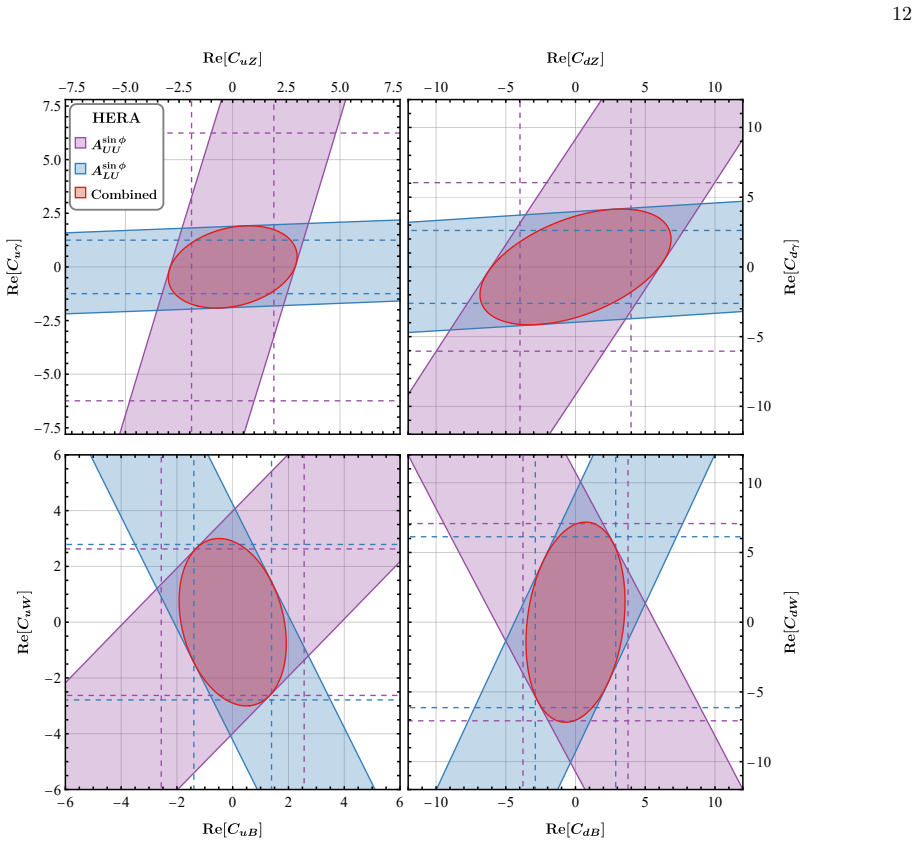
Owing to the parity violation induced by elec- tron polarization, the azimuthal modulations can be gen- erated viaγγinterference, withoutQ 2/m2 Z suppression present in the unpolarized case Σ sinϕ(cosϕ) U U . As indicated later, this leads to an enhanced sensitivity to the dipole couplings. Complete analytical results are provided in the Supplemental Mate...
work page 2023
-
[2]
W. Buchmuller and D. Wyler,Effective Lagrangian Analysis of New Interactions and Flavor Conservation, Nucl. Phys. B268(1986) 621
work page 1986
-
[3]
Patterns of Deviation from the Standard Model
C. Arzt, M.B. Einhorn and J. Wudka,Patterns of deviation from the standard model,Nucl. Phys. B433 (1995) 41 [hep-ph/9405214]
work page internal anchor Pith review Pith/arXiv arXiv 1995
-
[4]
Dimension-Six Terms in the Standard Model Lagrangian
B. Grzadkowski, M. Iskrzynski, M. Misiak and J. Rosiek,Dimension-Six Terms in the Standard Model Lagrangian,JHEP10(2010) 085 [1008.4884]
work page internal anchor Pith review Pith/arXiv arXiv 2010
-
[5]
R. Alonso, E.E. Jenkins, A.V. Manohar and M. Trott, Renormalization group evolution of the standard model dimension six operators iii: Gauge coupling dependence and phenomenology,JHEP04(2014) 159 [1312.2014]
- [6]
-
[7]
J. Aebischer, W. Dekens, E.E. Jenkins, A.V. Manohar, D. Sengupta and P. Stoffer,Effective field theory interpretation of lepton magnetic and electric dipole moments,JHEP07(2021) 107 [2102.08954]
-
[8]
M. Ardu and N. Valori,The equivalent electric dipole moment in smeft,2503.21920
-
[9]
R. Boughezal, E. Mereghetti and F. Petriello,Dilepton production in the SMEFT at O(1/Λ4),Phys. Rev. D 104(2021) 095022 [2106.05337]
-
[10]
L. Allwicher, D.A. Faroughy, F. Jaffredo, O. Sumensari and F. Wilsch,Drell-Yan tails beyond the Standard Model,JHEP03(2023) 064 [2207.10714]
-
[11]
E. da Silva Almeida, N. Rosa-Agostinho, O.J.P. ´Eboli and M.C. Gonzalez-Garcia,Light-quark dipole operators at the LHC,Phys. Rev. D100(2019) 013003 [1905.05187]
- [12]
- [13]
- [14]
-
[15]
Constraints on Fermion Magnetic and Electric Moments from LEP-I
R. Escribano and E. Masso,Constraints on fermion magnetic and electric moments from LEP-1,Nucl. Phys. B429(1994) 19 [hep-ph/9403304]
work page internal anchor Pith review Pith/arXiv arXiv 1994
-
[16]
G. Kopp, D. Schaile, M. Spira and P.M. Zerwas, Bounds on radii and magnetic dipole moments of quarks and leptons from LEP, SLC and HERA,Z. Phys. C65 (1995) 545 [hep-ph/9409457]
work page internal anchor Pith review Pith/arXiv arXiv 1995
-
[17]
R. Boughezal, D. de Florian, F. Petriello and W. Vogelsang,Transverse spin asymmetries at the EIC as a probe of anomalous electric and magnetic dipole moments,Phys. Rev. D107(2023) 075028 [2301.02304]
- [18]
-
[19]
X.-K. Wen, B. Yan, Z. Yu and C.P. Yuan,Dihadron azimuthal asymmetry and light-quark dipole moments at the Electron-Ion Collider,2408.07255
work page internal anchor Pith review arXiv
- [20]
-
[21]
Neutron electric dipole moment: Constituent-dressing and compositeness
M.B. Hecht, C.D. Roberts and S.M. Schmidt,Neutron electric dipole moment: Constituent dressing and compositeness,Phys. Rev. C64(2001) 025204 [nucl-th/0101058]
work page internal anchor Pith review Pith/arXiv arXiv 2001
-
[22]
Nucleon tensor charges and electric dipole moments
M. Pitschmann, C.-Y. Seng, C.D. Roberts and S.M. Schmidt,Nucleon tensor charges and electric dipole moments,Phys. Rev. D91(2015) 074004 [1411.2052]
work page internal anchor Pith review Pith/arXiv arXiv 2015
-
[23]
T. Liu, Z. Zhao and H. Gao,Experimental constraint on quark electric dipole moments,Phys. Rev. D97(2018) 074018 [1704.00113]
work page internal anchor Pith review Pith/arXiv arXiv 2018
-
[24]
Searching for New Physics beyond the Standard Model in Electric Dipole Moment
T. Fukuyama,Searching for new physics beyond the standard model in electric dipole moment,Int. J. Mod. Phys. A27(2012) 1230015 [1201.4252]
work page internal anchor Pith review Pith/arXiv arXiv 2012
-
[25]
Neutron Electric Dipole Moment from Beyond the Standard Model
T. Bhattacharya, V. Cirigliano and R. Gupta,Neutron Electric Dipole Moment from Beyond the Standard Model,PoSLA TTICE2012(2012) 179 [1212.4918]
work page internal anchor Pith review Pith/arXiv arXiv 2012
-
[26]
Electric Dipole Moments of the Atoms, Molecules, Nuclei and Particles
T. Chupp, P. Fierlinger, M. Ramsey-Musolf and J. Singh,Electric dipole moments of atoms, molecules, nuclei, and particles,Rev. Mod. Phys.91(2019) 015001 [1710.02504]
work page internal anchor Pith review Pith/arXiv arXiv 2019
-
[27]
Alarcon et al., inSnowmass 2021(2022), 2203.08103
R. Alarcon et al.,Electric dipole moments and the search for new physics, inSnowmass 2021, 3, 2022 [2203.08103]
-
[28]
A. Keshavarzi, K.S. Khaw and T. Yoshioka,Muon g−2: A review,Nucl. Phys. B975(2022) 115675 [2106.06723]
-
[29]
G.A. Gonz´ alez-Sprinberg,Electric and magnetic tau dipole moments revisited, in17th International Workshop on Tau Lepton Physics, 6, 2024, DOI [2406.15286]
-
[30]
B. Abi, T. Albahri, S. Al-Kilani, D. Allspach, L. Alonzi, A. Anastasi et al.,Measurement of the positive muon anomalous magnetic moment to 0.46 ppm,Physical Review Letters126(2021) 141801 [2104.03281]. [30]Muon g-2collaboration,Measurement of the Positive Muon Anomalous Magnetic Moment to 127 ppb, 2506.03069
-
[31]
The anomalous magnetic moment of the muon in the Standard Model: an update
R. Aliberti et al.,The anomalous magnetic moment of the muon in the Standard Model: an update, 2505.21476. [32]BESIIIcollaboration,Precise Measurement of theΛ Electric Dipole Moment through the Entangled Strange Baryon-Antibaryon System,2506.19180. [33]ACMEcollaboration,Improved limit on the electric dipole moment of the electron,Nature562(2018) 355
work page internal anchor Pith review Pith/arXiv arXiv 2018
- [32]
-
[33]
Measurement of the Permanent Electric Dipole Moment of the Neutron,
C. Abel et al.,Measurement of the permanent electric dipole moment of the neutron,Phys. Rev. Lett.124 (2020) 081803 [2001.11966]
-
[34]
H.-L. Wang, X.-K. Wen, H. Xing and B. Yan,Probing the four-fermion operators via the transverse double spin asymmetry at the Electron-Ion Collider,Phys. Rev. D109(2024) 095025 [2401.08419]
- [35]
- [36]
- [37]
- [38]
- [39]
-
[40]
K.-B. Chen, J.-P. Ma and X.-B. Tong,The connection between nucleon energy correlators and fracture functions,JHEP08(2024) 227 [2406.08559]
-
[41]
H. M¨ antysaari, Y. Tawabutr and X.-B. Tong,Nucleon Energy Correlators for the Odderon,2503.20157
- [42]
- [43]
- [44]
-
[45]
Science Requirements and Detector Concepts for the Electron-Ion Collider: EIC Yellow Report
R. Abdul Khalek et al.,Science Requirements and Detector Concepts for the Electron-Ion Collider: EIC Yellow Report,Nucl. Phys. A1026(2022) 122447 [2103.05419]
work page internal anchor Pith review Pith/arXiv arXiv 2022
-
[46]
N.A. Sveshnikov and F.V. Tkachov,Jets and quantum field theory,Phys. Lett. B382(1996) 403 [hep-ph/9512370]
work page internal anchor Pith review Pith/arXiv arXiv 1996
-
[47]
C.W. Bauer, S.P. Fleming, C. Lee and G.F. Sterman, Factorization of e+e- Event Shape Distributions with Hadronic Final States in Soft Collinear Effective Theory,Phys. Rev. D78(2008) 034027 [0801.4569]
work page internal anchor Pith review Pith/arXiv arXiv 2008
-
[48]
R.L. Jaffe and X.-D. Ji,Chiral odd parton distributions and Drell-Yan processes,Nucl. Phys. B375(1992) 527
work page 1992
- [49]
-
[50]
V. Barone, S. Melis and A. Prokudin,The Boer-Mulders effect in unpolarized SIDIS: An Analysis of the COMPASS and HERMES data on the cos 2 phi asymmetry,Phys. Rev. D81(2010) 114026 [0912.5194]
work page internal anchor Pith review Pith/arXiv arXiv 2010
-
[51]
M. Klein and R. Yoshida,Collider physics at hera, Prog. Part. Nucl. Phys.61(2008) 343 [0805.3334]. [54]LHeC, FCC-he Study Groupcollaboration,The Large Hadron–Electron Collider at the HL-LHC,J. Phys. G48(2021) 110501 [2007.14491]
work page internal anchor Pith review Pith/arXiv arXiv 2008
-
[52]
L. Ricci and M. Riembau,Energy correlators of hadronically decaying electroweak bosons,Phys. Rev. D 106(2022) 114010 [2207.03511]
- [53]
- [54]
-
[55]
M. Jaarsma, Y. Li, I. Moult, W.J. Waalewijn and H.X. Zhu,Energy correlators on tracks: resummation and non-perturbative effects,JHEP12(2023) 087 [2307.15739]
- [56]
-
[57]
Updating Boer-Mulders functions from unpolarized pd and pp Drell-Yan data
Z. Lu and I. Schmidt,Updating Boer-Mulders functions from unpolarized pd and pp Drell-Yan data,Phys. Rev. D81(2010) 034023 [0912.2031]. [61]H1, ZEUScollaboration,Combination of measurements of inclusive deep inelastice ±pscattering cross sections and QCD analysis of HERA data,Eur. Phys. J. C75 (2015) 580 [1506.06042]
work page internal anchor Pith review Pith/arXiv arXiv 2010
-
[58]
Nucleon energy correlators as a probe of light-quark dipole operators at the EIC
C. Diaconu, T. Haas, M. Medinnis, K. Rith and A. Wagner,Physics accomplishments of hera,Ann. Rev. Nucl. Part. Sci.60(2010) 101. Supplemental material for “Nucleon energy correlators as a probe of light-quark dipole operators at the EIC” Yingsheng Huang, ∗ Xuan-Bo Tong, † and Hao-Lin Wang ‡ Appendix A: The complete results for energy-pattern cross section ...
work page 2010
discussion (0)
Sign in with ORCID, Apple, or X to comment. Anyone can read and Pith papers without signing in.