REVIEW 3 major objections 6 minor 97 references
Magnetically tunable symmetry-enforced nodal lines producing huge anomalous Hall conductivity in altermagnetic $\alpha$-MnTe
T0 review · 3 major / 6 minor · reviewed 2026-08-10 · deepseek-v4-flash
Pith's one-line read Altermagnetic MnTe's large anomalous Hall conductivity comes from symmetry-enforced nodal lines, not from weak ferromagnetism alone.
desk verdict A credible computational identification of symmetry-protected nodal lines in alpha-MnTe that likely drive the large AHC, but the main text never quantifies the claimed agreement with experiment. read the letter →
The pith
A machine-rendered reading of the paper's core claim, the machinery that carries it, and where it could break.
The reading
What carries the argument
The machinery is a first-principles-derived tight-binding Hamiltonian with explicitly tunable spin canting, in which the two Mn spins are parametrized as $S_{Mn1} = (0, S\cos\theta, S\sin\theta)$ and $S_{Mn2} = (0, -S\cos\theta, S\sin\theta)$, with $\theta$ the canting angle and the Néel vector along $y$. The load-bearing symmetries are the mirror $M_z$ and the nonsymmorphic glide $G_z = \{M_z | 0,0,c/2\}$, which prevent hybridization between crossing bands carrying opposite eigenvalues on the $k_z = 0$ and $k_z = \pi/c$ planes; on those planes only the $S_z$ spin component survives with $Q_{x^2-y^2}$ spin-momentum locking. The nodal lines appear as crossings between the top and second valence bands, whose Mexican-hat and inverted Mexican-hat dispersions make the crossing energy-dependent. The paper further uses the decomposition $\sigma_{xy}^{AM} = (\sigma_{xy}(N,M)+\sigma_{xy}(N,-M))/2$ and $\sigma_{xy}^{FM} = (\sigma_{xy}(N,M)-\sigma_{xy}(N,-M))/2$ to separate altermagnetic from ferromagnetic contributions to the Hall conductivity, and linear-dichroism ARPES to image the nodal-line signature.
What would settle it
A direct symmetry-eigenvalue analysis of the two bands at the NL1 crossing points on $k_z = \pi/c$ would settle the claim: if the bands carry the same glide eigenvalue (or no definite glide eigenvalue), the crossing is not glide-enforced and the predicted anomalous Hall conductivity peak is not protected. Alternatively, a Hall measurement that tracks the 1.6-eV feature while smoothly varying the canting angle would falsify the claim if the feature persists after the nodal line gaps.
Extended reading notes
Core claim
The central claim is that the large anomalous Hall conductivity of altermagnetic α-MnTe is generated by the Berry curvature of symmetry-enforced nodal lines in the valence band. Two distinct nodal lines are identified: NL1 at $k_z = \pi/c$, protected by the glide symmetry $G_z = \{M_z | 0,0,c/2\}$, and NL2 at $k_z = 0$, protected by the mirror symmetry $M_z$. NL1 is a set of six warped triangles with approximate $C_6$ symmetry reduced to exact $C_2$ by the Néel vector, composed of two type-III and four type-II segments formed where the top valence band (Mexican-hat) crosses the second valence band (inverted Mexican-hat). The paper demonstrates, within first-principles accuracy, that NL1 provides the dominant anomalous Hall conductivity contribution and that this contribution collapses when spin canting gaps the nodal line; disentangling the conductivity into altermagnetic and ferromagnetic parts shows the altermagnetic part dominates at small canting angles while the ferromagnetic part becomes sizable for larger angles.
Load-bearing premise
The argument assumes that on the two special momentum planes the spin arrangement leaves only one spin component with exactly the symmetry pattern claimed in earlier work; if that pattern were even slightly different, the band crossings would open a gap and the nodal-line conductivity peak would disappear.
Editorial extensions
If this is right
- If the central claim is right, the measured anomalous Hall effect in α-MnTe is a probe of glide-protected band topology rather than of net magnetization, so interpreting its magnitude requires the nodal-line structure.
- Spin canting is a practical control knob: the dominant NL1 contribution collapses when the nodal line gaps, so magnetic fields, strain, or surface effects that change the canting angle can switch the anomalous Hall conductivity on and off.
- The altermagnetic and ferromagnetic contributions to the anomalous Hall conductivity separate cleanly: at small canting angles the altermagnetic part dominates, while at larger angles the ferromagnetic part takes over.
- The same symmetry logic should extend to isostructural and related materials such as h-FeS, CrTe-like ferromagnets, and MnBi, where nodal lines might sit closer to the Fermi level and give larger transport responses.
- Linear dichroism in ARPES can reveal nodal lines even in parity-symmetric altermagnets, through sign reversals at the predicted crossing positions.
Reading between the lines
- If this mechanism is general, engineered altermagnets with nodal lines deliberately placed near the Fermi level could combine room-temperature operation with magnetic switching, a combination useful for topological spintronics.
- The reported sensitivity of NL1 to an asymmetric canting as small as 0.1° suggests that unavoidable surface or interface canting in real samples may dominate the measured anomalous Hall conductivity, which could explain sample-to-sample variation.
- The disentanglement approach used here can be applied to other compensated magnets to decide whether an observed anomalous Hall effect is driven by band crossings or by residual ferromagnetism, a question that goes beyond MnTe.
- The linear-dichroism signature in a parity-symmetric material hints that dichroic sign reversal can report local or hidden orbital polarization; validating this on single-domain samples would extend the method to centrosymmetric magnets.
Editorial analysis
A structured set of objections, weighed in public.
Referee Report
Summary. The manuscript reports first-principles and model-Hamiltonian calculations identifying two symmetry-enforced nodal lines in the valence bands of altermagnetic α-MnTe, at kz=π/c (NL1, attributed to the glide Gz={Mz|0,0,c/2}) and at kz=0 (NL2, attributed to the mirror Mz). The authors show that NL1 sits at the crossing between Mexican-hat and inverted-Mexican-hat bands, that it is composed of type-II and type-III segments with approximate C6 symmetry reduced to C2, and that spin canting gaps out one or both subgroups. They compute the anomalous Hall conductivity versus canting angle, decompose it into altermagnetic and ferromagnetic parts using Eq. (1), and report that the largest contribution comes from NL1 and collapses when NL1 gaps. Linear-dichroism ARPES measurements on multi-domain samples show intensity modulations at the predicted in-plane momenta, which the authors cautiously interpret as spectroscopic signatures of NL1. The central claim is that the large AHC observed experimentally in α-MnTe originates from the Berry curvature of these nodal lines rather than from the weak ferromagnetism alone.
Significance. If correct, this work provides a concrete microscopic mechanism for the anomalous Hall effect in α-MnTe, identifying symmetry-enforced nodal lines as Berry-curvature sources and predicting strong magnetic tunability through the spin-canting angle. The paper's strengths include a transparent first-principles workflow with tunable magnetic parameters and an openly available code, an explicit disentanglement of altermagnetic and ferromagnetic AHC contributions, and falsifiable experimental predictions (LD-ARPES signature and canting-angle dependence). However, the quantitative claim that the computed AHC reproduces the measured value is not actually displayed, and the symmetry-enforced character of NL1 is imported from prior spin-texture results rather than demonstrated for the crossing bands. These gaps limit the strength of the central causal claim.
major comments (3)
- [Nodal lines and their interplay with weak ferromagnetism] The claim that NL1 is symmetry-enforced by the glide Gz is not demonstrated for the actual crossing bands. The text states that at kz=0 and kz=π/c the spin components Sx and Sy vanish, citing ref [27], and then relies on the Q_{x^2-y^2} locking of Sz from refs [26,27,50] to conclude that the crossings are protected. No symmetry-eigenvalue analysis of the two crossing bands is given, and the glide eigenvalues along NL1 are not reported. If the bands carry the same Gz eigenvalue, or if the vanishing of Sx and Sy is only approximate, the crossings are accidental and can gap under perturbations; the asymmetric-canting test (0.1° eliminates NL1) shows sensitivity but does not establish protection. Please report the little-group representations (glide/mirror eigenvalues) of the crossing bands on the kz=π/c and kz=0 planes, or provide an explicit magnetic space-group argument.
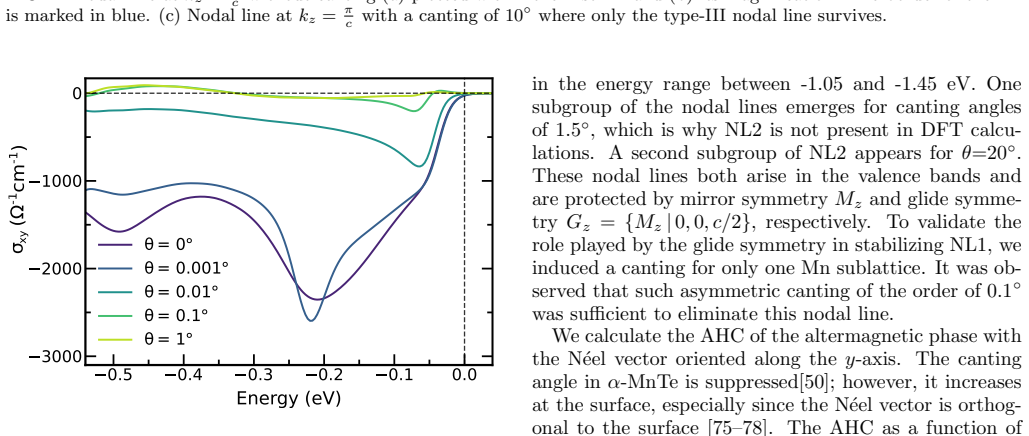
- [Abstract / AHC results (Fig. 3)] The abstract claims that within first-principles accuracy these nodal lines give rise to the large AHC observed experimentally, but no comparison between the computed σ_xy and a measured anomalous Hall conductivity is shown in the main text. Fig. 3 plots σ_xy versus energy for several canting angles, and Fig. 4(b) shows σ_xy versus canting angle at one energy, yet neither the magnitude of the computed σ_xy at the experimental Fermi level and canting angle (θ ≈ 0.0001–0.03°) nor the experimental value from refs [42,49] is stated. Please provide the computed σ_xy at the relevant θ and E_F, compare its sign and magnitude with the experimental AHC, and discuss any corrections (temperature, disorder, doping) that may affect the comparison.
- [Conclusions / Experimental results] The conclusion that the symmetry-enforced nodal line at kz=π/c was observed experimentally is stronger than the evidence presented in the Experimental results section, which explicitly says that the authors refrain from directly denoting the features reminiscent of six warped triangles as nodal lines and instead interpret them as spectroscopic signatures occurring at the predicted position of NL1. Given that the LD sign-change mechanism in an inversion-symmetric altermagnet is acknowledged to be non-unique (the TaAs mechanism does not apply), the conclusion overstates what the ARPES data establish. Please either temper the conclusion to match the stated interpretation or provide additional evidence such as kz-resolved measurements or a direct comparison of the LD pattern with the calculated orbital texture.
minor comments (6)
- [Fig. 3 caption] The caption of Fig. 3 does not specify the units of σ_xy or the energy axis, and the figure lacks a legend identifying the canting angles; please add these details.
- [Fig. 2 / nodal line persistence] The text states that one subgroup of NL1 persists up to approximately 10° and the other up to approximately 20°, but Fig. 2(c) shows only the 10° case; please show the 20° case or provide the corresponding data in the Supplementary Materials.
- [Disentangling contributions / Fig. 4(b)] The statement that only NL1 is relevant for the AHC should be qualified to the energy window of Fig. 4(b) (0.1 eV below the valence-band maximum), because Fig. 3 shows a second sizable peak at approximately 0.9 eV below the Fermi level that arises from the same bands elsewhere in the Brillouin zone.
- [References] Reference [75] is listed as 'In manuscript (2027)'; please update it to a published preprint or remove it, since unpublished in-manuscript citations cannot be verified by the reader.
- [Experimental results / energy alignment] The measured binding energies of the LD features (EB ≈ 2.0–2.5 eV) do not obviously match the calculated nodal-line energy range (≈1.5–1.7 eV below the valence-band maximum); the explanation relies on a revised E_F due to a surface state, but the alignment is not shown. Please display the comparison between the calculated bands and the ARPES cuts so that the correspondence can be verified.
- [Introduction] The statement that experimental samples of α-MnTe are intrinsically p-doped would benefit from an explicit supporting reference, since it underpins why valence-band nodal lines affect transport.
Circularity Check
The 'symmetry-enforced' label for NL1 is carried by same-group citations rather than by an in-paper glide-eigenvalue proof; the AHC calculation itself remains independent.
-
self citation load bearing
[Section 'Nodal lines and their interplay with weak ferromagnetism' (paragraph introducing NL1/NL2 and their protection by M_z and G_z).]
"At $k_z = 0$ and $k_z = \frac{\pi}{c}$, the spin components $S_x$ and $S_y$ vanish [27], as these planes correspond to nodal planes for their relativistic spin-momentum lockings. Therefore, only the $S_z$ component survives, with the spin-momentum locking characterized by the $Q_{x^2-y^2}$ symmetry dictating the structure of the nodal line."
The load-bearing claim is that NL1 is symmetry-enforced and is the microscopic source of the large AHC. The only in-paper justification for that protection is the assertion that Sx and Sy vanish on kz=pi/c and that Sz has Qx2-y2 locking, attributed to refs [26,27,50], which are prior works sharing co-authors with the present paper. No glide-eigenvalue or band-character symmetry analysis of the actual NL1 crossing bands is given here, so the 'symmetry-enforced' label is inherited rather than demonstrated. If the imported spin-texture condition were not exact for these bands, the crossing would not be protected, the AHC would not be tied to NL1, and the central causal chain would break.
full rationale
The AHC result itself is not circular: sigma_xy is obtained by integrating the Berry curvature of a DFT+U-derived Wannier Hamiltonian with the canting angle as an input, no transport coefficient is fitted to the experimental AHC, and the collapse of the AHC when NL1 gaps out is a numerical output rather than an assumed result. The disentangling formula (1) is a standard decomposition cited to ref [2], not to the present authors, and it does not by itself force the conclusion that the altermagnetic contribution dominates. The only significant circularity-adjacent step is the symmetry-enforcement premise for NL1, which is taken from refs [26,27,50] of the same group and is not re-proven in this paper for the actual crossing bands. Because that premise is load-bearing for attributing the large AHC to a symmetry-enforced nodal line, a moderate score of 4 is appropriate; the central AHC calculation retains substantial independent first-principles content, so this is not a full reduction-by-definition case. Supplying the glide eigenvalues or an explicit symmetry analysis of the NL1 wave functions from the current DFT calculation would remove the concern.
Assumptions & free parameters
free parameters (3)
- Coulomb repulsion U =
4 eV
- Canting angle theta =
varied 10^-4 to 90 degrees; experimental range 0.0001-0.03
- Fermi level position =
0.1 eV below top valence band
assumptions (6)
- domain assumption On the kz=0 and kz=pi/c planes the spin components Sx and Sy vanish, leaving only an Sz component with Q_{x^2-y^2} spin-momentum locking.
- standard math The intrinsic AHC is computed from the Kubo formula applied to the DFT and Wannier band structure.
- domain assumption The magnetic structure is described by S_Mn1=(0,+S cos theta, S sin theta) and S_Mn2=(0,-S cos theta, S sin theta), with the Néel vector along y and canting along z.
- domain assumption Linear dichroism sign changes in this centrosymmetric altermagnet reflect local orbital polarization and hidden OAM at the nodal line.
- domain assumption DFT+U with U=4 eV accurately describes the valence band ordering and the Mexican-hat dispersions.
- domain assumption The Wannier-derived Hamiltonian with artificially tuned spin canting preserves the symmetries and describes the dependence of nodal lines and AHC on theta.
Cite this review
Pith. "Pith review of Magnetically tunable symmetry-enforced nodal lines producing huge anomalous Hall conductivity in altermagnetic $\alpha$-MnTe." pith.science (2026). https://pith.science/paper/7NJE52NJ
@misc{pith2026260802416,
  author       = {Pith},
  title        = {Pith review of: Magnetically tunable symmetry-enforced nodal lines producing huge anomalous Hall conductivity in altermagnetic $\alpha$-MnTe},
  year         = {2026},
  howpublished = {\url{https://pith.science/paper/7NJE52NJ}},
  note         = {Machine review of arXiv:2608.02416}
}
abstract
Altermagnetic $\alpha$-MnTe exhibits huge anomalous Hall conductivity (AHC) up to room-temperature together with weak ferromagnetism arising from spin and orbital polarizations. We clarify the origin of the large value of the AHC by identifying two sets of distinct symmetry-enforced nodal lines in the valence bands with Mn character, located at $k_z=0$ and $k_z=\frac{\pi}{c}$, protected by mirror symmetry $M_z$ and glide symmetry $G_z = \{M_z\,|\,0,0,\tfrac{c}{2}\}$, respectively. Both nodal lines are energy-dependent with an approximate C$_6$ symmetry, which is reduced to an exact C$_2$ symmetry due to the presence of the N\'eel vector. The highest valence band exhibits a Mexican-hat dispersion, whereas the second-highest valence band exhibits an inverted Mexican-hat dispersion, with nodal lines at the crossing between the two bands. Within first-principles accuracy, we demonstrate that these nodal lines give rise to the large AHC observed experimentally and exhibit a strong interplay with the weak ferromagnetism. We further show that even a small spin canting strongly modifies the nodal lines and the AHC, making them both magnetically tunable. By disentangling the altermagnetic and ferromagnetic contributions to the AHC, the altermagnetic contribution dominates at small canting angles, while the ferromagnetic contribution becomes sizeable for larger values. Using linear dichroism in angle-resolved photoemission spectroscopy, we show a signature of the nodal line at the border of the Brillouin zone.
Figures


Figures from the paper (2 more)


Reference graph
Works this paper leans on
-
[27]
C. Autieri and A. Fakhredine, Relativistic spin- momentum locking in altermagnets, The Journal of Phys- ical Chemistry Letters17, 449 (2026)
work page 2026
-
[1]
ˇSmejkal, J
L. ˇSmejkal, J. Sinova, and T. Jungwirth, Beyond conven- tional ferromagnetism and antiferromagnetism: A phase with nonrelativistic spin and crystal rotation symmetry, Phys. Rev. X12, 031042 (2022)
2022
-
[2]
ˇSmejkal, R
L. ˇSmejkal, R. Gonz´ alez-Hern´ andez, T. Jungwirth, and J. Sinova, Crystal time-reversal symmetry breaking and spontaneous Hall effect in collinear antiferromagnets, Sci- ence Advances6, eaaz8809 (2020)
2020
-
[3]
Hayami, Y
S. Hayami, Y. Yanagi, and H. Kusunose, Momentum- dependent spin splitting by collinear antiferromagnetic ordering, Journal of the Physical Society of Japan88, 123702 (2019)
2019
-
[4]
Hayami, Y
S. Hayami, Y. Yanagi, and H. Kusunose, Bottom-up de- sign of spin-split and reshaped electronic band structures in antiferromagnets without spin-orbit coupling: Proce- dure on the basis of augmented multipoles, Physical Re- view B102, 144441 (2020)
2020
-
[5]
ˇSmejkal, J
L. ˇSmejkal, J. Sinova, and T. Jungwirth, Emerging re- search landscape of altermagnetism, Phys. Rev. X12, 040501 (2022)
2022
-
[6]
Yuan and A
L.-D. Yuan and A. Zunger, Degeneracy removal of spin bands in collinear antiferromagnets with non- interconvertible spin-structure motif pair, Advanced Ma- terials35, 2211966 (2023)
2023
-
[7]
Samanta, D.-F
K. Samanta, D.-F. Shao, and E. Y. Tsymbal, Spin filter- ing with insulating altermagnets, Nano Letters25, 3150 (2025)
2025
Show all 97 references
-
[8]
J. Sun, Y. Du, and E. Kan, Symmetry-breaking magneto- optical effects in altermagnets, Nano Letters25, 14960 (2025)
2025
-
[9]
R. M. Sattigeri, G. Cuono, and C. Autieri, Altermagnetic surface states: towards the observation and utilization of altermagnetism in thin films, interfaces and topological materials, Nanoscale15, 16998 (2023)
2023
-
[10]
M. J. Grzybowski, C. Autieri, J. Domagala, C. Kra- sucki, A. Kaleta, S. Kret, K. Gas, M. Sawicki, R. Bo˙ zek, J. Suffczy´ nski, and W. Pacuski, Wurtzite vs. rock-salt MnSe epitaxy: electronic and altermagnetic properties, Nanoscale16, 6259 (2024)
2024
-
[11]
Autieri, G
C. Autieri, G. Cuono, D. Chakraborty, P. Gentile, and A. M. Black-Schaffer, Conditions for orbital-selective al- termagnetism in Sr 2RuO4: Tight-binding model, simi- larities with cuprates, and implications for superconduc- tivity, Phys. Rev. B112, 014412 (2025)
2025
-
[12]
J. W. Gonz´ alez, A. M. Le´ on, C. Gonz´ alez-Fuentes, and R. A. Gallardo, Altermagnetism in two-dimensional Ca2RuO4 perovskite, Nanoscale17, 4796 (2025)
2025
-
[13]
J. Wang, X. Yang, Z. Yang, J. Lu, P. Ho, W. Wang, Y. S. Ang, Z. Cheng, and S. Fang, Pentagonal 2D alter- magnets: Material screening and altermagnetic tunneling junction device application, Advanced Functional Mate- rials36, 2505145 (2026)
2026
-
[14]
Yarmohammadi, M
M. Yarmohammadi, M. Berritta, M. Bukov, L. ˇSmejkal, J. Linder, and P. M. Oppeneer, Spin polarization en- gineering ind-wave altermagnets, Phys. Rev. B113, L060403 (2026)
2026
-
[15]
Ramires, From pure to mixed: Altermagnets as in- trinsic symmetry-breaking indicators, Phys
A. Ramires, From pure to mixed: Altermagnets as in- trinsic symmetry-breaking indicators, Phys. Rev. Res.8, L012025 (2026)
2026
-
[16]
Xiong, X
J.-X. Xiong, X. Zhang, L.-D. Yuan, and A. Zunger, Mat- ter with apparent and hidden spin physics, Matter9, 102674 (2026)
2026
-
[17]
H.-Y. Ma, M. Hu, N. Li, J. Liu, W. Yao, J.-F. Jia, and J. Liu, Multifunctional antiferromagnetic materials with giant piezomagnetism and noncollinear spin current, Na- ture Communications12, 2846 (2021)
2021
-
[18]
S. Sorn, C. Singh, L. Plucinski, G. Bihlmayer, Y. Mokrousov, and W. Wulfhekel, Projected altermag- netism by symmetry reduction at surfaces and in thin films (2026), arXiv:2606.18964
2026 arXiv
-
[19]
Plucinski, Multiplet-selective photoelectron diffraction from an altermagnet (2026), arXiv:2605.31531
L. Plucinski, Multiplet-selective photoelectron diffraction from an altermagnet (2026), arXiv:2605.31531
2026 arXiv
-
[20]
M. Dou, X. Chen, Q. Zhang, X. Wang, X.-Z. Lu, J. Zhang, and L. L. Tao, Electric-field switchable mag- netic spin Hall effect (2026), arXiv:2606.26988
2026 arXiv
-
[21]
X. Xie, X. He, F. Zhang, and C. Chen, Review on band structure and spin polarization of altermagnetic materi- als, Reports on Progress in Physics89, 076504 (2026). 7
2026
-
[22]
Fakhredine, G
A. Fakhredine, G. Cuono, J. Skolimowski, S. Picozzi, and C. Autieri, Interplay between relativistic spin-momentum locking and breaking of inversion symmetry: conditions for effective p-wave magnetism, Materials Horizons13, 7108 (2026)
2026
-
[23]
Dzyaloshinsky, A thermodynamic theory of “weak” fer- romagnetism of antiferromagnetics, Journal of Physics and Chemistry of Solids4, 241 (1958)
I. Dzyaloshinsky, A thermodynamic theory of “weak” fer- romagnetism of antiferromagnetics, Journal of Physics and Chemistry of Solids4, 241 (1958)
1958
-
[24]
M. Roig, Y. Yu, R. C. Ekman, A. Kreisel, B. M. Ander- sen, and D. F. Agterberg, Quasisymmetry-constrained spin ferromagnetism in altermagnets, Phys. Rev. Lett. 135, 016703 (2025)
2025
-
[25]
Sheoran and P
S. Sheoran and P. Dev, Spontaneous anomalous Hall ef- fect in two-dimensional altermagnets, Phys. Rev. B111, 184407 (2025)
2025
-
[26]
Autieri, R
C. Autieri, R. M. Sattigeri, G. Cuono, and A. Fakhre- dine, Staggered Dzyaloshinskii-Moriya interaction induc- ing weak ferromagnetism in centrosymmetric altermag- nets and weak ferrimagnetism in noncentrosymmetric al- termagnets, Phys. Rev. B111, 054442 (2025)
2025
-
[28]
R. M. Fernandes, V. S. de Carvalho, T. Birol, and R. G. Pereira, Topological transition from nodal to nodeless Zeeman splitting in altermagnets, Phys. Rev. B109, 024404 (2024)
2024
-
[29]
M. Roig, A. Kreisel, Y. Yu, B. M. Andersen, and D. F. Agterberg, Minimal models for altermagnetism, Phys. Rev. B110, 144412 (2024)
2024
-
[30]
Takahashi, H.-F
K. Takahashi, H.-F. Huang, J.-X. Yu, and J. Zang, Symmetry and minimal hamiltonian of nonsymmorphic collinear antiferromagnet MnTe, npj Quantum Materials 10, 70 (2025)
2025
-
[31]
Krempask´ y, L.ˇSmejkal, S
J. Krempask´ y, L.ˇSmejkal, S. W. D’Souza, M. Hajlaoui, G. Springholz, K. Uhl ´ ıˇ rov´ a, F. Alarab, P. C. Constanti- nou, V. Strocov, D. Usanov, W. R. Pudelko, R. Gonz´ alez- Hern´ andez, A. B. Hellenes, Z. Jansa, H. Reichlov´ a, Z. ˇSob´ aˇ n, R. D. G. Betancourt, P. Wadley...
2024
-
[32]
O. J. Amin, A. Dal Din, E. Golias, Y. Niu, A. Za- kharov, S. C. Fromage, C. J. B. Fields, S. L. Heywood, R. B. Cousins, F. Maccherozzi, J. Krempask´ y, J. H. Dil, D. Kriegner, B. Kiraly, R. P. Campion, A. W. Rushforth, K. W. Edmonds, S. S. Dhesi, L. ˇSmejkal, T. Jungwirth, and...
2024
-
[33]
Osumi, S
T. Osumi, S. Souma, T. Aoyama, K. Yamauchi, A. Honma, K. Nakayama, T. Takahashi, K. Ohgushi, and T. Sato, Observation of a giant band splitting in alter- magnetic MnTe, Phys. Rev. B109, 115102 (2024)
2024
-
[34]
Devaraj, A
N. Devaraj, A. Bose, A. Das, M. A. Reja, A. Mandal, A. Narayan, and B. R. K. Nanda, Unlocking doping ef- fects on altermagnetism in MnTe: Emergence of quasi- altermagnetism, Phys. Rev. B113, 104438 (2026)
2026
-
[35]
Uykur, M
E. Uykur, M. V. Gon ¸ calves Faria, S. R¨ oßler, V. A. Ginga, M. Schmidt, S. Winnerl, M. Helm, and A. A. Tsirlin, Re- visiting the symmetry and optical phonons of altermag- neticα-MnTe, Phys. Rev. B113, 224107 (2026)
2026
-
[36]
Y. Liu, Y. Zhi, S. Yang, Q. Liu, J. Zhao, and X. Jiang, Spin-dependent anisotropy of lattice thermal conductiv- ity in the altermagnetic semiconductor MnTe, Phys. Rev. B112, 144408 (2025)
2025
-
[37]
E. P. Carlisle, G. Yumnam, S. Calder, B. Haberl, J.-X. Xiong, M. A. McGuire, A. Zunger, R. P. Hermann, and B. A. Frandsen, Tuning the magnetic properties of the spin-split antiferromagnet MnTe through pressure, Phys. Rev. B112, 014450 (2025)
2025
-
[38]
J.-E. Lee, Y. Zhong, Q. Li, M. T. Edmonds, Z.-X. Shen, C. Hwang, and S.-K. Mo, Dichotomous temperature re- sponse in the electronic structure of epitaxially grown altermagnet MnTe, Nano Letters25, 8969 (2025)
2025
-
[39]
Weber, N
T. Weber, N. Heinsdorf, S. Smolenski, S. Beltz, A. Ivanov, A. Piovano, V. Mecoli, S. Knapp, R. Tang, A. Henderson, A. K. M. A. Shawon, T. Pierce-James, N. H. Jo, and D. Karaiskaj, Magnetic field control of the N´ eel vector and magnon visibility in altermagnetic MnTe (2026), a...
2026 arXiv
-
[40]
C. Song, R. Chu, X. Cheng, X. Fu, L. Han, S. Liang, Y. Su, J. Dai, Y. Cao, W. Du, F. Pan, and J. Liu, Ob- servation of spin-splitting torque in altermagnets CrSb, Research Square 10.21203/rs.3.rs-8852675/v1 (2026)
2026 doi
-
[41]
X. Gong, A. Fakhredine, S. I. Vishkayi, and C. Autieri, Symmetry-protected nodal planes and accidental nodal surfaces in mixed odd-even wave spin-momentum locking of relativistic altermagnets (2026), arXiv:2605.23438
2026 arXiv
-
[42]
R. D. Gonzalez Betancourt, J. Zub´ aˇ c, R. Gonzalez- Hernandez, K. Geishendorf, Z. ˇSob´ aˇ n, G. Springholz, K. Olejn ´ ık, L.ˇSmejkal, J. Sinova, T. Jungwirth, S. T. B. Goennenwein, A. Thomas, H. Reichlov´ a, J.ˇZelezn´ y, and D. Kriegner, Spontaneous anomalous Hall effect ...
2023
-
[43]
W. Chen, Z. Zhou, J. Meng, W. Wang, Y. Yang, and Z. Li, Strain engineering of intrinsic anomalous Hall and Nernst effects in altermagnetic MnTe at realistic doping levels (2026), arXiv:2601.02913
2026
-
[44]
Sarkar, S
R. Sarkar, S. K. Negi, A. Das, A. Mandal, P. Bhard- waj, S. Guin, A. Das, N. Shyaga, L. Nanda, B. R. K. Nanda, and D. Suri, Anomalous Hall effect in silicon- compatible altermagneticα-MnTe thin films (2026), arXiv:2605.25953
2026 arXiv
-
[45]
X. Yang, X. Cheng, Z. Deng, Y.-H. Gao, Q.-L. Yang, Z. Chang, P.-T. Yang, H.-M. Feng, X.-Q. Zhang, W. He, J. Liu, and Z.-H. Cheng, Ultrafast magneto-optical fin- gerprints of altermagnetism in MnTe, Phys. Rev. Lett. 136, 256702 (2026)
2026
-
[46]
S. Bey, S. S. Fields, N. G. Combs, B. G. M´ arkus, J. Wang, L. Schmidt, L. Curtis, A. Dodd-Noble, A. Poulin, S. M. Shahed, R. Regmi, M. Holub, P. Ohresser, A. Bansil, S. Kar, H. Ambaye, V. Lauter, L. Forr´ o, C. D. Cress, J. C. Prestigiacomo, N. Ghimire, A. de la Torre, S. P. ...
2026
-
[47]
Kriegner, H
D. Kriegner, H. Reichlova, J. Grenzer, W. Schmidt, E. Ressouche, J. Godinho, T. Wagner, S. Y. Martin, A. B. Shick, V. V. Volobuev, G. Springholz, V. Hol´ y, J. Wunderlich, T. Jungwirth, and K. V´ yborn´ y, Magnetic anisotropy in antiferromagnetic hexagonal MnTe, Phys. Rev. B96...
2017
-
[48]
Dzian, P
J. Dzian, P. Kubaˇ sˇ c ´ ık, S. T´ azlar ˚ u, M. Bia lek, M.ˇSindler, F. Le Mardel´ e, C. Kadlec, F. Kadlec, M. Gryglas- Borysiewicz, K. P. Kluczyk, A. Mycielski, P. Skupi´ nski, J. Hejtm´ anek, R. Tesaˇ r, J. ˇZelezn´ y, A.-L. Barra, C. Faugeras, J. Voln´ y, K. Uhl ´ ıˇ rov´...
2025
-
[49]
K. P. Kluczyk, K. Gas, M. J. Grzybowski, P. Skupi´ nski, M. A. Borysiewicz, T. Fas, J. Suffczy´ nski, J. Z. Do- magala, K. Grasza, A. Mycielski, M. Baj, K. H. Ahn, K. V´ yborn´ y, M. Sawicki, and M. Gryglas-Borysiewicz, Coexistence of anomalous Hall effect and weak magne- tiza...
2024
-
[50]
Chen Ye, K
C. Chen Ye, K. Tenzin, J. S lawi´ nska, and C. Autieri, Dominant orbital magnetization in the prototypical al- termagnet MnTe, Phys. Rev. B113, 014413 (2026)
2026
-
[51]
G. Ren, J. M. DeStefano, X.-W. Zhang, A. S. Thind, R. Giridharagopal, J. A. Castellanos-Reyes, P. M. Zeiger, N. Kamm, S. Xu, Z. Liu, Y. Xie, F. Krizek, J. Michalicka, R. Campion, P. Dai, P. Wadley, D. S. Ginger, T. Jung- wirth, R. F. Klie, J. Rusz, D. Xiao, J.-H. Chu, and J. C...
2026 arXiv
-
[52]
L. M. Sandratskii, K. Carva, and V. M. Silkin, Spin-orbit coupling effects in altermagnets: Interplay of weak spin and orbital ferromagnetism with relativistic splitting of electron states (2026), arXiv:2605.01780
2026 arXiv
-
[53]
Y. Zhao, Y. Jiang, K. Das, C.-X. Liu, and B. Yan, Resid- ual orbital magnetization governs the anomalous Hall ef- fect in altermagnets (2026), arXiv:2606.25999
2026 arXiv
-
[54]
Hirakida, K
R. Hirakida, K. Tenzin, C. C. Ye, B. Kilic, C. Autieri, and J. S lawi´ nska, Multipole analysis of spin currents in altermagnetic MnTe, Phys. Rev. B113, 155104 (2026)
2026
-
[55]
D. A. Usanov, S. W. D’Souza, A. D. Din, J. Krem- pask´ y, F. Guo, O. J. Amin, C. Polley, M. Leandersson, G. Carbone, B. Thiagarajan, T. Jungwirth, L. ˇSmejkal, J. Min´ ar, P. Wadley, and J. H. Dil, Discerning ground state and photoemission-induced spin textures in alter- magne...
2026 arXiv
-
[56]
A. D. Din, D. A. Usanov, L. ˇSmejkal, S. W. D’Souza, F. Guo, O. J. Amin, E. M. Dawa, R. P. Campion, K. W. Edmonds, B. Kiraly, A. W. Rushforth, C. Polley, M. Le- andersson, E. Golias, Y. Niu, S. Telkamp, F. Krizek, A. B. Hellenes, J. Priessnitz, W. H. Campos, J. Krem- pask´ y, ...
2025
-
[57]
Z. Liu, S. Asai, S. Takahashi, H. Saito, T. Nakajima, and T. Masuda, Observation of altermagnetic order switch- ing in bulk MnTe by polarized neutron diffraction, Phys. Rev. Lett.136, 256704 (2026)
2026
-
[58]
K. D. Belashchenko, Giant strain-induced spin splitting effect in MnTe, ag-wave altermagnetic semiconductor, Phys. Rev. Lett.134, 086701 (2025)
2025
-
[59]
A. S. Wadge, P. K. Tanwar, G. Cuono, and C. Au- tieri, Contemporary insights into electronic structure and microscopic transport in nodal-line semimetals (2026), arXiv:2604.00596
2026 arXiv
-
[60]
Muhammad, G
Z. Muhammad, G. Hussain, R. Islam, N. Zawadzka, M. S. Hossain, O. Iqbal, A. Babi´ nski, M. R. Molas, F. Xue, Y. Zhang, M. Z. Hasan, and W. Zhao, Electronic transport and interaction of lattice dynamics in topolog- ical nodalline semimetal HfAs 2 single crystals, Advanced Funct...
2024
-
[61]
Veyrat, K
A. Veyrat, K. Koepernik, L. Veyrat, G. Shipunov, I. Ko- valchuk, S. Aswartham, J. Qu, A. Kumar, M. Ceccardi, F. Caglieris, N. P´ erez, R. Giraud, B. B¨ uchner, J. van den Brink, C. Ortix, and J. Dufouleur, Dissipationless trans- port signature of topological nodal lines, Nat. ...
2025
-
[62]
M. M. Hosen, G. Dhakal, K. Dimitri, P. Maldonado, A. Aperis, F. Kabir, C. Sims, P. Riseborough, P. M. Op- peneer, D. Kaczorowski, T. Durakiewicz, and M. Neu- pane, Discovery of topological nodal-line fermionic phase in a magnetic material GdSbTe, Sci. Rep.8, 13283 (2018)
2018
-
[63]
K. Kim, J. Seo, E. Lee, K.-T. Ko, B. S. Kim, B. G. Jang, J. M. Ok, J. Lee, Y. J. Jo, W. Kang, J. H. Shim, C. Kim, H. W. Yeom, B. Il Min, B.-J. Yang, and J. S. Kim, Large anomalous Hall current induced by topological nodal lines in a ferromagnetic van der waals semimetal, Natur...
2018
-
[64]
O. J. Clark, M. Garcia-Diez, J. Fink, O. Rader, R. Mi- randa, M. G. Vergniory, and J. S´ anchez-Barriga, Mani- fold of magnetic nodal lines in an elemental ferromagnet, Communications Materials7, 62 (2026)
2026
-
[65]
Sadhukhan and S
S. Sadhukhan and S. Kanungo, Nonsymmorphic symme- try enforced weyl nodal metal in chalcopyrite MnGeAs 2, Scientific Reports15, 34739 (2025)
2025
-
[66]
Li, X.-S
J.-W. Li, X.-S. Ni, L. Zhuang, D.-X. Yao, R. Wu, and Y. Hou, Near room-temperature magnetic nodal-line semiconductors in technetium-based self-intercalated van der waals ferrimagnets, Commun. Phys.8(2025)
2025
-
[67]
Terada, V
I. Terada, V. T. N. Huyen, Y. Yanagi, and M.-T. Suzuki, Nodal-line-enhanced quantum geometric effects: anoma- lous and nonlinear Hall effects in the parity-mixed anti- ferromagnet NbMnP (2026), arXiv:2601.08317
2026
-
[68]
Bian, T.-R
G. Bian, T.-R. Chang, R. Sankar, S.-Y. Xu, H. Zheng, T. Neupert, C.-K. Chiu, S.-M. Huang, G. Chang, I. Be- lopolski, D. S. Sanchez, M. Neupane, N. Alidoust, C. Liu, B. Wang, C.-C. Lee, H.-T. Jeng, C. Zhang, Z. Yuan, S. Jia, A. Bansil, F. Chou, H. Lin, and M. Z. Hasan, Topologi...
2016
-
[69]
Lau and C
A. Lau and C. Ortix, Topological semimetals in the SnTe material class: Nodal lines and Weyl points, Phys. Rev. Lett.122, 186801 (2019)
2019
-
[70]
C. Li, M. Hu, Z. Li, Y. Wang, W. Chen, B. Thiagara- jan, M. Leandersson, C. Polley, T. Kim, H. Liu, C. Fulga, M. G. Vergniory, O. Janson, O. Tjernberg, and J. van den Brink, Topological Weyl altermagnetism in CrSb, Com- munications Physics8(2025)
2025
-
[71]
Y. Sun, Y. Zhang, C.-X. Liu, C. Felser, and B. Yan, Dirac nodal lines and induced spin Hall effect in metallic rutile oxides, Phys. Rev. B95, 235104 (2017)
2017
-
[72]
Q. Hu, X. Cheng, Q. Duan, Y. Hu, B. Jiang, Y. Xiao, Y. Li, M. Pan, L. Deng, C. Liu, G. Cao, Z. Liu, M. Ye, S. Qiao, Z. Liu, Z. Sun, A. Gao, Y. Huang, R. Zhong, J. Liu, B. Lv, and H. Ding, Observation of spin-valley locked nodal lines in a quasi-2d altermagnet (2026), arXiv:2601.02883
2026
-
[73]
Benny, X
M. Benny, X. Gong, K. Jamroszczyk, A. Fakhredine, G. Cuono, R. Islam, J. Skolimowski, and C. Autieri, Stag- gered Dzyaloshinskii-Moriya and the spin-canting an- gle in centrosymmetric altermagnetic and ferromagnetic phases: Influence on the anomalous Hall effect and Weyl point...
2026
-
[74]
Skolimowski, C
J. Skolimowski, C. Autieri, K. Jamroszczyk, and M. Benny, SOC Code V1, GitHub repository (2025)
2025
-
[75]
Benny, X
M. Benny, X. Gong, C. Autieri,et al., In manuscript (2027). 9
2027
-
[76]
S. F. Weber, A. Urru, S. Bhowal, C. Ederer, and N. A. Spaldin, Surface magnetization in antiferromag- nets: Classification, example materials, and relation to magnetoelectric responses, Phys. Rev. X14, 021033 (2024)
2024
-
[77]
Zhou, Z.-J
L.-J. Zhou, Z.-J. Yan, H. Rong, Y. Zhao, P. Xiao, L.- K. Lai, Z. Xi, K. Wang, T. Adhikari, G. P. Tiwari, Z. Lin, P. Manue, F. Orlandi, D. Khalyavin, A. J. Grut- ter, C.-X. Liu, B. Yan, and C.-Z. Chang, Surface-state- driven anomalous Hall effect in altermagnetic MnTe films (20...
2026
-
[78]
Y. Zhao, S. Mandal, C.-X. Liu, and B. Yan, Emergent anomalous Hall effect from surface states in the alter- magnet MnTe thin films (2026), arXiv:2603.12259
2026
-
[79]
Y. Bu, Z. Song, Z. Fang, Q. Wu, and H. Weng, Dis- entangling anomalous Hall effect mechanisms and extra symmetry protection in altermagnetic systems (2026), arXiv:2603.21246
2026
-
[80]
J. Kipp, K. Samanta, F. R. Lux, M. Merte, D. Go, J.-P. Hanke, M. Redies, F. Freimuth, S. Bl¨ ugel, M. Leˇ zai´ c, and Y. Mokrousov, The chiral Hall effect in canted ferromag- nets and antiferromagnets, Communications Physics4, 99 (2021)
2021
-
[81]
Schusser, H
J. Schusser, H. Bentmann, M. ¨Unzelmann, T. Figge- meier, C.-H. Min, S. Moser, J. Neu, T. Siegrist, and F. Reinert, Assessing nontrivial topology in Weyl semimetals by dichroic photoemission, Physical Review Letters129, 246404 (2022)
2022
-
[82]
Figgemeier, M
T. Figgemeier, M. ¨Unzelmann, P. Eck, J. Schusser, L. Crippa, J. Neu, B. Geldiyev, P. Kagerer, J. Buck, M. Kall¨ ane, M. Hoesch, K. Rossnagel, T. Siegrist, L.-K. Lim, R. Moessner, G. Sangiovanni, D. D. Sante, F. Rein- ert, and H. Bentmann, Imaging orbital vortex lines in three...
2025
-
[83]
¨Unzelmann, H
M. ¨Unzelmann, H. Bentmann, T. Figgemeier, P. Eck, J. N. Neu, B. Geldiyev, F. Diekmann, S. Rohlf, J. Buck, M. Hoesch, M. Kall¨ ane, K. Rossnagel, R. Thomale, T. Siegrist, G. Sangiovanni, D. D. Sante, and F. Reinert, Momentum-space signatures of Berry flux monopoles in the Weyl...
2021
-
[84]
Erhardt, C
J. Erhardt, C. Schmitt, P. Eck, M. Schmitt, P. Keßler, K. Lee, T. Kim, C. Cacho, I. Cojocariu, D. Baranowski, V. Feyer, L. Veyrat, G. Sangiovanni, R. Claessen, and S. Moser, Bias-free access to orbital angular momentum in two-dimensional quantum materials, Physical Review Lett...
2024
-
[85]
Sch¨ uler, U
M. Sch¨ uler, U. D. Giovannini, H. H¨ ubener, A. Rubio, M. A. Sentef, and P. Werner, Local Berry curvature signatures in dichroic angle-resolved photoelectron spec- troscopy from two-dimensional materials, Science Ad- vances6, 10.1126/sciadv.aay2730 (2020)
2020 doi
-
[86]
S. R. Park, J. Han, C. Kim, Y. Y. Koh, C. Kim, H. Lee, H. J. Choi, J. H. Han, K. D. Lee, N. J. Hur, M. Arita, K. Shimada, H. Namatame, and M. Taniguchi, Chi- ral orbital-angular momentum in the surface states of Bi2Se3, Physical Review Letters108, 046805 (2012)
2012
-
[87]
J.-H. Park, C. H. Kim, J.-W. Rhim, and J. H. Han, Or- bital Rashba effect and its detection by circular dichro- ism angle-resolved photoemission spectroscopy, Physical Review B85, 195401 (2012)
2012
-
[88]
D. Oh, H. Bentmann, and R. Comin, Interplay of or- bital angular momentum and chirality, Nature Physics 22, 1006 (2026)
2026
-
[89]
Cho, J.-H
S. Cho, J.-H. Park, J. Hong, J. Jung, B. S. Kim, G. Han, W. Kyung, Y. Kim, S.-K. Mo, J. D. Denlinger, J. H. Shim, J. H. Han, C. Kim, and S. R. Park, Experimen- tal observation of hidden Berry curvature in inversion- symmetric bulk 2H-WSe 2, Phys. Rev. Lett.121, 186401 (2018)
2018
-
[90]
Sidilkover, Y
I. Sidilkover, Y. Yen, S. W. D’Souza, J. Schusser, A. Pulkkinen, C. R. Rotundu, M. Hashimoto, D. Liu, Z.-X. Shen, J. Min´ ar, M. Sch¨ uler, H. Soifer, and J. A. Sobota, Reexamining circular dichroism in photoemission from a topological insulator, Physical Review Research7 (2025)
2025
-
[91]
Schusser, H
J. Schusser, H. Orio, M. ¨Unzelmann, J. Heßd¨ orfer, M. P. T. Masilamani, F. Diekmann, K. Rossnagel, and F. Reinert, Towards robust dichroism in angle-resolved photoemission, Communications Physics7, 270 (2024)
2024
-
[92]
Hajlaoui, S
M. Hajlaoui, S. W. D’Souza, L. ˇSmejkal, D. Krieg- ner, G. Krizman, T. Zakusylo, N. Olszowska, O. Caha, J. Michaliˇ cka, J. S´ anchez-Barriga, A. Marmodoro, K. V´ yborn´ y, A. Ernst, M. Cinchetti, J. Minar, T. Jung- wirth, and G. Springholz, Temperature dependence of relativis...
2024 doi
-
[93]
W. Yao, F. Ye, Z. J. Morgan, D. L. Abernathy, R. Liu, S. Xu, Y. Gao, K. Allen, Y. Fang, E. Morosan, Q. Si, and P. Dai, Uniaxial strain tuned magnetism of the al- termagnet candidate h-FeS (2026), arXiv:2602.14790
2026
-
[94]
X. Gong, A. Fakhredine, and C. Autieri, Relativistic spin–momentum locking in ferromagnets, Materials Hori- zons 10.1039/d6mh00164e (2026)
2026 doi
-
[95]
A. Sola, E. S. Olivetti, L. Martino, and V. Basso, Poly- crystalline MnBi as a transverse thermoelectric material, AIP Advances13, 035231 (2023)
2023
-
[96]
Snarski-Adamski, Z
J. Snarski-Adamski, Z. ´Sniadecki, and M. Werwi´ nski, First-principles study of enhanced magnetocrystalline anisotropy in transition metal-doped MnBi alloys, in 2026 IEEE International Magnetic Conference - Short Papers (INTERMAG Short Papers)(2026) pp. 1–2
2026
-
[97]
Giri and N
S. Giri and N. Ganguli, Strain as a topological selector in altermagnetic CrSb (2026), arXiv:2601.15916
2026
Reviewed August 10, 2026 · model on record in the stance chip above.
Discussion (0). Continue with ORCID to comment.