Qutrit-based Synthetic Three-Level System
Pith reviewed 2026-06-28 18:47 UTC · model grok-4.3
The pith
A two-qutrit system maps onto an effective synthetic three-level manifold using nine SU(3) entangled states.
A machine-rendered reading of the paper's core claim, the machinery that carries it, and where it could break.
Core claim
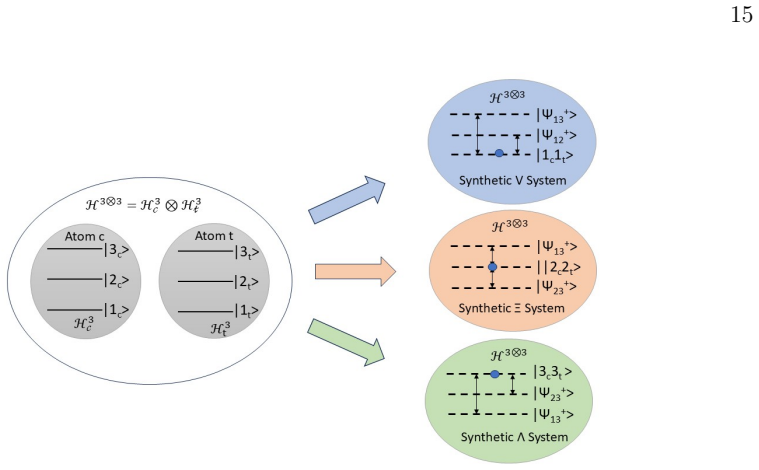
Utilizing its underlying algebraic structure and a set of nine SU(3) entangled states, the system Hamiltonian of a two-qutrit system can be mapped onto an effective synthetic three-level manifold without introducing Rydberg states, while entanglement dynamics are quantified via the SU(3) I-concurrence and a generalized Wootters-type SU(3) concurrence.
What carries the argument
The nine SU(3) entangled states that span and allow mapping of the two-qutrit Hamiltonian to the synthetic three-level manifold.
If this is right
- The effective manifold preserves the full dynamics of the original two-qutrit Hamiltonian.
- Entanglement in the synthetic configurations can be tracked with the SU(3) I-concurrence and the generalized Wootters-type SU(3) concurrence.
- Synthetic three-level systems become accessible without requiring Rydberg excitations.
- The framework supplies quantitative tools for studying entanglement evolution in the mapped manifold.
Where Pith is reading between the lines
- Experimental platforms limited to qutrit encodings could now simulate three-level atom behavior without additional atomic levels.
- The SU(3) concurrence measures may extend to entanglement quantification in other three-dimensional quantum systems.
- The mapping could reduce hardware overhead in quantum simulation or information processing tasks that need three-level manifolds.
Load-bearing premise
The nine SU(3) entangled states suffice to span the effective three-level manifold and preserve its dynamics under the two-qutrit Hamiltonian with no leakage.
What would settle it
Numerical simulation or experiment that shows population leaking outside the nine-state manifold or that the mapped Hamiltonian fails to reproduce the effective three-level dynamics.
Figures
read the original abstract
We present a theoretical framework based on the $SU(3)$ group to construct synthetic three-level configurations from a two-qutrit system consisting of two three-level subsystems. Utilizing its underlying algebraic structure and a set of nine $SU(3)$ entangled states, we show that the system Hamiltonian can be mapped onto an effective synthetic three-level manifold without introducing Rydberg states. We investigate the entanglement dynamics of these synthetic configurations by introducing the $SU(3)$ I-concurrence and a generalized Wootters-type $SU(3)$ concurrence as quantitative measures of entanglement in such system.
Editorial analysis
A structured set of objections, weighed in public.
Referee Report
Summary. The manuscript proposes a theoretical framework based on the SU(3) group to construct synthetic three-level configurations from a two-qutrit system. Utilizing nine SU(3) entangled states that span the full 9-dimensional space, it claims that the two-qutrit Hamiltonian can be mapped onto an effective synthetic three-level (3D) manifold without Rydberg states or additional approximations. The work also introduces an SU(3) I-concurrence and a generalized Wootters-type SU(3) concurrence to quantify entanglement dynamics in these configurations.
Significance. If the mapping is rigorously established with an invariant 3D subspace, the approach could enable effective three-level quantum systems in qutrit hardware without relying on Rydberg levels, offering a potential simplification for quantum simulation and control protocols. The new concurrence measures would provide quantitative tools tailored to SU(3) systems. The result would be of interest to the quantum information community working on higher-dimensional systems, provided the algebraic invariance holds without hidden assumptions.
major comments (1)
- [Mapping construction (likely §3)] The central claim (abstract and § on the mapping) asserts that the SU(3) structure and the nine entangled states suffice to map the Hamiltonian onto a 3D manifold without leakage. However, these nine states form a complete basis for the 9D two-qutrit Hilbert space. The manuscript must therefore explicitly demonstrate (e.g., via the Hamiltonian matrix in this basis or a proof of block-diagonal structure) that a 3-dimensional subspace is invariant under the interaction terms, with vanishing matrix elements to the orthogonal complement. Algebraic closure alone does not guarantee this invariance; if off-block elements are nonzero, the effective description fails. This is load-bearing for the no-Rydberg, no-approximation claim.
minor comments (2)
- [Abstract] The abstract would be clearer if it briefly indicated the specific choice of the 3D subspace within the nine-state basis.
- [Entanglement measures section] Notation for the new concurrences (I-concurrence and generalized Wootters-type) should be defined at first use with explicit formulas, even if derived later.
Simulated Author's Rebuttal
We thank the referee for their detailed review and for identifying a key point that requires clarification. We address the major comment below and will revise the manuscript to include the requested demonstration.
read point-by-point responses
-
Referee: [Mapping construction (likely §3)] The central claim (abstract and § on the mapping) asserts that the SU(3) structure and the nine entangled states suffice to map the Hamiltonian onto a 3D manifold without leakage. However, these nine states form a complete basis for the 9D two-qutrit Hilbert space. The manuscript must therefore explicitly demonstrate (e.g., via the Hamiltonian matrix in this basis or a proof of block-diagonal structure) that a 3-dimensional subspace is invariant under the interaction terms, with vanishing matrix elements to the orthogonal complement. Algebraic closure alone does not guarantee this invariance; if off-block elements are nonzero, the effective description fails. This is load-bearing for the no-Rydberg, no-approximation claim.
Authors: We agree that an explicit demonstration of subspace invariance is essential to substantiate the central claim. The nine SU(3) entangled states indeed span the full 9D space, and the original manuscript relied on the algebraic construction without providing the matrix elements or block-diagonal proof. In the revised manuscript we will add, in the mapping section, the explicit 9×9 matrix representation of the two-qutrit Hamiltonian expressed in this basis. We will show that the matrix is block-diagonal, with a decoupled 3×3 block corresponding to the synthetic three-level manifold and vanishing off-block elements to the orthogonal complement. This will be accompanied by a short proof that the chosen interaction terms preserve the 3D subspace. The revision will be marked as a new subsection. revision: yes
Circularity Check
No significant circularity detected
full rationale
The paper constructs an explicit mapping from the two-qutrit Hamiltonian to an effective three-level manifold by selecting a complete basis of nine SU(3) entangled states and invoking the underlying algebraic structure of SU(3). This is presented as a direct demonstration rather than a self-referential definition or a fitted parameter renamed as a prediction. The new SU(3) concurrence measures are introduced separately as quantitative tools for entanglement dynamics and are not used to define or justify the manifold mapping itself. No load-bearing self-citations, ansatz smuggling, or uniqueness theorems imported from prior author work are indicated in the abstract or skeptic analysis. The central claim therefore remains an independent algebraic construction within the 9-dimensional space and does not reduce to its own inputs by construction.
Axiom & Free-Parameter Ledger
axioms (2)
- standard math The SU(3) group structure governs the two-qutrit system and its entangled states
- domain assumption Nine SU(3) entangled states are sufficient to realize the effective three-level manifold mapping
Reference graph
Works this paper leans on
-
[1]
This configuration ensures that the entanglement dynamics is strictly confined within reduced manifoldM TU dyn = span{|ψ + 12⟩,|2 c2t⟩,|ψ + 23⟩}and the Hamiltonian in this basis is given by, HTU = 1 3 ETU 11 |ψ+ 12⟩⟨ψ+ 12|+ 1 3 ETU 22 |2c2t⟩⟨2c2t|+ 1 3 ETU 33 |ψ+ 23⟩⟨ψ+ 23| + Ω12√ 2 |2c2t⟩⟨ψ+ 12|+ Ω23√ 2 |2c2t⟩⟨ψ+ 23|+ h.c., (16) Similarly for theU Vconfi...
-
[2]
Saffman, T
M. Saffman, T. G. Walker, and K. Mølmer, Quantum information with rydberg atoms, Reviews of Modern Physics82, 2313 (2010)
2010
-
[3]
Levine, A
H. Levine, A. Keesling, G. Semeghini, A. Omran, T. T. Wang, S. Ebadi, H. Bernien, M. Greiner, V. Vuleti´ c, H. Pichler, and M. D. Lukin, Parallel implementation of high-fidelity multiqubit gates with neutral atoms, Phys. Rev. Lett.123, 170503 (2019)
2019
-
[4]
Browaeys and T
A. Browaeys and T. Lahaye, Many-body physics with individually controlled rydberg atoms, Nat. Phys.16, 132 (2020)
2020
-
[5]
J. D. Pritchard, D. Maxwell, A. Gauguet, K. J. Weatherill, M. P. A. Jones, and C. S. Adams, Cooperative atom-light interaction in a blockaded rydberg ensemble, Phys. Rev. Lett.105, 193603 (2010)
2010
-
[6]
Feldker, P
T. Feldker, P. Bachor, M. Stappel, D. Kolbe, R. Gerritsma, J. Walz, and F. Schmidt-Kaler, Rydberg excitation of a single trapped ion, Phys. Rev. Lett.115, 173001 (2015)
2015
-
[7]
Higgins, F
G. Higgins, F. Pokorny, C. Zhang, T. Feldker, H. A. M. Leymann, K. Kleinbach, J. Jimenez- Garcia, S. W¨ uster, T. Pohl, and M. Hennrich, Coherent control of a single trapped rydberg 16 ion, Phys. Rev. X7, 021038 (2017)
2017
-
[8]
Zhang, F
C. Zhang, F. Pokorny, W. Li, G. Higgins, A. P¨ oschl, I. Lesanovsky, and M. Hennrich, Sub- microsecond entangling gate with trapped ions via rydberg interaction, Nature580, 345 (2020)
2020
-
[9]
S. E. Harris, Electromagnetically induced transparency, Phys. Today50, 36 (1997)
1997
-
[10]
Fleischhauer, A
M. Fleischhauer, A. Imamoglu, and J. P. Marangos, Electromagnetically induced transparency: Optics in coherent media, Reviews of Modern Physics77, 633 (2005)
2005
-
[11]
S. Sen, T. K. Dey, M. R. Nath, and G. Gangopadhyay, Comparison of electromagnetically induced transparency in lambda, cascade and vee three-level systems, Journal of Modern Optics62, 166 (2015)
2015
-
[12]
A. K. Mohapatra, M. G. Bason, B. Butscher, K. J. Weatherill, and C. S. Adams, Coherent optical detection of highly excited rydberg states using electromagnetically induced trans- parency, Nat. Phys.4, 890 (2007)
2007
-
[13]
T. G. Walker and M. Saffman, Entanglement of two atoms using rydberg blockade, Advances in Atomic, Molecular, and Optical Physics61, 81 (2012)
2012
-
[14]
J. D. Pritchard, K. J. Weatherill, and C. S. Adams, Non-linear optics using cold rydberg atoms, Annual Review of Cold Atoms and Molecules1, 301 (2013)
2013
-
[15]
Firstenberg, C
O. Firstenberg, C. S. Adams, and S. Hofferberth, Nonlinear quantum optics mediated by rydberg interactions, Journal of Physics B: Atomic, Molecular and Optical Physics49, 152003 (2016)
2016
-
[16]
Saffman, Quantum computing with atomic qubits and rydberg interactions: progress and challenges, Journal of Physics B: Atomic, Molecular and Optical Physics49, 202001 (2016)
M. Saffman, Quantum computing with atomic qubits and rydberg interactions: progress and challenges, Journal of Physics B: Atomic, Molecular and Optical Physics49, 202001 (2016)
2016
-
[17]
C. S. Adams, J. D. Pritchard, and J. P. Shaffer, Rydberg atom quantum technologies, Journal of Physics B: Atomic, Molecular and Optical Physics53, 012002 (2019)
2019
-
[18]
Ziemkiewicz, Electromagnetically induced transparency in media with rydberg excitons 1: Slow light, Entropy22, 177 (2020)
D. Ziemkiewicz, Electromagnetically induced transparency in media with rydberg excitons 1: Slow light, Entropy22, 177 (2020)
2020
-
[19]
Finkelstein, S
R. Finkelstein, S. Bali, O. Firstenberg, and I. Novikova, A practical guide to electromagneti- cally induced transparency in atomic vapor, New Journal of Physics (2022)
2022
-
[20]
Møller, L
D. Møller, L. B. Madsen, and K. Mølmer, Quantum gates and multi-particle entanglement by rydberg excitation blockade and adiabatic passage, Physical Review Letters100, 170504 (2008). 17
2008
-
[21]
Observation of Rydberg blockade between two atoms
E. Urban, T. A. Johnson, T. Henage, L. Isenhower, D. D. Yavuz, T. G. Walker, and M. Saffman, Observation of rydberg blockade between two atoms, Nature Physics5, 110 (2009), arXiv:0805.0758 [quant-ph]
work page internal anchor Pith review Pith/arXiv arXiv 2009
-
[22]
T. Wilk, A. Ga¨ etan, P. Grangier, and A. Browaeys, Entanglement of two individual neutral atoms using Rydberg blockade, Physical Review Letters104, 010502 (2010)
2010
-
[23]
Zeybek, R
V. Zeybek, R. Mukherjee, and P. Schmelcher, Symmetry-broken collective dynamics of rydberg atoms, Physical Review Letters131, 203003 (2023)
2023
-
[24]
Yoo and J
H.-I. Yoo and J. H. Eberly, Dynamical theory of an atom with two or three levels interacting with quantized cavity fields, Physics Reports118, 239 (1985)
1985
-
[25]
S. Sen, M. R. Nath, T. K. Dey, and G. Gangopadhyay, Bloch space structure, the qutrit wavefunction and atom–field entanglement in three-level systems, Annals of Physics327, 224 (2012)
2012
-
[26]
M. R. Nath, S. Sen, A. K. Sen, and G. Gangopadhyay, Dynamical symmetry breaking of lambda-and vee-type three-level systems on quantization of the field modes, Pramana71, 77 (2008)
2008
-
[27]
Sen and T
S. Sen and T. K. Dey, An inequality for entangled qutrits in su(3) basis, Quantum Information Processing23, 267 (2024)
2024
-
[28]
S. Sen, T. K. Dey, A. Pandey, and S. Roy, Quantum teleportation of a single qutrit using two- qutrit entangled states, International Journal of Quantum Information23, 2540002 (2025)
2025
-
[29]
C. H. Bennett, G. Brassard, C. Cr´ epeau, R. Jozsa, A. Peres, and W. K. Wootters, Teleporting an unknown quantum state via dual classical and einstein–podolsky–rosen channels, Physical Review Letters70, 1895 (1993)
1993
-
[30]
W. K. Wootters, Entanglement of formation and concurrence, Phys. Rev. Lett.80, 2245 (1998)
1998
-
[31]
Rungta, V
P. Rungta, V. Buˇ zek, C. M. Caves, M. Hillery, and G. J. Milburn, Universal state inversion and concurrence in arbitrary dimensions, Physical Review A64, 042315 (2001), often referred to as the universal concurrence measure for arbitrary dimensional systems
2001
-
[32]
Albeverio and S.-M
S. Albeverio and S.-M. Fei, Concurrence and correlation matrices of a class of pure states, Journal of Optics B: Quantum and Semiclassical Optics3, 223 (2001)
2001
discussion (0)
Sign in with ORCID, Apple, or X to comment. Anyone can read and Pith papers without signing in.