REVIEW 3 major objections 4 minor 10 references
On the Gardner Transition in the Ising Pure $p$-Spin Glass II
T0 review · 3 major / 4 minor · reviewed 2026-08-10 · deepseek-v4-flash
Pith's one-line read For every p ≥ 3 the Ising pure p-spin glass has exactly two phase transitions, with a full replica symmetry breaking regime above the second.
desk verdict The theorem is the real completion of the Gardner phase diagram for the Ising pure p-spin glass, but the load-bearing appendix proofs are unrevised LLM drafts with not-yet-deposited interval certificates, so the result should be treated as conditional pending authorial rework and independent verification. read the letter →
The pith
A machine-rendered reading of the paper's core claim, the machinery that carries it, and where it could break.
The reading
What carries the argument
The load-bearing object is the variational criterion of prior work: for a candidate measure $\mu$ one defines $\Gamma_\mu(u)$ as the expected squared $x$-derivative of the Parisi PDE solution, $F_\mu(u)=\Gamma_\mu(u)-u$, and $f_\mu(u)=\frac12\int_0^u \xi''(t)F_\mu(t)\,dt$; the measure is the Parisi measure exactly when $f_\mu\leq 0$ on $[0,1]$ and $f_\mu=0$ on the support. The new proof shows that for a two-atom stationary measure the strict inequality $\Gamma'_\mu(q)<1$ implies the required sign of $f_\mu$, equality $\Gamma'_\mu(q)=1$ is a transversally crossed marginal point, and the no-gap theorem (Theorem 4.1) rules out any internal gap between positive support points. These pieces combine to give the exact support statement of Theorem 1.1.
What would settle it
Run the reproduction commands in Appendix D under the stated exact-arithmetic contracts; if any certificate fails, or an independent check finds a point in the certified boxes where the displayed scalar lower bound is non-positive or a terminal upper bound reaches 2, then the marginal-crossing or no-gap step collapses and Theorem 1.1 would not be established.
Extended reading notes
Core claim
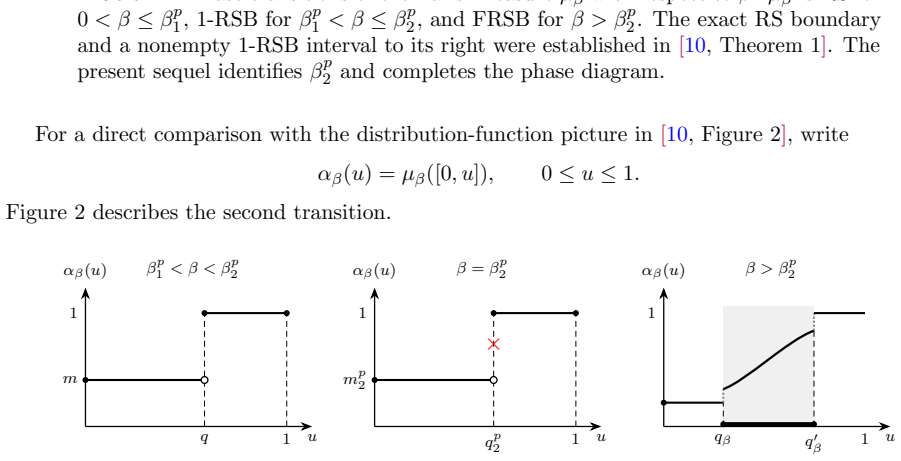
The central claim, Theorem 1.1, is that the Parisi measure undergoes exactly two phase transitions, with the first boundary already established in prior work and the second boundary determined here. The new content is the complete 1-RSB interval: while $\Gamma'_\mu(q) < 1$, the stationary two-atom measure satisfies the variational optimality criterion and is the true Parisi measure; at $\Gamma'_\mu(q) = 1$, the stationary curve is marginal and crosses transversally, giving a unique $\beta_2^p$. Above this temperature the measure can be neither RS nor 1-RSB, and the no-gap theorem forces the interval between its two extreme positive support points into the support. Hence for $\beta > \beta_2^p$, $\operatorname{supp} \mu_\beta = \{0\} \cup [q_\beta, q'_\beta]$ with a smooth density on the interior of the interval.
Load-bearing premise
The theorem depends on the correctness of the long appendix proofs, including the exact interval-arithmetic certificates; the acknowledgments state that these appendix proofs were drafted by large language models and have not yet received final authorial revision.
Editorial extensions
If this is right
- The second critical temperature $\beta_2^p$ is unique for every $p\geq 3$, so the 1-RSB phase is exactly $\beta_1^p < \beta \leq \beta_2^p$.
- For $\beta > \beta_2^p$, the overlap distribution is supported on $\{0\}\cup[q_\beta,q'_\beta]$; the origin is an isolated atom and the interval carries a smooth density.
- Gardner's two-transition prediction is established for all $p\geq3$ in zero field, not only in a high-temperature or perturbative regime.
- The crossing equation $\Gamma'_\mu(q)=1$, added to the two stationary equations, provides a concrete system whose unique solution locates the second transition for each $p$.
- Combined with the earlier paper, this gives a complete and exact finite-temperature phase diagram for the Ising pure $p$-spin glass with $p\geq3$.
Reading between the lines
- The same marginal-crossing mechanism could locate a second transition in other mean-field models whenever the candidate Parisi measure is supported on two atoms; the condition $\Gamma'_\mu(q)=1$ is a natural order-parameter equation.
- The no-gap theorem suggests a stronger structural principle: in zero external field, any Parisi measure with two positive support points has interval support, so FRSB phases cannot contain isolated positive atoms.
- The exact-arithmetic certificates could be converted into reproducible tables of $\beta_2^p$ and $q_2^p$ for small $p$, giving quantitative targets for numerical or experimental tests.
Editorial analysis
A structured set of objections, weighed in public.
Referee Report
Summary. The paper proves, for every p≥3, that the Ising pure p-spin glass without external field has exactly two phase transitions in the Parisi measure: replica symmetric for 0<β≤β1^p, one-step replica symmetry breaking for β1^p<β≤β2^p, and full replica symmetry breaking for β>β2^p, with support exactly {0}∪[qβ,q'β] in the FRSB region. The first transition and a nonempty 1-RSB interval are taken from the author's previous work [10]. The new content consists of three blocks: strict-sign results for the variational criterion f_μ on both sides of the positive atom of a 1-RSB candidate (Propositions 3.1–3.3), a marginal-crossing transversality statement for the second transition (Proposition 3.4), and a no-gap theorem for the Parisi support (Theorem 4.1). These results are proved in the main text only at the level of reduction; the actual estimates are delegated to Appendices B–G, which rely on lengthy analytic inequalities and exact interval-arithmetic certificates.
Significance. If the proof is correct, the paper resolves Gardner's two-transition picture for the Ising pure p-spin glass in a sharp, parameter-free form: unique critical temperatures and an exact support description in the FRSB phase. The result fits the standard Parisi variational framework, uses no fitted parameters, and makes the computational certificates an integral part of the proof rather than an optional numerical check. These are substantial strengths. However, the paper's own acknowledgments state that the appendix proofs were drafted by large language models and have not received final authorial revision, and a key inequality behind Theorem 4.1 is not actually reproduced in the text made available to me. The significance is therefore conditional: the theorem is important if the appendix infrastructure is correct, but the submitted text does not yet establish it.
major comments (3)
- [Acknowledgments; Appendices B–G] The acknowledgments state that all appendix proofs were drafted by large language models and have not yet received their final authorial revision. This is not a stylistic concern: Theorem 1.1 depends on Proposition 3.4 and Theorem 4.1, and both propositions are proved almost entirely inside Appendices C and E–G. A single erroneous interval certificate in Appendix D, for example in the P=2 scalar D certificate of Section B.6 or the p=3 entry certificate of Section C.5.3, would destroy the strict sign computation on which uniqueness of β2^p rests. Until the author has revised and verified these proofs, the central theorem is not established by the submitted text.
- [Lemma 4.4; Appendices G.1–G.3] Lemma 4.4 states that Appendices G.1–G.3 prove inequality (G.32), and the lemma is then the only input to Theorem 4.1. In the text under review, the derivation of (G.32) is not actually present: the reader is told that the appendices prove it, but the inequality and its proof are not shown. Since (G.32) is exactly the positivity Γμ(s)-sΓ'μ(s)>0 that makes the no-gap argument work, this missing proof is load-bearing. The same applies to Proposition 4.3, which is reduced to inequality (E.92) on region (E.143) and to Appendix F; those details are also not visible in the submitted text. The proof of Theorem 4.1 is therefore incomplete as presented.
- [Appendix D; Section B.6; Section C.5] The exact interval-arithmetic certificates are asserted through printed 'PASS' outputs and source listings, but no independent verifier is supplied and the 'PASS' statements are not accompanied by human-readable certificates of the individual polynomial or interval inequalities. For example, the Bernstein expansions in Section C.6 and the scalar certificates in Section B.6 report positive coefficients or positive interval lower bounds, but the reader cannot check these without re-implementing the entire verifier. Since these certificates are the decisive evidence for Proposition 3.4 and for the contact-curvature sign in Proposition 3.1, the manuscript should either provide an independent machine-checkable proof artifact or reduce the role of the certificates to a genuinely checkable finite computation. At minimum, a revised version should identify exactly which certificate is needed for which proposition and should make the verification source independently runnable.
minor comments (4)
- [Proposition 3.4; Section 3.2] The phrase 'β2 is a valid coordinate on this curve' is confusing because β2 elsewhere denotes inverse temperature squared, as in ξ''(u)=β²p(p-1)u^{p-2}; the intended object is β_p^2, the second critical temperature. Please use a consistent notation such as β_p^2 for the coordinate and β² for the squared inverse temperature.
- [Appendix B.6] The labels 'P=2' and 'P=3' in the scalar D certificates refer to P=p−1, so P=2 means p=3 and P=3 means p=4. This off-by-one convention is easy to misread; please label the certificates by p directly.
- [Figure 2] The middle panel says '1-RSB marginally at β=β_p^2', while Theorem 1.1(2) states that the measure is 1-RSB at β=β_p^2. The word 'marginally' is not defined; either define it or remove it to avoid an apparent contradiction.
- [Appendix D.2] Several source files have overlapping names and the text notes that 'the no-argument mode is an older, shorter diagnostic interval and is not the certificate used above.' It would help reproducibility if each certificate listing were prefaced by the exact command line and the precise role it plays in the proof of Proposition 3.1, Proposition 3.4, or Theorem 4.1.
Circularity Check
No significant circularity: the main theorem is derived from the Parisi variational principle and prior theorems, with no fitted parameters or predictions that reduce to their inputs.
full rationale
The derivation is a proof, not a data-fitting exercise. The Parisi variational formula and the characterization [10, Theorem 3] (f_mu <= 0 with equality on supp mu iff mu is the Parisi measure) are prior results; [10] establishes the RS boundary and an initial 1-RSB interval without assuming the present beta_2^p or FRSB conclusion. The interval-arithmetic certificates in Appendices B-D verify strict signs of analytically derived expressions; their constants are rational outputs, not tuned values. The paper's only flagged limitation is in the Acknowledgments ('The proofs in the appendix were drafted by large language models and have not yet received their final authorial revision'), and parts of the no-gap proof are delegated to unprinted estimates such as (G.32); these are auditability and reliability concerns, not circularity. No equation in the claimed derivation chain is equivalent by construction to its hypothesis, so the circularity score is 0.
Assumptions & free parameters
assumptions (4)
- standard math The Parisi variational formula holds and its minimizer is unique (Parisi, Panchenko, Auffinger-Chen-Zeng).
- domain assumption Zero belongs to the support of every Parisi measure in zero external field, and the distribution function is smooth on the interior of any support interval ([1, Theorems 1 and 2]).
- standard math The variational criterion f_mu(u) <= 0 with equality on supp(mu) characterizes the Parisi measure ([10, Theorem 3]).
- ad hoc to paper The analytic estimates and exact interval-arithmetic certificates in Appendices B, C, E-G are correct.
Cite this review
Pith. "Pith review of On the Gardner Transition in the Ising Pure $p$-Spin Glass II." pith.science (2026). https://pith.science/paper/7S7JQQ2N
@misc{pith2026260806523,
  author       = {Pith},
  title        = {Pith review of: On the Gardner Transition in the Ising Pure $p$-Spin Glass II},
  year         = {2026},
  howpublished = {\url{https://pith.science/paper/7S7JQQ2N}},
  note         = {Machine review of arXiv:2608.06523}
}
abstract
In previous work, we identified, for every $p\geq3$, a unique first critical temperature $\beta_1^p$ and proved that the Parisi measure is replica symmetric (RS) for $0<\beta\leq\beta_1^p$ and one-step replica symmetry breaking (1-RSB) on a nonempty interval immediately above $\beta_1^p$. In this sequel, we determine the rest of the phase diagram. We prove that there is a unique second critical temperature $\beta_2^p>\beta_1^p$ such that the Parisi measure is 1-RSB for $\beta_1^p<\beta\leq\beta_2^p$, while for $\beta>\beta_2^p$, $\operatorname{supp}\mu_\beta=\{0\}\cup[q_\beta,q'_\beta],$ for some $0<q_\beta<q'_\beta<1$, and is therefore full replica symmetry breaking (FRSB). Combined with our earlier results, this establishes the two transitions predicted by Gardner for the Ising pure $p$-spin glass.
Figures

Reference graph
Works this paper leans on
-
[10]
Zhou,On the Gardner transition in the Ising purep-spin glass, arXiv:2408.14630
Y. Zhou,On the Gardner transition in the Ising purep-spin glass, arXiv:2408.14630. 166
-
[1]
A. Auffinger and W.-K. Chen,On properties of Parisi measures, Probab. Theory Related Fields161(2015), 817–850; arXiv:1303.3573
arXiv 2015
-
[2]
A. Auffinger and W.-K. Chen,The Parisi formula has a unique minimizer, Comm. Math. Phys.335(2015), 1429–1444
work page 2015
-
[3]
W.-K. Chen. Phase transition in the spiked random tensor with Rademacher prior.The Annals of Statistics, 47(5):2734-2756, 2019
work page 2019
-
[4]
Gardner,Spin glasses withp-spin interactions, Nuclear Phys
E. Gardner,Spin glasses withp-spin interactions, Nuclear Phys. B257(1985), 747–765
work page 1985
-
[5]
FRSB in the SK spin glass: convergence to full-interval support at zero temperature
H.-B. Chen,FRSB in the SK spin glass: convergence to full-interval support at zero temperature, arXiv:2607.18032
-
[6]
Full replica symmetry breaking in the Sherrington-Kirkpatrick model
P. Lopatto,Full replica symmetry breaking in the Sherrington–Kirkpatrick model, arXiv:2607.11756
-
[7]
M. M´ ezard, G. Parisi, and M. A. Virasoro,Spin Glass Theory and Beyond, World Scientific, 1987
work page 1987
Show all 10 references
-
[8]
Panchenko,The Parisi formula for mixedp-spin models, Ann
D. Panchenko,The Parisi formula for mixedp-spin models, Ann. Probab.42(2014), 946–958
2014
-
[9]
Talagrand,The Parisi formula, Ann
M. Talagrand,The Parisi formula, Ann. of Math.163(2006), 221–263
2006
Reviewed August 10, 2026 · model on record in the stance chip above.
Discussion (0). Continue with ORCID to comment.