The Limits of Time
Pith reviewed 2026-06-27 05:15 UTC · model grok-4.3
The pith
A systematic review of LIMITS scholarship identifies five recurring types of engagement with time and temporality.
A machine-rendered reading of the paper's core claim, the machinery that carries it, and where it could break.
Core claim
Through a systematic literature review of the last decade of LIMITS scholarship, five recurring types of temporal engagement are identified in the work that does address time: computing time, methodological and design time, politics and ethics of time, biological and ecological time, and afterlife and waste time. These types show how implicit assumptions about time are embedded across research practices, design approaches, and accounts of technological impact, pointing to the need for more explicit, plural, and situated engagements with time.
What carries the argument
The systematic literature review that extracts and groups the five recurring types of temporal engagement from the last decade of LIMITS papers.
If this is right
- Implicit assumptions about time already shape which futures are imagined and which problems are prioritized in LIMITS work.
- Design approaches and research practices carry specific temporal frameworks that affect how technological impact is described.
- Cross-disciplinary scholarship on time as an analytic concern can be brought into conversation with existing LIMITS patterns.
- Making temporal assumptions explicit would support the community's orientation toward long-term well-being.
- Plural and situated engagements with time would alter accounts of technological impact within the field.
Where Pith is reading between the lines
- The same five-type classification might surface in other computing subfields that claim long-term orientations.
- Different temporal frames could reorder which solutions appear viable once they are examined side by side.
- Treating the five types as an analytic checklist could change how future LIMITS papers are written and reviewed.
- Extending the review beyond the LIMITS venue itself would test whether the patterns are community-specific or wider.
Load-bearing premise
The papers published in the LIMITS venue over the last decade form a representative sample from which the main patterns of temporal engagement can be identified.
What would settle it
A re-review of the same corpus that finds the majority of time-related passages fall outside the five listed types or that additional types appear with comparable frequency.
Figures

read the original abstract
The LIMITS community was founded to foster conversations that move away from growth-oriented visions and values in computing toward a focus on long-term well-being. This orientation, we argue, inherently engages questions of time and temporality. Prior work has shown that temporal frameworks shape how futures are imagined, which problems are understood to be worth attending to, and which solutions or alternatives are pursued. We begin this paper with author observations of time in their lived experience, and then extend these observations to the LIMITS community. Through a systematic literature review of the last decade of LIMITS scholarship, we identify ways that explicit attention to how concepts of time and temporality are understood would enrich Limits scholarship. Within the LIMITS scholarship that does engage with time, we identify five recurring types of temporal engagement: computing time, methodological and design time, politics and ethics of time, biological and ecological time, and afterlife and waste time. Together, these engagement types highlight how implicit assumptions about time are embedded across research practices, design approaches, and accounts of technological impact within LIMITS work. We discuss these findings in relation to cross-disciplinary scholarship that takes time as an analytic concern and consider how these patterns point to a broader need for more explicit, plural, and situated engagements with time in the LIMITS community, and why this matters for the community's commitments.
Editorial analysis
A structured set of objections, weighed in public.
Referee Report
Summary. The paper claims that the LIMITS community inherently engages questions of time and temporality. It begins with author observations of lived experience with time and extends these via a systematic literature review of the last decade of LIMITS scholarship. Within the subset of work that engages time, the authors identify five recurring types of temporal engagement: computing time, methodological and design time, politics and ethics of time, biological and ecological time, and afterlife and waste time. The paper argues that these types reveal embedded implicit assumptions about time and calls for more explicit, plural, and situated engagements with time to enrich the community's commitments to long-term well-being.
Significance. If the typology is shown to be robustly derived from a representative corpus, the work could help the LIMITS community surface how temporal frameworks shape problem selection, solution design, and accounts of impact. Linking these patterns to cross-disciplinary scholarship on time would strengthen the paper's bridge-building value without requiring new empirical data.
major comments (2)
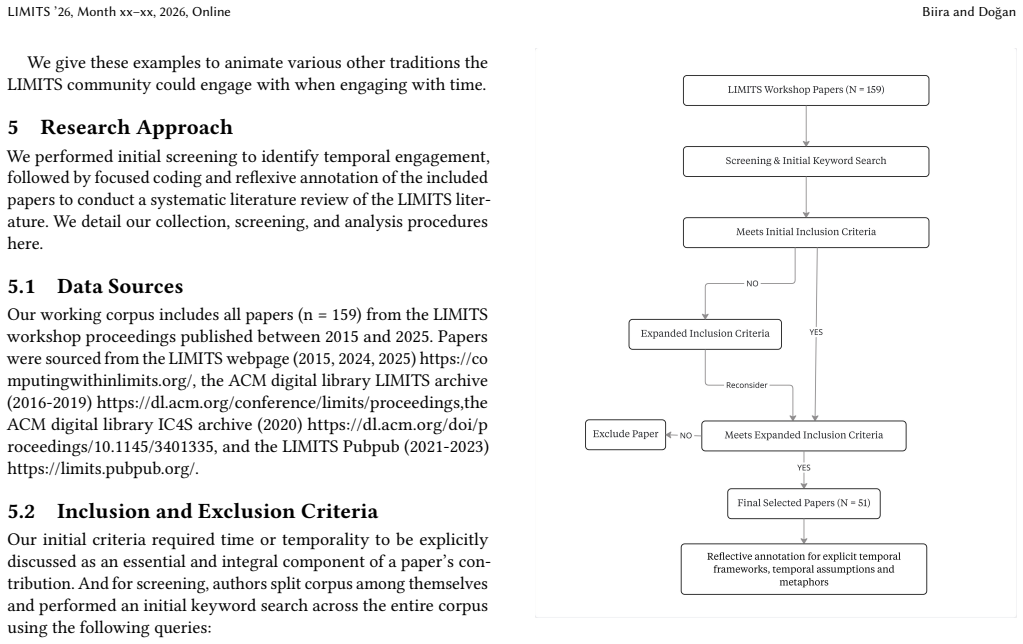
- [Methods / SLR description] The systematic literature review section provides no details on search strategy, databases, search terms, screening numbers, inclusion/exclusion criteria, total papers reviewed, or the inductive or deductive process used to derive the five types. This absence directly undermines the claim that the types represent the main recurring patterns, as the representativeness and reproducibility of the synthesis cannot be evaluated.
- [Results / Typology presentation] No quantitative indicators (e.g., number or proportion of papers per type, frequency thresholds, or inter-coder agreement) accompany the five-type classification. Without such grounding, the assertion that these are the 'recurring' types rests on uninspectable qualitative synthesis.
minor comments (2)
- [Introduction] The opening author observations of lived experience with time are not explicitly linked to the subsequent typology; a short paragraph clarifying their role (e.g., as sensitizing concepts) would improve transparency.
- A summary table listing the five types alongside one or two illustrative citations or short excerpts from the reviewed corpus would aid readability and allow readers to assess the mapping.
Simulated Author's Rebuttal
We thank the referee for their constructive feedback, which highlights important opportunities to strengthen the transparency and rigor of our systematic literature review. We agree that the current manuscript would benefit from expanded methodological details and quantitative indicators to support the typology. We address each major comment below and will revise the paper accordingly.
read point-by-point responses
-
Referee: [Methods / SLR description] The systematic literature review section provides no details on search strategy, databases, search terms, screening numbers, inclusion/exclusion criteria, total papers reviewed, or the inductive or deductive process used to derive the five types. This absence directly undermines the claim that the types represent the main recurring patterns, as the representativeness and reproducibility of the synthesis cannot be evaluated.
Authors: We acknowledge that the current draft omits these details, which limits evaluability. In the revised manuscript, we will add a dedicated Methods subsection that specifies: the search strategy and terms (including keywords such as time, temporality, future, long-term, and related variants), databases searched (e.g., ACM Digital Library and others relevant to LIMITS proceedings), screening and inclusion/exclusion criteria, total papers reviewed and retained, and the inductive process by which the five types were derived from the corpus. This addition will directly address concerns about representativeness and reproducibility. revision: yes
-
Referee: [Results / Typology presentation] No quantitative indicators (e.g., number or proportion of papers per type, frequency thresholds, or inter-coder agreement) accompany the five-type classification. Without such grounding, the assertion that these are the 'recurring' types rests on uninspectable qualitative synthesis.
Authors: We agree that quantitative grounding would strengthen the presentation. In the revision, we will include a summary table reporting the number and proportion of papers assigned to each of the five types. We will also clarify the inductive nature of the analysis and describe steps taken to ensure consistency in type assignment. While strict frequency thresholds were not applied (as the typology emerged from patterns rather than predefined criteria), the distribution data will make the claim of 'recurring' types more inspectable and transparent. revision: yes
Circularity Check
No circularity: observational typology from external corpus review
full rationale
The paper performs a systematic literature review of LIMITS scholarship and reports five recurring types of temporal engagement as observations drawn from the reviewed papers. These types are not defined in terms of each other, fitted to the authors' own prior equations, or justified via self-citation chains that reduce the central claim to unverified inputs. No mathematical derivations, predictions, or uniqueness theorems appear; the work is self-contained as an empirical mapping from an external corpus to a descriptive typology, with no load-bearing step that collapses by construction to the paper's own outputs.
Axiom & Free-Parameter Ledger
axioms (2)
- domain assumption Explicit attention to time and temporality would enrich LIMITS scholarship
- domain assumption A systematic literature review of the last decade captures the relevant temporal engagements in the field
Reference graph
Works this paper leans on
-
[1]
Roel Roscam Abbing. 2021. ‘This is a solar-powered website, which means it sometimes goes offline’: a design inquiry into degrowth and ICT. InLIMITS Workshop on Computing within Limits. doi:10.21428/bf6fb269.e78d19f6
-
[2]
Sakihitowin Awasis. 2020. "Anishinaabe time": temporalities and impact as- sessment in pipeline reviews.Journal of Political Ecology27, 1 (Jan. 2020). doi:10.2458/v27i1.23236
-
[3]
Laura Bear. 2016. Time as Technique.Annual Review of Anthropology45, 1 (Oct. 2016), 487–502. doi:10.1146/annurev-anthro-102313-030159
-
[4]
Esta Bhardwaj, Han Qiao, and Christoph Becker. 2023. Pathways to urban sustainability: Design perspectives on a data curation and visualization platform. InNinth Computing within Limits 2023. LIMITS, Virtual. doi:10.21428/bf6fb269. 541455de
-
[5]
Eshta Bhardwaj, Han Qiao, and Christoph Becker. 2024. Limits at a Distance: De- sign Directions to Address Psychological Distance in Policy Decisions Affecting Planetary Boundaries
2024
-
[6]
Eli Blevis, Chris Preist, Daniel Schien, and Priscilla Ho. 2017. Further Connecting Sustainable Interaction Design with Sustainable Digital Infrastructure Design. InProceedings of the 2017 Workshop on Computing Within Limits. ACM, Santa Barbara California USA, 71–83. doi:10.1145/3080556.3080568
-
[7]
Tega Brain, Alex Nathanson, and Benedetta Piantella. 2022. Solar Protocol: Exploring Energy-Centered Design
2022
-
[8]
Chris Caseldine. 2012. Conceptions of time in (paleo)climate science and some implications.WIREs Climate Change3, 4 (July 2012), 329–338. doi:10.1002/wcc.178
-
[9]
Xue Chen, Yanan Liao, and Yuanrong Li. 2023. Following the Rhythm of Nature: Wisdom in the 24 Solar Terms and the 12 Constellations. InScience Education and International Cross-Cultural Reciprocal Learning, George Zhou, Yuanrong Li, and Jian Luo (Eds.). Springer International Publishing, Cham, 11–26. doi:10.1007/978- 3-031-17157-4_2
-
[10]
David Colliaux, Jonathan Minchin, Sebastien Goelzer, and Peter Hanappe. 2022. Computational Agroecology: Should we bet the microfarm on it?. InEighth Workshop on Computing within Limits 2022. LIMITS. doi:10.21428/bf6fb269.5b85 20b2
-
[11]
Rob Comber and Elina Eriksson. 2023. Computing as Ecocide. InNinth Computing within Limits 2023. LIMITS, Virtual. doi:10.21428/bf6fb269.9fcdd0c0
-
[12]
Tim Edensor, Lesley Head, and Uma Kothari. 2020. Time, temporality and envi- ronmental change.Geoforum108 (2020), 255–258. doi:10.1016/j.geoforum.2019. 11.003
-
[13]
Elina Eriksson and Daniel Pargman. 2018. Meeting the future in the past - using counterfactual history to imagine computing futures. InProceedings of the 2018 Workshop on Computing within Limits. ACM, Toronto Ontario Canada, 1–8. doi:10.1145/3232617.3232621
-
[14]
Ashley Fent and Erik Kojola. 2020. Political ecologies of time and temporality in resource extraction.Journal of Political Ecology27, 1 (Nov. 2020), 819–829. https://journals.uair.arizona.edu/index.php/JPE/article/view/23252
2020
-
[15]
Birgan Gokmenoglu. 2022. Temporality in the social sciences: New directions for a political sociology of time.The British Journal of Sociology73, 3 (June 2022), 643–653. doi:10.1111/1468-4446.12938
-
[16]
Rupert Griffiths. 2023. Time and the Anthropocene: Making more-than-human temporalities legible through environmental observations and creative methods. Time & Society32, 4 (Nov. 2023), 461–487. doi:10.1177/0961463X231202928
-
[17]
Maren Hartmann. 2019. The Normative Framework of (Mobile) Time: Chrononor- mativity, Power-Chronography, and Mobilities. InMediated Time, Maren Hart- mann, Elizabeth Prommer, Karin Deckner, and Stephan O. Görland (Eds.). Springer International Publishing, Cham, 45–65. doi:10.1007/978-3-030-24950-2_3
-
[18]
David G. Hendry. 2021. Transition Discourse, Food, and Computing within Limits. InLIMITS Workshop on Computing within Limits. doi:10.21428/bf6fb269.244d268b
-
[19]
Lorenz M Hilty. [n. d.]. Computing Efficiency, Sufficiency, and Self-sufficiency: A Model for Sustainability?
-
[20]
Gonzalo Iparraguirre. 2015. Time, temporality and cultural rhythmics: An an- thropological case study.Time & Society(April 2015). https://journals.s agepub.com/doi/f ull/10.1177/0961463X15579802?casa_token=7e56pK GzR1wAAAAA%3AcF3zz86pm1w7B56YA30McywdYOR4IN9OW4NmPV- 213GX3ieJWPr7xRyliFcvqnAOiG-ohJEGOTII
-
[21]
Richard Irvine. 2014. Deep time: an anthropological problem:.Social Anthropology 22, 2 (May 2014), 157–172. doi:10.1111/1469-8676.12067
-
[22]
Pierre Jacquet and Adrien Luxey-Bitri. 2025. The Case for Time-Shared Comput- ing Resources
2025
-
[23]
Alison Kafer. 2021. After Crip, Crip Afters.South Atlantic Quarterly120, 2 (April 2021), 415–434. doi:10.1215/00382876-8916158
-
[24]
Minna Laurell Thorslund and Ola Leifler. 2025. Exploring Assumptions about Sustainability: Towards a Constructive Framework for Action in Sustainable HCI. InProceedings of the 2025 CHI Conference on Human Factors in Computing Systems. ACM, Yokohama Japan, 1–13. doi:10.1145/3706598.3714001
-
[25]
Débora De Castro Leal, Max Krüger, Michael Ahmadi, Jason Appiah, Ricardo A. Baquero Gómez, Daniel Courtney, Ata Daee, María Belén Giménez Cici- olli, Lena Hieber, Md Shakhawat Hossain, Jeongmin Lee, Ramona Plogmann, Liliana Savage Pinto, Sasmitha Sinnathurai, Darinka Yepez, and Volker Wulf
-
[26]
InLIMITS Workshop on Computing within Limits
HCI’s Role in the Capitalocene: Lessons Learned from an HCI Master Course Across the Globe. InLIMITS Workshop on Computing within Limits. doi:10.21428/bf6fb269.67a8d057
-
[27]
Samuel Mann, Oliver Bates, Glenys Forsyth, and Phil Osborne. 2018. Regenerative computing: de-limiting hope. InProceedings of the 2018 Workshop on Computing within Limits. ACM, Toronto Ontario Canada, 1–10. doi:10.1145/3232617.3232618
-
[28]
Jens Marquardt and Laurence L. Delina. 2021. Making time, making politics: Problematizing temporality in energy and climate studies.Energy Research & Social Science76 (June 2021), 102073. doi:10.1016/j.erss.2021.102073
-
[29]
2003.Timespace: Geographies of Temporality
Jon May and Nigel Thrift (Eds.). 2003.Timespace: Geographies of Temporality. Routledge, London. doi:10.4324/9780203360675
-
[30]
Eric J. Mayhew and Elizabeth Patitsas. 2021. Materiality Matters in Comput- ing Education: A Duoethnography of Two Digital Logic Educators. InLIMITS Workshop on Computing within Limits. doi:10.21428/bf6fb269.19c98f37
-
[31]
John S. Mbiti. 1970.African religions and philosophy. Garden City, N.Y. : Anchor Books. http://archive.org/details/africanreligions00john
1970
-
[32]
Samantha McDonald, Bonnie Nardi, and Bill Tomlinson. 2017. Political Realities of Digital Communication: The Limits of Value from Digital Messages to Members of the US Congress. InProceedings of the 2017 Workshop on Computing Within Limits. ACM, Santa Barbara California USA, 129–138. doi:10.1145/3080556.3080565
-
[33]
Olivier Michel and Émilie Frenkiel. 2025. ICT Within Limits Is Bound To Be Old-Fashioned By Design
2025
-
[34]
Alessandro Morosin. 2020. Comunalidad, Guendaliza’a and anti-mine mobiliza- tions in the Isthmus of Tehuantepec.Journal of Political Ecology27, 1 (Jan. 2020). doi:10.2458/v27i1.23237
-
[35]
Sofie Nyström, Miriam Börjesson Rivera, Björn Hedin, Cecilia Katzeff, and Ar- jun Rajendran Menon. 2021. Challenging the image of the altruistic and flexible household in the smart grid using design fiction. InLIMITS Workshop on Com- puting within Limits. doi:10.21428/bf6fb269.824814be
-
[36]
Kasia Paprocki. 2022. Anticipatory ruination.The Journal of Peasant Studies49, 7 (2022), 1399–1408. doi:10.1080/03066150.2022.2113068
-
[37]
Daniel Pargman. [n. d.]. On the Limits of Limits. LIMITS ’26, Month xx–xx, 2026, Online Biira and Doğan
2026
-
[38]
Daniel Pargman and Elina Eriksson. 2023. Exploring inner transition: Expanding computing for sustainability. InProc. Workshop Comput. Limits
2023
-
[39]
Teresa Cerratto Pargman, Somya Joshi, and Uta Wehn. 2019. Experimenting with Novel Forms of Computing: The case of the Swedish Citizen Observatory for Water Quality Conservation. InProceedings of the Fifth Workshop on Computing within Limits. ACM, Lappeenranta Finland, 1–10. doi:10.1145/3338103.3338111
-
[40]
Birgit Penzenstadler. 2020. Leverage Points for Focus Flow and Communi- tas. InProceedings of the 7th International Conference on ICT for Sustainability (ICT4S2020). Association for Computing Machinery, New York, NY, USA, 267–274. doi:10.1145/3401335.3401826
-
[41]
Birgit Penzenstadler. 2021. The Pursuit of Essence: Realizing Expansion and Oneness by Limitation. InLIMITS Workshop on Computing within Limits. doi:10 .21428/bf6fb269.390c5acb
2021
-
[42]
Thibault Pirson, Louis Golard, and David Bol. 2023. InNinth Computing within Limits 2023. LIMITS, Virtual. doi:10.21428/bf6fb269.6af396ff
-
[43]
Jörgen Rahm-Skågeby and Lina Rahm. 2022. HCI and deep time: toward deep time design thinking.Human–Computer Interaction37, 1 (Jan. 2022), 15–28. doi:10.108 0/07370024.2021.1902328 _eprint: https://doi.org/10.1080/07370024.2021.1902328
-
[44]
Amon Rapp, William Odom, Larissa Pschetz, and Daniela Petrelli. 2022. In- troduction to the special issue on time and HCI.Human–Computer Interac- tion37, 1 (Jan. 2022), 1–14. doi:10.1080/07370024.2021.1955681 _eprint: https://doi.org/10.1080/07370024.2021.1955681
-
[45]
2017.Beyond settler time: temporal sovereignty and indigenous self-determination
Mark Rifkin. 2017.Beyond settler time: temporal sovereignty and indigenous self-determination. Duke University Press, Durham London
2017
-
[46]
Ellen Samuels. 2017. Six Ways of Looking at Crip Time.Disability Studies Quarterly37, 3 (Aug. 2017). doi:10.18061/dsq.v37i3.5824
-
[47]
Sowards, and Bridie McGreavy
Samantha Senda-Cook, Danielle Endres, Stacey K. Sowards, and Bridie McGreavy
-
[48]
doi:10.3389/fcomm.2023.1176887
Engaging complex temporalities in environmental rhetoric.Frontiers in Communication8 (May 2023). doi:10.3389/fcomm.2023.1176887
-
[49]
Eric Snodgrass, Helen Pritchard, Miranda Moss, Daniel Gustafsson, and Jorge Luis Zapico. 2024. Designing grid-liberated servers for regenerative energy communi- ties. InLIMITS ’
2024
-
[50]
Robert Soden, Matt Ratto, G Arno Verhoeven, and Bart Simon. 2022. Photovoltaic Imagination: Solar Strategies for Community Integrated Research and Graduate Training
2022
-
[51]
Brian Sutherland. 2022. Strategies for Degrowth Computing. InEighth Workshop on Computing within Limits 2022. LIMITS, Virtual. doi:10.21428/bf6fb269.04676652
-
[52]
Mikael Wiberg and Erik Stolterman. 2021. Time and Temporality in HCI Research. Interacting with Computers33, 3 (Sept. 2021), 250–270. doi:10.1093/iwc/iwab025
-
[53]
Catherine Wieczorek, Anh-Ton Tran, Cindy Kaiying Lin, Laura Forlano, Carl DiSalvo, and Shaowen Bardzell. 2026. Whose Time Counts? Temporal Arrange- ments in Sociotechnical Infrastructures. InProceedings of the 2026 CHI Conference on Human Factors in Computing Systems. 1–18
2026
-
[54]
Hadas Zohar, Luca Simeone, Amalia de Götzen, and Nicola Morelli. 2024. When we talk about time, we mean many different things: employing visual mapping to think through more-than-human temporalities in participatory design.Frontiers in Communication9 (Aug. 2024). doi:10.3389/fcomm.2024.1440257
discussion (0)
Sign in with ORCID, Apple, or X to comment. Anyone can read and Pith papers without signing in.