REVIEW 4 major objections 7 minor 43 references
Vertical Federated Continual Learning via Evolving Prototype Knowledge
T0 review · 4 major / 7 minor · reviewed 2026-08-07 · deepseek-v4-flash
Pith's one-line read This paper proposes V-LETO, a method that lets vertical federated learning models add new classes and new features over time without catastrophic forgetting, by evolving class prototypes and freezing important local parameters.
desk verdict The FIL half is coherent and the problem framing is novel, but the CIL prototype-evolution equation is undefined as written, so the headline CIL claims are not yet supported. read the letter →
The pith
A machine-rendered reading of the paper's core claim, the machinery that carries it, and where it could break.
The reading
What carries the argument
The load-bearing object is the evolving global prototype list, a set of per-class mean embeddings stored at the active party. It compresses previous-task knowledge without raw data, generates synthetic old-class vectors for class-incremental learning, and supplies weighted prior-feature prototypes for feature-incremental learning. The second piece is the local model optimizer: a per-parameter Fisher Information estimate, computed from squared gradients, selects which passive-party parameters to freeze so that updates for the current task do not erase the parameters most significant to earlier tasks.
What would settle it
Run V-LETO on a class-incremental sequence; after the current task, take held-out old-class samples, compute their true mean global embedding, and compare its distance to the pseudo-prototype from Eq. (2) and to the unmodified stored prototype. If the pseudo-prototype is not closer to the true drifted embedding, or if using the unmodified prototype preserves old-class accuracy just as well, then the class-incremental evolution rule is not doing the work attributed to it.
Extended reading notes
Core claim
V-LETO claims that catastrophic forgetting in vertical federated learning can be prevented with an evolving global prototype list, without replaying raw data from earlier tasks. On each task, the active party sums passive-party local embeddings into global embeddings and averages them per class to make prototypes; the Class-Incremental branch synthesizes pseudo-prototypes for old classes by adding a cosine-similarity-scaled displacement to the stored prototype, and the Feature-Incremental branch blends the current class prototype with the stored one. The global model then trains on the real embeddings plus prototype-based losses for old and new knowledge, and each passive party computes a Fisher Information estimate per parameter and freezes the parameters above a threshold so local updates do not overwrite prior-task knowledge. The reported result is that class accuracy no longer collapses as tasks grow, and feature accuracy rises monotonically from task 1 to task 4 across the four datasets, with the largest margin over baselines in the feature-incremental setting.
Load-bearing premise
The load-bearing premise is that adding a cosine-similarity-scaled displacement to a stored old-class prototype produces a trustworthy stand-in for where that class's embedding actually moved after new classes were learned; nothing in the paper justifies the direction or size of that displacement.
Editorial extensions
If this is right
- A VFL deployment can receive a stream of new classes without needing old data or old labels at the passive parties, because the prototypes carry the prior knowledge.
- A VFL deployment can receive new feature columns without retraining on the full historical feature set, because the feature-incremental branch mixes current and stored prototypes.
- Passive parties do not need old gradients or old data to protect prior knowledge; freezing Fisher-selected parameters is enough.
- Because only prototypes and embeddings are shared, the method avoids the raw-data replay that would otherwise violate the privacy assumptions of VFL.
- If the reported gains hold, the method gives an upgrade path for existing VFL systems rather than a redesign: add the prototype modules and the freezing rule to the current pipeline.
Reading between the lines
- The class-incremental pseudo-prototype rule is the most fragile component: adding a cosine-similarity-scaled shift assumes that similarity between old and new prototypes points in the direction of the old class's drift, which will fail for class orders where new classes are unlike old ones; swapping the task order should change the reported margins if this is the active mechanism.
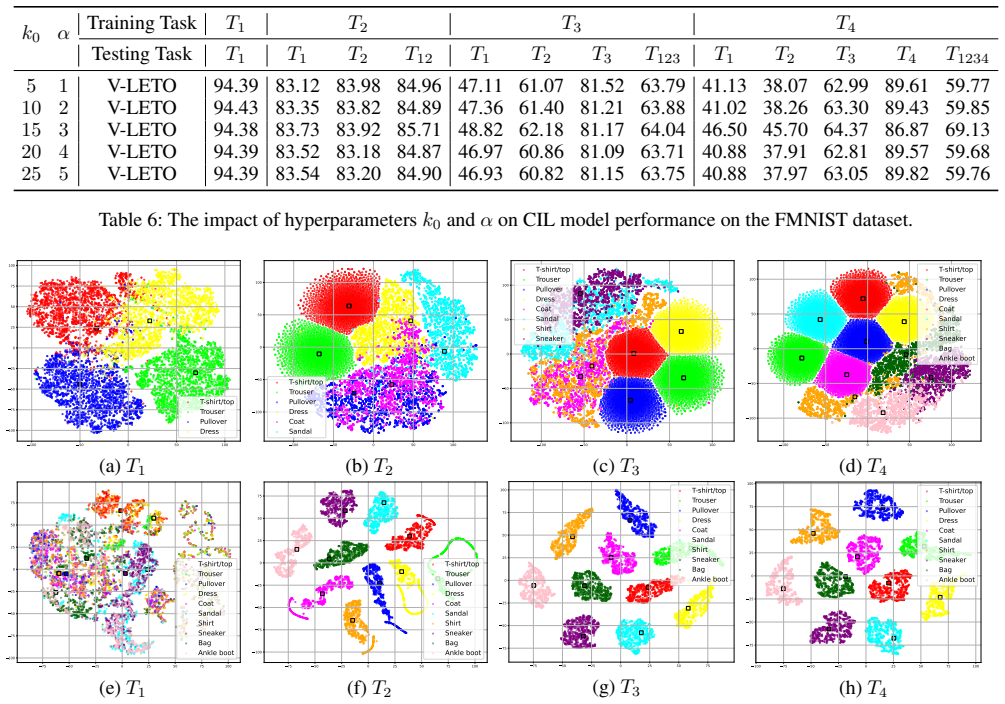
- The feature-incremental update is essentially a weighted running average of prototypes; comparing V-LETO against a simple exponential moving average with the same beta would isolate how much of the 35.15 percentage point gain comes from prototype weighting versus from the frozen local parameters.
- A natural extension is to add differential privacy to the shared global embeddings; privacy leakage through the prototype list is not analyzed in this work, so that boundary remains open.
Editorial analysis
A structured set of objections, weighed in public.
Referee Report
Summary. The manuscript proposes V-LETO, a vertical federated continual learning method that combines three modules: prototype generation from global embeddings, evolving prototype knowledge for class-incremental (CIL) and feature-incremental (FIL) tasks, and Fisher-information-based local parameter freezing. The authors claim that V-LETO is the first VFL method to handle both CIL and FIL, and report experiments on FMNIST, CIFAR10, CINIC10, and NEWS20 showing large accuracy gains over adapted baselines, together with ablations, hyperparameter analyses, and t-SNE visualizations.
Significance. If the results hold, the paper addresses an underexplored and practically important setting, and the FIL results in Table 2 are striking: V-LETO shows continuous accuracy growth as features are added, unlike all baselines. The method is also clearly described at a high level, and the authors provide an anonymized code link, which is a positive step for reproducibility. However, the central CIL mechanism is ill-defined as written, and the headline improvement numbers cannot be traced to the tables, so the current version does not yet provide a sound empirical or methodological basis for the paper's strongest claims.
major comments (4)
- [Prototype Evolving, Eq. (2)] Equation (2) computes a sum over c ∈ C_t (current-task classes) of dis(µ^{t-1}_c, µ^t_c), but the paper's CIL protocol specifies that each task introduces new, disjoint classes, so for any c ∈ C_t there is no prototype µ^{t-1}_c from the previous task. The text immediately before Eq. (2) also states p ∉ C_t, confirming that the sum runs over classes not seen before. Consequently, the arguments to dis are undefined, and the CI-PE module cannot be implemented as described. This is a load-bearing flaw because the reported CIL improvements (Table 1, abstract) are explicitly attributed to this module.
- [Prototype Evolving, Eq. (3)] Equation (3) defines dis as cosine similarity, yet Eq. (2) uses it as an additive displacement to the stored prototype µg_p. Cosine similarity is a similarity score in [-1,1], not a distance, and the paper gives no derivation or motivation for why adding the average cosine similarity (which can be negative) between previous and current prototypes produces a valid pseudo-prototype for an old class. Even if the indexing problem in Eq. (2) were corrected, the direction, magnitude, and sign handling of the added vector are not justified.
- [Abstract and Comparison with State-of-the-Art Methods] The abstract's claim of improvements of 10.39% (CIL) and 35.15% (FIL) over the state-of-the-art does not clearly match Tables 1 and 2. For CIL, the average-accuracy margins over the best baseline across the four datasets are approximately 2.2, 12.7, 8.0, and 5.0 percentage points (FMNIST, CIFAR10, CINIC10, NEWS20), not 10.39. For FIL, 35.15% appears to be the relative improvement on a single dataset/task (CIFAR10 T4: 88.34 vs. 65.36), but the text does not state this. The paper must specify which baseline, dataset, task, and absolute-vs-relative convention are used for every headline number.
- [Tables 1, 2, 3, 5, and 6] All experimental results are reported as point estimates without standard deviations, error bars, or the number of random seeds. Given that several improvements are modest (e.g., FMNIST CIL average 76.14 vs. 73.97, NEWS20 CIL 56.60 vs. 51.59), and the hyperparameters were tuned on FMNIST before being applied to other datasets, the statistical significance of the claimed gains is unclear. The authors should report mean ± std over at least three independent runs and, where appropriate, a significance test.
minor comments (7)
- [Prototype Evolving (text and Eq. (3))] The text repeatedly refers to a "distance" between prototypes, but Eq. (3) defines cosine similarity; either replace the term with a proper distance (e.g., 1 − cosine similarity) or explain why cosine similarity itself is the intended quantity.
- [Model Optimization] The subsection title "Gobal Model Optimization" contains a typo; it should read "Global Model Optimization."
- [Implementation Details] The hyperparameter values are incompletely reported: Eq. (2) introduces γ and Eq. (5) introduces λCE, but the implementation details paragraph gives values only for β, λF, λA, k0, and α, with no default for γ or λCE; Table 4 varies λCE but does not state the fixed values of λF and γ used in those runs.
- [Eq. (7) and surrounding text] The sentence "δ = k0 + α log(t+1) is a hyperparameter" is imprecise; δ is a function of the hyperparameters k0 and α, not itself a directly set hyperparameter, and the paper should clarify which quantity is actually tuned.
- [Table 3 caption] The evaluation protocol for the ablation table is hard to follow; the caption should explain how "T12" or "T123" accuracies are computed (e.g., joint evaluation on all classes from tasks 1 and 2) and what each row/column block represents.
- [Model Optimization (auxiliary losses)] The auxiliary losses LA and LF in Eq. (5) use prototypes generated from the model's own embeddings through the PG module, so they function as self-consistency regularization rather than externally grounded knowledge transfer; the paper should discuss this characterization explicitly, as the phrase "transfer of knowledge from previous tasks" overstates the mechanism.
- [Code availability] The abstract states that code is available through an anonymous link; if possible, provide a permanent repository URL or state that a cleaned version will be released in a public repository upon acceptance.
Circularity Check
No load-bearing circularity: the reported gains are empirical comparisons, and the evolving-prototype losses are self-distillation targets rather than derived predictions.
full rationale
The manuscript supports its central claim with held-out test accuracy across four datasets against adapted baselines, so the headline CIL/FIL improvements are not defined by construction from the method's own inputs. The prototype generation step builds class prototypes from current global embeddings, and the CI-PE/FI-PE losses L_A and L_F use those evolved prototypes as training targets; this is a self-referential optimization objective, but the benchmark results are evaluated on real data and labels, so the comparison does not reduce to a fitted parameter or a tautology. The CI-PE equation is a specification concern: Eq. (2)-(3) call for dis(µ^{t-1}_c, µ^t_c) for c in the current task's class set, yet the paper's disjoint-class CIL protocol means those previous-task prototypes do not exist; that is an undefined-input reproducibility issue, not an input/output equivalence. The self-citations (Wang et al. 2025a/b/c) appear only as general VFL background and do not carry the central argument. Hyperparameters tuned on FMNIST and applied to other sets are mild in-domain selection, not circular derivation. Overall, no step in the derivation chain is forced by definition or by a self-citation loop.
Assumptions & free parameters
free parameters (7)
- gamma =
not reported
- beta =
0.5
- lambda_CE =
0.5
- lambda_A =
0.5
- lambda_F =
0.5
- k0 =
15
- alpha =
3
assumptions (5)
- domain assumption Global embedding is the sum of local embeddings.
- ad hoc to paper Cosine similarity can serve as a distance measure for prototype evolution.
- domain assumption FIM on current-task gradients identifies parameters important for previous tasks.
- ad hoc to paper delta = k0 + alpha log(t+1) with larger delta putting more emphasis on previous tasks.
- domain assumption Previous task data is unavailable and cannot be replayed.
Cite this review
Pith. "Pith review of Vertical Federated Continual Learning via Evolving Prototype Knowledge." pith.science (2026). https://pith.science/paper/7TADTNEK
@misc{pith2026250209152,
  author       = {Pith},
  title        = {Pith review of: Vertical Federated Continual Learning via Evolving Prototype Knowledge},
  year         = {2026},
  howpublished = {\url{https://pith.science/paper/7TADTNEK}},
  note         = {Machine review of arXiv:2502.09152}
}
read the original abstract
Vertical Federated Learning (VFL) has garnered significant attention as a privacy-preserving machine learning framework for sample-aligned feature federation. However, traditional VFL approaches do not address the challenges of class and feature continual learning, resulting in catastrophic forgetting of knowledge from previous tasks. To address the above challenge, we propose a novel vertical federated continual learning method, named Vertical Federated Continual Learning via Evolving Prototype Knowledge (V-LETO), which primarily facilitates the transfer of knowledge from previous tasks through the evolution of prototypes. Specifically, we propose an evolving prototype knowledge method, enabling the global model to retain both previous and current task knowledge. Furthermore, we introduce a model optimization technique that mitigates the forgetting of previous task knowledge by restricting updates to specific parameters of the local model, thereby enhancing overall performance. Extensive experiments conducted in both CIL and FIL settings demonstrate that our method, V-LETO, outperforms the other state-of-the-art methods. For example, our method outperforms the state-of-the-art method by 10.39% and 35.15% for CIL and FIL tasks, respectively. Our code is available at https://anonymous.4open.science/r/V-LETO-0108/README.md.
Figures


Figures from the paper (1 more)
Reference graph
Works this paper leans on
-
[1]
, " * write output.state after.block = add.period write newline
ENTRY address archivePrefix author booktitle chapter edition editor eid eprint howpublished institution isbn journal key month note number organization pages publisher school series title type volume year label extra.label sort.label short.list INTEGERS output.state before.all mid.sentence after.sentence after.block FUNCTION init.state.consts #0 'before.a...
-
[2]
write newline
" write newline "" before.all 'output.state := FUNCTION n.dashify 't := "" t empty not t #1 #1 substring "-" = t #1 #2 substring "--" = not "--" * t #2 global.max substring 't := t #1 #1 substring "-" = "-" * t #2 global.max substring 't := while if t #1 #1 substring * t #2 global.max substring 't := if while FUNCTION word.in bbl.in capitalize " " * FUNCT...
-
[3]
Abouelnaga, Y.; Ali, O. S.; Rady, H.; and Moustafa, M. 2016. Cifar-10 : Knn-based ensemble of classifiers. In 2016 International Conference on Computational Science and Computational Intelligence, 1192--1195. Las Vegas, NV, USA
work page 2016
-
[4]
Cai, T. T.; and Ma, R. 2022. Theoretical foundations of t-sne for visualizing high-dimensional clustered data. Journal of Machine Learning Research, 23(301): 1--54
work page 2022
-
[5]
E.; Lema, D.; Iglesias, R.; Regueiro, C
Casado, F. E.; Lema, D.; Iglesias, R.; Regueiro, C. V.; and Barro, S. 2023. Ensemble and continual federated learning for classification tasks. Machine Learning, 112(9): 3413--3453
work page 2023
-
[6]
J.; Das, A.; Wang, S.; and Patterson, S
Castiglia, T. J.; Das, A.; Wang, S.; and Patterson, S. 2022. Compressed-VFL : Communication-efficient learning with vertically partitioned data. In International Conference on Machine Learning, 2738--2766. Baltimore, Maryland, USA
work page 2022
-
[7]
Feng Qiang, e. a., Boyan Wei. 2022. White Paper on the Application of Federated Learning Technology in Finance. Http://www.hbbill.com/uploadFiles/-16/548/058/54/
work page 2022
-
[8]
Gao, X.; Yang, X.; Yu, H.; Kang, Y.; and Li, T. 2024. FedProK: Trustworthy Federated Class-Incremental Learning via Prototypical Feature Knowledge Transfer. In Proceedings of the IEEE/CVF Conference on Computer Vision and Pattern Recognition, 4205--4214. Seattle, WA, USA
work page 2024
Show all 43 references
-
[9]
Hou, C.; Gu, S.; Xu, C.; and Qian, Y. 2023. Incremental Learning for Simultaneous Augmentation of Feature and Class. IEEE Transactions on Pattern Analysis and Machine Intelligence, 45(12): 14789--14806
2023
-
[10]
Hu, C.; Chen, Y.; Peng, X.; Yu, H.; Gao, C.; and Hu, L. 2019. A Novel Feature Incremental Learning Method for Sensor-Based Activity Recognition. IEEE Transactions on Knowledge and Data Engineering, 31(6): 1038--1050
2019
-
[11]
Krawczyk, A.; and Gepperth, A. 2024. An analysis of best-practice strategies for replay and rehearsal in continual learning. In Proceedings of the IEEE/CVF Conference on Computer Vision and Pattern Recognition, 4196--4204. Seattle,WA, USA
2024
-
[12]
Lang, K. 1995. Newsweeder: Learning to filter netnews. In Machine learning proceedings 1995, 331--339. Elsevier
1995
-
[13]
M.; Le Borgne, Y.-A.; Obl \'e , F.; and Bontempi, G
Lebichot, B.; Siblini, W.; Paldino, G. M.; Le Borgne, Y.-A.; Obl \'e , F.; and Bontempi, G. 2024. Assessment of catastrophic forgetting in continual credit card fraud detection. Expert Systems with Applications, 249(99): 123445
2024
-
[14]
Li, S.; Su, T.; Zhang, X.; and Wang, Z. 2024 a . Continual learning with knowledge distillation: A survey. IEEE Transactions on Neural Networks and Learning Systems, 36(6): 9798 -- 9818
2024
-
[15]
Li, Y.; Li, Q.; Wang, H.; Li, R.; Zhong, W.; and Zhang, G. 2024 b . Towards Efficient Replay in Federated Incremental Learning. In Proceedings of the IEEE/CVF Conference on Computer Vision and Pattern Recognition, 12820--12829. Seattle, WA, USA
2024
-
[16]
K.; Huang, H.; and Zheng, Z
Liao, T.; Fu, L.; Zhang, L.; Yang, L.; Chen, C.; Ng, M. K.; Huang, H.; and Zheng, Z. 2025. Privacy-preserving vertical federated learning with tensor decomposition for data missing features. IEEE Transactions on Information Forensics and Security, 20: 3445 -- 3460
2025
-
[17]
Liu, Y.; Kang, Y.; Zou, T.; Pu, Y.; He, Y.; Ye, X.; Ouyang, Y.; Zhang, Y.-Q.; and Yang, Q. 2024. Vertical federated learning: Concepts, advances, and challenges. IEEE Transactions on Knowledge and Data Engineering, 36(7): 3615 -- 3634
2024
-
[18]
Liu, Z.; Sun, H.; Song, J.; Zhang, B.; Yan, Y.; Qiu, B.; Jiang, L.; and Li, J. 2023. Vertical Federated Learning Architecture for Power Company and Financial Company and Electricity Pricing Model Considering User Credit Evaluation. In 2023 3rd International Conference on Consu...
2023
-
[19]
Luo, K.; Li, X.; Lan, Y.; and Gao, M. 2023. Gradma: A gradient-memory-based accelerated federated learning with alleviated catastrophic forgetting. In Proceedings of the IEEE/CVF Conference on Computer Vision and Pattern Recognition, 3708--3717. Seattle, WA, USA
2023
-
[20]
Luo, M.; Chen, F.; Hu, D.; Zhang, Y.; Liang, J.; and Feng, J. 2021 a . No Fear of Heterogeneity: Classifier Calibration for Federated Learning with Non-IID Data. In Advances in Neural Information Processing Systems, 5972--5984. Virtual
2021
-
[21]
Luo, X.; Wu, Y.; Xiao, X.; and Ooi, B. C. 2021 b . Feature inference attack on model predictions in vertical federated learning. In 2021 IEEE 37th International Conference on Data Engineering, 181--192. Chania, Greece
2021
-
[22]
Ma, Y.; Xie, Z.; Wang, J.; Chen, K.; and Shou, L. 2022. Continual Federated Learning Based on Knowledge Distillation. In Proceedings of the Thirty-First International Joint Conference on Artificial Intelligence, 2182--2188. Vienna, Austria
2022
-
[23]
Ni, H.; Gu, S.; Fan, R.; and Hou, C. 2024. Feature incremental learning with causality. Pattern Recognition, 146(99): 110033
2024
-
[24]
Qiao, F.; and Mahdavi, M. 2024. Learn more, but bother less: parameter efficient continual learning. Advances in Neural Information Processing Systems, 37: 97476--97498
2024
-
[25]
Qiu, P.; Pu, Y.; Liu, Y.; Liu, W.; Yue, Y.; Zhu, X.; Li, L.; Li, J.; and Ji, S. 2024. Integer Is Enough: When Vertical Federated Learning Meets Rounding. In Proceedings of the AAAI Conference on Artificial Intelligence, 14704--14712. Vancouver, Canada
2024
-
[26]
J.; Papadopoulos, P.; Titcombe, T.; Ismail, A.; Cebere, T.; Sandmann, R.; Roehm, R.; and Hoeh, M
Romanini, D.; Hall, A. J.; Papadopoulos, P.; Titcombe, T.; Ismail, A.; Cebere, T.; Sandmann, R.; Roehm, R.; and Hoeh, M. A. 2021. Pyvertical: A vertical federated learning framework for multi-headed splitnn. arXiv preprint arXiv:2104.00489, PP(99): 1--9
2021 arXiv
-
[27]
K.; and Das, A
Sakib, S. K.; and Das, A. B. 2024. Explainable Vertical Federated Learning for Healthcare: Ensuring Privacy and Optimal Accuracy. In 2024 IEEE International Conference on Big Data, 5068--5077. Washington, DC, USA
2024
-
[28]
Shenaj, D.; Toldo, M.; Rigon, A.; and Zanuttigh, P. 2023. Asynchronous federated continual learning. In Proceedings of the IEEE/CVF Conference on Computer Vision and Pattern Recognition, 5055--5063. Vancouver, BC, Canada
2023
-
[29]
Wang, G.; Gu, B.; Zhang, Q.; Li, X.; Wang, B.; and Ling, C. X. 2023. A unified solution for privacy and communication efficiency in vertical federated learning. In Advances in Neural Information Processing Systems, 13480--13491. New Orleans, LA, USA
2023
-
[30]
Wang, L.; Zhang, Z.; Huang, M.; Gai, K.; Wang, J.; and Shen, Y. 2025 a . RoPA: Robust Privacy-Preserving Forward Aggregation for Split Vertical Federated Learning. IEEE Transactions on Network and Service Management, 1
2025
-
[31]
Wang, Q.; Liu, B.; and Li, Y. 2024. Traceable Federated Continual Learning. In Proceedings of the IEEE/CVF Conference on Computer Vision and Pattern Recognition, 12872--12881. Seattle, WA, USA
2024
-
[32]
Wang, S.; Gai, K.; Yu, J.; Zhang, Z.; and Zhu, L. 2025 b . Pravfed: Practical heterogeneous vertical federated learning via representation learning. IEEE Transactions on Information Forensics and Security, 20(1): 2693 -- 2705
2025
-
[33]
Wang, S.; Gai, K.; Yu, J.; Zhang, Z.; and Zhu, L. 2025 c . PraVFed: Practical Heterogeneous Vertical Federated Learning via Representation Learning. IEEE Transactions on Information Forensics and Security, PP(99): 1
2025
-
[34]
Xiao, H.; Rasul, K.; and Vollgraf, R. 2017. Fashion-mnist: a novel image dataset for benchmarking machine learning algorithms. arXiv preprint arXiv:1708.07747, PP(99): 1
2017 arXiv
-
[35]
Yang, X.; Huang, W.; and Ye, M. 2023. Dynamic Personalized Federated Learning with Adaptive Differential Privacy. In Advances in Neural Information Processing Systems, 72181--72192. New Orleans, LA, USA
2023
-
[36]
Yang, X.; Yu, H.; Gao, X.; Wang, H.; Zhang, J.; and Li, T. 2024. Federated continual learning via knowledge fusion: A survey. IEEE Transactions on Knowledge and Data Engineering, 38(8): 3832--3850
2024
-
[37]
Ye, M.; Shen, W.; Du, B.; Snezhko, E.; Kovalev, V.; and Yuen, P. C. 2025. Vertical federated learning for effectiveness, security, applicability: A survey. ACM Computing Surveys, 57(9): 1--32
2025
-
[38]
Yoon, J.; Jeong, W.; Lee, G.; Yang, E.; and Hwang, S. J. 2021. Federated continual learning with weighted inter-client transfer. In International Conference on Machine Learning, 12073--12086. Virtual Event
2021
-
[39]
Yu, H.; Yang, X.; Gao, X.; Feng, Y.; Wang, H.; Kang, Y.; and Li, T. 2024. Overcoming Spatial-Temporal Catastrophic Forgetting for Federated Class-Incremental Learning. In ACM Multimedia 2024, 1--9. Melbourne, Australia
2024
-
[40]
Zhang, J.; Guo, S.; Qu, Z.; Zeng, D.; Wang, H.; Liu, Q.; and Zomaya, A. Y. 2022 a . Adaptive vertical federated learning on unbalanced features. IEEE Transactions on Parallel and Distributed Systems, 33(12): 4006--4018
2022
-
[41]
Zhang, Z.; Guo, B.; Sun, W.; Liu, Y.; and Yu, Z. 2022 b . Cross-FCL : Toward a cross-edge federated continual learning framework in mobile edge computing systems. IEEE Transactions on Mobile Computing, 23(1): 313--326
2022
-
[42]
Zhu, F.; Zhang, X.-Y.; Wang, C.; Yin, F.; and Liu, C.-L. 2021. Prototype augmentation and self-supervision for incremental learning. In Proceedings of the IEEE/CVF Conference on Computer Vision and Pattern Recognition, 5871--5880. Virtual
2021
-
[43]
write newline
" write newline "" before.all 'output.state := FUNCTION fin.entry add.period write newline FUNCTION new.block output.state before.all = 'skip after.block 'output.state := if FUNCTION new.sentence output.state after.block = 'skip output.state before.all = 'skip after.sentence '...
Reviewed August 7, 2026 · model on record in the stance chip above.
Discussion (0). Continue with ORCID to comment.