Optimization and robustness of cost-efficient seismic arrays for Newtonian noise cancellation at the Einstein Telescope
Pith reviewed 2026-06-26 13:38 UTC · model grok-4.3
The pith
Arrays using multiple seismometers per borehole plus tunnel sensors achieve stable Newtonian noise mitigation above 3-4 Hz for the Einstein Telescope.
A machine-rendered reading of the paper's core claim, the machinery that carries it, and where it could break.
Core claim
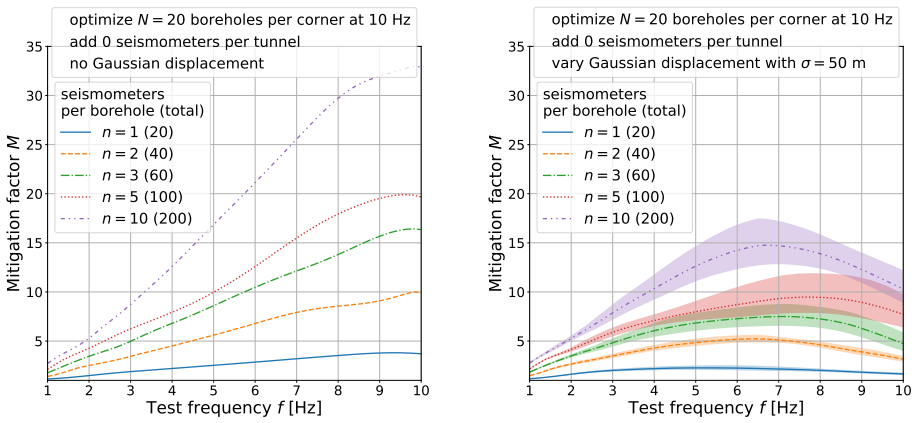
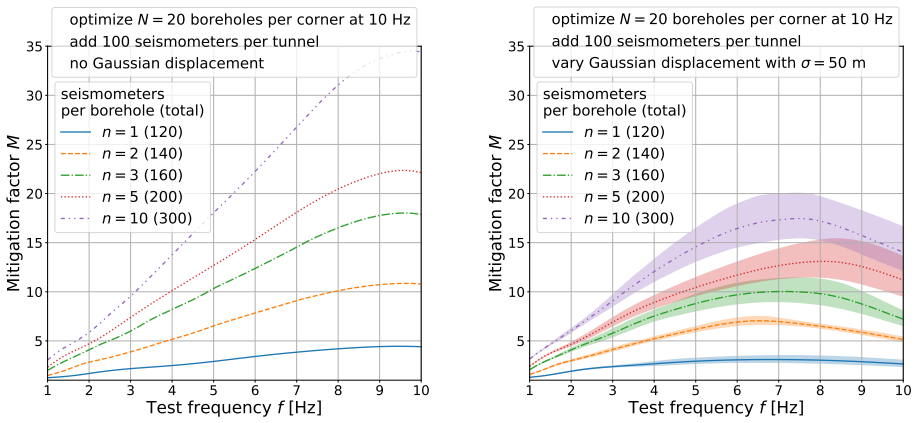
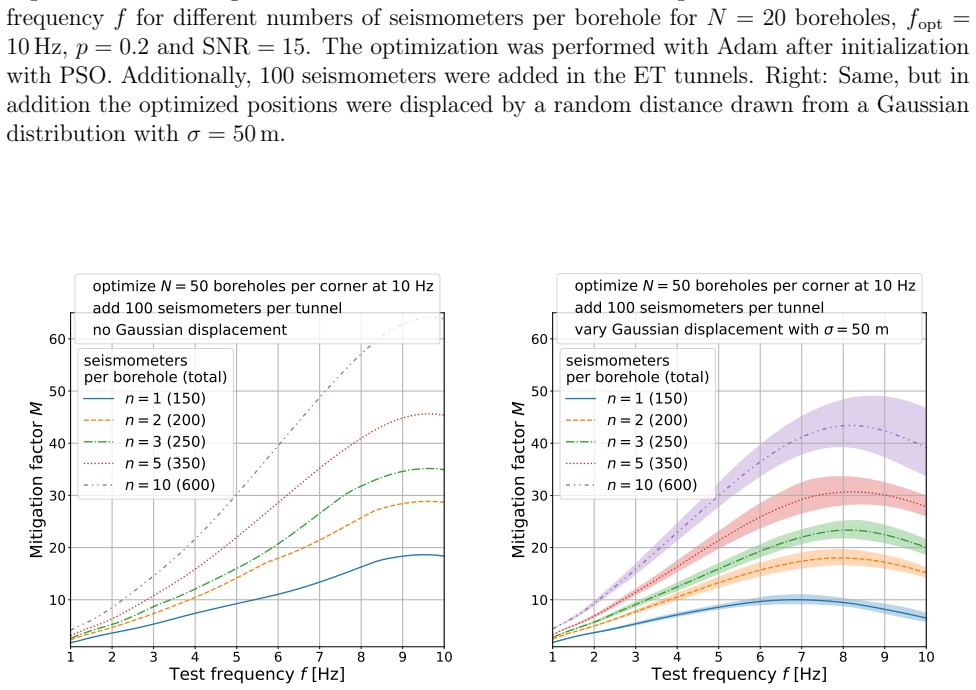
Arrays with multiple seismometers per borehole combined with additional seismometers in the interferometer tunnels provide promising broadband mitigation above 3 to 4 Hz; such arrays remain particularly stable against variations in seismometer positions, delivering mitigation factors greater than 6 for an array of 20 boreholes with 3 sensors each and greater than 15 for a large array of 50 boreholes with 10 sensors each.
What carries the argument
Position optimization of borehole and tunnel seismometers to cancel Newtonian noise via measurements of the seismic wave field.
Load-bearing premise
The seismic wave field model used for optimization accurately represents real conditions at the site so that computed mitigation factors translate to actual performance.
What would settle it
A side-by-side comparison of measured Newtonian noise reduction at the Einstein Telescope site against the model's predicted mitigation factors for the same array layout.
Figures


read the original abstract
Newtonian noise is expected to be the dominating noise source for low frequencies at the Einstein Telescope. It originates from seismic waves that cause density fluctuations in the rock around the interferometer. The mitigation strategy for Newtonian noise relies on an array of seismometers, placed at depth in boreholes, which provides measurements of the seismic wave field. We optimize the positions of the individual seismometers for the mitigation capabilities of the array for a full corner of the Einstein Telescope. We find that the mitigation capabilities of arrays with multiple seismometers in each borehole match the capabilities of only somewhat smaller arrays but with only one seismometer per borehole. Mitigation is further improved by extending the array with seismometers in the interferometer tunnels. Such configurations may hence provide a cost-effective way towards realizing an efficient seismic array. In each case, we quantify the broadband mitigation performance in the range from 1 to 10 Hz for arrays that are optimized for a frequency of 10 Hz, as well as the robustness of the arrays with respect to variations from their optimized positions. We find that larger arrays with several seismometers per borehole and additional seismometers in the tunnels provide promising broadband performance above 3 to 4 Hz and that such arrays are particularly stable against variations in the seismometer positions with mitigation factors $>6$ for an array of 20 boreholes with 3 seismometers each and $>15$ for a large array of 50 boreholes with 10 seismometers.
Editorial analysis
A structured set of objections, weighed in public.
Referee Report
Summary. The paper optimizes the geometry of seismic arrays (boreholes with multiple seismometers plus tunnel sensors) to cancel Newtonian noise at a corner of the Einstein Telescope. Using forward modeling of the seismic wave field, it reports that arrays optimized at 10 Hz achieve broadband mitigation factors >6 (20 boreholes, 3 sensors each) and >15 (50 boreholes, 10 sensors each) above 3–4 Hz, with good robustness to position perturbations; multi-sensor boreholes are claimed to be nearly as effective as larger single-sensor arrays.
Significance. If the underlying seismic model is faithful to site conditions, the results identify cost-effective array designs that could substantially reduce a dominant low-frequency noise source for ET, directly supporting interferometer sensitivity goals.
major comments (1)
- [Seismic model and optimization procedure (methods/results sections)] The mitigation factors and robustness claims rest entirely on the fidelity of the forward seismic wave-field model (spatial correlations, dispersion, density fluctuations between 1–10 Hz). No validation against site-specific data, no error propagation, and no sensitivity analysis to model assumptions (isotropy, layering, scattering) are described; without these the quoted factors >6 and >15 cannot be shown to translate to on-site performance.
minor comments (2)
- [Results on broadband performance] Clarify whether the broadband factors are computed from the same optimization run or require separate frequency-dependent optimizations.
- [Discussion of array configurations] Specify the exact cost metric used when claiming multi-sensor boreholes are 'cost-efficient' relative to single-sensor arrays of comparable performance.
Simulated Author's Rebuttal
We thank the referee for their detailed review and constructive comments on our manuscript. We address the major comment regarding the seismic model below.
read point-by-point responses
-
Referee: [Seismic model and optimization procedure (methods/results sections)] The mitigation factors and robustness claims rest entirely on the fidelity of the forward seismic wave-field model (spatial correlations, dispersion, density fluctuations between 1–10 Hz). No validation against site-specific data, no error propagation, and no sensitivity analysis to model assumptions (isotropy, layering, scattering) are described; without these the quoted factors >6 and >15 cannot be shown to translate to on-site performance.
Authors: We agree that the reported mitigation factors are dependent on the assumptions of the forward seismic model used. The manuscript presents an optimization procedure and results for a generic model of the seismic wave field at the ET site, without site-specific validation or sensitivity analysis to model parameters such as isotropy or scattering. This is a limitation of the current work, as detailed site data for the 1-10 Hz range may not be fully available or the study focused on the array optimization methodology itself. We have revised the manuscript to include a new subsection in the discussion explicitly stating the model assumptions and noting that the quantitative mitigation factors (>6 and >15) should be interpreted as indicative for the assumed model, with on-site performance requiring calibration using local seismic measurements. No error propagation was included, which we acknowledge as a point for future work. The robustness analysis to position variations is performed within the model framework. revision: partial
Circularity Check
No circularity: mitigation factors obtained via forward modeling of array response
full rationale
The derivation consists of optimizing seismometer positions inside an explicit forward model of the seismic wave field, then computing mitigation factors as the resulting cancellation performance of those optimized arrays. These steps are independent computations; the quoted broadband factors (>6, >15) and robustness metrics are outputs of the optimization, not parameters fitted to the target quantities or renamed inputs. No self-citations, uniqueness theorems, or ansatzes are invoked in a load-bearing way. The chain is self-contained against external benchmarks and does not reduce by construction.
Axiom & Free-Parameter Ledger
axioms (1)
- domain assumption A sufficiently accurate model of the seismic wave field exists that permits reliable prediction of Newtonian noise mitigation from array geometry.
Reference graph
Works this paper leans on
-
[1]
Design Report Update 2020 for the Einstein Telescope, 2020.url:https://apps.et-gw.eu/tds/?r=18715
ET Steering Committee Editorial Team. Design Report Update 2020 for the Einstein Telescope, 2020.url:https://apps.et-gw.eu/tds/?r=18715
2020
-
[2]
J. Aasi et al. Advanced LIGO.Classical and Quantum Gravity, 32:074001, 2015.doi: 10.1088/0264-9381/32/7/074001. arXiv:1411.4547 [gr-qc]
work page internal anchor Pith review Pith/arXiv arXiv doi:10.1088/0264-9381/32/7/074001 2015
-
[3]
Advanced Virgo: a 2nd generation interferometric gravitational wave detector
F. Acernese et al. Advanced Virgo: a second-generation interferometric gravitational wave detector.Classical and Quantum Gravity, 32:024001, 2015.doi:10.1088/0264- 9381/ 32/2/024001. arXiv:1408.3978 [gr-qc]
work page internal anchor Pith review Pith/arXiv arXiv doi:10.1088/0264- 2015
-
[4]
doi:10.1088/0264-9381/29/12/124007
K.Somiya(fortheKAGRACollaboration).DetectorconfigurationofKAGRA–theJapanese cryogenic gravitational-wave detector.Classical and Quantum Gravity, 29:124007, 2012. doi:10.1088/0264-9381/29/12/124007. arXiv:1111.7185 [gr-qc]
-
[5]
Aso et al
Y. Aso et al. Interferometer design of the KAGRA gravitational wave detector.Physical Review D, 88:043007, 2013.doi:10 . 1103 / PhysRevD . 88 . 043007. arXiv:1306 . 6747 [gr-qc]
2013
-
[6]
P. R. Saulson. Terrestrial gravitational noise on a gravitational wave antenna.Physical Review D, 30:732, 1984.doi:10.1103/PhysRevD.30.732
-
[7]
F. Amann et al. Site-selection criteria for the Einstein Telescope.Review of Scientific In- struments,91:094504,2020.doi:10.1063/5.0018414.arXiv:2003.03434 [physics.ins-det]
-
[8]
J. Harms. Terrestrial Gravity Fluctuations.Living Reviews in Relativity, 18:3, 2015.doi: 10.1007/lrr-2015-3
-
[9]
G. Cella. Off-Line Subtraction of Seismic Newtonian Noise. In B. Casciaro, D. Fortunato, M. Francaviglia, and A. Masiello, editors,Recent Developments in General Relativity, page 495, Milan. Springer, 2000.doi:10.1007/978-88-470-2113-6_44
-
[10]
F. Badaracco and J. Harms. Optimization of seismometer arrays for the cancellation of Newtonian noise from seismic body waves.Classical and Quantum Gravity, 36:145006, 2019.doi:10.1088/1361-6382/ab28c1. arXiv:1903.07936 [astro-ph.IM]
-
[11]
F. Badaracco, J. Harms, and L. Rei. Joint optimization of seismometer arrays for the cancellation of Newtonian noise from seismic body waves in the Einstein Telescope.Clas- sical and Quantum Gravity, 41:025013, 2024.doi:10.1088/1361-6382/ad1715. arXiv: 2310.05709 [astro-ph.IM]
-
[12]
P. Schillings and J. Erdmann. Fighting Newtonian noise with gradient-based optimization at the Einstein Telescope.Classical and Quantum Gravity, 42:065025, 2025.doi:10 . 1088/1361-6382/adb898. arXiv:2411.03251 [astro-ph.IM]. 9
arXiv 2025
-
[13]
F. Badaracco et al. Machine learning for gravitational-wave detection: surrogate Wiener filtering for the prediction and optimized cancellation of Newtonian noise at Virgo.Clas- sical and Quantum Gravity, 37:195016, 2020.doi:10.1088/1361-6382/abab64. arXiv: 2005.09289 [astro-ph.IM]
-
[14]
S. Koley et al. Design and implementation of a seismic Newtonian noise cancellation system for the Virgo gravitational-wave detector.The European Physical Journal Plus, 139:48, 2024.doi:10.1140/epjp/s13360-023-04834-0. arXiv:2310.17781 [gr-qc]
-
[15]
Subtraction of Newtonian Noise Using Optimized Sensor Arrays
J. Driggers, J. Harms, and R. Adhikari. Subtraction of newtonian noise using optimized sensor arrays.Physical Review D, 86, 2012.doi:10.1103/PhysRevD.86.102001. arXiv: 1207.0275 [gr-qc]
work page internal anchor Pith review Pith/arXiv arXiv doi:10.1103/physrevd.86.102001 2012
-
[16]
P. Ophardt, F. Badaracco, and K.-S. Isleif. Silencing Newtonian noise using fusion sensor arrays, 2025. arXiv:2512.13554 [gr-qc]
arXiv 2025
-
[17]
R. Rading et al. Distributed Acoustic Sensing for Environmental Monitoring, and Newto- nian Noise Mitigation: Comparable Sensitivity to Seismometers, 2025. arXiv:2507.13523 [astro-ph.IM]
arXiv 2025
-
[18]
V. van Beveren et al. A study of deep neural networks for Newtonian noise subtraction at Terziet in Limburg—the Euregio Meuse-Rhine candidate site for Einstein Telescope. Class. Quant. Grav., 40:205008, 2023.doi:10.1088/1361-6382/acf3c8
-
[19]
S. Koley et al. Adaptive algorithms for low-latency cancellation of seismic Newtonian- noise at the Virgo gravitational-wave detector.Physical Review D, 110:022002, 2024. doi:10.1103/PhysRevD.110.022002. arXiv:2404.13170 [gr-qc]
-
[20]
J. Kelleter et al. NNNN: Neural Networks for Newtonian Noise Mitigation at the Einstein Telescope, 2026. arXiv:2606.19907 [astro-ph.IM]
Pith/arXiv arXiv 2026
-
[21]
Wiener.Extrapolation, Interpolation, and Smoothing of Stationary Time Series: With Engineering Applications
N. Wiener.Extrapolation, Interpolation, and Smoothing of Stationary Time Series: With Engineering Applications. Wiley, New York, 1949
1949
-
[22]
J. Kennedy and R. Eberhart. Particle swarm optimization. InProceedings of ICNN’95 - International Conference on Neural Networks, volume 4, page 1942, 1995.doi:10.1109/ ICNN.1995.488968
arXiv 1942
-
[23]
D. P. Kingma and J. Ba. Adam: A Method for Stochastic Optimization, 2014. arXiv: 1412.6980 [cs.LG]
Pith/arXiv arXiv 2014
-
[24]
F. Amann et al. Tunnel Configurations and Seismic Isolation Optimization in Under- ground Gravitational Wave Detectors.Appl. Sciences, 12:8827, 2022.doi:10 . 3390 / app12178827. arXiv:2204.04131 [astro-ph.IM]
arXiv 2022
-
[25]
R. Pieter, X. Kuci, S. François, and G. Degrande. An efficient finite element formulation for Newtonian noise analysis, 2026. arXiv:2603.15157 [physics.app-ph]
Pith/arXiv arXiv 2026
-
[26]
arXiv:2603.15424 [astro-ph.IM]
P.Schillings,S.Yao,J.Erdmann,andA.Rietbrock.AnumericalframeworkforNewtonian- noise estimation at the Einstein Telescope: 2-D simulations beyond the plane-wave ap- proximation, 2026. arXiv:2603.15424 [astro-ph.IM]
arXiv 2026
-
[27]
DeSalvo et al
R. DeSalvo et al. A dual tunnel structure for the Einstein Telescope, 2026. arXiv:2601. 13438 [astro-ph.IM]. 10
2026
discussion (0)
Sign in with ORCID, Apple, or X to comment. Anyone can read and Pith papers without signing in.