Transfer observables of rotating acoustic black holes from ray tracing: shadow centroid, redshift asymmetry and flux imbalance
Pith reviewed 2026-05-21 07:28 UTC · model grok-4.3
The pith
Rotating acoustic black holes produce a linearly shifting shadow centroid and redshift asymmetries in ray-traced images.
A machine-rendered reading of the paper's core claim, the machinery that carries it, and where it could break.
Core claim
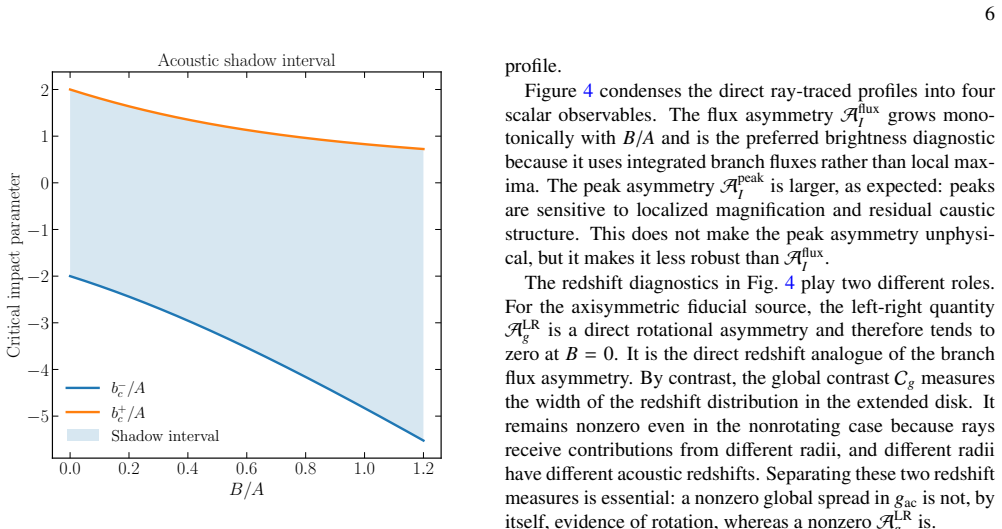
In the rotating draining-bathtub spacetime, an impact-parameter-resolved transfer framework for null acoustic rays separates the ray geometry from source and detector details and reveals that the geometric capture interval yields a shadow centroid shifting linearly with circulation and a shadow width growing monotonically with circulation, with rotation producing a left-right redshift tilt and a branch-dependent flux imbalance such that the total flux remains a degenerate circulation diagnostic.
What carries the argument
The geometric capture interval for null acoustic rays, which determines the boundaries of the shadow and allows computation of centroid shift and width as direct functions of the circulation parameter.
If this is right
- The shadow centroid provides a linear diagnostic for the strength of fluid circulation.
- Shadow width increases steadily as circulation rises, offering a monotonic measure.
- Left-right redshift asymmetry appears as a tilt induced by rotation.
- Flux imbalance varies by ray branch, leading to asymmetric brightness.
- Total integrated flux cannot distinguish different circulation values on its own.
Where Pith is reading between the lines
- Laboratory experiments with rotating fluids could test these predicted shifts in acoustic shadows.
- Differential observables may help separate rotation effects from other fluid properties like viscosity.
- The transfer framework might be applied to other analog black hole models to compare observable signatures.
Load-bearing premise
The ray-tracing approach assumes that acoustic rays follow the ideal null geodesic paths without dispersion, viscosity, or finite-depth effects significantly altering the underlying spacetime geometry.
What would settle it
An experiment in a rotating fluid system that measures no linear shift in the acoustic shadow centroid as circulation is increased would contradict the predicted observables.
Figures



read the original abstract
We construct an impact-parameter-resolved transfer framework for null acoustic rays in the rotating draining-bathtub spacetime. The formalism separates the source-independent ray geometry from the source and detector model by keeping explicit the acoustic redshift, transfer convention, emissivity, emitter velocity field, and source-to-screen mapping. The geometric capture interval provides two clean observables: a shadow centroid that shifts linearly with circulation and a shadow width that grows monotonically with circulation. Observable profiles are obtained from direct ray-source intersections, finite source width or extended-disk integration, detector convolution, and convergence checks, rather than from an approximate semi-analytic ring map. The transfer calculation shows that rotation produces a left-right redshift tilt and a branch-dependent flux imbalance, while the total flux alone remains a degenerate circulation diagnostic. The most useful diagnostics are differential quantities: the shadow centroid, branch-integrated flux asymmetry, peak asymmetry, left-right redshift asymmetry, and global redshift contrast. We also discuss how these observables respond to the transfer convention, intrinsic azimuthal emissivity, the choice of left-right split, finite resolution, and physical limitations such as dispersion, viscosity, and finite-depth corrections.
Editorial analysis
A structured set of objections, weighed in public.
Referee Report
Summary. The manuscript develops an impact-parameter-resolved transfer framework for null acoustic rays in the rotating draining-bathtub spacetime. It separates source-independent ray geometry from source and detector models, keeping explicit the acoustic redshift, transfer convention, emissivity, velocity field, and source-to-screen mapping. From the geometric capture interval the paper extracts two observables: a shadow centroid that shifts linearly with circulation and a shadow width that grows monotonically. Rotation is shown to induce a left-right redshift tilt and branch-dependent flux imbalance, while total flux remains degenerate; differential quantities (centroid, branch-integrated flux asymmetry, peak asymmetry, left-right redshift asymmetry, global redshift contrast) are identified as the most useful diagnostics. The work also examines sensitivities to transfer convention, azimuthal emissivity, left-right split, finite resolution, and physical limitations including dispersion, viscosity, and finite-depth corrections.
Significance. If the results hold, the framework supplies a systematic, source-independent route to circulation diagnostics in acoustic black-hole analogs, with the emphasis on differential rather than total-flux observables mitigating degeneracies. The explicit separation of ray geometry from modeling choices and the use of direct ray-source intersections with convergence checks are methodological strengths that support reproducibility and extensions to realistic sources.
major comments (1)
- [Discussion of physical limitations (referenced in abstract)] The assertion that dispersion, viscosity, and finite-depth corrections can be treated as small perturbations that leave the core geometry and capture interval unaltered (invoked when discussing physical limitations after presenting the ideal-model observables) is not accompanied by quantitative bounds, such as an estimate of the critical wavelength or Reynolds number at which the effective impact-parameter range changes by more than a few percent. This renders the claimed cleanliness of the differential observables conditional on an untested regime.
minor comments (2)
- [Abstract and results presentation] The abstract and main text would be strengthened by at least one concrete numerical example or reference to a table/figure that quantifies the linear centroid shift and monotonic width growth, including error bars or convergence metrics.
- [Methods section] Notation for the left-right split and transfer convention could be clarified with an explicit equation or diagram early in the manuscript to aid readers in reproducing the asymmetry calculations.
Simulated Author's Rebuttal
We thank the referee for the careful reading of the manuscript and for recognizing the methodological strengths of the impact-parameter-resolved transfer framework, including the separation of ray geometry from source and detector models. We address the major comment below.
read point-by-point responses
-
Referee: The assertion that dispersion, viscosity, and finite-depth corrections can be treated as small perturbations that leave the core geometry and capture interval unaltered (invoked when discussing physical limitations after presenting the ideal-model observables) is not accompanied by quantitative bounds, such as an estimate of the critical wavelength or Reynolds number at which the effective impact-parameter range changes by more than a few percent. This renders the claimed cleanliness of the differential observables conditional on an untested regime.
Authors: We agree that the original discussion of physical limitations was qualitative and did not supply explicit quantitative bounds on the regime where dispersion, viscosity, and finite-depth effects remain perturbative. The manuscript derives the ray geometry and capture interval exactly within the ideal effective metric and notes these real-world corrections as limitations that are expected to be small for appropriate experimental parameters, but it does not quantify the thresholds. In the revised manuscript we have added order-of-magnitude estimates based on typical values reported in the acoustic analog literature: dispersive corrections are expected to remain below a few percent when the wavelength exceeds the healing length by a factor of approximately ten or more, while viscous effects on the effective impact-parameter range stay negligible for Reynolds numbers greater than roughly 10^3. These additions clarify the domain of validity for the reported differential observables without altering the ideal-model results or the source-independent character of the framework. revision: yes
Circularity Check
No significant circularity; observables derived from explicit ray-tracing integration
full rationale
The derivation begins from the rotating draining-bathtub metric and computes null-ray trajectories via direct impact-parameter integration and source intersections. Observables (shadow centroid shift, width growth, redshift tilt, flux asymmetry) are extracted numerically from these intersections, finite-source convolutions, and convergence checks rather than from any fitted parameter, self-referential normalization, or ansatz smuggled through citation. The transfer framework explicitly separates source-independent geometry from detector and emissivity models. No load-bearing step reduces by construction to its own input; the central results remain falsifiable against external ray-tracing benchmarks or laboratory analogs. The unquantified perturbation assumption noted by the skeptic concerns validity range, not definitional circularity.
Axiom & Free-Parameter Ledger
axioms (1)
- domain assumption The background flow is described by the rotating draining-bathtub metric with constant circulation.
Lean theorems connected to this paper
-
IndisputableMonolith/Foundation/AlexanderDuality.leanalexander_duality_circle_linking unclear?
unclearRelation between the paper passage and the cited Recognition theorem.
The geometric capture interval provides two clean observables: a shadow centroid that shifts linearly with circulation and a shadow width that grows monotonically with circulation.
What do these tags mean?
- matches
- The paper's claim is directly supported by a theorem in the formal canon.
- supports
- The theorem supports part of the paper's argument, but the paper may add assumptions or extra steps.
- extends
- The paper goes beyond the formal theorem; the theorem is a base layer rather than the whole result.
- uses
- The paper appears to rely on the theorem as machinery.
- contradicts
- The paper's claim conflicts with a theorem or certificate in the canon.
- unclear
- Pith found a possible connection, but the passage is too broad, indirect, or ambiguous to say the theorem truly supports the claim.
Reference graph
Works this paper leans on
-
[1]
Transfer exponent The transfer indexηcontrols how a fixed redshift field is converted into a measured intensity contrast. In the notation of Eq. (26), the same ray-traced map can be reweighted as I(η) obs(X)= X branches Z gη acIem[r(λ), ϕ(λ)]W[r(λ)]dλ.(42) Increasingηenhances the bright branch and increasesA flux I andA peak I , whereas decreasingηweakens...
-
[2]
Intrinsic azimuthal emissivity The intrinsic angular emissivity can imitate part of a bright- ness asymmetry. For this reason we distinguish the geometric and frequency-shift diagnostics from the intensity-only diag- nostics. A useful one-parameter deformation of the fiducial TABLE II. Robustness of the diagnostic hierarchy under changes of the transfer e...
-
[3]
Laboratory split versus centroid-corrected split Because the capture interval is displaced whenB,0, the definition of a left-right asymmetry is not unique. The labora- tory split used in the main figures compares the two sides of the detector, Flab ± = Z ±X>0 Iobs(X)dX,(44) whereas a centroid-corrected split removes the pure geometric displacement before ...
work page 2025
-
[4]
Luminet, Image of a spherical black hole with thin accre- tion disk, Astron
J.-P. Luminet, Image of a spherical black hole with thin accre- tion disk, Astron. Astrophys.75, 228 (1979)
work page 1979
-
[5]
C. T. Cunningham and J. M. Bardeen, The optical appearance of a star orbiting an extreme kerr black hole, Astrophys. J. Lett. 173, L137 (1972)
work page 1972
-
[6]
P. V . P. Cunha and C. A. R. Herdeiro, Shadows and strong grav- itational lensing: A brief review, Gen. Relativ. Gravit.50, 42 (2018)
work page 2018
-
[7]
S. E. Gralla, D. E. Holz, and R. M. Wald, Black hole shad- ows, photon rings, and lensing rings, Phys. Rev. D100, 024018 (2019)
work page 2019
-
[8]
S. E. Gralla and A. Lupsasca, Lensing by Kerr black holes, Phys. Rev. D101, 044031 (2020)
work page 2020
-
[9]
M. D. Johnsonet al., Universal interferometric signatures of a black hole’s photon ring, Sci. Adv.6, eaaz1310 (2020)
work page 2020
-
[10]
Event Horizon Telescope Collaboration, First M87 Event Hori- zon Telescope results. I. the shadow of the supermassive black hole, Astrophys. J. Lett.875, L1 (2019)
work page 2019
-
[11]
Event Horizon Telescope Collaboration, First M87 Event Hori- zon Telescope results. II. array and instrumentation, Astrophys. J. Lett.875, L2 (2019)
work page 2019
-
[12]
Event Horizon Telescope Collaboration, First M87 Event Hori- zon Telescope results. III. data processing and calibration, As- trophys. J. Lett.875, L3 (2019)
work page 2019
-
[13]
Event Horizon Telescope Collaboration, First M87 Event Hori- zon Telescope results. IV. imaging the central supermassive black hole, Astrophys. J. Lett.875, L4 (2019)
work page 2019
-
[14]
Event Horizon Telescope Collaboration, First M87 Event Hori- zon Telescope results. V. physical origin of the asymmetric ring, Astrophys. J. Lett.875, L5 (2019)
work page 2019
-
[15]
Event Horizon Telescope Collaboration, First M87 Event Hori- zon Telescope results. VI. the shadow and mass of the central black hole, Astrophys. J. Lett.875, L6 (2019)
work page 2019
-
[16]
Event Horizon Telescope Collaboration, First Sagittarius A* Event Horizon Telescope results. I. the shadow of the super- massive black hole in the center of the Milky Way, Astrophys. J. Lett.930, L12 (2022)
work page 2022
-
[17]
Event Horizon Telescope Collaboration, First Sagittarius A* Event Horizon Telescope results. VI. testing the black hole met- ric, Astrophys. J. Lett.930, L17 (2022)
work page 2022
-
[18]
W. G. Unruh, Experimental black-hole evaporation?, Phys. Rev. Lett.46, 1351 (1981)
work page 1981
-
[19]
Visser, Acoustic black holes: horizons, ergospheres and Hawking radiation, Class
M. Visser, Acoustic black holes: horizons, ergospheres and Hawking radiation, Class. Quantum Grav.15, 1767 (1998)
work page 1998
- [20]
-
[21]
T. G. Philbin, C. Kuklewicz, S. Robertson, S. Hill, F. König, and U. Leonhardt, Fiber-optical analog of the event horizon, Science319, 1367 (2008)
work page 2008
-
[22]
G. Rousseaux, C. Mathis, P. Maïssa, T. G. Philbin, and U. Leon- hardt, Observation of negative-frequency waves in a water tank: a classical analogue to the Hawking effect?, New J. Phys.10, 053015 (2008)
work page 2008
-
[23]
S. Weinfurtner, E. W. Tedford, M. C. J. Penrice, W. G. Un- ruh, and G. A. Lawrence, Measurement of stimulated Hawking emission in an analogue system, Phys. Rev. Lett.106, 021302 (2011)
work page 2011
-
[24]
J. Steinhauer, Observation of self-amplifying Hawking radi- ation in an analogue black-hole laser, Nature Phys.10, 864 (2014)
work page 2014
-
[25]
J. Steinhauer, Observation of quantum Hawking radiation and its entanglement in an analogue black hole, Nature Phys.12, 959 (2016)
work page 2016
-
[26]
J. R. Muñoz de Nova, K. Golubkov, V . I. Kolobov, and J. Stein- hauer, Observation of thermal Hawking radiation and its tem- perature in an analogue black hole, Nature569, 688 (2019)
work page 2019
-
[27]
V . I. Kolobov, K. Golubkov, J. R. Muñoz de Nova, and J. Stein- hauer, Observation of stationary spontaneous Hawking radia- tion and the time evolution of an analogue black hole, Nature Phys.17, 362 (2021)
work page 2021
- [28]
- [29]
-
[30]
S. R. Dolan, The Kerr metric and superradiance, Phys. Rev. D 79, 084001 (2009)
work page 2009
-
[31]
E. S. Oliveira, S. R. Dolan, and L. C. B. Crispino, Absorption of planar massless scalar waves by Kerr black holes, Phys. Rev. D81, 124013 (2010)
work page 2010
-
[32]
S. R. Dolan, L. A. Oliveira, and L. C. B. Crispino, Resonances of a rotating black hole analogue, Phys. Rev. D85, 044031 (2012)
work page 2012
-
[33]
S. R. Dolan, L. A. Oliveira, and L. C. B. Crispino, Scattering of sound waves from a draining bathtub vortex, Phys. Rev. D87, 124026 (2013)
work page 2013
-
[34]
M. A. Anacleto, F. A. Brito, and E. Passos, Quantum-corrected self-dual black hole entropy in tunneling formalism with GUP, Phys. Lett. B703, 92 (2011)
work page 2011
-
[35]
V . Cardoso, J. P. S. Lemos, and S. Yoshida, Quasinormal modes and stability of the rotating acoustic black hole: Numerical analysis, Phys. Rev. D70, 124032 (2004)
work page 2004
-
[36]
S. Patrick, A. Coutant, M. Richartz, and S. Weinfurtner, Black- hole quasibound states from a draining bathtub vortex flow, Phys. Rev. Lett.121, 061101 (2018)
work page 2018
- [37]
- [38]
-
[39]
C. Barceló, S. Liberati, and M. Visser, Analogue gravity, Living Rev. Relativ.14, 3 (2011)
work page 2011
discussion (0)
Sign in with ORCID, Apple, or X to comment. Anyone can read and Pith papers without signing in.