Strong field lensing and shadows of boldsymbol{f(Q,mathcal{B})} gravity black holes
Pith reviewed 2026-06-25 23:07 UTC · model grok-4.3
The pith
f(Q,B) gravity black holes deflect light less than Schwarzschild black holes, with shadow data restricting q0 to roughly -3 to -2.
A machine-rendered reading of the paper's core claim, the machinery that carries it, and where it could break.
Core claim
For the static spherically symmetric black hole spacetime in f(Q,B) gravity, the strong deflection angle is smaller than the Schwarzschild value in all examined cases, and the shadow size from Sgr A* data requires the model parameter q0 to satisfy -3 ≲ q0 ≲ -2 for any allowed s0.
What carries the argument
Bozza's strong field lensing formalism applied to the f(Q,B) metric, combined with the calculation of the black hole shadow radius.
If this is right
- The angular position and separation of relativistic images change with the model parameters in the same direction as the deflection angle.
- Relative magnification behaves differently from the other observables under variation of s0 and q0.
- The allowed region of parameter space is reduced to a narrow strip around q0 = -2.5.
- Strong-field observables can be used to test f(Q,B) gravity against general relativity near compact objects.
Where Pith is reading between the lines
- More precise future shadow measurements could shrink the allowed q0 interval further or exclude the model entirely.
- The same lensing and shadow techniques could be applied to other modified-gravity black hole solutions to produce comparable bounds.
- If the constraint holds, it would indicate that any viable f(Q,B) black hole must lie close to the Schwarzschild limit in its strong-field behavior.
Load-bearing premise
The black hole spacetime is static and spherically symmetric, so standard lensing formulas and shadow radius expressions apply directly without rotation or extra astrophysical corrections.
What would settle it
A measured shadow angular size for Sgr A* lying outside the interval predicted by the allowed (s0, q0) pairs would rule out the derived constraint.
Figures



read the original abstract
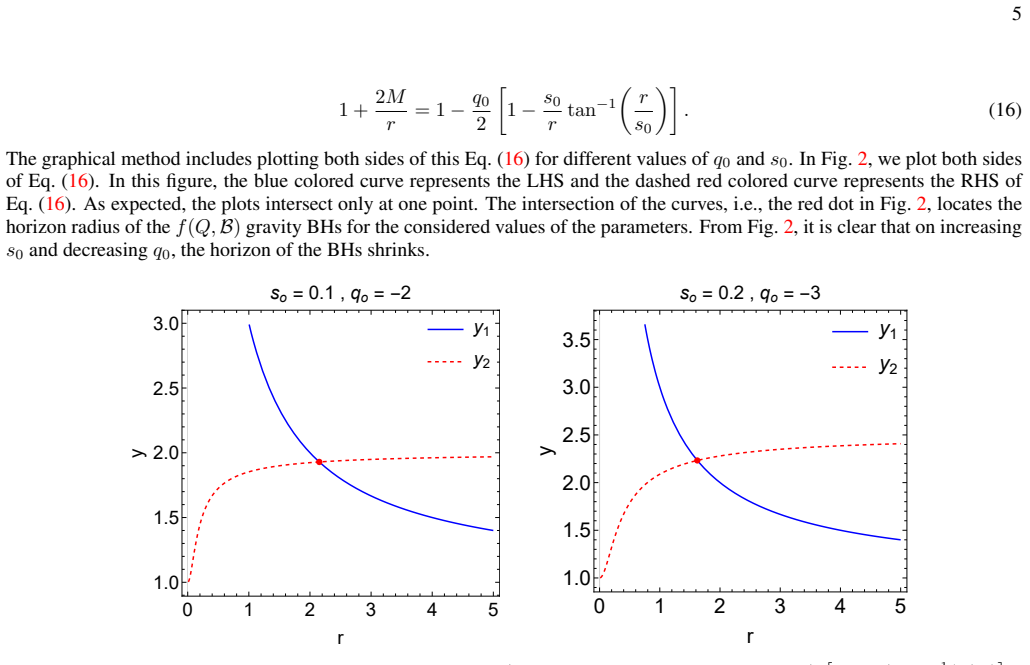
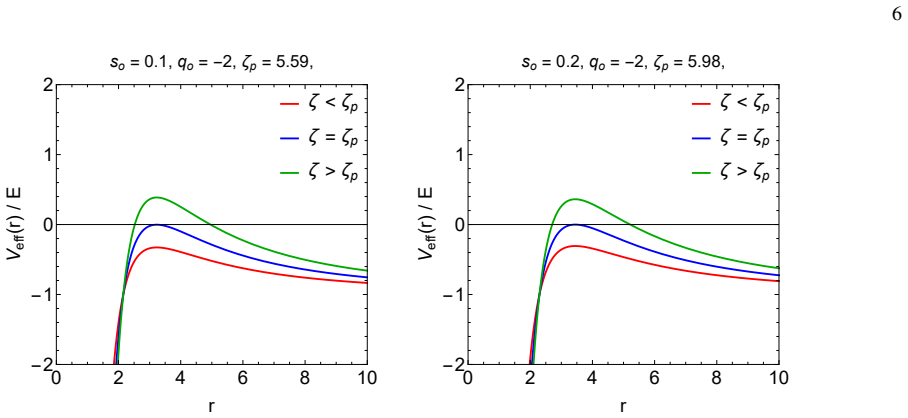
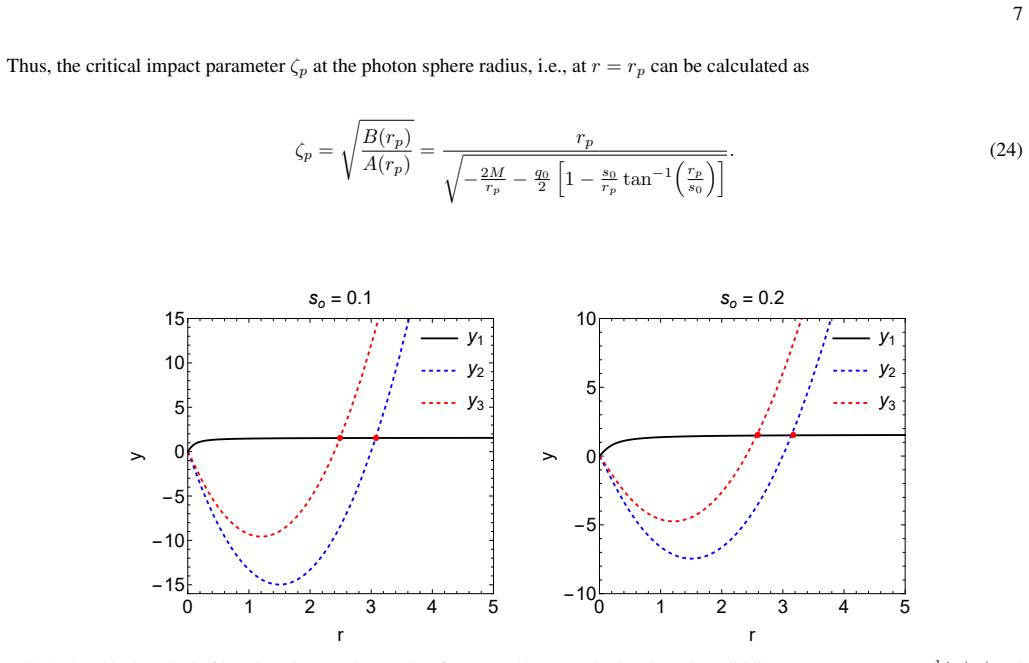
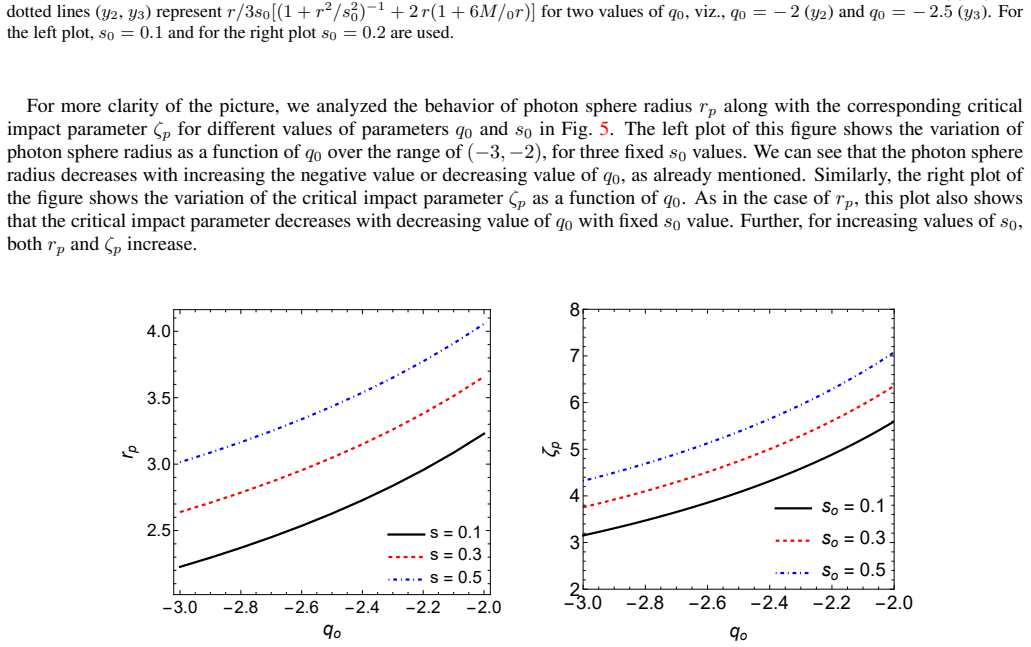
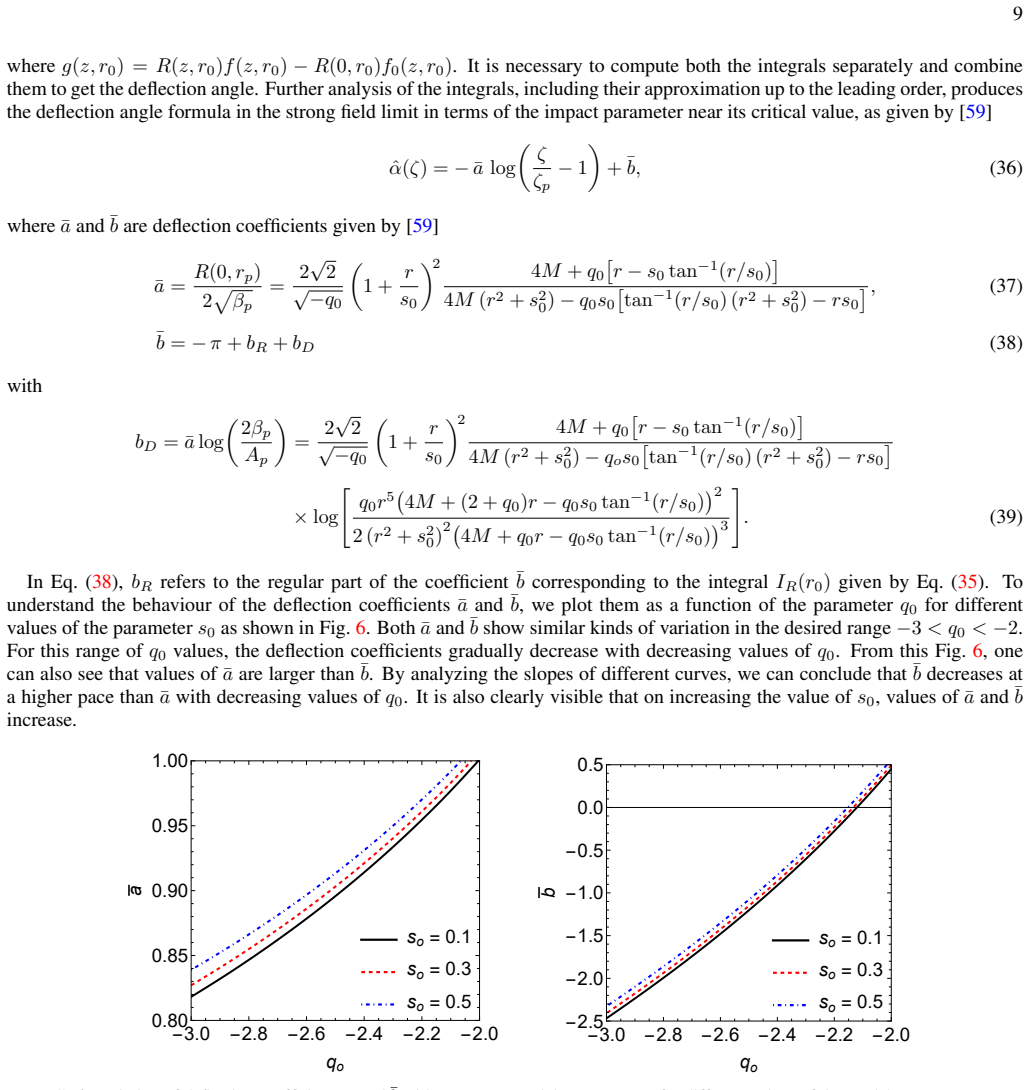
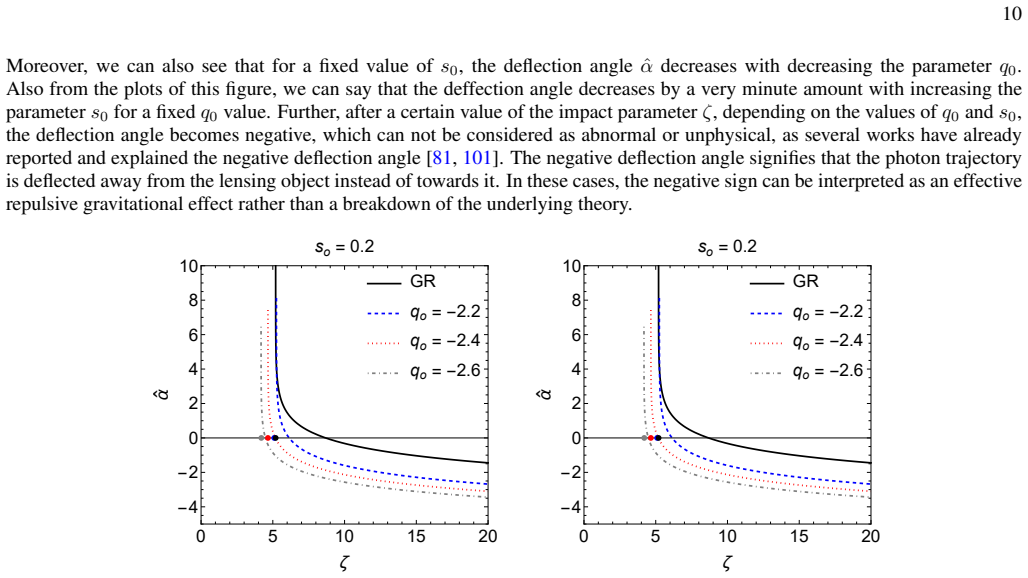
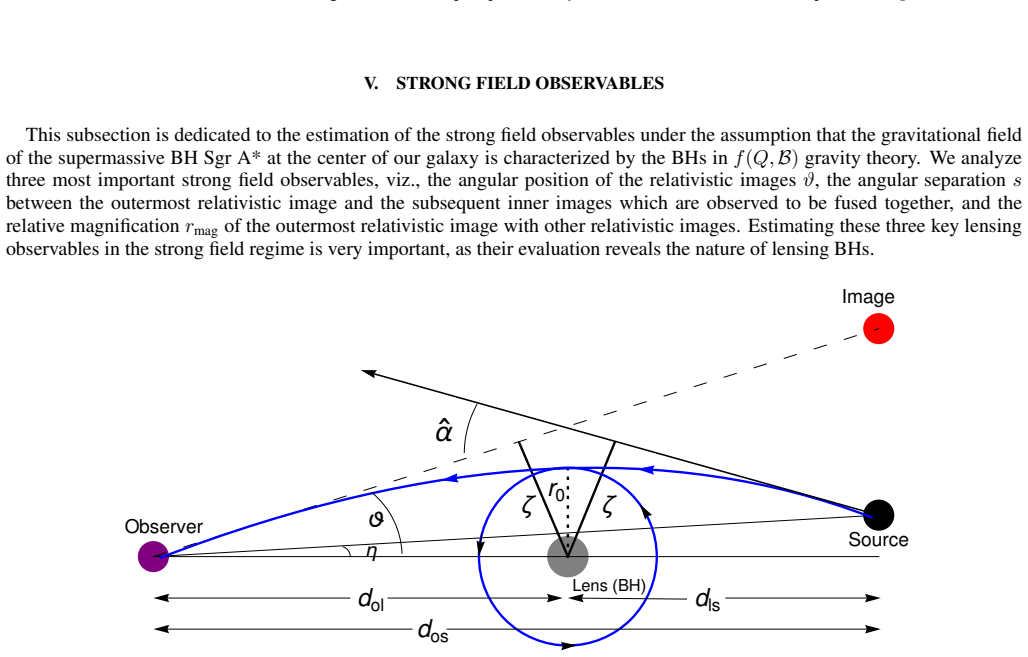
We investigate the strong field lensing of light by black holes (BHs)emerging in $f(Q, \mathcal{B})$ theory of gravity, which is an extension of $f(Q)$ gravity theory by including a boundary term $\mathcal{B}$. Our analysis starts with the study of horizon structure for the BH spacetime in $f(Q,\mathcal{B})$ gravity. The strong field lensing analysis is done by employing the method developed by V.~Booza. We calculate the deflection angle for the static and spherically symmetric $f(Q,\mathcal{B})$ gravity BH spacetime and compare the results with the Schwarzschild BH. It is found that for all considerable scenarios of model parameters the $f(Q,\mathcal{B})$ gravity BH produces less deflection of light than the Schwarzschild BH. We extend our study to examine the outermost relativistic Einstein rings and three other observables, viz., angular position $\vartheta_{\infty}$, angular separation $s$ and relative magnification $r_\text{mag}$. We see that except $r_\text{mag}$, other observables show the same kind of behavioural change with respect to model parameters. We also study the shadow of the considered BH. Moreover, using the shadow data of BH Sgr A* from EHT collaborations, we constrain the model parameters of the $f(Q,\mathcal{B})$ theory for the BH spacetime. The constraining analysis reveals that for all considerable values of the model parameter $s_0$, the allowed range of the other model parameter $q_0$ is $-3\lesssim q_0 \lesssim -2$.
Editorial analysis
A structured set of objections, weighed in public.
Referee Report
Summary. The paper studies black hole spacetimes in f(Q, B) gravity, an extension of f(Q) theory. It analyzes horizon structure, applies Bozza's strong-field lensing formalism to compute deflection angles and observables (θ∞, s, r_mag, relativistic Einstein rings), compares results to Schwarzschild, examines shadows, and constrains the model parameters q0 and s0 by matching the theoretical shadow radius to the EHT central value for Sgr A*, obtaining the range −3 ≲ q0 ≲ −2 for all considerable s0.
Significance. If the parameter constraint is robust, the work supplies an observational bound on this modified-gravity model that could be tested against future EHT or VLTI data. The manuscript performs a systematic comparison of lensing observables and shadow size across the two-parameter family, which is a standard and useful exercise in the field.
major comments (2)
- [constraining analysis] Constraining analysis (final section): the quoted interval −3 ≲ q0 ≲ −2 is obtained by equating the photon-sphere shadow radius r_sh(q0,s0) directly to the reported EHT central value (~5.2M) as a point estimate. No propagation of the ~10 % mass and ~5 % distance uncertainties on Sgr A* is described, nor are possible systematics from plasma or inclination; because the interval is narrow, modest error propagation could erase or shift the allowed region.
- [shadow and lensing sections] Shadow and lensing sections: the analysis assumes the spacetime remains exactly static and spherically symmetric, permitting direct application of Bozza’s strong-deflection formulae without additional terms. The manuscript does not quantify how deviations from this symmetry (e.g., slow rotation or external fields) would alter the derived bounds on q0.
minor comments (2)
- Notation: the symbols q0 and s0 are introduced without an explicit statement of their relation to the f(Q,B) action or the metric ansatz; a short paragraph clarifying the parametrization would improve readability.
- Figure captions: several plots of deflection angle and observables lack error bands or reference curves for the Schwarzschild limit, making quantitative comparison harder.
Simulated Author's Rebuttal
We thank the referee for the careful reading of our manuscript and the constructive comments. We address each major comment below, indicating where revisions will be made.
read point-by-point responses
-
Referee: [constraining analysis] Constraining analysis (final section): the quoted interval −3 ≲ q0 ≲ −2 is obtained by equating the photon-sphere shadow radius r_sh(q0,s0) directly to the reported EHT central value (~5.2M) as a point estimate. No propagation of the ~10 % mass and ~5 % distance uncertainties on Sgr A* is described, nor are possible systematics from plasma or inclination; because the interval is narrow, modest error propagation could erase or shift the allowed region.
Authors: We agree that the analysis uses the EHT central value as a point estimate without propagating the stated uncertainties in mass and distance, nor addressing plasma or inclination effects. This is a valid limitation of the current constraining section. In the revised version we will add explicit propagation of the ~10% mass and ~5% distance uncertainties to the shadow radius and show the resulting range for q0; we will also include a brief discussion of plasma and inclination as potential systematics that could affect the bounds. revision: yes
-
Referee: [shadow and lensing sections] Shadow and lensing sections: the analysis assumes the spacetime remains exactly static and spherically symmetric, permitting direct application of Bozza’s strong-deflection formulae without additional terms. The manuscript does not quantify how deviations from this symmetry (e.g., slow rotation or external fields) would alter the derived bounds on q0.
Authors: The f(Q,B) black-hole solution examined in the paper is derived under the static, spherically symmetric ansatz that solves the field equations of the theory. Bozza’s formalism is therefore applied exactly within this symmetry class. Extending the analysis to slow rotation or external fields would require new metric solutions (e.g., axisymmetric generalizations), which is outside the scope of the present work. We will add a clarifying remark in the conclusions noting this assumption and identifying rotating solutions as a topic for future investigation. revision: partial
Circularity Check
No significant circularity; constraints are data-driven from external EHT observations.
full rationale
The paper derives the f(Q,B) metric, applies Bozza's strong-field lensing formalism to compute deflection angles and observables, obtains the shadow radius from the photon-sphere condition, and then explicitly uses external EHT shadow data for Sgr A* to place bounds on q0 and s0. This is a standard observational constraint procedure, not a derivation or prediction that reduces to its own inputs by construction. No self-definitional steps, no fitted parameter renamed as prediction, and no load-bearing self-citation chain. The analysis is self-contained against external benchmarks (EHT data), so the central claim does not exhibit circularity per the enumerated patterns.
Axiom & Free-Parameter Ledger
free parameters (2)
- q0 =
-3 to -2
- s0 =
considerable values
axioms (2)
- domain assumption The f(Q,B) black hole spacetime is static and spherically symmetric
- domain assumption Bozza's strong field lensing method applies directly to this metric
Reference graph
Works this paper leans on
-
[1]
Will,The confrontation between General Relativity and Expermient, Living Reviews in Relativity17, 4 (2014)
C.M. Will,The confrontation between General Relativity and Expermient, Living Reviews in Relativity17, 4 (2014)
2014
-
[2]
Abbott et al
B.P. Abbott et al. ,Observation of Gravitational Waves from a Binary BlackHole Merger, Phys. Rev. Lett.116, 061102 (2016)
2016
-
[3]
Abbott et al.Observation of Gravitational Waves from a 22-Solar-Mass Binary Black Hole Coalescence, Phys
B.P. Abbott et al.Observation of Gravitational Waves from a 22-Solar-Mass Binary Black Hole Coalescence, Phys. Rev. Lett.116, 241103 (2016)
2016
-
[4]
Abbott et al.,Observation of Gravitational Waves from a Binary Neutron Star Inspiral, Phys
B.P. Abbott et al.,Observation of Gravitational Waves from a Binary Neutron Star Inspiral, Phys. Rev. Lett.119, 161101 (2017)
2017
-
[5]
Abbott et al.,Observation of a Binary-Black-Hole Coalescence with Asymmetric Masses,Phys
B.P. Abbott et al.,Observation of a Binary-Black-Hole Coalescence with Asymmetric Masses,Phys. Rev. D102, 043015 (2020)
2020
-
[6]
Abbott et al.,Observation of Gravitational Waves from Two Neutron Star–Black Hole Coalescences, APJL915, L5 (2021)
R. Abbott et al.,Observation of Gravitational Waves from Two Neutron Star–Black Hole Coalescences, APJL915, L5 (2021)
2021
-
[7]
Abbott et al.,Search for continuous gravitational wave emission from the MilkyWay center in O3 LIGO-Virgo data, Phys
R. Abbott et al.,Search for continuous gravitational wave emission from the MilkyWay center in O3 LIGO-Virgo data, Phys. Rev. D106 042003 (2022)
2022
-
[8]
I.The Shadow of the Supermassive Black Hole, APJL875, L1 (2019)
Event Horizon Telescope Collaboration et al.,First M87 Event Horizon Telescope Results. I.The Shadow of the Supermassive Black Hole, APJL875, L1 (2019)
2019
-
[9]
Event Horizon Telescope Collaboration et al.,First M87 Event Horizon Telescope Results. II. Array and Instrumentation, APJL875, L2 (2019)
2019
-
[10]
Event Horizon Telescope Collaboration et al.,First M87 Event Horizon Telescope Results. III. Data Processing and Calibration, APJL 875, L3 (2019)
2019
-
[11]
EventHorizonTelescopeCollaborationetal.,First M87 Event Horizon Telescope Results. IV . Imaging the Central Supermassive Black Hole, APJL875, L4 (2019)
2019
-
[12]
EventHorizonTelescopeCollaborationetal.,First M87 Event Horizon Telescope Results. V . Physical Origin of the Asymmetric Ring, APJL875, L5 (2019)
2019
-
[13]
Event Horizon Telescope Collaboration et al.,First M87 Event Horizon Telescope Results. VI. The Shadow and Mass of the Central BlackHole, APJL875, L6 (2019)
2019
-
[14]
Stelle,Renormalization of higher derivative quantum gravity, Phys
K.S. Stelle,Renormalization of higher derivative quantum gravity, Phys. Rev. D16, 953 (1977)
1977
-
[15]
N. A. Bahcall, J. P. Ostriker, S. Perlmutter and P. J. Steinhardt,The cosmic triangle: Revealing the state of the universe, Science284, 5419 (1999)
1999
-
[16]
jour 116, 1009 (1998)
Riess et al.,Observational Evidence from Supernovae for an Accelerating Universe and a Cosmological Constant, The Astrono. jour 116, 1009 (1998)
1998
-
[17]
Rubin,W.K
V .C. Rubin,W.K. Ford and N. Thonnard,Rotational Properties of 21 Sc Galaxies with a Large Range of Luminosities and Radii, The Astrop. jour.238, 478487 (1980)
1980
-
[18]
Rubin, N
V .C. Rubin, N. Thonnard and W.K. Ford,Extended Rotation Curves of High-Luminosity Spiral Galaxies. IV . Systematic Dynamical Properties, SA Through SC, The Astrop. jour. lett.225, 10711 (1978)
1978
-
[19]
Jour.116, 10091038 (1998)
Reiss et.al.,Observational Evidence from Supernovae for an Accelerating Universe and a Cosmological Constant,Astron. Jour.116, 10091038 (1998)
1998
-
[20]
Copeland, M
E.J. Copeland, M. Sami and S.Tsujikawa ,Dynamics of dark energy,IJMPD15, 17531936 (2006)
2006
-
[21]
Bertone and T.M.P
G. Bertone and T.M.P. Tait ,A new era in the search of Dark Matter,Nature562, 5156 (2018)
2018
-
[22]
Carpil et al.,Quantum Gravity: A Brief History of Ideas and Some Prospects, IJMPD24, 1530028(2015)
2015
-
[23]
A. A. Starobinsky,The Perturbation Spectrum Evolving from a Nonsingular Initially De-Sitter Cosmology and the Microwave Back- ground Anisotropy, Sov. Astron. Lett.9, 302 (1983)
1983
-
[24]
W. Hu, I. Sawicki,Models of f(R) Cosmic Acceleration that Evade Solar-System Tests, Phys. Rev. D76, 064004 (2007)
2007
-
[25]
D. J. Gogoi and U. D. Goswami,A new f(R) gravity model and properties of gravitational waves in it, EPJC80, 1101(2020)
2020
-
[26]
Rastall,Generalization of the Einstein Theory, Phys
P. Rastall,Generalization of the Einstein Theory, Phys. Rev. D6, 3357 (1972)
1972
-
[27]
F. S. N. Lobo and T. Harko,Extendedf(R, L M)theories of gravity, The Thirteenth Marcel Grossmann Meeting pp. 1164-1166 (2015)
2015
-
[28]
Masud,Kluson, J.,,O
C. Masud,Kluson, J.,,O. Markku, T. Anca,Can TeVeS be a viable theory of gravity?, Phy. Lett. B735, 322326 (2014)
2014
-
[29]
Bourliot, P.G
F. Bourliot, P.G. Ferreira, D.F. Mota and C. Skordis,Cosmological behavior of Bekenstein’s modified theory of gravity, Phys. Rev. D75, 063508 (2007)
2007
-
[30]
Shabani, A
H. Shabani, A. De, T. H. Loo and E. N. Saridakis,Cosmology of f(Q) gravity in non-flat Universe, EPJC84, 285 (2024)
2024
-
[31]
Sarmah, A
P. Sarmah, A. De and U. D. Goswami,Anisotropic LRS-BI Universe with f(Q) gravity theory, Phys. Dark Universe40, 101209 (2023)
2023
-
[32]
Zhao ,Covariant formulation of f(Q) theory, Eur
D. Zhao ,Covariant formulation of f(Q) theory, Eur. Phys. J. C82, 303 (2022)
2022
-
[33]
W. Wang, H. Chen and T. Katsuragawa,Static and spherically symmetric solutions inf(Q)gravity, Phys. Rev. D105, 024060 (2022)
2022
-
[34]
Bengochea and R
G.R. Bengochea and R. Ferraro,Dark torsion as the cosmic speed-up, Phys. Rev. D79, 124019 (2009)
2009
-
[35]
Einstein,Riemann-Geometrie mit Aufrechterhaltung des Begriffes des Fernparallelismus, Abhandlungen der K ¨oniglich Preussischen Akademie der Wissenschaften27, 123130 (1928)
A. Einstein,Riemann-Geometrie mit Aufrechterhaltung des Begriffes des Fernparallelismus, Abhandlungen der K ¨oniglich Preussischen Akademie der Wissenschaften27, 123130 (1928)
1928
-
[36]
Adak,The Symmetric teleparallel gravity, Turk
M. Adak,The Symmetric teleparallel gravity, Turk. J. Phys.30, 379390 (2006)
2006
-
[37]
Jim ´enez, L
J.B. Jim ´enez, L. Heisenberg and T. Koivisto,Coincident general relativity, Phys. Rev. D98, 044048 (2018)
2018
-
[38]
Heisenberg,A systematic approach to generalisations of General Relativity and their cosmological implications, Phys
L. Heisenberg,A systematic approach to generalisations of General Relativity and their cosmological implications, Phys. Rept.796, 1113 (2019)
2019
-
[39]
Jimenez, L
J.B. Jimenez, L. Heisenberg, D. Iosifidis, A.J.Cano and T. S. Koivisto,General teleparallel quadratic gravity, phys. Lett. B805, 135422 (2020)
2020
-
[40]
J. Lu,X. Zhao and G. Chee,Cosmology in symmetric teleparallel gravity and its dynamical system, EPJC79, 530 (2019). 17
2019
-
[41]
Lymperis,Late-time cosmology with phantom dark-energy in f(Q) gravity, JCAP11, 018 (2022)
A. Lymperis,Late-time cosmology with phantom dark-energy in f(Q) gravity, JCAP11, 018 (2022)
2022
-
[42]
B. C. Paul, A. Chanda, A. Beesham, and S. D. Maharaj,Late time cosmology in-gravity with interacting fluids, Class. Quant. Grav.39, 065006 (2022)
2022
-
[43]
S. A. Narawade, S. P. Singh and B. Mishra,Accelerating cosmological models in f(Q) gravity and the phase space analysis, Phys. Dark Univ.42, 101282 (2023)
2023
-
[44]
Dimakis, M
N. Dimakis, M. Roumeliotis, A. Paliathanasis and T. Christodoulakis,Anisotropic Solutions in Symmetric Teleparallel f (Q)-theory: Kantowski-Sachs and Bianchi III LRS Cosmologies, EPJC83, 74 (2023)
2023
-
[45]
Sokoliuk, S
O. Sokoliuk, S. Arora, S. Mraharaj, A. Baransky and P. K. Sahoo,On the impact of f(Q) gravity on the large scale structure, Mon. Not. Roy. Astron. Soc522, 252267 (2023)
2023
-
[46]
Milgrom,Noncovariance at low accelerations as a route to MOND, Phys
M. Milgrom,Noncovariance at low accelerations as a route to MOND, Phys. Rev. D100, 084039 (2019)
2019
-
[47]
D’Ambrosio, M
F. D’Ambrosio, M. Garg and L. Heisenberg,Non-linear extension of non-metricity scalar for MOND, Phys. Lett. B811, 135970 (2020)
2020
-
[48]
Bajardi, D
F. Bajardi, D. Vernieri, and S. Capozziello,Bouncing Cosmology in f(Q) Symmetric Teleparallel Gravity, EPJ Plus135, 912 (2020)
2020
-
[49]
A. S. Agrawal, L. Pati, S. K. Tripathy, and B. Mishra,Matter bounce scenario and the dynamical aspects in f(Q,T) gravity, Phys. Dark Univ.33, 100863 (2021)
2021
-
[50]
Dimakis, A
N. Dimakis, A. Paliathanasis, and T. Christodoulakis,Quantum cosmology in f(Q) theory, Class. Quant. Grav38, 225003 (2021)
2021
-
[52]
Paliathanasis,Symmetric teleparallel cosmology with boundary corrections, Phys
A. Paliathanasis,Symmetric teleparallel cosmology with boundary corrections, Phys. Dark Univ.43, 101388 (2024)
2024
-
[53]
Pradhan, A
A. Pradhan, A. Dixit, M. Zeyauddin and S. Krishnannair,A flat FLRW dark energy model in f(Q,C)-gravity theory with observational constraints, IJGMMP21, 2450167 (2024)
2024
-
[54]
D. C. Maurya,Quintessence behaviour dark energy models in f(Q,B)-gravity theory with observational constraints, Astro. and Comp.46, 100798 (2024)
2024
-
[55]
Einstein,The Foundation of the General Theory of Relativity, Ann
A. Einstein,The Foundation of the General Theory of Relativity, Ann. Phys. (N.Y .)49, 769 (1916);14, 517 (2005)
1916
-
[56]
F. W. Dyson, et al.,A determination of the deflection of light by the sun’s gravitational field, from observations made at the total eclipse of May 29, 1919, Phil. Trans. R. Soc. A220, 291 (1920)
1919
-
[57]
C. G. Darwin,The Gravity Field of a Particle, Proc. A249, 1257 (1959)
1959
-
[58]
Parbin, D.J
N. Parbin, D.J. Gogoi, and U.D. Goswami,Weak gravitational lensing and shadow cast by rotating black holes in axionic Chern-Simons theory, Phys. of dark Uni.41, 101265 (2023)
2023
-
[59]
Bozza,Gravitational lensing in the strong field limit, Phys
V . Bozza,Gravitational lensing in the strong field limit, Phys. Rev. D66, 103001 (2002)
2002
-
[60]
Bozza,Quasiequatorial Gravitational Lensing by Spinning Black Holes in the Strong Field Limit, Phys
V . Bozza,Quasiequatorial Gravitational Lensing by Spinning Black Holes in the Strong Field Limit, Phys. Rev. D67, 103006 (2003)
2003
-
[61]
BartelmannGravitational Lensing, Class
M. BartelmannGravitational Lensing, Class. Quan. Grav27, 233001 (2010)
2010
-
[62]
Wambsganss,Gravitational Lensing in Astronomy, Living Rev
J. Wambsganss,Gravitational Lensing in Astronomy, Living Rev. Relativ1, 12 (1998)
1998
-
[63]
K. S. Virbhadra, D. Narasimha and S. M. Chitre,Role of the scalar field in gravitational lensing, Astro phy. As337, 1 (1998)
1998
-
[64]
K. S. Virbhadra and G. F. R. Ellis,Schwarzschild black hole lensing, Phys. Rev. D62, 084003 (2000)
2000
-
[65]
K. S. Virbhadra,Relativistic Images of Schwarzschild Black Hole Lensing, Phys. Rev. D79, 083004 (2009)
2009
-
[66]
K. S. Virbhadra,Distortions of Images of Schwarzschild Lensing, Phys. Rev. D106, 064038 (2002)
2002
-
[67]
Atamurotov and S
F. Atamurotov and S. G. Ghosh,Gravitational Weak Lensing by a Naked Singularity in Plasma, EPJ Plus137, 662 (2022)
2022
-
[68]
Chen et al.,Gravitational Lensing by Born-Infeld Naked Singularities, Phys
Y . Chen et al.,Gravitational Lensing by Born-Infeld Naked Singularities, Phys. Rev. D109, 084014 (2024)
2024
-
[69]
Bozza and L
V . Bozza and L. Mancini,Time Delay in Black Hole Gravitational Lensing as a Distance Estimator, Gen. Relativ. Gravit36, 435 (2004)
2004
-
[70]
Hsieh, D
T. Hsieh, D. S. Lee, and C. Y . Lin,Gravitational Time Delay Effects by Kerr and Kerr-Newman Black Holes in Strong Field Limits, Phys. Rev. D104, 104013 (2021)
2021
-
[71]
L. Zhao, M. Tang and Z. Xu ,The lensing effect of quantum-corrected black hole and parameter constraints from EHT observations,EPJC 84, 971 (2024)
2024
-
[72]
Guo et.al.,Strong gravitational lensing effects around rotating regular black holes,Phys
M.Y . Guo et.al.,Strong gravitational lensing effects around rotating regular black holes,Phys. Lett. B860, 139221 (2025)
2025
-
[73]
Chen-Kai Qiao and Mi ZhouGravitational lensing of Schwarzschild and charged black holes immersed in perfect fluid dark matter halo, JCAP2023, 005 (2023)
2023
-
[74]
G.S.B.Kogan and O. Y . Tsupko,Gravitational lensing in plasmic medium, Plas. Phys. Rep.41, (2015)
2015
-
[75]
G.S.B.Kogan and O. Y . Tsupko,Gravitational lensing in plasma: Relativistic images at homogeneous plasma, Phys. Rev. D87, 124009, (2013)
2013
-
[76]
G.S.B.Kogan and O. Y . Tsupko,Gravitational lensing in a non-uniform plasma, Mon. Not. of the R.Astro. Soc.404, (2010)
2010
-
[77]
Shaikh et al.,Strong Gravitational Lensing by Wormholes, JCAP2019, 028 (2019)
R. Shaikh et al.,Strong Gravitational Lensing by Wormholes, JCAP2019, 028 (2019)
2019
-
[78]
Kumar, A
S. Kumar, A. Uniyal, and S. Chakrabarti,Shadow and Weak Gravitational Lensing of Rotating Traversable Wormhole in Nonhomoge- neous Plasma Spacetime, Phys. Rev. D109, 104012 (2024)
2024
-
[79]
Godani and G
N. Godani and G. C. Samanta,Gravitational Lensing for Wormhole with Scalar Field in f(R) Gravity, IJGMMP20, 2350075 (2023)
2023
-
[80]
G. Mohan,R. Karmakar,R.J.Borah and U.D. Goswami,Strong lensing effect and quasinormal modes of oscillations of black holes in f(R,T) gravity theory, Phy Dark Uni.49, 102007 (2025)
2025
-
[81]
G. Mohan,N. Parbin and U.D. Goswami,. Investigating the effects of gravitational lensing by Hu-Sawicki f(R) gravity black holes, EPJC 85, 413 (2025)
2025
discussion (0)
Sign in with ORCID, Apple, or X to comment. Anyone can read and Pith papers without signing in.