Strongest constraints on dark acoustic oscillations from the Lyman-alpha forest
Pith reviewed 2026-06-30 01:31 UTC · model grok-4.3
The pith
Lyman-alpha forest data limits dark acoustic oscillations to at most 30% of dark matter at small scales.
A machine-rendered reading of the paper's core claim, the machinery that carries it, and where it could break.
Core claim
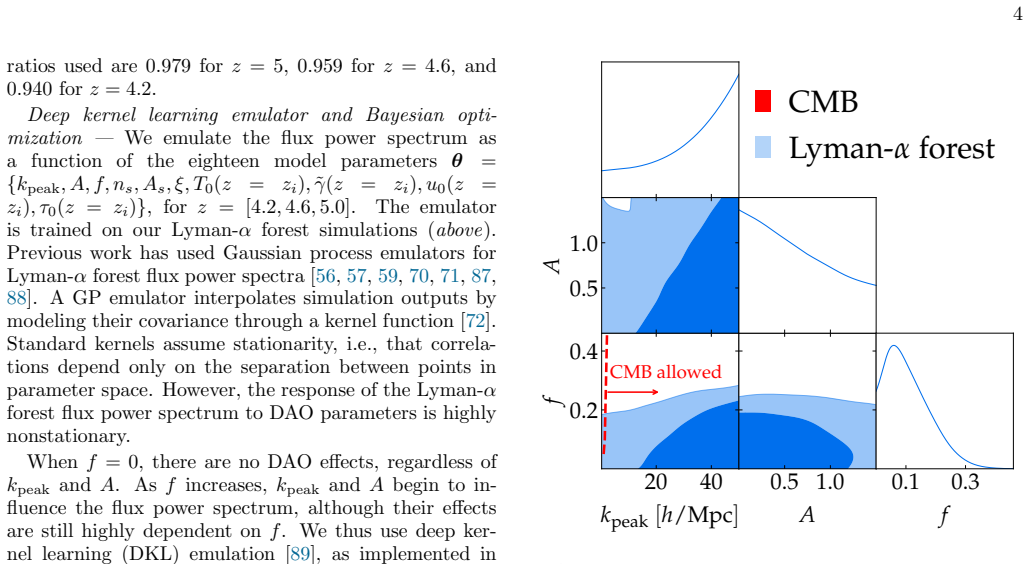
Using a deep kernel learning emulator of hydrodynamical simulations, Lyman-alpha forest observations constrain the fraction of dark matter that can participate in dark acoustic oscillations peaking below 50 h Mpc^{-1} to no more than 30% at 95% confidence level.
What carries the argument
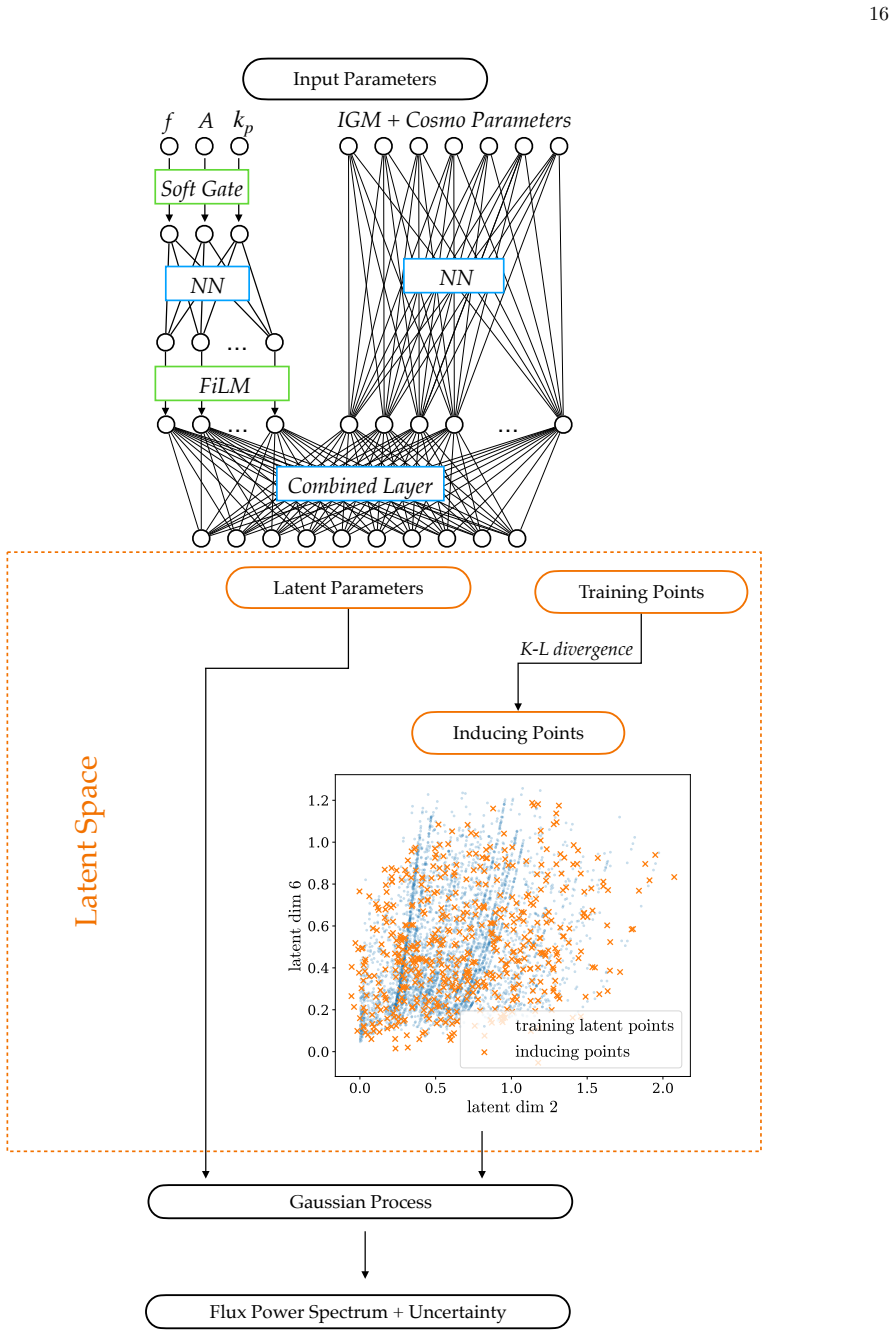
Deep kernel learning emulator of hydrodynamical simulations that isolates linear DAO imprints in the Ly-alpha forest transmission despite covariance with nuisance parameters.
If this is right
- Dark sector interaction models must keep any DAO component subdominant on these scales.
- The Lyman-alpha forest now provides the leading probe of linear power spectrum oscillations below CMB scales.
- Similar emulator-based forward modeling can be applied to other small-scale features in future forest analyses.
- The 30% limit tightens viable parameter space for interacting dark matter scenarios.
Where Pith is reading between the lines
- The same emulator technique could test for other oscillatory or suppressed features in the small-scale power spectrum.
- Dominant dark matter must remain effectively cold and non-interacting on scales around 50 h Mpc^{-1} to satisfy the bound.
- Cross-checks with other tracers like the 21 cm signal could independently verify or strengthen the DAO fraction limit.
Load-bearing premise
The deep kernel learning emulator accurately reproduces the effects of DAO oscillations on the Lyman-alpha forest despite their covariance with other parameters.
What would settle it
A Lyman-alpha forest power spectrum measurement showing DAO signatures from more than 30% of dark matter at wavenumbers below 50 h Mpc^{-1} would contradict the reported upper limit.
Figures


read the original abstract
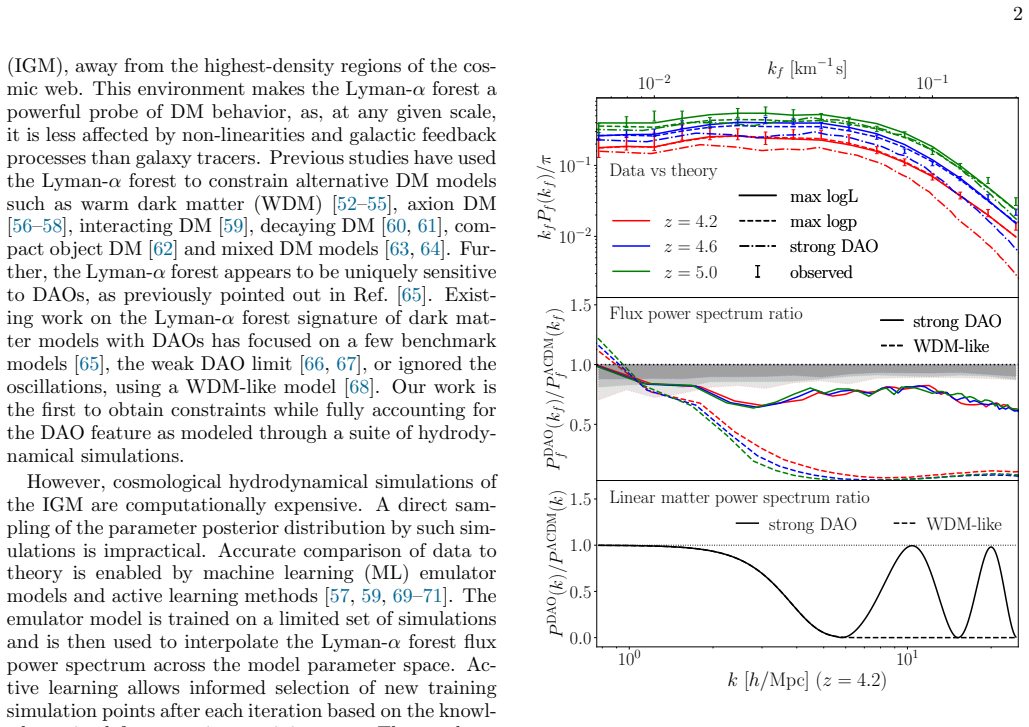
We set the first constraints on a small-scale dark acoustic oscillation (DAO) in the linear matter power spectrum arising from dark sector interactions, with a full forward model of the Ly-$\alpha$ forest. No more than 30\% of dark matter can form DAOs if they peak at wavenumbers $< 50\,h\,\mathrm{Mpc}^{-1}$ (95\% c.l.), probing scales $25 \times$ smaller than the cosmic microwave background (CMB). Given the complex covariance of DAO and nuisance parameters, we use a deep kernel learning emulator of hydrodynamical simulations to capture imprints of linear oscillations in the Ly-$\alpha$ forest.
Editorial analysis
A structured set of objections, weighed in public.
Referee Report
Summary. The paper claims the first constraints on small-scale dark acoustic oscillations (DAOs) in the linear matter power spectrum from a full forward model of the Lyman-alpha forest. Using a deep kernel learning emulator of hydrodynamical simulations to capture the imprints of linear DAO oscillations, it concludes that no more than 30% of dark matter can form DAOs peaking at wavenumbers <50 h Mpc^{-1} (95% c.l.), extending 25x beyond CMB scales.
Significance. If the emulator validation holds, the result would provide the strongest existing limits on DAO models from small-scale structure probes, directly constraining dark sector interactions at wavenumbers inaccessible to the CMB. The forward-modeling approach with explicit nuisance covariance handling is a methodological strength.
major comments (1)
- [Emulator and forward-modeling sections] The 30% DAO fraction limit at k<50 h Mpc^{-1} is obtained by forward-modeling linear oscillations through the deep kernel learning emulator. No explicit test is described that isolates recovery of DAO wiggle amplitude and phase in the 1D flux power spectrum after marginalization over the full nuisance covariance (thermal history, IGM pressure, etc.). This is load-bearing for the central claim.
Simulated Author's Rebuttal
We thank the referee for their careful reading and constructive feedback. The major comment identifies a gap in the presented validation of the emulator's ability to recover DAO features after nuisance marginalization. We address this point directly below and agree that additional explicit tests are warranted to support the central claim.
read point-by-point responses
-
Referee: [Emulator and forward-modeling sections] The 30% DAO fraction limit at k<50 h Mpc^{-1} is obtained by forward-modeling linear oscillations through the deep kernel learning emulator. No explicit test is described that isolates recovery of DAO wiggle amplitude and phase in the 1D flux power spectrum after marginalization over the full nuisance covariance (thermal history, IGM pressure, etc.). This is load-bearing for the central claim.
Authors: We agree that the current manuscript does not describe an explicit test that isolates recovery of the DAO wiggle amplitude and phase in the 1D flux power spectrum after full marginalization over the nuisance covariance. This is a substantive point. In the revised manuscript we will add a dedicated subsection in the emulator validation section presenting mock-data recovery tests. These will inject DAO signals of controlled amplitude and phase into simulated flux power spectra, then recover the parameters using the emulator while sampling the full nuisance space (thermal history, IGM pressure smoothing, etc.). The tests will quantify any bias or degradation in the recovered DAO parameters relative to the input values. We view this addition as necessary to make the central claim fully robust. revision: yes
Circularity Check
No significant circularity; DAO limit obtained via independent forward modeling and emulator comparison to data
full rationale
The paper's central result is a 95% upper limit on the DAO dark-matter fraction obtained by training a deep kernel learning emulator on hydrodynamical simulations that include linear DAO oscillations in the initial power spectrum, then performing a full forward-model likelihood comparison against observed Ly-α forest flux power spectra while marginalizing over nuisance parameters. No equation or section reduces the reported limit to a fitted parameter by construction, nor does any load-bearing step rely on a self-citation whose content is itself unverified within the paper. The emulator is presented as a computational tool whose fidelity is an assumption (as noted by the reader), but that assumption is external to the derivation chain and does not create a self-definitional or renaming circularity. The analysis is therefore self-contained against external benchmarks.
Axiom & Free-Parameter Ledger
free parameters (2)
- DAO peak wavenumber cutoff
- DAO dark matter fraction =
0.3
axioms (2)
- domain assumption Linear DAO features in the matter power spectrum are faithfully imprinted in the Ly-alpha forest through hydrodynamical evolution
- domain assumption The deep kernel learning emulator reproduces the full covariance between DAO parameters and nuisance parameters without bias
Reference graph
Works this paper leans on
-
[1]
D. E. Kaplan, G. Z. Krnjaic, K. R. Rehermann, and C. M. Wells, “Atomic Dark Matter,”JCAP05(2010) 021,arXiv:0909.0753 [hep-ph]
Pith/arXiv arXiv 2010
-
[2]
Cosmology of atomic dark matter,
F.-Y. Cyr-Racine and K. Sigurdson, “Cosmology of atomic dark matter,”Phys. Rev. D87no. 10, (2013) 103515,arXiv:1209.5752 [astro-ph.CO]
Pith/arXiv arXiv 2013
-
[3]
Constraints on Large-Scale Dark Acoustic Oscillations from Cosmology,
F.-Y. Cyr-Racine, R. de Putter, A. Raccanelli, and K. Sigurdson, “Constraints on Large-Scale Dark Acoustic Oscillations from Cosmology,”Phys. Rev. D 89no. 6, (2014) 063517,arXiv:1310.3278 [astro-ph.CO]
Pith/arXiv arXiv 2014
-
[4]
Partially Acoustic Dark Matter, Interacting Dark Radiation, and Large Scale Structure,
Z. Chacko, Y. Cui, S. Hong, T. Okui, and Y. Tsai, “Partially Acoustic Dark Matter, Interacting Dark Radiation, and Large Scale Structure,”JHEP12 (2016) 108,arXiv:1609.03569 [astro-ph.CO]
Pith/arXiv arXiv 2016
-
[5]
Mirror twin Higgs cosmology: constraints and a possible resolution to the H 0 and S8 tensions,
S. Bansal, J. H. Kim, C. Kolda, M. Low, and Y. Tsai, “Mirror twin Higgs cosmology: constraints and a possible resolution to the H 0 and S8 tensions,”JHEP 05(2022) 050,arXiv:2110.04317 [hep-ph]
arXiv 2022
-
[6]
The H0 Olympics: A fair ranking of proposed models,
N. Sch¨ oneberg, G. Franco Abell´ an, A. P´ erez S´ anchez, S. J. Witte, V. Poulin, and J. Lesgourgues, “The H0 Olympics: A fair ranking of proposed models,”Phys. Rept.984(2022) 1–55,arXiv:2107.10291 [astro-ph.CO]
arXiv 2022
-
[7]
Stepped partially acoustic dark matter, large scale structure, and the Hubble tension,
M. A. Buen-Abad, Z. Chacko, C. Kilic, G. Marques-Tavares, and T. Youn, “Stepped partially acoustic dark matter, large scale structure, and the Hubble tension,”JHEP06(2023) 012, arXiv:2208.05984 [hep-ph]
arXiv 2023
-
[8]
Dark Acoustic Oscillations as an Early-Universe Explanation of the DESI Anomaly,
M. Garny, F. Niedermann, and M. S. Sloth, “Dark Acoustic Oscillations as an Early-Universe Explanation of the DESI Anomaly,” arXiv:2512.15870 [astro-ph.CO]
-
[9]
Dark Acoustic Oscillations and the Hubble Tension,
M. Garny, F. Niedermann, and M. S. Sloth, “Dark Acoustic Oscillations and the Hubble Tension,” arXiv:2602.23895 [astro-ph.CO]
-
[10]
Constraining Dark Acoustic Oscillations with the High-Redshift UV Luminosity Function,
J. Barron, D. Curtin, H. Liu, J. Munoz, and S. Roy, “Constraining Dark Acoustic Oscillations with the High-Redshift UV Luminosity Function,” arXiv:2512.01998 [astro-ph.CO]
-
[11]
J. Barron, R. Essig, M. H. McDuffie, J. P´ erez-R´ ıos, and G. Suczewski, “Pushing the Limits of Atomic Dark Matter: First-Principles Recombination Rates and Cosmological Constraints,”arXiv:2602.10197 [hep-ph]
-
[12]
Simulating Atomic Dark Matter in Milky Way Analogs,
S. Roy, X. Shen, M. Lisanti, D. Curtin, N. Murray, and P. F. Hopkins, “Simulating Atomic Dark Matter in Milky Way Analogs,”Astrophys. J. Lett.954no. 2, (2023) L40,arXiv:2304.09878 [astro-ph.GA]
arXiv 2023
-
[13]
Dissipative Dark Substructure: The Consequences of Atomic Dark Matter on Milky Way Analog Subhalos,
C. Gemmell, S. Roy, X. Shen, D. Curtin, M. Lisanti, N. Murray, and P. F. Hopkins, “Dissipative Dark Substructure: The Consequences of Atomic Dark Matter on Milky Way Analog Subhalos,”Astrophys. J. 967no. 1, (2024) 21,arXiv:2311.02148 [astro-ph.GA]
arXiv 2024
-
[14]
S. Roy, X. Shen, J. Barron, M. Lisanti, D. Curtin, N. Murray, and P. F. Hopkins, “Aggressively-Dissipative Dark Dwarfs: The Effects of Atomic Dark Matter on the Inner Densities of Isolated Dwarf Galaxies,”arXiv:2408.15317 [astro-ph.GA]
-
[15]
Probing Atomic Dark Matter with Stellar Streams in Milky Way-Mass Galaxies,
L. S. Mandacar´ u Guerra, S. O’Neil, M. Lisanti, S. Roy, R. Sanderson, A. Kundu, A. Arora, L. Necib, N. Shipp, and X. Shen, “Probing Atomic Dark Matter with Stellar Streams in Milky Way-Mass Galaxies,” arXiv:2603.20367 [astro-ph.GA]
-
[16]
Direct Detection of Atomic Dark Matter in White Dwarfs,
D. Curtin and J. Setford, “Direct Detection of Atomic Dark Matter in White Dwarfs,”JHEP03(2021) 166, arXiv:2010.00601 [hep-ph]
arXiv 2021
-
[17]
D. Curtin and J. Setford, “How To Discover Mirror Stars,”Phys. Lett. B804(2020) 135391, arXiv:1909.04071 [hep-ph]
arXiv 2020
-
[18]
M. Hippert, J. Setford, H. Tan, D. Curtin, J. Noronha-Hostler, and N. Yunes, “Mirror neutron stars,”Phys. Rev. D106no. 3, (2022) 035025, arXiv:2103.01965 [astro-ph.HE]
arXiv 2022
-
[19]
Electromagnetic Signatures of Mirror Stars,
I. Armstrong, B. Gurbuz, D. Curtin, and C. D. Matzner, “Electromagnetic Signatures of Mirror Stars,”Astrophys. J.965no. 1, (2024) 42, arXiv:2311.18086 [astro-ph.HE]
arXiv 2024
-
[20]
Generalized Predictions for the Electromagnetic Signatures of Mirror Stars,
F. Cabral, S. Williamson, D. Curtin, and C. D. Matzner, “Generalized Predictions for the Electromagnetic Signatures of Mirror Stars,” arXiv:2604.00106 [astro-ph.HE]. 7
-
[21]
Gravitational Waves from Binary Mergers of Subsolar Mass Dark Black Holes,
S. Shandera, D. Jeong, and H. S. G. Gebhardt, “Gravitational Waves from Binary Mergers of Subsolar Mass Dark Black Holes,”Phys. Rev. Lett.120no. 24, (2018) 241102,arXiv:1802.08206 [astro-ph.CO]
Pith/arXiv arXiv 2018
-
[22]
J. Gurian, D. Jeong, M. Ryan, and S. Shandera, “Molecular Chemistry for Dark Matter II: Recombination, Molecule Formation, and Halo Mass Function in Atomic Dark Matter,”Astrophys. J.934 (2022) 121,arXiv:2110.11964 [astro-ph.CO]
arXiv 2022
-
[23]
A Lower Bound on the Mass of Compact Objects from Dissipative Dark Matter,
J. Gurian, M. Ryan, S. Schon, D. Jeong, and S. Shandera, “A Lower Bound on the Mass of Compact Objects from Dissipative Dark Matter,”Astrophys. J. Lett.939no. 1, (2022) L12,arXiv:2209.00064 [astro-ph.CO]. [Erratum: Astrophys.J.Lett. 949, L44 (2023), Erratum: Astrophys.J. 949, L44 (2023)]
arXiv 2022
-
[24]
Gravitational-wave limit on the Chandrasekhar mass of dark matter,
D. Singh, M. Ryan, R. Magee, T. Akhter, S. Shandera, D. Jeong, and C. Hanna, “Gravitational-wave limit on the Chandrasekhar mass of dark matter,”Phys. Rev. D104no. 4, (2021) 044015,arXiv:2009.05209 [astro-ph.CO]
arXiv 2021
-
[25]
Exotic compact objects: The dark white dwarf,
M. Ryan and D. Radice, “Exotic compact objects: The dark white dwarf,”Phys. Rev. D105no. 11, (2022) 115034,arXiv:2201.05626 [astro-ph.HE]
arXiv 2022
-
[26]
The Twin Higgs: Natural electroweak breaking from mirror symmetry,
Z. Chacko, H.-S. Goh, and R. Harnik, “The Twin Higgs: Natural electroweak breaking from mirror symmetry,”Phys. Rev. Lett.96(2006) 231802, arXiv:hep-ph/0506256
Pith/arXiv arXiv 2006
-
[27]
Cosmology in Mirror Twin Higgs and Neutrino Masses,
Z. Chacko, N. Craig, P. J. Fox, and R. Harnik, “Cosmology in Mirror Twin Higgs and Neutrino Masses,”JHEP07(2017) 023,arXiv:1611.07975 [hep-ph]
Pith/arXiv arXiv 2017
-
[28]
Cosmological Signals of a Mirror Twin Higgs,
N. Craig, S. Koren, and T. Trott, “Cosmological Signals of a Mirror Twin Higgs,”JHEP05(2017) 038, arXiv:1611.07977 [hep-ph]
Pith/arXiv arXiv 2017
-
[29]
R. Barbieri, L. J. Hall, and K. Harigaya, “Minimal Mirror Twin Higgs,”JHEP11(2016) 172, arXiv:1609.05589 [hep-ph]
Pith/arXiv arXiv 2016
-
[30]
Solving the Hierarchy Problem at Reheating with a Large Number of Degrees of Freedom,
N. Arkani-Hamed, T. Cohen, R. T. D’Agnolo, A. Hook, H. D. Kim, and D. Pinner, “Solving the Hierarchy Problem at Reheating with a Large Number of Degrees of Freedom,”Phys. Rev. Lett.117no. 25, (2016) 251801,arXiv:1607.06821 [hep-ph]
Pith/arXiv arXiv 2016
-
[31]
M. Farina, “Asymmetric Twin Dark Matter,”JCAP 11(2015) 017,arXiv:1506.03520 [hep-ph]
Pith/arXiv arXiv 2015
-
[32]
Baryogenesis through asymmetric reheating in the mirror twin Higgs,
G. Alonso- ´Alvarez, D. Curtin, A. Rasovic, and Z. Yuan, “Baryogenesis through asymmetric reheating in the mirror twin Higgs,”JHEP05(2024) 069, arXiv:2311.06341 [hep-ph]
arXiv 2024
-
[33]
X. Chen, S. Hannestad, and R. J. Scherrer, “Cosmic microwave background and large scale structure limits on the interaction between dark matter and baryons,” Physical Review D65no. 12, (June, 2002) 123515. http://dx.doi.org/10.1103/PhysRevD.65.123515
-
[34]
Constraints on dark matter interactions from structure formation: damping lengths,
C. Boehm and R. Schaeffer, “Constraints on dark matter interactions from structure formation: damping lengths,”Astronomy & Astrophysics438no. 2, (July,
-
[35]
http://dx.doi.org/10.1051/0004-6361:20042238
419–442. http://dx.doi.org/10.1051/0004-6361:20042238
-
[36]
Constraining dark matter-baryon scattering with linear cosmology,
C. Dvorkin, K. Blum, and M. Kamionkowski, “Constraining dark matter-baryon scattering with linear cosmology,”Physical Review D89no. 2, (Jan.,
-
[37]
http://dx.doi.org/10.1103/PhysRevD.89.023519
023519. http://dx.doi.org/10.1103/PhysRevD.89.023519
-
[38]
Probing sub-gev dark matter-baryon scattering with cosmological observables,
W. L. Xu, C. Dvorkin, and A. Chael, “Probing sub-gev dark matter-baryon scattering with cosmological observables,”Physical Review D97 no. 10, (May, 2018) 103530. http://dx.doi.org/10.1103/PhysRevD.97.103530
-
[39]
Constraints on scattering of kev–tev dark matter with protons in the early universe,
V. Gluscevic and K. K. Boddy, “Constraints on scattering of kev–tev dark matter with protons in the early universe,”Physical Review Letters121no. 8, (Aug., 2018) 081301.http: //dx.doi.org/10.1103/PhysRevLett.121.081301
-
[40]
N-body simulations of dark matter–baryon interactions,
M. S. Fischer, K. Dolag, M. Garny, V. Gluscevic, F. Groth, and E. O. Nadler, “N-body simulations of dark matter–baryon interactions,”Astronomy & Astrophysics700(Aug., 2025) A145. http://dx.doi.org/10.1051/0004-6361/202554983
-
[41]
Ethos—an effective theory of structure formation: From dark particle physics to the matter distribution of the universe,
F.-Y. Cyr-Racine, K. Sigurdson, J. Zavala, T. Bringmann, M. Vogelsberger, and C. Pfrommer, “Ethos—an effective theory of structure formation: From dark particle physics to the matter distribution of the universe,”Physical Review D93no. 12, (June,
-
[42]
http://dx.doi.org/10.1103/PhysRevD.93.123527
123527. http://dx.doi.org/10.1103/PhysRevD.93.123527
-
[43]
S. Bohr, J. Zavala, F.-Y. Cyr-Racine, M. Vogelsberger, T. Bringmann, and C. Pfrommer, “ETHOS – an effective parametrization and classification for structure formation: the non-linear regime at z >∼ 5,” Mon. Not. Roy. Astron. Soc.498no. 3, (2020) 3403–3419,arXiv:2006.01842 [astro-ph.CO]
arXiv 2020
-
[44]
Gravitational collapse of small scale structure as the origin of the Lyman alpha forest,
R.-y. Cen, J. Miralda-Escude, J. P. Ostriker, and M. Rauch, “Gravitational collapse of small scale structure as the origin of the Lyman alpha forest,” Astrophys. J. Lett.437(1994) L9, arXiv:astro-ph/9409017
Pith/arXiv arXiv 1994
-
[45]
Recovery of the power spectrum of mass fluctuations from observations of the Lyman alpha forest,
R. A. C. Croft, D. H. Weinberg, N. Katz, and L. Hernquist, “Recovery of the power spectrum of mass fluctuations from observations of the Lyman alpha forest,”Astrophys. J.495(1998) 44, arXiv:astro-ph/9708018
Pith/arXiv arXiv 1998
-
[46]
Precision cosmological constraints on atomic dark matter,
S. Bansal, J. Barron, D. Curtin, and Y. Tsai, “Precision cosmological constraints on atomic dark matter,”JHEP10(2023) 095,arXiv:2212.02487 [hep-ph]. [48]Atacama Cosmology TelescopeCollaboration, T. Louiset al., “The Atacama Cosmology Telescope: DR6 power spectra, likelihoods and ΛCDM parameters,”JCAP11(2025) 062,arXiv:2503.14452 [astro-ph.CO]. [49]Atacama...
arXiv 2023
-
[47]
A. Lagu¨ eet al., “The Atacama Cosmology Telescope: Probing new signatures of ultralight axions with gravitational lensing,”arXiv:2606.06410 [astro-ph.CO]. [51]SPT-3GCollaboration, F. Geet al., “Cosmology from CMB lensing and delensed EE power spectra using 2019–2020 SPT-3G polarization data,”Phys. Rev. D111no. 8, (2025) 083534,arXiv:2411.06000 [astro-ph.CO]
Pith/arXiv arXiv 2019
-
[48]
M. Viel, G. D. Becker, J. S. Bolton, and M. G. Haehnelt, “Warm dark matter as a solution to the small scale crisis: New constraints from high redshift 8 Lyman-αforest data,”Phys. Rev. D88(2013) 043502, arXiv:1306.2314 [astro-ph.CO]
Pith/arXiv arXiv 2013
-
[49]
V. Irˇ siˇ cet al., “New Constraints on the free-streaming of warm dark matter from intermediate and small scale Lyman-αforest data,”Phys. Rev. D96no. 2, (2017) 023522,arXiv:1702.01764 [astro-ph.CO]
Pith/arXiv arXiv 2017
-
[50]
New constraints on warm dark matter from the Lyman-αforest power spectrum,
B. Villasenor, B. Robertson, P. Madau, and E. Schneider, “New constraints on warm dark matter from the Lyman-αforest power spectrum,”Phys. Rev. D108no. 2, (2023) 023502,arXiv:2209.14220 [astro-ph.CO]
arXiv 2023
-
[51]
V. Irˇ siˇ cet al., “Unveiling dark matter free streaming at the smallest scales with the high redshift Lyman-alpha forest,”Phys. Rev. D109no. 4, (2024) 043511,arXiv:2309.04533 [astro-ph.CO]
arXiv 2024
-
[52]
Strong Bound on Canonical Ultralight Axion Dark Matter from the Lyman-Alpha Forest,
K. K. Rogers and H. V. Peiris, “Strong Bound on Canonical Ultralight Axion Dark Matter from the Lyman-Alpha Forest,”Phys. Rev. Lett.126no. 7, (2021) 071302,arXiv:2007.12705 [astro-ph.CO]
arXiv 2021
-
[53]
General framework for cosmological dark matter bounds usingN-body simulations,
K. K. Rogers and H. V. Peiris, “General framework for cosmological dark matter bounds usingN-body simulations,”Phys. Rev. D103no. 4, (2021) 043526, arXiv:2007.13751 [astro-ph.CO]
arXiv 2021
-
[54]
Post-inflationary axion constraints from the Lyman-αforest,
O. Garcia-Gallego, V. Irˇ siˇ c, M. Viel, M. G. Haehnelt, and J. S. Bolton, “Post-inflationary axion constraints from the Lyman-αforest,”arXiv:2603.04401 [astro-ph.CO]
-
[55]
Limits on the light dark matter–proton cross section from cosmic large-scale structure,
K. K. Rogers, C. Dvorkin, and H. V. Peiris, “Limits on the light dark matter–proton cross section from cosmic large-scale structure,”Physical Review Letters128 no. 17, (Apr., 2022) 171301.http: //dx.doi.org/10.1103/PhysRevLett.128.171301
-
[56]
Lyman-αconstraints on cosmic heating from dark matter annihilation and decay,
H. Liu, W. Qin, G. W. Ridgway, and T. R. Slatyer, “Lyman-αconstraints on cosmic heating from dark matter annihilation and decay,”Phys. Rev. D104 no. 4, (2021) 043514,arXiv:2008.01084 [astro-ph.CO]
arXiv 2021
-
[57]
CMB and Lyman-αconstraints on dark matter decays to photons,
F. Capozzi, R. Z. Ferreira, L. Lopez-Honorez, and O. Mena, “CMB and Lyman-αconstraints on dark matter decays to photons,”JCAP06(2023) 060, arXiv:2303.07426 [astro-ph.CO]
arXiv 2023
-
[58]
Lyman-αForest Constraints on Primordial Black Holes as Dark Matter,
R. Murgia, G. Scelfo, M. Viel, and A. Raccanelli, “Lyman-αForest Constraints on Primordial Black Holes as Dark Matter,”Phys. Rev. Lett.123no. 7, (2019) 071102,arXiv:1903.10509 [astro-ph.CO]
arXiv 2019
-
[59]
Lyman-αconstraints on ultralight scalar dark matter: Implications for the early and late universe,
T. Kobayashi, R. Murgia, A. De Simone, V. Irˇ siˇ c, and M. Viel, “Lyman-αconstraints on ultralight scalar dark matter: Implications for the early and late universe,”Phys. Rev. D96no. 12, (2017) 123514, arXiv:1708.00015 [astro-ph.CO]
Pith/arXiv arXiv 2017
-
[60]
Constraining mixed dark matter models with high-redshift Lyman-alpha forest data,
O. Garcia-Gallego, V. Irˇ siˇ c, M. G. Haehnelt, M. Viel, and J. S. Bolton, “Constraining mixed dark matter models with high-redshift Lyman-alpha forest data,” Phys. Rev. D112no. 4, (2025) 043502, arXiv:2504.06367 [astro-ph.CO]
arXiv 2025
-
[61]
S. Bose, M. Vogelsberger, J. Zavala, C. Pfrommer, F.-Y. Cyr-Racine, S. Bohr, and T. Bringmann, “ETHOS – an Effective Theory of Structure Formation: detecting dark matter interactions through the Lyman-αforest,”Mon. Not. Roy. Astron. Soc. 487no. 1, (2019) 522–536,arXiv:1811.10630 [astro-ph.CO]
Pith/arXiv arXiv 2019
-
[62]
Wandering in the Lyman-alpha Forest: A Study of Dark Matter-Dark Radiation Interactions,
R. Krall, F.-Y. Cyr-Racine, and C. Dvorkin, “Wandering in the Lyman-alpha Forest: A Study of Dark Matter-Dark Radiation Interactions,”JCAP09 (2017) 003,arXiv:1705.08894 [astro-ph.CO]
Pith/arXiv arXiv 2017
-
[63]
Lyman-αforest constraints on interacting dark sectors,
M. Garny, T. Konstandin, L. Sagunski, and S. Tulin, “Lyman-αforest constraints on interacting dark sectors,”JCAP09(2018) 011,arXiv:1805.12203 [astro-ph.CO]
Pith/arXiv arXiv 2018
-
[64]
Constraining Dark Matter-Dark Radiation interactions with CMB, BAO, and Lyman-α,
M. Archidiacono, D. C. Hooper, R. Murgia, S. Bohr, J. Lesgourgues, and M. Viel, “Constraining Dark Matter-Dark Radiation interactions with CMB, BAO, and Lyman-α,”JCAP10(2019) 055, arXiv:1907.01496 [astro-ph.CO]
arXiv 2019
-
[65]
The Coyote Universe Extended: Precision Emulation of the Matter Power Spectrum,
K. Heitmann, E. Lawrence, J. Kwan, S. Habib, and D. Higdon, “The Coyote Universe Extended: Precision Emulation of the Matter Power Spectrum,”Astrophys. J.780no. 1, (Jan., 2014) 111,arXiv:1304.7849 [astro-ph.CO]
Pith/arXiv arXiv 2014
-
[66]
Bayesian emulator optimisation for cosmology: application to the Lyman-alpha forest,
K. K. Rogers, H. V. Peiris, A. Pontzen, S. Bird, L. Verde, and A. Font-Ribera, “Bayesian emulator optimisation for cosmology: application to the Lyman-alpha forest,”JCAP02(2019) 031, arXiv:1812.04631 [astro-ph.CO]
Pith/arXiv arXiv 2019
-
[67]
An Emulator for the Lyman-alpha Forest,
S. Bird, K. K. Rogers, H. V. Peiris, L. Verde, A. Font-Ribera, and A. Pontzen, “An Emulator for the Lyman-alpha Forest,”JCAP02(2019) 050, arXiv:1812.04654 [astro-ph.CO]
arXiv 2019
-
[68]
C. E. Rasmussen and C. K. I. Williams,Gaussian processes for machine learning. Cambridge, Mass. Mit Press, 2008
2008
-
[69]
E. Boera, G. D. Becker, J. S. Bolton, and F. Nasir, “Revealing Reionization with the Thermal History of the Intergalactic Medium: New Constraints from the LyαFlux Power Spectrum,”Astrophys. J.872no. 1, (2019) 101,arXiv:1809.06980 [astro-ph.CO]
Pith/arXiv arXiv 2019
-
[70]
HIRES: the high-resolution echelle spectrometer on the Keck 10-m Telescope,
S. S. Vogt, S. L. Allen,et al., “HIRES: the high-resolution echelle spectrometer on the Keck 10-m Telescope,” inInstrumentation in Astronomy VIII, D. L. Crawford and E. R. Craine, eds., vol. 2198 of Society of Photo-Optical Instrumentation Engineers (SPIE) Conference Series, p. 362. June, 1994
1994
-
[71]
Design, construction, and performance of UVES, the echelle spectrograph for the UT2 Kueyen Telescope at the ESO Paranal Observatory,
H. Dekker, S. D’Odorico, A. Kaufer, B. Delabre, and H. Kotzlowski, “Design, construction, and performance of UVES, the echelle spectrograph for the UT2 Kueyen Telescope at the ESO Paranal Observatory,” inOptical and IR Telescope Instrumentation and Detectors, M. Iye and A. F. Moorwood, eds., vol. 4008 ofSociety of Photo-Optical Instrumentation Engineers (...
2000
-
[72]
R. Murgia, A. Merle, M. Viel, M. Totzauer, and A. Schneider, “”Non-cold” dark matter at small scales: a general approach,”JCAP11(2017) 046, arXiv:1704.07838 [astro-ph.CO]
Pith/arXiv arXiv 2017
-
[73]
Massive neutrinos and degeneracies in Lyman-alpha forest simulations,
C. Pedersen, A. Font-Ribera, T. D. Kitching, P. McDonald, S. Bird, A. Slosar, K. K. Rogers, and A. Pontzen, “Massive neutrinos and degeneracies in Lyman-alpha forest simulations,”JCAP04(2020) 025,arXiv:1911.09596 [astro-ph.CO]
arXiv 2020
-
[74]
K. K. Rogers and V. Poulin, “5σtension between Planck cosmic microwave background and eBOSS Lyman-alpha forest and constraints on physics beyond ΛCDM,”Phys. Rev. Res.7no. 1, (2025) L012018, arXiv:2311.16377 [astro-ph.CO]
arXiv 2025
-
[75]
A cosmic UV/X-ray background model update,
C.-A. Faucher-Gigu` ere, “A cosmic UV/X-ray background model update,”Mon. Not. Roy. Astron. Soc.493no. 2, (2020) 1614–1632,arXiv:1903.08657 9 [astro-ph.CO]
arXiv 2020
-
[76]
Self-Consistent Modeling of Reionization in Cosmological Hydrodynamical Simulations,
J. O˜ norbe, J. F. Hennawi, and Z. Luki´ c, “Self-Consistent Modeling of Reionization in Cosmological Hydrodynamical Simulations,” Astrophys. J.837no. 2, (2017) 106, arXiv:1607.04218 [astro-ph.CO]
Pith/arXiv arXiv 2017
-
[77]
Novel constraints on noncold, nonthermal dark matter from Lyman-α forest data,
R. Murgia, V. Irˇ siˇ c, and M. Viel, “Novel constraints on noncold, nonthermal dark matter from Lyman-α forest data,”Phys. Rev. D98no. 8, (2018) 083540, arXiv:1806.08371 [astro-ph.CO]
Pith/arXiv arXiv 2018
-
[78]
A new class of accurate, mesh-free hydrodynamic simulation methods,
P. F. Hopkins, “A new class of accurate, mesh-free hydrodynamic simulation methods,”Mon. Not. Roy. Astron. Soc.450no. 1, (2015) 53–110, arXiv:1409.7395 [astro-ph.CO]
Pith/arXiv arXiv 2015
-
[79]
2012, MNRAS, 419, 2195, doi: 10.1111/j.1365-2966.2011.19870.x
O. Hahn and T. Abel, “Multi-scale initial conditions for cosmological simulations,”Monthly Notices of the Royal Astronomical Society415no. 3, (08, 2011) 2101–2121.https: //doi.org/10.1111/j.1365-2966.2011.18820.x
-
[80]
Effect of separate initial conditions on the lyman-α forest in simulations,
M. A. Fernandez, S. Bird, and P. Upton Sanderbeck, “Effect of separate initial conditions on the lyman-α forest in simulations,”Mon. Not. Roy. Astron. Soc. 503no. 2, (2021) 1668–1679,arXiv:2009.09119 [astro-ph.CO]
arXiv 2021
discussion (0)
Sign in with ORCID, Apple, or X to comment. Anyone can read and Pith papers without signing in.