Rashba Spin-Orbit Driven Topological Phase Transitions in Heterogeneous Armchair Honeycomb Nanoribbons
Pith reviewed 2026-05-15 20:40 UTC · model grok-4.3
The pith
Increasing Rashba spin-orbit coupling in armchair graphene nanoribbon heterostructures drives a topological phase transition that creates symmetry-protected interface states.
A machine-rendered reading of the paper's core claim, the machinery that carries it, and where it could break.
Core claim
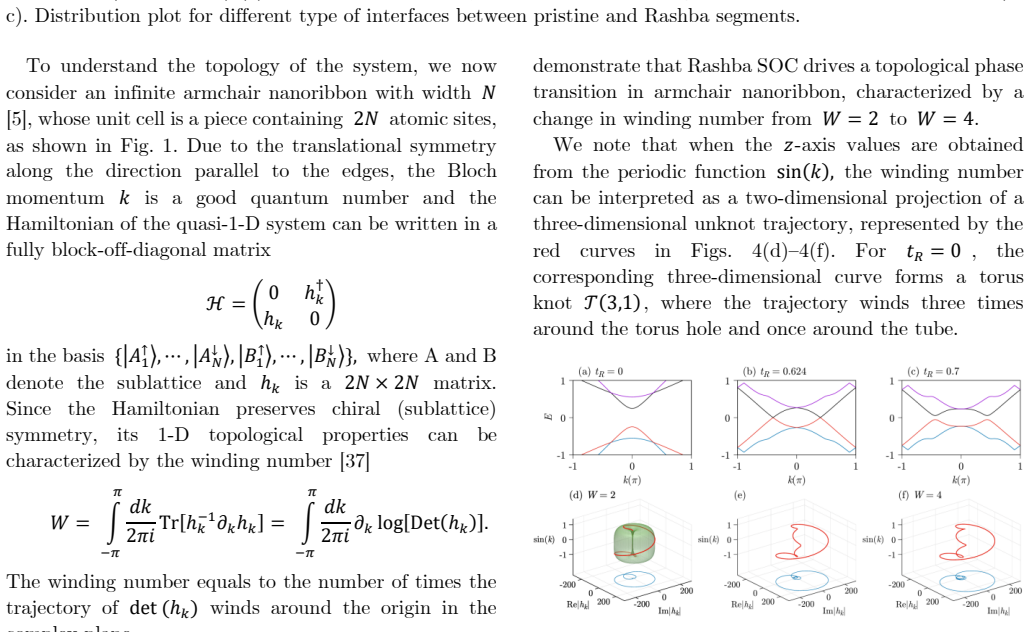
The interplay between structural geometry and Rashba spin-orbit coupling generates nontrivial topological phases in honeycomb nanoribbon heterostructures. Increasing the Rashba coupling induces symmetry-protected interface states localized at the junction between topologically distinct regions, which remain robust against edge perturbations. For finite ribbon widths, Rashba spin-orbit coupling drives a gap closing and reopening, signaling a topological phase transition without modifying the lattice structure.
What carries the argument
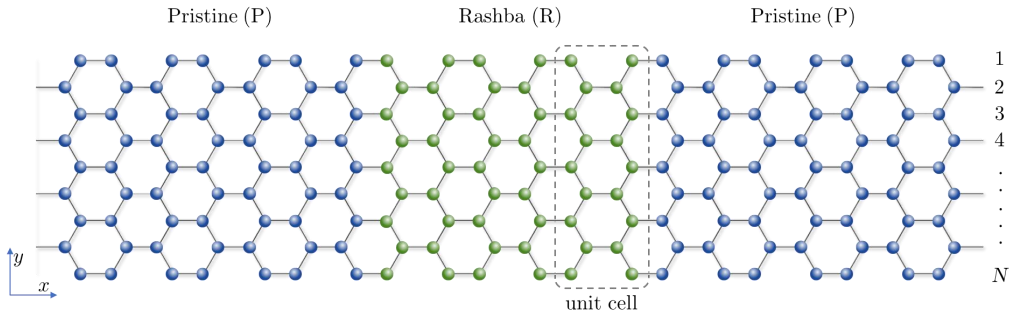
Rashba spin-orbit coupling applied only to a central embedded region of an armchair nanoribbon heterostructure, which changes the topological character and produces symmetry-protected interface states at the boundaries.
If this is right
- Symmetry-protected interface states form at the junctions and remain robust against edge perturbations.
- A gap closes and reopens at finite ribbon widths, marking the topological phase transition.
- Topological states become tunable through the strength of the spin-orbit interaction alone.
- Interfacial geometry cooperates with spin-orbit coupling to engineer the states without lattice modification.
Where Pith is reading between the lines
- Gate voltages that induce Rashba coupling could provide all-electrical switching of topological features in graphene devices.
- The same embedding strategy might produce analogous transitions in other two-dimensional materials with strong spin-orbit effects.
- The protected interface states could serve as channels for dissipationless transport in future nanoelectronic circuits.
- Transport measurements of conductance plateaus or local density of states at the junctions would test the predicted robustness.
Load-bearing premise
A Rashba spin-orbit coupled region can be cleanly embedded between pristine segments with no extra scattering or lattice distortion at the interfaces.
What would settle it
Direct measurement showing no gap closing and reopening when Rashba strength is increased in finite-width ribbons, or interface states that disappear under small edge disorder, would disprove the topological transition.
Figures
read the original abstract
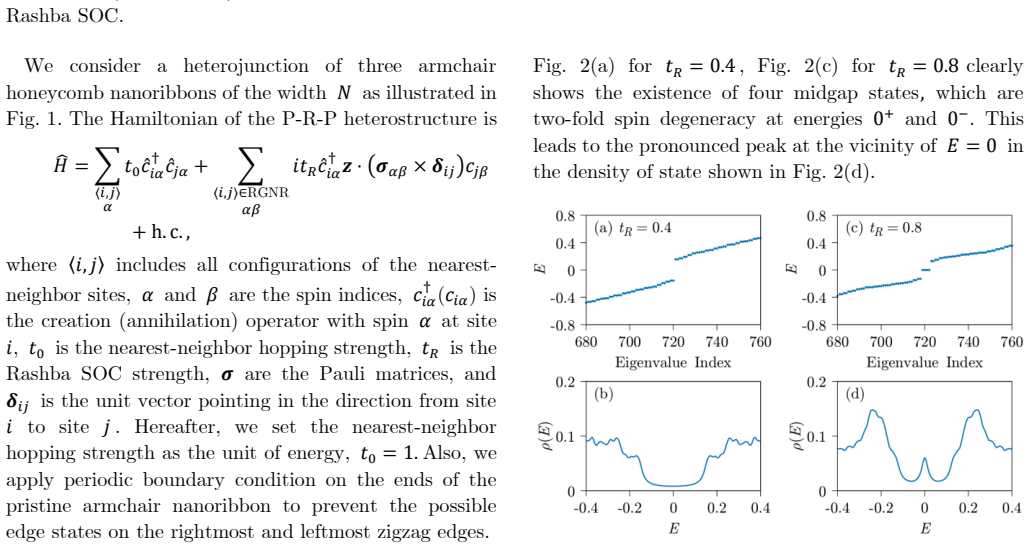
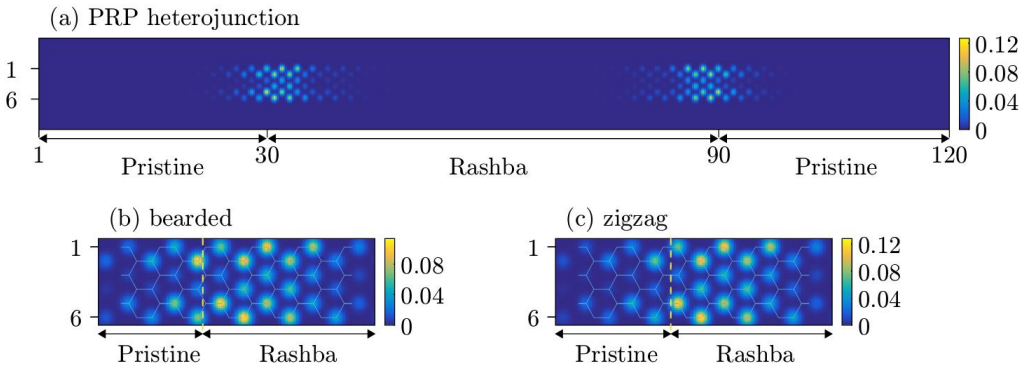
We investigate the emergence of nontrivial topological phases in heterogeneous armchair honeycomb nanoribbons arising from the interplay between structural geometry and Rashba spin-orbit coupling (RSOC). The system consists of a central RSOC-active region sandwiched between two pristine segments, forming interfaces between topologically distinct phases. As the RSOC strength increases, interface states emerge and become localized at the junctions, exhibiting robustness against edge perturbations. For finite ribbon widths, the RSOC induces a closing and subsequent reopening of the bulk energy gap, signaling a topological phase transition without altering the underlying lattice geometry. These findings reveal a route to engineering tunable topological states through the cooperative effects of interfacial structure and spin-orbit interactions.
Editorial analysis
A structured set of objections, weighed in public.
Referee Report
Summary. The manuscript studies armchair graphene nanoribbon heterostructures consisting of a central Rashba spin-orbit coupled segment embedded between pristine segments. It claims that increasing Rashba coupling strength induces symmetry-protected interface states localized at the junctions between topologically distinct regions; these states remain robust to edge perturbations. For finite ribbon widths, Rashba SOC is asserted to drive a gap closing and reopening that signals a topological phase transition without any modification to the underlying lattice structure.
Significance. If the central claims hold after verification, the results would demonstrate a lattice-preserving route to engineer tunable topological interface states in graphene nanoribbons via Rashba SOC alone. This mechanism could be relevant for spintronic or quantum-transport applications in 2D carbon nanostructures, building on standard tight-binding models with Rashba terms.
major comments (1)
- [Abstract] Abstract: the assertion that gap closing and reopening signals a topological phase transition is not supported by any explicit computation of a topological invariant (Zak phase, parity index, or equivalent) that would place the pristine and Rashba-coupled segments in distinct topological classes. In a 1D gapped system, gap closing alone does not establish a change in topological character or guarantee protected interface states.
minor comments (1)
- The abstract and introduction should specify the tight-binding parameters (nearest-neighbor hopping, Rashba strength range, ribbon widths considered) and the numerical method used for the band-structure calculations.
Simulated Author's Rebuttal
We thank the referee for their careful reading and constructive comments on our manuscript. We address the major comment below and will incorporate the suggested clarification in the revised version.
read point-by-point responses
-
Referee: [Abstract] Abstract: the assertion that gap closing and reopening signals a topological phase transition is not supported by any explicit computation of a topological invariant (Zak phase, parity index, or equivalent) that would place the pristine and Rashba-coupled segments in distinct topological classes. In a 1D gapped system, gap closing alone does not establish a change in topological character or guarantee protected interface states.
Authors: We agree that an explicit calculation of a topological invariant is required to rigorously confirm the topological character of the two segments. The original manuscript infers the transition from the gap closing/reopening together with the appearance of symmetry-protected interface states, but does not report a direct invariant computation. In the revised manuscript we will add calculations of the Zak phase (or parity index) for both the pristine and Rashba-coupled armchair nanoribbons, explicitly demonstrating that they belong to distinct topological classes. This addition will strengthen the claim that the observed gap closing signals a genuine topological phase transition. revision: yes
Circularity Check
No circularity; derivation is self-contained via standard tight-binding spectral analysis
full rationale
The paper constructs a tight-binding Hamiltonian for armchair graphene nanoribbon heterostructures that includes a position-dependent Rashba spin-orbit term between pristine segments. It numerically diagonalizes this model for finite widths, tracks the evolution of the bulk gap with increasing Rashba strength, and notes gap closing/reopening together with the appearance of interface-localized states. None of these steps defines any output quantity in terms of the claimed topological transition itself, nor renames a fitted parameter as a prediction, nor relies on a self-citation chain whose only justification is the present work. The central inference therefore rests on direct computation from the model rather than on any of the enumerated circular patterns.
Axiom & Free-Parameter Ledger
axioms (1)
- standard math Standard nearest-neighbor tight-binding model for graphene nanoribbons with added Rashba spin-orbit term
Lean theorems connected to this paper
-
IndisputableMonolith/Foundation/AlexanderDuality.leanalexander_duality_circle_linking unclear?
unclearRelation between the paper passage and the cited Recognition theorem.
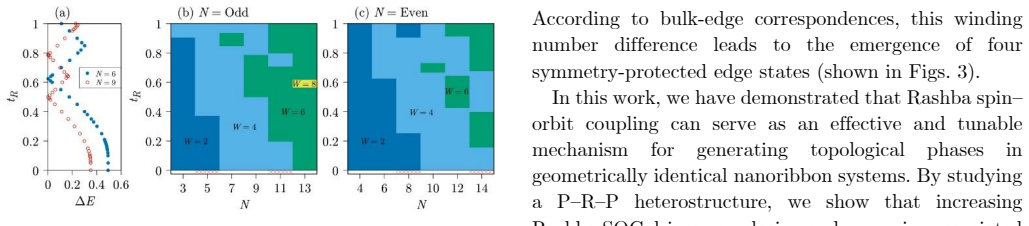
winding number W = ∫ dk/2πi Tr[h_k^{-1} ∂_k h_k] ... changes from W=2 to W=4
-
IndisputableMonolith/Cost/FunctionalEquation.leanwashburn_uniqueness_aczel unclear?
unclearRelation between the paper passage and the cited Recognition theorem.
Rashba SOC drives gap closing and reopening ... without modifying the lattice structure
What do these tags mean?
- matches
- The paper's claim is directly supported by a theorem in the formal canon.
- supports
- The theorem supports part of the paper's argument, but the paper may add assumptions or extra steps.
- extends
- The paper goes beyond the formal theorem; the theorem is a base layer rather than the whole result.
- uses
- The paper appears to rely on the theorem as machinery.
- contradicts
- The paper's claim conflicts with a theorem or certificate in the canon.
- unclear
- Pith found a possible connection, but the passage is too broad, indirect, or ambiguous to say the theorem truly supports the claim.
discussion (0)
Sign in with ORCID, Apple, or X to comment. Anyone can read and Pith papers without signing in.