REVIEW 4 major objections 8 minor 43 references
DynamicAvatars: Accurate Dynamic Facial Avatars Reconstruction and Precise Editing with Diffusion Models
T0 review · 4 major / 8 minor · reviewed 2026-08-12 · deepseek-v4-flash
Pith's one-line read DynamicAvatars reconstructs moving 3D head avatars from video and edits them with text prompts.
desk verdict A plausible reconstruction system whose editing claims rest on an unspecified mapping net and an undefined 3D uplift objective; needs major method details before it can be evaluated. read the letter →
The pith
A machine-rendered reading of the paper's core claim, the machinery that carries it, and where it could break.
The reading
What carries the argument
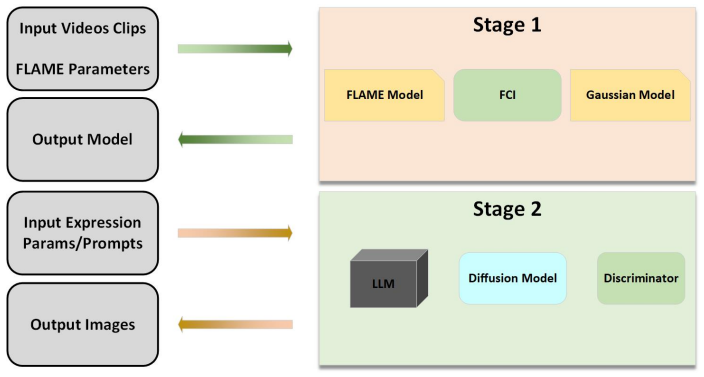
The load-bearing machinery is dual tracking over semantic-labeled 3D Gaussian splats—small oriented 3D blobs rendered into images—bound to the FLAME face mesh. In the modeling stage, each splat is first bound to a FLAME mesh triangle to preserve face structure, then tagged with a semantic label from a facial component identifier, so the same splats can be followed through time and across camera poses. A mapping network carries an editing mask from a baseline view to every target view by taking the target timestep and camera pose as inputs and applying bilinear interpolation on the time-pose plane, identifying which splats contribute to the edited region throughout the sequence. The editing stage then chains an LLM-based prompt preprocessing module (GPT-4) that turns a user prompt into structured instructions, a diffusion editor (DALL-E) that generates the edited images, and a conditional GAN discriminator that supervises color consistency. This chain is what lets edits apply to the whole dynamic avatar rather than to one frame.
What would settle it
Hold out one expression sequence or camera view from the NeRSemble training set, edit a spatially localized feature such as an earring using a prompt that names its position, and render the edited avatar across that held-out view; if the earring drifts, flickers, or disappears as the head moves, the claimed dynamic editing consistency is refuted.
Extended reading notes
Core claim
The paper claims that dynamic facial avatar reconstruction and precise editing should be built on one shared representation, not as separate steps. That representation is a set of 3D Gaussian splats bound to the FLAME mesh for structural rigidity, with each splat additionally labeled by a facial component identifier so that regions outside FLAME (hair, rings, hats) can also be tracked and edited consistently. During editing, a mapping network propagates a requested edit mask across time steps and camera poses, an LLM restructures the user's prompt into detailed instructions, a diffusion model renders the edited frames, and a discriminator removes color and texture artifacts around sensitive regions such as eyes and teeth. The authors state that this combination removes facial distortions and inaccurate head movements that hamper prior NeRF- and 3DGS-based avatars, and they support it with comparisons to GaussianAvatars, HeadStudio, PointAvatar, GaussianEditor, and GenN2N.
Load-bearing premise
The load-bearing premise is that the mapping network, trained on masks generated from the same NeRSemble training data, will correctly warp an editing mask to unseen time steps and camera poses; if that warping fails, the edited region will flicker, drift, or corrupt the avatar.
Editorial extensions
If this is right
- Because reconstruction and editing share the same Gaussian splat representation, an edit made at any frame is defined over the whole moving sequence rather than a single image.
- The semantic labeling of splats means accessories such as earrings, rings, and hats can be added or modified without breaking the FLAME-tracked face structure.
- LLM prompt preprocessing and the GAN discriminator should allow prompts that specify relative positions and fine style details, where prior prompt-only editors fail.
- On the reported benchmarks, the same pipeline improves both reconstruction fidelity and edit success, so dynamic editing no longer requires a separate edited-avatar retraining step per prompt.
Reading between the lines
- Beyond the paper, the mapping network's generalization is the part to test first: if it transfers to unseen identities, expressions, or camera poses, the same pipeline could likely run on sparser or monocular capture rather than dense multi-view rigs.
- Beyond the paper, because the editing backbone uses off-the-shelf GPT-4 and DALL-E, edit fidelity should improve automatically as those base models improve, without changes to the avatar representation.
- Beyond the paper, the reported edit metrics measure instruction-following, not frame-to-frame temporal stability; a direct flicker or temporal-consistency metric on long sequences would be a natural next evaluation.
- Beyond the paper, the densification and splitting schedule is fixed and the authors note it is not tuned; an adaptive module that densifies where the semantic mask changes could further improve fine accessory edits.
Editorial analysis
A structured set of objections, weighed in public.
Referee Report
Summary. The paper proposes DynamicAvatars, a two-stage method for reconstructing dynamic 3D head avatars from multi-view video and for performing text-based edits on those avatars. The first stage binds Gaussian splats to a FLAME mesh with a ``dual-tracking'' mechanism and semantic masks; the second stage uses an LLM-based prompt preprocessor, a mask-warping mapping network, and a GAN-based discriminator to propagate edits across time and pose. Experiments on NeRSemble report improved reconstruction (PSNR 30.1 vs. 29.3 for GaussianAvatars, SSIM 0.907 vs. 0.865) and substantially higher edit-success rates (67.5% vs. 36.4% for GenN2N). The central claim is that the method enables precise dynamic editing of facial avatars, but the paper provides only high-level descriptions of the editing mechanism and does not define the evaluation protocol for edit quality.
Significance. If fully specified and validated, the proposed dynamic editing pipeline would be a useful contribution to the growing line of work on editable 3D Gaussian avatars. The paper identifies a real problem: static semantic masks fail in dynamic scenes where Gaussians move relative to the mesh, and existing prompt-based editing methods struggle with fine-grained spatial instructions. The reported reconstruction improvements are plausible and consistent with the qualitative figures. The paper also credits the use of an LLM for prompt restructuring, which is a reasonable design choice. However, the manuscript currently lacks the implementation details needed to assess the central editing claim: the mapping network is not described, the objective for lifting 2D edits back to 3D is missing, and the headline edit-success metric is undefined. The paper therefore has the shape of a system demonstration rather than a complete, reproducible method.
major comments (4)
- [§4.2, Fig. 5] The dynamic mask propagation step is the backbone of the editing pipeline, but the mapping network is not specified. The text states ``We train this module by utilizing the mask of the training dataset at different time and poses generated at the first stage'' without giving the architecture, loss function, or validation procedure. There is also no quantitative evaluation of the predicted masks (e.g., mask IoU on held-out timesteps or camera poses). Because the paper itself concedes that ``a labeled splat at time t0 may not contribute to the color of the corresponding semantic region at time t1,'' the correctness of the warp is load-bearing for the whole editing claim. Without these details, the claim of temporally consistent editing cannot be verified.
- [§4.3, Fig. 6, Eq. (17)] The second editing stage is described only as ``latent manipulation,'' but no equation or algorithm explains how the edited 2D images update the 3D Gaussian model. Eq. (17) defines L_edit with L_rgb, L_gs, and L_G, yet there is no ground-truth edited image I_edited; the text does not specify which rendered frames are compared with which edited images, how per-frame edits are fused, or how gradients flow to the Gaussian splats. This omission is load-bearing because the paper's central contribution is ``precise editing'' of dynamic avatars. The authors should provide the exact optimization objective and the backpropagation path from edited images to splat parameters.
- [§5.3, Table 2] The edit-quality numbers are uninterpretable as reported. The metric ``Average Spacial Attribute'' is not defined, and no protocol is given: number of subjects, number and content of prompts, number of raters, definition of ``success,'' or confidence intervals. The headline claim of 67.5% versus 36.4% therefore has no documented basis. Please specify the exact metric, the evaluation setup, and provide per-prompt or per-subject breakdowns so the result can be reproduced and compared with baselines.
- [§4.4, Eqs. (14)–(15)] The ``specialized GAN algorithm'' is presented only as two generic adversarial losses. There is no discriminator architecture, no description of how D and G are trained alternately, no loss weights or training schedule, and no discussion of how the GAN interacts with the mapping network and the diffusion-based editing process. Since the paper attributes its style-editing quality and temporal consistency to this component, the reported improvements cannot be reproduced or assessed without these details.
minor comments (8)
- [§5.1] The terms ``SLM'' and ``Instruct-Pix2Pix metric'' are used without definition; please explain what SLM stands for and how the text-image direction similarity is computed.
- [§4.4, Eq. (12)] The tracking loss uses L_perceptron(l, bl), but the symbols l and bl are not defined before the equation.
- [§4.4, Eq. (11) context] The text says the λ values ``have been tested to be effective during ablation study in our work,'' but the paper contains no ablation study; either add the ablation or remove the claim.
- [Table 2 and Figure 3 caption] There are typos that should be corrected: ``Spacial'' should be ``Spatial,'' and ``ultilize'' in the Figure 3 caption should be ``utilize.'
- [Figure 7 captions] The subcaptions in Figure 7 are labeled (a)–(e) but the main text references Figure 8 and Figure 9 in a confusing order; please align the caption labels with the in-text references.
- [Section 3.2] Section 3.2 is a generic review of prompt-based diffusion editing and is not connected to the actual implementation of the method; either remove it or explicitly state how the described components are instantiated in DynamicAvatars.
- [Eq. (17)] The weights λ1, λ2, λ3 in L_edit are not reported; please provide the values used in the experiments.
- [References] The reference list contains minor formatting issues, such as ``[42]'' being cited as ``[42]'' while some entries lack venue information; please standardize the bibliography.
Circularity Check
No significant circularity: the reconstruction and editing claims rest on external components and standard losses, not on self-referential definitions or fitted predictions.
full rationale
The paper does not derive its headline results from a circular chain. Reconstruction (Section 4.1, Eqs. 11-16) optimizes L2 and LPIPS photometric losses against observed video frames and a tracking loss against FLAME mesh constraints, and is evaluated with external metrics (PSNR/SSIM/LPIPS in Table 1). The editing stage (Sections 4.2-4.3, Eq. 17) combines external pre-trained models (DALL-E, GPT-4) with an adversarial loss; no fitted parameter is renamed as a prediction, and no equation reduces to its own input. The mapping net is trained on masks from the same NeRSemble dataset, but it is a learned component used to propagate edit regions, not a quantity defined in terms of the evaluation target; even if its generalization is untested, that is an empirical gap, not a circular reduction. The paper itself flags open aspects, such as the t0/t1 semantic mismatch in Section 4.2 and unoptimized densification timing in Section 4.4, as limitations. Table 2's 'success' metric is under-defined and the mapping-net architecture and loss are unspecified; these are reproducibility and validity concerns, not circularity. No load-bearing self-citation appears: GaussianAvatars, SLD, InstructPix2Pix, and GenN2N are external prior works. The derivation chain is therefore self-contained in the relevant sense; weaknesses are omissions, not circular reductions.
Assumptions & free parameters
free parameters (4)
- λ in Lrgb =
0.9 (modeling), 0.7 (editing)
- λ1, λ2, λ3 in Ledit =
not reported
- learning rate schedule =
1e-3 to 1e-5
- densification interval =
2048 iterations
assumptions (4)
- domain assumption FLAME model parameters capture facial shape and expression
- domain assumption Pre-trained DALL-E and GPT-4 perform reliably as off-the-shelf components
- ad hoc to paper The mapping network learns to transfer masks across time and pose
- domain assumption NeRSemble dataset is representative and free of bias for evaluation
Cite this review
Pith. "Pith review of DynamicAvatars: Accurate Dynamic Facial Avatars Reconstruction and Precise Editing with Diffusion Models." pith.science (2026). https://pith.science/paper/A4AL3FIV
@misc{pith2026241115732,
  author       = {Pith},
  title        = {Pith review of: DynamicAvatars: Accurate Dynamic Facial Avatars Reconstruction and Precise Editing with Diffusion Models},
  year         = {2026},
  howpublished = {\url{https://pith.science/paper/A4AL3FIV}},
  note         = {Machine review of arXiv:2411.15732}
}
read the original abstract
Generating and editing dynamic 3D head avatars are crucial tasks in virtual reality and film production. However, existing methods often suffer from facial distortions, inaccurate head movements, and limited fine-grained editing capabilities. To address these challenges, we present DynamicAvatars, a dynamic model that generates photorealistic, moving 3D head avatars from video clips and parameters associated with facial positions and expressions. Our approach enables precise editing through a novel prompt-based editing model, which integrates user-provided prompts with guiding parameters derived from large language models (LLMs). To achieve this, we propose a dual-tracking framework based on Gaussian Splatting and introduce a prompt preprocessing module to enhance editing stability. By incorporating a specialized GAN algorithm and connecting it to our control module, which generates precise guiding parameters from LLMs, we successfully address the limitations of existing methods. Additionally, we develop a dynamic editing strategy that selectively utilizes specific training datasets to improve the efficiency and adaptability of the model for dynamic editing tasks.
Figures


Figures from the paper (6 more)




Reference graph
Works this paper leans on
-
[1]
Multidiffusion: Fusing diffusion paths for controlled image generation, 2023
Omer Bar-Tal, Lior Yariv, Yaron Lipman, and Tali Dekel. Multidiffusion: Fusing diffusion paths for controlled image generation, 2023. 5
work page 2023
-
[2]
Barron, Ben Mildenhall, Matthew Tancik, Peter Hedman, Ricardo Martin-Brualla, and Pratul P
Jonathan T. Barron, Ben Mildenhall, Matthew Tancik, Peter Hedman, Ricardo Martin-Brualla, and Pratul P. Srinivasan. Mip-nerf: A multiscale representation for anti-aliasing neu- ral radiance fields. ICCV, 2021. 3
work page 2021
-
[3]
In- structpix2pix: Learning to follow image editing instructions
Tim Brooks, Aleksander Holynski, and Alexei A Efros. In- structpix2pix: Learning to follow image editing instructions. arXiv preprint arXiv:2211.09800, 2022. 3
arXiv 2022
-
[4]
Light- ning NeRF: Efficient hybrid scene representation for au- tonomous driving
Junyi Cao, Zhichao Li, Naiyan Wang, and Chao Ma. Light- ning NeRF: Efficient hybrid scene representation for au- tonomous driving. arXiv preprint arXiv:2403.05907, 2024. 2
arXiv 2024
-
[5]
Yang Cao, Yuanliang Ju, and Dan Xu. 3dgs-det: Em- power 3d gaussian splatting with boundary guidance and box-focused sampling for 3d object detection, 2024. 2
work page 2024
-
[6]
Eric R. Chan, Connor Z. Lin, Matthew A. Chan, Koki Nagano, Boxiao Pan, Shalini De Mello, Orazio Gallo, Leonidas Guibas, Jonathan Tremblay, Sameh Khamis, Tero Karras, and Gordon Wetzstein. Efficient geometry-aware 3D generative adversarial networks. In arXiv, 2021. 3
work page 2021
-
[7]
Gaussianeditor: Swift and controllable 3d editing with gaussian splatting, 2023
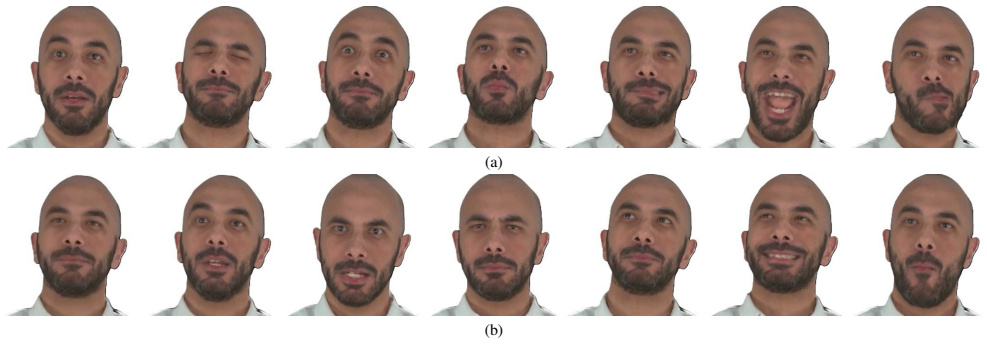
Yiwen Chen, Zilong Chen, Chi Zhang, Feng Wang, Xiaofeng Yang, Yikai Wang, Zhongang Cai, Lei Yang, Huaping Liu, and Guosheng Lin. Gaussianeditor: Swift and controllable 3d editing with gaussian splatting, 2023. 2, 5 (a) (b) Figure 7. Demonstration of our expression editing experiments. (a) Expression Editing with original appearance. (b) Prompt: Turn the m...
work page 2023
-
[8]
Omnire: Omni urban scene reconstruction
Ziyu Chen, Jiawei Yang, Jiahui Huang, Riccardo de Lutio, Janick Martinez Esturo, Boris Ivanovic, Or Litany, Zan Go- jcic, Sanja Fidler, Marco Pavone, Li Song, and Yue Wang. Omnire: Omni urban scene reconstruction. arXiv preprint arXiv:2408.16760, 2024. 2
arXiv 2024
Show all 43 references
-
[9]
Dynamic neural radiance fields for monocular 4d facial avatar reconstruction, 2020
Guy Gafni, Justus Thies, Michael Zollh ¨ofer, and Matthias Nießner. Dynamic neural radiance fields for monocular 4d facial avatar reconstruction, 2020. 3
2020
-
[10]
Generative adversarial nets
Ian Goodfellow, Jean Pouget-Abadie, Mehdi Mirza, Bing Xu, David Warde-Farley, Sherjil Ozair, Aaron Courville, and Yoshua Bengio. Generative adversarial nets. In Advances in neural information processing systems, pages 2672–2680,
-
[11]
Srinivasan, Ben Mildenhall, Jonathan T
Peter Hedman, Pratul P. Srinivasan, Ben Mildenhall, Jonathan T. Barron, and Paul Debevec. Baking neural ra- diance fields for real-time view synthesis. ICCV, 2021. 2
2021
-
[12]
Prompt-to-prompt im- age editing with cross attention control
Amir Hertz, Ron Mokady, Jay Tenenbaum, Kfir Aberman, Yael Pritch, and Daniel Cohen-Or. Prompt-to-prompt im- age editing with cross attention control. arXiv preprint arXiv:2208.01626, 2022. 3
2022 arXiv
-
[13]
Diffusion model-based image editing: A survey, 2024
Yi Huang, Jiancheng Huang, Yifan Liu, Mingfu Yan, Jiaxi Lv, Jianzhuang Liu, Wei Xiong, He Zhang, Shifeng Chen, and Liangliang Cao. Diffusion model-based image editing: A survey, 2024. 3
2024
-
[14]
Robust dual gaussian splatting for immersive human-centric volu- metric videos, 2024
Yuheng Jiang, Zhehao Shen, Yu Hong, Chengcheng Guo, Yize Wu, Yingliang Zhang, Jingyi Yu, and Lan Xu. Robust dual gaussian splatting for immersive human-centric volu- metric videos, 2024. 2
2024
-
[15]
A style-based generator architecture for generative adversarial networks
Tero Karras, Samuli Laine, and Timo Aila. A style-based generator architecture for generative adversarial networks. In Proceedings of the IEEE/CVF conference on computer vi- sion and pattern recognition, pages 4401–4410, 2019. 3
2019
-
[16]
Imagic: Text-based real image editing with diffusion models
Bahjat Kawar, Shiran Zada, Oran Lang, Omer Tov, Huiwen Chang, Tali Dekel, Inbar Mosseri, and Michal Irani. Imagic: Text-based real image editing with diffusion models. InCon- ference on Computer Vision and Pattern Recognition 2023 ,
2023
-
[17]
3d gaussian splatting for real-time radiance field rendering
Bernhard Kerbl, Georgios Kopanas, Thomas Leimk ¨uhler, and George Drettakis. 3d gaussian splatting for real-time radiance field rendering. ACM Transactions on Graphics, 42 (4), 2023. 2, 3
2023
-
[18]
Tianye Li, Timo Bolkart, Michael. J. Black, Hao Li, and Javier Romero. Learning a model of facial shape and ex- pression from 4D scans. ACM Transactions on Graphics, (Proc. SIGGRAPH Asia), 36(6):194:1–194:17, 2017. 4
2017
-
[19]
Llm- grounded diffusion: Enhancing prompt understanding of text-to-image diffusion models with large language models
Long Lian, Boyi Li, Adam Yala, and Trevor Darrell. Llm- grounded diffusion: Enhancing prompt understanding of text-to-image diffusion models with large language models. arXiv preprint arXiv:2305.13655, 2023. 3
2023 arXiv
-
[20]
Deep 3d mask volume for view synthesis of dynamic scenes
Kai-En Lin, Lei Xiao, Feng Liu, Guowei Yang, and Ravi Ramamoorthi. Deep 3d mask volume for view synthesis of dynamic scenes. In ICCV, 2021. 4
2021
-
[21]
Gva: Reconstructing vivid 3d gaussian avatars from monocular videos
Xinqi Liu, Chenming Wu, Jialun Liu, Xing Liu, Chen Zhao, Haocheng Feng, Errui Ding, and Jingdong Wang. Gva: Reconstructing vivid 3d gaussian avatars from monocular videos. Arxiv, 2024. 3
2024
-
[22]
Genn2n: Generative nerf2nerf translation
Xiangyue Liu, Han Xue, Kunming Luo, Ping Tan, and Li Yi. Genn2n: Generative nerf2nerf translation. In Proceedings of the IEEE/CVF Conference on Computer Vision and Pattern Recognition, pages 5105–5114, 2024. 3
2024
-
[23]
Gaussianhair: Hair modeling and rendering with light-aware gaussians
Haimin Luo, Min Ouyang, Zijun Zhao, Suyi Jiang, Longwen Zhang, Qixuan Zhang, Wei Yang, Lan Xu, and Jingyi Yu. Gaussianhair: Hair modeling and rendering with light-aware gaussians. arXiv preprint arXiv:2402.10483, 2024. 2
2024 arXiv
-
[24]
Ricardo Martin-Brualla, Noha Radwan, Mehdi S. M. Sajjadi, Jonathan T. Barron, Alexey Dosovitskiy, and Daniel Duck- worth. NeRF in the Wild: Neural Radiance Fields for Un- constrained Photo Collections. In CVPR, 2021. 2
2021
-
[25]
Srinivasan, Matthew Tancik, Jonathan T
Ben Mildenhall, Pratul P. Srinivasan, Matthew Tancik, Jonathan T. Barron, Ravi Ramamoorthi, and Ren Ng. Nerf: representing scenes as neural radiance fields for view synthe- sis. Commun. ACM, 65(1):99–106, 2021. 2
2021
-
[26]
Large language models: A survey, 2024
Shervin Minaee, Tomas Mikolov, Narjes Nikzad, Meysam Chenaghlu, Richard Socher, Xavier Amatriain, and Jianfeng Gao. Large language models: A survey, 2024. 1
2024
-
[27]
Instant neural graphics primitives with a multires- olution hash encoding
Thomas M ¨uller, Alex Evans, Christoph Schied, and Alexan- der Keller. Instant neural graphics primitives with a multires- olution hash encoding. ACM Trans. Graph. , 41(4):102:1– 102:15, 2022. 3
2022
-
[28]
An introduction to convolu- tional neural networks, 2015
Keiron O’Shea and Ryan Nash. An introduction to convolu- tional neural networks, 2015. 3
2015
-
[29]
Diffusion handles: Enabling 3d edits for diffusion models by lifting activations to 3d, 2023
Karran Pandey, Paul Guerrero, Matheus Gadelha, Yannick Hold-Geoffroy, Karan Singh, and Niloy Mitra. Diffusion handles: Enabling 3d edits for diffusion models by lifting activations to 3d, 2023. 5
2023
-
[30]
D-NeRF: Neural Radiance Fields for Dynamic Scenes
Albert Pumarola, Enric Corona, Gerard Pons-Moll, and Francesc Moreno-Noguer. D-NeRF: Neural Radiance Fields for Dynamic Scenes. In Proceedings of the IEEE/CVF Con- ference on Computer Vision and Pattern Recognition, 2020. 2
2020
-
[31]
Gaus- sianavatars: Photorealistic head avatars with rigged 3d gaus- sians
Shenhan Qian, Tobias Kirschstein, Liam Schoneveld, Davide Davoli, Simon Giebenhain, and Matthias Nießner. Gaus- sianavatars: Photorealistic head avatars with rigged 3d gaus- sians. In Proceedings of the IEEE/CVF Conference on Com- puter Vision and Pattern Recognition , pages 2...
-
[32]
Rig3dgs: Creating controllable portraits from ca- sual monocular videos, 2024
Alfredo Rivero, ShahRukh Athar, Zhixin Shu, and Dimitris Samaras. Rig3dgs: Creating controllable portraits from ca- sual monocular videos, 2024. 2
2024
-
[33]
SplattingAvatar: Realistic Real-Time Human Avatars with Mesh-Embedded Gaussian Splatting
Zhijing Shao, Zhaolong Wang, Zhuang Li, Duotun Wang, Xiangru Lin, Yu Zhang, Mingming Fan, and Zeyu Wang. SplattingAvatar: Realistic Real-Time Human Avatars with Mesh-Embedded Gaussian Splatting. In Proceedings of the IEEE/CVF Conference on Computer Vision and Pattern Recogniti...
2024
-
[34]
Diffusion-gan: Training gans with diffusion, 2023
Zhendong Wang, Huangjie Zheng, Pengcheng He, Weizhu Chen, and Mingyuan Zhou. Diffusion-gan: Training gans with diffusion, 2023. 3
2023
-
[35]
4d gaussian splatting for real-time dynamic scene render- ing
Guanjun Wu, Taoran Yi, Jiemin Fang, Lingxi Xie, Xiaopeng Zhang, Wei Wei, Wenyu Liu, Qi Tian, and Xinggang Wang. 4d gaussian splatting for real-time dynamic scene render- ing. In Proceedings of the IEEE/CVF Conference on Com- puter Vision and Pattern Recognition (CVPR), pages 2...
2024
-
[36]
Self-correcting llm-controlled diffusion models
Tsung-Han Wu, Long Lian, Joseph E Gonzalez, Boyi Li, and Trevor Darrell. Self-correcting llm-controlled diffusion models. arXiv preprint arXiv:2311.16090, 2023. 3, 5
2023 arXiv
-
[37]
Paint by example: Exemplar-based image editing with diffusion mod- els
Binxin Yang, Shuyang Gu, Bo Zhang, Ting Zhang, Xuejin Chen, Xiaoyan Sun, Dong Chen, and Fang Wen. Paint by example: Exemplar-based image editing with diffusion mod- els. arXiv preprint arXiv:2211.13227, 2022. 3
2022 arXiv
-
[38]
Paint by example: Exemplar-based image editing with diffusion mod- els
Binxin Yang, Shuyang Gu, Bo Zhang, Ting Zhang, Xuejin Chen, Xiaoyan Sun, Dong Chen, and Fang Wen. Paint by example: Exemplar-based image editing with diffusion mod- els. In Proceedings of the IEEE/CVF Conference on Com- puter Vision and Pattern Recognition (CVPR), pages 18381–...
2023
-
[39]
Dylin: Making light field networks dy- namic
Heng Yu, Joel Julin, Zoltan A Milacski, Koichiro Niinuma, and Laszlo A Jeni. Dylin: Making light field networks dy- namic. arXiv preprint arXiv:2303.14243, 2023. 2
2023 arXiv
-
[40]
Mip-splatting: Alias-free 3d gaussian splat- ting
Zehao Yu, Anpei Chen, Binbin Huang, Torsten Sattler, and Andreas Geiger. Mip-splatting: Alias-free 3d gaussian splat- ting. Conference on Computer Vision and Pattern Recogni- tion (CVPR), 2024. 2
2024
-
[41]
Psavatar: A point-based shape model for real- time head avatar animation with 3d gaussian splatting, 2024
Zhongyuan Zhao, Zhenyu Bao, Qing Li, Guoping Qiu, and Kanglin Liu. Psavatar: A point-based shape model for real- time head avatar animation with 3d gaussian splatting, 2024. 2
2024
-
[42]
Black, and Otmar Hilliges
Yufeng Zheng, Wang Yifan, Gordon Wetzstein, Michael J. Black, and Otmar Hilliges. Pointavatar: Deformable point- based head avatars from videos, 2023. 8
2023
-
[43]
Headstudio: Text to animatable head avatars with 3d gaussian splatting
Zhenglin Zhou, Fan Ma, Hehe Fan, Zongxin Yang, and Yi Yang. Headstudio: Text to animatable head avatars with 3d gaussian splatting. In ECCV, 2024. 3
2024
Reviewed August 12, 2026 · model on record in the stance chip above.
Discussion (0). Continue with ORCID to comment.