REVIEW 4 major objections 4 minor 46 references
iARCS: Iterative Agentic RL for Controllable 3D Scene Generation
T0 review · 4 major / 4 minor · reviewed 2026-08-07 · deepseek-v4-flash
Pith's one-line read A two-stage agentic RL loop makes pretrained 3D scene generators obey natural-language functional constraints.
desk verdict A promising but under-evidenced integration of DDPO and LLM reward generation for 3D scenes; the self-augmentation result is the strongest part, but Table 3 never actually measures the task constraints it claims to satisfy. read the letter →
The pith
A machine-rendered reading of the paper's core claim, the machinery that carries it, and where it could break.
The reading
What carries the argument
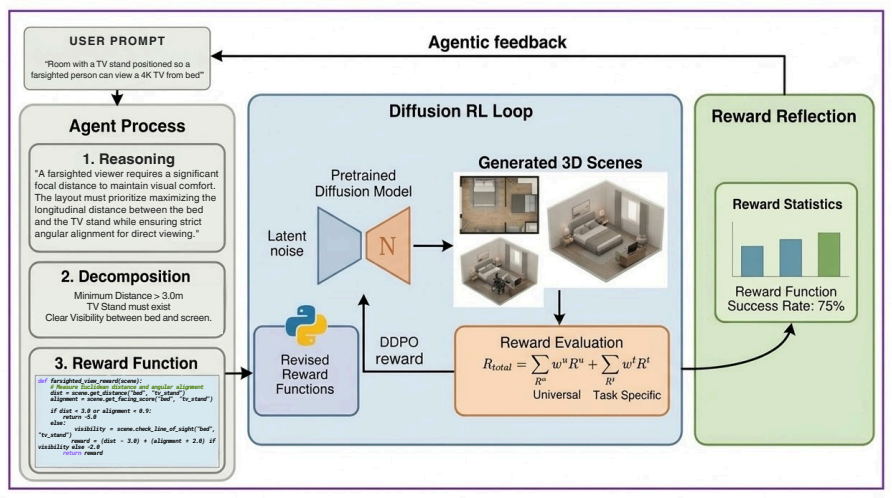
The load-bearing mechanism is a two-stage RL schedule wrapped around a diffusion scene generator. Stage 1 optimizes a set of universal rewards (collision avoidance, boundary adherence, accessibility, object-count diversity) to remove dataset biases such as penetration and out-of-bound placement. Stage 2 uses an LLM agent that performs reasoning, constraint decomposition, and executable Python reward-code generation from the user prompt, then DDPO treats the denoising process as a Markov decision process and updates a LoRA-adapted policy against the composite reward. A reflection module inspects reward statistics and top-down projections every 10 epochs and either rewrites the reward code or decomposes the objective into an easier curriculum, which is what lets the loop recover from poorly specified rewards.
What would settle it
Take a held-out prompt with an objective geometric ground truth (for example, 'a clear line of sight from the sofa to the bookshelf with no furniture in the cone') and compare iARCS against the same RL pipeline using an oracle hand-written reward over identical rollout compute and LoRA settings. If the LLM-driven reward loop does not match or beat the oracle on that task, the agentic reward synthesis is not what carries the claimed generalization.
Extended reading notes
Core claim
On the paper's own terms, the central discovery is that reinforcement learning over LLM-synthesized reward programs can shift a pretrained scene prior toward user-specified functional constraints without sacrificing distribution quality. Using MiDiffusion as the base generator and DDPO as the policy optimizer, iARCS reports object-collision rate down from 52.67% to 40.45%, scene-collision rate down from 81.67% to 64.63%, out-of-bound placement down from 5.89% to 3.04%, reachability up from 85.7% to 87.82%, and walkability up from 0.806 to 0.861, with a CLIP-FID of 1.60 versus 1.34 for the base model. In the data-augmentation experiment, training MiDiffusion on 3D-FRONT plus 4,000 iARCS-generated scenes gives reachability of 92.52% versus 85.7% and matched FID of 1.34. Task-conditioned policies also achieve lower FID than the constraint-satisfying subsets of 3D-FRONT, and the ablation shows two-stage training beats single-stage training under the same reward budget.
Load-bearing premise
The argument depends on the language model being able to convert an arbitrary natural-language constraint into a reward program that is nearly correct, with the reflection loop able to repair residual errors; the paper's own limitation note says ambiguous prompts can yield suboptimal or incomplete constraints.
Editorial extensions
If this is right
- Constraint fidelity on walkability, reachability, and clearance tasks improves over the base generator while scene diversity stays within a competitive range.
- Augmenting a base generator's training set with iARCS-generated scenes improves that generator's physical plausibility and functional utility without extra external data.
- Task-adapted generators can explore beyond the set of dataset scenes that already satisfy a constraint, giving lower FID than filtered 3D-FRONT subsets.
- Two-stage training (universal pretraining then joint task fine-tuning) is required; single-stage joint optimization degrades all metrics.
- The same post-training recipe can transfer to new natural-language constraints without retraining the base model from scratch, so scaling to new rules costs reward engineering plus RL fine-tuning rather than model redesign.
Reading between the lines
- I would not infer from the paper that the gains are monotone under repeated augmentation; testing multiple rounds of generate-and-retrain is a natural experiment that the paper leaves open.
- The same two-stage reward loop is a template for other generative priors with non-differentiable objectives, such as physics-valid motion generation, although the paper only demonstrates indoor scenes.
- The reported metrics sample one operating point of the fidelity-diversity trade-off; a Pareto sweep over reward weights would make the cost of constraint enforcement explicit.
Editorial analysis
A structured set of objections, weighed in public.
Referee Report
Summary. The paper proposes iARCS, a two-stage reinforcement learning framework that adapts a pretrained 3D scene diffusion generator to natural-language functional constraints. Stage 1 optimizes universal rule-based rewards for physical plausibility and functional utility; Stage 2 uses an LLM agent to synthesize executable reward programs for a given task prompt, then fine-tunes the generator with DDPO while iteratively reflecting on reward statistics and sampled scene images. Experiments on 3D-FRONT report improved physical plausibility and functional utility over ATISS and MiDiffusion, lower FID than constraint-satisfying dataset subsets in three task-specific settings, and an augmentation result in which training MiDiffusion on iARCS-generated data improves that base generator's metrics. The paper also includes an ablation supporting the two-stage training schedule.
Significance. If the central claims are fully verified, the framework would be a practical tool for controllable synthetic 3D scene generation for embodied AI, combining post-training RL with LLM-based reward synthesis in a way that could scale to new constraints without manual reward engineering. The self-augmentation result (Table 2) is a compelling direction because it shows the generated data can improve a downstream generator. However, the missing direct task-constraint satisfaction metrics and the absence of constraint-aware baselines leave the core claim under-supported, so the contribution is not yet convincingly established.
major comments (4)
- [§4.4, Table 3] The paper's central claim of improved constraint fidelity is not directly supported, because Table 3 reports no task-level constraint satisfaction metric. For Task 1 there is no reported fraction of generated scenes in which all support surfaces are within 1.0 m vertical reach; for Task 2 there is no measured viewing distance or angular alignment between bed and TV; and for Task 3 there is no operational definition or measured success rate for a 'functional study zone'. The reported FID, SCA, and generic physics/functional metrics do not measure adherence to the specific natural-language constraints, and the FID numbers are computed against the full 3D-FRONT dataset rather than against the constraint-satisfying subsets used for comparison. Without direct constraint-satisfaction rates, the abstract's promise of improved constraint fidelity is not testable from the reported evidence.
- [§4.1, Baselines] The experimental comparison omits the constraint-aware baselines PhyScene [41] and Steerable Scene Generation [26], both cited in Related Work as methods for physically or functionally constrained scene synthesis. Because the paper's novelty claim is improved constraint fidelity over existing scene generators, the absence of these baselines makes it impossible to assess whether iARCS improves on prior constraint-aware methods; the comparison against ATISS and MiDiffusion, which have no explicit constraint-satisfaction mechanism, does not establish state-of-the-art constraint fidelity.
- [§4.1, Evaluation Metrics] All quantitative results in Tables 1-3 are point estimates over a single evaluation run, with no error bars, multiple seeds, or statistical significance tests, and the test set is filtered with a hand-chosen non-penetration threshold (-0.25) that is not analyzed for sensitivity. Several differences that support the paper's claims are small (e.g., Table 3 Task 3 R_walkable 0.738 vs. 0.728, and Task 1 Col_scene 83.61% vs. 83.72%), so without uncertainty quantification the improvement claims are not robustly established.
- [§3.6 and §4.6] The agentic reward synthesis is a load-bearing component whose reliability is not evaluated. The paper's Limitations section concedes that LLM-generated reward code can be suboptimal for ambiguous prompts, yet no experiments measure how often the LLM produces correct executable rewards for the three tasks, how many reflection iterations were needed, or how sensitive final results are to the initial reward program. Since the claimed scalability to arbitrary constraints rests on this component, some direct evaluation of reward-code quality is needed.
minor comments (4)
- [§4.1 vs. Appendix B] The learning rate for RL fine-tuning is reported as 1×10^-5 in Section 4.1 but as 3×10^-4 in Appendix B; please clarify which value was used for the main experiments.
- [Figure 2 caption] The caption states 'matched FID (1.34)' without explaining what 'matched' means; specify whether the FID is computed on the same test set for both models or whether the claim is that the FID values are equal by construction.
- [Table 3] The notation '3D-FRONT* (229/4041)' is not explained in the main text; please clarify the meaning of the two numbers and how the filtered subsets are constructed, especially given the very small subset sizes (e.g., 42 scenes for Task 3).
- [References] Reference [9] lists 'Jiaming Wang Cao Li' as a single author; this appears to be two authors with a missing comma and should be corrected to 'Jiaming Wang, Cao Li'.
Circularity Check
No significant circularity: iARCS is an empirical RL pipeline whose claims rest on external benchmarks and standard optimization protocols, not on self-citation or definitional reductions.
full rationale
This paper is an empirical reinforcement-learning study, not a derivation, so the circularity burden is low. The central claims—that iARCS improves physical plausibility, functional utility, and task-specific constraint satisfaction—are supported by quantitative comparisons against fixed baselines (ATISS, MiDiffusion) and fixed dataset subsets (3D-FRONT*). The training rewards and evaluation metrics are admittedly aligned (e.g., collision avoidance and walkability appear in both the universal rewards and the reported metrics), but this is standard practice in RL for non-differentiable objectives; reporting the optimized objective as an evaluation metric does not make the result equivalent to its input by construction. The self-augmentation experiment in Section 4.3, which trains MiDiffusion on 3D-FRONT plus iARCS-generated data, is a legitimate self-referential protocol: the base generator is improved by training on data produced by an already-adapted version of itself. This is not a fitted parameter renamed as a prediction, nor does any equation in the paper reduce a claimed output to an input definition. I found no load-bearing self-citations; the framework builds on external prior work (DDPO, Eureka, MiDiffusion) without invoking any uniqueness theorem or ansatz from the present authors. The main weakness is an evidence gap, not circularity: the abstract claims improved constraint fidelity, but Table 3 reports no direct per-task constraint-satisfaction rates, and the lower-FID-versus-filtered-subset argument does not by itself prove constraint adherence. That is a completeness or correctness concern, and the paper's Limitations section even concedes that LLM-generated reward programs can be suboptimal. Such an evidence gap does not qualify as a circular derivation under the criteria here, because the paper's claims are empirically testable rather than logically forced by its own definitions or citations.
Assumptions & free parameters
free parameters (4)
- Evaluation non-penetration threshold =
-0.25
- Learning rate for RL fine-tuning =
1e-5 (main text) vs 3e-4 (Appendix B)
- Reward weights w_u, w_t =
1.0 each (uniform)
- LoRA rank and scaling =
r=16, alpha=16
assumptions (4)
- standard math The diffusion forward noising process in eq (3) and the DDIM sampling in Algorithm 1 are valid for the scene layout representation.
- domain assumption The universal reward functions (collision avoidance, boundary adherence, accessibility, object count diversity) are appropriate proxies for physical plausibility and functional utility.
- domain assumption The evaluation metrics (FID, SCA, collision rate, reachability, walkability) faithfully measure realism and functional quality.
- ad hoc to paper The LLM agent can generate executable Python reward functions that correctly implement the geometric constraints implied by natural-language prompts.
Cite this review
Pith. "Pith review of iARCS: Iterative Agentic RL for Controllable 3D Scene Generation." pith.science (2026). https://pith.science/paper/A5G5NXKJ
@misc{pith2026260806161,
  author       = {Pith},
  title        = {Pith review of: iARCS: Iterative Agentic RL for Controllable 3D Scene Generation},
  year         = {2026},
  howpublished = {\url{https://pith.science/paper/A5G5NXKJ}},
  note         = {Machine review of arXiv:2608.06161}
}
read the original abstract
Synthetic 3D scene generation is increasingly used as a data source for computer vision and embodied AI, but existing generators often optimize perceptual realism without reliably satisfying task-critical functional constraints. This mismatch limits the usefulness of synthetic data for downstream training, where accessibility, traversability, and spatial rule compliance are often essential. We present iARCS, an iterative agentic reinforcement learning framework that adapts a pretrained scene generator to natural-language task requirements. iARCS uses a two-stage strategy: universal-reward pretraining to improve physical plausibility and layout quality, followed by task-specific fine-tuning with LLM-generated reward programs that are iteratively refined from training feedback. Experiments show improved constraint fidelity on walkability, reachability, and clearance-focused tasks, effective task-specific constraint optimization, and competitive scene diversity. We further show that data generated by iARCS improves a base generator, supporting its value as a practical synthetic data generation tool rather than only a controllable scene editing method.
Figures


Figures from the paper (5 more)


Reference graph
Works this paper leans on
-
[41]
Physcene: Physically interactable 3d scene synthesis for embodied ai, 2024
Yandan Yang, Baoxiong Jia, Peiyuan Zhi, and Siyuan Huang. Physcene: Physically interactable 3d scene synthesis for embodied ai, 2024. 1, 2, 3, 6
work page 2024
-
[26]
Steerable scene generation with post training and inference-time search, 2025
Nicholas Pfaff, Hongkai Dai, Sergey Zakharov, Shun Iwase, and Russ Tedrake. Steerable scene generation with post training and inference-time search, 2025. 2, 3
work page 2025
-
[1]
Holodeck 2.0: Vision-language-guided 3d world gen- eration with editing, 2025
Zixuan Bian, Ruohan Ren, Yue Yang, and Chris Callison- Burch. Holodeck 2.0: Vision-language-guided 3d world gen- eration with editing, 2025. 2, 3
work page 2025
-
[2]
Training diffusion models with reinforce- ment learning, 2023
Kevin Black, Michael Janner, Yilun Du, Ilya Kostrikov, and Sergey Levine. Training diffusion models with reinforce- ment learning, 2023. 2, 3, 4, 5, 6, 12
work page 2023
-
[3]
Bernhard Bucher et al. Respace: Iterative scene generation with retrieval-augmented spatial constraints.arXiv preprint arXiv:2501.05484, 2025. 2, 3, 4
arXiv 2025
-
[4]
Angel Chang, Will Monroe, Manolis Savva, Christopher Potts, and Christopher D. Manning. Text to 3d scene gen- eration with rich lexical grounding, 2015. 2
work page 2015
-
[5]
Procthor: Large-scale embodied ai using procedural genera- tion, 2022
Matt Deitke, Eli VanderBilt, Alvaro Herrasti, Luca Weihs, Jordi Salvador, Kiana Ehsani, Winson Han, Eric Kolve, Ali Farhadi, Aniruddha Kembhavi, and Roozbeh Mottaghi. Procthor: Large-scale embodied ai using procedural genera- tion, 2022. 1, 2
work page 2022
-
[6]
Graph-to-3d: End-to-end generation and ma- nipulation of 3d scenes using scene graphs, 2021
Helisa Dhamo, Fabian Manhardt, Nassir Navab, and Fed- erico Tombari. Graph-to-3d: End-to-end generation and ma- nipulation of 3d scenes using scene graphs, 2021. 2, 3
work page 2021
Show all 46 references
-
[7]
Dpok: Reinforcement learning for fine-tuning text-to-image diffu- sion models, 2023
Ying Fan, Olivia Watkins, Yuqing Du, Hao Liu, Moonkyung Ryu, Craig Boutilier, Pieter Abbeel, Moham- mad Ghavamzadeh, Kangwook Lee, and Kimin Lee. Dpok: Reinforcement learning for fine-tuning text-to-image diffu- sion models, 2023. 3
2023
-
[8]
Layoutgpt: Compositional visual planning and generation with large language models.arXiv preprint arXiv:2303.09499, 2023
Weitao Feng, Hang Zhou, Jing Liao, Li Cheng, and Wenbo Zhou. Layoutgpt: Compositional visual planning and generation with large language models.arXiv preprint arXiv:2303.09499, 2023. 2, 3, 4
2023 arXiv
-
[9]
3d-front: 3d furnished rooms with layouts and semantics, 2021
Huan Fu, Bowen Cai, Lin Gao, Lingxiao Zhang, Jiaming Wang Cao Li, Zengqi Xun, Chengyue Sun, Rongfei Jia, Bin- qiang Zhao, and Hao Zhang. 3d-front: 3d furnished rooms with layouts and semantics, 2021. 5, 6
2021
-
[10]
3d-front: 3d furnished rooms with layouts and semantics
Huan Fu, Bowen Cai, Lin Gao, Ling-Xiao Zhang, Jiaming Wang, Cao Li, Qixun Zeng, Chengyue Sun, Rongfei Jia, Bin- qiang Zhao, et al. 3d-front: 3d furnished rooms with layouts and semantics. InProceedings of the IEEE/CVF Interna- tional Conference on Computer Vision, pages 10933–10942,
-
[11]
3d-future: 3d fur- niture shape with texture.International Journal of Computer Vision, 129(12):3313–3337, 2021
Huan Fu, Rongfei Jia, Lin Gao, Mingming Gong, Binqiang Zhao, Steve Maybank, and Dacheng Tao. 3d-future: 3d fur- niture shape with texture.International Journal of Computer Vision, 129(12):3313–3337, 2021. 5
2021
-
[12]
Gaussian error linear units (gelus), 2023
Dan Hendrycks and Kevin Gimpel. Gaussian error linear units (gelus), 2023. 12
2023
-
[13]
Classifier-free diffusion guidance, 2022
Jonathan Ho and Tim Salimans. Classifier-free diffusion guidance, 2022. 3
2022
-
[14]
Denoising dif- fusion probabilistic models
Jonathan Ho, Ajay Jain, and Pieter Abbeel. Denoising dif- fusion probabilistic models. InAdvances in Neural Informa- tion Processing Systems (NeurIPS), 2020. 1, 3
2020
-
[15]
Hu, Yelong Shen, Phillip Wallis, Zeyuan Allen- Zhu, Yuanzhi Li, Shean Wang, Lu Wang, and Weizhu Chen
Edward J. Hu, Yelong Shen, Phillip Wallis, Zeyuan Allen- Zhu, Yuanzhi Li, Shean Wang, Lu Wang, and Weizhu Chen. Lora: Low-rank adaptation of large language models, 2021. 6, 12
2021
-
[16]
Mixed dif- fusion for 3d indoor scene synthesis, 2024
Siyi Hu, Diego Martin Arroyo, Stephanie Debats, Fabian Manhardt, Luca Carlone, and Federico Tombari. Mixed dif- fusion for 3d indoor scene synthesis, 2024. 1, 2, 3, 5, 6, 12
2024
-
[17]
Elucidating the design space of diffusion-based generative models
Tero Karras, Miika Aittala, Timo Aila, and Samuli Laine. Elucidating the design space of diffusion-based generative models. InAdvances in Neural Information Processing Sys- tems (NeurIPS), 2022. 1
2022
-
[18]
Kingma and Jimmy Ba
Diederik P. Kingma and Jimmy Ba. Adam: A method for stochastic optimization, 2017. 6, 12
2017
-
[19]
Ai2-thor: An inter- active 3d environment for visual ai
Eric Kolve, Roozbeh Mottaghi, Daniel Gordon, Yuke Zhu, Abhinav Gupta, and Ali Farhadi. Ai2-thor: An inter- active 3d environment for visual ai. InarXiv preprint arXiv:1712.05474, 2017. 1
2017 arXiv
-
[20]
Instructscene: Instruction- driven 3d indoor scene synthesis with semantic graph prior,
Chenguo Lin and Yadong Mu. Instructscene: Instruction- driven 3d indoor scene synthesis with semantic graph prior,
-
[21]
Yaron Lipman, Ricky T. Q. Chen, Heli Ben-Hamu, Maxi- milian Nickel, and Matt Le. Flow matching for generative modeling. InInternational Conference on Learning Repre- sentations (ICLR), 2023. 1
2023
-
[22]
Gabrielle Littlefair, Niladri Shekhar Dutt, and Niloy J. Mitra. Flairgpt: Repurposing llms for interior designs.Computer Graphics Forum, 44(2), 2025. 2
2025
-
[23]
Eureka: Human-level reward design via coding large language models, 2024
Yecheng Jason Ma, William Liang, Guanzhi Wang, De-An Huang, Osbert Bastani, Dinesh Jayaraman, Yuke Zhu, Linxi Fan, and Anima Anandkumar. Eureka: Human-level reward design via coding large language models, 2024. 2, 3, 4
2024
-
[24]
Atiss: Autoregres- sive transformers for indoor scene synthesis, 2021
Despoina Paschalidou, Amlan Kar, Maria Shugrina, Karsten Kreis, Andreas Geiger, and Sanja Fidler. Atiss: Autoregres- sive transformers for indoor scene synthesis, 2021. 1, 2, 3, 5, 6
2021
-
[25]
Scalable diffusion models with transformers
William Peebles and Saining Xie. Scalable diffusion models with transformers. InIEEE/CVF International Conference on Computer Vision (ICCV), 2023. 1
2023
-
[27]
Qi, Hao Su, Kaichun Mo, and Leonidas J
Charles R. Qi, Hao Su, Kaichun Mo, and Leonidas J. Guibas. Pointnet: Deep learning on point sets for 3d classification and segmentation, 2017. 12
2017
-
[28]
Human-centric indoor scene synthesis us- ing stochastic grammar, 2018
Siyuan Qi, Yixin Zhu, Siyuan Huang, Chenfanfu Jiang, and Song-Chun Zhu. Human-centric indoor scene synthesis us- ing stochastic grammar, 2018. 2
2018
-
[29]
Learning transferable visual models from natural language supervision, 2021
Alec Radford, Jong Wook Kim, Chris Hallacy, Aditya Ramesh, Gabriel Goh, Sandhini Agarwal, Girish Sastry, Amanda Askell, Pamela Mishkin, Jack Clark, Gretchen Krueger, and Ilya Sutskever. Learning transferable visual models from natural language supervision, 2021. 6
2021
-
[30]
Infinigen indoors: Photorealistic indoor scenes using procedural generation, 2024
Alexander Raistrick, Lingjie Mei, Karhan Kayan, David Yan, Yiming Zuo, Beining Han, Hongyu Wen, Meenal Parakh, Stamatis Alexandropoulos, Lahav Lipson, Zeyu Ma, and Jia Deng. Infinigen indoors: Photorealistic indoor scenes using procedural generation, 2024. 2
2024
-
[31]
A general framework for inference-time scaling and steering of diffusion models, 2025
Raghav Singhal, Zachary Horvitz, Ryan Teehan, Mengye Ren, Zhou Yu, Kathleen McKeown, and Rajesh Ranganath. A general framework for inference-time scaling and steering of diffusion models, 2025. 3 11
2025
-
[32]
Denois- ing diffusion implicit models
Jiaming Song, Chenlin Meng, and Stefano Ermon. Denois- ing diffusion implicit models. InInternational Conference on Learning Representations (ICLR), 2021. 1, 3, 6
2021
-
[33]
Behavior-1k: A benchmark for embodied ai with 1,000 ev- eryday activities and realistic simulation.arXiv preprint arXiv:2403.09227, 2024
Sanjana Srivastava, Aishwarya Padmakumar, Theophile Gervet, Dustin Schwenk, Shubham Mahi, Tejas Gokhale, Jaya Dharanipragada, Ilija Radosavovic, Roberto Mart’in- Mart’in, Li Fei-Fei, Silvio Savarese, Hyowon Gweon, Juan Carlos Niebles, Yuke Zhu, and Siddharth Karamcheti. Behavi...
2024 arXiv
-
[34]
Going deeper with convolutions, 2014
Christian Szegedy, Wei Liu, Yangqing Jia, Pierre Sermanet, Scott Reed, Dragomir Anguelov, Dumitru Erhan, Vincent Vanhoucke, and Andrew Rabinovich. Going deeper with convolutions, 2014. 6
2014
-
[35]
Habitat 2.0: Training home assistants to rearrange their habitat.Ad- vances in Neural Information Processing Systems, 34:251– 266, 2021
Andrew Szot, Alexander Clegg, Eric Undersander, Erik Wi- jmans, Yili Zhao, Jack Turner, Nathan Maestre, Mustafa Mukadam, Oleksandr Maksymets, Li Anqi, et al. Habitat 2.0: Training home assistants to rearrange their habitat.Ad- vances in Neural Information Processing Systems, 3...
2021
-
[36]
Diffuscene: Denoising diffu- sion models for generative indoor scene synthesis, 2024
Jiapeng Tang, Yinyu Nie, Lev Markhasin, Angela Dai, Justus Thies, and Matthias Nießner. Diffuscene: Denoising diffu- sion models for generative indoor scene synthesis, 2024. 1, 2, 5, 6
2024
-
[37]
Gemini: A family of highly capable multi- modal models, 2025
Gemini Team. Gemini: A family of highly capable multi- modal models, 2025. 3
2025
-
[38]
Rearrange indoor scenes for human-robot co-activity, 2023
Weiqi Wang, Zihang Zhao, Ziyuan Jiao, Yixin Zhu, Song- Chun Zhu, and Hangxin Liu. Rearrange indoor scenes for human-robot co-activity, 2023. 2
2023
-
[39]
Sceneformer: Indoor scene generation with transformers,
Xinpeng Wang, Chandan Yeshwanth, and Matthias Nießner. Sceneformer: Indoor scene generation with transformers,
-
[40]
Lego-net: Learning regular rearrangements of ob- jects in rooms, 2023
Qiuhong Anna Wei, Sijie Ding, Jeong Joon Park, Rahul Sajnani, Adrien Poulenard, Srinath Sridhar, and Leonidas Guibas. Lego-net: Learning regular rearrangements of ob- jects in rooms, 2023. 12
2023
-
[42]
Holodeck: Language guided generation of 3d embodied ai environ- ments, 2024
Yue Yang, Fan-Yun Sun, Luca Weihs, Eli VanderBilt, Al- varo Herrasti, Winson Han, Jiajun Wu, Nick Haber, Ranjay Krishna, Lingjie Liu, Chris Callison-Burch, Mark Yatskar, Aniruddha Kembhavi, and Christopher Clark. Holodeck: Language guided generation of 3d embodied ai environ- ...
2024
-
[43]
Op- tiscene: Llm-driven indoor scene layout generation via scaled human-aligned data synthesis and multi-stage prefer- ence optimization, 2025
Yixuan Yang, Zhen Luo, Tongsheng Ding, Junru Lu, Mingqi Gao, Jinyu Yang, Victor Sanchez, and Feng Zheng. Op- tiscene: Llm-driven indoor scene layout generation via scaled human-aligned data synthesis and multi-stage prefer- ence optimization, 2025. 2
2025
-
[44]
Commonscenes: Generating commonsense 3d indoor scenes with scene graph diffusion, 2023
Guangyao Zhai, Evin Pınar ¨Ornek, Shun-Cheng Wu, Yan Di, Federico Tombari, Nassir Navab, and Benjamin Busam. Commonscenes: Generating commonsense 3d indoor scenes with scene graph diffusion, 2023. 2, 3
2023
-
[45]
Large-scale reinforcement learning for diffusion models,
Yinan Zhang, Eric Tzeng, Yilun Du, and Dmitry Kislyuk. Large-scale reinforcement learning for diffusion models,
-
[2024]
3 Appendix A. Base Diffusion Model Object and Floor Plan Encoding.Following MiDiffu- sion [16], we encode object features by processing geo- metric attributes through an MLP and combining them with learnable class label embeddings. For floor plan condition- ing, we sample 256 ...
Reviewed August 7, 2026 · model on record in the stance chip above.
Discussion (0). Continue with ORCID to comment.