REVIEW 4 major objections 5 minor 63 references
MASS: Overcoming Language Bias in Image-Text Matching
T0 review · 4 major / 5 minor · reviewed 2026-08-10 · deepseek-v4-flash
Pith's one-line read Subtracting a black-image baseline from token likelihoods cancels language bias in image-text matching.
desk verdict MASS debiasing works empirically and is honestly framed, but the derivation of the text-only marginal is wrong and the null-image surrogate is unvalidated. read the letter →
The pith
A machine-rendered reading of the paper's core claim, the machinery that carries it, and where it could break.
The reading
What carries the argument
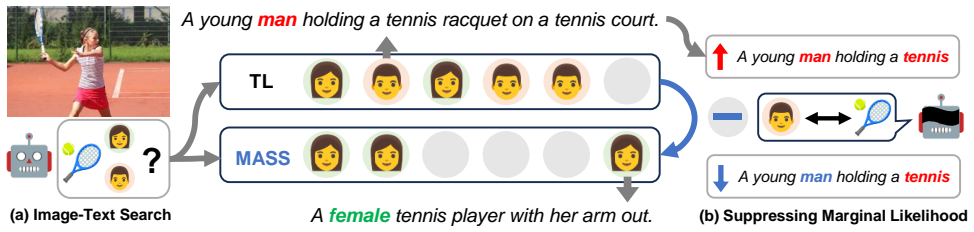
MASS (Multimodal ASsociation Score) is the central mechanism, defined by Eq. 9 as the per-token log-ratio $\log \frac{p_{\bar\theta}(x_t | x_{<t}, c)}{p_{\bar\theta}(x_t | x_{<t}, c_\emptyset)}$, with $c_\emptyset$ a black-filled image. The black-image baseline is the load-bearing device: it gives a one-pass estimate of the text-only marginal, letting the score subtract the language prior without Monte Carlo sampling across many images. Averaging these per-token log-ratios over the sequence produces a debiased similarity score that can be plugged into any off-the-shelf autoregressive vision-language model.
What would settle it
Compute MASS on a set of 100 captions where language prior conflicts with visual evidence, and compare its ranking with a Monte Carlo estimate of pointwise mutual information using many natural images as the marginal; if the black-image score ranks true captions below rivals while the Monte Carlo version ranks them above, the null-image approximation is the failure point.
Extended reading notes
Core claim
On the paper's own terms, the log-likelihood a captioning model assigns to a caption decomposes into a linguistic component (the text prior) and an association component that measures genuine image-text correspondence. MASS separates the two by computing, per token, the log ratio of the image-conditioned token probability to the token probability given a black image, which the paper argues approximates the text-only marginal $p_{\bar\theta}(x_t | x_{<t})$. Averaged over the caption, this ratio is an estimate of pointwise mutual information; using it as the similarity metric instead of raw token likelihood removes the language prior. The paper shows that MASS outperforms token likelihood and CLIP-based scores on color debiasing, adversarial counting, and gender-balanced retrieval, and that on Winoground and SVO-Probes it improves groupscore and image-score, indicating that the debiasing does not come at the cost of linguistic compositionality.
Load-bearing premise
The load-bearing premise is that a black image makes the model produce the same token probabilities as it would with no visual information at all, so the subtraction removes the language prior rather than adding an arbitrary per-token constant.
Editorial extensions
If this is right
- MASS turns any autoregressive vision-language model into a debiased image-text similarity scorer with only two forward passes per sample, no training, and no hyperparameters.
- On adversarial counting foils (true captions with large numbers versus foils with small numbers), MASS raises OFA-large's pairwise ranking accuracy from 66.8 to 76.7, matching the best multitask baseline.
- On Winoground, MASS lifts OFA-large's groupscore from 15.8 (token likelihood) to 20.3, with the gain concentrated on the No-Tag subset that isolates compositionality.
- In gender-balanced retrieval on MS-COCO, MASS improves both text-to-image and image-to-text recall over token likelihood while keeping bias scores low, unlike debiasing baselines that trade recall for fairness.
- The improvement transfers across backbone families: MASS raises groupscore for OFA, BLIP-2, and LLaVA, suggesting the language-prior subtraction generalizes beyond a single architecture.
Reading between the lines
- We would test the null-image shortcut directly: on a set of captions with a strong language prior (e.g., gray tomato), compare MASS ranking against a Monte Carlo marginal estimate averaged over many natural images; if the rankings diverge on high-bias items, the black-image approximation, not the PMI idea, is the fragile component.
- The likelihood-ratio recipe may transfer to other tasks that suffer from language priors, such as hallucination detection in image captioning or debiasing text-to-image generation scores.
- Because the method needs no retraining, it can serve as a cheap audit tool: applying MASS to a new VLM reveals where its token likelihoods are dominated by textual stereotypes rather than visual evidence.
Editorial analysis
A structured set of objections, weighed in public.
Referee Report
Summary. The paper proposes MASS, an inference-time score for image-text matching that subtracts a text-only marginal term from the token-level conditional likelihood of an autoregressive vision-language model, aiming to reduce language bias. The score is defined as the average per-token log-ratio of the image-conditioned likelihood to the likelihood under a black 'null image' surrogate, which is claimed to approximate the text-only marginal. Experiments cover color bias, counting, gender bias in retrieval, and the compositionality benchmarks Winoground and SVO-Probes, using OFA, BLIP-2, and LLaVA backbones. The central empirical claim is that MASS improves over raw token likelihood and CLIP-style baselines on these tasks without additional training.
Significance. If the empirical claim holds, the paper would offer a simple, training-free, hyperparameter-free recipe for reducing language bias in image-text matching, with potential practical value in retrieval and fairness-oriented applications. The paper is commendable for evaluating across multiple backbones, reporting a fine-grained Winoground category breakdown, and including qualitative examples. However, the theoretical framing of MASS as pointwise mutual information rests on an invalid Monte Carlo identity and an unvalidated null-image surrogate, and the closest prior method using null images and PMI is acknowledged but not compared experimentally. These issues leave the mechanism of the reported improvements unclear, even though the empirical results are suggestive and mostly consistent with the paper's claims. The manuscript is worth further consideration after the load-bearing validation and comparison gaps are addressed.
major comments (4)
- [§3.2, Eqs. (7)-(8)] The displayed Monte Carlo identity is mathematically incorrect. The marginal log-likelihood is log pθ(xt|x<t) = log ∫_C pθ(xt|x<t,c) p(c) dc, not ∫_C log pθ(xt|x<t,c) dc. Averaging log-conditionals as in Eq. (8) estimates E_c[log pθ(xt|x<t,c)], which by Jensen's inequality is not equal to log E_c[pθ(xt|x<t,c)], and the prior p(c) over images is missing. Since this derivation is presented as the motivation for the black-image surrogate in Eq. (9), the paper should either correct it or explicitly state that Eq. (9) is a heuristic and not a valid Monte Carlo estimate of the marginal.
- [§3.2, Eq. (9)] The central approximation that the black-filled image c∅ satisfies log pθ(xt|x<t,c∅) ≈ log pθ(xt|x<t) is asserted without evidence. This is load-bearing: if c∅ is out-of-distribution for a model trained on natural images, MASS is not pointwise mutual information but token likelihood shifted by per-token, per-prefix offsets log pθ(xt|x<t,c∅), and the debiasing effect has no theoretical grounding. The authors should validate the approximation empirically, for example by comparing pθ(·|x<t,c∅) against a Monte Carlo estimate using random natural images (with the corrected formula), and by testing sensitivity to the choice of null input (black, gray, noise, or blurred images).
- [§6, Related Work] Lin et al. (2024), which the paper explicitly acknowledges as sharing the null-image and PMI methodology, is never compared experimentally. Since the claim that MASS outperforms strong baselines is central to the paper, a direct comparison on at least Winoground and SVO-Probes (or a clearly stated reason why a direct comparison is infeasible) is needed. Without it, the incremental contribution over the closest prior method is not established.
- [Tables 1-4] No uncertainty quantification is reported for any of the main results. Several improvements are small in absolute terms, for example the OFA-large balanced counting gain of +1.5 in Table 1, the BLIP-2 Winoground group-score gain of +2.5 in Table 3, and the decreases in some BLIP-2/LLaVA rows. Bootstrapped confidence intervals or paired significance tests over the benchmark samples are necessary to assess whether these differences are reliable, even though the scoring functions themselves are deterministic.
minor comments (5)
- [§2.2, Eq. (3) and §3.1, Eq. (6)] The summation index is written as t<l, which would exclude the final token; the sums should run over t=1,...,l. Please correct the notation.
- [Appendix D, Table 5] The UNITER baseline appears in Table 5 but is not cited or introduced in the main text; please add the appropriate reference and clarify where it appears in the experiments.
- [§4.3] The phrase 'at an expanse of high degradation' should be 'at the expense of high degradation'; the same typo occurs in the following paragraph.
- [Author list and references] There are formatting issues in the author list ('Y oungjae Yu') and in the VAL SE dataset name ('V ALSE'); please clean these up.
- [§3.2] The phrase 'we discovered that using image input as a null image c∅ ... is a good alternative' is a strong claim; please replace it with a verifiable statement and provide the validation requested in the major comments.
Circularity Check
No significant circularity: MASS is a fixed, benchmark-free function of off-the-shelf model likelihoods, and its gains are not fitted into existence.
full rationale
The derivation chain for MASS (Eqs. 5-9) is not circular. Eq. 6 defines the score as a per-token log-ratio of image-conditioned to text-only likelihood, and Eq. 9 substitutes a black-image conditional for the unavailable marginal. No parameter is tuned on any evaluation benchmark: the same frozen score is applied to the color, counting, gender, Winoground, and SVO-Probes tests, so the reported improvements cannot be an artifact of fitting the method to the test labels. The load-bearing step is the identification of p_theta(xt|x<t,c_empty) with p_theta(xt|x<t). This is an empirical approximation, not a definitional identity, and the paper's own derivation of the marginal is mathematically invalid: Eq. 7 writes log p(x) as an integral of log-conditionals, whereas the correct marginal is the log of an integral of conditionals weighted by p(c). That is a correctness and validation gap, not circularity: the score would be a poor PMI estimate if the surrogate fails, but the score itself is not defined in terms of the benchmarks it is claimed to predict. The only self-citation (Yu et al. 2023, in the introduction) is non-load-bearing context about CLIP-score uses, and the paper explicitly acknowledges the closely related null-image PMI method of Lin et al. (2024), so no load-bearing premise is smuggled in by self-citation. The Broader Impact section candidly notes that MASS 'relies on the output of visual-language models' and cannot audit hidden model biases, a stated limitation rather than a circular step.
Assumptions & free parameters
assumptions (3)
- ad hoc to paper The black image c∅ conditional pθ(xt|x<t,c∅) approximates the text-only marginal pθ(xt|x<t).
- domain assumption Autoregressive captioning likelihoods are well-calibrated estimates of the true conditional p(x|c).
- domain assumption Averaging token-level PMI over the sequence gives a valid image-text similarity score.
invented entities (1)
-
Null image c∅ (black-filled image)
Cite this review
Pith. "Pith review of MASS: Overcoming Language Bias in Image-Text Matching." pith.science (2026). https://pith.science/paper/AAITS4U4
@misc{pith2026250111469,
  author       = {Pith},
  title        = {Pith review of: MASS: Overcoming Language Bias in Image-Text Matching},
  year         = {2026},
  howpublished = {\url{https://pith.science/paper/AAITS4U4}},
  note         = {Machine review of arXiv:2501.11469}
}
read the original abstract
Pretrained visual-language models have made significant advancements in multimodal tasks, including image-text retrieval. However, a major challenge in image-text matching lies in language bias, where models predominantly rely on language priors and neglect to adequately consider the visual content. We thus present Multimodal ASsociation Score (MASS), a framework that reduces the reliance on language priors for better visual accuracy in image-text matching problems. It can be seamlessly incorporated into existing visual-language models without necessitating additional training. Our experiments have shown that MASS effectively lessens language bias without losing an understanding of linguistic compositionality. Overall, MASS offers a promising solution for enhancing image-text matching performance in visual-language models.
Figures


Figures from the paper (4 more)


Reference graph
Works this paper leans on
-
[1]
, " * write output.state after.block = add.period write newline
ENTRY address archivePrefix author booktitle chapter edition editor eid eprint howpublished institution isbn journal key month note number organization pages publisher school series title type volume year label extra.label sort.label short.list INTEGERS output.state before.all mid.sentence after.sentence after.block FUNCTION init.state.consts #0 'before.a...
-
[2]
write newline
" write newline "" before.all 'output.state := FUNCTION n.dashify 't := "" t empty not t #1 #1 substring "-" = t #1 #2 substring "--" = not "--" * t #2 global.max substring 't := t #1 #1 substring "-" = "-" * t #2 global.max substring 't := while if t #1 #1 substring * t #2 global.max substring 't := if while FUNCTION word.in bbl.in capitalize " " * FUNCT...
-
[3]
Agrawal, A.; Batra, D.; and Parikh, D. 2016. Analyzing the Behavior of Visual Question Answering Models. In Proceedings of the 2016 Conference on Empirical Methods in Natural Language Processing, 1955--1960
work page 2016
-
[4]
Agrawal, A.; Batra, D.; Parikh, D.; and Kembhavi, A. 2018. Don't just assume; look and answer: Overcoming priors for visual question answering. In Proceedings of the IEEE conference on computer vision and pattern recognition, 4971--4980
work page 2018
-
[5]
Alayrac, J.-B.; Donahue, J.; Luc, P.; Miech, A.; Barr, I.; Hasson, Y.; Lenc, K.; Mensch, A.; Millican, K.; Reynolds, M.; et al. 2022. Flamingo: a visual language model for few-shot learning. Advances in neural information processing systems, 35: 23716--23736
2022
-
[6]
Anwar, S.; Tahir, M.; Li, C.; Mian, A.; Khan, F. S.; and Muzaffar, A. W. 2020. Image colorization: A survey and dataset. arXiv preprint arXiv:2008.10774
arXiv 2020
-
[7]
Beaumont, R. 2022. Clip retrieval: Easily compute clip embeddings and build a clip retrieval system with them. GitHub
work page 2022
-
[8]
Birhane, A.; Prabhu, V. U.; and Kahembwe, E. 2021. Multimodal datasets: misogyny, pornography, and malignant stereotypes. arXiv preprint arXiv:2110.01963
arXiv 2021
Show all 63 references
-
[9]
Chen, X.; Fang, H.; Lin, T.-Y.; Vedantam, R.; Gupta, S.; Doll \'a r, P.; and Zitnick, C. L. 2015. Microsoft coco captions: Data collection and evaluation server. arXiv preprint arXiv:1504.00325
2015 arXiv
-
[10]
E.; et al
Chiang, W.-L.; Li, Z.; Lin, Z.; Sheng, Y.; Wu, Z.; Zhang, H.; Zheng, L.; Zhuang, S.; Zhuang, Y.; Gonzalez, J. E.; et al. 2023. Vicuna: An open-source chatbot impressing gpt-4 with 90\ quality, March 2023. URL https://lmsys. org/blog/2023-03-30-vicuna, 3(5)
2023
-
[11]
Davidson, T.; Bhattacharya, D.; and Weber, I. 2019. Racial bias in hate speech and abusive language detection datasets. arXiv preprint arXiv:1905.12516
2019 arXiv
-
[12]
de Vassimon Manela, D.; Errington, D.; Fisher, T.; van Breugel, B.; and Minervini, P. 2021. Stereotype and skew: Quantifying gender bias in pre-trained and fine-tuned language models. In Proceedings of the 16th Conference of the European Chapter of the Association for Computat...
2021
-
[13]
Diwan, A.; Berry, L.; Choi, E.; Harwath, D.; and Mahowald, K. 2022. Why is winoground hard? investigating failures in visuolinguistic compositionality. arXiv preprint arXiv:2211.00768
2022 arXiv
-
[14]
Elazar, Y.; Zhang, H.; Goldberg, Y.; and Roth, D. 2021. Back to Square One: Artifact Detection, Training and Commonsense Disentanglement in the Winograd Schema. In Proceedings of the 2021 Conference on Empirical Methods in Natural Language Processing, 10486--10500
2021
-
[15]
Garcia, N.; Hirota, Y.; Wu, Y.; and Nakashima, Y. 2023. Uncurated image-text datasets: Shedding light on demographic bias. In Proceedings of the IEEE/CVF Conference on Computer Vision and Pattern Recognition, 6957--6966
2023
-
[16]
Goyal, Y.; Khot, T.; Summers-Stay, D.; Batra, D.; and Parikh, D. 2017. Making the v in vqa matter: Elevating the role of image understanding in visual question answering. In Proceedings of the IEEE conference on computer vision and pattern recognition, 6904--6913
2017
-
[17]
A.; Burns, K.; Saenko, K.; Darrell, T.; and Rohrbach, A
Hendricks, L. A.; Burns, K.; Saenko, K.; Darrell, T.; and Rohrbach, A. 2018. Women also snowboard: Overcoming bias in captioning models. In Proceedings of the European conference on computer vision (ECCV), 771--787
2018
-
[18]
A.; and Nematzadeh, A
Hendricks, L. A.; and Nematzadeh, A. 2021. Probing Image-Language Transformers for Verb Understanding. In Findings of the Association for Computational Linguistics: ACL-IJCNLP 2021, 3635--3644
2021
-
[19]
Hessel, J.; Holtzman, A.; Forbes, M.; Le Bras, R.; and Choi, Y. 2021. CLIPScore: A Reference-free Evaluation Metric for Image Captioning. In Proceedings of the 2021 Conference on Empirical Methods in Natural Language Processing, 7514--7528
2021
-
[20]
Honnibal, M.; and Montani, I. 2017. spaCy 2: Natural language understanding with Bloom embeddings, convolutional neural networks and incremental parsing. To appear, 7(1): 411--420
2017
-
[21]
Karpathy, A.; and Fei-Fei, L. 2015. Deep visual-semantic alignments for generating image descriptions. In Proceedings of the IEEE conference on computer vision and pattern recognition, 3128--3137
2015
-
[22]
Lee, K.-H.; Chen, X.; Hua, G.; Hu, H.; and He, X. 2018. Stacked cross attention for image-text matching. In Proceedings of the European conference on computer vision (ECCV), 201--216
2018
-
[23]
Li, J.; Galley, M.; Brockett, C.; Gao, J.; and Dolan, B. 2015. A diversity-promoting objective function for neural conversation models. arXiv preprint arXiv:1510.03055
2015 arXiv
-
[24]
Li, J.; Li, D.; Savarese, S.; and Hoi, S. 2023. Blip-2: Bootstrapping language-image pre-training with frozen image encoders and large language models. In International conference on machine learning, 19730--19742. PMLR
2023
-
[25]
Li, J.; Li, D.; Xiong, C.; and Hoi, S. 2022. Blip: Bootstrapping language-image pre-training for unified vision-language understanding and generation. In International conference on machine learning, 12888--12900. PMLR
2022
-
[26]
Li, J.; Selvaraju, R.; Gotmare, A.; Joty, S.; Xiong, C.; and Hoi, S. C. H. 2021. Align before fuse: Vision and language representation learning with momentum distillation. Advances in neural information processing systems, 34: 9694--9705
2021
-
[27]
H.; Yatskar, M.; Yin, D.; Hsieh, C.-J.; and Chang, K.-W
Li, L. H.; Yatskar, M.; Yin, D.; Hsieh, C.-J.; and Chang, K.-W. 2019. Visualbert: A simple and performant baseline for vision and language. arXiv preprint arXiv:1908.03557
2019 arXiv
-
[28]
Lin, Z.; Chen, X.; Pathak, D.; Zhang, P.; and Ramanan, D. 2024. Revisiting the Role of Language Priors in Vision-Language Models. In Forty-first International Conference on Machine Learning
2024
-
[29]
Liu, H.; Li, C.; Wu, Q.; and Lee, Y. J. 2024. Visual instruction tuning. Advances in neural information processing systems, 36
2024
-
[30]
Lu, J.; Batra, D.; Parikh, D.; and Lee, S. 2019. Vilbert: Pretraining task-agnostic visiolinguistic representations for vision-and-language tasks. Advances in neural information processing systems, 32
2019
-
[31]
Lu, J.; Clark, C.; Zellers, R.; Mottaghi, R.; and Kembhavi, A. 2022. Unified-io: A unified model for vision, language, and multi-modal tasks. In The Eleventh International Conference on Learning Representations
2022
-
[32]
Lu, J.; Goswami, V.; Rohrbach, M.; Parikh, D.; and Lee, S. 2020. 12-in-1: Multi-Task Vision and Language Representation Learning. In The IEEE/CVF Conference on Computer Vision and Pattern Recognition (CVPR)
2020
-
[33]
Nikolaus, M.; Salin, E.; Ayache, S.; Fourtassi, A.; and Favre, B. 2022. Do Vision-and-Language Transformers Learn Grounded Predicate-Noun Dependencies? In Proceedings of the 2022 Conference on Empirical Methods in Natural Language Processing
2022
-
[34]
Niu, Y.; Tang, K.; Zhang, H.; Lu, Z.; Hua, X.; and rong Wen, J. 2020. Counterfactual VQA: A Cause-Effect Look at Language Bias. 2021 IEEE/CVF Conference on Computer Vision and Pattern Recognition (CVPR), 12695--12705
2020
-
[35]
Oord, A. v. d.; Li, Y.; and Vinyals, O. 2018. Representation learning with contrastive predictive coding. arXiv preprint arXiv:1807.03748
2018 arXiv
-
[36]
Parcalabescu, L.; Cafagna, M.; Muradjan, L.; Frank, A.; Calixto, I.; and Gatt, A. 2022. VALSE: A Task-Independent Benchmark for Vision and Language Models Centered on Linguistic Phenomena. In Proceedings of the 60th Annual Meeting of the Association for Computational Linguisti...
2022
-
[37]
Parcalabescu, L.; Gatt, A.; Frank, A.; and Calixto, I. 2021. Seeing past words: Testing the cross-modal capabilities of pretrained V&L models on counting tasks. IWCS 2021, 32
2021
-
[38]
E.; Darrell, T.; Rohrbach, A.; and Rohrbach, M
Petryk, S.; Whitehead, S.; Gonzalez, J. E.; Darrell, T.; Rohrbach, A.; and Rohrbach, M. 2024. Simple token-level confidence improves caption correctness. In Proceedings of the IEEE/CVF Winter Conference on Applications of Computer Vision, 5742--5752
2024
-
[39]
W.; Hallacy, C.; Ramesh, A.; Goh, G.; Agarwal, S.; Sastry, G.; Askell, A.; Mishkin, P.; Clark, J.; Krueger, G.; and Sutskever, I
Radford, A.; Kim, J. W.; Hallacy, C.; Ramesh, A.; Goh, G.; Agarwal, S.; Sastry, G.; Askell, A.; Mishkin, P.; Clark, J.; Krueger, G.; and Sutskever, I. 2021. Learning Transferable Visual Models From Natural Language Supervision. In International Conference on Machine Learning
2021
-
[40]
Ramakrishnan, S.; Agrawal, A.; and Lee, S. 2018. Overcoming language priors in visual question answering with adversarial regularization. Advances in Neural Information Processing Systems, 31
2018
-
[41]
Ross, C.; Katz, B.; and Barbu, A. 2021. Measuring Social Biases in Grounded Vision and Language Embeddings. In Proceedings of the 2021 Conference of the North American Chapter of the Association for Computational Linguistics: Human Language Technologies, 998--1008
2021
-
[42]
Salin, E.; Farah, B.; Ayache, S.; and Favre, B. 2022. Are vision-language transformers learning multimodal representations? a probing perspective. In Proceedings of the AAAI Conference on Artificial Intelligence, volume 36, 11248--11257
2022
-
[43]
Shekhar, R.; Pezzelle, S.; Klimovich, Y.; Herbelot, A.; Nabi, M.; Sangineto, E.; and Bernardi, R. 2017. FOIL it! Find One mismatch between Image and Language caption. In Proceedings of the 55th Annual Meeting of the Association for Computational Linguistics (Volume 1: Long Pap...
2017
-
[44]
Si, Q.; Liu, Y.; Meng, F.; Lin, Z.; Fu, P.; Cao, Y.; Wang, W.; and Zhou, J. 2022. Towards Robust Visual Question Answering: Making the Most of Biased Samples via Contrastive Learning. In Findings of the Association for Computational Linguistics: EMNLP 2022, 6650--6662
2022
-
[45]
Srinivasan, T.; and Bisk, Y. 2021. Worst of both worlds: Biases compound in pre-trained vision-and-language models. arXiv preprint arXiv:2104.08666
2021 arXiv
-
[46]
Tan, H.; and Bansal, M. 2019. Lxmert: Learning cross-modality encoder representations from transformers. arXiv preprint arXiv:1908.07490
2019 arXiv
-
[47]
Thrush, T.; Jiang, R.; Bartolo, M.; Singh, A.; Williams, A.; Kiela, D.; and Ross, C. 2022. Winoground: Probing vision and language models for visio-linguistic compositionality. In Proceedings of the IEEE/CVF Conference on Computer Vision and Pattern Recognition, 5238--5248
2022
-
[48]
Touvron, H.; Lavril, T.; Izacard, G.; Martinet, X.; Lachaux, M.-A.; Lacroix, T.; Rozi \`e re, B.; Goyal, N.; Hambro, E.; Azhar, F.; et al. 2023. Llama: Open and efficient foundation language models. arXiv preprint arXiv:2302.13971
2023 arXiv
-
[49]
Tschannen, M.; Kumar, M.; Steiner, A.; Zhai, X.; Houlsby, N.; and Beyer, L. 2024. Image captioners are scalable vision learners too. Advances in Neural Information Processing Systems, 36
2024
-
[50]
Van der Poel, L.; Cotterell, R.; and Meister, C. 2022. Mutual information alleviates hallucinations in abstractive summarization. arXiv preprint arXiv:2210.13210
2022 arXiv
-
[51]
Wang, J.; Liu, Y.; and Wang, X. 2021. Are Gender-Neutral Queries Really Gender-Neutral? Mitigating Gender Bias in Image Search. In Proceedings of the 2021 Conference on Empirical Methods in Natural Language Processing, 1995--2008
2021
-
[52]
Wang, J.; Yang, Z.; Hu, X.; Li, L.; Lin, K.; Gan, Z.; Liu, Z.; Liu, C.; and Wang, L. 2022 a . Git: A generative image-to-text transformer for vision and language. arXiv preprint arXiv:2205.14100
2022 arXiv
-
[53]
Wang, P.; Yang, A.; Men, R.; Lin, J.; Bai, S.; Li, Z.; Ma, J.; Zhou, C.; Zhou, J.; and Yang, H. 2022 b . Ofa: Unifying architectures, tasks, and modalities through a simple sequence-to-sequence learning framework. In International Conference on Machine Learning, 23318--23340. PMLR
2022
-
[54]
Yamada, Y.; Tang, Y.; and Yildirim, I. 2022. When are lemons purple? the concept association bias of clip. arXiv preprint arXiv:2212.12043
2022 arXiv
-
[55]
Young, P.; Lai, A.; Hodosh, M.; and Hockenmaier, J. 2014. From image descriptions to visual denotations: New similarity metrics for semantic inference over event descriptions. Transactions of the Association for Computational Linguistics, 2: 67--78
2014
-
[56]
S.; Lu, X.; Zellers, R.; Ammanabrolu, P.; Le Bras, R.; Kim, G.; et al
Yu, Y.; Chung, J.; Yun, H.; Hessel, J.; Park, J. S.; Lu, X.; Zellers, R.; Ammanabrolu, P.; Le Bras, R.; Kim, G.; et al. 2023. Fusing pre-trained language models with multimodal prompts through reinforcement learning. In Proceedings of the IEEE/CVF Conference on Computer Vision...
2023
-
[57]
Yuksekgonul, M.; Bianchi, F.; Kalluri, P.; Jurafsky, D.; and Zou, J. 2022. When and why vision-language models behave like bags-of-words, and what to do about it? In The Eleventh International Conference on Learning Representations
2022
-
[58]
Zhang, P.; Goyal, Y.; Summers-Stay, D.; Batra, D.; and Parikh, D. 2016. Yin and yang: Balancing and answering binary visual questions. In Proceedings of the IEEE conference on computer vision and pattern recognition, 5014--5022
2016
-
[59]
Zhang, P.; Li, X.; Hu, X.; Yang, J.; Zhang, L.; Wang, L.; Choi, Y.; and Gao, J. 2021. Vinvl: Revisiting visual representations in vision-language models. In Proceedings of the IEEE/CVF conference on computer vision and pattern recognition, 5579--5588
2021
-
[60]
Zhao, D.; Wang, A.; and Russakovsky, O. 2021. Understanding and evaluating racial biases in image captioning. In Proceedings of the IEEE/CVF International Conference on Computer Vision, 14830--14840
2021
-
[61]
Zhu, D.; Chen, J.; Shen, X.; Li, X.; and Elhoseiny, M. 2023. Minigpt-4: Enhancing vision-language understanding with advanced large language models. arXiv preprint arXiv:2304.10592
2023 arXiv
-
[62]
, " * write output.state after.block = add.period write
ENTRY address author booktitle chapter doi edition editor eid howpublished institution journal key month note number organization pages publisher school series title type url volume year label INTEGERS output.state before.all mid.sentence after.sentence after.block FUNCTION in...
-
[63]
write newline
" write newline "" before.all 'output.state := FUNCTION n.dashify 't := "" t empty not t #1 #1 substring "-" = t #1 #2 substring "--" = not "--" * t #2 global.max substring 't := t #1 #1 substring "-" = "-" * t #2 global.max substring 't := while if t #1 #1 substring * t #2 gl...
Reviewed August 10, 2026 · model on record in the stance chip above.
Discussion (0). Continue with ORCID to comment.