Multi-field Return Point Memory
Pith reviewed 2026-05-25 02:45 UTC · model grok-4.3
The pith
Sequences of multiple applied fields restore a hysteretic system to its exact previous microstate in the zero-temperature Ising model.
A machine-rendered reading of the paper's core claim, the machinery that carries it, and where it could break.
Core claim
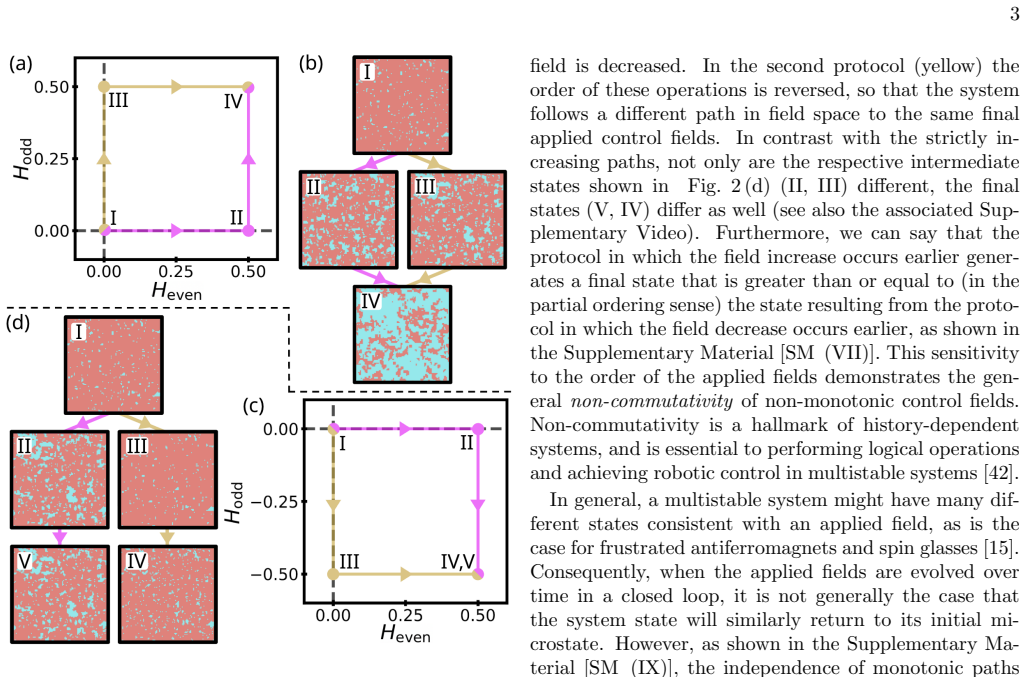
Within the zero-temperature Ising model subject to multiple control fields, an applied sequence of fields restores the hysteretic system not only to a previous magnetization, but to a previous exact microstate. The multiplicity of fields grants more precise and complex control of the system, with different classes of operations displaying commutative and noncommutative behavior.
What carries the argument
Multi-field return point memory obtained by generalizing partial ordering to systems with multiple control fields.
If this is right
- Sequences of fields can return the system to a chosen prior microstate rather than only a chosen magnetization.
- Some field sequences commute while others do not, producing distinct memory behaviors.
- Systems with exponentially many microstates become more controllable through the added fields.
- The same framework supplies a model for how physical systems can learn and be trained by field sequences.
Where Pith is reading between the lines
- If the effect holds in real materials, multi-field protocols could be used to write specific microstates into spin glasses or granular media.
- Finite-temperature versions of the model would test whether thermal fluctuations destroy or preserve the exact-state return.
- The commutative versus noncommutative distinction may connect to programmable hysteresis in engineered metamaterials.
- Similar multi-field memory might appear in other models of multistability, such as those for martensitic transformations.
Load-bearing premise
The zero-temperature Ising model with multiple fields is a faithful proxy for the memory behavior of real multistable systems such as spin glasses, martensites, and granular matter.
What would settle it
Apply a sequence of multiple fields to a real spin glass or granular sample and check whether the exact microstate is recovered, for instance by direct imaging or by measuring higher-order correlation functions that distinguish configurations with the same magnetization.
Figures



read the original abstract
Non-equilibrium systems display memory, a dependence not merely on their present environment but on previously applied fields. Multistable systems such as spin glasses, martensites and granular matter have exponentially many microstates consistent with an applied field, making their rich dynamics difficult to control. Control and order can be achieved through the concept of partial ordering, which we here generalize to systems subject to multiple control fields. We demonstrate, within the model system of the zero-temperature Ising model, that this leads to return-point memory, in which an applied sequence of fields restores the hysteretic system not only to a previous magnetization, but to a previous exact microstate. The multiplicity of fields grants more precise and complex control of the system, with different classes of operations displaying commutative and noncommutative behavior. This grants new insight into how physical systems can remember, learn, and be trained.
Editorial analysis
A structured set of objections, weighed in public.
Referee Report
Summary. The manuscript generalizes the concept of partial ordering to hysteretic systems controlled by multiple fields. It claims that, in the zero-temperature Ising model, specific sequences of these fields restore the system not only to a prior magnetization value but to the exact previous microstate, realizing multi-field return-point memory. The work further identifies commutative and noncommutative classes of operations enabled by the additional fields.
Significance. If the central demonstration holds, the result supplies a concrete, model-internal mechanism for exact microstate restoration in multistable systems. The zero-temperature Ising setting permits direct verification of microstate identity, which is a clear strength of the approach and distinguishes it from purely macroscopic treatments of hysteresis.
minor comments (3)
- [Abstract] The abstract asserts a demonstration within the Ising model but supplies no reference to the specific update rule, field protocol, or system size used; a single sentence in the abstract or a pointer to §2 would improve accessibility.
- [Introduction] Notation for the multiple fields (e.g., H_x, H_y) and the partial-order relation should be introduced once in the main text with an explicit definition before being used in later sections.
- Figure captions could explicitly state the lattice size and boundary conditions employed in the simulations so that the microstate-recovery claim can be reproduced without consulting the methods section.
Simulated Author's Rebuttal
We thank the referee for the positive summary and for highlighting the significance of our demonstration that multi-field sequences in the zero-temperature Ising model realize exact microstate return-point memory, along with the identification of commutative and noncommutative operation classes. The recommendation of minor revision is noted. No specific major comments appear in the report, so we have no points requiring point-by-point rebuttal.
Circularity Check
No significant circularity; derivation is model-internal and self-contained
full rationale
The paper's central result is a direct demonstration inside the zero-temperature Ising model that multi-field sequences restore exact prior microstates via a generalization of partial ordering. No equations, fitted parameters, or predictions appear in the provided text. No self-citations are invoked as load-bearing premises, no ansatz is smuggled, and no renaming of known results occurs. The claim reduces only to the model's own dynamics and the stated generalization, with no reduction by construction to its own inputs. This is the normal case of a self-contained theoretical result.
Axiom & Free-Parameter Ledger
axioms (1)
- domain assumption The zero-temperature Ising model with multiple fields exhibits return-point memory to exact microstates.
Reference graph
Works this paper leans on
-
[1]
R. K. Pathria,Statistical Mechanics: International Se- ries of Monographs in Natural Philosophy, Vol. 45 (Else- vier, 2017)
work page 2017
-
[2]
N. C. Keim, J. D. Paulsen, Z. Zeravcic, S. Sastry, and S. R. Nagel, Memory formation in matter, Reviews of Modern Physics91, 035002 (2019)
work page 2019
-
[3]
J. D. Paulsen and N. C. Keim, Mechanical memories in solids, from disorder to design, Annual Review of Con- densed Matter Physics16, 61 (2025)
work page 2025
-
[4]
S. N. Coppersmith and P. B. Littlewood, Pulse-duration memory effect and deformable charge-density waves, Physical Review B36, 311 (1987)
work page 1987
-
[5]
S. N. Coppersmith, T. C. Jones, L. P. Kadanoff, A. Levine, S. R. Nagel, and S. C. Venkataramani, Self- organized short-term memories, Physical Review Letters 78, 3983 (1997)
work page 1997
-
[6]
C. Josserand, A. V. Tkachenko, D. M. Mueth, and H. M. Jaeger, Memory effects in granular materials, Physical Review Letters85, 3632 (2000)
work page 2000
-
[7]
N. C. Keim and S. R. Nagel, Generic transient memory formation in disordered systems with noise, Physical Re- view Letters107, 010603 (2011)
work page 2011
-
[8]
J. D. Paulsen, N. C. Keim, and S. R. Nagel, Multi- ple transient memories in experiments on sheared non- brownian suspensions, Physical Review Letters113, 068301 (2014)
work page 2014
- [9]
-
[10]
S. Dillavou and S. M. Rubinstein, Nonmonotonic aging and memory in a frictional interface, Physical Review Letters120, 224101 (2018)
work page 2018
-
[11]
N. C. Keim and D. Medina, Mechanical annealing and memories in a disordered solid, Science Advances8, eabo1614 (2022)
work page 2022
-
[12]
D. Shohat and Y. Lahini, Dissipation indicates memory formation in driven disordered solids, Physical Review Letters130, 048202 (2023)
work page 2023
- [13]
-
[14]
S. Mukherji, N. Kandula, A. K. Sood, and R. Ganapathy, Strength of mechanical memories is maximal at the yield point of a soft glass, Physical Review Letters122, 158001 (2019)
work page 2019
-
[15]
K. Binder and A. P. Young, Spin glasses: Experimental facts, theoretical concepts, and open questions, Reviews of Modern physics58, 801 (1986)
work page 1986
-
[16]
M. C. Marchetti, J.-F. Joanny, S. Ramaswamy, T. B. Liverpool, J. Prost, M. Rao, and R. A. Simha, Hydrody- namics of soft active matter, Reviews of modern physics 85, 1143 (2013)
work page 2013
-
[17]
J. J. Hopfield, Neural networks and physical systems with emergent collective computational abilities, Proceedings of the National Academy of Sciences79, 2554 (1982)
work page 1982
-
[18]
D. J. Amit, H. Gutfreund, and H. Sompolinsky, Spin- glass models of neural networks, Physical Review A32, 1007 (1985)
work page 1985
- [19]
- [20]
-
[21]
S. Dillavou, M. Stern, A. J. Liu, and D. J. Durian, Demonstration of decentralized physics-driven learning, Physical Review Applied18, 014040 (2022)
work page 2022
-
[22]
S. Dillavou, B. D. Beyer, M. Stern, A. J. Liu, M. Z. Miskin, and D. J. Durian, Machine learning without a processor: Emergent learning in a nonlinear analog net- work, Proceedings of the National Academy of Sciences 121, e2319718121 (2024)
work page 2024
-
[23]
M. Stern and A. Murugan, Learning without neurons in physical systems, Annual Review of Condensed Matter Physics14, 417 (2023)
work page 2023
- [24]
- [25]
-
[26]
A. A. Middleton, Asymptotic uniqueness of the sliding state for charge-density waves, Physical review letters68, 670 (1992)
work page 1992
-
[27]
J. P. Sethna, K. Dahmen, S. Kartha, J. A. Krumhansl, B. W. Roberts, and J. D. Shore, Hysteresis and hier- archies: Dynamics of disorder-driven first-order phase transformations, Physical Review Letters70, 3347 (1993)
work page 1993
-
[28]
J. P. Sethna, K. A. Dahmen, and O. Perkovic, Random- field ising models of hysteresis, inThe Science of Hys- teresis(Elsevier, 2006) pp. 107–179
work page 2006
-
[29]
J. M. Deutsch, A. Dhar, and O. Narayan, Return to re- turn point memory, Physical Review Letters92, 227203 (2004)
work page 2004
-
[30]
J. P. Sethna, M. K. Bierbaum, K. A. Dahmen, C. P. Goodrich, J. R. Greer, L. X. Hayden, J. P. Kent-Dobias, E. D. Lee, D. B. Liarte, X. Ni,et al., Deformation of crys- tals: Connections with statistical physics, Annual Review of Materials Research47, 217 (2017)
work page 2017
-
[31]
Ising, Beitrag zur theorie des ferromagnetismus, Zeitschrift f¨ ur Physik31, 253 (1925)
E. Ising, Beitrag zur theorie des ferromagnetismus, Zeitschrift f¨ ur Physik31, 253 (1925)
work page 1925
-
[32]
J. P. Sethna,Statistical mechanics: entropy, order pa- rameters, and complexity, Vol. 14 (Oxford University Press, 2021)
work page 2021
-
[33]
Cardy,Scaling and renormalization in statistical physics, Vol
J. Cardy,Scaling and renormalization in statistical physics, Vol. 5 (Cambridge university press, 1996)
work page 1996
- [34]
-
[35]
S. H. Kang, S. Shan, A. Koˇ smrlj, W. L. Noorduin, S. Shian, J. C. Weaver, D. R. Clarke, and K. Bertoldi, Complex ordered patterns in mechanical instability in- duced geometrically frustrated triangular cellular struc- tures, Physical review letters112, 098701 (2014). 6
work page 2014
-
[36]
A. Plummer and D. R. Nelson, Buckling and metastabil- ity in membranes with dilation arrays, Physical Review E102, 033002 (2020)
work page 2020
-
[37]
A. Plummer, P. Z. Hanakata, and D. R. Nelson, Curva- ture as an external field in mechanical antiferromagnets, Physical Review Materials6, 115203 (2022)
work page 2022
-
[38]
N. G. Fytas, V. Mart´ ın-Mayor, M. Picco, and N. Sourlas, Review of recent developments in the random-field ising model, Journal of Statistical Physics172, 665 (2018)
work page 2018
-
[39]
D. Belanger and A. Young, The random field ising model, Journal of magnetism and magnetic materials100, 272 (1991)
work page 1991
-
[40]
D. Dhar, Self-organized critical state of sandpile automa- ton models, Physical Review Letters64, 1613 (1990)
work page 1990
-
[41]
P. Bak, C. Tang, and K. Wiesenfeld, Self-organized crit- icality: An explanation of the 1/f noise, Physical review letters59, 381 (1987)
work page 1987
-
[42]
T. Zhao, X. Dang, K. Manos, S. Zang, J. Mandal, M. Chen, and G. H. Paulino, Modular chiral origami metamaterials, Nature640, 931 (2025)
work page 2025
-
[43]
O. Perkovi´ c and J. P. Sethna, Improved magnetic infor- mation storage using return-point memory, Journal of applied physics81, 1590 (1997)
work page 1997
- [44]
discussion (0)
Sign in with ORCID, Apple, or X to comment. Anyone can read and Pith papers without signing in.