Amplitude-Phase-Frequency Block Modulation for OFDM-ISAC with SI-Free PAPR Reduction and Pilotless Sensing
Pith reviewed 2026-06-26 15:54 UTC · model grok-4.3
The pith
A new block modulation for OFDM-ISAC maps symbols to Jones vectors with a fixed per-block phase reference to reduce PAPR without side information and extract sensing data directly from the communication waveform.
A machine-rendered reading of the paper's core claim, the machinery that carries it, and where it could break.
Core claim
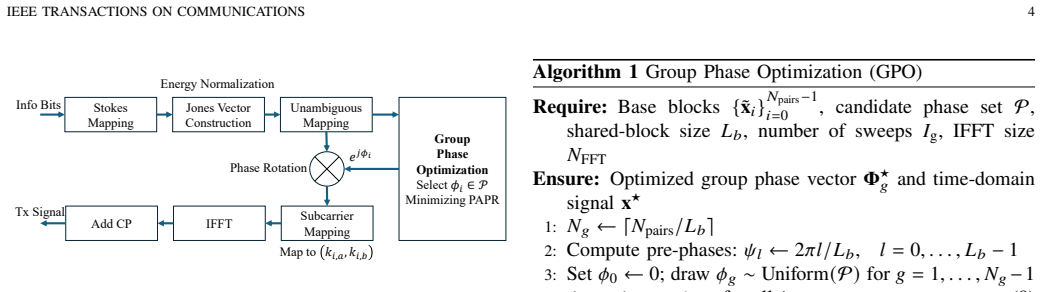
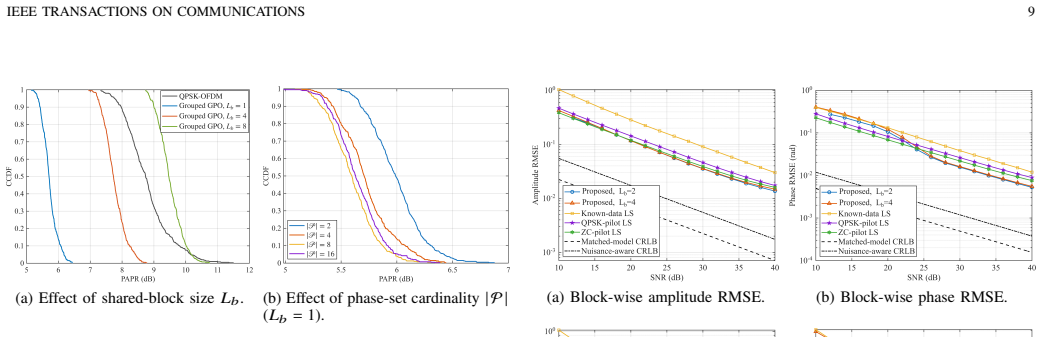
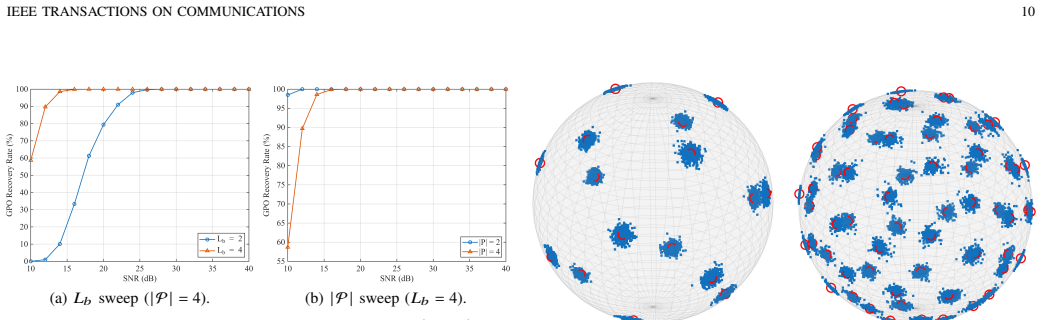
The central claim is that representing information symbols on the Stokes sphere and mapping them to energy-normalized Jones vectors via an unambiguous rule produces a deterministic phase reference per block. This common phase freedom is used at the transmitter for grouped phase optimization that achieves SI-free PAPR reduction and at the receiver for Viterbi-based joint phase recovery and block-wise channel estimation. No separate sensing pilots are transmitted because the required observables are obtained directly from the communication waveform.
What carries the argument
The Stokes-sphere to Jones-vector mapping that fixes a deterministic phase reference per block, enabling both grouped phase optimization at the transmitter and Viterbi ML sequence detection at the receiver.
If this is right
- PAPR reduction occurs without any side information being sent to the receiver.
- Channel amplitude and phase estimates are obtained block-wise without allocating sensing pilots.
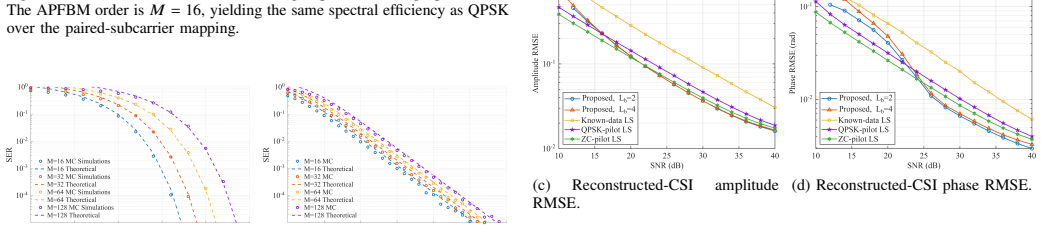
- Closed-form expressions give both symbol error rate and sensing accuracy as functions of SNR and block parameters.
- The same deterministic phase structure supports stable CSI reconstruction on real hardware links.
Where Pith is reading between the lines
- The phase-reference structure could be applied to other multicarrier waveforms that already use polarization or vector signaling.
- Block size and grouping parameters offer a direct trade-off knob between PAPR, spectral efficiency, and sensing accuracy that could be optimized per deployment.
- Viterbi detection complexity scales with block length, suggesting a possible limit on maximum block size before real-time processing becomes impractical.
Load-bearing premise
Information symbols can be represented on the Stokes sphere and mapped unambiguously to energy-normalized Jones vectors to establish a deterministic phase reference per block.
What would settle it
An experiment in which the measured phase-recovery error rate exceeds the closed-form bound or in which PAPR reduction disappears in hardware measurements would show the claim does not hold.
Figures



read the original abstract
Orthogonal Frequency Division Multiplexing (OFDM)-based integrated sensing and communication systems demand a unified waveform that simultaneously supports reliable data transmission, low peak-to-average power ratio (PAPR), and accurate channel sensing. Existing approaches multiplex communication and sensing across separate time or frequency resources, or rely on dedicated pilots for channel estimation, limiting system flexibility and increasing overhead. This paper proposes an amplitude-phase-frequency block modulation (APFBM) scheme for OFDM that achieves waveform-level integration of communication and sensing without resource partitioning. Information symbols are represented on the Stokes sphere and mapped to energy-normalized Jones vectors through an unambiguous rule that establishes a deterministic phase reference per block. This mapping exposes a commonphase degree of freedom inherent in the signal structure. At the transmitter, a grouped phase optimization algorithm exploits this structural freedom to reduce the PAPR without side information (SI). At the receiver, the same deterministic phase structure enables a Viterbi-based maximum-likelihood (ML) sequence detection algorithm that jointly recovers the optimization phases and estimates the block-wise channel amplitude and phase. No dedicated sensing pilots are required, as the sensing observables are extracted directly from the communication waveform. Closed-form error-rate and sensing-accuracy expressions are derived. Numerical simulations and over-the-air measurements on a software-defined radio link confirm effective PAPR reduction, accurate channel sensing, reliable phase recovery, and stable channel state information reconstruction. The proposed scheme trades a moderate reduction in spectral efficiency for a unified waveform design that simultaneously delivers SI-free PAPR reduction and pilotless sensing.
Editorial analysis
A structured set of objections, weighed in public.
Referee Report
Summary. The paper proposes an amplitude-phase-frequency block modulation (APFBM) scheme for OFDM-ISAC. Information symbols on the Stokes sphere are mapped to energy-normalized Jones vectors via an unambiguous rule establishing a deterministic per-block phase reference. This exposes a common phase degree of freedom used at the transmitter for grouped phase optimization to achieve SI-free PAPR reduction, and at the receiver for a Viterbi-based ML detector that jointly recovers phases and estimates block-wise channel amplitude/phase without dedicated pilots. Closed-form error-rate and sensing-accuracy expressions are derived; the scheme is validated by simulations and OTA SDR measurements.
Significance. If the mapping is unambiguous as claimed and the closed-form derivations hold, the work offers a waveform-level ISAC integration without time/frequency partitioning or pilot overhead. The exploitation of structural phase freedom for both PAPR control and pilotless sensing, together with closed-form expressions, would represent a meaningful advance over existing multiplexed or pilot-dependent approaches.
major comments (1)
- [Abstract and §3] Abstract (mapping rule) and §3 (Stokes-to-Jones mapping): the claim that the mapping is unambiguous and fixes a deterministic phase reference per block is load-bearing for both the SI-free optimization and the pilotless Viterbi recovery. The manuscript must explicitly enumerate or prove that no discrete global or intra-block phase ambiguities arise for any point on the Stokes sphere; otherwise the grouped phase optimization requires side information and the ML detector loses its ability to jointly estimate without pilots.
minor comments (2)
- [Abstract] Abstract: 'commonphase' is missing a space and should read 'common phase'.
- [Abstract] The abstract states that 'closed-form error-rate and sensing-accuracy expressions are derived' but does not indicate where these appear or whether they rely on the mapping being strictly unambiguous.
Simulated Author's Rebuttal
We thank the referee for their thorough review and positive assessment of the significance of our work. We address the major comment point by point below.
read point-by-point responses
-
Referee: [Abstract and §3] Abstract (mapping rule) and §3 (Stokes-to-Jones mapping): the claim that the mapping is unambiguous and fixes a deterministic phase reference per block is load-bearing for both the SI-free optimization and the pilotless Viterbi recovery. The manuscript must explicitly enumerate or prove that no discrete global or intra-block phase ambiguities arise for any point on the Stokes sphere; otherwise the grouped phase optimization requires side information and the ML detector loses its ability to jointly estimate without pilots.
Authors: We agree that the unambiguity of the mapping is fundamental to the proposed scheme, and that an explicit proof is required to fully substantiate the claims regarding SI-free PAPR reduction and pilotless sensing. The current manuscript describes the mapping rule in Section 3 as unambiguous, but we acknowledge that a detailed enumeration or formal proof addressing all points on the Stokes sphere, including potential discrete ambiguities, is not provided. In the revised manuscript, we will add this proof to Section 3, demonstrating that the rule establishes a unique phase reference without global or intra-block ambiguities for every Stokes vector. This will confirm that no side information is needed for the optimization or detection algorithms. revision: yes
Circularity Check
No significant circularity; derivation is self-contained via explicit design rule
full rationale
The abstract defines the core element as an 'unambiguous rule' mapping Stokes-sphere symbols to energy-normalized Jones vectors that establishes a deterministic per-block phase reference. This rule is presented as a design choice that exposes a structural degree of freedom, which is then exploited by the grouped phase optimization and Viterbi detector. No equations, fitted parameters, or self-citations are shown that would reduce any claimed performance (PAPR reduction, pilotless sensing, error-rate expressions) to an input by construction. The derivation chain therefore remains independent of its own outputs and does not match any of the enumerated circularity patterns.
Axiom & Free-Parameter Ledger
axioms (1)
- domain assumption Information symbols are represented on the Stokes sphere and mapped to energy-normalized Jones vectors through an unambiguous rule that establishes a deterministic phase reference per block.
Reference graph
Works this paper leans on
-
[1]
Integrated sensing and communications: Toward dual-functional wireless networks for 6g and beyond,
F. Liu, C. Masouros, A. Li, H. Sun, and L. Hanzo, “Integrated sensing and communications: Toward dual-functional wireless networks for 6g and beyond,”IEEE J. Sel. Areas Commun., vol. 40, no. 6, pp. 1728– 1767, 2022
2022
-
[2]
An overview of signal processing techniques for joint communication and radar sensing,
J. A. Zhang, F. Liu, C. Masouros, R. W. Heath, Z. Feng, L. Zheng, and A. Petropulu, “An overview of signal processing techniques for joint communication and radar sensing,”IEEE J. Sel. Topics Signal Process., vol. 15, no. 6, pp. 1295–1315, 2021
2021
-
[3]
A survey on fundamental limits of integrated sensing and communication,
A. Liu, Z. Huang, M. Li, Y . Wan, W. Li, T. X. Han, C. Liu, R. Du, D. K. P. Tan, J. Lu, Y . Shen, F. Colone, and K. Chetty, “A survey on fundamental limits of integrated sensing and communication,”IEEE Commun. Surveys Tuts., vol. 24, no. 2, pp. 994–1034, 2022
2022
-
[4]
Waveform design and signal processing aspects for fusion of wireless communications and radar sensing,
C. Sturm and W. Wiesbeck, “Waveform design and signal processing aspects for fusion of wireless communications and radar sensing,”Proc. IEEE, vol. 99, no. 7, pp. 1236–1259, 2011
2011
-
[5]
Multicarrier ISAC: Advances in waveform de- sign, signal processing, and learning under nonidealities,
V . Koivunen, M. F. Keskin, H. Wymeersch, M. Valkama, and N. González-Prelcic, “Multicarrier ISAC: Advances in waveform de- sign, signal processing, and learning under nonidealities,”IEEE Signal Process. Mag., vol. 41, no. 5, pp. 17–30, 2024
2024
-
[6]
Peak-to-average power ratio reduction in OFDM systems: A survey and taxonomy,
Y . Rahmatallah and S. Mohan, “Peak-to-average power ratio reduction in OFDM systems: A survey and taxonomy,”IEEE Commun. Surveys Tuts., vol. 15, no. 4, pp. 1567–1592, 2013
2013
-
[7]
Joint design of ISAC waveform under PAPR constraints,
C. Yating, W. Cai, H. Yan, L. Le, L. Jie, Z. Hui, and H. Wei, “Joint design of ISAC waveform under PAPR constraints,”China Commun., vol. 21, no. 7, pp. 186–211, 2024
2024
-
[8]
MIMO-OFDM dual-function radar-communication under error rate and beampattern constraints,
J. R. Johnston, L. Venturino, E. Grossi, M. Lops, and X. Wang, “MIMO-OFDM dual-function radar-communication under error rate and beampattern constraints,”IEEE J. Sel. Areas Commun., vol. 40, no. 6, pp. 1951–1964, 2022
1951
-
[9]
MIMO-OFDM joint radar-communications: Is ICI friend or foe?
M. F. Keskin, H. Wymeersch, and V . Koivunen, “MIMO-OFDM joint radar-communications: Is ICI friend or foe?”IEEE J. Sel. Topics Signal Process., vol. 15, no. 6, pp. 1393–1408, 2021
2021
-
[10]
Integrated sensing and communication-assisted orthogonal time frequency space transmis- sion for vehicular networks,
W. Yuan, Z. Wei, S. Li, J. Yuan, and D. W. K. Ng, “Integrated sensing and communication-assisted orthogonal time frequency space transmis- sion for vehicular networks,”IEEE J. Sel. Topics Signal Process., vol. 15, no. 6, pp. 1515–1528, 2021
2021
-
[11]
Peak-to-average power reduction for OFDM by repeated clipping and frequency domain filtering,
J. Armstrong, “Peak-to-average power reduction for OFDM by repeated clipping and frequency domain filtering,”Electron. Lett., vol. 38, no. 5, pp. 246–247, 2002
2002
-
[12]
An overview of peak-to-average power ratio reduction techniques for OFDM systems,
L. Wang and C. Tellambura, “An overview of peak-to-average power ratio reduction techniques for OFDM systems,” inIEEE Int. Symp. Signal Process. Inf. Technol., 2006, pp. 840–845
2006
-
[13]
A study of various peak to average power ratio (PAPR) reduction techniques for 5G communication system (5G-CS),
H. K. Sinha, A. Kumar, and D. Pradhan, “A study of various peak to average power ratio (PAPR) reduction techniques for 5G communication system (5G-CS),” inOptimization Techniques in Engineering: Advances and Applications. Wiley, 2023, pp. 437–454
2023
-
[14]
Reducing the peak-to- average power ratio of multicarrier modulation by selected mapping,
R. W. Bauml, R. F. H. Fischer, and J. B. Huber, “Reducing the peak-to- average power ratio of multicarrier modulation by selected mapping,” inProc. IEEE Int. Symp. Inf. Theory (ISIT), 1996, p. 530
1996
-
[15]
Genetic algorithm based bilayer PTS scheme for peak-to-average power ratio reduction of FBMC/OQAM signal,
S. Lv, J. Zhao, L. Yang, and Q. Li, “Genetic algorithm based bilayer PTS scheme for peak-to-average power ratio reduction of FBMC/OQAM signal,”IEEE Access, vol. 8, pp. 17 945–17 955, 2020
2020
-
[16]
PAPR reduction for OFDM-IM: An enhanced active constellation extension method,
W. Li, J. Wang, L. He, and Z. Yao, “PAPR reduction for OFDM-IM: An enhanced active constellation extension method,” inProc. 18th IEEE United Conf. Millimeter Waves Terahertz Technol. (UCMMT), 2025, pp. 1–3
2025
-
[17]
PAPR reduction of OFDM signals using cross-entropy-based tone injection schemes,
J.-C. Chen and C.-K. Wen, “PAPR reduction of OFDM signals using cross-entropy-based tone injection schemes,”IEEE Signal Process. Lett., vol. 17, no. 8, pp. 727–730, 2010
2010
-
[18]
An active-set approach for OFDM PAR reduction via tone reservation,
B. S. Krongold and D. L. Jones, “An active-set approach for OFDM PAR reduction via tone reservation,”IEEE Trans. Signal Process., vol. 52, no. 2, pp. 495–509, 2004
2004
-
[19]
Mask-based PAPR reduction scheme with deep learning for OFDM systems,
R. He, X. Zhang, Z. Liu, Q. Cui, and X. Tao, “Mask-based PAPR reduction scheme with deep learning for OFDM systems,”IEEE Trans. Wireless Commun., vol. 25, pp. 1813–1826, 2026
2026
-
[20]
Optimized canceling signals for PTS schemes to improve the PAPR of OFDM systems without side information,
T. K. Nguyen, E. Bedeer, H. H. Nguyen, J. E. Salt, and C. Howlett, “Optimized canceling signals for PTS schemes to improve the PAPR of OFDM systems without side information,”IEEE Trans. Broadcast., vol. 71, no. 1, pp. 360–370, 2025
2025
-
[21]
Joint transmit wave- form and receive filter design for dual-functional radar-communication systems,
R. Liu, M. Li, Q. Liu, and A. Lee Swindlehurst, “Joint transmit wave- form and receive filter design for dual-functional radar-communication systems,” inProc. IEEE Int. Conf. Commun. (ICC), 2022, pp. 5116– 5121
2022
-
[22]
Amplitude-phase-time block modulation for resisting nonlinear amplification and its application for energy-efficient wireless communications,
M. Fan, C. Yi, W. Xu, H. Wang, and X. You, “Amplitude-phase-time block modulation for resisting nonlinear amplification and its application for energy-efficient wireless communications,”IEEE Trans. Commun., vol. 73, no. 4, pp. 2329–2343, 2025
2025
-
[23]
Forward distortion compensation based on amplitude–phase–frequency block modulation for nonlinear OFDM wireless communications,
M. Fan, C. Yi, B. Yang, W. Xu, H. Wang, and X. You, “Forward distortion compensation based on amplitude–phase–frequency block modulation for nonlinear OFDM wireless communications,”IEEE Trans. Commun., vol. 74, pp. 2907–2923, 2026
2026
-
[24]
Experimental demonstration of forward distortion compensation based on amplitude- phase block modulation for nonlinear wireless communications,
M. Fan, C. Yi, H. Wang, W. Xu, B. Yang, and X. You, “Experimental demonstration of forward distortion compensation based on amplitude- phase block modulation for nonlinear wireless communications,”Sci. China Inf. Sci., vol. 69, no. 5, p. 154301, 2026
2026
-
[25]
Measurement of areas on a sphere using Fibonacci and latitude–longitude lattices,
Á. González, “Measurement of areas on a sphere using Fibonacci and latitude–longitude lattices,”Math. Geosci., vol. 42, no. 1, pp. 49–64, 2010
2010
-
[26]
On the fundamental tradeoff of integrated sensing and communications under Gaussian channels,
Y . Xiong, F. Liu, Y . Cui, W. Yuan, T. X. Han, and G. Caire, “On the fundamental tradeoff of integrated sensing and communications under Gaussian channels,”IEEE Trans. Inf. Theory, vol. 69, no. 9, pp. 5723– 5751, 2023
2023
discussion (0)
Sign in with ORCID, Apple, or X to comment. Anyone can read and Pith papers without signing in.