Dynamics of quantum entanglement in two time-dependent coupled harmonic oscillators
Pith reviewed 2026-06-30 07:07 UTC · model grok-4.3
The pith
In resonant time-dependent coupled oscillators at strong coupling, linear entropy shows undamped synchronized periodic oscillations for all states, preserving coherence without saturation.
A machine-rendered reading of the paper's core claim, the machinery that carries it, and where it could break.
Core claim
Using the Lewis-Riesenfeld invariant method, the authors derive exact wave functions for the time-dependent coupled oscillators and obtain general expressions for purity and linear entropy. They find that entanglement dynamics is sensitive to detuning, frequency parameter, and coupling, with stronger coupling enhancing entanglement measures. Most importantly, in the resonance case with strong couplings, robust undamped synchronized periodic oscillations of linear entropy occur, indicating preserved quantum coherence.
What carries the argument
The Lewis-Riesenfeld invariant method, which supplies exact analytical wave functions for the time-dependent system, paired with Wigner-function phase-space analysis to compute linear entropy as the entanglement measure.
Load-bearing premise
The Lewis-Riesenfeld invariant method yields exact analytical wave functions for this specific time-dependent coupled oscillator system without perturbative or adiabatic approximations.
What would settle it
Measurement of damping or saturation in the linear entropy for the resonance case at coupling strength near 0.99 would falsify the claim of undamped periodic preservation of coherence.
Figures

read the original abstract
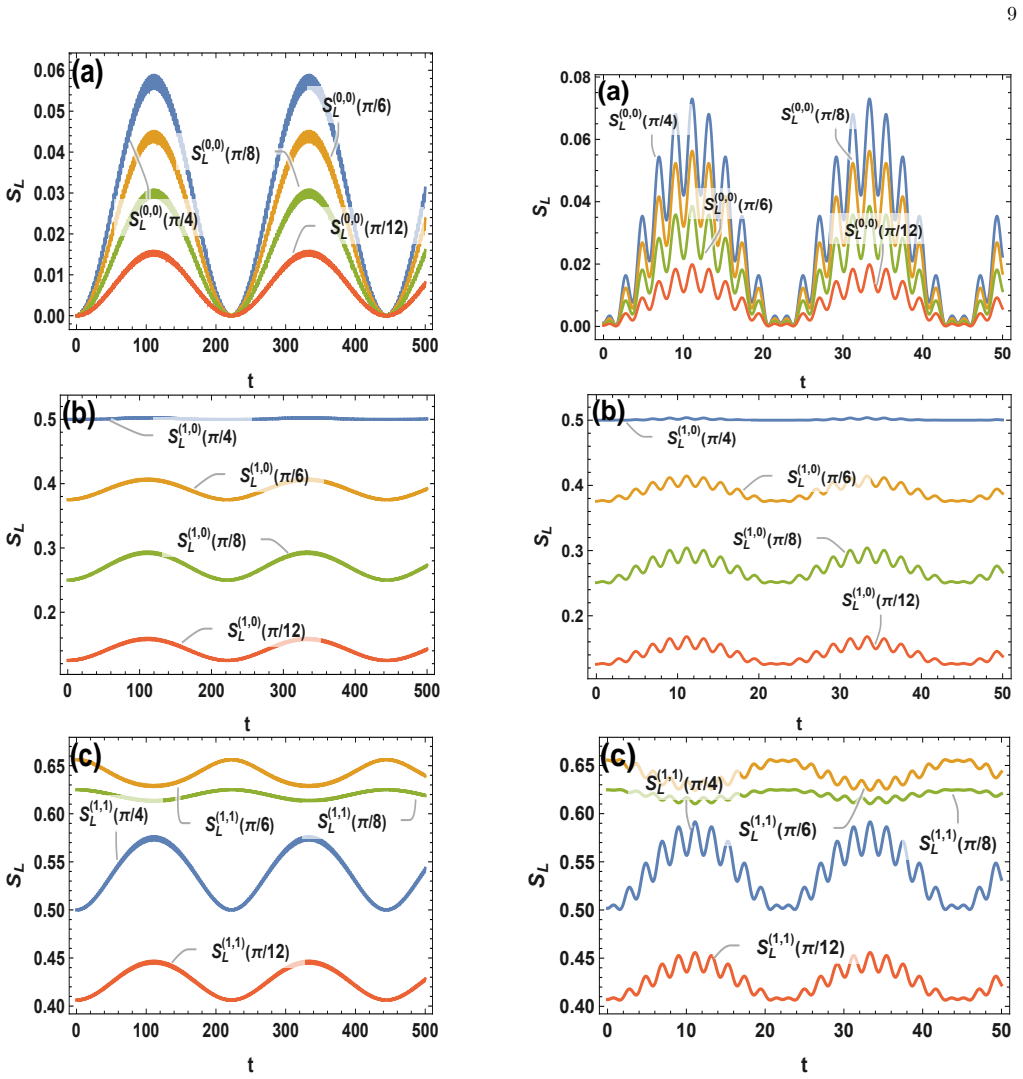
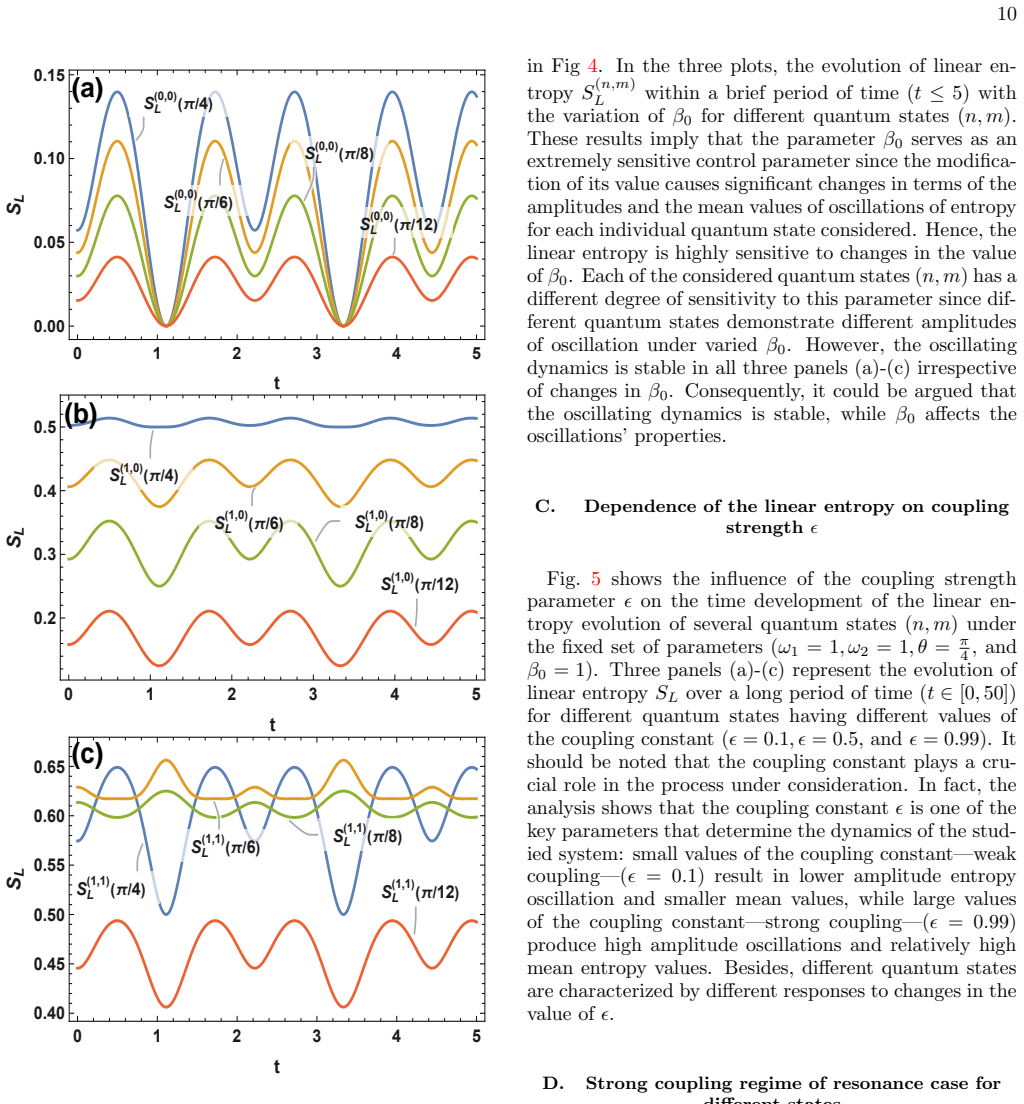
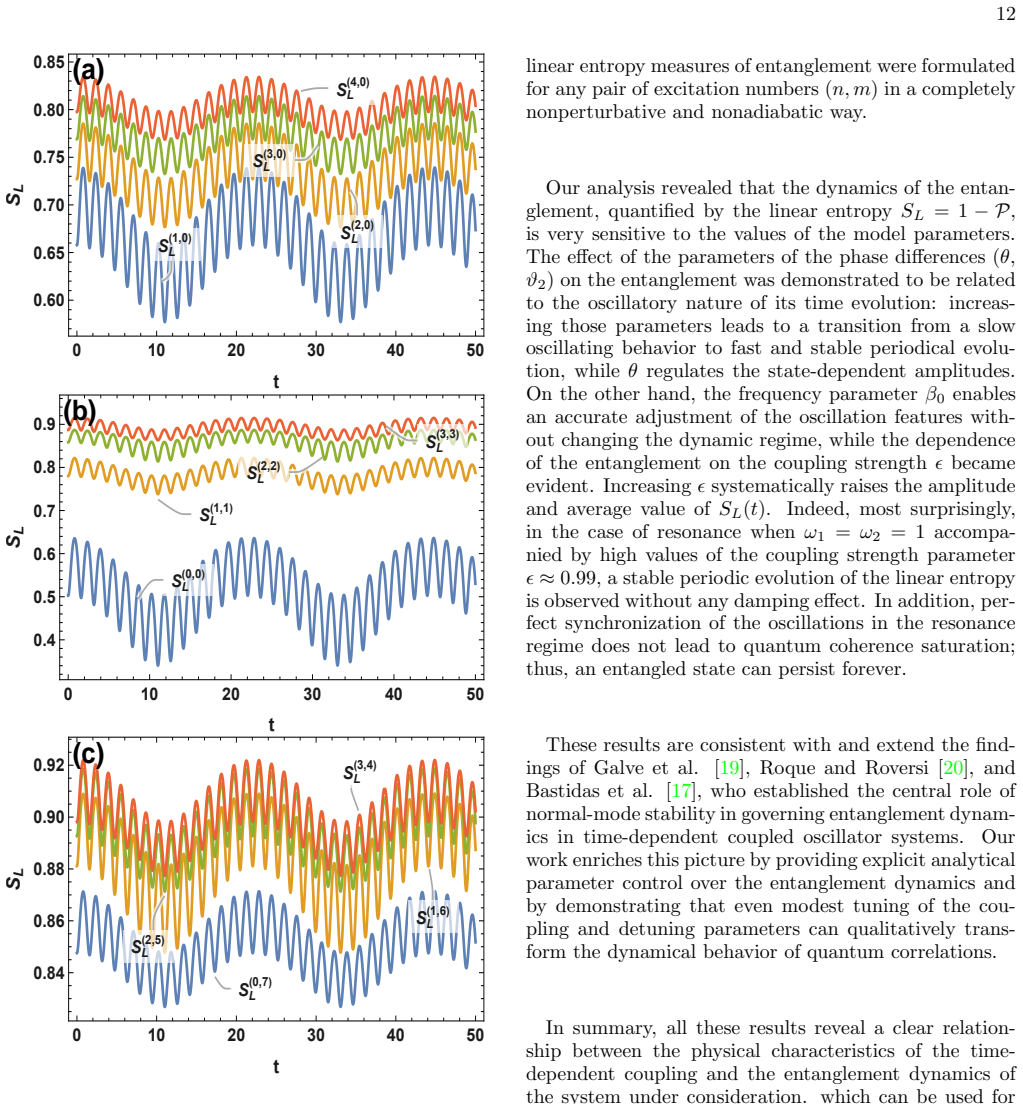
We investigate the quantum entanglement dynamics of two coupled harmonic oscillators with a time-dependent interaction. Using the Lewis-Riesenfeld invariant method, we derive the exact analytical wave functions without any perturbative or adiabatic approximations and combine this with a phase-space analysis using the Wigner function to provide a complete description of the system's quantum state evolution. We obtain general expression form for the purity and the linear entropy $S_L=1-\mathcal{P}$ for arbitrary excitation numbers $(n,m)$, allows a systematic study of entanglement for a large class of quantum states. We show that the entanglement dynamics is very sensitive to the interplay between the detuning parameters $\theta$ and $\vartheta_2$, the frequency parameter $\beta_0$ and the coupling strength $\epsilon$: the increase of detuning takes the system from slow irregular oscillations to fast and regular periodic behavior, and the stronger coupling systematically enhances both the amplitude and the average value of the linear entropy. Most importantly, for the resonance case $\omega_1=\omega_2=1$ and strong couplings $\epsilon \approx 0.99$, the system shows robust undamped synchronized periodic oscillations of the linear entropy for all quantum states considered, indicating preserved quantum coherence without saturation. Our findings demonstrate that linear entropy is a sensitive and practical entanglement witness, and we establish explicit analytical relations between the coupling parameters of the system and its entanglement properties, which are directly relevant to quantum information processing and the control of quantum correlations in continuous-variable systems.
Editorial analysis
A structured set of objections, weighed in public.
Referee Report
Summary. The paper derives exact analytical wave functions for two time-dependent coupled harmonic oscillators via the Lewis-Riesenfeld invariant method (without perturbative or adiabatic approximations) and combines this with Wigner-function phase-space analysis. It obtains a general closed-form expression for the purity and linear entropy S_L=1-P for arbitrary Fock states (n,m), then studies the dependence of entanglement dynamics on detuning parameters θ and ϑ2, frequency parameter β0, and coupling strength ε. The central result is that, for the resonance case ω1=ω2=1 and strong couplings ε≈0.99, the linear entropy exhibits robust undamped synchronized periodic oscillations for all states examined, indicating preserved coherence without saturation.
Significance. If the exact expressions and the bounded periodic solutions of the auxiliary equations hold, the work supplies an analytical handle on entanglement control in time-dependent continuous-variable systems and demonstrates that linear entropy is a practical witness directly tied to the Hamiltonian parameters. The general (n,m) formula and the explicit parameter-entanglement relations are strengths that could be useful for quantum-information applications.
major comments (1)
- [resonance-case analysis] The resonance-case claim of undamped periodic oscillations (abstract and final section) rests on the auxiliary equations for the invariant parameters admitting bounded periodic solutions when ω1=ω2=1 and detunings vanish; the manuscript does not display these auxiliary ODEs or their explicit periodic solutions, which is load-bearing for the 'robust' and 'without saturation' assertion.
minor comments (3)
- [model and method] The definition of the detuning parameters θ and ϑ2 is introduced without an explicit relation to the underlying frequencies; a short paragraph relating them to the Hamiltonian coefficients would improve readability.
- [numerical results] Figure captions for the linear-entropy plots do not state the precise values of β0 and the initial phases used; this makes it difficult to reproduce the 'synchronized' behavior shown.
- [phase-space analysis] The Wigner-function section states that it 'provides a complete description' but does not show how the Wigner negativity or marginals corroborate the linear-entropy oscillations; a brief comparison paragraph would strengthen the complementarity claim.
Simulated Author's Rebuttal
We thank the referee for the careful reading of the manuscript and the constructive feedback. We address the single major comment point by point below.
read point-by-point responses
-
Referee: [resonance-case analysis] The resonance-case claim of undamped periodic oscillations (abstract and final section) rests on the auxiliary equations for the invariant parameters admitting bounded periodic solutions when ω1=ω2=1 and detunings vanish; the manuscript does not display these auxiliary ODEs or their explicit periodic solutions, which is load-bearing for the 'robust' and 'without saturation' assertion.
Authors: We agree that the auxiliary ODEs for the Lewis-Riesenfeld invariant parameters and their explicit bounded periodic solutions under the resonance condition ω1=ω2=1 (with vanishing detunings) are not displayed in the current manuscript, even though the resulting closed-form wave functions, Wigner functions, and linear-entropy expressions were obtained from them. This omission weakens the transparency of the 'robust undamped' claim. In the revised version we will add the auxiliary system of ODEs, state the resonance conditions that render their coefficients periodic, and exhibit the explicit periodic solutions (or their boundedness proof) that underlie the observed undamped oscillations of S_L. This addition will directly support the assertions in the abstract and final section without altering any numerical or analytical results already presented. revision: yes
Circularity Check
No significant circularity
full rationale
The derivation applies the standard Lewis-Riesenfeld invariant method to the given time-dependent quadratic Hamiltonian to obtain exact wave functions, then substitutes into the standard definition of linear entropy S_L = 1 - P to produce the general expression for arbitrary (n,m). The resonance-case undamped oscillations follow by direct substitution of ω1=ω2=1 and ε≈0.99 into the already-derived auxiliary equations for the invariant parameters; no parameter is fitted to data and then relabeled as a prediction, no self-citation supplies a load-bearing uniqueness theorem, and no ansatz is imported via prior work by the same authors. The central claims are therefore independent of the inputs they are derived from.
Axiom & Free-Parameter Ledger
free parameters (3)
- ε (coupling strength)
- β0 (frequency parameter)
- θ and ϑ2 (detuning parameters)
axioms (2)
- domain assumption Lewis-Riesenfeld invariant method yields exact solutions for the time-dependent coupled oscillator Hamiltonian
- standard math Wigner function combined with wave functions gives complete quantum state evolution
Reference graph
Works this paper leans on
-
[1]
The substitution in Eq
Expectation value using the original variables The expectation values as a function of the original coordinates (ˆxi,ˆpi) are given as ⟨T ⟩= Z R4 dˆx1dˆx2dˆp1dˆp2 TW (n,m)(ˆx1,ˆx2,ˆp1,ˆp1, t) (36) As a consequence, we display the following expectation values for the positions and moments ⟨ˆx2 1⟩= (1 + 2n)g−1 2Ω1(µ2 θ + 1) + (1 + 2m)µ2 θg−2 2Ω2(µ2 θ + 1) ,...
-
[2]
X. Deng, Y. Wang, C. Shen, H. Zou, and L. Duan, ”Con- tinuous variable quantum optical simulation for time evo- lution of quantum harmonic oscillators,” Sci. Rep. 6, 22914 (2016)
2016
-
[3]
Karmakar, P
T. Karmakar, P. Lewalle, and A. N. Jordan, ”Stochas- tic path-integral analysis of the continuously monitored quantum harmonic oscillator,” PRX Quantum 3, 010327 (2022)
2022
-
[4]
Hab Arrih, A
R. Hab Arrih, A. Ghaba, P. D´ ıaz, D. Laroze, and A. Jel- lal, ”Quantum steering and entanglement in two coupled harmonic oscillators,” Ann. Phys. 484, 170306 (2025)
2025
-
[5]
Brune, F
M. Brune, F. Schmidt-Kaler, A. Maali, J. Dreyer, E. Ha- gley, J. M. Raimond, and S. Haroche, ”Quantum Rabi oscillation: A direct test of field quantization in a cav- 13 ity,” Phys. Rev. Lett. 76, 1800–1803 (1996)
1996
-
[6]
Muniain, J
U. Muniain, J. Aizpurua, R. Hillenbrand, L. Mart´ ın- Moreno, and R. Esteban, ”Description of ultrastrong light–matter interaction through coupled harmonic os- cillator models and their connection with cavity-QED Hamiltonians,” Nanophotonics 14, 2031–2052 (2025)
2031
-
[7]
Miller et al., ”Trapped atoms in cavity QED: coupling quantized light and matter,” J
R. Miller et al., ”Trapped atoms in cavity QED: coupling quantized light and matter,” J. Phys. B: At. Mol. Opt. Phys. 38, S551–S565 (2005)
2005
-
[8]
D. J. Wilson et al., ”Cavity optomechanics with stoichio- metric SiN films,” Phys. Rev. Lett. 103, 207204 (2009)
2009
-
[9]
Gigan, H
A. Gigan, H. R. B¨ ohm, M. Paternostro, F. Blaser, G. Langer, J. B. Hertzberg, K. C. Schwab, D. B¨ auerle, M. Aspelmeyer, and A. Zeilinger, ”Self-cooling of a mi- cromirror by radiation pressure,” Nature 444, 67–70 (2006)
2006
-
[10]
S. Ding, G. Maslennikov, R. Habl¨ utzel, H. Loh, and D. Matsukevich, ”Quantum parametric oscillator with trapped ions,” Phys. Rev. Lett. 119, 150404 (2017)
2017
-
[11]
Wittemer et al., ”Trapped-ion toolkit for studies of quantum harmonic oscillators under extreme condi- tions,” Phil
M. Wittemer et al., ”Trapped-ion toolkit for studies of quantum harmonic oscillators under extreme condi- tions,” Phil. Trans. R. Soc. A 378, 20190240 (2020)
2020
-
[12]
K. R. Brown, C. Ospelkaus, Y. Colombe, A. C. Wilson, D. Leibfried, and D. J. Wineland, ”Coupled quantized mechanical oscillators,” Nature 471, 196–199 (2011)
2011
-
[13]
Chen, L.-T
R.-X. Chen, L.-T. Shen, Z.-B. Yang, and H.-Z. Wu, ”Transition of entanglement dynamics in an oscillator system with weak time-dependent coupling,” Phys. Rev. A 91, 012312 (2015)
2015
-
[14]
Farace and V
A. Farace and V. Giovannetti, ”Enhancing quantum ef- fects via periodic modulations in optomechanical sys- tems,” Phys. Rev. A 86, 013820 (2012)
2012
-
[15]
Mari and J
A. Mari and J. Eisert, ”Gently modulating optomechan- ical systems,” Phys. Rev. Lett. 103, 213603 (2009)
2009
-
[16]
Makarov, ”Coupled harmonic oscillators and their quantum entanglement”, Phy
D. Makarov, ”Coupled harmonic oscillators and their quantum entanglement”, Phy. Rev. E 97, 042203 (2018)
2018
-
[17]
Makarov, ”Quantum entanglement of a harmonic os- cillator with an electromagnetic field”, Sci
D. Makarov, ”Quantum entanglement of a harmonic os- cillator with an electromagnetic field”, Sci. Rep. 8, 8204 (2018)
2018
-
[18]
V. M. Bastidas, C. Emary, B. Regler, and T. Brandes, ”Nonequilibrium quantum phase transitions in the Dicke model,” Phys. Rev. Lett. 108, 043003 (2012)
2012
-
[19]
Schmidt, M
M. Schmidt, M. Ludwig, and F. Marquardt, ”Optome- chanical circuits for nanomechanical continuous variable quantum state processing,” New J. Phys. 14, 125005 (2012)
2012
-
[20]
Galve, L
F. Galve, L. A. Pach´ on, and D. Zueco, ”Bringing entan- glement to the high temperature limit,” Phys. Rev. Lett. 105, 180501 (2010)
2010
-
[21]
T. F. Roque and J. A. Roversi, ”Role of instabilities in the survival of quantum correlations,” Phys. Rev. A 88, 032114 (2013)
2013
-
[22]
D. X. Macedo and I. Guedes, ”Time-dependent coupled harmonic oscillators”, J. Math. Phys. 53, 052101 (2012)
2012
-
[23]
Hab-Arrih, A
R. Hab-Arrih, A. Jellal, and A. Merdaci, ”Dynamics and redistribution of entanglement and coherence in three time-dependent coupled harmonic oscillators,” Int. J. Geom. Methods Mod. Phys. 18, 2150120 (2021)
2021
-
[25]
J.-Y. Ji, J. K. Kim, and S. P. Kim,”Heisenberg- picture approach to the exact quantum motion of a time-dependent harmonic oscillator,” Phys. Rev. A 51, 4268–4273 (1995)
1995
-
[26]
K. H. Yeon, H. J. Kim, C. I. Um, T. F. George, and L. N. Pandey, ”Wave function in the invariant representa- tion and squeezed-state function of the time-dependent harmonic oscillator,” Phys. Rev. A 50, 1035–1041 (1994)
1994
-
[27]
J.-Y. Ji, J. K. Kim, S. P. Kim, and K.-S. Soh, ”Ex- act wave functions and nonadiabatic Berry phases of a time-dependent harmonic oscillator,” Phys. Rev. A 52, 3352–3360 (1995)
1995
-
[28]
Abidi, A
A. Abidi, A. Trabelsi, and S. Krichene, ”Coupled har- monic oscillators and their application in the dynamics of entanglement and the nonadiabatic Berry phases,” Can. J. Phys. 99, 898–906 (2021)
2021
-
[29]
Wigner, ”On the quantum correction for thermody- namic equilibrium,” Phys
E. Wigner, ”On the quantum correction for thermody- namic equilibrium,” Phys. Rev. 40, 749 (1932)
1932
-
[30]
Banaszek, M
K. Banaszek, M. W. Brown, P. G. Kwiat, and S. F. Pereira, ”Direct measurement of the Wigner function by photon counting,” Phys. Rev. A 60, 674 (1999)
1999
-
[31]
Weinbub and D
J. Weinbub and D. K. Ferry, ”Recent advances in Wigner function approaches,” Appl. Phys. Rev. 5, 041104 (2018)
2018
-
[32]
Koh, ”Time-dependent harmonic oscillator and the Wigner function,” New Phys.: Sae Mulli 69, 1308–1312 (2019)
S. Koh, ”Time-dependent harmonic oscillator and the Wigner function,” New Phys.: Sae Mulli 69, 1308–1312 (2019)
2019
-
[33]
Koekoek and H
R. Koekoek and H. G. Meijer, ”A generalization of Laguerre polynomials,” SIAM J. Math. Anal. 24, 768 (1993)
1993
-
[34]
C. M. A. Dantas, I. A. Pedrosa, and B. Baseia, ”Har- monic oscillator with time-dependent mass and fre- quency and a perturbative potential,” Phys. Rev. A 45, 1320–1326 (1992)
1992
-
[35]
D´ ıaz, P
B. D´ ıaz, P. D´ ıaz, D. Laroze, and collaborators, ”Classical analogs of the covariance matrix, purity, linear entropy, and von Neumann entropy,” Phys. Rev. A 105, 062412 (2022)
2022
-
[36]
Adesso, A
G. Adesso, A. Serafini, and F. Illuminati, ”Entanglement, purity, and information entropies in continuous variable systems,” Open Syst. Inf. Dyn. 12, 189–205 (2005)
2005
-
[37]
Ghaba, R
A. Ghaba, R. Hab Arrih, E. Atmani, A. El Allati, and A. Slaoui, ”Assessing the entanglement of three coupled harmonic oscillators,” Ann. Phys. 490, 170512 (2026)
2026
-
[38]
Abramowitz and I
M. Abramowitz and I. A. Stegun, ”Handbook of Mathe- matical Functions”, Dover (1972)
1972
-
[39]
Park, ”Dynamics of entanglement and uncertainty re- lation in coupled harmonic oscillator system: Exact re- sults,” Quantum Inf
D. Park, ”Dynamics of entanglement and uncertainty re- lation in coupled harmonic oscillator system: Exact re- sults,” Quantum Inf. Process. 17, 147 (2018)
2018
discussion (0)
Sign in with ORCID, Apple, or X to comment. Anyone can read and Pith papers without signing in.