REVIEW 3 major objections 4 minor 29 references
Factorization Algebras and Quantum Groups from Generalized Poisson Sigma Models
T0 review · 3 major / 4 minor · reviewed 2026-07-13 · grok-4.5
Pith's one-line read Higher-dimensional Poisson sigma models recover shifted Poisson data on their boundaries and quantize them into factorization algebras and quantum groups.
desk verdict Solid tree-level dictionary from shifted Poisson data to higher/HT Poisson sigma models and quantum-group defects; full deformation quantization and some Koszul duals stay partly conjectural. read the letter →
The pith
A machine-rendered reading of the paper's core claim, the machinery that carries it, and where it could break.
The reading
What carries the argument
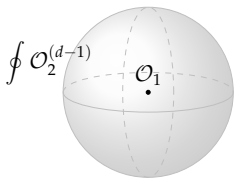
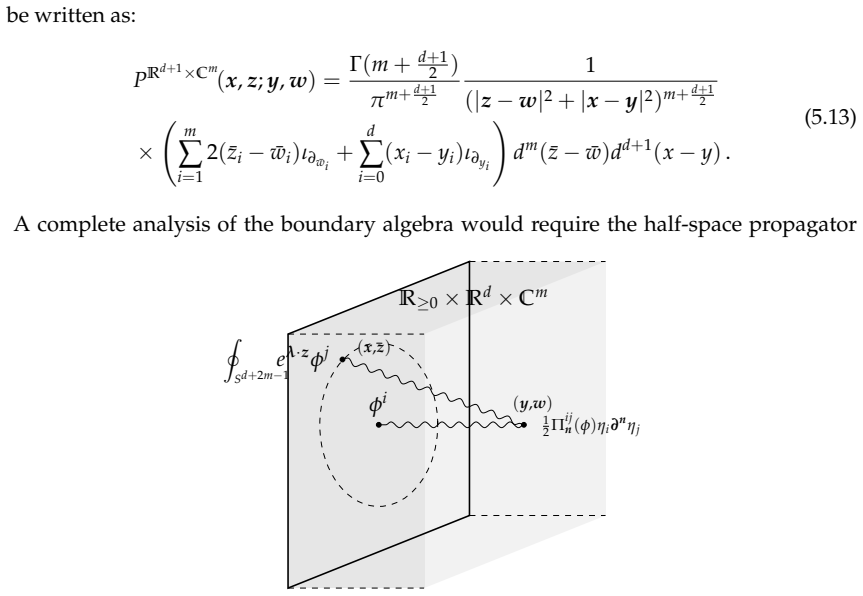
The universal bulk-to-boundary (and bulk-to-corner) Feynman integral identities (Theorems 7.1–7.2): after integrating the half-space (or corner) propagators built by reflection from a heat kernel, one recovers exactly the lower-dimensional propagator that encodes the original Poisson bracket.
What would settle it
Explicitly evaluate a higher-loop bulk-boundary diagram in a curved or higher-arity example (for instance a non-vanishing associator) and check whether the resulting boundary operation still satisfies the Jacobi identity of a deformation quantization of the original Poisson structure; any obstruction that cannot be absorbed into a redefinition of the bulk interaction would falsify the claim.
Extended reading notes
Core claim
Tree-level bulk-to-boundary diagrams of a generalized Poisson sigma model, whose target is a freely generated derived P_d or cP_{d,m} algebra, reproduce the original (shifted chiral) Poisson brackets on the boundary; when the bulk is anomaly-free the quantum theory deforms that algebra into an E_d (or holomorphic-topological) factorization algebra whose E_1 Koszul dual is a quantized enveloping, quasi-Hopf or Yangian algebra.
Load-bearing premise
The argument that higher-loop corrections either vanish or can be controlled so the boundary remains a well-defined deformation quantization rests on anomaly-freeness for theories with two or more topological directions and on the existence of well-behaved heat-kernel propagators, without a complete all-order renormalization analysis for every curved or higher-arity case.
Editorial extensions
If this is right
- Any freely generated derived P_d or cP_{d,m} algebra admits an explicit tree-level boundary realization and, when the bulk is anomaly-free, a candidate deformation quantization into an E_d or holomorphic-topological factorization algebra.
- E_1 Koszul duals of the resulting boundary algebras systematically produce quantized universal enveloping algebras of Lie bialgebras, quasi-Hopf algebras with Drinfeld associators, and Yangians from twists of supersymmetric gauge theories.
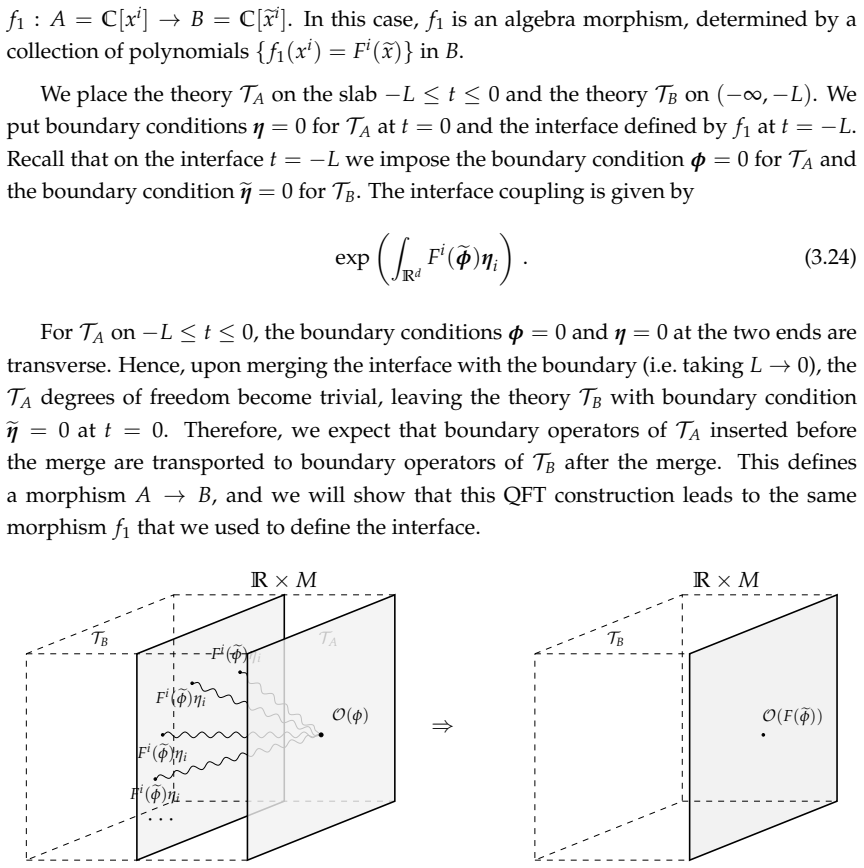
- Interfaces, coisotropic modules and higher-codimension defects of the Poisson data become concrete bulk couplings that realize morphisms and modules of the boundary algebras.
- The same bulk-boundary integral identities apply to corner algebras, giving a systematic route to higher-codimension algebraic structures.
- Twists of supersymmetric gauge theories and certain non-supersymmetric examples (Virasoro, higher Kac–Moody, twisted 11d supergravity) are uniformly recovered as generalized Poisson sigma models.
Reading between the lines
- If the higher-codimension corner identities of Conjecture 7.1 hold, the construction may supply a recursive reconstruction of the full theory from its deepest corner data, in the spirit of the cobordism hypothesis.
- The same framework should produce higher Ek Koszul duals and chiral Koszul duals, offering a field-theoretic approach to tetrahedron and n-simplex equations beyond the Yang–Baxter equation.
- Once all-order renormalization is under control, the method could serve as a practical machine for producing new quantum groups from any freely generated shifted chiral Poisson structure.
- The bulk algebra computing Poisson cohomology of the boundary suggests a holomorphic-topological analogue of the higher Deligne conjecture that has not yet been stated in the pure algebraic literature.
Editorial analysis
A structured set of objections, weighed in public.
Referee Report
Summary. The paper constructs higher-dimensional (topological and holomorphic–topological) Poisson sigma models whose target data are freely generated derived P_d-algebras or shifted chiral Poisson (cP_{d,m}) algebras. It shows that tree-level bulk-to-boundary Feynman diagrams, controlled by universal heat-kernel identities (Theorems 7.1–7.2), reproduce the input (shifted chiral) Poisson brackets on the boundary; when the bulk is anomaly-free the construction is claimed to supply a deformation quantization of that algebra into an E_d or HT factorization algebra. Interfaces, coisotropic/enriched boundaries and defects of various codimensions are built from morphisms and modules in derived algebraic geometry, and E_1 Koszul duals of selected boundary algebras are identified (partly conjecturally) with quantized universal enveloping algebras, quasi-Hopf algebras and the Yangian. Concrete examples include deformations of BF theory, Courant algebroid models, and twists of supersymmetric gauge theories (including a Yangian from a 5d N=2 twist).
Significance. If the tree-level matching and the anomaly-freeness arguments hold, the work supplies a flexible, Lagrangian route to a large class of (shifted chiral) Poisson and factorization algebras that are not realized as bulk algebras of free or non-degenerate BV theories, together with a systematic dictionary between derived-geometric modules/morphisms and extended QFT defects. The explicit universal bulk-to-boundary and bulk-to-corner integral identities (Theorems 7.1–7.2) and the concrete recovery of known quantum-group structures (QUE of quasi-Lie bialgebras, Drinfeld associator, Yangian R-matrix and coproduct) from Feynman diagrams are genuine technical contributions that go beyond existing AKSZ or formality literature. The framework also unifies several known twists of supersymmetric theories under a single Poisson-sigma-model umbrella.
major comments (3)
- Section 3.3 writes a formal Feynman-graph formula for the E_d operations on the boundary algebra but explicitly defers “a careful analysis and rigorous proofs to future work,” noting that the forms Ω_Γ may diverge. The passage from the classical P_d data to a well-defined quantum boundary factorization algebra therefore remains incomplete for the general (higher-arity or curved) case; the claim that the bulk supplies a deformation quantization rests on this unfinished step.
- Conjectures 4.1 and 4.2 identify the E_1 Koszul duals of the N-boundary algebras of the 3d quasi-Lie-bialgebra model and of Chern–Simons theory with the QUE algebra U_ħ(g,δ) and the quasitriangular quasi-Hopf algebra U_ħ(g)^Φ respectively. Only tree-level (and selected one-loop) diagrams are evaluated; higher-loop corrections to product, coproduct and associator are not controlled. The conjectures should either be proved under stated finiteness/renormalization hypotheses or clearly labelled as open and removed from the list of main results.
- The anomaly-freeness results of [BGK+23, WW24, GKW25] are invoked for theories with ≥2 topological directions, yet the paper also treats curved L_∞ structures, pure-chiral (d=0) cases and higher-arity brackets where those results do not directly apply (§§3.3, 5.3, 7). A precise statement of the class of targets for which the boundary algebra is known to be a well-defined deformation quantization is needed; otherwise the central claim that “the full quantum theory supplies a deformation quantization” overreaches the cited theorems.
minor comments (4)
- Notation for multi-component λ-brackets and multi-indices (e.g. Π^{i_0…i_k}_{n_1…n_k}) is dense; a short “notation summary” box at the start of §5 would help.
- Several figures (Figs. 1, 2, 7, 18–22) are described only in captions; adding a one-line physical interpretation in the main text would improve readability.
- The comparison with the formality theorems of Kontsevich and of [Kon99] is mentioned but not made fully precise; a short paragraph clarifying the precise operadic relationship would be useful.
- Typos: “Pois(BG,n)” vs “Pois(BG,n-1)” footnote in §4.4; occasional missing spaces after punctuation in the arXiv source.
Circularity Check
No significant circularity: Poisson data are inputs; boundary brackets are reconstructed by Feynman computation, not fitted or defined into existence.
-
self citation load bearing
[§1.1, §6.2 (references to [KZ25])]
"In recent work [KZ25], a 3d holomorphic-topological version of the Poisson sigma model was introduced and shown to be intimately related to chiral/vertex algebras. In this paper, we further generalize this construction to higher dimensions."
Minor only: [KZ25] is the author’s prior 3d special case used as a building block. The higher-d tree-level identities, universal integrals, and quantum-group conjectures are derived independently in the present text and do not reduce to that citation. Not load-bearing for the central reconstruction claim.
full rationale
The derivation chain is constructive and reconstructive rather than circular. Freely generated (derived) P_d / cP_{d,m} data define the bulk BV action (Eqs. 2.8, 5.11); the classical master equation is arranged to encode the Jacobi/L_∞ identities of those data (explicitly stated as such in §2.2–2.3). Tree-level bulk-to-boundary diagrams (§§3.1–3.2, 5.3) then recover the same brackets via the universal heat-kernel identities (Thms 7.1–7.2). That recovery is a consistency/reconstruction check of the model, not a claim that the Poisson structure is derived from independent first principles. Quantum-group identifications (Conjectures 4.1–4.2, Yangian §6.6) match leading Feynman orders to known algebraic structures (Etingof–Kazhdan, Drinfeld associator, Costello–Witten–Yamazaki) rather than forcing them by a fitted normalization. Self-citation to the author’s prior 3d HT work [KZ25] supplies a special case being generalized; it is not load-bearing for the higher-dimensional identities or the anomaly-freeness results, which are taken from independent sources ([BGK+23, WW24, GKW25]). Incomplete all-order control of curved/higher-arity quantization is a correctness gap, not circularity. Score 1 only for the minor, non-load-bearing self-citation building block.
Assumptions & free parameters
assumptions (4)
- domain assumption Classical master equation {S,S}_BV=0 is equivalent to the L_∞ Jacobi identities of the target shifted Poisson structure.
- domain assumption Existence of a well-behaved heat kernel for the elliptic complex (E,Q) satisfying the semigroup law.
- domain assumption Holomorphic-topological theories with ≥2 topological directions are anomaly-free (citing BGK+23, WW24, GKW25).
- standard math Standard operadic formality H_•(E_d)≅P_d and Dunn additivity for E_n algebras.
invented entities (3)
-
Generalized Poisson sigma models (topological and HT)
-
cP_{d,m}-algebras (shifted chiral Poisson algebras)
-
Universal bulk-boundary and bulk-corner Feynman integral identities
independent evidence
Cite this review
Pith. "Pith review of Factorization Algebras and Quantum Groups from Generalized Poisson Sigma Models." pith.science (2026). https://pith.science/paper/AIVSGGDG
@misc{pith2026260709486,
  author       = {Pith},
  title        = {Pith review of: Factorization Algebras and Quantum Groups from Generalized Poisson Sigma Models},
  year         = {2026},
  howpublished = {\url{https://pith.science/paper/AIVSGGDG}},
  note         = {Machine review of arXiv:2607.09486}
}
read the original abstract
In this work we introduce and study a family of holomorphic--topological field theories, which we call generalized Poisson sigma models. These theories are higher-dimensional analogues of the two-dimensional Poisson sigma model, with target data encoded by shifted chiral Poisson structures. We investigate their relationship with deformation quantizations of holomorphic--topological factorization algebras. Along the way, we give a systematic construction of extended objects, including interfaces, enriched boundaries and defects based on relevant notions in derived algebraic geometry. We employ Koszul-duality methods to study boundary algebras, yielding various versions of quantum groups. We illustrate the general framework through a range of examples, including twists of supersymmetric gauge theories as well as examples beyond the supersymmetric origin.
Figures


Figures from the paper (25 more)






Reference graph
Works this paper leans on
-
[1]
[Aam21] Nanna Havn Aamand,Chern–Simons theory and the R-matrix, Lett. Math. Phys.111(2021), no. 6,
2021
-
[2]
[AF21] David Ayala and John Francis,Zero-pointed manifolds, Journal of the Institute of Mathematics of Jussieu20(2021), no. 3, 785–858. 122 [AFT17] David Ayala, John Francis, and Hiro Lee Tanaka,Factorization homology of stratified spaces, Selecta Mathematica23(2017), no. 1, 293–362. [AK25] Luigi Alfonsi and Hyungrok Kim,On coefficients of operator produc...
arXiv 2021
-
[3]
2, 249–342
[BDSHK19] Bojko Bakalov, Alberto De Sole, Reimundo Heluani, and Victor G Kac, An operadic approach to vertex algebra and poisson vertex algebra cohomology, Japanese Journal of Mathematics14(2019), no. 2, 249–342. [BG25] Paul-Hermann Balduf and Davide Gaiotto,Combinatorial proof of a non- renormalization theorem, Journal of High Energy Physics2025(2025), n...
2019
-
[4]
[BGK+24b] Kasia Budzik, Davide Gaiotto, Justin Kulp, Brian R Williams, Jingxiang Wu, and Matthew Yu,Semi-chiral operators in 4d n = 1 gauge theories, Journal of High Energy Physics2024(2024), no. 5, 1–70. [BGV92] Nicole Berline, Ezra Getzler, and Mich `ele Vergne,Heat kernels and dirac oper- ators, Grundlehren der mathematischen Wissenschaften, vol. 298, ...
2024
-
[5]
Kazez, ed.), AMS/IP Studies in Advanced Mathematics, vol
[BN97] Dror Bar-Natan,Non-associative tangles, Geometric Topology: Proceedings of the 1993 Georgia International Topology Conference (William H. Kazez, ed.), AMS/IP Studies in Advanced Mathematics, vol. 2.1, American Mathe- matical Society and International Press, Providence, RI, 1997, pp. 139–183. [BN26] Dylan Butson and Sujay Nair,On the deformation the...
1993
-
[6]
[BY16] Dylan Butson and Philsang Yoo,Degenerate classical field theories and boundary theories, arXiv preprint arXiv:1611.00311 (2016). [CC22] Alejandro Cabrera and Miquel Cueca,Dimensional reduction of courant sigma models and lie theory of poisson groupoids, Letters in Mathematical Physics112 (2022), no. 5,
arXiv 2016
-
[7]
[CCG19] Kevin Costello, Thomas Creutzig, and Davide Gaiotto,Higgs and coulomb branches from vertex operator algebras, Journal of High Energy Physics2019 (2019), no. 3, 1–50. [CCRFM95] Alberto S. Cattaneo, Paolo Cotta-Ramusino, Jurg Frohlich, and Maurizio Martellini,Topological BF theories in three-dimensions and four-dimensions, J. Math. Phys.36(1995), 61...
arXiv 2019
-
[8]
[CG19] Kevin Costello and Davide Gaiotto,Vertex operator algebras and 3d n = 4 gauge theories, Journal of High Energy Physics2019(2019), no. 5, 1–39. [CG21] K. Costello and O. Gwilliam,Factorization algebras in quantum field theory, New Mathematical Monographs, no. v. 2, Cambridge University Press,
2019
Show all 29 references
-
[9]
[CG22] Hank Chen and Florian Girelli,Categorified Drinfel’d double and BF theory: 2-groups in 4D, Phys. Rev. D106(2022), no. 10, 105017. [CG25] Kevin Costello and Davide Gaiotto,Twisted holography, JHEP01(2025),
2022
-
[10]
[CKY94] Louis Crane, Louis H
[Che25] Hank Chen,Combinatorial quantization of 4d 2-Chern-Simons theory I: the Hopf category of higher-graph states, arXiv preprint arXiv:2501.06486 (2025). [CKY94] Louis Crane, Louis H. Kauffman, and David N. Yetter,State sum invariants of four manifolds. 1., arXiv preprint ...
2025
-
[11]
1, 73–165
[Cos13a] ,Notes on supersymmetric and holomorphic field theories in dimensions 2 and 4, Pure and applied mathematics quarterly9(2013), no. 1, 73–165. [Cos13b] ,Supersymmetric gauge theory and the Yangian. [Cos17] ,Holography and Koszul duality: the example of the M2brane. [CP2...
2013 arXiv
-
[12]
[EY18] Chris Elliott and Philsang Yoo,Geometric langlands twists of n=4gauge theory from derived algebraic geometry, Adv. Theor. Math. Phys.22(2018), 615–
2018
-
[13]
[FGY25] Laura O
[FGT08] Susanna Fishel, Ian Grojnowski, and Constantin Teleman,The strong mac- donald conjecture and hodge theory on the loop grassmannian, Annals of mathe- matics (2008), 175–220. [FGY25] Laura O. Felder, Zhengping Gui, and Charles A. S. Young,Higher Chiral Algebras in a Poly...
2008 arXiv
-
[14]
[GKW25] Davide Gaiotto, Justin Kulp, and Jingxiang Wu,Higher operations in pertur- bation theory, JHEP05(2025),
2025
-
[15]
[GLZ24] Zhengping Gui, Si Li, and Keyou Zeng,Quadratic duality for chiral algebras, Adv
[GLL17] Ryan E Grady, Qin Li, and Si Li,Batalin–vilkovisky quantization and the alge- braic index, Advances in Mathematics317(2017), 575–639. [GLZ24] Zhengping Gui, Si Li, and Keyou Zeng,Quadratic duality for chiral algebras, Adv. Math.451(2024), 109791. [GR19] Davide Gaiotto ...
2017
-
[16]
[GR22] Davide Gaiotto and Miroslav Rapcak,Miura operators, degenerate fields and the M2-M5 intersection, JHEP01(2022),
2022
-
[17]
[GW09a] Davide Gaiotto and Edward Witten,S-duality of boundary conditions in n= 4 super yang-mills theory, Advances in Theoretical and Mathematical Physics 13(2009), 721–896
[GTZ12] Gregory Ginot, Thomas Tradler, and Mahmoud Zeinalian,Higher hochschild cohomology, brane topology and centralizers of e n-algebra maps, arXiv preprint arXiv:1205.7056 (2012). [GW09a] Davide Gaiotto and Edward Witten,S-duality of boundary conditions in n= 4 super yang-m...
2012 arXiv
-
[18]
[GWW25] Zhengping Gui, Minghao Wang, and Brian R
[Gwi25] ,Remarks on the locality of generalized global symmetries. [GWW25] Zhengping Gui, Minghao Wang, and Brian R. Williams,Higher-dimensional Chiral Algebras in the Jouanolou Model, arXiv preprint arXiv:2510.26608 (2025). [GZ26] Davide Gaiotto and Keyou Zeng,Interface Minim...
2025 arXiv
-
[19]
[Ike17] Noriaki Ikeda,Lectures on AKSZ Sigma Models for Physicists, Workshop on Strings, Membranes and Topological Field Theory, WSPC, 2017, pp. 79–169. [Joh95] A. Johansen,Twisting of N=1SUSY gauge theories and heterotic topological theories, Int. J. Mod. Phys. A10(1995), 432...
2017 arXiv
-
[20]
[Lur08] ,On the classification of topological field theories, Current developments in mathematics2008(2008), no
[Lur] Jacob Lurie,Higher algebra. [Lur08] ,On the classification of topological field theories, Current developments in mathematics2008(2008), no. 1, 129–280. [Mar17] Nikita Markarian,Weyl n-algebras, Communications in Mathematical Physics350(2017), no. 2, 421–442. [May06] J.P...
2008
-
[21]
[NP25] Wenjun Niu and Victor Py,1-shifted Lie bialgebras and their quantizations, arXiv preprint arXiv:2503.08770 (2025)
[Mel16] Valerio Melani,Poisson bivectors and poisson brackets on affine derived stacks, Advances in Mathematics288(2016), 1097–1120. [NP25] Wenjun Niu and Victor Py,1-shifted Lie bialgebras and their quantizations, arXiv preprint arXiv:2503.08770 (2025). [OY20] Jihwan Oh and J...
2016 arXiv
-
[22]
[Rab22] Eugene Rabinovich,A classical bulk-boundary correspondence, arXiv preprint arXiv:2202.12332 (2022)
[Pim15] Slava Pimenov,Shifted poisson and batalin-vilkovisky structures on the derived variety of complexes, arXiv preprint arXiv:1511.00946 (2015). [Rab22] Eugene Rabinovich,A classical bulk-boundary correspondence, arXiv preprint arXiv:2202.12332 (2022). [Roy02] Dmitry Royte...
2015 arXiv
-
[23]
1, 87–121
[Saf17] Pavel Safronov,Poisson reduction as a coisotropic intersection, Higher Struc- tures1(2017), no. 1, 87–121. [Saf18] ,Braces and poisson additivity, Compositio Mathematica154(2018), no. 8, 1698–1745. [Saf23] ,Shifted geometric quantization, Journal of Geometry and Physic...
2017
-
[24]
[Vai97] A Yu Vaintrob,Lie algebroids and homological vector fields, Russian Mathemat- ical Surveys52(1997), no. 2,
1997
-
[25]
[Wan25] Minghao Wang,Feynman Graph Integrals onC d, Commun. Math. Phys.406 (2025), no. 5,
2025
-
[26]
[Wit88a] Edward Witten,Topological Quantum Field Theory, Commun
[Wil17] Thomas Willwacher,(non-) formality of the extended swiss cheese operads, arXiv preprint arXiv:1706.02945 (2017). [Wit88a] Edward Witten,Topological Quantum Field Theory, Commun. Math. Phys.117 (1988),
2017 arXiv
-
[27]
131 [Wit88b] ,Topological Sigma Models, Commun. Math. Phys.118(1988),
1988
-
[28]
3, 351–399
[Wit89] ,Quantum field theory and the jones polynomial, Communications in mathematical physics121(1989), no. 3, 351–399. [Wit10] ,A new look at the path integral of quantum mechanics, arXiv preprint arXiv:1009.6032 (2010). [Wit11a] ,Analytic Continuation Of Chern-Simons Theory...
1989 arXiv
-
[29]
[Zuc16] Roberto Zucchini,A Lie based 4–dimensional higher Chern–Simons theory, J. Math. Phys.57(2016), no. 5, 052301. K. Zeng, CENTER OFMATHEMATICALSCIENCES ANDAPPLICATIONS, HARVARDUNIVERSITY, MA 02138, USA E-mail address:kzeng@cmsa.fas.harvard.edu 132
2016
Reviewed July 13, 2026 · model on record in the stance chip above.
Discussion (0). Continue with ORCID to comment.