pith. machine review for the scientific record. sign in

math.QA

Quantum Algebra

Quantum groups, skein theories, operadic and diagrammatic algebra, quantum field theory

0
math.QA 2026-05-13 2 theorems

Localized stated skein algebras equal quantum cluster algebras on polygons

Quantum cluster algebra realization for stated {rm SL}_n-skein algebras and rotation-invariant bases for polygons

The match supplies rotation-invariant bases from the theta basis, carrying positivity and natural parametrization.
Figure from the paper full image
abstract click to expand
We construct a quantum cluster structure on the skew-field of fractions ${\rm Frac}({\mathscr S}_\omega(\mathfrak{S}))$ of the stated ${\rm SL}_n$-skein algebra ${\mathscr S}_\omega(\mathfrak{S})$, where $\mathfrak{S}$ is a triangulable pb surface without interior punctures. This work complements the construction for the projected stated skein algebra $\widetilde{\mathscr S}_\omega(\mathfrak{S})$ given by the last two authors. Let ${\mathscr S}_\omega^{\rm fr}(\mathfrak{S})$ denote the localization of ${\mathscr S}_\omega(\mathfrak{S})$ at the multiplicative set generated by all frozen variables. Let ${\mathscr A}_\omega^{\rm fr}(\mathfrak{S})$ and ${\mathscr U}_\omega^{\rm fr}(\mathfrak{S})$ (respectively $\overline{\mathscr A}_\omega(\mathfrak{S})$ and $\overline{\mathscr U}_\omega(\mathfrak{S})$) denote the quantum cluster algebra and quantum upper cluster algebra associated to ${\rm Frac}({\mathscr S}_\omega(\mathfrak{S}))$ (respectively ${\rm Frac}(\widetilde{\mathscr S}_\omega(\mathfrak{S}))$). We prove that \[ \widetilde{\mathscr S}_\omega(\mathfrak{S}) = \overline{\mathscr A}_\omega(\mathfrak{S}) = \overline{\mathscr U}_\omega(\mathfrak{S}) \quad \text{and} \quad {\mathscr S}_\omega^{\rm fr}(\mathfrak{S}) = {\mathscr A}_\omega^{\rm fr}(\mathfrak{S}) = {\mathscr U}_\omega^{\rm fr}(\mathfrak{S}) \] whenever $\mathfrak{S}$ is a polygon. As a consequence, when $\mathfrak{S}$ is a polygon, we show that the theta basis of $\overline{\mathscr U}_\omega(\mathfrak{S})$ (respectively ${\mathscr U}_\omega^{\rm fr}(\mathfrak{S})$) yields a rotation-invariant basis of $\overline{\mathscr S}_\omega(\mathfrak{S})$ (respectively ${\mathscr S}_\omega^{\rm fr}(\mathfrak{S})$) with several desirable properties, including positivity and a natural parametrization.
0
0
math.QA 2026-05-11 Recognition

Type C varieties realize quasi-split AIII iquantum groups

Affine iquantum groups and Steinberg varieties of type C, II

Equivariant K-groups of Steinberg varieties define the algebra for even type AIII_{2n}^{(τ)} and supply a type D model for the odd case.

Figure from the paper full image
abstract click to expand
A geometric realization of the quasi-split affine iquantum group of type $\mathrm{AIII}_{2n-1}^{(\tau)}$ was given by Wang and the second author, in terms of equivariant K-groups of Steinberg varieties of type C. As a completion of that work, this paper focuses on the previously untreated case. We provide a similar construction of the quasi-split affine iquantum group of type $\mathrm{AIII}_{2n}^{(\tau)}$, using the same equivariant K-groups of Steinberg varieties of type C. In the appendix, we employ Steinberg varieties of type D to give a new realization of the quasi-split affine iquantum group of type $\mathrm{AIII}_{2n-1}^{(\tau)}$, thereby avoiding the localization method adopted in the previous work.
0
0
math.QA 2026-05-08 2 theorems

3-manifold quantum invariants are easy exactly when categories are pointed

A Complexity Dichotomy for Quantum Invariants of 3-Manifolds

A single family of graph manifolds reduces both Reshetikhin-Turaev and Turaev-Viro problems to a known graph-homomorphism dichotomy.

abstract click to expand
We prove exact complexity dichotomies for two quantum invariants of closed oriented three-manifolds, with the categorical data fixed. For a modular category $\mathcal{C}$, computing the Reshetikhin--Turaev invariant $Z_{\mathcal{C}}(M)$ from a framed-link surgery presentation is in $\mathrm{FP}$ exactly when $\mathcal{C}$ is pointed, that is, when all simple objects are invertible under tensor product; otherwise it is $\#\mathrm{P}$-hard. For a spherical fusion category $\mathcal{A}$, computing the Turaev--Viro invariant $|M|_{\mathcal{A}}$ from a triangulation, equivalently from a skeleton, is in $\mathrm{FP}$ exactly when its Drinfeld center $\mathcal{Z}(\mathcal{A})$ is pointed, equivalently when $\mathcal{A}$ is trivializable pointed; otherwise it is $\#\mathrm{P}$-hard. The polynomial-time cases reduce to finite abelian linear algebra and Gauss sums. The reductions are based on a genus-one graph-manifold family $M_G$, indexed by graphs $G$. In the anomaly-free case, the core calculation expresses $Z_{\mathcal{C}}(M_G)$ as the weighted graph homomorphism partition function with matrix $A_{\mathcal{C}}(i,j)=S_{i,j^*}/(d_i d_j)$, where $S$ is the modular matrix, $d_i$ is the quantum dimension of $i$, and $j^*$ is the dual label. Combining this formula with the Cai--Govorov dichotomy gives the hard side; the remaining Reshetikhin--Turaev and Turaev--Viro cases then follow by passing to Drinfeld centers.
0
0
math.QA 2026-05-06

Vertical transformation shows CFT field functors are equivalences

Modular functors and CFT correlators via double categories

Skein methods prove an equivalence between double-categorical modular functors for the delooping of a pivotal category and its Frobenius-al

abstract click to expand
We point out that double categories provide a natural setting for modular functors obtained by a (bicategorical) string-net construction: The source of the modular functor -- which is now a double functor -- is a symmetric monoidal double category of bordisms, with bordisms as horizontal morphisms and smooth embeddings of manifolds as vertical morphisms. The target of the modular functor is a double category with profunctors and functors as horizontal and vertical morphisms. The correlators and field functors for a conformal field theory based on a pivotal monoidal category $\mathcal C$ can then be understood in the unified setting of a vertical transformation between the modular functors for two pointed pivotal bicategories, the delooping of $\mathcal C$ and the bicategory of $\Delta$-separable symmetric Frobenius algebras in $\mathcal C$. Using skein theoretic methods, we show that this vertical transformation is an equivalence, which implies that field functors are equivalences of categories and that universal correlators are isomorphisms of vector spaces.
0
0
math.QA 2026-05-04 3 theorems

Braid symmetries extended to supersymmetric quantum pairs

Relative braid group symmetries on quantum supersymmetric pairs of type sAIII

Quasi K-matrices supply the intertwining that lets the symmetries obey relations in the relative Coxeter groupoid.

abstract click to expand
We introduce the relative Coxeter groupoid and construct intrinsic relative braid group symmetries for quantum supersymmetric pairs of type sAIII. These symmetries are constructed by establishing new intertwining properties of quasi $K$-matrices, which generalize the earlier non-super construction of Wang and the second author. We derive explicit formulas for these symmetries and prove that they satisfy the braid relations in the relative Coxeter groupoid.
0
0
math.QA 2026-05-04

Bosonic ghost four-point functions carry logarithmic singularities

Bosonic Ghost Correlators: A Case Study

Differential equations reveal richer correlator structure than free-field expectations in this logarithmic model.

Figure from the paper full image
abstract click to expand
There has been a lot of recent work addressing the representation theory that underlies logarithmic conformal field theories. A full understanding of these models will however also need analytic data, in particular the correlation functions. Here, we explore the correlators of one of the most fundamental of all logarithmic models: the bosonic ghost system. In this first part, we use differential equations to show that the correlation functions exhibit a richness beyond what one might have expected, given the free-field nature of the theory. Our main result is the verification that there are four-point functions with logarithmic singularities. In a sequel, we will employ Coulomb gas and bootstrap methods to further refine the results presented here.
0
0
math.QA 2026-05-01

Connections on noncommutative curves exist iff jet sequences split

Holomorphic Jet Modules and Holomorphic Connections for Noncommutative Complex Curves

The existence of holomorphic connections is equivalent to the holomorphic splitting of the jet sequence, providing a noncommutative version.

abstract click to expand
We extend Atiyah's holomorphic jet bundle formalism to holomorphic vector bundles over noncommutative algebras endowed with a bigraded differential calculus truncated at bidegree $(1,1)$; we refer to such structures as noncommutative complex curves. For a holomorphic vector bundle $(E,\overline{\nabla}_E)$ over such an algebra $\mathcal{A}$, we construct a canonical holomorphic structure $\overline{\nabla}_J$ on the first jet module $J_E^1\,$, making the jet sequence \[ 0\longrightarrow \Omega^{1,0}(\mathcal{A})\otimes_{\mathcal A}E\longrightarrow J_E^1\longrightarrow E\longrightarrow 0 \] exact in the holomorphic category. The association $(E,\overline\nabla_E)\rightsquigarrow(J_E^1\,,\overline\nabla_J)$ defines an endofunctor on the category of holomorphic vector bundles over $\mathcal{A}$. We define the notion of holomorphic connection in this setting and prove that a holomorphic vector bundle admits a holomorphic connection if and only if the jet sequence splits in the holomorphic category, or equivalently, if and only if its Atiyah class vanishes. This yields a noncommutative analogue of Atiyah's classical correspondence for Riemann surfaces. Finally, we specialize to the quantum projective line $\mathbb{CP}_q^1\,$ and determine when $\overline{\nabla}_J$ defines a bimodule connection, assuming that $\overline{\nabla}_E$ does.
0
0
math.QA 2026-04-23

Tensor category cohomology conjecture reduces to Hochschild finiteness

On the cohomology of finite tensor categories

The finite-generation conjecture for finite tensor categories is equivalent to the same property for Hochschild cohomology of endomorphismal

abstract click to expand
It has been conjectured that finite tensor categories have finitely generated cohomology. We show that this is equivalent to finitely generated Hochschild cohomology for the endomorphism algebras of the projective generators.
0
0
math.QA 2026-04-23

Explicit bases place quantum super immanants in tensor weight spaces

Quantum Super Littlewood Correspondences

The construction uses quantum super Schur-Weyl duality to realize immanants inside weight spaces of the covariant tensor representations.

abstract click to expand
In this paper, we study the Littlewood theory associated with the quantum super immanants and supersymmetric polynomials, including both the super case and the quantum generalization. In the setting of quantum super Schur-Weyl duality between the quantum superalgebra $U_q(\mathfrak{gl}_{m|n})$ and the Iwahori-Hecke algebra $\mathcal{H}_r$ of type A, we explicitly construct basis vectors of the $(U_q(\mathfrak{gl}_{m|n}), \mathcal{H}_r)$-bimodule on the tensor product space $(\mathbb{C}^{m|n})^{\otimes r}$. Using this construction, we interpret the quantum super immanants via weight spaces of covariant tensor representations of $U_q(\mathfrak{gl}_{m|n})$.
0
0
math.QA 2026-04-21

QCD collinear singularities recast inside non-linear Lie conformal algebras

Non-linear Lie Conformal Algebras and One-Loop Corrections of self-dual Yang-Mills amplitudes

The reformulation supplies an algebraic handle on one-loop corrections to self-dual Yang-Mills amplitudes

abstract click to expand
This work is motivated by recent developments in celestial holography. In \cite{CP}, the authors interpreted QCD collinear singularities in terms of operator product expansions in a two-dimensional CFT. We reformulate the algebraic structures arising in their work using the formalism of non-linear Lie conformal algebras developed in \cite{SK}.
0
0
math.QA 2026-04-20

Lie quandles generalize Lie algebras to nonlinear mechanics

Lie Quandles, Leibniz Racks and Noether's First Theorem

A linear-nonlinear correspondence classifies the structures and yields first results on a nonlinear Noether theorem.

abstract click to expand
In [Self-distributive structures in physics. Internat. J. Theoret. Phys. 64 (2025), no. 3, Paper No. 73], Fritz was motivated by the structure of Hamiltonian/Heisenberg mechanics to define the notion of "Lie Quandle", which he argued are nonlinear generalizations of finite dimensional real Lie algebras. In this article, we will investigate a linear/nonlinear correspondence to which Fritz' is a special case, classify a class of generalizations of these objects, as well as describe some results in the direction of a nonlinear analogue of Noether's first theorem first described by Fritz.
0
0
math.QA 2026-04-15

New elements disprove Huang's conjecture on vertex algebra ideal

The Huang Algebra Ideal and the Diagonal Shift Property

They lack the diagonal shift property satisfied by Huang's families, showing the ideal Q^∞(V) is strictly larger.

abstract click to expand
Let $V$ be a grading-restricted vertex algebra and let $A^\infty(V)=U^\infty(V)/Q^\infty(V)$ be the associative algebra constructed by Huang, where $U^\infty(V)$ is the space of column-finite infinite matrices with entries in V and $Q^\infty(V)$ is an ideal of a (nonassociative) algebra structure on $U^\infty(V)$ defined by Huang. Huang introduced families of elements in $Q^\infty(V)$ and conjectured that these elements generate $Q^\infty(V)$. We discover and prove that Huang's elements all satisfy what we call ``the diagonal shift property". On the other hand, in the case that $V$ is the rank one Heisenberg vertex operator algebra, we construct infinitely many linearly independent elements in $Q^\infty(V)$ that do not satisfy the diagonal shift property. As a corollary, we disprove Huang's conjecture.
0
0
math.QA 2026-04-15

Quantum vertex algebra centers yield q-analogues of immanants

Evaluation-type deformed modules over the quantum affine vertex algebras of type A

Deformed modules over V^c(gl_N) connect the structures and produce these analogues at the critical level.

abstract click to expand
Let $\mathcal{V}^c(\mathfrak{gl}_N)$ be Etingof--Kazhdan's quantum affine vertex algebra associated with the trigonometric $R$-matrix. We establish a connection between suitably generalized deformed $\phi$-coordinated $\mathcal{V}^c(\mathfrak{gl}_N)$-modules and the representations of quantized enveloping algebra $U_h(\mathfrak{gl}_N)$ and reflection equation algebra $\mathcal{O}_h(Mat_N)$. As an application, we demonstrate how the elements of the center of $\mathcal{V}^c(\mathfrak{gl}_N)$ at the critical level $c=-N$ give rise to the $q$-analogues of quantum immanants for $U_h(\mathfrak{gl}_N)$, which were recently found by Jing, Liu and Molev. Finally, we derive the analogues of these results for the quantum affine vertex algebra associated with the normalized Yang $R$-matrix.
0
0
math.QA 2026-04-15

Quasi-Hopf Heisenberg doubles satisfy quasi-pentagon equations

A Quasi-Pentagon Equation for a Heisenberg Double of a Quasi-Hopf Algebra

Natural analogues for finite-dimensional quasi-Hopf algebras have canonical elements obeying a quasi-pentagon identity thanks to inverse-

abstract click to expand
For a finite-dimensional Hopf algebra $H$, the canonical elements of the Heisenberg doubles $\mathcal{H}(H^\ast)$ and $\mathcal{H}(H)$ satisfy the pentagon and Hopf equations, respectively. In this paper we construct quasi-Hopf analogues of these structures. For a finite-dimensional quasi-Hopf algebra $H$, we consider natural quasi-Hopf analogues $\mathcal{H}_1(H^\ast)$ and $\mathcal{H}_1(H)$ of $\mathcal{H}(H^\ast)$ and $\mathcal{H}(H)$. Although their canonical elements are defined just as in the Hopf algebra case, they need not be invertible. We prove that there nevertheless exist natural inverse-like elements. In $\mathcal{H}_1(H^\ast)$, the canonical element satisfies a quasi-pentagon equation and its inverse-like element satisfies a quasi-Hopf equation, while in $\mathcal{H}_1(H)$ the roles are reversed.
0
0
math.QA 2026-04-14

Heisenberg Z2-orbifold modules form braided tensor category

Tensor category of mathbb{Z}₂-orbifold of Heisenberg vertex operator algebra and its applications

The structure implies semisimplicity for all grading-restricted modules of the affine vertex algebra L_{-1}(sp(2n)) via commutant pairs.

abstract click to expand
In this paper, we prove the category of finite length modules for the $\mathbb{Z}_2$-orbifold $M(1)^+$ of the Heisenberg vertex operator algebra whose simple composition factors are $M(1)^\pm$ or $M(1,\lambda)$ for $\lambda \in \mathbb{C}^\times$ is a vertex and braided tensor category. Our strategy is to show these simple composition factors are $C_1$-cofinite and the category of finite length $M(1)^+$-modules is exactly the category of grading-restricted $C_1$-cofinite modules. We also determine the fusion product decompositions of simple objects and prove the rigidity of this category. As an application of the tensor category structure of $M(1)^+$-modules, we prove the category $\mathcal{C}_{-1}(sp(2n))$ of grading-restricted generalized modules for the simple affine vertex algebra $L_{-1}(sp(2n))$ is semisimple. For this, we first prove $M(1)^+$ and simple affine vertex algebra $L_{-\frac{1}{2}}(sp(2n))$ form a commutant pair in the simple minimal $W$-algebra $W_{-1}^{min}(sp(2n))$ for $n \geq 2$ and determine $W_{-1}^{min}(sp(2n))$ as well as its irreducible modules obtained from quantum Hamilton reduction as decompositions of $M(1)^+ \otimes L_{-\frac{1}{2}}(sp(2n))$-modules, then we show all the highest weight modules for $L_{-1}(sp(2n))$ in $\mathcal{C}_{-1}(sp(2n))$ are irreducible via the quantum Hamilton reduction. We also prove a Schur-Weyl duality between $L_{-1}(sp(2n))$ and $M(1)^+$ by showing they form a commutant pair in the $\mathbb{Z}_2$-orbifold of the rank $n$ $\beta\gamma$ system, and then establish a braided reversed equivalence between the category $\mathcal{C}_{-1}(sp(2n))$ and the full subcategory of $C_1$-cofinite $M(1)^+$-modules consisting of direct sums of irreducible modules $M(1)^\pm$ and $M\big(1, \frac{s}{\sqrt{-2n}}\big)$ for $s \in \mathbb{Z}_{\geq 0}$.
0
0
math.QA 2026-04-14

Wheel graphs reduce to sums of 3- and 4-valent graphs

Wheel Classes in Kontsevich Graph Complex and Merkulov's Low-Valence Conjecture

For each odd wheel W_{2m+1}, an explicit sum of 2^{m-1} low-valence graphs is homologous to it.

Figure from the paper full image
abstract click to expand
We show that the wheel classes in the Kontsevich graph complex $GC_d$ admit representatives supported on graphs with only $3$- and $4$-valent vertices. This verifies that Merkulov's low-valence conjecture holds for the wheel classes. More precisely, for every $m \ge 2$, we prove that the wheel graph $W_{2m+1}$ is homologous to an explicit linear combination of $2^{m-1}$ graphs, each having only $3$- and $4$-valent vertices.
0
0
math.QA 2026-04-14

Six-term sequence ties Galois cohomology to Brauer-Picard groupoids

Putting the Brauer back in Brauer-Picard

The construction works over arbitrary fields and lets researchers compute graded extensions of fusion categories over the reals.

abstract click to expand
We establish a 6-term left exact sequence, involving Galois cohomology of the base field $\mathbb K$, and the Brauer-Picard groupoid of a fusion category. This generalizes a result of Etingof, Nikshych, and Ostrik to the setting where $\mathbb K$ is not algebraically closed. Following their example, we use this exact sequence to compute examples of graded extensions of fusion categories over $\mathbb R$. Along the way, we establish several structural theorems regarding the duality morphisms for a fusion category as an object in the 4-category of braided tensor categories. The paper ends with a speculative look at a potential higher categorical explanation of the main result.
0
0
math.QA 2026-04-13

Pre-tensor category is Morita-equivalent to tensor category iff its Drinfeld center is a

Finite Pre-Tensor Categories that are Morita Equivalent to Finite Tensor Categories

tensor category. The iff statement completely classifies which finite pre-tensor categories belong to the Morita classes of ordinary tensor

abstract click to expand
A finite pre-tensor category is a finite abelian category equipped with a right exact tensor product for which every projective object has duals. Finite tensor categories, for which every object has duals, are notable examples. More generally, the category of bimodules over an algebra in a finite tensor category is a finite pre-tensor category. In particular, it is natural to extend the notion of Morita equivalence between finite tensor categories to finite pre-tensor categories. We characterize completely those finite pre-tensor categories that are Morita equivalent to finite tensor categories. More precisely, we show that a finite pre-tensor category $\mathcal{C}$ is Morita equivalent to a finite tensor category if and only if the Drinfeld center of $\mathcal{C}$ is a finite tensor category. We also discuss higher algebraic consequences of our characterization.
0
0
math.QA 2026-04-13

Reformulated algorithm proves conjecture on deformed W-algebras in B and C

Fundamental fields in the deformed W-algebras

New formal framework validates generation from dominant monomials and confirms Frenkel-Reshetikhin prediction for classical types.

Figure from the paper full image
abstract click to expand
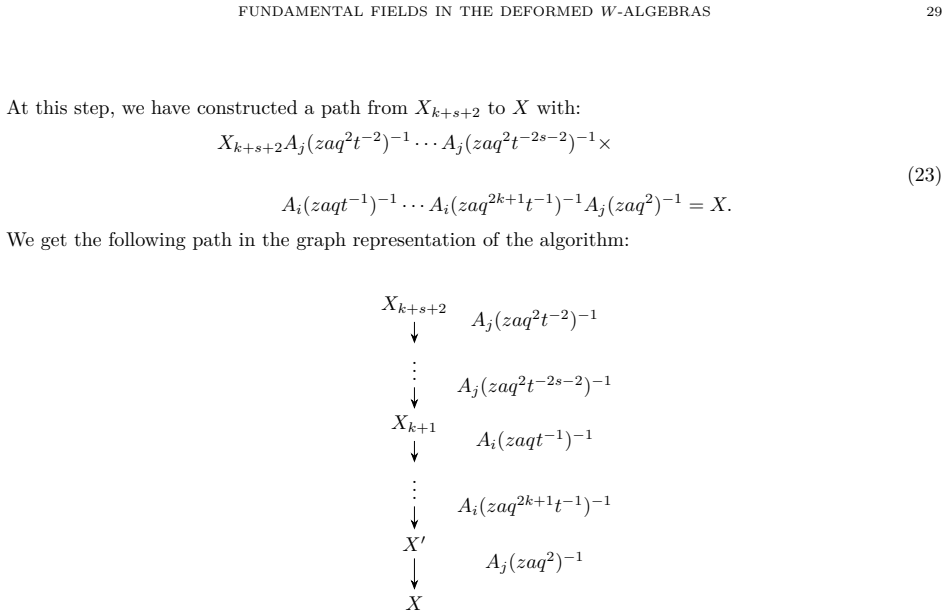
Let $\mathfrak{g}$ be a simple Lie algebra. Frenkel and Reshetikhin introduced the deformed $W$-algebra $\mathbf{W}_{qt}(\mathfrak{g})$. In this work, we propose a formal reformulation of this definition in a different context. In this framework, we reformulate and prove the well-definedness of an algorithm (arxiv:2103.15247, arxiv:2205.08312) inspired by the Frenkel-Mukhin algorithm (arXiv:math/9911112) which, starting from a given dominant monomial $m$ satisfying some degree conditions, produces elements of the deformed $W$-algebra. Then, we apply this algorithm to construct explicitly some specific elements of $\mathbf{W}_{q,t}(\mathfrak{g})$. In particular, we apply this to prove a conjecture of Frenkel and Reshetikhin in arXiv:q-alg/9708006 in types $B_\ell$, $C_\ell$, and for some nodes in other types. This framework opens up new possibilities for studying explicitly fields in the deformed $W$-algebra $\mathbf{W}_{q,t}(\mathfrak{g})$.
0
0
math.QA 2026-04-08 Recognition

Multigraphs recover quantum channel confusability graphs by edge count

A multigraph approach to confusability in quantum channels

A new structure incorporates output information and fully characterizes which multigraphs come from actual channels.

Figure from the paper full image
abstract click to expand
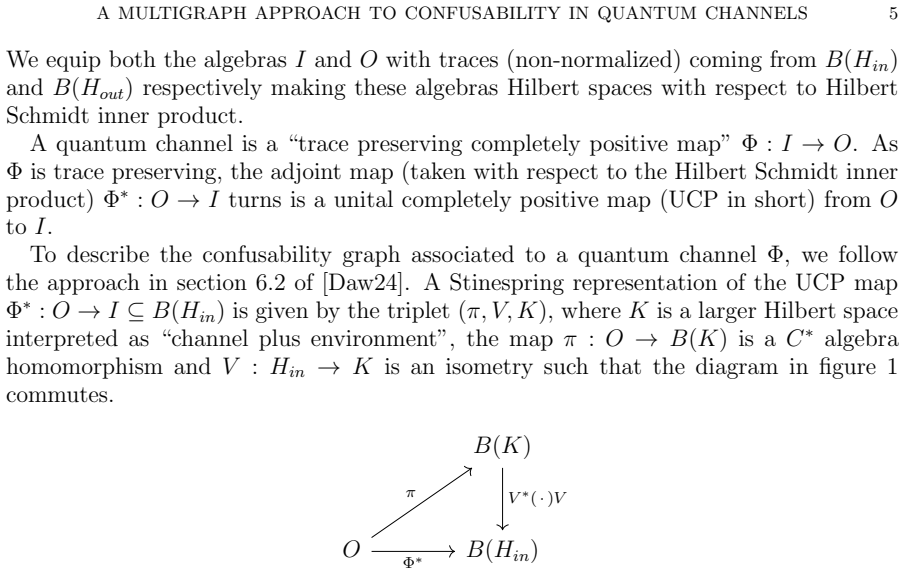
We introduce a new approach to confusability in a quantum channel, namely quantum confusability multigraph, which incorporates the output information into the graphical structure. By``counting" the edges between two vertices of this confusability multigraph, one recovers the traditional confusability ``single-edged" graph of the channel. With this physical motivation, we therefore develop a theory of quantum multigraphs from Weaver's quantum relations point of view and explore its quantum graph theoretic properties. Finally, we provide a necessary and sufficient condition characterizing those quantum multigraphs that arise as quantum confusability multigraphs.
0
0
math.QA 2026-04-07 1 theorem

Cocycles twist bialgebroid antipodes via conjugation

Drinfeld-Xu bialgebroid 2-cocycles twist the antipode

When the original antipode and the derived element V_F are invertible, the twisted bialgebroid obtains its own invertible antipode.

abstract click to expand
Ping Xu generalized Drinfeld 2-cocycles from bialgebras to associative bialgebroids over noncommutative base algebras. Any counital Drinfeld--Xu 2-cocycle twists the base algebra of the bialgebroid and a comultiplication on the total algebra, obtaining a new, twisted bialgebroid. Antipodes for bialgebroids have been considered, but finding a general way to twist the antipode, which is straightforward in the Hopf algebra case, appeared somewhat elusive. In this article, we prove that if an invertible antipode $S$ for the original bialgebroid exists, and another expression $V_F$ depending on the 2-cocycle $F$ is invertible, then the expected conjugation formula $S_F(-) = V_F^{-1} S(-) V_F$ indeed produces an invertible antipode $S_F$ for the twisted bialgebroid.
0
0
math.QA 2026-04-07 Recognition

Current algebra presentation for quantum affine algebra at root of unity

Quantum affine vertex algebra at root of unity

Yields Z_wp-module quantum vertex algebras and a fully faithful functor from smooth weighted modules to equivariant phi-coordinated quasi-

abstract click to expand
Let $\mathfrak g$ be a finite simple Lie algebra, and let $r$ denote the ratio of the square length of long roots to that of short roots. Let $\wp>2r$ be an integer and $\zeta$ a primitive $\wp$-th root of unity. Denote by $\mathcal U_\zeta(\widehat{\mathfrak g})$ the Lusztig big quantum affine algebra at root of unity defined by divided powers. In this paper, we establish a current algebra presentation of $\mathcal U_\zeta(\widehat{\mathfrak g})$. Based on this presentation, we construct a $\mathbb Z_\wp$-module quantum vertex algebras $V_{\wp,\tau}^\ell(\mathfrak g)$ for each integer $\ell$. Moreover, we establish a fully faithful functor from the category of smooth weighted $\mathcal U_\zeta(\widehat{\mathfrak g})$-modules of level $\ell$ to the category of $(\mathbb Z_\wp,\chi_\phi)$-equivariant $\phi$-coordinated quasi-modules of $V_{\wp,\tau}^\ell(\mathfrak g)$, where $\chi_\phi:\mathbb Z_\wp\to\mathbb C^\times$ is the group homomorphism defined by $s\mapsto \zeta^s$. We also determine the image of this functor. The structure $V_{\wp,\tau}^\ell(\mathfrak g)$ is substantially different from that of affine vertex algebras. We realize $V_{\wp,\tau}^\ell(\mathfrak g)$ as a deformation of a simpler quantum vertex algebra $V_{\wp,\varepsilon}^\ell(\mathfrak g)$ by using vertex bialgebras, and decompose $V_{\wp,\varepsilon}^\ell(\mathfrak g)$ into a Heisenberg vertex algebra and a more interesting quantum vertex algebra determined by a quiver.
1 0
0
math.QA 2026-04-07 2 theorems

Quantum K-divisor axiom holds without cancellations for quasi-minuscule flags

Cancellation-free version of the quantum K-theoretic divisor axiom for the flag manifold in the quasi-minuscule case

Removes cancelling terms from earlier formulas when the fundamental weight is quasi-minuscule.

abstract click to expand
We prove a cancellation-free version of the quantum $K$-theoretic divisor axiom for the flag manifold in the quasi-minuscule case. Namely, we remove the cancellations from the quantum $K$-theoretic divisor axiom due to Lenart-Naito-Sagaki-Xu in the case where the fundametal weight corresponding to the divisor class is quasi-minuscule.
0
0
math.QA 2026-04-07 Recognition

Quantum Borcherds-Bozec superalgebras yield semisimple integrable categories

Quantum Borcherds-Bozec Superalgebras

The algebras carry bilinear forms, higher Serre relations, quasi-R-matrices, and character formulas for irreducible highest weight modules.

abstract click to expand
We introduce quantum Borcherds-Bozec superalgebras. We present and prove various results of the quantum superalgebras including a bilinear form, higher Serre relation, quasi-R-matrix, character formula for the irreducible highest weight modules. We also prove the category of integrable representations is semi-simple.
0
0
math.QA 2026-04-06 Recognition

Satake diagrams classify quantizable spherical subalgebras

Graded Satake diagrams and super-symmetric pairs

Complete list covers every such subalgebra in basic matrix Lie superalgebras for arbitrary Borel choice and yields proper families after gr

abstract click to expand
We list classical spherical subalgebras in basic matrix Lie superalgebras which are quantizable to coideal subalgebras in the standard quantum supergroups, for any choice of Borel subalgebra. We classify the corresponding Satake-type diagrams and prove that each of them defines a family of proper spherical subalgebras.
0
0
math.QA 2026-04-06 2 theorems

Finite quadratic modules classify extended Abelian Chern-Simons theories

Classification of Extended Abelian Chern-Simons Theories

Every theory with U(1)^n gauge group matches uniquely to a finite quadratic module from an even lattice, covering related TQFTs and tensor c

abstract click to expand
We classify extended Abelian Chern-Simons theories with gauge group $U(1)^n$ as extended $(2+1)$-dimensional topological quantum field theories. For an even integral nondegenerate lattice $(\Lambda,K)$, let $(G_K,q_K)$ denote its discriminant quadratic module. We prove that the associated theory is determined, up to symmetric monoidal natural isomorphism, by this finite quadratic module, and that every finite quadratic module is realized as the discriminant quadratic module of an even integral nondegenerate lattice. It follows that finite quadratic modules classify extended Abelian Chern-Simons theories, pointed Abelian Reshetikhin-Turaev TQFTs, and pointed modular tensor categories.
0
0
math.QA 2026-04-03 2 theorems

Rigid C* category reconstructs free wreath product quantum group

Representation Category of Free Wreath Product of Classical Groups

The category is built so that Woronowicz-Tannaka-Krein duality recovers exactly the free wreath product of classical groups.

abstract click to expand
In this paper, we construct a rigid concrete $C^*$-tensor category whose associated compact quantum group, reconstructed via Woronowicz--Tannaka--Krein duality, is the free wreath product of classical groups.
0
0
math.QA 2026-04-03 Recognition

Toral Chern-Simons matches Reshetikhin-Turaev via quadratic modules

Equivalence of toral Chern-Simons and Reshetikhin-Turaev theories

Geometric quantization of U(1)^n Chern-Simons produces the same extended TQFT as the modular category from the lattice discriminant form.

abstract click to expand
We prove a natural isomorphism between toral Chern-Simons theory with gauge group $\mathbb T=\mathfrak t/\Lambda\cong U(1)^n$ and the Reshetikhin-Turaev theory associated with the finite quadratic module determined by an even, integral, nondegenerate symmetric bilinear form $K:\Lambda\times\Lambda\to\mathbb Z.$ More precisely, let $G_K=\Lambda^*/K\Lambda$ be the discriminant group of $K$, equipped with its induced quadratic form $q_K$, and let $C(G_K,q_K)$ be the corresponding pointed modular category. Using the geometric quantization formulation of toral Chern-Simons theory, we show that the resulting TQFT is naturally isomorphic to the Reshetikhin--Turaev TQFT determined by $C(G_K,q_K)$. The equivalence is established at the level of closed 3-manifold invariants, bordism operators for manifolds with boundary, and the extended $(2+1)$-dimensional structure, yielding a natural isomorphism of extended TQFTs.
1 0
0
math.QA 2026-04-02 2 theorems

Poincaré T-matrix contracts to Galilei for quantum frames

Universal T-matrices for quantum Poincar\'e groups: contractions and quantum reference frames

The universal T-matrix of a new quantum Poincaré deformation contracts exactly to the Galilei T-matrix for non-relativistic quantum frames.

abstract click to expand
Universal $T$-matrices, or Hopf algebra dual forms, for quantum groups are revisited, and their contraction theory is developed. As a first illustrative example, the (1+1) timelike $\kappa$-Poincar\'e $T$-matrix is explicitly worked out. Afterwards, motivated by recent results on the role of the Hopf algebra dual form of a quantum (1+1) centrally extended Galilei group as the algebraic object underlying non-relativistic quantum reference frame transformations, a new quantum deformation of the (1+1) centrally extended Poincar\'e Lie algebra is obtained, and its universal $T$-matrix is presented. Finally, the Hopf algebra dual form contraction is applied to this Poincar\'e $T$-matrix, showing that its corresponding non-relativistic counterpart is precisely the Galilei $T$-matrix associated with quantum reference frames. In this way, the Poincar\'e Hopf algebra dual form introduced here stands as a natural candidate for describing the symmetry structure of relativistic quantum reference frame transformations. In the appropriate basis, the associated quantum Poincar\'e group is recognized, remarkably, as a non-trivial central extension of the (1+1) spacelike $\kappa$-Poincar\'e dual Hopf algebra.
0
0
math.QA 2026-04-02 2 theorems

Mixed associator deformations controlled by Drinfeld center Ext

Deformations of mixed associators in module categories

For finite module categories the controlling cohomology equals relative Ext groups of the unit and adjoint algebra, giving dimension formula

Figure from the paper full image
abstract click to expand
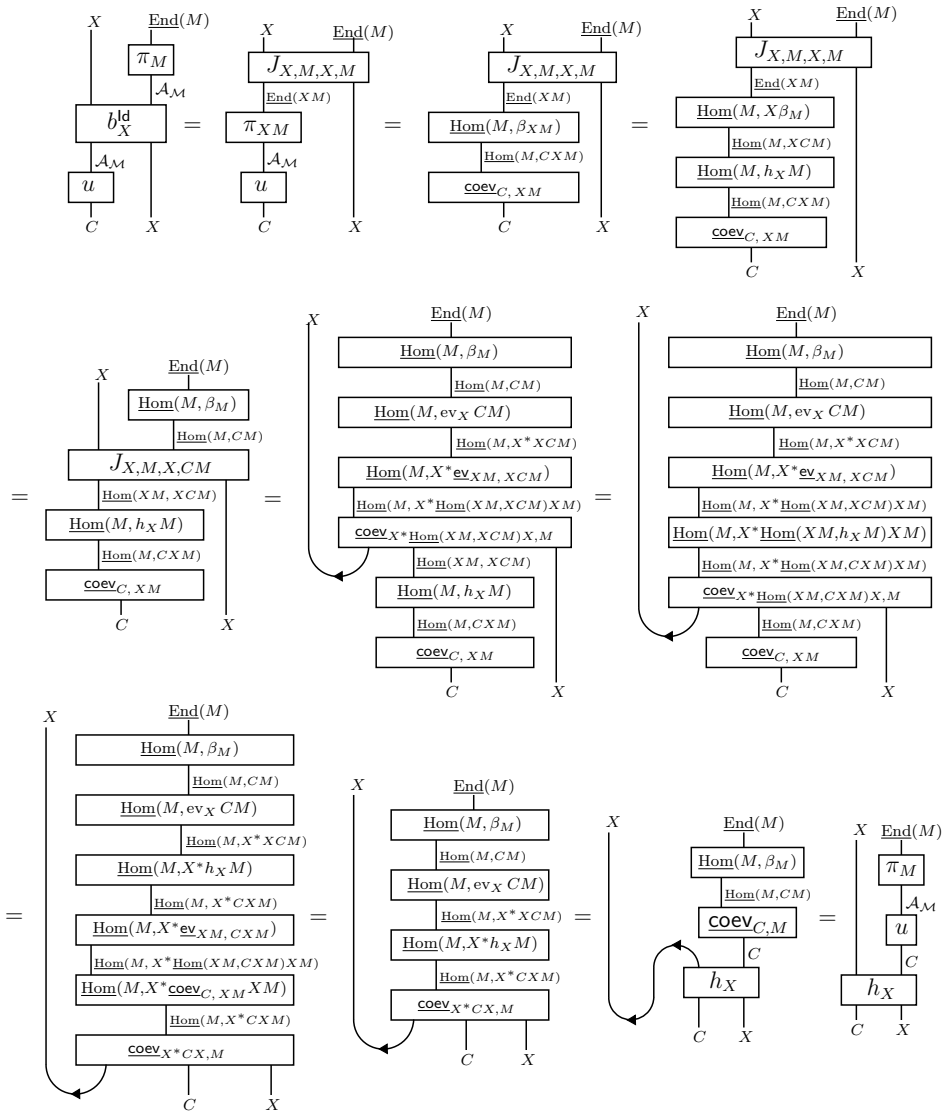
We set up a cochain complex $C^\bullet_{\mathrm{mix}}(\mathcal{M})$ whose cohomology controls deformations of the mixed associator of a module category $\mathcal{M}$ over a $\Bbbk$-linear monoidal category $\mathcal{C}$. We show that $C^\bullet_{\mathrm{mix}}(\mathcal{M})$ is isomorphic to the Davydov-Yetter (DY) complex of the representation functor $\rho : \mathcal{C} \to \mathrm{End}(\mathcal{M})$. Using our previous results on DY cohomology (arXiv:2411.19111), we prove that if $\mathcal{C}$ and $\mathcal{M}$ are finite then the cohomology $H^\bullet_{\mathrm{mix}}(\mathcal{M})$ is isomorphic to the relative Ext groups $\mathrm{Ext}^\bullet_{\mathcal{Z}(\mathcal{C}),\mathcal{C}}(\boldsymbol{1},\mathcal{A}_{\mathcal{M}})$ for the usual adjunction between the Drinfeld center $\mathcal{Z}(\mathcal{C})$ and $\mathcal{C}$, where $\mathcal{A}_{\mathcal{M}}$ is the so-called adjoint algebra of $\mathcal{M}$. This allows us to give a dimension formula for $H^n_{\mathrm{mix}}(\mathcal{M})$ in terms of certain Hom spaces in $\mathcal{Z}(\mathcal{C})$, and also to prove that $H^{>0}_{\mathrm{mix}}(\mathcal{C}) = 0$. We also show that the algebra $\mathcal{A}_{\mathcal{M}}$ is the ``full center'' of an algebra in $\mathcal{C}$ realizing $\mathcal{M}$. We furthermore establish a generalized version of Ocneanu rigidity for monoidal functors with coefficients, and provide its application to general (non-exact and non-finite) $\mathcal{C}$-module categories over a fusion category $\mathcal{C}$ such that $\dim(\mathcal{C}) \neq 0$. We spell out these results for module categories defined by finite-dimensional comodule algebras over finite-dimensional Hopf algebras. Examples based on comodule algebras over Sweedler's Hopf algebra are worked out in detail and yield new continuous families of inequivalent non-exact module categories.
0
0
math.QA 2025-09-09

Field-theory recipe builds every Clifford cellular automaton on a lattice

Clifford quantum cellular automata from topological quantum field theories and invertible subalgebras

Cup-product actions reproduce the L-theory classification in all dimensions and pin down each automaton's order.

abstract click to expand
We present a general framework for constructing quantum cellular automata (QCA) from topological quantum field theories (TQFT) and invertible subalgebras (ISA) using the cup-product formalism. This approach explicitly realizes all $\mathbb{Z}_2$ and $\mathbb{Z}_p$ Clifford QCAs (for prime $p$) in all admissible dimensions, in precise agreement with the classification predicted by algebraic $L$-theory. We determine the orders of these QCAs by explicitly showing that finite powers reduce to the identity up to finite-depth quantum circuits (FDQC) and lattice translations. In particular, we demonstrate that the $\mathbb{Z}_2$ Clifford QCAs in $(4l{+}1)$ spatial dimensions can be disentangled by non-Clifford FDQCs. Our construction applies beyond cubic lattices, allowing $\mathbb{Z}_2$ QCAs to be defined on arbitrary cellulations. Furthermore, we explicitly construct invertible subalgebras in higher dimensions, obtaining $\mathbb{Z}_2$ ISAs in $2l$ spatial dimensions and $\mathbb{Z}_p$ ISAs in $(4l{-}2)$ spatial dimensions. These ISAs give rise to $\mathbb{Z}_2$ QCAs in $(2l{+}1)$ dimensions and $\mathbb{Z}_p$ QCAs in $(4l{-}1)$ dimensions. We further prove that the QCAs in $3$ spatial dimensions constructed via TQFTs and ISAs are equivalent by identifying their boundary algebras, and show that this approach extends to higher dimensions. Together, these results establish a unified and dimension-periodic framework for Clifford QCAs, connecting their explicit lattice realizations to field theories.
1 0

browse all of math.QA → full archive · search · sub-categories