REVIEW 3 major objections 5 minor 1 cited by
Observation of Orbital-Selective Dual Modulations in an Anisotropic Antiferromagnetic Kagome Metal TbTi3Bi4
T0 review · 3 major / 5 minor · reviewed 2026-08-11 · deepseek-v4-flash
Pith's one-line read Antiferromagnetic order in TbTi3Bi4 is driven by nesting of Tb $5d_{xz}$ Fermi surfaces, producing Dirac cones at M1.
desk verdict Solid ARPES/NPD observation of dual band modulations at the AFM transition, but the orbital-selective nesting mechanism and topological claims go beyond the evidence. read the letter →
The pith
A machine-rendered reading of the paper's core claim, the machinery that carries it, and where it could break.
The reading
What carries the argument
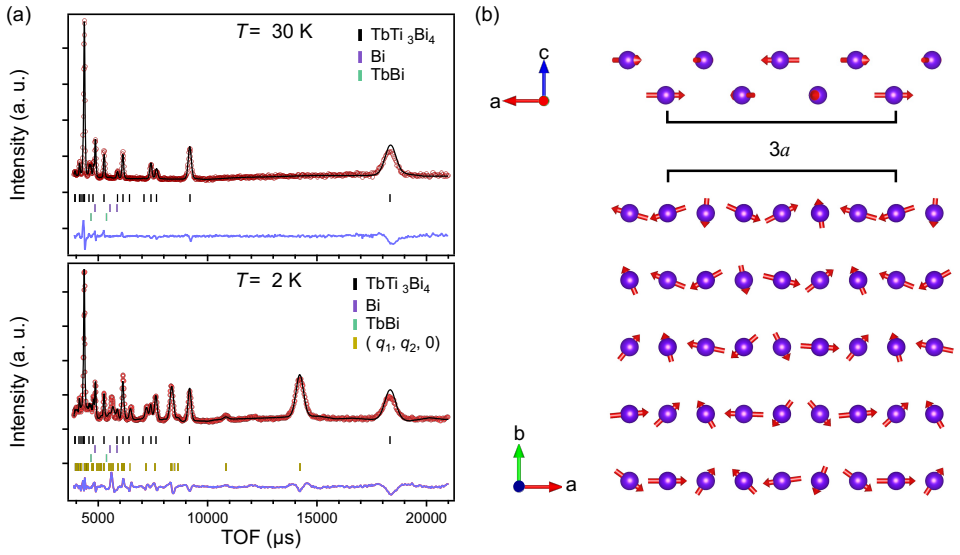
The central object is the quasi-one-dimensional Fermi surface of the intercalated Tb zigzag chains, specifically its Tb $5d_{xz}$ orbital weight, which the calculations show is concentrated on the $k_z = \pi$ sheets parallel to the $a^*$ direction. Its nesting vector $q_1 \approx a^*/3$ (with a secondary $q_2 \approx 0.28 b^*$) matches the magnetic wavevector $(0.35, 0.28, 0)$ refined from neutron data. This nesting is proposed to enhance the RKKY exchange between Tb $4f$ moments, and the folded-band analysis of the ARPES data carries the argument: the emergent bands at M1 and the gapped pockets are reproduced by folding the normal-state bands by $q_1$ and $q_2$, connecting the observed electronic reconstruction directly to the magnetic periodicity.
What would settle it
Track the magnetic peaks at $(q_1, q_2, 0)$ with neutron diffraction on a field-oriented single crystal while sweeping the field through the 1/3 magnetization plateau: if the $b$-axis ($q_2$) modulation does not collapse as the plateau forms, the proposed spin-flip mechanism is wrong.
Extended reading notes
Core claim
Below $T_{N1} \approx 20.4$ K, TbTi3Bi4 enters an antiferromagnetic state whose electronic structure shows two coexisting band modulations: a strong folding along $a^*$ with $q_1 \approx a^*/3$, seen as a gap of roughly 43 meV on the outer pocket at M1 and a 77.6 meV gap on the quasi-1D Fermi surface, and a weaker folding along $b^*$ with $q_2 \approx 0.28 b^*$, with a gap near 27 meV. The folded bands live mainly in the $k_z = \pi$ plane, exactly where the band-structure calculation places a well-nested quasi-1D Fermi surface dominated by the Tb $5d_{xz}$ orbital. Neutron powder diffraction finds magnetic peaks at the same $(q_1, q_2, 0)$ wavevector below $T_{N1}$, while STM sees no charge order at that wavevector, so the authors conclude the modulations are the band-structure signature of the antiferromagnetic order itself. The momentum-dependent folding produces symmetry-protected Dirac cones at the M1 point, and the approximate $3a$ period along the zigzag chains provides a natural microscopic picture for the 1/3 magnetization plateau: an intralayer spin flip at the first metamagnetic field produces the plateau, and a second flip saturates the magnetization. The paper's central claim is that this entire chain is driven by nesting of the intercalated Tb $5d_{xz}$ orbitals, making orbital selectivity the organizing principle of the magnetic ground state.
Load-bearing premise
The argument depends on two fragile premises: that a band-structure calculation which leaves out Tb's localized $4f$ electrons still gets the orbital character and nesting right, and that the proposed magnetic structure\textemdash which the authors concede is one plausible solution, not excluding a spin helix\textemdash is the true one.
Editorial extensions
If this is right
- The same $(1/3, 0.28, 0)$ wavevector governs both the magnetic order and the band folding, so the antiferromagnetic state is electronically driven rather than purely a local-moment effect.
- The Dirac cones at M1 below $T_{N1}$ imply a magnetic-order-induced topological transition in the antiferromagnetic state.
- The 1/3 magnetization plateau follows from the approximate $3a$ magnetic period along the zigzag chains, with an intralayer spin flip at the first metamagnetic field and a second flip at higher field.
- In the LnTi3Bi4 family, the presence or absence of a well-nested quasi-1D Fermi surface predicts which compounds show the 1/3 plateau, consistent with the contrast between GdTi3Bi4 and EuTi3Bi4.
- Tuning the Fermi surface by gating or doping should change the nesting vector and could stabilize other fractional magnetization plateaus.
Reading between the lines
- Because the calculation that identifies the Tb $5d_{xz}$ nesting excludes the Tb $4f$ electrons, the paper implicitly assumes the itinerant $d$-orbital physics is decoupled enough from the localized $f$ moments to set the ordering wavevector; a resonant ARPES experiment at the Tb M edge could test this directly.
- The $q_2$ modulation is presented as the weaker, secondary instability; an interesting extension is whether doping or strain that shifts the $b^*$ nesting condition would suppress the 1/3 plateau while leaving the $a^*$ order intact.
- The same orbital-selective nesting mechanism may apply to other intercalated kagome metals with zigzag chains, suggesting a design rule: align the chain direction with the dominant nesting vector to select the magnetic order.
- The proposed spin-flip sequence for the plateau is a minimal model; field-dependent neutron diffraction on a single crystal could distinguish it from the alternative spin-helix configuration the authors say cannot be excluded.
Editorial analysis
A structured set of objections, weighed in public.
Referee Report
Summary. The manuscript reports a combined ARPES, neutron powder diffraction, STM, magnetization, and DFT study of the kagome metal TbTi3Bi4. The authors identify two band modulations below the antiferromagnetic transition at TN1 ≈ 20.4 K: q1 ≈ 1/3 a* along the Tb zigzag-chain direction and q2 ≈ 0.28 b* perpendicular to it. They attribute these modulations to Fermi-surface nesting of quasi-1D Tb 5dxz orbitals, propose that the associated band folding produces a Dirac cone at the M1 point signaling a topological phase transition, and connect the resulting ~3a magnetic period to the observed 1/3 magnetization plateau. The experimental observations of band reconstruction, gap openings, and their temperature dependence are presented in detail and supported by NPD showing magnetic peaks at the same wavevector.
Significance. If the central claims hold, this work would provide a rare experimental example of orbital-selective band reconstruction driven by magnetism in a kagome metal, with implications for the LnTi3Bi4 family. The strengths of the paper are the multi-technique approach (VUV and soft-X-ray ARPES, NPD, STM, transport, magnetization), the clear temperature dependence showing that the band folding onsets at TN1, and the identification of two distinct modulation vectors consistent between ARPES and neutron diffraction. The STM exclusion of a charge-density-wave origin is a valuable control. The paper is, however, less convincing in three load-bearing areas: the orbital-selective nesting mechanism relies on a 4f-less DFT calculation, the topological interpretation is inferred from a single Dirac-cone-like crossing without symmetry or surface-state analysis, and the magnetic structure underlying the 1/3 plateau is admitted to be non-unique.
major comments (3)
- [Methods C and Fig. 7] The assignment of the reconstructed quasi-1D Fermi surface to Tb 5dxz orbitals and the identification of q1 and q2 as nesting vectors rest entirely on DFT calculations that exclude Tb 4f electrons (Methods C: 'projector augmented wave potentials with nine valence electrons for Tb (f electrons are not considered)'). Since the 4f electrons are the ordered moments and can hybridize with the 5d states, the orbital projection and the Fermi-surface topology may change below TN1. The authors should provide a quantitative check of the nesting scenario, for example a q-resolved static susceptibility χ0(q) computed from the DFT band structure, or a 4f-inclusive calculation (DFT+U or open-core treatment) showing that the Tb 5dxz character and the nesting vectors are robust. Without such a check, the causal statement in the Discussion that 'the Tb 5dxz orbital plays a direct role in establishing the antiferromagnetic ground state' is not established; the ARPES data support band folding with q1 and q2, but the nesting-driven orbital-selective mechanism remains a plausible interpretation rather than a demonstrated one.
- [Results, Fig. 4 and Abstract] The claim of a 'symmetry-protected Dirac cone' and a topological phase transition is not supported by the evidence presented. The text states that 'the emergent gapless Dirac point at the BZ boundary must either be protected by magnetic symmetries or originate from surface states induced by bulk band inversions,' and then concludes that either scenario points to an underlying topological state. However, no magnetic-space-group analysis, no calculation of topological invariants, and no surface-state computation are provided to distinguish these alternatives or to establish protection. The abstract and conclusion nonetheless state the topological transition as a finding. The authors should either downgrade the topological claim to a more cautious statement—that a Dirac-cone-like crossing appears below TN1 with an as-yet-undetermined origin—or supply the missing symmetry and topological analysis.
- [Fig. 8 and Discussion of the 1/3 plateau] The proposed magnetic structure with wavevector (0.35, 0.28, 0) is explicitly admitted to be 'one plausible solution derived from the NPD data; alternative magnetic configurations, e.g. spin helix, however, cannot be fully excluded.' Because the 1/3 magnetization plateau mechanism in Fig. 9(c) relies on a specific ~3a-period moment arrangement along the a-axis, the non-uniqueness of the Rietveld model is a load-bearing uncertainty for that mechanism. The authors should either present additional experimental constraints (e.g., single-crystal neutron diffraction, or field-dependent neutron data) that discriminate the proposed collinear-like structure from a spin helix, or frame the plateau mechanism more explicitly as a speculative proposal whose validity is contingent on the magnetic structure being confirmed.
minor comments (5)
- [Abstract] In the abstract, the phrases 'Dirac cones only at the point' and 'leading to the emergence of Dirac cones' contain missing symbols (M1 or similar); these should be completed before publication.
- [Methods A] The text says TbTi3Bi4 'crystallizes in a centrosymmetric cubic structure (space group Fmmm, No. 69)'; Fmmm is an orthorhombic space group, not cubic. Please correct this.
- [Fig. 5 caption] The caption refers to 'the pockets' and 'the point' with missing symbols; the momentum labels (M1, M2, or similar) should be specified for clarity.
- [Fig. 4 and Appendix D] The quantity 'Peak 3' is introduced in the text before its definition in the caption of Fig. 4(g); consider defining it in the main text where it is first mentioned.
- [Introduction and Discussion] The manuscript cites ref. [17] (arXiv:2405.16831) for recent single-crystal neutron diffraction results showing anisotropic moments along a and b; given the reliance on that result for the plateau mechanism, the authors should state explicitly which quantities are taken from that work and which are measured here.
Circularity Check
No significant circularity: the wavevectors, gaps, and magnetic ordering vector are independently measured, and the DFT orbital assignment is a stated modeling assumption rather than a fitted input.
full rationale
The paper's central claim—that q1 ~ 1/3 a* and q2 ~ 0.28 b* band modulations are orbital-selective manifestations of AFM order—rests on a chain of independent measurements. ARPES directly observes the folded bands and momentum-dependent gaps below TN1; NPD independently determines a magnetic wavevector (0.35, 0.28, 0) with the same in-plane components; STM rules out charge order; and DFT (explicitly stated to exclude Tb 4f electrons) is used only to assign orbital character and to display parallel Fermi-surface segments. None of these quantities is defined in terms of another, and no parameter is fitted to a subset of data and then renamed a prediction. The causal statement that the AFM order is 'driven by' nesting is an interpretation supported by wavevector coincidence and temperature onset, not a derivation that reduces to its own inputs. The single overlapping-author citation, ref. [17], supplies an external single-crystal neutron-diffraction result (a-axis moments approximately three times b-axis moments) used only in the explicitly 'plausible' 1/3-plateau model, and is directly falsifiable experimental evidence rather than a circularity-inducing self-citation. The admitted limitations—the magnetic structure being 'one plausible solution' with spin-helix alternatives 'not fully excluded,' and the absence of a computed q-resolved susceptibility or 4f-inclusive DFT check—are correctness and robustness risks, not circularity.
Assumptions & free parameters
assumptions (5)
- domain assumption DFT without 4f electrons captures the itinerant band structure and orbital character near the Fermi level.
- domain assumption ARPES data represent the bulk electronic structure.
- domain assumption RKKY interaction is the dominant exchange mechanism connecting Fermi surface nesting to magnetic order.
- domain assumption The magnetic structure with wavevector (q1, q2, 0) is correctly determined from NPD Rietveld refinement.
- standard math No symmetry-enforced degeneracies exist at L1 and M1 in space group Fmmm.
Cite this review
Pith. "Pith review of Observation of Orbital-Selective Dual Modulations in an Anisotropic Antiferromagnetic Kagome Metal TbTi3Bi4." pith.science (2026). https://pith.science/paper/AJ5CCGBQ
@misc{pith2026241216815,
  author       = {Pith},
  title        = {Pith review of: Observation of Orbital-Selective Dual Modulations in an Anisotropic Antiferromagnetic Kagome Metal TbTi3Bi4},
  year         = {2026},
  howpublished = {\url{https://pith.science/paper/AJ5CCGBQ}},
  note         = {Machine review of arXiv:2412.16815}
}
read the original abstract
Orbital selectivity is pivotal in dictating the phase diagrams of multiorbital systems, with prominent examples including the orbital-selective Mott phase and superconductivity, etc. The intercalation of anisotropic layers represents an effective method for enhancing orbital selectivity and, thereby shaping the low-energy physics of multiorbital systems. Despite its potential, related experimental studies remain limited. In this work, we systematically examine the interplay between orbital selectivity and magnetism in the newly discovered anisotropic kagome TbTi3Bi4 single crystal, and report a unidirectional, orbital-selective band reconstruction within the antiferromagnetic (AFM) state. By combining soft X-ray and vacuum ultraviolet angle-resolved photoemission spectroscopy (ARPES) measurements with orbital-resolved density functional theory (DFT) calculations, we identify that the band reconstruction is a manifestation of the AFM order, driven by a 1/3 nesting instability of the intercalated Tb 5dxz orbitals. Such an orbital-selective modulation leads the unusual momentum-dependent band folding and the emergence of symmetry-protected Dirac cones only at the M1 point. More importantly, the discovery of orbital-selective 3 x 1 AFM order offers crucial insights into the underlying mechanism of the fractional magnetization plateau in this Kagome AFM metal. Our findings not only underscore the essential role of both conducting and localized electrons in determining the magnetic orders of LnTi3Bi4 (Ln = Lanthanide) kagome metals but also offer a pathway for manipulating magnetism through selective control of anisotropic electronic structures.
Figures


Figures from the paper (1 more)
Forward citations
Cited by 1 Pith paper
-
Synergistic doping and stabilization of magnetically tunable LnTi$_3$(Sb,Sn)$_4$ (Ln:Ce--Gd) kagome metals
In LnTi3(Sb,Sn)4 kagome metals, Sb/Sn alloying stabilizes a structure with no pure endpoints and tunes the Sm series between AFM, FM, and mixed A(FM) magnetic states.
Reference graph
Works this paper leans on
-
[1]
G. R. Stewart, Non-Fermi-liquid behavior in d- and f-electron metals, Rev. Mod. Phys. 73, 797 (2001). [2] P. Gegenwart, Q. Si, and F. Steglich, Quantum criticality in heavy-fermion metals, Nature Phys 4, 3 (2008). [3] A. Georges, L. de’ Medici, and J. Mravlje, Strong Correlations from Hund’s Coupling, Annual Review of Condensed Matter Physics 4, 137 (2013...
work page 2001
-
[16]
B. R. Ortiz, H. Zhang, K. Górnicka, D. S. Parker, G. D. Samolyuk, F. Yang, H. Miao, Q. Lu, R. G. Moore, A. F. May, and M. A. McGuire, Intricate Magnetic Landscape in Antiferromagnetic Kagome Metal TbTi3Bi4 and Interplay with Ln2–xTi6+xBi9 (Ln: Tb···Lu) Shurikagome Metals, Chem. Mater. 36, 8002 (2024). [17] E. Cheng, K. Wang, Y. Hao, W. Chen, H. Tan, Z. Li...
arXiv 2024
-
[29]
J. Guo, L. Zhou, J. Ding, G. Qu, Z. Liu, Y. Du, H. Zhang, J. Li, Y. Zhang, F. Zhou, W. Qi, M. Cui, Y. Zhang, F. Guo, T. Wang, F. Fei, Y. Huang, T. Qian, D. Shen, Y. Song, H. Weng, and F. Song, Tunable magnetism and band structure in kagome materials RETi3Bi4 family with weak interlayer interactions, Science Bulletin (2024). [30] Z. Zheng, L. Chen, X. Ji, ...
work page 2024
Reviewed August 11, 2026 · model on record in the stance chip above.
Discussion (0). Continue with ORCID to comment.