Interior marginally outer trapped surfaces in Hayward black holes
Pith reviewed 2026-06-28 05:19 UTC · model grok-4.3
The pith
Near the inner horizon of certain Hayward black holes, MOTS locations are given by hypergeometric functions after reduction to a singular Sturm-Liouville problem whose eigenspace is complete, not discrete, and discontinuous.
A machine-rendered reading of the paper's core claim, the machinery that carries it, and where it could break.
Core claim
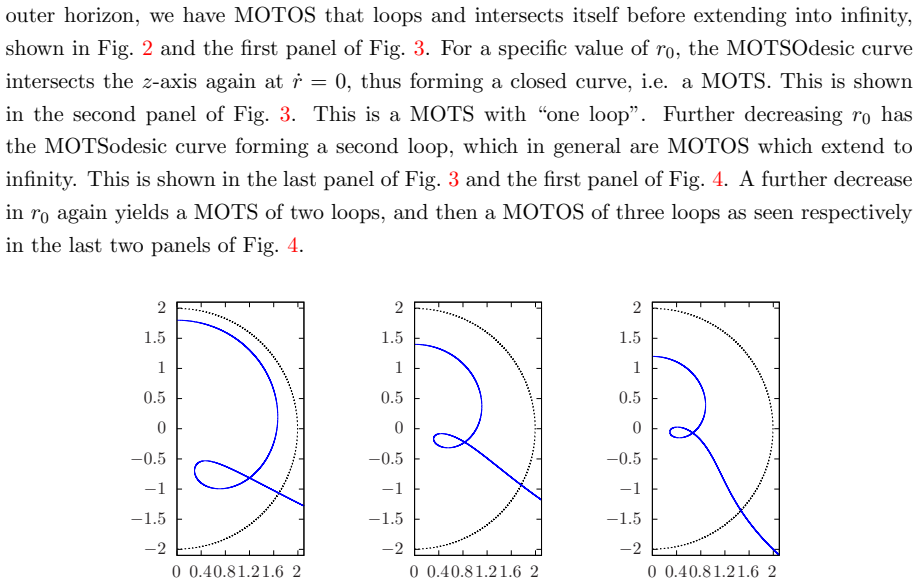
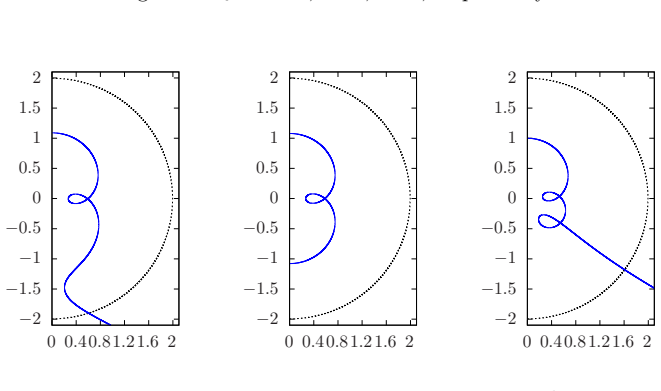
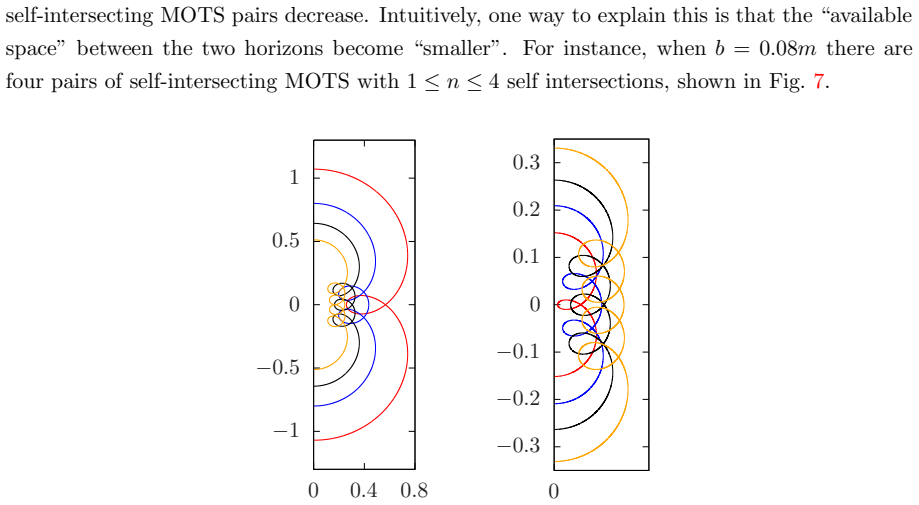
In a neighborhood of the inner horizon for certain values of b, upon reduction of the problem to a singular Sturm-Liouville problem, the locations of the MOTS are given by hypergeometric functions, the eigenspace of the operator for which is complete, not discrete, and discontinuous. Self-intersecting MOTS occur in pairs. For b close to the critical value there are no self-intersecting MOTS/MOTOS, and one can fine-tune b so that the interior contains only near-spherical MOTS.
What carries the argument
Reduction of the MOTS locating equation to a singular Sturm-Liouville problem solved by hypergeometric functions, with the operator's eigenspace being complete yet not discrete and discontinuous.
If this is right
- Self-intersecting MOTS occur in pairs for some range of b.
- For b sufficiently close to the critical value, self-intersecting MOTS and MOTOS are absent.
- Fine-tuning of b produces an interior containing only near-spherical MOTS.
- The completeness of the eigenspace permits representation of general solutions in the neighborhood of the inner horizon.
Where Pith is reading between the lines
- The same reduction technique may apply to the locating equations for trapped surfaces in other spherically symmetric regular black hole metrics.
- The discontinuous character of the eigenspace suggests that standard spectral theorems for Sturm-Liouville operators require modification inside these spacetimes.
- Explicit hypergeometric expressions for MOTS could serve as initial data or test cases for numerical evolutions of black hole interiors.
Load-bearing premise
The equation that locates MOTS can be reduced to a singular Sturm-Liouville problem whose solutions are hypergeometric functions possessing the stated completeness and discontinuity properties, and this reduction holds in a neighborhood of the inner horizon for selected values of b.
What would settle it
A direct numerical integration or shooting method that computes the actual radial locations of MOTS near the inner horizon for the selected b values and finds they deviate from the values predicted by the hypergeometric solutions.
Figures





read the original abstract
We locate interior marginally outer trapped and marginally outer trapped open surfaces (MOTS/MOTOS) in the regular Haward metric with parameter $b$ for which a critical (extremal) value $b=b_c$ demarcates when the spacetime admits no horizon and when it admits inner and outer horizons. We identify self-intersecting MOTS which occur in pairs. For $b$ close to the critical value, there are no self-intersecting MOTS/MOTOS, and one can fine-tune $b$ so that the interior contains only near-spherical MOTS. We also show that in a neighborhood of the inner horizon for certain values of $b$, upon reduction of the problem to a singular Sturm-Liouville problem, the locations of the MOTS are given by hypergeometric functions, the eigenspace of the operator for which is complete, not discrete, and discontinuous.
Editorial analysis
A structured set of objections, weighed in public.
Referee Report
Summary. The paper locates interior marginally outer trapped surfaces (MOTS) and marginally outer trapped open surfaces (MOTOS) in the regular Hayward metric parameterized by b, with a critical value b_c separating regimes with and without horizons. It identifies self-intersecting MOTS occurring in pairs, conditions with no self-intersecting surfaces, and fine-tuning of b yielding only near-spherical interior MOTS. The central claim is that, in a neighborhood of the inner horizon for selected b, reduction of the locating equation to a singular Sturm-Liouville problem gives MOTS locations via hypergeometric functions, with the eigenspace of the operator being complete, not discrete, and discontinuous.
Significance. If the reduction to a singular Sturm-Liouville problem and the stated spectral properties hold with explicit verification, the work would supply an analytic handle on MOTS locations in a regular black-hole spacetime, including the possibility of a continuous family of surfaces. This could inform studies of trapped surfaces and horizon structure in non-singular geometries. The manuscript does not supply machine-checked proofs or reproducible code, so the result remains dependent on the correctness of the reduction steps.
major comments (2)
- Abstract: the claim that MOTS locations are 'given by hypergeometric functions' while the eigenspace is 'complete, not discrete, and discontinuous' requires clarification; a continuous spectrum ordinarily parametrizes a continuum of solutions rather than isolated locations, and the manuscript must show explicitly (via the weight function, singularity classification, or self-adjoint extension) how the hypergeometric family maps onto concrete MOTS positions without extra selection rules.
- Abstract (and implied § on the reduction): the reduction of the MOTS locating equation to a singular Sturm-Liouville problem is asserted for a neighborhood of the inner horizon and selected b, yet no explicit operator, boundary conditions, or verification that the assumptions of the Sturm-Liouville theory are satisfied are provided; this step is load-bearing for the hypergeometric claim and must be derived in full.
minor comments (1)
- Abstract: the metric is referred to as 'Haward' on one line; correct to 'Hayward' for consistency with the title.
Simulated Author's Rebuttal
We thank the referee for the careful reading and the constructive major comments. Both points identify places where the manuscript asserts results without sufficient explicit derivation or clarification; we will address them by expanding the relevant sections.
read point-by-point responses
-
Referee: Abstract: the claim that MOTS locations are 'given by hypergeometric functions' while the eigenspace is 'complete, not discrete, and discontinuous' requires clarification; a continuous spectrum ordinarily parametrizes a continuum of solutions rather than isolated locations, and the manuscript must show explicitly (via the weight function, singularity classification, or self-adjoint extension) how the hypergeometric family maps onto concrete MOTS positions without extra selection rules.
Authors: We agree the abstract phrasing risks conflating the continuous spectrum with discrete surface locations. The hypergeometric solutions arise for a continuous range of the spectral parameter that labels distinct MOTS near the inner horizon; the claimed completeness means the family spans all admissible solutions in that neighborhood. We will revise the abstract to state this parameterization explicitly and add a paragraph in the reduction section that identifies the weight function, classifies the singularities, and shows how each value of the continuous parameter corresponds to a unique MOTS without additional selection rules. revision: yes
-
Referee: Abstract (and implied § on the reduction): the reduction of the MOTS locating equation to a singular Sturm-Liouville problem is asserted for a neighborhood of the inner horizon and selected b, yet no explicit operator, boundary conditions, or verification that the assumptions of the Sturm-Liouville theory are satisfied are provided; this step is load-bearing for the hypergeometric claim and must be derived in full.
Authors: The referee correctly notes that the reduction is asserted rather than derived in full. In the revised manuscript we will insert a self-contained subsection that starts from the MOTS equation, performs the change of variables that produces the Sturm-Liouville form, writes the explicit differential operator and weight function, states the boundary conditions at the singular points, and verifies the hypotheses of singular Sturm-Liouville theory (limit-point/limit-circle classification and self-adjointness) for the chosen range of b. This will make the appearance of hypergeometric functions and the spectral properties fully traceable. revision: yes
Circularity Check
No significant circularity; derivation reduces MOTS equation to independent Sturm-Liouville analysis
full rationale
The paper's central step reduces the MOTS locating equation in the Hayward metric to a singular Sturm-Liouville problem whose eigenfunctions are identified as hypergeometric functions with a claimed complete, non-discrete, discontinuous spectrum. This reduction is performed directly from the metric and the MOTS definition (null expansion vanishing) without any parameter fitting, self-referential definitions, or load-bearing self-citations. The spectral properties are presented as mathematical consequences of the resulting operator, not as inputs renamed as outputs. No equations or citations in the provided text exhibit the enumerated circularity patterns; the derivation remains self-contained against the spacetime geometry.
Axiom & Free-Parameter Ledger
axioms (2)
- domain assumption The Hayward metric with parameter b is a valid regular black hole spacetime in general relativity.
- domain assumption The MOTS locating equation admits a reduction to a singular Sturm-Liouville problem near the inner horizon.
Reference graph
Works this paper leans on
-
[1]
Penrose, Gravitational collapse: The role of general relativity , Riv
R. Penrose, Gravitational collapse: The role of general relativity , Riv. Nuovo Cim. 1 (1969), no. 12 252–276
1969
-
[2]
S. W. Hawking and G. F. R. Ellis, The Large Scale Structure of Space-Time . Cambridge Monographs on Mathematical Physics (Cambridge University Press), Cambridge, (1973)
1973
-
[3]
A. Ashtekar and B. Krishnan, Isolated and dynamical horizons and their applications , Living Rev. Rel. 7 (2004) 10, [ gr-qc/0407042]
Pith/arXiv arXiv 2004
-
[4]
A. Ashtekar and G. J. Galloway, Some uniqueness results for dynamical horizons , Adv. Theor. Math. Phys. 9 (2005) 1, [ gr-qc/0503109v4]
Pith/arXiv arXiv 2005
-
[5]
Booth, Black-hole boundaries, Canadian J
I. Booth, Black-hole boundaries, Canadian J. phys. 83 (2005) 1073, [ gr-qc/0508107v2]
Pith/arXiv arXiv 2005
-
[6]
S. A. Hayward, General laws of black-hole dynamics , Phys. Rev. D 49 (1994) 6467, [gr-qc/9303006]
Pith/arXiv arXiv 1994
-
[7]
I. Booth and S. Fairhurst, The First law for slowly evolving horizons , Phys. Rev. Lett. 92 (2004) 011102, [ gr-qc/0307087]
Pith/arXiv arXiv 2004
-
[8]
A. M. Sherif, R. Goswami, and S. D. Maharaj, Some results on cosmological and astrophysical horizons and trapped surfaces , Class. Quantum Grav. 36 (2019) 215001, [gr-qc/1905.02056v2]
arXiv 2019
-
[9]
A. Ashtekar and B. Krishnan, Quasi-Local Black Hole Horizons: Recent Advances , arXiv:2502.11825
- [10]
- [11]
-
[12]
K. T. B. Sievers, L. Newhook, S. Muth, I. Booth, R. A. Henn igar, and H. K. Kunduri, Marginally outer trapped tori in black hole spacetimes , Phys. Rev. D 109 (2024), no. 12 124023, [ arXiv:2312.00769]
arXiv 2024
- [13]
-
[14]
D. Pook-Kolb, R. Hennigar, and I. Booth, What happens to apparent horizons during a binary black hole merger? , Phys. Rev. Lett. 127 (2021), no. 18 181101, [arXiv:2104.10265]. 20
arXiv 2021
-
[15]
D. Pook-Kolb, I. Booth, and R. Hennigar, Ultimate fate of apparent horizons during a binary black hole merger. II. The vanishing of the apparent hori zons, Phys. Rev. D 104 (2021), no. 8 084084, [ arXiv:2104.11344]
arXiv 2021
-
[16]
L. Andersson, M. Mars, and W. Simon, Local existence of dynamical and trapping horizons, Phys. Rev. Lett. 95 (2005) 111102, [ gr-qc/0506013]
Pith/arXiv arXiv 2005
-
[17]
L. Andersson, M. Mars, and W. Simon, Stability of marginally outer trapped surfaces and existence of marginally outer trapped tubes , Adv. Theor. Math. Phys. 12 (2008), no. 4 853–888, [ arXiv:0704.2889]
Pith/arXiv arXiv 2008
- [18]
-
[19]
R. A. Hennigar, K. T. B. Chan, L. Newhook, and I. Booth, Interior marginally outer trapped surfaces of spherically symmetric black holes , Phys. Rev. D 105 (2022), no. 4 044024, [ arXiv:2111.09373]
arXiv 2022
- [20]
-
[21]
A. M. Sherif, Instability of marginally outer trapped surfaces from initi al data set symmetry, Class. Quant. Grav. 42 (2025), no. 13 137001, [ arXiv:2502.11581]. 21
arXiv 2025
discussion (0)
Sign in with ORCID, Apple, or X to comment. Anyone can read and Pith papers without signing in.