REVIEW 3 major objections 5 minor 25 references
Learning Predictive Ambiguity Sets for Decision-Focused Distributionally Robust Optimization
T0 review · 3 major / 5 minor · reviewed 2026-07-14 · grok-4.5
Pith's one-line read A deep model can learn how large a robustness ball should be for each market state, recovering most of the gains of strong fixed-radius DRO while using a smaller average radius.
desk verdict Clean, usable recipe for adaptive Wasserstein radii in decision-focused DRO; the math is standard and the portfolio gains look real, but the superiority claim still sits on one chronological path of one 20-name basket. read the letter →
The pith
A machine-rendered reading of the paper's core claim, the machinery that carries it, and where it could break.
The reading
What carries the argument
Learned predictive ambiguity sets (LPAS): a contextual Wasserstein ball whose center is a neural finite nominal scenario distribution and whose radius is a state-dependent network; the dual of that ball supplies a tractable robust decision layer that is trained jointly with the radius.
What would settle it
Re-run the same portfolio experiment over multiple rolling windows, random seeds, and a larger asset universe and find that the learned-radius model no longer matches fixed-radius DRO on return and Sharpe while keeping a smaller radius, or that the learned radius fails to rise with market volatility.
Extended reading notes
Core claim
Learned predictive ambiguity sets—a contextual finite scenario distribution plus a state-dependent Wasserstein radius trained by quantile calibration, size regularization, and downstream decision loss—can make distributionally robust optimization adaptive rather than globally fixed. On the reported 20-asset portfolio task they recover most of the out-of-sample performance of a deep fixed-radius DRO baseline while using a smaller average radius, slightly better tail metrics, and stronger regime adaptivity.
Load-bearing premise
The out-of-sample superiority and regime-adaptivity claims rest on a single chronological train/validation/test split of one 20-stock S&P 500 universe, without multi-seed or multi-fold checks.
Editorial extensions
If this is right
- Robust optimizers can shrink the ambiguity radius in calm regimes without giving up protection when forecasts are unreliable.
- How large the robustness ball should be can be driven by decision quality, not only by predictive coverage.
- Historical fixed-radius Wasserstein DRO underuses context and can be outperformed by predictive centers plus adaptive radii.
- Most of the reported gains can be obtained by staged training: pretrain scenarios, calibrate the radius, then decision-focused fine-tuning.
Reading between the lines
- The same radius-learning pattern should transfer to inventory, routing, and energy dispatch, where context likewise modulates forecast reliability.
- When decision-aware tuning leaves empirical coverage below the nominal quantile, conformal post-calibration of the learned radius can restore strict risk control without fully undoing performance.
- The optional anisotropic ground metric (proposed but not tested) could further cut conservatism by stretching the ball only in decision-sensitive directions.
Editorial analysis
A structured set of objections, weighed in public.
Referee Report
Summary. The paper proposes learned predictive ambiguity sets (LPAS): a contextual deep model that outputs a finite nominal scenario distribution and a state-dependent Wasserstein radius (optionally an anisotropic ground metric), which define a contextual ambiguity set for a DRO decision layer. The radius is trained by combining pinball quantile calibration, size regularization, and downstream decision loss (Eqs. 24–28; Algorithm 1). The finite dual of the Wasserstein DRO layer is derived (Eqs. 14–15) and specialized to a long-only portfolio problem with Euclidean cost, yielding a closed-form robust objective (Eqs. 19–20). On a single chronological split of 20 S&P 500 names (2018–2026), LPAS-W reports 26.28% annualized return, Sharpe 1.30, final wealth 1.61, and a smaller average radius than a deep fixed-radius DRO baseline while remaining competitive on tail metrics and improving some regime slices (Tables 2–4).
Significance. If the empirical claims hold under stronger validation, the work would be a useful bridge between decision-focused learning and Wasserstein DRO: instead of a hand-tuned fixed radius centered on historical samples, both the nominal distribution and the radius become contextual and trainable. The dual specialization for the portfolio layer is standard and correctly applied, and the staged training objective (prediction + calibration + size + decision loss) is a concrete, implementable recipe. The main contribution is therefore architectural and empirical rather than theoretical; its value hinges on whether adaptive radii reliably reduce unnecessary conservatism while preserving robustness. The paper is transparent about the single-split limitation (§7), which is appropriate.
major comments (3)
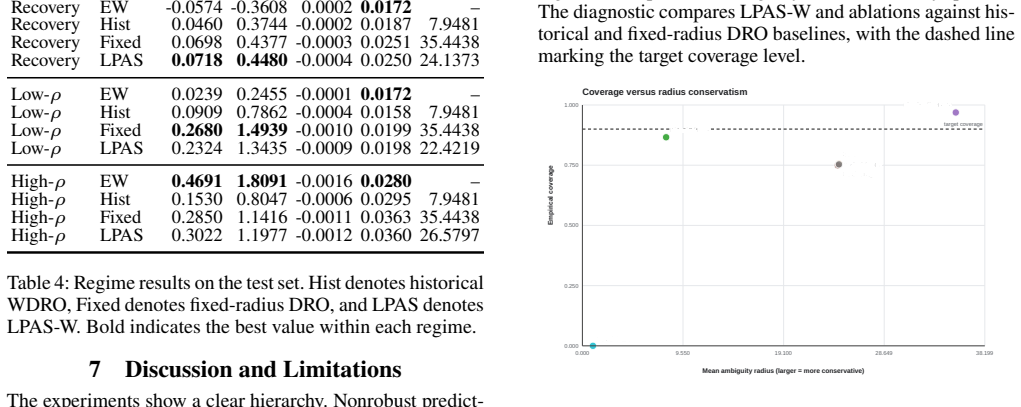
- §6.1–6.3 and Tables 2–4: The central superiority and regime-adaptivity claims rest on a single chronological 1129/410/515 split of one 20-name S&P 500 universe, with no multi-seed, multi-fold, or multi-universe results. Because the Transformer scenario generator, radius network, and decision-aware validation score are all selected on this path, the reported edge (26.28% return / Sharpe 1.30 / radius 24.3 vs Fixed-DRO’s 35.4) and the high-ρ / drawdown regime gains in Table 4 could be path-specific. §7 already flags this; for the claims as stated, at least one additional rolling fold or multi-seed summary is load-bearing.
- §4.5 and §6.5 / Fig. 4–5: After decision-aware tuning the empirical coverage of LPAS-W is 0.755 versus the nominal τ=0.9 target. The paper notes that size regularization and decision loss trade exact coverage for performance, and suggests conformal post-calibration if strict coverage is required. That is fine as a design choice, but the abstract and introduction still present the radius as “calibrated”; the manuscript should either report a post-calibrated variant or qualify the calibration claim so that readers do not over-read statistical coverage guarantees.
- §3–4 and experiments: The optional anisotropic ground metric c_ψ (Eq. 7) is part of the stated framework and contributions but is never evaluated; all results use fixed Euclidean cost. Either evaluate a learned-metric ablation or narrow the contribution statement so that the unevaluated component is not presented as part of the empirical method.
minor comments (5)
- Table 1: Candidate numbering and the “Selected” column are hard to parse; a clearer description of the decision-aware validation score (weights on loss, tail, calibration, size) would help reproducibility.
- Figures 1–2 legends truncate method names (“Deep Predictive Fixed-radius D”); expand for readability.
- Eq. (26): The scenario prediction loss is written as a min-i reconstruction; clarify whether this is the sole L_pred used or whether NLL/energy-score variants were also tried.
- §6.1: List of 20 tickers and feature construction details are useful; a short note on data source and any survivorship handling would strengthen the experimental section.
- Notation: ρ_t, ρ_ϕ(z_t), and ρ_min appear in several places; a single consistent symbol table would reduce minor ambiguity.
Circularity Check
No significant circularity: dual forms are standard Wasserstein theory, training is staged empirical fitting, and reported portfolio metrics are chronological out-of-sample realizations, not forced by construction.
full rationale
The paper's load-bearing mathematical step is the finite Wasserstein dual (Eqs. 14–15) and the portfolio closed form (Eqs. 19–20), both standard results from the cited external DRO literature (Mohajerin Esfahani & Kuhn, Blanchet & Murthy, Gao & Kleywegt) rather than self-defined identities. The radius is not defined as the quantity later reported as performance: it is trained by pinball calibration on normalized forecast errors (Eqs. 21–23), size/stability regularizers, and a separate decision loss (Eq. 24), then evaluated by realized out-of-sample portfolio return, Sharpe, wealth, and CVaR on a chronological held-out window (Table 2). Hyperparameter selection on a decision-aware validation score is ordinary model selection, not a fitted input renamed as a prediction of the same quantity. There are no self-citations, no uniqueness theorems imported from the author, and no ansatz smuggled from prior own work. Ablations (Table 3) further show that removing calibration collapses coverage and performance, which would be impossible if the main metrics were tautological. Empirical limitations (single split, one universe) affect external validity, not circularity of the derivation chain.
Assumptions & free parameters
free parameters (7)
- quantile level τ =
0.9
- risk penalty λ_risk =
8.0
- transaction-cost objective weight λ_tc =
0.0015
- scenario count N =
7
- radius floor ρ_min =
1e-4
- Transformer architecture (layers/heads/dim/lookback) =
2 layers, 4 heads, dim 48, lookback 63
- ridge coefficient =
1.0
assumptions (4)
- standard math The Wasserstein dual formula (Eq. 14–15) holds for the chosen loss and ground cost, reducing the portfolio problem to −μ̂ᵀw + ρ‖w‖₂ plus deterministic regularizers (Eq. 19–20).
- domain assumption A single chronological split of daily returns for the listed 20 S&P 500 names is representative of out-of-sample regime-adaptive performance.
- ad hoc to paper Euclidean ground metric with fixed (non-learned) cost is sufficient; the optional anisotropic metric c_ψ is left unevaluated.
- domain assumption Pinball loss at level τ plus size and stability regularizers produce a radius that is both statistically meaningful and decision-relevant after fine-tuning.
invented entities (2)
-
Learned Predictive Ambiguity Set (LPAS)
-
Context-dependent radius network ρ_ϕ(z)
Cite this review
Pith. "Pith review of Learning Predictive Ambiguity Sets for Decision-Focused Distributionally Robust Optimization." pith.science (2026). https://pith.science/paper/AKVF544V
@misc{pith2026260709820,
  author       = {Pith},
  title        = {Pith review of: Learning Predictive Ambiguity Sets for Decision-Focused Distributionally Robust Optimization},
  year         = {2026},
  howpublished = {\url{https://pith.science/paper/AKVF544V}},
  note         = {Machine review of arXiv:2607.09820}
}
read the original abstract
Predict-then-optimize systems usually compress uncertainty into a point forecast and then solve a downstream optimization problem as if the forecast were reliable. Distributionally robust optimization (DRO) offers protection against misspecification, but the ambiguity set is often centered at historical samples and uses a fixed radius. We propose \emph{learned predictive ambiguity sets} (LPAS): a deep contextual model outputs a finite nominal scenario distribution, a state-dependent Wasserstein radius, and optionally an anisotropic ground metric. These outputs define a contextual ambiguity set that feeds a DRO decision layer. The radius is trained by a combination of conditional quantile calibration, size regularization, and downstream decision loss, so that robustness is adaptive rather than globally fixed. We derive the finite dual form used by the decision layer, present a staged training algorithm, and evaluate the method on distributionally robust portfolio optimization with 20 S&P 500 constituents from 2018--2026. The proposed method substantially improves over equal-weight, predict-then-optimize, and historical Wasserstein DRO baselines, achieving 26.28% annualized return, Sharpe ratio 1.30, final wealth 1.61, and lower tail loss than a deep fixed-radius DRO baseline while using a smaller average radius. The results show that learned ambiguity radii can recover most of the performance of strong fixed-radius DRO while reducing unnecessary conservatism and improving regime adaptivity.
Figures


Figures from the paper (3 more)


Reference graph
Works this paper leans on
-
[1]
Agrawal, A.; Amos, B.; Barratt, S.; Boyd, S.; Diamond, S.; and Kolter, J. Z. 2019. Differentiable Convex Optimization Layers. In Advances in Neural Information Processing Systems
2019
-
[2]
Amos, B.; and Kolter, J. Z. 2017. OptNet: Differentiable Optimization as a Layer in Neural Networks. In Proceedings of the International Conference on Machine Learning, 136--145
2017
-
[3]
Ben-Tal, A.; El Ghaoui, L.; and Nemirovski, A. 2009. Robust Optimization. Princeton University Press
2009
-
[4]
B.; and Caramanis, C
Bertsimas, D.; Brown, D. B.; and Caramanis, C. 2011. Theory and Applications of Robust Optimization. SIAM Review, 53(3): 464--501
2011
-
[5]
Blanchet, J.; and Murthy, K. 2019. Quantifying Distributional Model Risk via Optimal Transport. Mathematics of Operations Research, 44(2): 565--600
2019
-
[6]
Blanchet, J.; Chen, L.; and Zhou, X. Y. 2022. Distributionally Robust Mean-Variance Portfolio Selection with Wasserstein Distances. Management Science, 68(9): 6382--6410
2022
-
[7]
R.; and Delage, E
Chenreddy, A. R.; and Delage, E. 2024. End-to-End Conditional Robust Optimization. In Proceedings of the Conference on Uncertainty in Artificial Intelligence
2024
-
[8]
Delage, E.; and Ye, Y. 2010. Distributionally Robust Optimization Under Moment Uncertainty with Application to Data-Driven Problems. Operations Research, 58(3): 595--612
2010
Show all 25 references
-
[9]
C.; and Namkoong, H
Duchi, J. C.; and Namkoong, H. 2021. Learning Models with Uniform Performance via Distributionally Robust Optimization. The Annals of Statistics, 49(3): 1378--1406
2021
-
[10]
N.; and Grigas, P
Elmachtoub, A. N.; and Grigas, P. 2022. Smart ``Predict, then Optimize''. Management Science, 68(1): 9--26
2022
-
[11]
Gao, R.; and Kleywegt, A. J. 2023. Distributionally Robust Stochastic Optimization with Wasserstein Distance. Mathematics of Operations Research, 48(2): 603--655
2023
-
[12]
Gao, R.; Chen, X.; and Kleywegt, A. J. 2022. Wasserstein Distributionally Robust Optimization and Variation Regularization. Operations Research, 70(5): 2939--2961
2022
-
[13]
Goh, J.; and Sim, M. 2010. Distributionally Robust Optimization and Its Tractable Approximations. Operations Research, 58(4): 902--917
2010
-
[14]
Koenker, R.; and Bassett, G. 1978. Regression Quantiles. Econometrica, 46(1): 33--50
1978
-
[15]
A.; and Shafieezadeh-Abadeh, S
Kuhn, D.; Mohajerin Esfahani, P.; Nguyen, V. A.; and Shafieezadeh-Abadeh, S. 2019. Wasserstein Distributionally Robust Optimization: Theory and Applications in Machine Learning. arXiv preprint arXiv:1908.08729
2019 arXiv
-
[16]
Markowitz, H. 1952. Portfolio Selection. The Journal of Finance, 7(1): 77--91
1952
-
[17]
Mohajerin Esfahani, P.; and Kuhn, D. 2018. Data-Driven Distributionally Robust Optimization Using the Wasserstein Metric: Performance Guarantees and Tractable Reformulations. Mathematical Programming, 171: 115--166
2018
-
[18]
T.; and Uryasev, S
Rockafellar, R. T.; and Uryasev, S. 2000. Optimization of Conditional Value-at-Risk. Journal of Risk, 2(3): 21--41
2000
-
[19]
Romano, Y.; Patterson, E.; and Candes, E. J. 2019. Conformalized Quantile Regression. In Advances in Neural Information Processing Systems
2019
-
[20]
Shafieezadeh-Abadeh, S.; Mohajerin Esfahani, P.; and Kuhn, D. 2015. Distributionally Robust Logistic Regression. In Advances in Neural Information Processing Systems
2015
-
[21]
Sinha, A.; Namkoong, H.; and Duchi, J. 2018. Certifying Some Distributional Robustness with Principled Adversarial Training. In International Conference on Learning Representations
2018
-
[22]
Sun, C.; Liu, L.; and Li, X. 2023. Predict-then-Calibrate: A New Perspective of Robust Contextual LP. In Advances in Neural Information Processing Systems
2023
-
[23]
N.; Kaiser, L.; and Polosukhin, I
Vaswani, A.; Shazeer, N.; Parmar, N.; Uszkoreit, J.; Jones, L.; Gomez, A. N.; Kaiser, L.; and Polosukhin, I. 2017. Attention Is All You Need. In Advances in Neural Information Processing Systems
2017
-
[24]
Wang, I.; Becker, C.; Van Parys, B.; and Stellato, B. 2023. Learning Decision-Focused Uncertainty Sets in Robust Optimization. arXiv preprint arXiv:2305.19225
2023
-
[25]
Wilder, B.; Dilkina, B.; and Tambe, M. 2019. Melding the Data-Decisions Pipeline: Decision-Focused Learning for Combinatorial Optimization. In Proceedings of the AAAI Conference on Artificial Intelligence
2019
Reviewed July 14, 2026 · model on record in the stance chip above.
Discussion (0). Continue with ORCID to comment.