REVIEW 5 major objections 5 minor 33 references
Precise Length Control in Large Language Models
T0 review · 5 major / 5 minor · reviewed 2026-08-11 · deepseek-v4-flash
Pith's one-line read Decoder-only LLMs can be given precise, token-level response-length control by adding a reversed positional encoding that counts down to the target end; low-rank fine-tuning yields mean token errors under 3 tokens.
desk verdict Solid, honest adaptation of LDPE to decoder-only LLMs with clear length-control gains, but the evaluation is thin and the countdown mechanism is not isolated from alternative positional signals. read the letter →
The pith
A machine-rendered reading of the paper's core claim, the machinery that carries it, and where it could break.
The reading
What carries the argument
The length-difference positional encoding (LDPE): a sinusoidal positional encoding, $PE(i,2k)=\sin(i/10000^{2k/d})$ and $PE(i,2k+1)=\cos(i/10000^{2k/d})$, added to the token embeddings with the index reversed so that $i_{\mathrm{LDPE}}=(L+1)-i$ gives each token a countdown of remaining tokens to the end. The added signal is rescaled by the ratio of the Frobenius norms of the token embeddings and the positional encodings, so it does not drown out the learned embeddings, and a low-rank fine-tune teaches the model to terminate at the countdown's end. The offset variant (ORPE) applies the countdown only to the response portion; Max New Tokens++ adds a random half-normal shift to the countdown during training so the model can stop before an upper bound.
What would settle it
Evaluate an LDPE fine-tuned model on a large held-out prompt set at target lengths of 5, 300, and 1000 tokens, and compare the mean absolute token error against lengths inside the 10-200 training range; if the error grows steeply outside the range, the model is memorizing training-length associations rather than using the countdown as a general remaining-token budget.
Extended reading notes
Core claim
Adding a second, reversed sinusoidal positional encoding to input token embeddings, with an optional offset so the countdown begins only at the response, teaches a decoder-only LLM during low-rank fine-tuning to associate the remaining encoding index with the number of tokens left to generate. At inference, setting the encoding to a desired total length yields responses that terminate near that length; the paper reports mean absolute token errors of 2.8 and 2.4 tokens on summarization for the two tested 7-8B parameter instruction-tuned models, and near-perfect length alignment on question-answering targets from 10 to 200 tokens, while BERT and ROUGE scores match a prompt-fine-tuned baseline.
Load-bearing premise
The reverse positional encoding is learned as a general 'remaining token budget' that transfers from the 110,000-sample fine-tuning set to unseen prompts and to target lengths across the 10-200 token range, even though the evaluation used 20 hand-selected question-answering prompts and no held-out model-selection split.
Editorial extensions
If this is right
- Question-answering responses can be generated at any user-chosen length between 10 and 200 tokens with near-perfect target alignment.
- Summarization reaches a mean absolute length error of 2.4-2.8 tokens, versus roughly 24.8 tokens for a prompt-based length-control baseline, at comparable BERT and ROUGE quality.
- The method works on existing decoder-only models without changing the pretrained rotary positional embeddings, so it can be added as a low-rank fine-tune rather than a full retraining.
- Max New Tokens++ extends exact-length control to upper-bound control, allowing the model to end before the limit when its response is naturally complete.
Reading between the lines
- If the remaining-budget interpretation is correct, the same countdown should transfer to word- or character-level targets by rescaling the index; the paper itself lists this as future work.
- The conditioning signal is not inherently tied to the end-of-sequence token, so the same mechanism might steer other discrete choices, such as how many facts to state or where to place a citation.
- A stronger test would evaluate out-of-range lengths, such as 5, 300, or 1000 tokens, on a large held-out prompt set; the paper's current evidence does not fully isolate the countdown from memorized length associations.
- Replacing the sinusoidal countdown with a learned scalar 'remaining budget' embedding could preserve control while avoiding interference with existing positional encodings, and would be a direct way to test whether the countdown or the fine-tune itself carries the effect.
Editorial analysis
A structured set of objections, weighed in public.
Referee Report
Summary. The paper proposes a method for precise token-level length control in decoder-only LLMs. It adapts a reverse sinusoidal positional encoding, called LDPE (and an offset variant ORPE), adds it to the input token embeddings, and fine-tunes the model with LoRA. At inference, the encoding counts down from a user-specified target length, and the model is expected to terminate at the set length. The authors report mean absolute length errors below three tokens on a summarization task, qualitative evidence on 20 question-answering prompts, a Max New Tokens++ extension for upper-bound control, and benchmark results indicating preserved general quality. The paper is clearly written and the method is simple, but the empirical evidence is thin in several respects, and a missing control leaves the causal role of the countdown direction unestablished.
Significance. If the central claim is correct, the method provides a lightweight, LoRA-based way to give decoder-only LLMs explicit token-budget awareness, which is practically valuable for production systems requiring structured or length-constrained outputs. The approach builds on existing encoder-decoder length-control ideas (Takase and Okazaki, 2019) and adapts them to modern decoder-only models, and the Max New Tokens++ extension is a plausible way to relax exact-length targets. The paper uses standard open models (Mistral-7B, Llama3-8B) and standard datasets (OpenOrca, MMLU, CNN/DailyMail), which is a strength for reproducibility, and the limitations section is candid about several remaining gaps. However, the evidence base is too narrow to fully support the claims: the control condition problem, the tuning-on-evaluation issue, and the small hand-selected QA set all bear directly on the paper's central assertions.
major comments (5)
- [Section 3.1 and Section 4] The claim that the reversed countdown semantics of LDPE/ORPE are what enables length control is not isolated by the experiments. The only length-control baseline is prompt-based fine-tuning, which differs from LDPE in multiple ways: it adds no per-token encoding, the target length is textual, and the model receives the target only once. The observed low errors could therefore be due to the added per-token signal generally (e.g., any consistent positional feature), to a length prior learned from the 110,000-sample training set, or to the countdown specifically. A control condition using the same added-embedding procedure but with forward sinusoidal encodings, or with fixed random per-token encodings, under identical fine-tuning is necessary to attribute the effect to the countdown direction. Without such a control, the causal role of LDPE is not independently established.
- [Section 4, Hyperparameters] The manuscript states that hyperparameters were "obtained via manual experimentation and evaluation until satisfactory results were obtained." No separate held-out model-selection split is described; the only evaluation set consists of 200 samples drawn in the same manner as the training set, and the QA length-control results use 20 hand-selected prompts. This means the reported numerical results are likely optimistically biased, because the same evaluation data may have been used to guide tuning. The paper should report results on a genuinely held-out test split, describe the tuning procedure, and provide error bars (e.g., bootstrap confidence intervals or multiple training seeds) for the mean token errors.
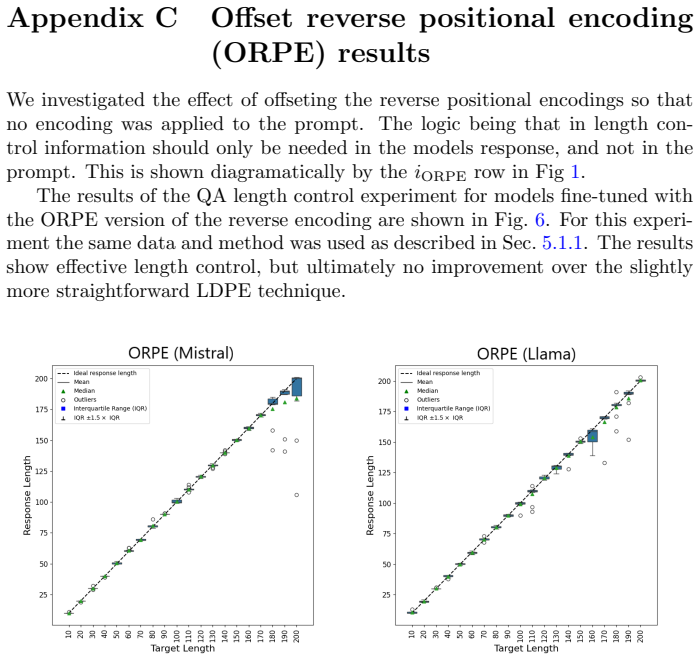
- [Section 5.1.1] The question-answering length-control evaluation is based on only 20 hand-selected samples, and the results are presented solely as scatter plots. No quantitative summary (mean or median absolute error, standard deviation, or per-target-length breakdown) is given, and the selection criterion for the 20 prompts is not stated. The visual claim of "near-perfect alignment" is not sufficient to support the abstract's "mean token errors of less than 3 tokens," which is actually only supported by the summarization experiment. The authors should provide numeric length-error statistics for both models and for ORPE, along with confidence intervals and a description of how the 20 prompts were chosen.
- [Section 5.1.2] The response-quality claim "without compromising response quality" is primarily evaluated by comparing generated summaries to GPT-3.5-turbo-generated summaries using BERT and ROUGE scores. This is an automatic proxy, not a human judgment, and the target summaries themselves are generated by another LLM, so the comparison measures similarity to a particular model's style and content rather than absolute quality. The standard benchmarks in Section 5.1.3 partially mitigate this, but one benchmark (Mistral on HellaSwag) shows a reduction, and the evaluation harness was modified for QA tasks. A human evaluation of summary faithfulness, or at least evaluation against a dataset with human-written reference summaries, would substantially strengthen the quality-preservation claim.
- [Section 5.1.3] The description of the LM Evaluation Harness modification is insufficiently precise. The text says the harness was "modified to optionally apply the LDPE countdown to the queries" for QA tasks, and that this gave the model "additional information about the response length, but no information about whether a specific question response pair was correct or incorrect." It is unclear whether the base (non-fine-tuned) models also received these added LDPE encodings during evaluation. If they did, adding untrained encodings could distort their log-likelihoods; if they did not, the comparison is not controlled. The exact evaluation protocol for each model and task should be specified in detail.
minor comments (5)
- [Abstract and Section 5.1.1] The abstract's claim of "mean token errors of less than 3 tokens" is presented without specifying that it comes from the summarization experiment; the QA experiment does not report a mean error. The scope of this claim should be stated explicitly.
- [Section 5.2] The Max New Tokens++ results are shown only as a plot with no numeric metrics. The statement that the 95% confidence interval "still follows closely" should be defined (e.g., bootstrap over samples) and quantified with a table of, for example, median absolute error and coverage of the confidence interval.
- [Appendix A, Table 1] The table caption says "ORPE fine tuned Llama3 8B" while Section 5.1.1 reports the LDPE results in the main text; please verify that the model and encoding names are consistent throughout.
- [Section 4, Data] The OpenOrca reference contains a malformed URL ("https://https://huggingface.co/..."). Please correct the citation.
- [Section 5.1.2] There are minor grammatical issues, for example "for the Mistral-prompted was an order of magnitude larger" and "the target length as was added to the prompt." A copy-editing pass is recommended.
Circularity Check
No significant circularity: the length-control result is an empirical fine-tuning measurement, not a claim derived from its own inputs.
full rationale
LDPE is an input-side conditioning mechanism: the reverse sinusoidal encoding of Eqs. (1)-(2) with i_LDPE=(L+1)-i explicitly injects the target total length into the token embeddings, and the fine-tuning loss in Eq. (4) is standard next-token prediction on responses of known length. The paper's central claim is an empirical measurement—fine-tuned models stop near the target count—not a derivation from an assumption that already contains the result. No equation reduces to the claimed outcome by construction; the model could in principle ignore the added encoding, and the prompt-tuned baseline shows that simply knowing the target as text gives much larger errors (mean 24.8 tokens vs. 2.8 for Mistral-LDPE). The method adapts LDPE from Takase and Okazaki [27], an external source, and no load-bearing self-citation or imported uniqueness theorem is used. The admission that hyperparameters were tuned until satisfactory results (Section 4) is a validation and selection-bias concern, not a circular step, because the reported errors are measured outcomes rather than parameter-free forecasts. Consequently, no circular step meets the quoted-evidence bar.
Assumptions & free parameters
free parameters (5)
- Max New Tokens++ sigma_0 =
0.1
- Max New Tokens++ sigma_max =
2048
- LoRA rank =
16
- LoRA alpha =
32
- Learning rate =
0.0003
assumptions (4)
- domain assumption Sinusoidal positional encodings in reversed order provide a usable countdown signal to a transformer pretrained with rotary embeddings.
- domain assumption The Frobenius-norm scaling makes the reverse positional embeddings comparable in magnitude to token embeddings.
- domain assumption Fine-tuning on OpenOrca/MMLU QA data teaches a general length-control behavior that transfers to summarization.
- domain assumption BERT/ROUGE scores against GPT-3.5-generated summaries are a valid proxy for response quality.
Cite this review
Pith. "Pith review of Precise Length Control in Large Language Models." pith.science (2026). https://pith.science/paper/ANGKSFLY
@misc{pith2026241211937,
  author       = {Pith},
  title        = {Pith review of: Precise Length Control in Large Language Models},
  year         = {2026},
  howpublished = {\url{https://pith.science/paper/ANGKSFLY}},
  note         = {Machine review of arXiv:2412.11937}
}
read the original abstract
Large Language Models (LLMs) are increasingly used in production systems, powering applications such as chatbots, summarization, and question answering. Despite their success, controlling the length of their response remains a significant challenge, particularly for tasks requiring structured outputs or specific levels of detail. In this work, we propose a method to adapt pre-trained decoder-only LLMs for precise control of response length. Our approach incorporates a secondary length-difference positional encoding (LDPE) into the input embeddings, which counts down to a user-set response termination length. Fine-tuning with LDPE allows the model to learn to terminate responses coherently at the desired length, achieving mean token errors of less than 3 tokens. We also introduce Max New Tokens++, an extension that enables flexible upper-bound length control, rather than an exact target. Experimental results on tasks such as question answering and document summarization demonstrate that our method enables precise length control without compromising response quality.
Figures


Figures from the paper (3 more)


Reference graph
Works this paper leans on
-
[1]
Yoshua Bengio, J´ erˆ ome Louradour, Ronan Collobert, and Jason Weston. Curriculum learning. In Proceedings of the 26th annual international con- ference on machine learning , pages 41–48, 2009
work page 2009
-
[2]
PIQA: reasoning about physical commonsense in natural language
Yonatan Bisk, Rowan Zellers, Ronan Le Bras, Jianfeng Gao, and Yejin Choi. PIQA: reasoning about physical commonsense in natural language. CoRR, abs/1911.11641, 2019
arXiv 1911
-
[3]
Language models are few-shot learners
Tom B Brown, Benjamin Mann, Nick Ryder, Melanie Subbiah, Jared Ka- plan, Prafulla Dhariwal, Arvind Neelakantan, Pranav Shyam, Girish Sas- try, Amanda Askell, et al. Language models are few-shot learners. arXiv preprint arXiv:2005.14165, 2020. 14
arXiv 2005
-
[4]
Bert: Pre-training of deep bidirectional transformers for language understanding
Jacob Devlin, Ming-Wei Chang, Kenton Lee, and Kristina Toutanova. Bert: Pre-training of deep bidirectional transformers for language understanding. arXiv preprint arXiv:1810.04805 , 2018
arXiv 2018
-
[5]
Recent automatic text summarization techniques: a survey
Mahak Gambhir and Vishal Gupta. Recent automatic text summarization techniques: a survey. Artificial Intelligence Review , 47(1):1–66, 2017
work page 2017
-
[6]
A framework for few-shot language model evaluation, 12 2023
Leo Gao, Jonathan Tow, Baber Abbasi, Stella Biderman, Sid Black, Anthony DiPofi, Charles Foster, Laurence Golding, Jeffrey Hsu, Alain Le Noac’h, Haonan Li, Kyle McDonell, Niklas Muennighoff, Chris Ociepa, Jason Phang, Laria Reynolds, Hailey Schoelkopf, Aviya Skowron, Lintang Sutawika, Eric Tang, Anish Thite, Ben Wang, Kevin Wang, and Andy Zou. A framework...
2023
-
[7]
Contextual position encoding: Learning to count what’s important
Olga Golovneva, Tianlu Wang, Jason Weston, and Sainbayar Sukhbaatar. Contextual position encoding: Learning to count what’s important. arXiv preprint arXiv:2405.18719, 2024
arXiv 2024
-
[8]
News summarization and evaluation in the era of gpt-3
Tanya Goyal, Junyi Jessy Li, and Greg Durrett. News summarization and evaluation in the era of gpt-3. arXiv preprint arXiv:2209.12356 , 2022
arXiv 2022
Show all 33 references
-
[9]
Measuring massive multitask language understanding, 2021
Dan Hendrycks, Collin Burns, Steven Basart, Andy Zou, Mantas Mazeika, Dawn Song, and Jacob Steinhardt. Measuring massive multitask language understanding, 2021
2021
-
[10]
Hu, Yelong Shen, Phillip Wallis, Zeyuan Allen-Zhu, Yuanzhi Li, Shean Wang, and Weizhu Chen
Edward J. Hu, Yelong Shen, Phillip Wallis, Zeyuan Allen-Zhu, Yuanzhi Li, Shean Wang, and Weizhu Chen. Lora: Low-rank adaptation of large language models. CoRR, abs/2106.09685, 2021
2021 arXiv
-
[11]
Albert Q. Jiang, Alexandre Sablayrolles, Arthur Mensch, Chris Bamford, Devendra Singh Chaplot, Diego de las Casas, Florian Bressand, Gianna Lengyel, Guillaume Lample, Lucile Saulnier, L´ elio Renard Lavaud, Marie- Anne Lachaux, Pierre Stock, Teven Le Scao, Thibaut Lavril, Thom...
2023
-
[12]
Prompt-based length controlled generation with reinforcement learning
Renlong Jie, Xiaojun Meng, Lifeng Shang, Xin Jiang, and Qun Liu. Prompt-based length controlled generation with reinforcement learning. ArXiv, abs/2308.12030, 2023
2023 arXiv
-
[13]
Controlling output length in neural encoder-decoders
Yuta Kikuchi, Graham Neubig, Ryohei Sasano, Hiroya Takamura, and Manabu Okumura. Controlling output length in neural encoder-decoders. In Proceedings of the 2016 Conference on Empirical Methods in Natural Language Processing, pages 1328–1338, 2016
2016
-
[14]
Chao Lei, Nir Lipovetzky, and Krista A. Ehinger. Generalized planning for the abstraction and reasoning corpus, 2024
2024
-
[15]
Openorca: An open dataset of gpt augmented flan reasoning traces
Wing Lian, Bleys Goodson, Eugene Pentland, Austin Cook, Chanvichet Vong, and ”Teknium”. Openorca: An open dataset of gpt augmented flan reasoning traces. https://https://huggingface.co/Open-Orca/ OpenOrca, 2023. 15
2023
-
[16]
Pre-train, prompt, and predict: A systematic survey of prompting methods in natural language processing
Pengfei Liu, Weizhe Yuan, Jinlan Fu, Zhengbao Jiang, Hiroaki Hayashi, and Graham Neubig. Pre-train, prompt, and predict: A systematic survey of prompting methods in natural language processing. ACM Computing Surveys, 55:1 – 35, 2021
2021
-
[17]
Length control in abstractive summa- rization by pretraining information selection
Yizhu Liu, Qi Jia, and Kenny Zhu. Length control in abstractive summa- rization by pretraining information selection. In Proceedings of the 60th Annual Meeting of the Association for Computational Linguistics (Volume 1: Long Papers) , pages 6885–6895, 2022
2022
-
[18]
Decoupled weight decay regularization, 2019
Ilya Loshchilov and Frank Hutter. Decoupled weight decay regularization, 2019
2019
-
[19]
Transformers can do arithmetic with the right embeddings
Sean McLeish, Arpit Bansal, Alex Stein, Neel Jain, John Kirchenbauer, Brian R Bartoldson, Bhavya Kailkhura, Abhinav Bhatele, Jonas Geiping, Avi Schwarzschild, et al. Transformers can do arithmetic with the right embeddings. arXiv preprint arXiv:2405.17399 , 2024
2024 arXiv
-
[20]
Introducing Meta Llama 3: The most capable openly available LLM to date — ai.meta.com
Meta. Introducing Meta Llama 3: The most capable openly available LLM to date — ai.meta.com. https://ai.meta.com/blog/meta-llama-3/,
-
[21]
Abstractive text summarization using sequence-to- sequence rnns and beyond, 2016
Ramesh Nallapati, Bowen Zhou, Cicero Nogueira dos santos, Caglar Gul- cehre, and Bing Xiang. Abstractive text summarization using sequence-to- sequence rnns and beyond, 2016
2016
-
[22]
GPT3.5 Turbo-0125, 2024
OpenAI. GPT3.5 Turbo-0125, 2024
2024
-
[23]
Recipes for building an open-domain chatbot
Stephen Roller, Emily Dinan, Naman Goyal, Da Ju, Mary Williamson, Yinhan Liu, Jing Xu, Myle Ott, Kurt Shuster, Eric Michael Smith, et al. Recipes for building an open-domain chatbot. arXiv preprint arXiv:2004.13637, 2021
2004 arXiv
-
[24]
WINOGRANDE: an adversarial winograd schema challenge at scale
Keisuke Sakaguchi, Ronan Le Bras, Chandra Bhagavatula, and Yejin Choi. WINOGRANDE: an adversarial winograd schema challenge at scale. CoRR, abs/1907.10641, 2019
1907 arXiv
-
[25]
Self-attention with relative position representations
Peter Shaw, Jakob Uszkoreit, and Ashish Vaswani. Self-attention with relative position representations. arXiv preprint arXiv:1803.02155 , 2018
2018 arXiv
-
[26]
Roformer: Enhanced transformer with rotary position embedding
Jianlin Su, Murtadha Ahmed, Yu Lu, Shengfeng Pan, Wen Bo, and Yunfeng Liu. Roformer: Enhanced transformer with rotary position embedding. Neurocomputing, 568:127063, 2024
2024
-
[27]
Positional encoding to control output se- quence length
Sho Takase and Naoaki Okazaki. Positional encoding to control output se- quence length. In Proceedings of the 2019 Conference of the North Amer- ican Chapter of the Association for Computational Linguistics: Human Language Technologies, Volume 1 (Long and Short Papers) , pages...
2019
-
[28]
Attention is all you need
Ashish Vaswani, Noam Shazeer, Niki Parmar, Jakob Uszkoreit, Llion Jones, Aidan N Gomez, Lukasz Kaiser, and Illia Polosukhin. Attention is all you need. In Advances in neural information processing systems , pages 5998– 6008, 2017
2017
-
[29]
Huggingface’s transformers: State-of-the-art natural lan- guage processing
Thomas Wolf, Lysandre Debut, Victor Sanh, Julien Chaumond, Clement Delangue, Anthony Moi, Pierric Cistac, Tim Rault, R´ emi Louf, Morgan Funtowicz, et al. Huggingface’s transformers: State-of-the-art natural lan- guage processing. arXiv preprint arXiv:1910.03771 , 2019
1910 arXiv
-
[30]
Lenatten: An effective length controlling unit for text summarization
Zhongyi Yu, Zhenghao Wu, Hao Zheng, Zhe XuanYuan, Jefferson Fong, and Weifeng Su. Lenatten: An effective length controlling unit for text summarization. CoRR, abs/2106.00316, 2021
2021 arXiv
-
[31]
Hellaswag: Can a machine really finish your sentence? CoRR, abs/1905.07830, 2019
Rowan Zellers, Ari Holtzman, Yonatan Bisk, Ali Farhadi, and Yejin Choi. Hellaswag: Can a machine really finish your sentence? CoRR, abs/1905.07830, 2019
1905 arXiv
-
[32]
Latent prompt tuning for text summarization
Yubo Zhang, Xingxing Zhang, Xun Wang, Si-Qing Chen, and Furu Wei. Latent prompt tuning for text summarization. ArXiv, abs/2211.01837, 2022. 17 Appendix A Example length controlled outputs Examples of length controlled outputs from the LDPE finetuned Llama model are shown in Ta...
2022 arXiv
-
[2024]
[Accessed 13-05-2024]
2024
Reviewed August 11, 2026 · model on record in the stance chip above.
Discussion (0). Continue with ORCID to comment.