REVIEW 4 major objections 6 minor 58 references
Simulating Before Planning: Constructing Intrinsic User World Model for User-Tailored Dialogue Policy Planning
T0 review · 4 major / 6 minor · reviewed 2026-08-16 · deepseek-v4-flash
Pith's one-line read The paper claims that dialogue policy planning improves when the agent first builds an intrinsic model of the user—inferring the persona with a diffusion model and anticipating reactions with a Brownian Bridge—before choosing its next…
desk verdict Worth engaging with: a useful user-modeling framework and a new persona protocol, but the ESConv results conflict across tables and the active-learning rule looks backwards. read the letter →
The pith
A machine-rendered reading of the paper's core claim, the machinery that carries it, and where it could break.
The reading
What carries the argument
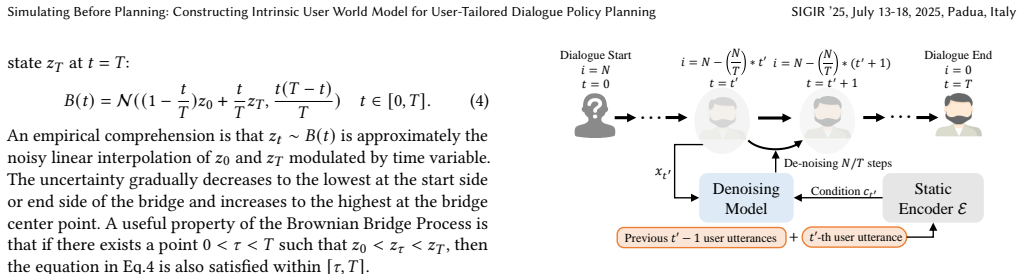
The central object is the Intrinsic User World Model, made of two trained modules. The User Persona Portrayer is a conditional diffusion model: starting from pure noise at dialogue turn 0, it performs N/T denoising steps after each turn conditioned on the encoded user utterances, yielding a predicted persona distribution used both as a classification target and as the bridge endpoint for the next stage. The User Feedback Anticipator is a Brownian Bridge process conditioned on the inferred persona; its transition distribution predicts the distribution of the user's next latent state given the previous user reaction and the candidate system strategy, with variance that swells in the middle of the dialogue and shrinks near the fixed endpoints. Together they form a lightweight world model that lets the planner ask, before acting, what kind of user this is and how they will react if the agent does something.
What would settle it
Run the same P4G and ESConv evaluations with real human users playing the persona-defined roles instead of an LLM user simulator, keeping the same strategy labels and success criteria; if UDP's success-rate advantage over TRIP shrinks to noise, the intrinsic user world model is an artifact of LLM role-play rather than a faithful model of user traits. A cheaper first check is to have human annotators score, turn by turn, whether UDP's anticipated user reactions match what a real user of that persona later says.
Extended reading notes
Core claim
The central claim is that user-tailored policy planning succeeds by simulating before planning: a dialogue agent that can estimate who it is talking to and foresee the user's reaction to a strategy will pick better next actions than one that optimizes over a uniform user agent. UDP embodies this in three stages. Stage 1 treats persona inference as a conditional denoising task, walking a diffusion model from noise toward a clean persona representation as user utterances accumulate. Stage 2 models the possible next user state as a Brownian Bridge pinned between the current reaction and the terminal persona, so the uncertainty of the prediction is naturally highest mid-dialogue. Stage 3 feeds a fusion of dialogue history and inferred persona, together with strategy-plus-predicted-reaction features, into a softmax policy. The reported result is consistent and significant improvement over planners that ignore or weakly model user traits, for example success rate 0.598 versus 0.495 for TRIP on P4G and 0.832 versus 0.808 on ESConv, with the biggest wins on rejective, introvert, and neurotic personas.
Load-bearing premise
The load-bearing premise is that an LLM prompted with a persona description behaves like a real user with that persona, and that a critic LLM's scalar reward exceeding 0.6 measures true dialogue success.
Editorial extensions
If this is right
- On both tasks, UDP's success-rate gains over TRIP are concentrated on the personas where baselines fail most—rejective, introvert, neurotic, and conservative—so modeling user traits is exactly what recovers performance on hard users.
- The persona evaluation protocol exposes a 19.2% (P4G) and 34.9% (ESConv) spread in success rate across personas for existing planners, which means user diversity should be a standard axis in dialogue planning evaluation.
- Ablations show that on the non-cooperative P4G task both the persona portrayer and the feedback anticipator contribute, while on the cooperative ESConv task the feedback anticipator can be removed without harm, so the value of reaction prediction depends on task cooperativity.
- Active learning that up-weights personas after failed dialogues improves both metrics on P4G, indicating that the training distribution, not just the architecture, matters for user-tailored policies.
- On ESConv, UDP deliberately comforts before suggesting and therefore uses more turns than TRIP; the paper interprets this as closer to real emotion-support practice rather than as an efficiency loss.
Reading between the lines
- Beyond the paper's stated results, the same simulate-before-plan pipeline could transfer directly to conversational search and recommendation: pretrain the world model on persona-tagged interaction logs, then run candidate strategies through the feedback anticipator before the system commits to a response.
- The Brownian Bridge's variance profile implies that user reactions are hardest to foresee mid-dialogue; a testable extension is to make the planner deliberately more exploratory or more clarifying in middle turns, and to check whether that improves success rate on hard personas.
- The ESConv ablation, where removing the anticipator helps, suggests the world-model modules are not universally beneficial; a portfolio view—learning when to simulate reactions and when to rely on persona portraiture alone—is a natural next question.
- A cheap validity check on the evaluation protocol: replace the critic's scalar reward with human success labels on a held-out set of simulated dialogues, and see whether UDP's margin over TRIP survives the swap.
Signed reviews
Editorial analysis
A structured set of objections, weighed in public.
Referee Report
Summary. The paper argues that existing dialogue policy planners rely on a uniform user simulation and therefore fail to adapt to diverse user traits. It first proposes a task-specific persona-based evaluation protocol for the P4G persuasion and ESConv emotional-support tasks, using GPT-generated profiles and LLM self-play with a critic reward to measure success. It then introduces UDP, a three-stage framework: a diffusion-based User Persona Portrayer that infers user traits from dialogue history, a Brownian Bridge-inspired User Feedback Anticipator that predicts user reactions to candidate strategies, and a User-Aware Policy Planner that combines history, persona, and anticipated feedback to select actions. UDP is trained by pretraining each stage on self-play data with persona labels, followed by policy-gradient reinforcement learning with an active-learning sampling scheme over personas. The paper reports consistent improvements over prior planners on both tasks, together with a human evaluation, per-persona analysis, ablation studies, and analyses of persona-prediction accuracy and strategy-distribution differences.
Significance. If the reported results hold, the paper makes a useful contribution by foregrounding user diversity in dialogue policy planning and by providing a concrete simulation protocol for measuring user-tailored behavior. The three-stage decomposition (persona portrayer, feedback anticipator, planner) is a sensible architectural idea, and the paper includes human evaluation, per-persona breakdowns, and several diagnostic analyses. However, the current validation is entirely internal to the authors' synthetic user world, and there are internal numerical inconsistencies, an asserted rather than derived stochastic-process formula, and a training objective that appears opposite to its stated purpose. These issues are load-bearing for the central claim of consistent, significant gains, so the manuscript needs substantive revision before the claims can be accepted.
major comments (4)
- [§5.2 Table 2 vs. §5.5 Table 4] The ESConv results for the full UDP model are inconsistent across tables: Table 2 reports SSR 0.774 / SR 0.832 (above TRIP's 0.744 / 0.808), while Table 4 reports SSR 0.742 / SR 0.791 for the same full model (below TRIP), and the '-w/o S2' row in Table 4 carries exactly the Table 2 full-model values (0.774 / 0.832). No note explains different checkpoints, evaluation splits, or random seeds. Because the headline claim of consistent ESConv improvements and the ablation conclusion that removing Stage 2 helps on ESConv both rest on these numbers, the discrepancy must be resolved before the main claim is reliable.
- [§4.3.4, Eq. (11)] The active-learning update is reversed relative to its stated goal. The text says the agent should 'trial more times with more challenging users' and 'prioritize challenging user personas,' but Eq. (11) increments w_i after a successful dialogue and decrements it after a failure. If w_i is a sampling weight, this increases sampling of easy personas and decreases sampling of hard ones. Please correct the update to increase weight on failures, or clarify that the intended objective is different and adjust the text accordingly. As written, the active-learning contribution and the '-w/o AL' ablation in §5.5 do not test the stated mechanism.
- [§4.2.2, Eq. (5)] Equation (5) is asserted rather than derived and deviates from the standard Brownian Bridge conditional distribution. For a bridge pinned at (t-1, z_{t-1}) and (T, z_T), the conditional distribution at time t has mean ((T-t)/(T-t+1)) z_{t-1} + (1/(T-t+1)) z_T and variance (T-t)/(T-t+1). The proposed mean inserts z_a into the first term, and the variance is 4(T-t)ψ(z_a)/(T-t+1)^2, with no derivation or justification of the factor 4 or the ψ scaling. The Brownian Bridge motivation, the pretraining objective in Eq. (8), and the downstream action features in §4.2.3 all depend on this distribution, so the formula needs to be derived or corrected.
- [§3.3, §4.3, §5.1.2] There is a partial circularity between training and evaluation: the same synthetic user world is used on both sides. The GPT-3.5-turbo-generated profiles condition the GPT-4o-mini user role-play, and the persona labels used to construct the user simulator are also the targets used to train the portrayer and the basis of the evaluation protocol. The human evaluation in §3.3.2 only verifies that role-play is consistent with the prompt, not that it resembles real users. To support the 'user-tailored' claim beyond simulation, please report results on held-out personas or on real interaction data, or explicitly restrict the claims to the simulated protocol and discuss how persona-conditioned simulation could bias the measured gains.
minor comments (6)
- [§5.2] The text says 'increasing the SRR and SR' and later 'improvements of SRR and SR'; the metric is SSR throughout the tables, so please correct the typo.
- [§4.1.2, Eq. (2)] The forward noising kernel is written as q(x_{i-1}|x_i) with x_i on the left and x_{i-1} on the right; the standard form is q(x_i|x_{i-1}) = N(x_i; sqrt(1-beta_i) x_{i-1}, beta_i I), so the conditioning and subscripts should be corrected.
- [§4.3.2, Eq. (8)] The denominator in the contrastive loss is typeset with an undefined symbol; please define the negative samples explicitly, for example as z' drawn uniformly from the batch, so that the loss is well defined.
- [References [12] and [13]] References [12] and [13] are the same paper (Fu et al., 2023), and Table 2 cites ICL-AIF as [13] while §5.1.1 cites it as [12]; please unify the citations.
- [§5.1.2 / Table 2 caption] The caption of Table 2 states that results are averaged over five inference runs with p < 0.05 under a t-test, but the table contains no significance markers, confidence intervals, or standard deviations; please add them or clarify which pairwise comparisons were tested.
- [§5.3, Table 3] The table header for the Identification dimension is 'Ind.' while the text abbreviates it as 'Ide.'; please make the abbreviation consistent.
Circularity Check
UDP's reported success partly reduces to its own RL objective and author-defined persona simulation, though held-out profiles and external baselines prevent full circularity.
-
fitted input called prediction
[Section 3.3.1 (self-play critic threshold) and Section 4.3.4, Eq. (10)]
"Following previous work [19], we view the dialogue objective as being achieved if r(s_t) exceeds a threshold of 0.6. ... L_rl(θ) = − Σ_t log π_θ(a_t|s_{t−1}) · R_t, where R_t = Σ_{t′=t}^{T} γ^{T−t′} r_{t′} represents the cumulative reward."
The headline SR and SSR metrics are computed from the same GPT-3.5-turbo critic reward r_t that Eq. (10) directly maximizes during reinforcement learning: SR is the fraction of episodes whose final critic reward exceeds 0.6, and SSR is the mean final critic reward. The policy is therefore fitted to the very scalar that is later reported as 'success rate,' so the reported success is partly an in-sample check of the optimized objective rather than an independent measurement. The comparison with baselines may still be fair, but the central external-validity claim is not derived from evidence independent of the training signal.
-
self definitional
[Section 3.1–3.2 and Section 4.3, with Section 4.2.1]
"These dialogues were prompted using the predefined user profiles; thus, the constructed pretraining dataset inherently contains user persona labels. ... During evaluation, we select the user persona with the highest probability from D_t to help subsequent dialogue policy planning."
Stage 1 is supervised with the persona label y_p that the authors attached to each generated profile, and the same persona taxonomy is used to prompt the GPT-4o-mini user during both self-play training and evaluation. The model is therefore trained to recover the authors' own construction from behavior generated by that construction, and the user-tailored planning advantage is demonstrated only against users defined by the same labels. The personas are not grounded in an independent external population, so the 'intrinsic user world model' is a function fitted to the authors' simulation rather than an independently validated model of real users.
full rationale
The central derivation is not fully circular because UDP is compared against several external baselines on held-out profiles, and the persona labels are hidden from the model during inference, requiring genuine inference from dialogue behavior. However, two structural loops weaken the independence of the main claim. First, the RL objective in Eq. (10) maximizes the same critic reward that defines SR/SSR in Section 3.3.1, so the reported success metric is partly the optimized training signal. Second, the persona taxonomy and profile generator are author-defined inputs that simultaneously create the training labels, the test user behavior, and the 'world model' targets; the evaluation therefore measures performance inside the authors' synthetic construction. The internal inconsistency between Table 2 and Table 4 on ESConv is primarily a correctness and reproducibility concern rather than a circularity finding, but it further undermines the headline claim of consistent gains. Overall, the paper has partial circularity rather than definitional identity, so a score of 4 is appropriate.
Assumptions & free parameters
free parameters (3)
- Critic reward mapping and success threshold =
P4G: -1.0/-0.5/0.1/1.0; ESConv: -1.0/-0.5/0.1/1.0/1.0; threshold 0.6
- Brownian Bridge variance scale =
4 (Eq.5)
- Maximum dialogue turns T =
10
assumptions (5)
- standard math Brownian Bridge conditional distribution property (Revuz and Yor 1990).
- domain assumption A small set of hand-crafted binary traits captures the relevant diversity of real users in P4G and ESConv.
- domain assumption LLM role-play with persona profiles faithfully simulates real users with those traits.
- domain assumption The LLM critic's reward mapping and 0.6 threshold correctly measure dialogue success.
- ad hoc to paper User feedback states follow a modified Brownian Bridge depending on the action and a learned variance function.
invented entities (2)
-
Latent user feedback state z_t
-
Persona embeddings P=[p_i]
Cite this review
Pith. "Pith review of Simulating Before Planning: Constructing Intrinsic User World Model for User-Tailored Dialogue Policy Planning." pith.science (2026). https://pith.science/paper/AOP7Q6MG
@misc{pith2026250413643,
  author       = {Pith},
  title        = {Pith review of: Simulating Before Planning: Constructing Intrinsic User World Model for User-Tailored Dialogue Policy Planning},
  year         = {2026},
  howpublished = {\url{https://pith.science/paper/AOP7Q6MG}},
  note         = {Machine review of arXiv:2504.13643}
}
read the original abstract
Recent advancements in dialogue policy planning have emphasized optimizing system agent policies to achieve predefined goals, focusing on strategy design, trajectory acquisition, and efficient training paradigms. However, these approaches often overlook the critical role of user characteristics, which are essential in real-world scenarios like conversational search and recommendation, where interactions must adapt to individual user traits such as personality, preferences, and goals. To address this gap, we first conduct a comprehensive study utilizing task-specific user personas to systematically assess dialogue policy planning under diverse user behaviors. By leveraging realistic user profiles for different tasks, our study reveals significant limitations in existing approaches, highlighting the need for user-tailored dialogue policy planning. Building on this foundation, we present the User-Tailored Dialogue Policy Planning (UDP) framework, which incorporates an Intrinsic User World Model to model user traits and feedback. UDP operates in three stages: (1) User Persona Portraying, using a diffusion model to dynamically infer user profiles; (2) User Feedback Anticipating, leveraging a Brownian Bridge-inspired anticipator to predict user reactions; and (3) User-Tailored Policy Planning, integrating these insights to optimize response strategies. To ensure robust performance, we further propose an active learning approach that prioritizes challenging user personas during training. Comprehensive experiments on benchmarks, including collaborative and non-collaborative settings, demonstrate the effectiveness of UDP in learning user-specific dialogue strategies. Results validate the protocol's utility and highlight UDP's robustness, adaptability, and potential to advance user-centric dialogue systems.
Figures


Figures from the paper (2 more)


Reference graph
Works this paper leans on
-
[1]
Layla El Asri, Jing He, and Kaheer Suleman. 2016. A Sequence-to-Sequence Model for User Simulation in Spoken Dialogue Systems. In Interspeech. https: //arxiv.org/pdf/1607.00070
arXiv 2016
-
[2]
Yejin Bang, Samuel Cahyawijaya, Nayeon Lee, Wenliang Dai, Dan Su, Bryan Wilie, Holy Lovenia, Ziwei Ji, Tiezheng Yu, Willy Chung, Quyet V. Do, Yan Xu, and Pascale Fung. 2023. A Multitask, Multilingual, Multimodal Evaluation of ChatGPT on Reasoning, Hallucination, and Interactivity. ArXiv abs/2302.04023 (2023). https://aclanthology.org/2023.ijcnlp-main.45.pdf
arXiv 2023
-
[3]
Jiangjie Chen, Xintao Wang, Rui Xu, Siyu Yuan, Yikai Zhang, Wei Shi, Jian Xie, Shuang Li, Ruihan Yang, Tinghui Zhu, Aili Chen, Nianqi Li, Lida Chen, Caiyu Hu, Siye Wu, Scott Ren, Ziquan Fu, and Yanghua Xiao. 2024. From Persona to Per- sonalization: A Survey on Role-Playing Language Agents. ArXiv abs/2404.18231 (2024). https://arxiv.org/pdf/2404.18231
arXiv 2024
-
[4]
Nuo Chen, Yang Deng, and Jia Li. 2024. The Oscars of AI Theater: A Survey on Role-Playing with Language Models. ArXiv abs/2407.11484 (2024). https: //arxiv.org/pdf/2407.11484
arXiv 2024
-
[5]
Hsien chin Lin, Shutong Feng, Christian Geishauser, Nurul Lubis, Carel van Niekerk, Michael Heck, Benjamin Matthias Ruppik, Renato Vukovic, and Milica Gavsi’c. 2023. EmoUS: Simulating User Emotions in Task-Oriented Dialogues. Proceedings of the 46th International ACM SIGIR Conference on Research and Development in Information Retrieval (2023). https://dl....
arXiv 2023
-
[6]
Konstantina Christakopoulou, Alex Beutel, Rui Li, Sagar Jain, and Ed H Chi. 2018. Q&R: A two-stage approach toward interactive recommendation. In Proceedings of the 24th ACM SIGKDD international conference on knowledge discovery & data mining. 139–148
work page 2018
-
[7]
Huy Dao, Yang Deng, Khanh-Huyen Bui, Dung D. Le, and Lizi Liao. 2024. Ex- perience as Source for Anticipation and Planning: Experiential Policy Learning for Target-driven Recommendation Dialogues. In Conference on Empirical Meth- ods in Natural Language Processing . https://api.semanticscholar.org/CorpusID: 273822277
work page 2024
-
[8]
Yang Deng, Wenqiang Lei, Hongru Wang, and Tat seng Chua. 2023. Prompting and Evaluating Large Language Models for Proactive Dialogues: Clarification, Target-guided, and Non-collaboration. In Conference on Empirical Methods in Natural Language Processing. https://arxiv.org/pdf/2305.13626
arXiv 2023
Show all 58 references
-
[9]
Yang Deng, Wenxuan Zhang, Wai Lam, See-Kiong Ng, and Tat-Seng Chua. 2023. Plug-and-Play Policy Planner for Large Language Model Powered Dialogue Agents. ArXiv abs/2311.00262 (2023). https://arxiv.org/pdf/2311.00262
2023 arXiv
-
[10]
Prafulla Dhariwal and Alex Nichol. 2021. Diffusion Models Beat GANs on Image Synthesis. ArXiv abs/2105.05233 (2021). https://arxiv.org/pdf/2105.05233
2021 arXiv
-
[11]
Jingtao Ding, Yunke Zhang, Yu Shang, Yuheng Zhang, Zefang Zong, Jie Feng, Yuan Yuan, Hongyuan Su, Nian Li, Nicholas Sukiennik, Fengli Xu, and Yong Li
-
[13]
Yao Fu, Hao-Chun Peng, Tushar Khot, and Mirella Lapata. 2023. Improving Language Model Negotiation with Self-Play and In-Context Learning from AI Feedback. ArXiv abs/2305.10142 (2023). https://arxiv.org/pdf/2305.10142
2023 arXiv
-
[14]
Jianfeng Gao, Michel Galley, and Lihong Li. 2018. Neural Approaches to Conversa- tional AI. The 41st International ACM SIGIR Conference on Research & Development in Information Retrieval (2018). https://dl.acm.org/doi/10.1145/3209978.3210183
2018
-
[15]
Goldberg
Lewis R. Goldberg. 1992. THE DEVELOPMENT OF MARKERS FOR THE BIG- FIVE FACTOR STRUCTURE. Psychological Assessment 4 (1992), 26–42. https: //psycnet.apa.org/doiLanding?doi=10.1037/1040-3590.4.1.26
1992 doi
-
[16]
Shasha Guo, Lizi Liao, Jing Zhang, Cuiping Li, and Hong Chen. 2024. PCQPR: Proactive Conversational Question Planning with Reflection. In Conference on Empirical Methods in Natural Language Processing. https://aclanthology.org/2024. emnlp-main.631.pdf
2024
-
[17]
David R Ha and Jürgen Schmidhuber. 2018. World Models. ArXiv abs/1803.10122 (2018). https://arxiv.org/pdf/1803.10122
2018 arXiv
-
[18]
Tao He, Lizi Liao, Yixin Cao, Yuanxing Liu, Ming Liu, Zerui Chen, and Bing Qin
-
[19]
Tao He, Lizi Liao, Yixin Cao, Yuanxing Liu, Yiheng Sun, Zerui Chen, Ming Liu, and Bing Qin. 2024. Simulation-Free Hierarchical Latent Policy Planning for Proactive Dialogues. https://arxiv.org/pdf/2412.14584
2024 arXiv
-
[20]
ArXiv abs/2406.05374 (2024)
Planning Like Human: A Dual-process Framework for Dialogue Planning. ArXiv abs/2406.05374 (2024). https://arxiv.org/pdf/2406.05374
2024 arXiv
-
[21]
Campbell, K
Lukasz Kaiser, Mohammad Babaeizadeh, Piotr Milos, Blazej Osinski, Roy H. Campbell, K. Czechowski, D. Erhan, Chelsea Finn, Piotr Kozakowski, Sergey Levine, Afroz Mohiuddin, Ryan Sepassi, G. Tucker, and Henryk Michalewski
-
[22]
Jonathan Ho, Ajay Jain, and P. Abbeel. 2020. Denoising Diffusion Probabilistic Models. ArXiv abs/2006.11239 (2020). https://arxiv.org/pdf/2006.11239
2020 arXiv
-
[23]
Yann LeCun and Courant. 2022. A Path Towards Autonomous Machine Intel- ligence Version 0.9.2, 2022-06-27. https://api.semanticscholar.org/CorpusID: 251881108
2022
-
[24]
Li, Hasan Hammoud, Hani Itani, Dmitrii Khizbullin, and Bernard Ghanem
G. Li, Hasan Hammoud, Hani Itani, Dmitrii Khizbullin, and Bernard Ghanem
-
[25]
Wai-Chung Kwan, Hongru Wang, Huimin Wang, and Kam-Fai Wong. 2022. A Survey on Recent Advances and Challenges in Reinforcement Learning Methods for Task-oriented Dialogue Policy Learning. Machine Intelligence Research (2022), 1–17. https://link.springer.com/article/10.1007/s116...
2022 doi
-
[26]
Jinggui Liang, Lizi Liao, Hao Fei, Bobo Li, and Jing Jiang. 2024. Actively Learn from LLMs with Uncertainty Propagation for Generalized Category Discovery. In North American Chapter of the Association for Computational Linguistics . https: //aclanthology.org/2024.naacl-long.434.pdf
2024
-
[27]
Hsien-Chin Lin, Christian Geishauser, Shutong Feng, Nurul Lubis, Carel van Niekerk, Michael Heck, and Milica Gavsi’c. 2022. GenTUS: Simulating User Be- haviour and Language in Task-oriented Dialogues with Generative Transformers. ArXiv abs/2208.10817 (2022). https://aclantholo...
2022 arXiv
-
[28]
Hsien-Chin Lin, Nurul Lubis, Songbo Hu, Carel van Niekerk, Christian Geishauser, Michael Heck, Shutong Feng, and Milica Gavsi’c. 2021. Domain-independent User Simulation with Transformers for Task-oriented Dialogue Systems. In SIGDIAL Conferences. https://aclanthology.org/2021...
2021
-
[29]
Williams
Lihong Li, He He, and J. Williams. 2014. Temporal supervised learning for inferring a dialog policy from example conversations. 2014 IEEE Spoken Lan- guage Technology Workshop (SLT) (2014), 312–317. https://ieeexplore.ieee.org/ document/7078593/
2014
-
[30]
Keming Lu, Bowen Yu, Chang Zhou, and Jingren Zhou. 2024. Large Language Models are Superpositions of All Characters: Attaining Arbitrary Role-play via Self-Alignment. ArXiv abs/2401.12474 (2024). https://arxiv.org/pdf/2401.12474
2024 arXiv
-
[31]
María Luisa Menéndez, JA Pardo, L Pardo, and MC Pardo. 1997. The jensen- shannon divergence. Journal of the Franklin Institute 334, 2 (1997), 307–318
1997
-
[32]
Filip Moons and Ellen Vandervieren. 2023. Measuring agreement among several raters classifying subjects into one-or-more (hierarchical) nominal categories. A generalisation of Fleiss’ kappa. https://arxiv.org/pdf/2303.12502
2023
-
[33]
Siyang Liu, Chujie Zheng, Orianna Demasi, Sahand Sabour, Yu Li, Zhou Yu, Yong Jiang, and Minlie Huang. 2021. Towards Emotional Support Dialog Systems. In Annual Meeting of the Association for Computational Linguistics . https:// aclanthology.org/2021.acl-long.269.pdf
2021
-
[34]
Daniel Revuz and Marc Yor. 1990. Continuous martingales and Brownian motion. https://link.springer.com/book/10.1007/978-3-662-21726-9
1990 doi
-
[35]
Scott and Reginald A
Susanne G. Scott and Reginald A. Bruce. 1995. Decision-Making Style: The Development and Assessment of a New Measure. Educational and Psychological Measurement 55 (1995), 818 – 831. https://api.semanticscholar.org/CorpusID: 143479230
1995
-
[36]
Ivan Sekuli’c, Silvia Terragni, Victor Guimaraes, Nghia Khau, Bruna Guedes, Modestas Filipavicius, Andre Manso, and Roland Mathis. 2024. Reliable LLM- based User Simulator for Task-Oriented Dialogue Systems. ArXiv abs/2402.13374 (2024). https://aclanthology.org/2024.scichat-1.3.pdf
2024 arXiv
-
[37]
Baolin Peng, Xiujun Li, Jianfeng Gao, Jingjing Liu, and Kam-Fai Wong. 2018. Deep Dyna-Q: Integrating Planning for Task-Completion Dialogue Policy Learning. In Annual Meeting of the Association for Computational Linguistics . https:// aclanthology.org/P18-1203.pdf
2018
-
[38]
Sutton, David A
Richard S. Sutton, David A. McAllester, Satinder Singh, and Y. Mansour. 1999. Policy Gradient Methods for Reinforcement Learning with Function Approxi- mation. In Neural Information Processing Systems . https://www.cis.upenn.edu/ ~mkearns/finread/Sutton.pdf
1999
-
[39]
Leila Tavakoli, Hamed Zamani, Falk Scholer, William Bruce Croft, and Mark Sanderson. 2022. Analyzing clarification in asynchronous information-seeking conversations. Journal of the Association for Information Science and Technology 73, 3 (2022), 449–471
2022
-
[40]
Quan Tu, Shilong Fan, Zihang Tian, and Rui Yan. 2024. CharacterEval: A Chinese Benchmark for Role-Playing Conversational Agent Evaluation. InAnnual Meeting of the Association for Computational Linguistics . https://arxiv.org/pdf/2401.01275
2024 arXiv
-
[41]
Jiaming Song, Chenlin Meng, and Stefano Ermon. 2020. Denoising Diffusion Implicit Models. ArXiv abs/2010.02502 (2020). https://arxiv.org/pdf/2010.02502
2020 arXiv
-
[42]
Jian Wang, Dongding Lin, and Wenjie Li. 2023. Dialogue Planning via Brow- nian Bridge Stochastic Process for Goal-directed Proactive Dialogue. ArXiv abs/2305.05290 (2023). https://arxiv.org/pdf/2305.05290
2023 arXiv
-
[43]
Xuewei Wang, Weiyan Shi, Richard Kim, Yoo Jung Oh, Sijia Yang, Jingwen Zhang, and Zhou Yu. 2019. Persuasion for Good: Towards a Personalized Persuasive Dialogue System for Social Good. ArXiv abs/1906.06725 (2019). https://aclanthology.org/P19-1566.pdf
2019 arXiv
-
[44]
Zekun Moore Wang, Zhongyuan Peng, Haoran Que, Jiaheng Liu, Wangchun- shu Zhou, Yuhan Wu, Hongcheng Guo, Ruitong Gan, Zehao Ni, Man Zhang, Simulating Before Planning: Constructing Intrinsic User World Model for User-Tailored Dialogue Policy Planning SIGIR ’25, July 13-18, 2025,...
2025
-
[45]
Stefan Ultes, Lina Maria Rojas-Barahona, Pei hao Su, David Vandyke, Dongho Kim, Iñigo Casanueva, Paweł Budzianowski, Nikola Mrksic, Tsung-Hsien Wen, Milica Gavsic, and Steve J. Young. 2017. PyDial: A Multi-domain Statistical Dialogue System Toolkit. In Annual Meeting of the As...
2017
-
[46]
Jianxiang Xiang, Zhenhua Liu, Haodong Liu, Yin Bai, Jia Cheng, and Wenliang Chen. 2024. DiffusionDialog: A Diffusion Model for Diverse Dialog Genera- tion with Latent Space. In International Conference on Language Resources and Evaluation. https://aclanthology.org/2024.lrec-ma...
2024
-
[47]
Jing Ye, Lu Xiang, Yaping Zhang, and Chengqing Zong. 2024. SweetieChat: A Strategy-Enhanced Role-playing Framework for Diverse Scenarios Handling Emotional Support Agent. ArXiv abs/2412.08389 (2024). https://arxiv.org/pdf/ 2412.08389
2024 arXiv
-
[48]
Fengji Yi, Wenlong Fu, and Huan Liang. 2018. Model-based reinforcement learn- ing: A survey. https://api.semanticscholar.org/CorpusID:108339287
2018
-
[49]
In Annual Meeting of the Association for Computational Linguistics
RoleLLM: Benchmarking, Eliciting, and Enhancing Role-Playing Abilities of Large Language Models. In Annual Meeting of the Association for Computational Linguistics. https://arxiv.org/pdf/2310.00746
-
[50]
Bowen Wu, Kaili Sun, Ziwei Bai, Ying Li, and Baoxun Wang. 2025. RAIDEN Benchmark: Evaluating Role-playing Conversational Agents with Measurement- Driven Custom Dialogues. In Proceedings of the 31st International Conference on Computational Linguistics. 11086–11106
2025
-
[51]
Shuo Zhang and Krisztian Balog. 2020. Evaluating Conversational Recommender Systems via User Simulation. Proceedings of the 26th ACM SIGKDD International Conference on Knowledge Discovery & Data Mining (2020). https://dl.acm.org/ doi/10.1145/3394486.3403202
2020
-
[52]
Tong Zhang, Chen Huang, Yang Deng, Hongru Liang, Jia Liu, Zujie Wen, Wen- qiang Lei, and Tat-Seng Chua. 2024. Strength Lies in Differences! Improving Strategy Planning for Non-collaborative Dialogues via Diversified User Sim- ulation. In Conference on Empirical Methods in Natu...
2024
-
[53]
Zhirui Zhang, Xiujun Li, Jianfeng Gao, and Enhong Chen. 2019. Budgeted Policy Learning for Task-Oriented Dialogue Systems. In Annual Meeting of the Association for Computational Linguistics . https://aclanthology.org/P19-1364.pdf
2019
-
[54]
Xiao Yu, Maximillian Chen, and Zhou Yu. 2023. Prompt-Based Monte-Carlo Tree Search for Goal-Oriented Dialogue Policy Planning. In Conference on Empirical Methods in Natural Language Processing . https://arxiv.org/pdf/2305.13660
2023 arXiv
-
[55]
Qiang Zhang, Jason Naradowsky, and Yusuke Miyao. 2023. Ask an Expert: Lever- aging Language Models to Improve Strategic Reasoning in Goal-Oriented Dia- logue Models. In Annual Meeting of the Association for Computational Linguistics . https://arxiv.org/pdf/2305.17878
2023 arXiv
-
[59]
Weixiang Zhao, Yanyan Zhao, Xin Lu, Shilong Wang, Yanpeng Tong, and Bing Qin. 2023. Is ChatGPT Equipped with Emotional Dialogue Capabilities? ArXiv abs/2304.09582 (2023). https://arxiv.org/pdf/2304.09582
2023 arXiv
-
[2019]
ArXiv abs/1903.00374 (2019)
Model-Based Reinforcement Learning for Atari. ArXiv abs/1903.00374 (2019). https://arxiv.org/pdf/1903.00374
2019 arXiv
-
[2023]
In Neural Information Processing Systems
CAMEL: Communicative Agents for "Mind" Exploration of Large Language Model Society. In Neural Information Processing Systems . https://arxiv.org/pdf/ 2303.17760
-
[2024]
https://arxiv.org/pdf/2411.14499
Understanding World or Predicting Future? A Comprehensive Survey of World Models. https://arxiv.org/pdf/2411.14499
Reviewed August 16, 2026 · model on record in the stance chip above.
Discussion (0). Continue with ORCID to comment.