Integrating Gyrokinetic Flux Predictions with Ideal MHD Stability Boundaries
Pith reviewed 2026-06-26 00:39 UTC · model grok-4.3
The pith
The SPARC H-mode pedestal operates in an intermediate regime bounded by local KBM second stability on one side and global finite-n ballooning instability on the other.
A machine-rendered reading of the paper's core claim, the machinery that carries it, and where it could break.
Core claim
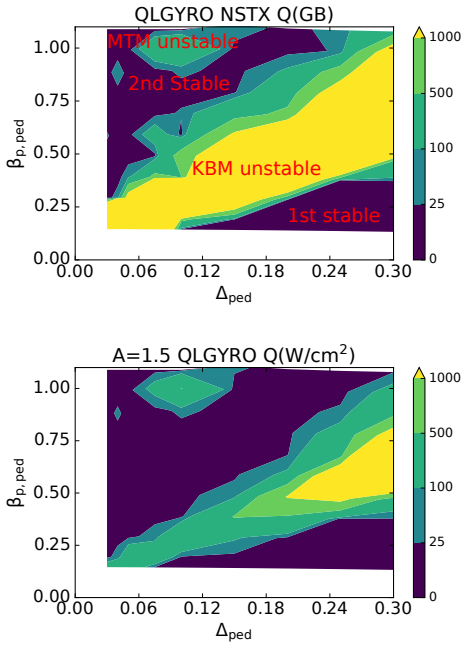
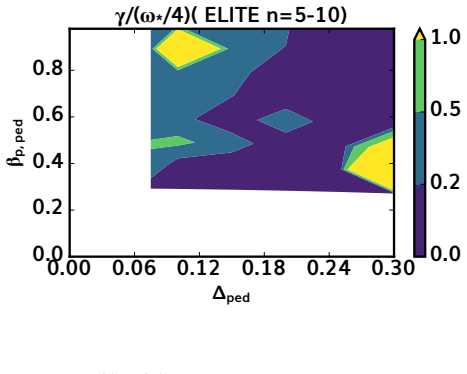
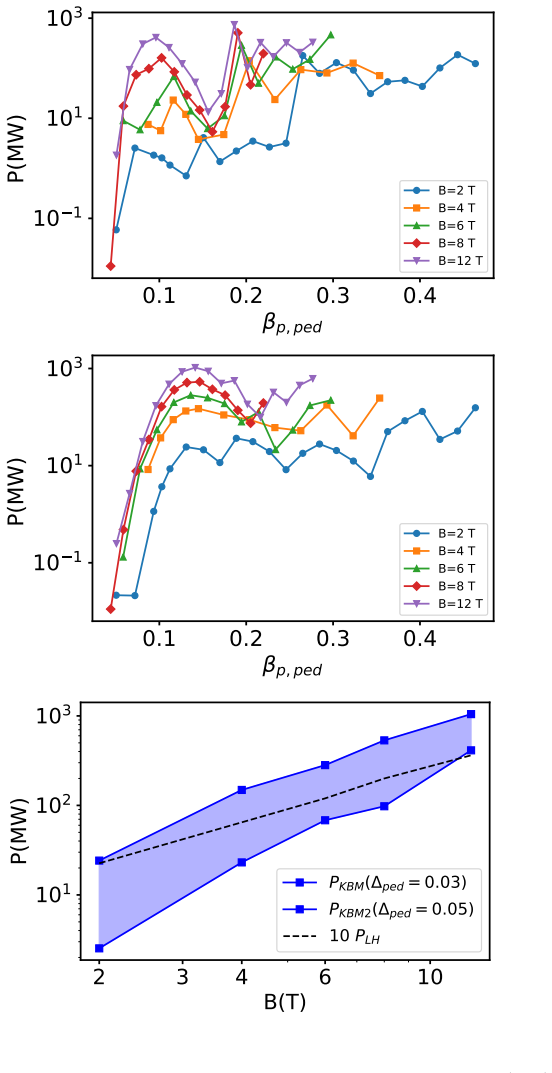
The integrated pedestal-stability workflow reproduces the characteristic KBM first- and second-stability structure. In spherical tokamaks the workflow agrees with prior studies when low-n peeling stability is retained. For SPARC-like high toroidal field plasmas, KBM and MTM heat fluxes increase strongly with toroidal field, limiting access to the KBM second-stability region. Comparison with global ELITE finite-n analysis indicates that the H-mode pedestal lies in an intermediate regime bounded by local KBM second stability and global finite-n ballooning instability, consistent with the EPED model once global effects are included.
What carries the argument
Integrated workflow of equilibrium scans, ELITE/GATO MHD stability analysis, and CGYRO/QLGYRO gyrokinetic transport predictions that maps local KBM stability boundaries onto global finite-n constraints.
If this is right
- Low-n peeling modes must be resolved to obtain correct pedestal stability limits in spherical tokamaks.
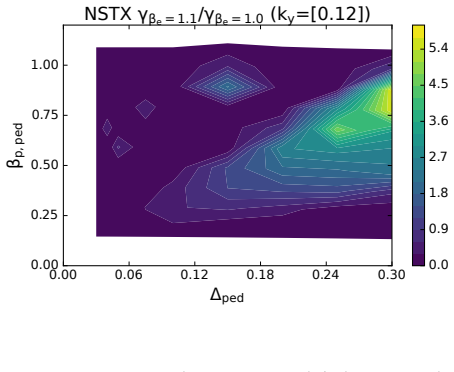
- KBM and MTM heat fluxes rise rapidly with increasing toroidal field, making second-stability access harder in high-field devices.
- The pedestal operating point in SPARC parameters is set by competition between local KBM second stability and global finite-n ballooning.
- The EPED model remains consistent once global finite-n effects are restored to the local gyrokinetic picture.
Where Pith is reading between the lines
- High-field reactor designs may need additional control techniques or profile shaping to reach the second-stability region.
- The intermediate regime identified here could be tested by varying toroidal field in existing or near-term devices while holding other parameters fixed.
- Global electromagnetic effects omitted from the local gyrokinetic step might further narrow or widen the allowed pedestal window.
Load-bearing premise
Local gyrokinetic flux predictions remain accurate when extrapolated to SPARC parameters without global electromagnetic or finite-n corrections that could shift the KBM second-stability boundary.
What would settle it
Measurement of the actual pedestal height and width in a high-field device such as SPARC, compared against the workflow's predicted intermediate-regime boundary, would confirm or refute the placement between local KBM second stability and global ballooning limits.
Figures




read the original abstract
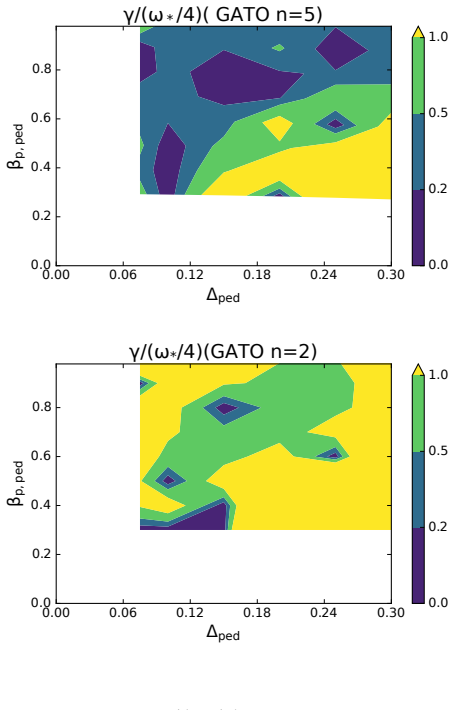
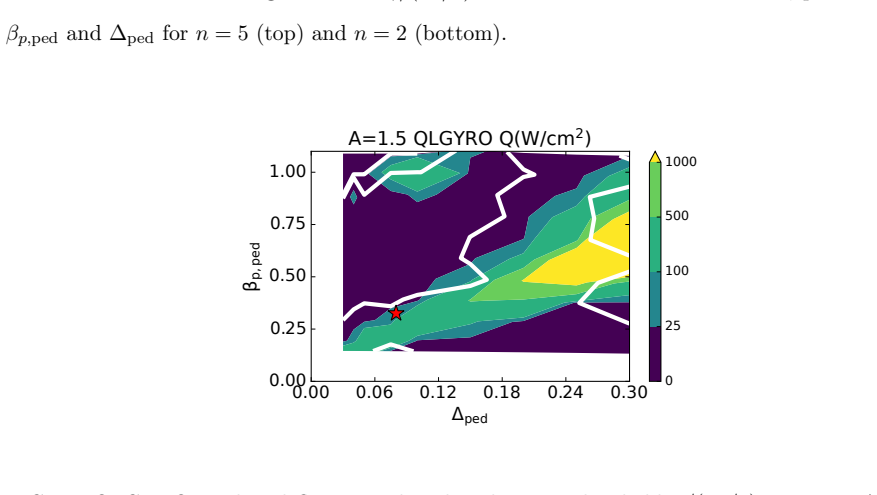
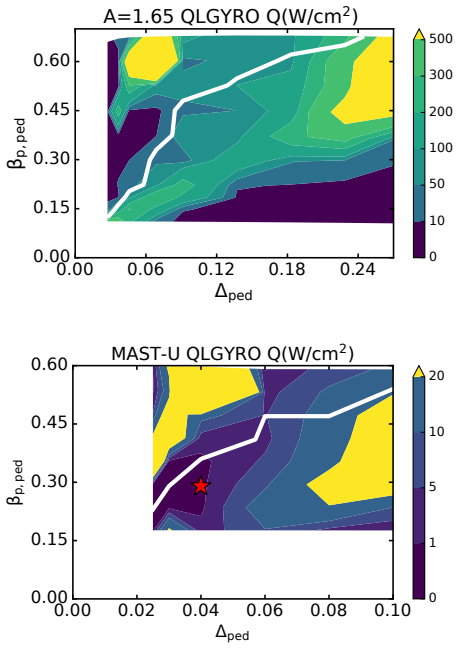
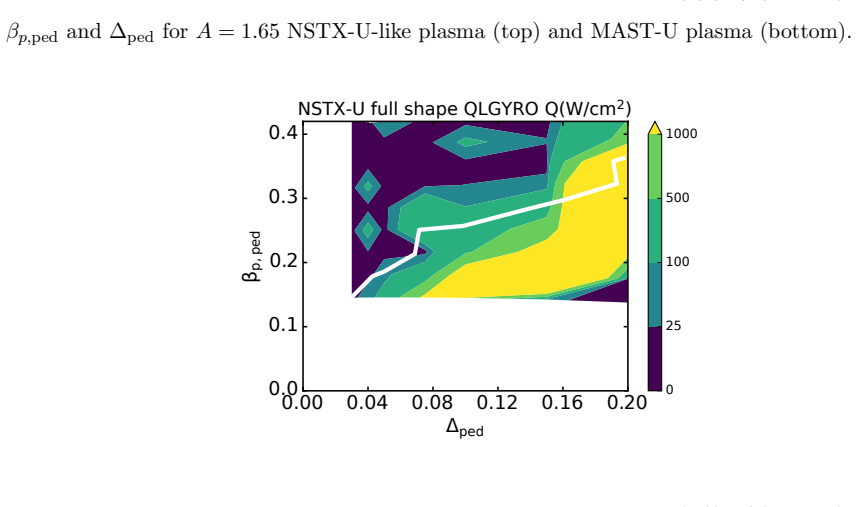
Accurate prediction of pedestal height and width in tokamaks remains a critical issue as it strongly influences the predicted plasma performance of all future reactors. We present an integrated pedestal-stability workflow that combines equilibrium scans with magnetohydrodynamic (MHD) stability analysis using ELITE and GATO and gyrokinetic transport predictions using CGYRO/QLGYRO. The workflow reproduces the characteristic KBM first- and second-stability structure previously identified in gyrokinetic pedestal studies. Applied to spherical tokamaks (STs), the workflow shows good agreement with past studies when low-n peeling stability is included, emphasizing the importance of resolving low-n physics in ST pedestals. Extending the analysis to SPARC-like, high toroidal field plasmas, kinetic ballooning mode (KBM) and microtearing mode (MTM) heat fluxes are found to increase strongly with toroidal field, suggesting that access to the KBM second-stability region may become significantly more difficult in high toroidal field devices. Comparison with global ELITE finite-n analysis at SPARC parameters suggests that the H-mode pedestal lies in an intermediate regime bounded by local KBM second stability on one side and global finite-n ballooning instability on the other, consistent with the EPED picture once global effects are included
Editorial analysis
A structured set of objections, weighed in public.
Referee Report
Summary. The paper presents an integrated pedestal-stability workflow that combines equilibrium scans with MHD stability analysis using ELITE and GATO and gyrokinetic transport predictions using CGYRO/QLGYRO. The workflow reproduces the characteristic KBM first- and second-stability structure previously identified in gyrokinetic pedestal studies. Applied to spherical tokamaks, it shows good agreement with past studies when low-n peeling stability is included. Extending to SPARC-like high toroidal field plasmas, KBM and MTM heat fluxes increase strongly with toroidal field. Comparison with global ELITE finite-n analysis suggests the H-mode pedestal lies in an intermediate regime bounded by local KBM second stability on one side and global finite-n ballooning instability on the other, consistent with the EPED picture once global effects are included.
Significance. If the central claims hold, the workflow provides a practical method for combining local gyrokinetic flux predictions with global ideal MHD stability boundaries. This could help assess pedestal access in high-field devices such as SPARC by quantifying the increase in KBM/MTM fluxes with toroidal field and the resulting difficulty in reaching the second-stability region. The reproduction of known KBM structures and agreement with prior ST studies are noted strengths.
major comments (1)
- [Abstract] Abstract (SPARC extrapolation): The claim that the pedestal occupies an intermediate regime bounded by the local KBM second-stability boundary rests on the assumption that local CGYRO/QLGYRO predictions remain quantitatively valid at SPARC parameters. No quantitative error bars, data exclusion criteria, or assessment of how global electromagnetic or finite-n effects might shift the KBM threshold are provided; this assumption is load-bearing for the consistency with the EPED picture.
Simulated Author's Rebuttal
We thank the referee for their constructive review and recognition of the workflow's strengths. We address the single major comment below.
read point-by-point responses
-
Referee: [Abstract] Abstract (SPARC extrapolation): The claim that the pedestal occupies an intermediate regime bounded by the local KBM second-stability boundary rests on the assumption that local CGYRO/QLGYRO predictions remain quantitatively valid at SPARC parameters. No quantitative error bars, data exclusion criteria, or assessment of how global electromagnetic or finite-n effects might shift the KBM threshold are provided; this assumption is load-bearing for the consistency with the EPED picture.
Authors: The manuscript presents an integrated workflow that deliberately combines local gyrokinetic flux predictions with global ideal MHD boundaries, as described in the introduction and methods. We agree that the local approximation carries inherent uncertainties at SPARC parameters and that quantitative error bars or explicit global-effect assessments are not provided. We will revise the abstract and add a paragraph in the discussion section to explicitly state this limitation, reference relevant literature on global electromagnetic effects in pedestals, and note that the EPED consistency is presented as suggestive within the local-global hybrid framework. This addresses the concern without requiring new simulations. revision: partial
Circularity Check
No significant circularity detected in the integrated workflow
full rationale
The paper presents a workflow that combines outputs from independent established codes (CGYRO/QLGYRO for local gyrokinetic fluxes and ELITE/GATO for MHD stability) to reproduce known KBM first- and second-stability features and compare local vs. global boundaries at SPARC parameters. The conclusion that the pedestal occupies an intermediate regime consistent with the EPED picture is an interpretive result of this cross-code comparison, not a quantity forced by definition, parameter fitting, or self-citation reduction. No load-bearing step equates a prediction to its own input by construction, and the derivation remains self-contained against external benchmarks.
Axiom & Free-Parameter Ledger
Reference graph
Works this paper leans on
-
[1]
Snyder, R.J
P.B. Snyder, R.J. Groebner, J.W. Hughes, T.H. Osborne, M. Beurskens, A.W. Leonard, H.R. Wilson, and X.Q. Xu. A first-principles predictive model of the pedestal height and width: development, testing and ITER optimization with the EPED model.Nucl. Fusion, 51:103016, 2011
2011
-
[2]
P. B. Snyder, H. R. Wilson, J.R. Ferron, L. L. Lao, A. W. Leonard, T. H. Osborne, and A. D. Turnbull. Edge localized modes and the pedestal: A model based on coupled peeling- ballooning modes.Phys. Plasmas, 9:2037, 2002
2037
-
[3]
Wilson, P.B
H.R. Wilson, P.B. Snyder, and G.T.A. Huysmans. Numerical studies of edge localized instabilities in tokamaks.Phys. Plasmas, 9:1277, 2002
2002
-
[4]
Harrison, R.J
J.R. Harrison, R.J. Akers, S.Y. Allan, J.S. Allcock, J.O. Allen, L. Appel, M. Barnes, N. Ben Ayed, W. Boeglin, C. Bowman, J. Bradley, P. Browning, P. Bryant, M. Carr, M. Cecconello, C.D. Challis, S. Chapman, I.T. Chapman, G.J. Colyer, S. Conroy, N.J. Conway, M. Cox, G. Cunningham, R.O. Dendy, W. Dorland, B.D. Dudson, L. Easy, S.D. Elmore, T. Farley, X. Fe...
2019
-
[5]
Knolker, T
M. Knolker, T. Osborne, E. A. Belli, S. S. Henderson, A. Kirk, L. Kogan, S. Saarelma, and P. B. Snyder. Pedestal stability analysis on MAST in preparation for MAST-U.Nuclear Fusion, 61:046041, 2021
2021
-
[6]
Ono, S.M
M. Ono, S.M. Kaye, Y.-K.M. Peng, G. Barnes, W. Blanchard, M.D. Carter, J. Chrzanowski, L. Dudek, R. Ewig, D. Gates, R.E. Hatcher, T. Jarboe, S.C. Jardin, D. Johnson, R. Kaita, M. Kalish, C.E. Kessel, H.W. Kugel, R. Maingi, R. Majeski, J. Manickam, B. McCormack, J. Menard, D. Mueller, B.A. Nelson, B.E. Nelson, C. Neumeyer, G. Oliaro, F. Paoletti, R. Parsel...
2000
-
[7]
Diallo, G
A. Diallo, G. J. Kramer, D. R. Smith, R. Maingi, R. E. Bell, W. Guttenfelder, B. P. LeBlanc, M. Podest` a, G. J. McKee, and R. Fonck. Observation of ion scale fluctuations in the pedestal region during the edge-localized-mode cycle on the national spherical torus experiment.Phys. Plasmas, 20(1):012505, 2013
2013
-
[8]
D. J. Battaglia, W. Guttenfelder, R. E. Bell, A. Diallo, N. Ferraro, E. Fredrickson, S. P. Gerhardt, S. M. Kaye, R. Maingi, and D. R. Smith. Enhanced pedestal H-mode at low edge ion collisionality on NSTX.Phys. Plasmas, 27(7):072511, 07 2020
2020
-
[9]
J. F. Parisi, A. O. Nelson, W. Guttenfelder, R. Gaur, J. Berkery, S. Kaye, K. Barada, C. Clauser, A. Diallo, D. Hatch, A. Kleiner, M. Lampert, T. Macwan, and J. Menard. Stability and transport of gyrokinetic critical pedestals.Nuclear Fusion, 64:086034, 2024
2024
-
[10]
B. Patel. Confinement physics for a steady state net electric burning spherical tokamak phd thesis university of york.PhD Thesis University of York, 2021
2021
-
[11]
Bernard, F.J
L.C. Bernard, F.J. Helton, and R.W. Moore. GATO: An MHD stability code for axisymmetric plasmas with internal separatrices.Comput. Phys. Commun., 24(3):377 – 380, 1981
1981
-
[12]
Candy, E.A
J. Candy, E.A. Belli, and R.V. Bravenec. A high-accuracy Eulerian gyrokinetic solver for collisional plasmas.J. Comput. Phys., 324:73, 2016
2016
-
[13]
Staebler, N.T
G.M. Staebler, N.T. Howard, J. Candy, and C. Holland. A model of the saturation of coupled electron and ion scale gyrokinetic turbulence.Nucl. Fusion, 57:066046, 2017. 22
2017
-
[14]
Meneghini, S.P
O. Meneghini, S.P. Smith, L.L. Lao, O. Izacard, Q. Ren, J.M. Park, J. Candy, Z. Wang, C.J. Luna, V.A. Izzo, B.A. Grierson, P.B. Snyder, C. Holland, J. Penna, G. Lu, P. Raum, A. McCubbin, D.M. Orlov, E.A. Belli, N.M. Ferraro, R. Prater, T.H. Osborne, A.D. Turnbull, G.M. Staebler, and The AToM Team. Integrated modeling applications for tokamak experiments w...
2015
-
[15]
Slendebroek, J
T. Slendebroek, J. McClenaghan, O. M. Meneghini, B. C. Lyons, S. P. Smith, T. F. Neiser, N. Shi, and J. Candy. Elevating zero dimensional global scaling predictions to self-consistent theory-based simulations.Phys. Plasmas, 30(7):072511, 07 2023
2023
-
[16]
A. Redl, C. Angioni, E. Belli, and O. Sauter. A new set of analytical formulas for the current drive efficiency and the bootstrap current in toroidal plasmas.Physics of Plasmas, 28:022502, 2021
2021
-
[17]
Osborne, G.L
T.H. Osborne, G.L. Jackson, Z. Yan, R. Maingi, D.K. Mansfield, B.A. Grierson, C.P. Chrobak, A.G. McLean, S.L. Allen, D.J. Battaglia, A.R. Briesemeister, M.E. Fenstermacher, G.R. McKee, P.B. Snyder, and The DIII-D Team. Enhanced H-mode pedestals with lithium injection in DIII-D.Nucl. Fusion, 55(6):063018, 2015
2015
-
[18]
R. L. Miller, M. S. Chu, J. M. Greene, Y. R. Lin-Liu, and R. E. Waltz. Noncircular, finite aspect ratio, local equilibrium model.Phys. Plasmas, 5(4):973–978, 1998
1998
-
[19]
Imada, T
K. Imada, T. H. Osborne, S. Saarelma, J. G. Clark, A. Kirk, M. Knolker, R. Scannell, P.B. Snyder, C. Vincent, H.R. Wilson, and the MAST Upgrade Team. Observation of a new pedestal stability regime in MAST Upgrade H-mode plasmas.Nucl. Fusion, 64(8):086002, 2024
2024
-
[20]
A study of resistive peeling–ballooning modes across spherical tokamaks.Plasma Phys
A Kleiner, K Imada, F Ebrahimi, N M Ferraro, S R Haskey, L Kogan, and A Pankin. A study of resistive peeling–ballooning modes across spherical tokamaks.Plasma Phys. Control. Fusion, 67(8):085026, 2025
2025
-
[21]
Peeling-ballooning modes in spherical tokamaks: Multi-branch instabilities and effects beyond ideal MHD.Phys
Yueqiang Liu, Chen Zhao, and Fatima Ebrahimi. Peeling-ballooning modes in spherical tokamaks: Multi-branch instabilities and effects beyond ideal MHD.Phys. Plasmas, 32(12):122507, 2025
2025
-
[22]
Effects beyond ideal MHD on stability of wide and enhanced pedestal regimes in nstx.Plasma Phys
Alexei Pankin, Fatima Ebrahimi, Jacob King, Andreas Kleiner, and Jesus Dominguez- Palacios. Effects beyond ideal MHD on stability of wide and enhanced pedestal regimes in nstx.Plasma Phys. Control. Fusion, 67(9):095023, 2025
2025
-
[23]
Rodriguez-Fernandez, A
P. Rodriguez-Fernandez, A. J. Creely, M. J. Greenwald, D. Brunner, S. B. Ballinger, C. P. 23 Chrobak, D. T. Garnier, R. Granetz, Z. S. Hartwig, N. T. Howard, J. W. Hughes, J. H. Irby, V. A. Izzo, A. Q. Kuang, Y. Lin, E. S. Marmar, R. T. Mumgaard, C. Rea, M. L. Reinke, V. Riccardo, J. E. Rice, S. D. Scott, B. N. Sorbom, J. A. Stillerman, R. Sweeney, R. A. ...
2022
-
[24]
J.L. Luxon. A design retrospective of the DIII-D tokamak.Nucl. Fusion, 42(5):614, 2002
2002
-
[25]
Keilhacker and ASDEX Team
M. Keilhacker and ASDEX Team. The ASDEX divertor tokamak.Nucl. Fusion, 25(9):1045, 1985
1985
-
[26]
Power requirement for accessing the h-mode in iter.Journal of Physics: Conference Series, 123(1):012033, 2008
Y R Martin, T Takizuka, and (and the ITPA CDBM H-mode Threshold Database Working Group). Power requirement for accessing the h-mode in iter.Journal of Physics: Conference Series, 123(1):012033, 2008
2008
-
[27]
Non-local effects on pedestal kinetic ballooning mode stability
S Saarelma, J Martin-Collar, D Dickinson, B F McMillan, C M Roach, MAST team, and The JET Contributors4. Non-local effects on pedestal kinetic ballooning mode stability. Plasma Phys. Control. Fusion, 59(6):064001, 2017. 24
2017
discussion (0)
Sign in with ORCID, Apple, or X to comment. Anyone can read and Pith papers without signing in.