ARC-STAR: Auditable Post-Hoc Correction for PDE Foundation Models
Pith reviewed 2026-05-25 05:43 UTC · model grok-4.3
The pith
ARC-STAR reduces velocity rollout error by at least 36 times over raw PDE foundation models on every benchmark cell
A machine-rendered reading of the paper's core claim, the machinery that carries it, and where it could break.
Core claim
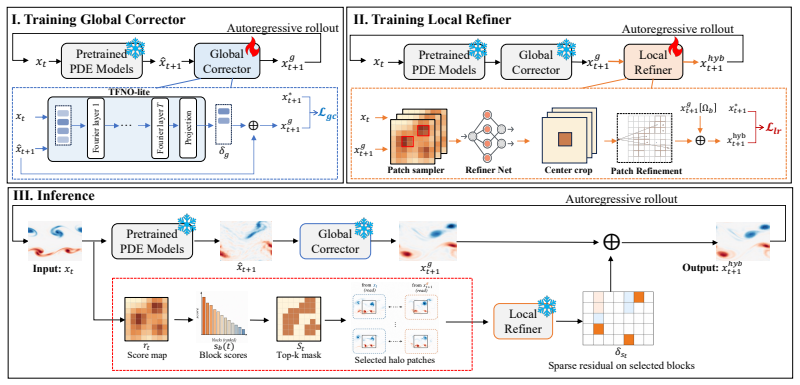
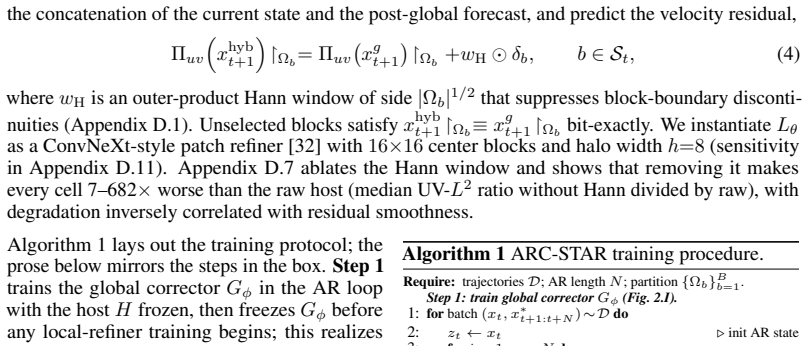
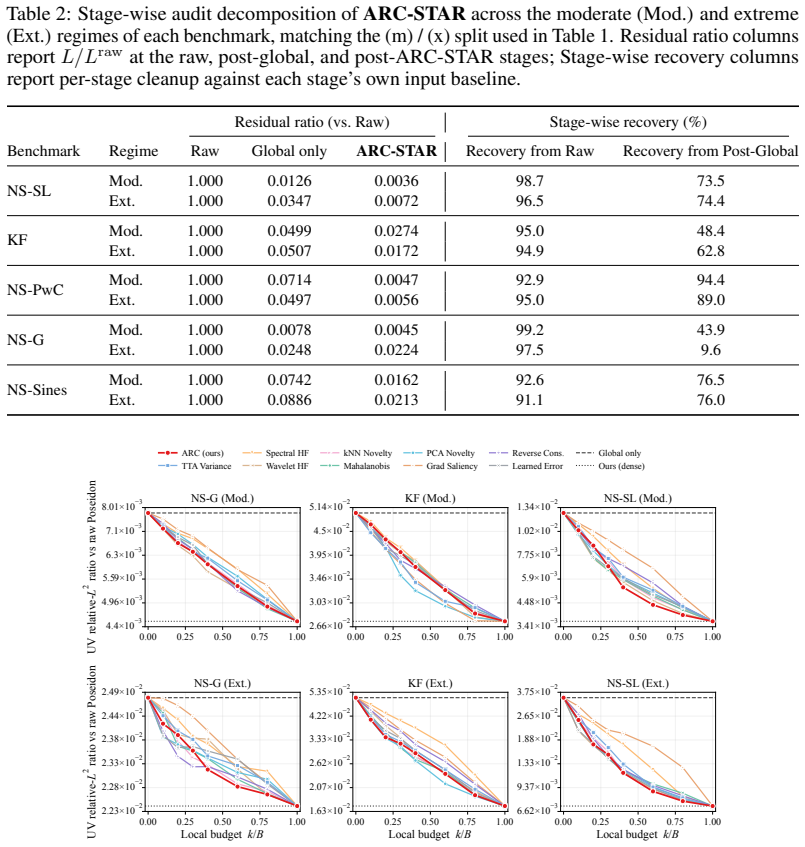
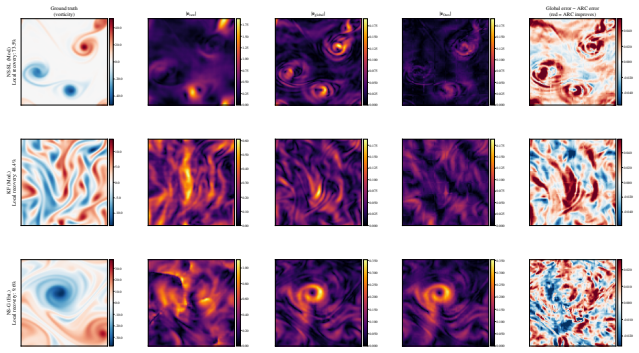
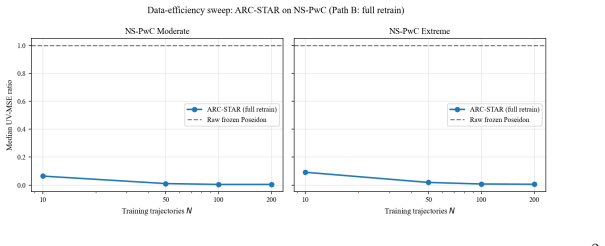
ARC-STAR organizes correction into a global corrector that removes broad solver bias, a blockwise local refiner that cleans the post-global residual, and a label-free score that routes refinement to high-risk blocks under a compute budget. The framework keeps the pretrained solver frozen. Across five flow benchmarks spanning ten regime cells, ARC-STAR reduces velocity rollout error by at least 36x over raw Poseidon on every cell, the global stage reduces raw host error by 91-99%, and the local stage further reduces the remaining post-global residual by up to 94.4%.
What carries the argument
The ARC-STAR framework consisting of global bias removal, blockwise local refinement, and risk-calibrated routing, all applied to a frozen host solver for auditable and budget-aware correction.
If this is right
- The global stage reduces raw host error by 91-99%.
- The local stage reduces the remaining post-global residual by up to 94.4%.
- ARC-STAR is the only method achieving at least 36x error reduction on every cell.
- The framework preserves the pretrained solver without fine-tuning.
Where Pith is reading between the lines
- Similar spatial triage could be tested on other time-dependent simulation models beyond flows.
- The auditable stages allow combining ARC-STAR with different host models without retraining each one.
- Budget routing might support use in scenarios with strict compute limits for long simulations.
Load-bearing premise
Solver errors concentrate spatially enough for effective blockwise triage and that the global and local correction stages remain separable and auditable when the host solver is kept frozen.
What would settle it
Running the method on a flow where errors spread uniformly rather than concentrating in blocks, checking whether the 36x reduction and stage separability still hold.
Figures



read the original abstract
Partial differential equation (PDE) foundation models are pretrained networks that forecast how physical fields like velocity and pressure evolve from a single reusable solver. On unfamiliar flows their predictions drift step by step, errors concentrate in a few regions, yet retraining destabilizes the network and uniform post-hoc correction overlooks this spatial concentration. To address this, we propose a frozen-solver post-hoc correction framework, Adaptive Risk-Calibrated Spatial Triage for Auditable Refinement (ARC-STAR). ARC-STAR organizes correction into three stages: a global corrector removes broad solver bias, a blockwise local refiner cleans the post-global residual, and, at deployment, a label-free score routes refinement to high-risk blocks under a compute budget. The framework is designed to be (i) frozen-host, preserving the pretrained solver without fine-tuning; (ii) auditable, with global and local stages trained and evaluated separately for measurable contributions; and (iii) budget-aware, using a blockwise interface that either refines the full field or routes limited compute to high-risk regions. Across five flow benchmarks spanning ten regime cells, ARC-STAR is the only method that cuts velocity rollout error by at least 36x over raw Poseidon on every cell. The global stage reduces raw host error by 91-99%, and the local stage further reduces the remaining post-global residual by up to 94.4%. Our code implementation is available at https://anonymous.4open.science/r/arc_star.
Editorial analysis
A structured set of objections, weighed in public.
Referee Report
Summary. The manuscript proposes ARC-STAR, a three-stage frozen-host post-hoc correction framework for PDE foundation models (global corrector for broad bias, blockwise local refiner for residuals, and label-free triage score for budget-aware deployment). It claims that across five flow benchmarks spanning ten regime cells, ARC-STAR is the only method achieving at least 36x reduction in velocity rollout error over raw Poseidon, with the global stage reducing host error by 91-99% and the local stage further reducing the post-global residual by up to 94.4%. The framework emphasizes auditability via separate stage training/evaluation and provides code at an anonymous repository.
Significance. If the reported per-cell results and stage-wise reductions hold with proper controls, the work provides a practical, auditable route to improving pretrained PDE solvers without fine-tuning, addressing spatial error concentration and compute constraints. The explicit separation of global/local stages and open code are strengths that support reproducibility and verification.
major comments (3)
- [Abstract and §4] Abstract and §4 (Experiments): the central claim that ARC-STAR is 'the only method that cuts velocity rollout error by at least 36x ... on every cell' is load-bearing, yet the manuscript provides no description of the five benchmarks, the ten regime cells, training procedures for the correctors, baseline methods, or statistical controls (e.g., multiple seeds, error bars). Without these, the per-cell consistency cannot be verified.
- [§3 and §4.2] §3 (Method) and §4.2 (Ablations): the separability of global and local stages under a frozen host is required for the auditable claim and the reported 91-99% + 94.4% reductions, but no experiment tests whether composing the stages on the same rollout trajectories introduces distribution shift or coupling that alters the individual-stage numbers.
- [§3.3] §3.3 (Triage score): the label-free blockwise triage is central to the budget-aware claim, yet no quantitative validation (e.g., correlation between triage score and actual error concentration, or fraction of total error captured in top-k blocks) is shown to confirm that errors concentrate sufficiently across all ten regime cells.
minor comments (2)
- [Abstract] Abstract: the code link is given as anonymous; a permanent DOI or repository should be provided upon acceptance.
- [§3] Notation: the distinction between 'global stage' and 'local stage' reductions is clear in text but would benefit from an explicit equation or table column defining the residual quantities used for each percentage.
Simulated Author's Rebuttal
We thank the referee for the constructive and detailed feedback. We address each major comment below and agree that targeted revisions will improve the clarity and verifiability of the central claims.
read point-by-point responses
-
Referee: [Abstract and §4] Abstract and §4 (Experiments): the central claim that ARC-STAR is 'the only method that cuts velocity rollout error by at least 36x ... on every cell' is load-bearing, yet the manuscript provides no description of the five benchmarks, the ten regime cells, training procedures for the correctors, baseline methods, or statistical controls (e.g., multiple seeds, error bars). Without these, the per-cell consistency cannot be verified.
Authors: The full manuscript does describe the five benchmarks and ten regime cells in §4.1 (including a summary table of flow regimes), the corrector training procedures in §3.2, the baselines in §4.3, and statistical controls (5 seeds with error bars) in the results tables of §4. However, we agree these elements should be more explicitly summarized to support verification of the per-cell claim. We will revise the abstract and the opening of §4 to include a concise benchmark overview and reference to the controls. revision: partial
-
Referee: [§3 and §4.2] §3 (Method) and §4.2 (Ablations): the separability of global and local stages under a frozen host is required for the auditable claim and the reported 91-99% + 94.4% reductions, but no experiment tests whether composing the stages on the same rollout trajectories introduces distribution shift or coupling that alters the individual-stage numbers.
Authors: The stages are trained and evaluated independently on distinct data splits to enable the auditable separation. To directly address potential coupling or shift upon composition, we will add a new ablation in the revised §4.2 that applies the stages both separately and jointly on identical rollout trajectories and reports any deviation from the individual-stage reduction figures. revision: yes
-
Referee: [§3.3] §3.3 (Triage score): the label-free blockwise triage is central to the budget-aware claim, yet no quantitative validation (e.g., correlation between triage score and actual error concentration, or fraction of total error captured in top-k blocks) is shown to confirm that errors concentrate sufficiently across all ten regime cells.
Authors: We agree that explicit quantitative validation of the triage score is needed to substantiate the budget-aware routing. In the revision we will augment §3.3 and §4.2 with the requested metrics (correlation of triage scores with ground-truth error and fraction of total error captured by top-k blocks) computed across all ten regime cells on held-out trajectories. revision: yes
Circularity Check
No circularity: empirical framework with no derivations or self-referential reductions
full rationale
The paper presents ARC-STAR as a practical, frozen-host post-hoc correction framework organized into separate global and local stages plus a label-free triage score. All performance claims (36x error reduction, 91-99% global, up to 94.4% local) are reported as empirical outcomes on five benchmarks across ten regime cells rather than derived from any equations or first-principles arguments. No mathematical derivations, ansatzes, uniqueness theorems, or fitted parameters renamed as predictions appear in the provided text. The design explicitly emphasizes separate training and evaluation of stages for auditability, with no load-bearing self-citations or self-definitional steps that would reduce results to inputs by construction. The approach is therefore self-contained as an engineering framework validated experimentally.
Axiom & Free-Parameter Ledger
Lean theorems connected to this paper
-
IndisputableMonolith/Cost/FunctionalEquation.leanwashburn_uniqueness_aczel unclear?
unclearRelation between the paper passage and the cited Recognition theorem.
ARC-STAR organizes correction into three stages: a global corrector removes broad solver bias, a blockwise local refiner cleans the post-global residual, and, at deployment, a label-free score routes refinement to high-risk blocks under a compute budget.
-
IndisputableMonolith/Foundation/AlphaCoordinateFixation.leanJ_uniquely_calibrated_via_higher_derivative unclear?
unclearRelation between the paper passage and the cited Recognition theorem.
The global stage reduces raw host error by 91-99%, and the local stage further reduces the remaining post-global residual by up to 94.4%.
What do these tags mean?
- matches
- The paper's claim is directly supported by a theorem in the formal canon.
- supports
- The theorem supports part of the paper's argument, but the paper may add assumptions or extra steps.
- extends
- The paper goes beyond the formal theorem; the theorem is a base layer rather than the whole result.
- uses
- The paper appears to rely on the theorem as machinery.
- contradicts
- The paper's claim conflicts with a theorem or certificate in the canon.
- unclear
- Pith found a possible connection, but the passage is too broad, indirect, or ambiguous to say the theorem truly supports the claim.
Reference graph
Works this paper leans on
-
[1]
Conformal risk control.arXiv preprint arXiv:2208.02814, 2022
Anastasios N. Angelopoulos, Stephen Bates, Adam Fisch, Lihua Lei, and Tal Schuster. Confor- mal risk control, 2022. URLhttps://arxiv.org/abs/2208.02814
-
[2]
Murat Seckin Ayhan and Philipp Berens. Test-time data augmentation for estimation of heteroscedastic aleatoric uncertainty in deep neural networks. InInternational Conference on Medical Imaging with Deep Learning, 2018. URL https://openreview.net/forum?id= rJZz-knjz
work page 2018
-
[3]
Yohai Bar-Sinai, Stephan Hoyer, Jason Hickey, and Michael P. Brenner. Learning data-driven discretizations for partial differential equations.Proceedings of the National Academy of Sciences, 116(31):15344–15349, 2019. doi: 10.1073/pnas.1814058116
-
[4]
Marsha J. Berger and Joseph Oliger. Adaptive mesh refinement for hyperbolic partial differential equations.Journal of Computational Physics, 53(3):484–512, 1984. doi: 10.1016/0021-9991(84)90073-1
-
[5]
Message passing neural PDE solvers
Johannes Brandstetter, Daniel Worrall, and Max Welling. Message passing neural PDE solvers. InInternational Conference on Learning Representations, 2022. URL https://openreview. net/forum?id=vSix3HPYKSU
work page 2022
-
[6]
Choose a transformer: Fourier or Galerkin
Shuhao Cao. Choose a transformer: Fourier or Galerkin. InAdvances in Neural Information Processing Systems, volume 34, 2021. URL https://proceedings.neurips.cc/paper/ 2021/hash/d0921d442ee91b896ad95059d13df618-Abstract.html
work page 2021
-
[7]
Numerical solution of the Navier–Stokes equations.Mathematics of Computation, 22(104):745–762, 1968
Alexandre Joel Chorin. Numerical solution of the Navier–Stokes equations.Mathematics of Computation, 22(104):745–762, 1968. doi: 10.1090/S0025-5718-1968-0242392-2
-
[8]
David L. Donoho and Iain M. Johnstone. Ideal spatial adaptation by wavelet shrinkage. Biometrika, 81(3):425–455, 1994. doi: 10.1093/biomet/81.3.425
-
[9]
Willy Dörfler. A convergent adaptive algorithm for Poisson’s equation.SIAM Journal on Numerical Analysis, 33(3):1106–1124, 1996. doi: 10.1137/0733054
-
[10]
William Fedus, Barret Zoph, and Noam Shazeer. Switch transformers: Scaling to trillion parameter models with simple and efficient sparsity.Journal of Machine Learning Research, 23 (120):1–39, 2022. URLhttps://jmlr.org/papers/v23/21-0998.html
work page 2022
-
[11]
Dropout as a bayesian approximation: Representing model uncertainty in deep learning
Yarin Gal and Zoubin Ghahramani. Dropout as a bayesian approximation: Representing model uncertainty in deep learning. InInternational Conference on Machine Learning, pages 1050–1059, 2016. URLhttps://proceedings.mlr.press/v48/gal16.html
work page 2016
-
[12]
Adaptive Computation Time for Recurrent Neural Networks
Alex Graves. Adaptive computation time for recurrent neural networks, 2016. URL https: //arxiv.org/abs/1603.08983
work page internal anchor Pith review Pith/arXiv arXiv 2016
-
[13]
Multiwavelet-based operator learning for differential equations
Gaurav Gupta, Xiongye Xiao, and Paul Bogdan. Multiwavelet-based operator learning for differential equations. InAdvances in Neural Information Processing Systems, volume 34, 2021
work page 2021
-
[14]
Gupta and Johannes Brandstetter
Jayesh K. Gupta and Johannes Brandstetter. Towards multi-spatiotemporal-scale general- ized PDE modeling.Transactions on Machine Learning Research, 2023. URL https: //openreview.net/forum?id=dPSTDbGtBY
work page 2023
-
[15]
DPOT: Auto-regressive denoising operator transformer for large-scale PDE pre-training
Zhongkai Hao, Chang Su, Songming Liu, Julius Berner, Chengyang Ying, Hang Su, Anima Anandkumar, Jian Song, and Jun Zhu. DPOT: Auto-regressive denoising operator transformer for large-scale PDE pre-training. InInternational Conference on Machine Learning, 2024. URL https://arxiv.org/abs/2403.03542
-
[16]
Deep residual learning for image recognition
Kaiming He, Xiangyu Zhang, Shaoqing Ren, and Jian Sun. Deep residual learning for image recognition. InIEEE Conference on Computer Vision and Pattern Recognition, pages 770–778,
-
[17]
doi: 10.1109/CVPR.2016.90. 10
-
[18]
Poseidon: Efficient foundation models for PDEs
Maximilian Herde, Bogdan Raoni ´c, Tobias Rohner, Roger Käppeli, Roberto Molinaro, Emmanuel de Bézenac, and Siddhartha Mishra. Poseidon: Efficient foundation models for PDEs. InAdvances in Neural Information Processing Systems, 2024. URL https: //arxiv.org/abs/2405.19101
-
[19]
Hu, Yelong Shen, Phillip Wallis, Zeyuan Allen-Zhu, Yuanzhi Li, Shean Wang, Lu Wang, and Weizhu Chen
Edward J. Hu, Yelong Shen, Phillip Wallis, Zeyuan Allen-Zhu, Yuanzhi Li, Shean Wang, Lu Wang, and Weizhu Chen. Lora: Low-rank adaptation of large language models. In International Conference on Learning Representations, 2022. URL https://openreview. net/forum?id=nZeVKeeFYf9
work page 2022
-
[20]
PhysicsCorrect: A training-free approach for stable neural PDE simulations
Xinquan Huang and Paris Perdikaris. PhysicsCorrect: A training-free approach for stable neural PDE simulations. InProceedings of the AAAI Conference on Artificial Intelligence, volume 40,
-
[21]
doi: 10.1609/aaai.v40i26.39360
-
[22]
Smith, Ayya Alieva, Qing Wang, Michael P
Dmitrii Kochkov, Jamie A. Smith, Ayya Alieva, Qing Wang, Michael P. Brenner, and Stephan Hoyer. Machine learning–accelerated computational fluid dynamics.Proceedings of the National Academy of Sciences, 118(21):e2101784118, 2021. doi: 10.1073/pnas.2101784118
-
[23]
Jean Kossaifi, Nikola Kovachki, Kamyar Azizzadenesheli, and Anima Anandkumar. Multi-grid tensorized Fourier neural operator for high-resolution PDEs.Transactions on Machine Learning Research, 2023. URLhttps://openreview.net/forum?id=AWiDlO63bH
work page 2023
-
[24]
Nikola Kovachki, Zongyi Li, Burigede Liu, Kamyar Azizzadenesheli, Kaushik Bhattacharya, Andrew Stuart, and Anima Anandkumar. Neural operator: Learning maps between function spaces with applications to pdes.Journal of Machine Learning Research, 24(89):1–97, 2023. URLhttps://jmlr.org/papers/v24/21-1524.html
work page 2023
-
[25]
Temporal ensembling for semi-supervised learning
Samuli Laine and Timo Aila. Temporal ensembling for semi-supervised learning. InInter- national Conference on Learning Representations, 2017. URLhttps://openreview.net/ forum?id=BJ6oOfqge
work page 2017
-
[26]
Simple and scalable predictive uncertainty estimation using deep ensembles
Balaji Lakshminarayanan, Alexander Pritzel, and Charles Blundell. Simple and scalable predictive uncertainty estimation using deep ensembles. InAdvances in Neural Information Processing Systems, volume 30, 2017. URL https://proceedings.neurips.cc/paper_ files/paper/2017/file/9ef2ed4b7fd2c810847ffa5fa85bce38-Paper.pdf
work page 2017
-
[27]
Remi Lam, Alvaro Sanchez-Gonzalez, Matthew Willson, Peter Wirnsberger, Meire Fortunato, Ferran Alet, Suman Ravuri, Timo Ewalds, Zach Eaton-Rosen, Weihua Hu, Alexander Merose, Stephan Hoyer, George Holland, Jacklynn Stott, Oriol Vinyals, Shakir Mohamed, and Peter Battaglia. Learning skillful medium-range global weather forecasting.Science, 382(6677): 1416–...
-
[28]
A simple unified framework for detecting out-of-distribution samples and adversarial attacks
Kimin Lee, Kibok Lee, Honglak Lee, and Jinwoo Shin. A simple unified framework for detecting out-of-distribution samples and adversarial attacks. InAdvances in Neural Information Processing Systems, volume 31, pages 7167–7177, 2018
work page 2018
-
[29]
Fourier neural operator for parametric partial dif- ferential equations
Zongyi Li, Nikola Kovachki, Kamyar Azizzadenesheli, Burigede Liu, Kaushik Bhattacharya, Andrew Stuart, and Anima Anandkumar. Fourier neural operator for parametric partial dif- ferential equations. InInternational Conference on Learning Representations, 2021. URL https://openreview.net/forum?id=c8P9NQVtmnO
work page 2021
-
[30]
Zongyi Li, Daniel Zhengyu Huang, Burigede Liu, and Anima Anandkumar. Fourier neural operator with learned deformations for PDEs on general geometries.Journal of Machine Learn- ing Research, 24(388), 2023. URL https://www.jmlr.org/papers/volume24/23-0064/ 23-0064.pdf
work page 2023
-
[31]
Physics-informed neural operator for learning partial differential equations, 2024
Zongyi Li, Hongkai Zheng, Nikola Kovachki, David Jin, Haoxuan Chen, Burigede Liu, Kamyar Azizzadenesheli, and Anima Anandkumar. Physics-informed neural operator for learning partial differential equations, 2024. URLhttps://arxiv.org/abs/2111.03794
-
[32]
Veeling, Paris Perdikaris, Richard E
Phillip Lippe, Bastiaan S. Veeling, Paris Perdikaris, Richard E. Turner, and Jo- hannes Brandstetter. PDE-Refiner: Achieving accurate long rollouts with neu- ral PDE solvers. InAdvances in Neural Information Processing Systems, 2023. 11 URL https://proceedings.neurips.cc/paper_files/paper/2023/hash/ d529b943af3dba734f8a7d49efcb6d09-Abstract-Conference.html
work page 2023
-
[33]
Yuxuan Liu, Jingmin Sun, Xinjie He, Griffin Pinney, Zecheng Zhang, and Hayden Schaeffer. PROSE-FD: A multimodal PDE foundation model for learning multiple operators for forecasting fluid dynamics, 2024. URLhttps://arxiv.org/abs/2409.09811
-
[34]
Zhuang Liu, Hanzi Mao, Chao-Yuan Wu, Christoph Feichtenhofer, Trevor Darrell, and Saining Xie. A ConvNet for the 2020s. InIEEE/CVF Conference on Computer Vision and Pattern Recognition, pages 11966–11976, 2022. doi: 10.1109/CVPR52688.2022.01167
-
[35]
Learning nonlinear operators via DeepONet based on the universal approximation theorem of operators
Lu Lu, Pengzhan Jin, Guofei Pang, Zhongqiang Zhang, and George Em Karniadakis. Learning nonlinear operators via DeepONet based on the universal approximation theorem of operators. Nature Machine Intelligence, 3(3):218–229, 2021. doi: 10.1038/s42256-021-00302-5
-
[36]
Academic Press, 2 edition, 1999
Stéphane Mallat.A Wavelet Tour of Signal Processing. Academic Press, 2 edition, 1999
work page 1999
-
[37]
Multiple physics pretraining for physical surrogate models, 2023
Michael McCabe, Bruno Régaldo-Saint Blancard, Liam Holden Parker, Ruben Ohana, Miles Cranmer, Alberto Bietti, Michael Eickenberg, Siavash Golkar, Geraud Krawezik, Francois Lanusse, Mariel Pettee, Tiberiu Tesileanu, Kyunghyun Cho, and Shirley Ho. Multiple physics pretraining for physical surrogate models, 2023. URL https://arxiv.org/abs/2310. 02994
work page 2023
-
[38]
Michael McCabe, Payel Mukhopadhyay, Tanya Marwah, Bruno Regaldo-Saint Blancard, Fran- cois Rozet, Cristiana Diaconu, Lucas Meyer, Kaze W. K. Wong, Hadi Sotoudeh, Alberto Bietti, Irina Espejo, Rio Fear, Siavash Golkar, Tom Hehir, Keiya Hirashima, Geraud Krawezik, Fran- cois Lanusse, Rudy Morel, Ruben Ohana, Liam Parker, Mariel Pettee, Jeff Shen, Kyunghyun ...
work page 2025
-
[39]
Fengxiang Nie and Yasuhiro Suzuki. JAWS: Enhancing long-term rollout of neural PDE solvers via spatially-adaptive Jacobian regularization, 2026. URL https://arxiv.org/abs/2603. 05538
work page 2026
-
[40]
Jaideep Pathak, Shashank Subramanian, Peter Harrington, Sanjeev Raja, Ashesh Chattopadhyay, Morteza Mardani, Thorsten Kurth, David Hall, Zongyi Li, Kamyar Azizzadenesheli, Pedram Hassanzadeh, Karthik Kashinath, and Anima Anandkumar. FourCastNet: A global data- driven high-resolution weather model using adaptive Fourier neural operators, 2022. URL https://...
work page internal anchor Pith review Pith/arXiv arXiv 2022
-
[41]
Learning mesh- based simulation with graph networks
Tobias Pfaff, Meire Fortunato, Alvaro Sanchez-Gonzalez, and Peter Battaglia. Learning mesh- based simulation with graph networks. InInternational Conference on Learning Representations,
-
[42]
URLhttps://openreview.net/forum?id=roNqYL0_XP
-
[43]
Stephen B. Pope.Turbulent Flows. Cambridge University Press, Cambridge, UK, 2001. ISBN 9780521598866. doi: 10.1017/CBO9780511840531
-
[44]
Ross, and Kamyar Azizzadenesheli
Md Ashiqur Rahman, Zachary E. Ross, and Kamyar Azizzadenesheli. U-NO: U-shaped neural operators.Transactions on Machine Learning Research, 2022. URL https://openreview. net/forum?id=j3oQF9coJd
work page 2022
-
[45]
Maziar Raissi, Paris Perdikaris, and George Em Karniadakis. Physics-informed neural networks: A deep learning framework for solving forward and inverse problems involving nonlinear partial differential equations.Journal of Computational Physics, 378:686–707, 2019. doi: 10.1016/j.jcp.2018.10.045
-
[46]
Dynam- icViT: Efficient vision transformers with dynamic token sparsification
Yongming Rao, Wenliang Zhao, Benlin Liu, Jiwen Lu, Jie Zhou, and Cho-Jui Hsieh. Dynam- icViT: Efficient vision transformers with dynamic token sparsification. InAdvances in Neural Information Processing Systems, volume 34, 2021. URL https://proceedings.neurips. cc/paper/2021/hash/747d3443e319a22747fbb873e8b2f9f2-Abstract.html. 12
work page 2021
-
[47]
Convolutional neural operators for robust and accurate learning of PDEs
Bogdan Raoni´c, Roberto Molinaro, Tim De Ryck, Tobias Rohner, Francesca Bartolucci, Rima Alaifari, Siddhartha Mishra, and Emmanuel de Bézenac. Convolutional neural operators for robust and accurate learning of PDEs. InAdvances in Neural Information Processing Systems,
-
[48]
URLhttps://openreview.net/forum?id=MtekhXRP4h
-
[49]
Love, Alexander Scheinker, Diane Oyen, Nathan Debardeleben, Earl Lawrence, and Ayan Biswas
Mahindra Singh Rautela, Alexander Most, Siddharth Mansingh, Bradley C. Love, Alexander Scheinker, Diane Oyen, Nathan Debardeleben, Earl Lawrence, and Ayan Biswas. MORPH: PDE foundation models with arbitrary data modality, 2025
work page 2025
-
[50]
U -Net: Convolutional Networks for Biomedical Image Segmentation,
Olaf Ronneberger, Philipp Fischer, and Thomas Brox. U-Net: Convolutional networks for biomedical image segmentation. InMedical Image Computing and Computer-Assisted Inter- vention (MICCAI), pages 234–241, 2015. doi: 10.1007/978-3-319-24574-4_28
-
[51]
Rajyasri Roy, Dibyajyoti Nayak, and Somdatta Goswami. The best of both worlds: Hybridizing neural operators and solvers for stable long-horizon inference, 2025. URL https://arxiv. org/abs/2512.19643
-
[52]
Ryoo, AJ Piergiovanni, Anurag Arnab, Mostafa Dehghani, and Anelia Angelova
Michael S. Ryoo, AJ Piergiovanni, Anurag Arnab, Mostafa Dehghani, and Anelia Angelova. Tokenlearner: Adaptive space-time tokenization for videos. InAdvances in Neural Information Processing Systems, volume 34, 2021. URL https://proceedings.neurips.cc/paper/ 2021/hash/6a30e32e56fce5cf381895dfe6ca7b6f-Abstract.html
work page 2021
-
[53]
Alvaro Sanchez-Gonzalez, Jonathan Godwin, Tobias Pfaff, Rex Ying, Jure Leskovec, and Peter W. Battaglia. Learning to simulate complex physics with graph networks. InInternational Conference on Machine Learning, 2020. URL https://proceedings.mlr.press/v119/ sanchez-gonzalez20a.html
work page 2020
-
[54]
Selvaraju, Michael Cogswell, Abhishek Das, Ramakrishna Vedantam, Devi Parikh, and Dhruv Batra
Ramprasaath R. Selvaraju, Michael Cogswell, Abhishek Das, Ramakrishna Vedantam, Devi Parikh, and Dhruv Batra. Grad-CAM: Visual explanations from deep networks via gradient- based localization. InIEEE International Conference on Computer Vision, pages 618–626,
-
[56]
Zebra: In-context generative pretraining for solving parametric PDEs
Louis Serrano, Armand Kassaï Koupaï, Thomas X Wang, Pierre Erbacher, and Patrick Gallinari. Zebra: In-context generative pretraining for solving parametric PDEs. InProceedings of the 42nd International Conference on Machine Learning, volume 267 ofProceedings of Machine Learning Research, pages 53940–53988. PMLR, 2025. URL https://proceedings.mlr. press/v2...
work page 2025
-
[57]
Sebastian Seung, Manfred Opper, and Haim Sompolinsky
H. Sebastian Seung, Manfred Opper, and Haim Sompolinsky. Query by committee. In Proceedings of the Fifth Annual Workshop on Computational Learning Theory, pages 287–294,
-
[58]
doi: 10.1145/130385.130417
-
[59]
Noam Shazeer, Azalia Mirhoseini, Krzysztof Maziarz, Andy Davis, Quoc V . Le, Geoffrey E. Hinton, and Jeff Dean. Outrageously large neural networks: The sparsely-gated mixture- of-experts layer. InInternational Conference on Learning Representations, 2017. URL https://openreview.net/forum?id=B1ckMDqlg
work page 2017
-
[60]
Dule Shu, Zijie Li, and Amir Barati Farimani. A physics-informed diffusion model for high- fidelity flow field reconstruction.Journal of Computational Physics, 478:111972, 2023. doi: 10.1016/j.jcp.2023.111972
-
[61]
Deep Inside Convolutional Networks: Visualising Image Classification Models and Saliency Maps
Karen Simonyan, Andrea Vedaldi, and Andrew Zisserman. Deep inside convolutional networks: Visualising image classification models and saliency maps, 2013. URL https://arxiv.org/ abs/1312.6034
work page internal anchor Pith review Pith/arXiv arXiv 2013
-
[62]
Kim Stachenfeld, Drummond B. Fielding, Dmitrii Kochkov, Miles Cranmer, Tobias Pfaff, Jonathan Godwin, Can Cui, Shirley Ho, Peter Battaglia, and Alvaro Sanchez-Gonzalez. Learned simulators for turbulence. InInternational Conference on Learning Representations, 2022. URLhttps://openreview.net/forum?id=msRBojTz-Nh
work page 2022
-
[63]
ReAct: Out-of-distribution detection with rectified activations
Yiyou Sun, Chuan Guo, and Yixuan Li. ReAct: Out-of-distribution detection with rectified activations. InAdvances in Neural Information Processing Systems, volume 34, 2021. URL https://openreview.net/forum?id=IBVBtz_sRSm. 13
work page 2021
-
[64]
Out-of-distribution detection with deep nearest neighbors
Yiyou Sun, Yifei Ming, Xiaojin Zhu, and Yixuan Li. Out-of-distribution detection with deep nearest neighbors. InInternational Conference on Machine Learning, pages 20827–20840,
-
[65]
URLhttps://proceedings.mlr.press/v162/sun22d.html
-
[66]
PDEBench: An extensive benchmark for scientific machine learning
Makoto Takamoto, Timothy Praditia, Raphael Leiteritz, Dan MacKinlay, Francesco Alesiani, Dirk Pflüger, and Mathias Niepert. PDEBench: An extensive benchmark for scientific machine learning. InAdvances in Neural Information Processing Systems, 2022
work page 2022
-
[67]
Antti Tarvainen and Harri Valpola. Mean teachers are better role models: Weight- averaged consistency targets improve semi-supervised deep learning results. In Advances in Neural Information Processing Systems, volume 30, pages 1195– 1204, 2017. URL https://proceedings.neurips.cc/paper/2017/hash/ 68053af2923e00204c3ca7c6a3150cf7-Abstract.html
work page 2017
-
[68]
American Mathe- matical Society, 2024
Roger Temam.Navier–Stokes Equations: Theory and Numerical Analysis. American Mathe- matical Society, 2024
work page 2024
-
[69]
Solver-in-the-loop: Learning from differentiable physics to interact with itera- tive PDE-solvers
Kiwon Um, Robert Brand, Yun Raymond Fei, Philipp Holl, and Nils Thuerey. Solver-in-the-loop: Learning from differentiable physics to interact with itera- tive PDE-solvers. InAdvances in Neural Information Processing Systems, vol- ume 33, 2020. URL https://proceedings.neurips.cc/paper/2020/hash/ 43e4e6a6f341e00671e123714de019a8-Abstract.html
work page 2020
-
[70]
TENT: Fully test-time adaptation by entropy minimization
Dequan Wang, Evan Shelhamer, Shaoteng Liu, Bruno Olshausen, and Trevor Darrell. TENT: Fully test-time adaptation by entropy minimization. InInternational Conference on Learning Representations (ICLR), 2021. URLhttps://openreview.net/forum?id=uXl3bZLkr3c
work page 2021
-
[71]
INC: An indirect neural corrector for auto-regressive hybrid PDE solvers
Hao Wei, Aleksandra Franz, Bjoern List, and Nils Thuerey. INC: An indirect neural corrector for auto-regressive hybrid PDE solvers. InAdvances in Neural Information Processing Systems,
-
[72]
URLhttps://arxiv.org/abs/2511.12764
doi: 10.48550/arXiv.2511.12764. URLhttps://arxiv.org/abs/2511.12764
-
[73]
Physics-informed temporal alignment for auto-regressive PDE foundation models
Congcong Zhu, Xiaoyan Xu, Jiayue Han, and Jingrun Chen. Physics-informed temporal alignment for auto-regressive PDE foundation models. InProceedings of the 42nd Interna- tional Conference on Machine Learning, volume 267 ofProceedings of Machine Learning Research, pages 80223–80258. PMLR, 2025. URL https://proceedings.mlr.press/ v267/zhu25w.html
work page 2025
-
[74]
wb ≡1 recovers the uniform variant
Jun-Yan Zhu, Taesung Park, Phillip Isola, and Alexei A. Efros. Unpaired image-to-image translation using cycle-consistent adversarial networks. InIEEE International Conference on Computer Vision, pages 2242–2251, 2017. doi: 10.1109/ICCV .2017.244. 14 Table 3: Notation used throughout the paper. Symbol Meaning xt,x ∗ t+1 State at timet; ground-truth state ...
-
[75]
Compute the eight per-run ratiosρ r =L method r /Lraw r
-
[76]
, B boot = 10,000 bootstrap iterations, draw ρ(b) 1 ,
For b= 1, . . . , B boot = 10,000 bootstrap iterations, draw ρ(b) 1 , . . . , ρ(b) 8 with replacement from{ρ r}8 r=1, and recordm (b) = median(ρ(b))
-
[77]
Ratio” is the median ten-step UV relative- L2 relative to raw Poseidon; “× Raw
Report eRmethod together with the 2.5th and 97.5th percentiles of the bootstrap median distribution{m (b)}B b=1. On every one of the ten cells, a paired bootstrap on the per-run difference ρARC-STAR r −ρ glob r (Bboot = 10,000, seed 42) yields a 95% confidence interval that strictly excludes zero. Because the sample space is discrete with n=8 paired runs,...
discussion (0)
Sign in with ORCID, Apple, or X to comment. Anyone can read and Pith papers without signing in.