Emergence of Dynamical Anisotropy induced by Demixing in a Binary System with Differential Diffusivity under an External Potential
Pith reviewed 2026-06-29 01:01 UTC · model grok-4.3
The pith
An external potential expands demixing in a binary mixture of particles with different diffusivities and produces direction-dependent motion through percolating bands.
A machine-rendered reading of the paper's core claim, the machinery that carries it, and where it could break.
Core claim
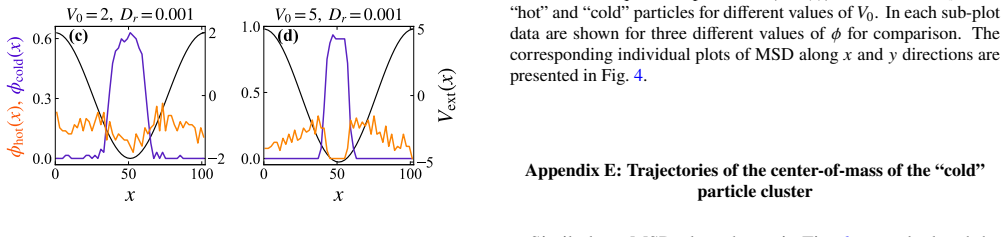
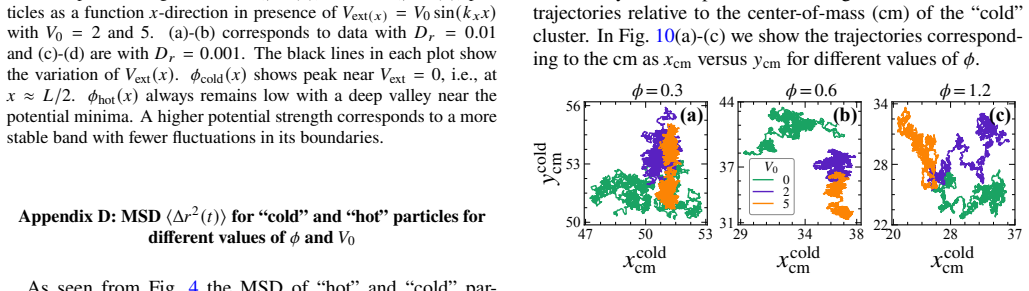
In simulations of a binary mixture with differential diffusivity under a spatially varying external potential, demixing occurs across a broader interval of packing fractions than without the potential. The less diffusive particles form bands near the potential minima that exhibit pronounced hexatic order. Mean-squared displacements of the two species differ markedly along the potential direction but remain normally diffusive in the transverse direction for both species. The arrangement produces a percolating band and a clear dynamical anisotropy that is absent when the external potential is removed.
What carries the argument
The spatially varying external potential acting on particles that differ in diffusivity, which drives directional band formation and anisotropic transport.
If this is right
- Demixing persists over a wider interval of packing fractions when the potential is present.
- Slower particles inside the bands near potential minima show stronger hexatic order.
- A connected percolating band appears that is absent without the potential.
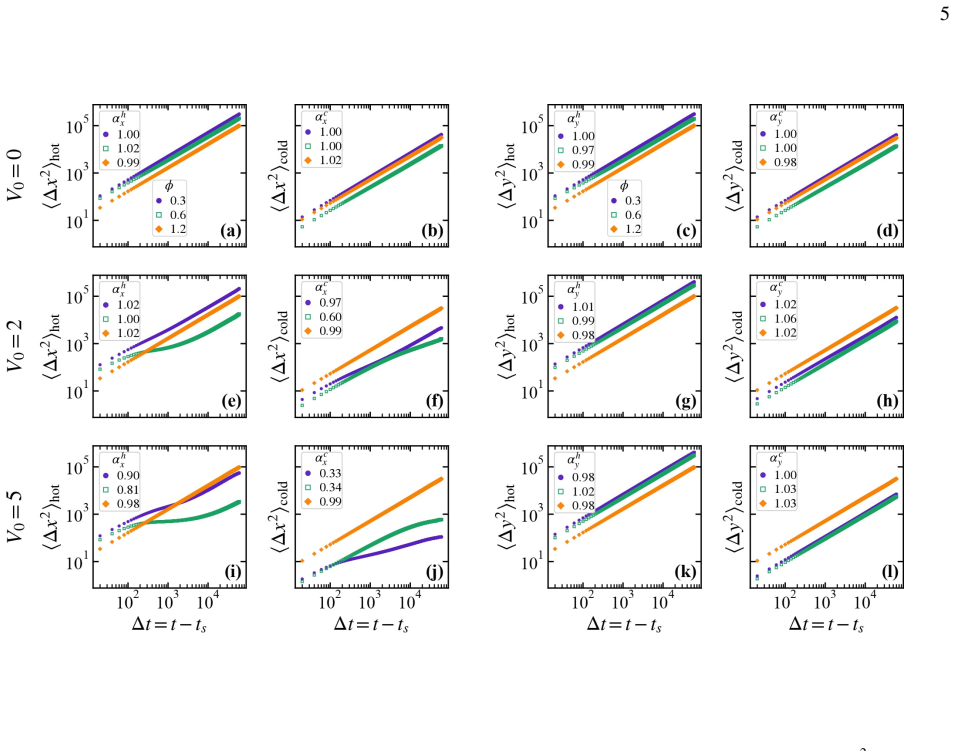
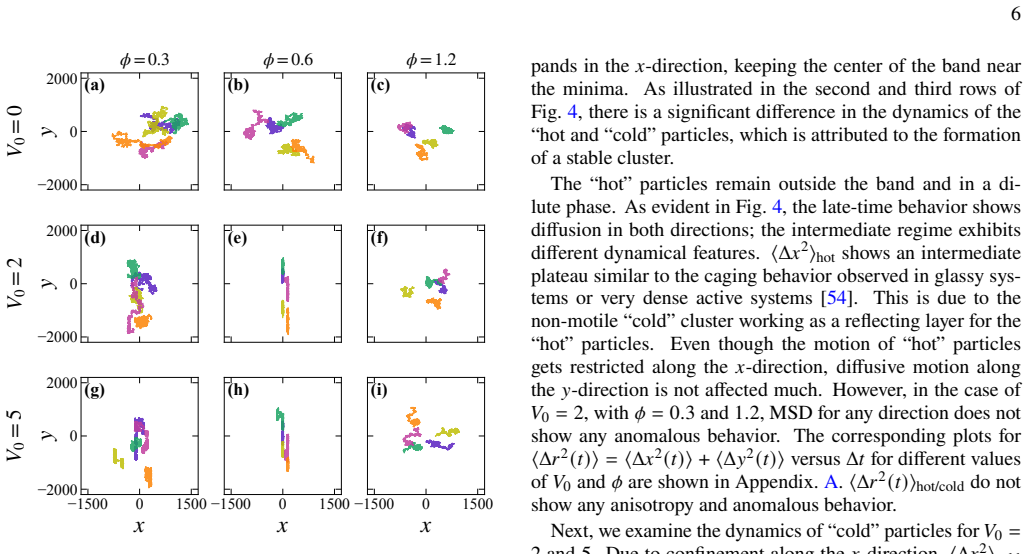
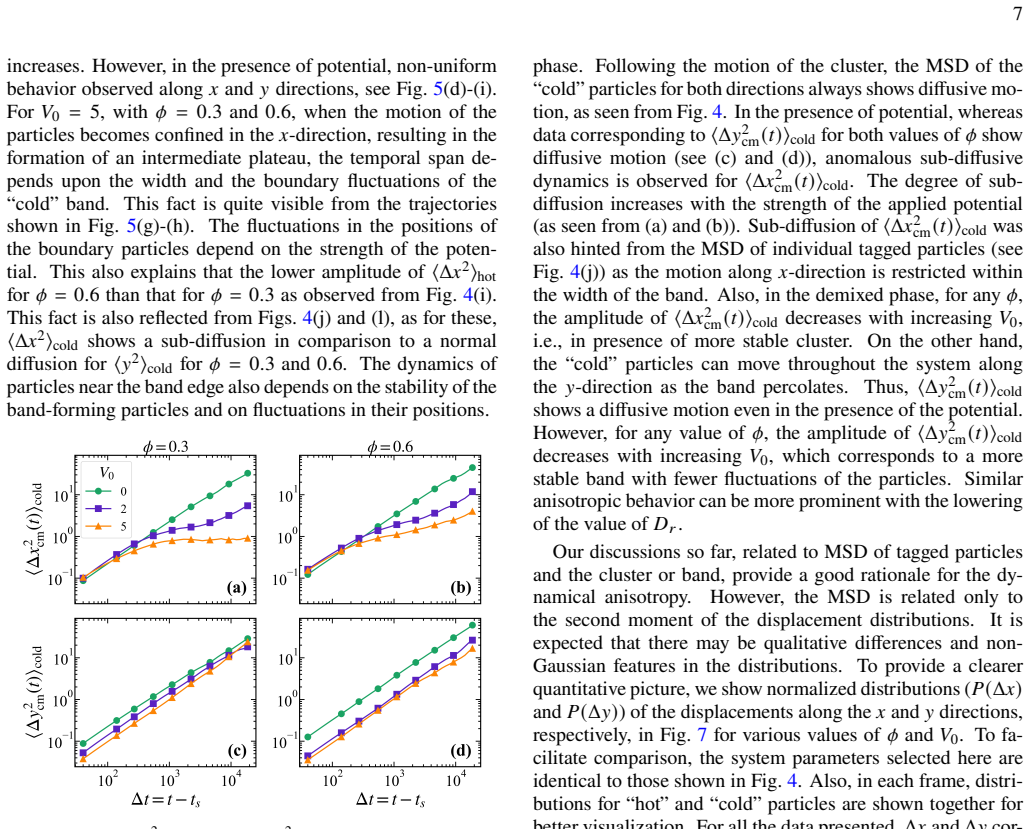
- Long-time motion becomes sub-diffusive for cold particles and diffusive for hot particles along the potential axis, while both remain normally diffusive perpendicular to it.
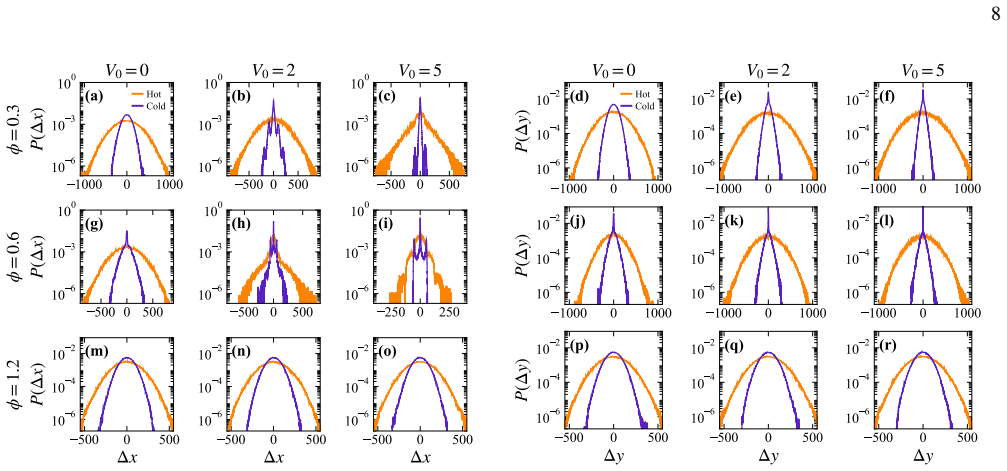
- Non-Gaussian displacement statistics appear that reflect the spatial separation of the two species.
Where Pith is reading between the lines
- The same mechanism could be used to steer segregation in confined granular or cellular systems by tuning the shape or strength of an external field.
- The transverse normal diffusion suggests that anisotropy is strictly aligned with the potential gradient and could be reversed by rotating the field direction.
- The percolating band may act as a transport channel whose permeability changes with packing fraction, offering a route to density-controlled filtering in soft-matter devices.
Load-bearing premise
The demixing, ordering, and anisotropy arise specifically from the combination of the particles' differing diffusivities and the chosen one-dimensional external potential.
What would settle it
Running the same simulations with equal diffusivities for both species or with the external potential turned off and finding no percolating band or directional difference in long-time motion.
Figures

read the original abstract
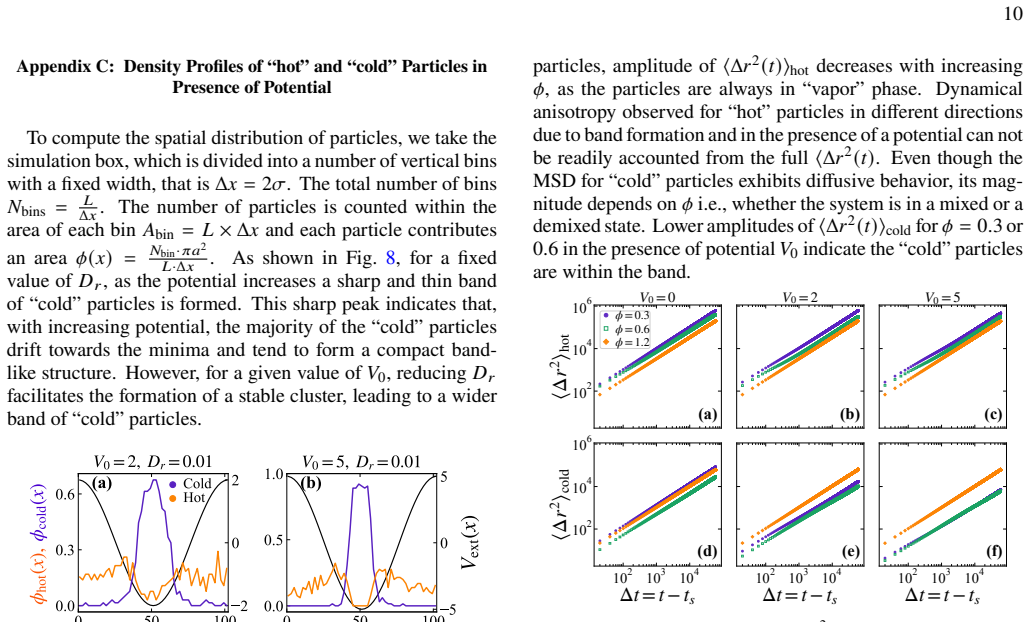
Spontaneous demixing in active matter is a ubiquitous phenomenon that is crucial for numerous living processes ranging from bacterial swarming to sorting of cells in dense tissues. Here, we systematically investigate the effect of spatially varying potential acting along one direction and packing fraction on the binary mixture of particles with different diffusivities. Our results indicate that the presence of an external potential promotes demixing over a larger range of packing fractions, while also fostering a more pronounced 'hexatic order' within the bands of less diffusive "cold") particles formed near the minima of the potential. The mean-squared displacements (MSD) of "cold" and "hot" particles in different directions exhibit a distinct behavior. In contrast to the long-time sub-diffusive behavior of the "cold" particles, the "hot" ones display diffusive nature following an intermediate plateau. However, in the direction transverse to the applied potential, both types of particles undergo normal diffusion. Furthermore, interesting non-Gaussian characteristics are observed, corresponding to the spatial distribution of the displacement of "hot" and "cold" particles. Interestingly, our results reveal the formation of a 'percolating band', and the emergence of such dynamic anisotropy is not observed in the absence of an external potential. These aspects are highly relevant to the dynamics of various systems-including densely packed tissues, bacterial motility in confined spaces, and granular segregation in the pharmaceutical industry.
Editorial analysis
A structured set of objections, weighed in public.
Referee Report
Summary. The manuscript investigates the emergence of dynamical anisotropy in a binary mixture of particles with different diffusivities under a spatially varying external potential using molecular dynamics simulations. It claims that the external potential promotes demixing over a larger range of packing fractions, enhances hexatic order in the bands of less diffusive 'cold' particles, results in anisotropic mean squared displacements (sub-diffusive for cold particles and diffusive for hot particles along the potential direction, with normal diffusion transverse to it), non-Gaussian displacement distributions, and the formation of a percolating band leading to dynamic anisotropy that is absent without the external potential.
Significance. If the simulation results are robust, the work demonstrates a mechanism by which an external potential can induce directional dependence in particle dynamics through demixing in systems with heterogeneous diffusivity. This is relevant to understanding cell sorting in tissues, bacterial motility, and granular segregation. The inclusion of a control simulation without the potential provides a clear baseline for attributing the anisotropy to the potential. The study is simulation-based with no machine-checked proofs or parameter-free derivations noted.
major comments (1)
- The provided abstract and text do not detail the simulation methodology, such as the explicit form of the external potential, the diffusivity values for 'cold' and 'hot' particles, the particle interaction model, time step, system size, or criteria for data analysis and error estimation. This is a load-bearing issue because all central claims (demixing range, hexatic order, MSD behaviors, percolating band) rely on these simulation outcomes.
minor comments (2)
- The term 'hexatic order' is placed in quotes; if this refers to the standard six-fold bond orientational order parameter, it should be defined or referenced explicitly.
- The abstract would benefit from mentioning the range of packing fractions simulated and any quantitative measures of the demixing or anisotropy.
Simulated Author's Rebuttal
We thank the referee for the detailed feedback. We agree that explicit simulation methodology is essential for reproducibility and will add a dedicated Methods section in the revision.
read point-by-point responses
-
Referee: The provided abstract and text do not detail the simulation methodology, such as the explicit form of the external potential, the diffusivity values for 'cold' and 'hot' particles, the particle interaction model, time step, system size, or criteria for data analysis and error estimation. This is a load-bearing issue because all central claims (demixing range, hexatic order, MSD behaviors, percolating band) rely on these simulation outcomes.
Authors: We agree that the manuscript as submitted does not provide sufficient methodological detail. In the revised version we will insert a new Methods section that explicitly states the functional form of the external potential, the numerical values of diffusivity for cold and hot particles, the form of the interparticle potential, the integration time step, the system sizes employed, and the procedures used for computing MSD, hexatic order parameters, and error bars (including the number of independent runs and any block-averaging protocol). These additions will directly underpin the reported demixing range, ordering, and dynamical anisotropy. revision: yes
Circularity Check
No significant circularity
full rationale
The paper reports direct outputs from molecular dynamics simulations of a binary mixture with differential diffusivity under a spatially varying external potential. Key claims (enlarged demixing regime, hexatic order in cold-particle bands, direction-dependent MSD, non-Gaussian displacements, percolating band, and dynamic anisotropy) are obtained by comparing simulation runs with and without the potential across packing fractions. No analytical derivation chain, self-definitional equations, fitted parameters renamed as predictions, or load-bearing self-citations appear in the abstract or described results. All quantities are computed from particle trajectories in the model; the zero-potential control is an independent simulation, not a circular input.
Axiom & Free-Parameter Ledger
Reference graph
Works this paper leans on
-
[1]
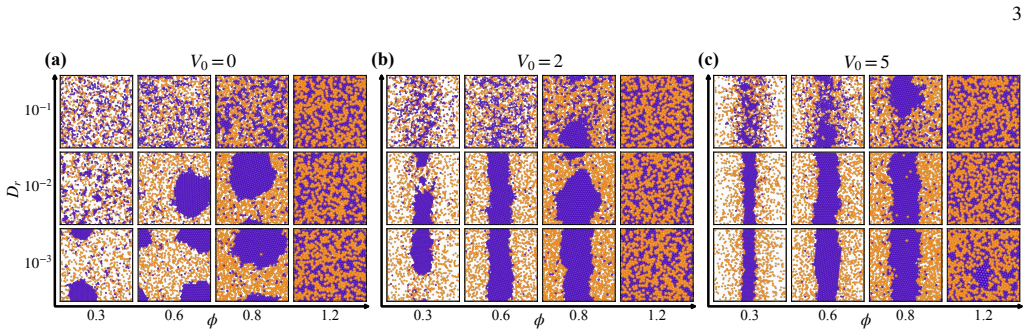
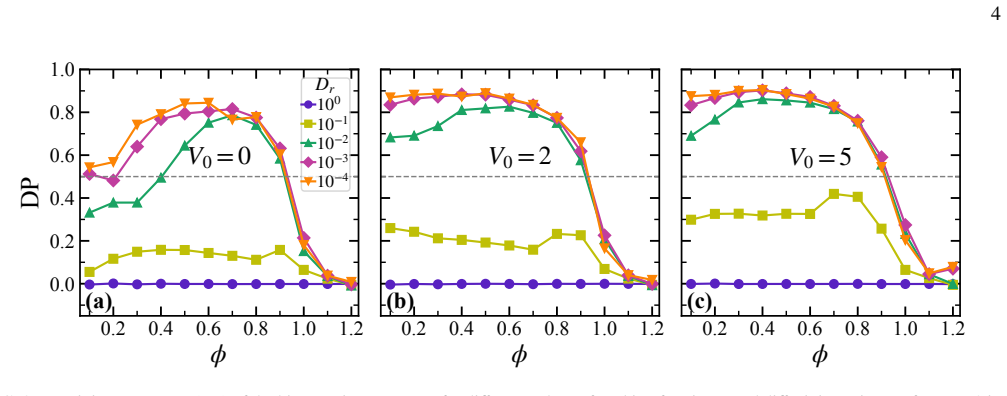
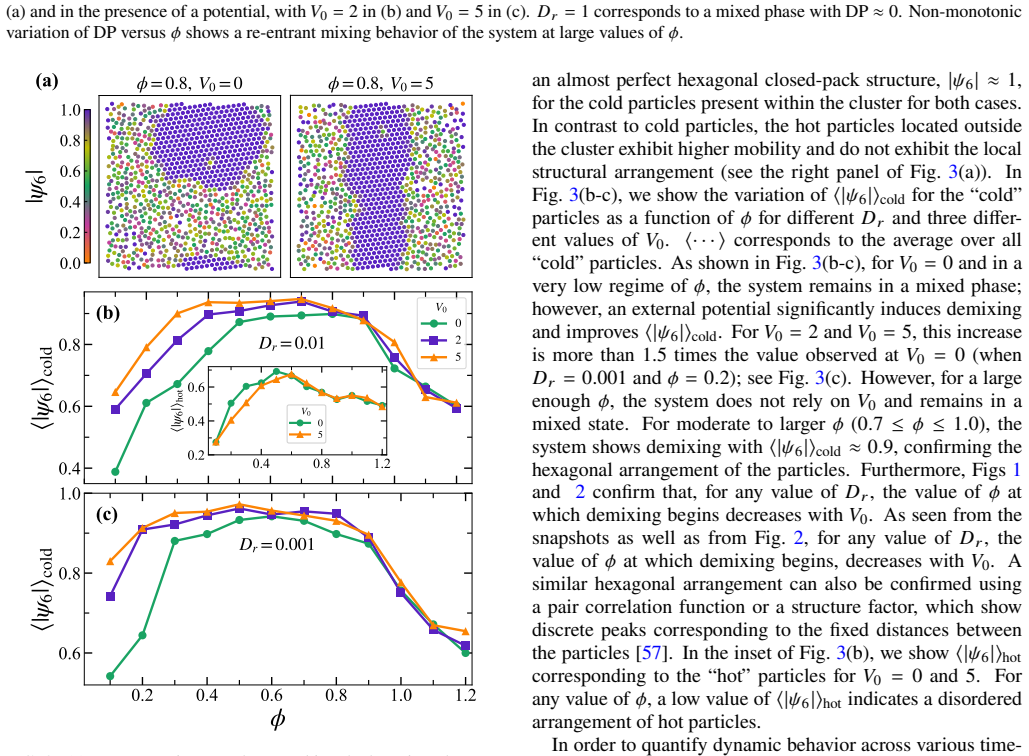
For𝐷 𝑟 =1.0, i.e., with𝐷 cold =𝐷 hot, we do not observe any demixing and DP remains close to 0 throughout the range of𝜙. For𝑉 0 =0 only for intermediate values of𝜙, with 0.4≤𝜙≤0.9 the system shows demixing with the corre- sponding values of DP close to∼0.8. As𝐷 𝑟 decreases, the degree of demixing improves, and the value of DP increases. However, for𝜙 >0.9...
arXiv 2000
-
[2]
Bechinger, R
C. Bechinger, R. Di Leonardo, H. L ¨owen, C. Reichhardt, G. Volpe, and G. Volpe, Active particles in complex and crowded environments, Rev. Mod. Phys.88, 045006 (2016)
2016
-
[3]
Vicsek and A
T. Vicsek and A. Zafeiris, Collective motion, Phys. Rep.517, 71 (2012)
2012
-
[4]
Romanczuk, M
P. Romanczuk, M. B ¨ar, W. Ebeling, B. Lindner, and L. Schimansky-Geier, Active Brownian particles: From indi- vidual to collective stochastic dynamics, Eur. Phys. J. Spec. Top.202, 1–162 (2012)
2012
-
[5]
M. E. Cates and J. Tailleur, Motility-induced phase separation, Annu. Rev. Cond. Mat. Phys.6, 219–244 (2015)
2015
-
[6]
Vicsek, A
T. Vicsek, A. Czir ´ok, E. Ben-Jacob, I. Cohen, and O. Shochet, Novel type of phase transition in a system of self-driven parti- cles, Phys. Rev. Lett.75, 1226–1229 (1995)
1995
-
[7]
Peruani, A
F. Peruani, A. Deutsch, and M. B ¨ar, Nonequilibrium clustering of self-propelled rods, Phys. Rev. E74, 030904 (2006)
2006
-
[8]
Fily and M
Y. Fily and M. C. Marchetti, Athermal Phase Separation of Self-Propelled Particles with No Alignment, Phys. Rev. Lett. 108, 235702 (2012)
2012
-
[9]
L. Barberis and F. Peruani, Phase separation and emergence of collective motion in a one-dimensional system of active parti- cles, J. Chem. Phys.150, 10.1063/1.5085840 (2019)
-
[10]
S. Paul, A. Bera, and S. K. Das, How do clusters in phase- separating active matter systems grow? a study for vicsek ac- tivity in systems undergoing vapor–solid transition, Soft Matter 17, 645–654 (2021)
2021
-
[11]
L. Caprini and H. L ¨owen, Flocking without alignment interac- tions in attractive active Brownian particles, Phys. Rev. Lett. 130, 10.1103/physrevlett.130.148202 (2023)
-
[12]
M. Gaur, A. Saha, and S. Paul, From global flocking to lo- cal clustering: Interplay between velocity alignment and visual perception of active particles, arXiv preprint arXiv:2602.21338 (2026)
arXiv 2026
-
[13]
Brilliantov, C
N. Brilliantov, C. Salue ˜na, T. Schwager, and T. P ¨oschel, Tran- sient structures in a granular gas, Phys. Rev. Lett.93, 134301 (2004). 12
2004
-
[14]
Melby, F
P. Melby, F. V. Reyes, A. Prevost, R. Robertson, P. Kumar, D. A. Egolf, and J. S. Urbach, The dynamics of thin vibrated granular layers, J. Phys.: Condens. Matter17, S2689–S2704 (2005)
2005
-
[15]
Surpassing the en- ergy resolution limit with ferromagnetic torque sensors,
N. Rivas, S. Ponce, B. Gallet, D. Risso, R. Soto, P. Cordero, and N. Mujica, Sudden chain energy transfer events in vi- brated granular media, Phys. Rev. Lett.106, 10.1103/phys- revlett.106.088001 (2011)
-
[16]
Paul and S
S. Paul and S. K. Das, Dynamics of clustering in freely cooling granular fluid, EPL (Europhysics Letters)108, 66001 (2014)
2014
-
[17]
Y. Mao, M. Cates, and H. Lekkerkerker, Depletion force in colloidal systems, Physica A222, 10–24 (1995)
1995
-
[18]
Biben, P
T. Biben, P. Bladon, and D. Frenkel, Depletion effects in binary hard-sphere fluids, J. Phys.: Cond. Mat.8, 10799–10821 (1996)
1996
-
[19]
Dijkstra and D
M. Dijkstra and D. Frenkel, Evidence for entropy-driven demix- ing in hard-core fluids, Phys. Rev. Lett.72, 298–300 (1994)
1994
-
[20]
R. J. Wheeler and A. A. Hyman, Controlling compartmentaliza- tion by non-membrane-bound organelles, Philos. Trans. R. Soc. B373, 20170193 (2018)
2018
-
[21]
X. Su, J. A. Ditlev, E. Hui, W. Xing, S. Banjade, J. Okrut, D. S. King, J. Taunton, M. K. Rosen, and R. D. Vale, Phase separation of signaling molecules promotes t cell receptor signal transduction, Science352, 595–599 (2016)
2016
-
[22]
C. P. Brangwynne, C. R. Eckmann, D. S. Courson, A. Ry- barska, C. Hoege, J. Gharakhani, F. J¨ ulicher, and A. A. Hy- man, Germline p granules are liquid droplets that localize by controlled dissolution/condensation, Science324, 1729–1732 (2009)
2009
-
[23]
B. Y. Finck and B. J. Schwartz, Drift-diffusion studies of com- positional morphology in bulk heterojunctions: The role of the mixed phase in photovoltaic performance, Phys. Rev. Applied 6, 10.1103/physrevapplied.6.054008 (2016)
-
[24]
Zhang, C
I. Zhang, C. P. Royall, M. A. Faers, and P. Bartlett, Phase sep- aration dynamics in colloid–polymer mixtures: the effect of interaction range, Soft Matter9, 2076 (2013)
2076
-
[25]
W. C. K. Poon, The physics of a model colloid polymer mixture, J. Phys.: Cond. Mat.14, R859–R880 (2002)
2002
-
[26]
J. Guo, H. Liang, and Z.-G. Wang, Coil-to-globule transition by dissipative particle dynamics simulation, J. Chem. Phys.134, 10.1063/1.3604812 (2011)
-
[27]
Reddy and D
G. Reddy and D. Thirumalai, Collapse precedes folding in denaturant-dependent assembly of ubiquitin, The Journal of Physical Chemistry B121, 995–1009 (2017)
2017
-
[28]
S. Paul, S. Majumder, S. K. Das, and W. Janke, Effects of alignment activity on the collapse kinetics of a flexible polymer, Soft Matter18, 1978–1990 (2022)
1978
-
[29]
S. K. Das, S. Puri, J. Horbach, and K. Binder, Molecular dy- namics study of phase separation kinetics in thin films, Phys. Rev. Lett.96, 10.1103/physrevlett.96.016107 (2006)
-
[30]
S. K. Das, S. Roy, S. Majumder, and S. Ahmad, Finite-size effects in dynamics: Critical vs. coarsening phenomena, Euro- phys. Lett.97, 66006 (2012)
2012
-
[31]
S. K. Das, K. Das, N. Vadakkayil, S. Chakraborty, and S. Paul, Initial correlation dependence of aging in phase separating solid binary mixtures and ordering ferromagnets, Journal of Physics: Condensed Matter32, 184005 (2020)
2020
-
[32]
Elgeti, R
J. Elgeti, R. G. Winkler, and G. Gompper, Physics of microswim- mers—single particle motion and collective behavior: a review, Reports on Progress in Physics78, 056601 (2015)
2015
-
[33]
J. P. Gollub and J. S. Langer, Pattern formation in nonequilib- rium physics, Rev. Mod. Phys.71, S396 (1999)
1999
-
[34]
Liu and X
B. Liu and X. Wang, Deagglomeration of fine granular mate- rials under low-frequency vertical harmonic vibration, Powder Technol.396, 754–764 (2022)
2022
-
[35]
Kudrolli, Size separation in vibrated granular matter, Rep
A. Kudrolli, Size separation in vibrated granular matter, Rep. Prog. Phys.67, 209–247 (2004)
2004
-
[36]
Menbari and K
A. Menbari and K. Hashemnia, Studying the particle size ratio effect on granular mixing in a vertically vibrated bed of two particle types, Particuology53, 100–111 (2020)
2020
-
[37]
S. R. McCandlish, A. Baskaran, and M. F. Hagan, Spontaneous segregation of self-propelled particles with different motilities, Soft Matter8, 2527 (2012)
2012
-
[38]
Mishra, K
S. Mishra, K. Tunstrøm, I. D. Couzin, and C. Huepe, Collective dynamics of self-propelled particles with variable speed, Phys. Rev. E86, 011901 (2012)
2012
-
[39]
G. S. Redner, M. F. Hagan, and A. Baskaran, Structure and dynamics of a phase-separating active colloidal fluid, Physical Review Letters110, 10.1103/physrevlett.110.055701 (2013)
-
[40]
Levis and B
D. Levis and B. Liebchen, Micro-flock patterns and macro- clusters in chiral active brownian disks, Journal of Physics: Condensed Matter30, 084001 (2018)
2018
-
[41]
S. Mandal, B. Liebchen, and H. L ¨owen, Motility-induced tem- perature difference in coexisting phases, Physical Review Letters 123, 10.1103/physrevlett.123.228001 (2019)
-
[42]
S. Paul, S. Majumder, and W. Janke, Spontaneous micro flocking of active inertial particles without alignment interaction, arXiv preprint arXiv:2402.04397 (2024)
arXiv 2024
-
[43]
Chat ´e, F
H. Chat ´e, F. Ginelli, G. Gr ´egoire, F. Peruani, and F. Raynaud, Modeling collective motion: Variations on the Vicsek model, Eur. Phys. J. B64, 451 (2008)
2008
-
[44]
B ¨ar, R
M. B ¨ar, R. Großmann, S. Heidenreich, and F. Peruani, Self- propelled rods: Insights and perspectives for active matter, Annu. Rev. Condens. Matter Phys.11, 441–466 (2020)
2020
-
[45]
Chat ´e, Dry aligning dilute active matter, Ann
H. Chat ´e, Dry aligning dilute active matter, Ann. Rev. Cond. Mat. Phys.11, 189–212 (2020)
2020
-
[46]
T. Speck, J. Bialk´e, A. M. Menzel, and H. L¨owen, Effective cahn- hilliard equation for the phase separation of active brownian particles, Phys. Rev. Lett.112, 10.1103/physrevlett.112.218304 (2014)
-
[47]
J. T. Siebert, J. Letz, T. Speck, and P. Virnau, Phase behavior of active Brownian disks, spheres, and dimers, Soft Matter13, 1020–1026 (2017)
2017
-
[48]
L. Caprini, U. M. B. Marconi, and A. Puglisi, Spontaneous velocity alignment in motility-induced phase separation, Phys. Rev. Lett.124, 10.1103/physrevlett.124.078001 (2020)
-
[49]
S. Paul, A. Dhar, and D. Chaudhuri, Dynamical crossovers and correlations in a harmonic chain of active particles, Soft Matter 20, 8638–8653 (2024)
2024
-
[50]
S. S. Khali, F. Peruani, and D. Chaudhuri, When an active bath behaves as an equilibrium one, Phys. Rev. E109, 024120 (2024)
2024
-
[51]
T. Knippenberg, A. Jayaram, T. Speck, and C. Bechinger, Motility-induced clustering of active particles under soft con- finement, Phys. Rev. Lett.133, 10.1103/physrevlett.133.048301 (2024)
-
[52]
S. Majumder, S. Paul, and W. Janke, Enhanced diffusion and universal rouse-like scaling of an active polymer in poor solvent, Physical Review Materials8, 10.1103/physrevmateri- als.8.075601 (2024)
-
[53]
M. Jhajhria, S. K. Das, and S. Thakur, Kinetics of phase transi- tion in nonreciprocal mixtures of passive and chemophoretically active particles, J. Chem. Phys.162, 10.1063/5.0258020 (2025)
-
[54]
M. Patel, S. Paul, and D. Chaudhuri, Crossover dynamics and non-Gaussian fluctuations in inertial active chains, J. Chem. Phys164, 10.1063/5.0321684 (2026)
-
[55]
L. Berthier, E. Flenner, and G. Szamel, Glassy dynamics in dense systems of active particles, J. Chem. Phys.150, 10.1063/1.5093240 (2019). 13
-
[56]
S. Henkes, K. Kostanjevec, J. M. Collinson, R. Sknepnek, and E. Bertin, Dense active matter model of motion pat- terns in confluent cell monolayers, Nature Communications11, 10.1038/s41467-020-15164-5 (2020)
-
[57]
Pasupalak, L
A. Pasupalak, L. Yan-Wei, R. Ni, and M. Pica Ciamarra, Hexatic phase in a model of active biological tissues, Soft Matter16, 3914–3920 (2020)
2020
-
[58]
Dolai, A
P. Dolai, A. Simha, and S. Mishra, Phase separation in bi- nary mixtures of active and passive particles, Soft Matter14, 6137–6145 (2018)
2018
-
[59]
S. N. Weber, C. A. Weber, and E. Frey, Binary mixtures of particles with different diffusivities demix, Phys. Rev. Lett.116, 058301 (2016)
2016
-
[60]
Kumari, A
S. Kumari, A. S. Nunes, N. A. M. Araujo, and M. M. Telo da Gama, Demixing of active particles in the presence of external fields, J. Chem. Phys.147, 174702 (2017)
2017
-
[61]
E. Ilker and J.-F. Joanny, Phase separation and nucleation in mixtures of particles with different temperatures, Phys. Rev. Res.2, 10.1103/physrevresearch.2.023200 (2020)
-
[62]
McCarthy, R
E. McCarthy, R. K. Manna, O. Damavandi, and M. L. Manning, Demixing in binary mixtures with differential diffusivity at high density, Phys. Rev. Lett.132, 098301 (2024)
2024
-
[63]
D. Loi, S. Mossa, and L. F. Cugliandolo, Effective temperature of active matter, Phys. Rev. E77, 051111 (2008)
2008
-
[64]
A. C. Bra ´nka and D. M. Heyes, Algorithms for brownian dy- namics computer simulations: Multivariable case, Phys. Rev. E 60, 2381–2387 (1999)
1999
-
[65]
S. Paul and S. K. Das, Ballistic aggregation in systems of inelas- tic particles: Cluster growth, structure, and aging, Phys. Rev. E 96, 10.1103/physreve.96.012105 (2017)
-
[66]
I. M. Sokolov, Models of anomalous diffusion in crowded envi- ronments, Soft Matter8, 9043 (2012)
2012
-
[67]
Calascibetta, L
C. Calascibetta, L. Giraldi, Z. El Khiyati, and J. Bec, Effects of collective patterns, confinement, and fluid flow on active particle transport, Phys. Rev. E110, 064601 (2024)
2024
-
[68]
C. B. Caporusso, P. Digregorio, D. Levis, L. F. Cugliandolo, and G. Gonnella, Motility-induced microphase and macrophase sep- aration in a two-dimensional active Brownian particle system, Phys. Rev. Lett.125, 178004 (2020)
2020
-
[69]
J. L. Bentley, Multidimensional binary search trees used for associative searching, Commun. ACM18, 509–517 (1975)
1975
-
[70]
Lemaitre, I
E. Lemaitre, I. M. Sokolov, R. Metzler, and A. V. Chechkin, Non- gaussian displacement distributions in models of heterogeneous active particle dynamics, New J. Phys.25, 013010 (2023)
2023
discussion (0)
Sign in with ORCID, Apple, or X to comment. Anyone can read and Pith papers without signing in.