REVIEW 3 major objections 6 minor 48 references
Graph-based Document Structure Analysis
T0 review · 3 major / 6 minor · reviewed 2026-08-09 · deepseek-v4-flash
Pith's one-line read Graph-based Document Structure Analysis (gDSA) redefines document layout tasks as the joint detection of elements and the prediction of a labeled relation graph over them, backed by GraphDoc (80K pages, 4.13M relations) and a DRGG…
desk verdict A useful large-scale document-graph resource with a legitimate new task; the rule-based annotation pipeline is transparent and the core value holds up despite soft spots in reference-relation quality. read the letter →
The pith
A machine-rendered reading of the paper's core claim, the machinery that carries it, and where it could break.
The reading
What carries the argument
The central object is the document relation graph $G=(V,E)$, a pair of layout nodes and labeled edges, where each pair of elements can carry several relation types at once. The mechanism that produces it is DRGG's relation head: object queries from every decoder layer are pooled, upsampled, and concatenated into pairwise features, which are aggregated across layers with learned weights and classified by an MLP into $N \times N \times k$ relation predictions; an auxiliary head that only predicts whether any relation exists multiplies the final scores to suppress false positives. A second piece of machinery is the evaluation protocol, which matches predicted to ground-truth instances by class and IoU and then reports mRg and mAPg at relation-confidence thresholds, so that rare relations like reference are not cut off by top-k ranking.
What would settle it
Take a random sample of unverified GraphDoc pages (the 41.5% not manually checked), have two independent annotators label every reference relation from the raw text without seeing the rule-based labels, and measure agreement with GraphDoc and between annotators; if agreement on reference edges is near chance, the reference ground truth, and the 16.8% reference AP, is not a reliable yardstick.
Extended reading notes
Core claim
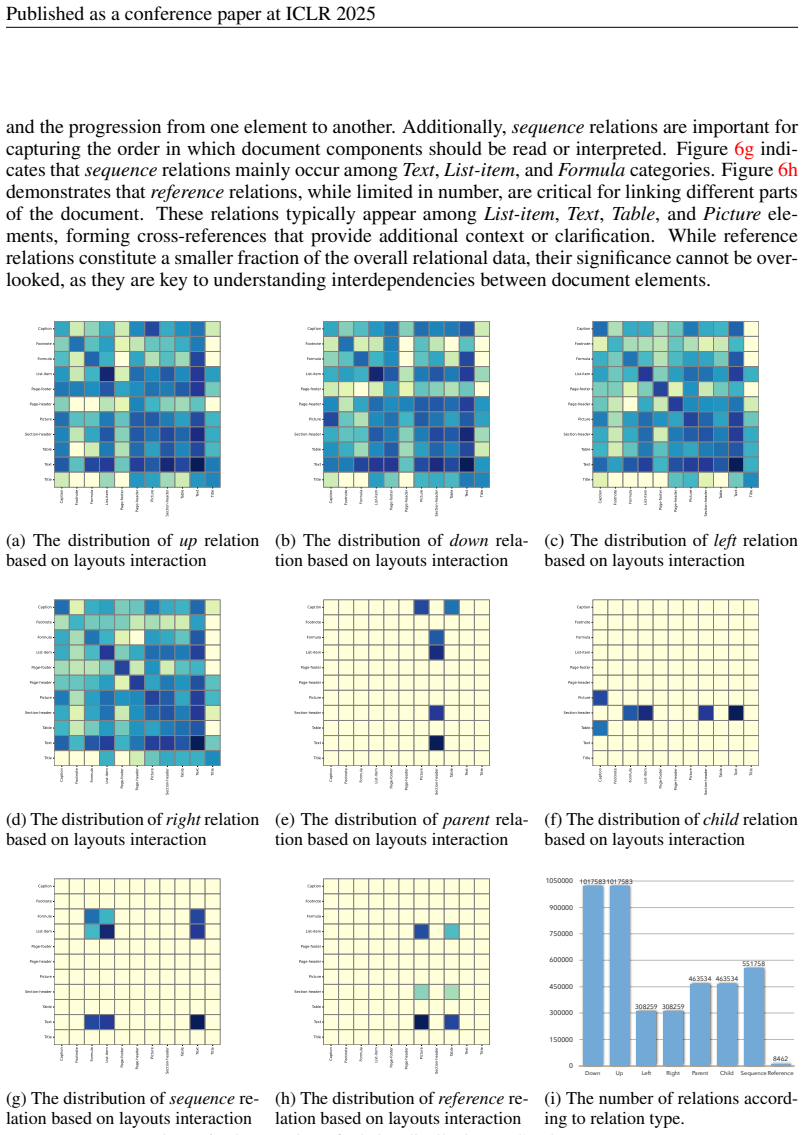
The central claim is that document structure can be represented as a labeled graph $G=(V,E)$, where $V$ are detected layout elements and $E$ carry both spatial relations (up, down, left, right) and logical relations (parent, child, sequence, reference), and that such graphs can be predicted from raw page images in one end-to-end model. The paper builds GraphDoc by enriching DocLayNet pages with roughly 4.13M relation pairs using a rule-based annotation system: OCR and PDF text extraction, nearest-neighbor spatial scanning, Recursive X-Y Cut reading order, text-marker matching for references, and hierarchical grouping, with manual verification on 58.5% of the data. On this benchmark, DRGG with an InternImage backbone and RoDLA detector reaches 57.6% mAPg@0.5 (30.7% mRg@0.5) and 81.5% mAP@50:5:95 on layout detection, with near-perfect left/right relations (99.0% AP) but only 16.8% AP on reference relations, whose textual nature makes them the hardest category.
Load-bearing premise
The 4.13M relation labels are mostly produced by rule-based heuristics (nearest-neighbor spatial scans, Recursive X-Y Cut, and text-marker matching), and only 58.5% of pages were manually verified, so if those heuristics mark the wrong pairs, especially for rare 'reference' links, the benchmark and any model trained on it inherit the errors.
Editorial extensions
If this is right
- A single trained model can produce reading order, hierarchy, and cross-references simultaneously, because all three are edges of one predicted graph.
- Relation accuracy is coupled to detection accuracy: gDSA metrics are computed only over instances matched by IoU and class, so better layout detection should directly raise mRg and mAPg.
- DRGG acts as a plug-and-play relation head: adding it to the RoDLA detector lifts DLA mAP from 80.5 to 81.5 on an InternImage backbone.
- GraphDoc's scale (80K pages, 4.13M relations, 11 element categories, 8 relation types) makes it a large training and evaluation resource for structure-aware document understanding.
- Reference relations are the hardest category at 16.8% AP, so progress on textual cross-references, not spatial layout, is the near-term bottleneck for the task.
Reading between the lines
- Inference: because reference relations are defined by textual mentions ('see Table 1', footnote markers), a multimodal variant of DRGG that fuses OCR text into the relation head should improve reference AP beyond the current 16.8% far more than better bounding boxes would.
- Inference: the per-domain refinement rates (8-26% of labels changed) create a natural stress test: if label noise drives performance, domains with higher refinement should show lower relation AP even after matching layout difficulty.
- Inference: switching from threshold-based mAPg to ranking-based top-k recall, as scene graph generation uses, would change which detectors win, since threshold metrics reward confident predictions and may underweight the rare reference class.
Editorial analysis
A structured set of objections, weighed in public.
Referee Report
Summary. The paper introduces graph-based Document Structure Analysis (gDSA), a task that requires detecting document layout elements and predicting an eight-category relational graph (Up, Down, Left, Right, Parent, Child, Sequence, Reference) over them. It contributes GraphDoc, a dataset of 80,000 document page images with 1.10M layout instances and 4.13M relation annotations built by extending DocLayNet with a rule-based annotation pipeline and partial human verification. It also proposes DRGG, a plug-and-play relation head for DETR-style detectors, and reports DLA mAP of 81.5% and gDSA mAPg@0.5 of 57.6% with an InternImage backbone and RoDLA detector. The authors position these results as a strong benchmark baseline for the new task.
Significance. If the GraphDoc annotations are reliable, the paper provides a valuable large-scale resource that extends document layout analysis toward structured graph prediction, and the task definition is a natural step beyond existing reading-order and hierarchy datasets. The authors report per-domain results, per-relation-category results, ablations of the relation head, and qualitative error analysis, which are useful for the community. The plan to release dataset and code is a further strength. The significance of the contribution, however, rests on two load-bearing points: the correctness of the rule-generated relation ground truth and the precise definition of the evaluation metric. Both need to be established before the 57.6% mAPg@0.5 number can serve as a trustworthy benchmark.
major comments (3)
- [Section 3.1.4 and Appendix A.1] The central value of GraphDoc rests on the rule-based annotations being accurate enough to serve as ground truth. The paper reports that only 58.5% of pages were manually verified and that refinement rates range from 8% to 26%, but it does not provide per-relation verification statistics, inter-annotator agreement, or a comparison of the heuristic labels against a fully manually annotated sample. This matters particularly for Reference relations: they constitute about 0.2% of all relations and are generated by phrase matching, so errors there would be invisible in the aggregate refinement rates. The listed page counts in Appendix A.1 (4,852 + 12,000 + 6,469 + 8,000 = 31,321) also do not sum to 58.5% of 80,000 pages, introducing uncertainty about the actual verification coverage. I ask the authors to resolve this numerical inconsistency, report per-relation human-verification outcomes, and provide a concrete test (e.g., inter-annotator agreement on a random subset and per-relation precision of the heuristic labels against human labels). Without this, it is unclear whether the 57.6% mAPg@0.5 result measures human-perceived document structure or artifacts of the annotation heuristics.
- [Section 3.3, Algorithm 1, and Appendix B] The definition of mAPg@TR is under-specified. Algorithm 1 thresholds all relation predictions at score > TR before calling fmAP, while Appendix B describes integrating a precision-recall curve; these are not the same procedure unless the threshold is swept to obtain the curve, and the pseudocode does not specify how precision and recall are accumulated when a subject-object pair has multiple coexisting relations. The headline number 57.6% therefore cannot be reproduced from the paper alone. In addition, the IoU threshold TIoU used for instance matching is not stated in Section 4.3 or in Table 2; it appears only as an aside in Appendix B. Please specify the exact ranking/threshold protocol, state TIoU for all reported results, and release the evaluation code with the paper.
- [Section 4.4, Table 2, and Appendix E, Table 7] The paper's general claim that DRGG improves DLA is not supported by the ablations. Table 7 shows that adding DRGG decreases DLA mAP for ResNet+RoDLA (74.3 to 71.0) and leaves ResNeXt essentially unchanged (77.7 to 77.9), while improving InternImage from 80.5 to 81.5. Since the conclusion states that DRGG 'enhanced the effectiveness' of document structure analysis, the authors should qualify the claim and either analyze the conditions under which the relation head helps or hurts or restrict the claim to the configurations that improve. This does not invalidate the gDSA results but is necessary for accurate reporting.
minor comments (6)
- [Section 4.2 and Appendix F] The loss weights λ and σ in Eq. (13) are never specified; without them the training procedure is not fully reproducible.
- [Section 3.1.4] The sentence 'The reference relations among Table and Picture are established' is ambiguous; it should clarify whether references are between Table/Picture and text, as described in Section 3.1.3.
- [Figure 6i] The axis labels and numbers in Figure 6i are garbled in the current text; please provide relation counts in a table.
- [Section 3.3] The notation mAPg@0.5 is easily confused with IoU-based mAP@0.5; please define it explicitly as a relation-confidence threshold at first use.
- [Appendix D] The sentence 'We used InternImage as the backbone, RoDLA as the detector, and DRGG for relationship extraction' appears twice in succession; please remove the duplicate.
- [Section 4.2] The paper does not describe the train/validation split of GraphDoc; please specify the split and whether it matches DocLayNet's official split.
Circularity Check
No significant circularity: GraphDoc's heuristic labels and self-cited baseline are transparent benchmark choices, not a derivation loop.
full rationale
GraphDoc is a dataset-and-baseline contribution; it does not claim a first-principles derivation of document structure. The relation annotations are generated by a transparent rule-based pipeline (Sec. 3.1.4, App. A.1), and DRGG is trained and evaluated on the resulting labels. This is a standard benchmark-construction choice: the model does not use the annotation heuristics at inference, and the validation split is held out. The heuristic origin of the labels is a data-quality and validity concern (only 58.5% of pages human-verified, with refinement rates from 8% to 26%), but it is not a circular reduction, because nothing in the paper's equations makes the predicted relations equal to the annotation rules by construction. The only self-citation, RoDLA (Chen et al. 2024), is used as a comparative detector and backbone and is not load-bearing for the central claim. No uniqueness theorem or ansatz is imported from prior work. Accordingly, no circular step is exhibited.
Assumptions & free parameters
free parameters (3)
- lambda (relation head loss weight)
- sigma (auxiliary relation head loss weight)
- Relation confidence threshold TR for headline metric =
0.5
assumptions (5)
- domain assumption DocLayNet bounding boxes are class-correct and mutually non-overlapping.
- domain assumption Scientific documents are predominantly Manhattan layouts, so four spatial relations (up, down, left, right) suffice to encode spatial structure.
- domain assumption OCR and PDF text extraction correctly recover text for reference matching and hierarchy construction.
- domain assumption Recursive X-Y Cut produces a reading order that matches human reading for this corpus.
- ad hoc to paper Human verification of 58.5% of pages is sufficient to guarantee the quality of the remaining algorithmically labeled pages.
Cite this review
Pith. "Pith review of Graph-based Document Structure Analysis." pith.science (2026). https://pith.science/paper/AWD35S4X
@misc{pith2026250202501,
  author       = {Pith},
  title        = {Pith review of: Graph-based Document Structure Analysis},
  year         = {2026},
  howpublished = {\url{https://pith.science/paper/AWD35S4X}},
  note         = {Machine review of arXiv:2502.02501}
}
abstract
When reading a document, glancing at the spatial layout of a document is an initial step to understand it roughly. Traditional document layout analysis (DLA) methods, however, offer only a superficial parsing of documents, focusing on basic instance detection and often failing to capture the nuanced spatial and logical relations between instances. These limitations hinder DLA-based models from achieving a gradually deeper comprehension akin to human reading. In this work, we propose a novel graph-based Document Structure Analysis (gDSA) task. This task requires that model not only detects document elements but also generates spatial and logical relations in form of a graph structure, allowing to understand documents in a holistic and intuitive manner. For this new task, we construct a relation graph-based document structure analysis dataset (GraphDoc) with 80K document images and 4.13M relation annotations, enabling training models to complete multiple tasks like reading order, hierarchical structures analysis, and complex inter-element relation inference. Furthermore, a document relation graph generator (DRGG) is proposed to address the gDSA task, which achieves performance with 57.6% at mAP$_g$@0.5 for a strong benchmark baseline on this novel task and dataset. We hope this graphical representation of document structure can mark an innovative advancement in document structure analysis and understanding. The new dataset and code will be made publicly available at https://yufanchen96.github.io/projects/GraphDoc.
Figures


Figures from the paper (5 more)




Reference graph
Works this paper leans on
-
[1]
BE it: BERT pre-training of image transformers
Hangbo Bao, Li Dong, Songhao Piao, and Furu Wei. BE it: BERT pre-training of image transformers. In International Conference on Learning Representations, 2022. URL https://openreview.net/forum?id=p-BhZSz59o4
work page 2022
-
[2]
End-to-end object detection with transformers
Nicolas Carion, Francisco Massa, Gabriel Synnaeve, Nicolas Usunier, Alexander Kirillov, and Sergey Zagoruyko. End-to-end object detection with transformers. In Computer Vision – ECCV 2020: 16th European Conference, Glasgow, UK, August 23–28, 2020, Proceedings, Part I, pp.\ 213–229, 2020
work page 2020
-
[3]
MMDetection : Open mmlab detection toolbox and benchmark
Kai Chen, Jiaqi Wang, Jiangmiao Pang, Yuhang Cao, Yu Xiong, Xiaoxiao Li, Shuyang Sun, Wansen Feng, Ziwei Liu, Jiarui Xu, Zheng Zhang, Dazhi Cheng, Chenchen Zhu, Tianheng Cheng, Qijie Zhao, Buyu Li, Xin Lu, Rui Zhu, Yue Wu, Jifeng Dai, Jingdong Wang, Jianping Shi, Wanli Ouyang, Chen Change Loy, and Dahua Lin. MMDetection : Open mmlab detection toolbox and ...
arXiv 1906
-
[4]
Rodla: Benchmarking the robustness of document layout analysis models
Yufan Chen, Jiaming Zhang, Kunyu Peng, Junwei Zheng, Ruiping Liu, Philip Torr, and Rainer Stiefelhagen. Rodla: Benchmarking the robustness of document layout analysis models. In CVPR, 2024
work page 2024
-
[5]
Form-nlu: Dataset for the form natural language understanding
Yihao Ding, Siqu Long, Jiabin Huang, Kaixuan Ren, Xingxiang Luo, Hyunsuk Chung, and Soyeon Caren Han. Form-nlu: Dataset for the form natural language understanding. In Proceedings of the 46th International ACM SIGIR Conference on Research and Development in Information Retrieval, pp.\ 2807--2816, 2023 a
work page 2023
-
[6]
Pdf-vqa: A new dataset for real-world vqa on pdf documents
Yihao Ding, Siwen Luo, Hyunsuk Chung, and Soyeon Caren Han. Pdf-vqa: A new dataset for real-world vqa on pdf documents. In Gianmarco De Francisci Morales, Claudia Perlich, Natali Ruchansky, Nicolas Kourtellis, Elena Baralis, and Francesco Bonchi (eds.), Machine Learning and Knowledge Discovery in Databases: Applied Data Science and Demo Track, pp.\ 585--6...
work page 2023
-
[7]
Image captioning with scene-graph based semantic concepts
Lizhao Gao, Bo Wang, and Wenmin Wang. Image captioning with scene-graph based semantic concepts. In Proceedings of the 2018 10th international conference on machine learning and computing, pp.\ 225--229, 2018
work page 2018
-
[8]
Unidoc: Unified pretraining framework for document understanding
Jiuxiang Gu, Jason Kuen, Vlad I Morariu, Handong Zhao, Rajiv Jain, Nikolaos Barmpalios, Ani Nenkova, and Tong Sun. Unidoc: Unified pretraining framework for document understanding. Advances in Neural Information Processing Systems, 34: 0 39--50, 2021
work page 2021
Show all 48 references
-
[9]
C ycle GT : Unsupervised graph-to-text and text-to-graph generation via cycle training
Qipeng Guo, Zhijing Jin, Xipeng Qiu, Weinan Zhang, David Wipf, and Zheng Zhang. C ycle GT : Unsupervised graph-to-text and text-to-graph generation via cycle training. In Thiago Castro Ferreira, Claire Gardent, Nikolai Ilinykh, Chris van der Lee, Simon Mille, Diego Moussallem,...
2020
-
[10]
Haralick, and I.T
Jaekyu Ha, R.M. Haralick, and I.T. Phillips. Recursive x-y cut using bounding boxes of connected components. In Proceedings of 3rd International Conference on Document Analysis and Recognition, volume 2, pp.\ 952--955 vol.2, 1995. doi:10.1109/ICDAR.1995.602059
1995
-
[11]
Deep residual learning for image recognition
Kaiming He, Xiangyu Zhang, Shaoqing Ren, and Jian Sun. Deep residual learning for image recognition. In Proceedings of the IEEE conference on computer vision and pattern recognition, pp.\ 770--778, 2016
2016
-
[12]
Layoutlmv3: Pre-training for document ai with unified text and image masking
Yupan Huang, Tengchao Lv, Lei Cui, Yutong Lu, and Furu Wei. Layoutlmv3: Pre-training for document ai with unified text and image masking. In Proceedings of the 30th ACM International Conference on Multimedia, 2022
2022
-
[13]
Funsd: A dataset for form understanding in noisy scanned documents
Guillaume Jaume, Hazim Kemal Ekenel, and Jean-Philippe Thiran. Funsd: A dataset for form understanding in noisy scanned documents. In 2019 International Conference on Document Analysis and Recognition Workshops (ICDARW), volume 2, pp.\ 1--6. IEEE, 2019
2019
-
[14]
How can we know what language models know? Transactions of the Association for Computational Linguistics, 8: 0 423--438, 2020
Zhengbao Jiang, Frank F Xu, Jun Araki, and Graham Neubig. How can we know what language models know? Transactions of the Association for Computational Linguistics, 8: 0 423--438, 2020
2020
-
[15]
Image retrieval using scene graphs
Justin Johnson, Ranjay Krishna, Michael Stark, Li-Jia Li, David Shamma, Michael Bernstein, and Li Fei-Fei. Image retrieval using scene graphs. In Proceedings of the IEEE conference on computer vision and pattern recognition, pp.\ 3668--3678, 2015
2015
-
[16]
Image generation from scene graphs
Justin Johnson, Agrim Gupta, and Li Fei-Fei. Image generation from scene graphs. In Proceedings of the IEEE conference on computer vision and pattern recognition, pp.\ 1219--1228, 2018
2018
-
[17]
Harold W. Kuhn. The hungarian method for the assignment problem. In Michael J \" u nger, Thomas M. Liebling, Denis Naddef, George L. Nemhauser, William R. Pulleyblank, Gerhard Reinelt, Giovanni Rinaldi, and Laurence A. Wolsey (eds.), 50 Years of Integer Programming 1958-2008 -...
1958 doi
-
[18]
Dit: Self-supervised pre-training for document image transformer
Junlong Li, Yiheng Xu, Tengchao Lv, Lei Cui, Cha Zhang, and Furu Wei. Dit: Self-supervised pre-training for document image transformer. In Proceedings of the 30th ACM International Conference on Multimedia, pp.\ 3530--3539, 2022
2022
-
[19]
Relation-aware graph attention network for visual question answering
Linjie Li, Zhe Gan, Yu Cheng, and Jingjing Liu. Relation-aware graph attention network for visual question answering. In Proceedings of the IEEE/CVF international conference on computer vision, pp.\ 10313--10322, 2019
2019
-
[20]
Commonsense knowledge base completion
Xiang Li, Aynaz Taheri, Lifu Tu, and Kevin Gimpel. Commonsense knowledge base completion. In Proceedings of the 54th Annual Meeting of the Association for Computational Linguistics (Volume 1: Long Papers), pp.\ 1445--1455, 2016
2016
-
[21]
Prefix-tuning: Optimizing continuous prompts for generation
Xiang Lisa Li and Percy Liang. Prefix-tuning: Optimizing continuous prompts for generation. In Chengqing Zong, Fei Xia, Wenjie Li, and Roberto Navigli (eds.), Proceedings of the 59th Annual Meeting of the Association for Computational Linguistics and the 11th International Joi...
2021 doi
-
[22]
Swin transformer: Hierarchical vision transformer using shifted windows
Ze Liu, Yutong Lin, Yue Cao, Han Hu, Yixuan Wei, Zheng Zhang, Stephen Lin, and Baining Guo. Swin transformer: Hierarchical vision transformer using shifted windows. In Proceedings of the IEEE/CVF International Conference on Computer Vision (ICCV), 2021
2021
-
[23]
A review and efficient implementation of scene graph generation metrics, 2024
Julian Lorenz, Robin Schön, Katja Ludwig, and Rainer Lienhart. A review and efficient implementation of scene graph generation metrics, 2024
2024
-
[24]
Hrdoc: Dataset and baseline method toward hierarchical reconstruction of document structures
Jiefeng Ma, Jun Du, Pengfei Hu, Zhenrong Zhang, Jianshu Zhang, Huihui Zhu, and Cong Liu. Hrdoc: Dataset and baseline method toward hierarchical reconstruction of document structures. Proceedings of the AAAI Conference on Artificial Intelligence, 37 0 (2): 0 1870--1877, Jun. 20...
2023 doi
-
[25]
Commonsense knowledge base completion with structural and semantic context
Chaitanya Malaviya, Chandra Bhagavatula, Antoine Bosselut, and Yejin Choi. Commonsense knowledge base completion with structural and semantic context. In Proceedings of the AAAI conference on artificial intelligence, volume 34, pp.\ 2925--2933, 2020
2020
-
[26]
Interactive image generation using scene graphs
Gaurav Mittal, Shubham Agrawal, Anuva Agarwal, Sushant Mehta, and Tanya Marwah. Interactive image generation using scene graphs. arXiv preprint arXiv:1905.03743, 2019
1905 arXiv
-
[27]
Nassar, and Peter Staar
Birgit Pfitzmann, Christoph Auer, Michele Dolfi, Ahmed S. Nassar, and Peter Staar. Doclaynet: A large human-annotated dataset for document-layout segmentation. In Proceedings of the 28th ACM SIGKDD Conference on Knowledge Discovery and Data Mining, KDD '22, pp.\ 3743–3751, New...
2022
-
[28]
Cascadetabnet: An approach for end to end table detection and structure recognition from image-based documents
Devashish Prasad, Ayan Gadpal, Kshitij Kapadni, Manish Visave, and Kavita Sultanpure. Cascadetabnet: An approach for end to end table detection and structure recognition from image-based documents. In Proceedings of the IEEE/CVF conference on computer vision and pattern recogn...
2020
-
[29]
Adam Roberts, Colin Raffel, and Noam Shazeer. How much knowledge can you pack into the parameters of a language model? In Bonnie Webber, Trevor Cohn, Yulan He, and Yang Liu (eds.), Proceedings of the 2020 Conference on Empirical Methods in Natural Language Processing (EMNLP), ...
2020 doi
-
[30]
Deepdesrt: Deep learning for detection and structure recognition of tables in document images
Sebastian Schreiber, Stefan Agne, Ivo Wolf, Andreas Dengel, and Sheraz Ahmed. Deepdesrt: Deep learning for detection and structure recognition of tables in document images. In 2017 14th IAPR international conference on document analysis and recognition (ICDAR), volume 1, pp.\ ...
2017
-
[31]
Generating semantically precise scene graphs from textual descriptions for improved image retrieval
Sebastian Schuster, Ranjay Krishna, Angel Chang, Li Fei-Fei, and Christopher D Manning. Generating semantically precise scene graphs from textual descriptions for improved image retrieval. In Proceedings of the fourth workshop on vision and language, pp.\ 70--80, 2015
2015
-
[32]
Logan IV, Eric Wallace, and Sameer Singh
Taylor Shin, Yasaman Razeghi, Robert L. Logan IV, Eric Wallace, and Sameer Singh. AutoPrompt : Eliciting knowledge from language models with automatically generated prompts. In Empirical Methods in Natural Language Processing (EMNLP), 2020
2020
-
[33]
Detect-order-construct: A tree construction based approach for hierarchical document structure analysis
Jiawei Wang, Kai Hu, Zhuoyao Zhong, Lei Sun, and Qiang Huo. Detect-order-construct: A tree construction based approach for hierarchical document structure analysis. Pattern Recognition, 156: 0 110836, 2024. ISSN 0031-3203. doi:https://doi.org/10.1016/j.patcog.2024.110836. URL ...
2024
-
[34]
W. Wang, J. Dai, Z. Chen, Z. Huang, Z. Li, X. Zhu, X. Hu, T. Lu, L. Lu, H. Li, X. Wang, and Y. Qiao. Internimage: Exploring large-scale vision foundation models with deformable convolutions. In 2023 IEEE/CVF Conference on Computer Vision and Pattern Recognition (CVPR), pp.\ 14...
2023
-
[35]
Layoutreader: Pre-training of text and layout for reading order detection, 2021
Zilong Wang, Yiheng Xu, Lei Cui, Jingbo Shang, and Furu Wei. Layoutreader: Pre-training of text and layout for reading order detection, 2021
2021
-
[36]
Aggregated residual transformations for deep neural networks
Saining Xie, Ross Girshick, Piotr Doll \'a r, Zhuowen Tu, and Kaiming He. Aggregated residual transformations for deep neural networks. In Computer Vision and Pattern Recognition, 2017
2017
-
[37]
XFUND : A benchmark dataset for multilingual visually rich form understanding
Yiheng Xu, Tengchao Lv, Lei Cui, Guoxin Wang, Yijuan Lu, Dinei Florencio, Cha Zhang, and Furu Wei. XFUND : A benchmark dataset for multilingual visually rich form understanding. In Findings of the Association for Computational Linguistics: ACL 2022, pp.\ 3214--3224, Dublin, Ir...
2022 doi
-
[38]
Cross-modal relationship inference for grounding referring expressions
Sibei Yang, Guanbin Li, and Yizhou Yu. Cross-modal relationship inference for grounding referring expressions. In Proceedings of the IEEE/CVF conference on computer vision and pattern recognition, pp.\ 4145--4154, 2019 a
2019
-
[39]
Auto-encoding scene graphs for image captioning
Xu Yang, Kaihua Tang, Hanwang Zhang, and Jianfei Cai. Auto-encoding scene graphs for image captioning. In Proceedings of the IEEE/CVF conference on computer vision and pattern recognition, pp.\ 10685--10694, 2019 b
2019
-
[40]
Kg-bert: Bert for knowledge graph completion
Liang Yao, Chengsheng Mao, and Yuan Luo. Kg-bert: Bert for knowledge graph completion. arXiv preprint arXiv:1909.03193, 2019
1909 arXiv
-
[41]
An empirical study on leveraging scene graphs for visual question answering
Cheng Zhang, Wei-Lun Chao, and Dong Xuan. An empirical study on leveraging scene graphs for visual question answering. arXiv preprint arXiv:1907.12133, 2019
1907 arXiv
-
[42]
Ni, and Heung-Yeung Shum
Hao Zhang, Feng Li, Shilong Liu, Lei Zhang, Hang Su, Jun Zhu, Lionel M. Ni, and Heung-Yeung Shum. Dino: Detr with improved denoising anchor boxes for end-to-end object detection, 2022
2022
-
[43]
Publaynet: largest dataset ever for document layout analysis
Xu Zhong, Jianbin Tang, and Antonio Jimeno Yepes. Publaynet: largest dataset ever for document layout analysis. In 2019 International Conference on Document Analysis and Recognition (ICDAR), pp.\ 1015--1022. IEEE, Sep. 2019. doi:10.1109/ICDAR.2019.00166
2019
-
[44]
Deformable DETR: deformable transformers for end-to-end object detection
Xizhou Zhu, Weijie Su, Lewei Lu, Bin Li, Xiaogang Wang, and Jifeng Dai. Deformable DETR: deformable transformers for end-to-end object detection. In 9th International Conference on Learning Representations, ICLR 2021, Virtual Event, Austria, May 3-7, 2021 . OpenReview.net, 202...
2021
-
[45]
write newline
" write newline "" before.all 'output.state := FUNCTION n.dashify 't := "" t empty not t #1 #1 substring "-" = t #1 #2 substring "--" = not "--" * t #2 global.max substring 't := t #1 #1 substring "-" = "-" * t #2 global.max substring 't := while if t #1 #1 substring * t #2 gl...
-
[46]
@esa (Ref
\@ifxundefined[1] #1\@undefined \@firstoftwo \@secondoftwo \@ifnum[1] #1 \@firstoftwo \@secondoftwo \@ifx[1] #1 \@firstoftwo \@secondoftwo [2] @ #1 \@temptokena #2 #1 @ \@temptokena \@ifclassloaded agu2001 natbib The agu2001 class already includes natbib coding, so you should ...
-
[47]
\@lbibitem[] @bibitem@first@sw\@secondoftwo \@lbibitem[#1]#2 \@extra@b@citeb \@ifundefined br@#2\@extra@b@citeb \@namedef br@#2 \@nameuse br@#2\@extra@b@citeb \@ifundefined b@#2\@extra@b@citeb @num @parse #2 @tmp #1 NAT@b@open@#2 NAT@b@shut@#2 \@ifnum @merge>\@ne @bibitem@firs...
-
[48]
d_ӗݷ? /L ɻ. sܽ/mol5>Z/_7?o ̟ )0vJv笝jn jV`O 훴nkD; &5x Go y t헏ow o>ϏT6x å5vgoX` A+Ҕ +^ 印w x ?| | >=r ?|ď_w<OAj y/ qa5i p͓P ĸ>7 P zM= 3 pJ>(F1N> M|SE*. 3^z
@open @close @open @close and [1] URL: #1 \@ifundefined chapter * \@mkboth \@ifxundefined @sectionbib * \@mkboth * \@mkboth\@gobbletwo \@ifclassloaded amsart * \@ifclassloaded amsbook * \@ifxundefined @heading @heading NAT@ctr thebibliography [1] @ \@biblabel @NAT@ctr \@bibset...
1999
Reviewed August 9, 2026 · model on record in the stance chip above.
Discussion (0). Continue with ORCID to comment.